


Spring is here, which means motorcyclists across America are dusting off their steeds and swinging a leg over their saddles. If you’re looking to add a new motorcycle to your garage, Honda has a new deal that it isn’t even advertising on a bike that’s great for commuters and beginners. You can get a 2026 Honda CB300R right now for 13 percent cheaper than last year’s price.
There’s no doubt that a lot of people are feeling squeezed right now with gas prices on top of the cost of everything else. But there is a way to save a little bit of money and have fun doing it. Motorcycles and scooters are great ways to get around with a smile on your face and without dropping your jaw at every fuel stop. You can fit into parking spaces that your car can’t, and if you’re one of our readers in a place where lane-splitting is legal, traffic doesn’t even apply to you!


Right now is also just a great time to get into motorcycling. There are countless cheap motorcycles to be had on the used market, while the new market has something for everyone of nearly any budget. The safety tech and gear are getting better seemingly every year, too. Nowadays, you can even find all sorts of diverse and fun motorcycling groups to join.

Honda has been one of the brands to cater to practically all ends of the motorcycle market, from the cute $2,199 Navi to the luxurious $29,500 Gold Wing Tour. If you’re looking for something that will feel comfortable on a highway or on a back road, but won’t break the bank, Honda has good news. It just dropped the price of its CB300R to just $4,499 before fees. Let’s check out what you’d be getting for the price.
Honda’s Modern-Retro Entry-Level Bike
The Honda CB300R, which replaced the CB300F, made its debut in 2017 as part of Honda’s Neo Sports Café lineup. Asia and Europe got to enjoy the ride first, but America eventually got it in 2018 for the 2019 model year.
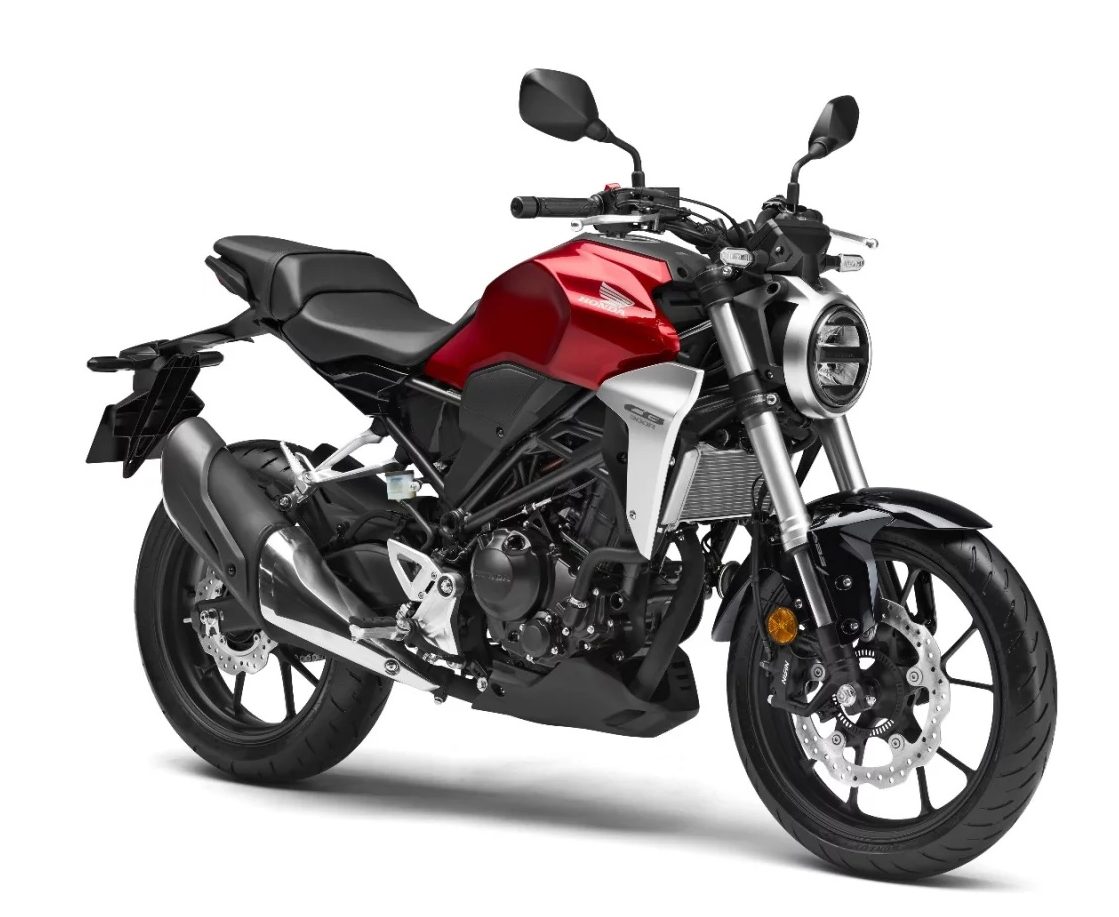
The CB300R is Honda’s take on the hot naked street bike segment. If you’re looking for a stripped-down and lightweight street bike with a sort of classic vibe, this market is huge. Aside from the Honda, you’ll find entries like the Yamaha MT-03, the Husqvarna Vitpilen 401, the Kawasaki Z400, the BMW G 310 R, the Triumph Speed 400, and the KTM 390 Duke. All of these motorcycles offer accessible fun with price tags far under $10,000 and with specs great enough to have a blast, but not exactly send you to an early grave if you make a mistake.
The CB300R’s story started with the CB300F, which served as the naked version of the CBR300R beginning in 2015 in America. The 300F, which was marketed as a beginner-friendly naked bike, had the same brakes, frame, suspension, and tires as the fully-faired 300R. They also shared the same liquid-cooled, 286cc counterbalanced single with a claimed 31 horses in the stable (around 27 HP at the wheel) and 20.3 lb-ft of torque (17 lb-ft at the wheel).

Reviews suggested that the CB300F was a blast to ride, easy to learn on, and quick without being too dangerous. These are all great traits to have in a commuter or a beginner bike. The bonus was that it was cheaper than a CBR300R and weighed less, too.
So, how do you follow up a well-loved machine? Honda doubled down on the formula. When the CB300R launched in America, it weighed only 313 pounds, or a good 35 pounds less than the CB300F. Honda also refined the new bike’s design so that it looked more retro rather than “alien” like the old CB300F. Team Red also worked on the ergonomics to make the new bike feel more like a larger motorcycle than it actually is.

Not everything was new; the CB300R launched with the same 286cc 31 HP single that powered the CB300F back in 2015. That engine is still being used today. Yet, the bike impressed, anyway. Here’s what Cycle World said:
It’s not the most powerful motor in the entry level class, but it’s got good torque and a wonderfully smooth gearbox and clutch. Off-the-line acceleration is fast enough for city riding and the bike feels smooth and quick up to about 60 mph, but above that the motor gets winded. Top speed is about 90 mph, and cruising down the freeway at 70 mph puts about 8,000 rpm on the tachometer and sends some vibes through the seat and grips, hence the constant attempts to upshift.
That experience is familiar from the CB300F. What’s also familiar is the handling and ride quality. There’s a new stout-looking 41mm inverted fork in place of the old 37mm legs plus a linkageless lay-down shock out back, and while the parts are new they provide the same old ride quality. Which is to say it’s fantastic. The springs are on the softer side but well damped, so the bike doesn’t pitch excessively while accelerating or braking, doesn’t wallow while cornering quickly, and absorbs bumps very well without bouncing. We’ve always loved how balanced and nimble this platform feels, even when pushed hard by an experienced rider, and those characteristics are carried forward in the CB300R.
Another thing we’ve always loved about the CBR/CB family is the brakes. In a class full of spongy levers and so-so stopping power, the little Honda always stopped with more precision and authority. And while the CB300R now has a big, four-piston, radial-mount caliper, the front brake has lost the feel and braking force we admired. It still works well enough, but a hard squeeze will bring the lever back to the grip. I blame it on the master cylinder, which was sized somewhat aggressively for the previous two-piston caliper but probably doesn’t move enough fluid for this bigger caliper. I’d be curious to see if a master cylinder with a larger piston diameter would bring some feel and braking force to the arrangement.
From what I’ve seen with reviews, it seems like the CB300R is a great backroad bomber and nimble city machine. Yet, unlike smaller machines, it can also spend some time on the highway. Well, provided that you’re okay with running the engine at or above 8,000 RPM to keep up with traffic.

Much of what applied to the CB300R in 2019 is still around today. Honda says the 2026 model weighs 316 pounds with all fluids and with a full tank of gas. The seat height is an accessible 31.6 inches, and there’s standard ABS plus a six-axis Inertial Measurement Unit. A single 296mm disc handles stopping power up front, with a 220mm platter taking up the rear. A 41mm inverted fork handles damping up front with Pro-Link single shock out back.
Nothing here is particularly amazing. But, again, that’s fine because this is the sort of motorcycle that you buy while you’re still learning. Or, it’s the motorcycle you get when you want to commute to work, returning an easy 75 mpg. You even get a screen, but it’s a simple monochrome LCD.

Pretty much all of Honda’s competition is putting down more power. A KTM 390 Duke lays down 45 HP, while even the BMW G 310 R beats the Honda with 34 ponies in its stable. Yet, don’t discount the Honda. The BMW weighs around 349 pounds, while the KTM is 364 pounds. Even the Kawasaki is nearly 50 pounds heavier than the CB300R. So, if the absolute lightest weight is something you’re into, the Honda is compelling.
Old Tech, Low Price
Then there’s the price. The base price of a Yamaha MT-03 is $4,999, the KTM 390 Duke is $5,899, and the cheapest BMW G 310 R is $5,195. Meanwhile, a Triumph Speed 400 is $5,495. Of course, all of these prices come before mandatory freight fees in addition to fees like setup fees and document fees, which will vary. To give you an example of these fees, Yamaha automatically adds $650 as its destination charge. Sometimes you can get a dealer to come down on the price, sometimes not.

For 2026, Honda has decided to drop the price of the CB300R by $650, bringing the bike’s MSRP to $4,499 before the $600 destination charge. Honda says it didn’t take out any content, but just lowered the price.
That new price makes the CB300R quite affordable for this size class. To put this into perspective, you can buy a Royal Enfield Hunter 350, a bike with a bigger engine that makes only 20.2 HP, for $4,299 before freight and setup. The Honda is only $200 more for a faster and lighter motorcycle.

The CB300R seems like a good deal within Honda’s own lineup, too. A much slower and smaller Honda Monkey is only $400 cheaper than the CB300R after you account for the destination charge. So, the Honda CB300R might not be the fastest, flashiest, or newest 300-class naked out there, but Honda seems to be getting aggressive in trying to get them off dealer lots.
Of course, I want to point out that buying a new motorcycle is often a terrible idea for a beginner. Motorcyclists who don’t have a ton of experience are likely to drop or crash their bikes. It hurts your feelings and your pocketbook a whole lot less to drop a used motorcycle than it is to drop something that’s factory-fresh. Also, used bikes are cheaper, anyway. So, I still recommend going used. But that’s just something to consider. A lot of newbies never drop their bikes while they’re learning. I know I didn’t. If this is your first season of riding, you also want to consider taking a Motorcycle Safety Foundation Basic RiderCourse.
This news makes me happy. Not everyone can spend new car money on a motorcycle, so I love championing bikes that the average person might be able to afford. I’m a firm believer that motorcycling is for everyone, and this Honda seems to make the fun of two wheels within closer reach. So, if you’ve been looking for a new bike or just want to get into a life of two wheels, do it. The road awaits, and there are so many choices on how to ride it!
Top graphic image: Honda



I just want to second your MSF shoutout. I took the class 25 years ago and, in some states, (including Washington where I took it) passing the class gets your motorcycle rating with just a visit to the DMV with a printout. I had a motorcycle endorsement in California in the 80s but it didn’t survive my moves to NY and Ohio.
My class was useful and I met a lot of fun-to-talk-to people during the breaks. We rode or drove to the site and used their 300 CC-ish bikes to navigate around cones and brake kind of hard. Not a single bike was dropped over two days with around 30 riders going through the paces.
It’s mildly amusing to see the same turn signal bits on this CB300R as my ADV160 scooter. Not a knock… They’re LEDs and have proved to be plenty visible on my scoots around town. Honda knows where to save money and where to spend it.
I’m surprised to get the left-hand two finger salute from guys on much bigger bikes heading the opposite direction, but they get the same salute back from me usually simultaneously. Just a reflex from when I rode bigger things, I guess.
Sorry to go here, but the opening lines of this story almost perfectly repeat what a surgeon told my brother-in-law, who was waiting for a kidney. Capacity on the existing spuds was getting low and he wasn’t moving up the recipient list very quickly. Things were getting stressful. “Don’t worry” the doc told him, “it’s spring. Young men are dusting off their bikes. You’ll find a donor soon enough.”
And he did. BIL is fine today but that story scared the crap out of me.
yeah buddy. i had a 2006 Triumph T100. loved that bike. rode for about 2ish years. as much as i loved it, i just could never relax enough to enjoy it. head on a swivel at all times worried about everything possibly being out to kill me. paranoid? weak constitution? nope. XRAY tech by trade and i get to see the consequences of cagers vs bikes first hand. every time i feel like i should revisit getting a bike, a trauma alert tells me nah, youre good.
We’re called “donorcyclists” for a reason. I’ve got the little heart icon on my license, but I’m 13 months away from turning 70, so I don’t know how useful my organs will be.
This bike is so good looking it makes me want to get another motorcycle. I won’t. Because I like being alive and I do not trust these other morons on the roads in the SUVs, trucks and vans.
I never spent more than $200 on my first 5 bikes over 30 years ago and eventually bought a new bike for $5K 15 years ago and having a new bike was such a pleasure not riding a falling apart death trap that actually worked and started right up, stopped safely. There can be some argument for new riders having a cheap new bike to learn on even if they drop it. Also dropping a new bike is a better lesson that dropping an old POS.
Maybe my C125 SuperCub needs a big sister?
That’s pretty damned affordable for a new ride.
That’s nearing e-bike territory.
In fact, there are a few Sur-Ron e-bikes that cost more.
Lots of human powered bikes that cost more lol. I’m not a motorcycle person but this seems shockingly cheap. Wish I was younger with less sense of self preservation.
I gave up motorcycles ages ago simply because of how bad drivers were back then. Compared to today though, those drivers back then were infinitely better than the brain-dead morons driving in our post-COVID world.
As much as I miss riding, I just can’t see myself ever buying another motorcycle again.
I rode a bike in my younger years until the kids came along and gave it up because I thought other drivers were too dangerous. I thought about getting another one after they were out of the house, then I got creamed in the rear end in my Jeep by some young girl on her phone when I was at a stoplight after work. No warning, no screeching tires, nothing. I would have been a dead man if I was on a bike. So, no more motorcycles for me.
Same here. Had to console a victim of a hit and run motorcycle accident in front of my house earlier this week as the two younger girls who ran a stop sign and hit him hopped out of the car and ran off. Let’s just say watching him bleed out from his head was the longest 20 minutes of my life waiting for EMS to arrive.
Decided then and there that I’ve had my fun. The bikes going up for sale in a couple of weeks. Be safe out there everyone.
I hope that of those two girls, the one who was the driver was charged with something.
Unless the car they crashed was stolen (didn’t seem like it) their day most definitely went from bad to worse. Prayers up for the rider – I’m holding out hope that he somehow pulled through as there has been no memorial set up on the street since the accident.
OK, or I can get a KTM 350 EXC with a tetch more horsepower and 80 less pounds. I have a kick-only DR-Z400 that handles like it’s made out of cast iron and I’ve been seriously considering the upgrade.
As someone who’s ridden dirtbikes for ~30yrs, the weight of street bikes always disappoints me. I know you (generally) won’t be trying to wrestle them through tough terrain, but lightness improves pretty much everything. That said, a new 350 EXC retails at about 2.5x the price of this little bugger!
This is one of the few times I’ve been pleasantly surprised by a road bike wet weight.
I have a 350EXC – Dude – you do not want to ride that on the road for any distance – I mean you -can- but it’s so high strung, and uncomfortable (even with the seat concepts seat) that it’s really a non starter if you’re looking for a commuter street bike. Two completely different animals. Also. I’d love to see what kind of EXC you end up with at this price point…
Very good point. I should’ve checked the market first. I’ve seen 1-2 supermoto’d ones around town and they look like a riot, and I live out near some ORV parks now but I imagine the engine’s peaky and high maintenance.
As cool as that KTM sounds, at $13,049, I’m not sure it and the Honda are actually on the same playing field.
Yeah, I checked prices after and 20-year-old used ones are going for what that bike’s going for new. Oops.
Thank you for this
I like that color … I have a CB1000R but I’m always looking at ads for the CB650R and CB300R. I guess I really like this design.
I saw a huge discount on the 2025 version at a dealer, now I know why they’re discounting so much.
I admit to not paying much attention to the 2-wheeler market anymore. I begin to wonder if some of the low-end, commuter, gasoline powered motorcycle is starting to lose volume to electrically-powered 2-wheel conveyances. Most of those don’t require a special license, registration fees, or insurance, and have significantly lower maintenance requirements.
More than a few of my coworkers who have shorter commutes do so on stand-up electric scooters. Some of those get quite expensive upfront, but have lower overall costs. In my line of work, scooters can be brought straight into the workspace, eliminating parking feels and long walks to/from faraway parking lots.
No Honda can compete with that. I suspect that the short-distance commuter class of gas bikes doesn’t have much of a future.
The lower cc ones where you can’t even get on the highway, ebikes might be the competition.
But for these 300ccs, I think its more due to Chinese bikes.
Plus plenty of ppl have anti-motorcycle prejudice or worry about others judging them.
I think the future for small bore motorcycles is fine, at least until EVs take over. Then we’ll just have tiny electric motorcycles.
While there’s some overlap in use case between electric conveyances and a small motorcycles (electric or gas), there are also key differences. Motorcycles are legal motor vehicles, faster (unless you’re riding a juiced up eBike), and more comfortable.
Also consider that, in America, motorcycle riding is considered to be more for leisure with practical travel as a side benefit. A lot of folks buy things like Honda Groms just to do wheelies and stoppies. There’s not a single motorcycle I own for a practical reason! Ha.
I think it just depends on what you’re looking for. Those stand-up scooters and eBikes are stupendously cheap ways of getting around, but they have their legal and physical limitations. Urban motorcycles have their own positives and negatives. I think both can continue to co-exist. Both seem to do well in other parts of the world!
The data doesn’t show electrics taking market share from ICE in the USA but they are popular. I listened to an interview with a guy that does motorcycle data and he said the best selling motorcycle in the USA is the Surron.
Electric stand-up scooters are a odd thing. In my state they are legally limited to 15 mph and banned on sidewalks and police have periodically enforced that restriction. So they have to be ridden in the street but are too slow to ride in the street.
E-bicycles – some legal but many illegal are far more popular as actual transport.
I agree used is the way to go. But this is marketed as a beginner bike so…someone’s got to be buying them new before they can be used. I guess expect most of them to be pretty beat up (which, for a first bike, is perfect). Plus, philosophically, I believe you should start on the low end with vehicles. If you start at the top, that will just feel “normal” and not special whereas if you upgrade, you can appreciate (and enjoy) the difference in performance.
Unlike in the press photo, you should never leave your helmet on the seat. It is SO easy to end up dropping it, at which point it’s a crapshoot how much protection it will offer if you ever need it. Even if a dropped helmet is “usually fine,” riding with a damaged lid can be fatal and thus not worth risking.
There is way more to the cost of riding than just gas. Motorcycles have maintenance requirements that are completely foreign to car drivers. For example the CB300F requires the head to come off for a valve adjustment every 16,000 miles. A sent of midrange tires will run about $400 – $500 and last 8,000 to 10,000 miles. Riding gear isn’t cheap. Insurance can be more than a car – especially if you are young or new to riding.
Plenty of people have found that buying a motorcycle to save money on gas doesn’t pencil out. They are fun though.
You must be tracking your bike if you’re only getting 8k miles from your tires!
depends on the bike. 10K is about right for my R1200rt. Heavy bike with a rear tire that gets squared off from highway riding. Plus the friendly folks at the BMW dealership that urge me to get new ones for “safety.” (/s on that last part).
Nope and that was optimistic. Looking at my records the front Michelin Pilot Road on my R1200RT lasted 6,011 miles. The tires on the R1150R I had before that lasted from 2,200 (OEM) to 6,900 (Metzler Touring tire)
I’ve never tracked a large bike but my brother used to race WERA. A rear tire would last a weekend – the front two.
Tires are the only thing keeping my butt from sliding down the road. I buy quality and tires that will let reach the limit of lean angle. They aren’t a place to try to pinch a penny.
I guess it’s very bike dependant. I roll Pilot Roads too and get 20k from fronts and 15k from rears on my NC700.
Bike and rider dependent. My RT has more than double the HP of your NC700 and I’m not commuting on it.
Most of my riding is spirited weekend rides on twisty roads with the knowledge that a safe speed for corners is double the yellow speed advisory sign and even that isn’t pushing things that much. I’ve backed off from my youthful days when I tried to get a knee down on a public road.
Unlike with my cars I’m running motorcycle tires at the recommended PSI for grip no running them high to prolong tire life. Grip is key not tire life even though I’m not running a full sport tire that would only last a few thousand miles.
My prefered roads are 2 lane, rural, and twisty.
It isn’t just bigger bikes though. Tires on my old Ninja 500 which made about the same amount of horsepower as your NC700 didn’t last more than 10,000 miles either.
I get far fewer on a Speed3 if I’m riding on Pilot Power , they’re rather soft so from road riding get squared off quick. I could get over 8000 miles out of a front from a set of Pilot Road, thought – but I normally swap both front and rear together.
I dream of getting 8k miles out of track tires… My Dunlop Q5Ss had well under 1000 miles when they got down to the wear bars
Your mileage may vary, of course…
Even factoring in those other costs, my motorcycles have almost always been cheaper overall than my cars. Then again, I do drive unreliable European crap and tend to ride smaller, cheaper motorcycles. lol
I suspect you also do your own maintenance. Just an informal survey of people I know with motorcycles – even the people that work on their own cars take the motorcycles to the dealer for anything besides an oil change Not too many people want to pop of the head and pull camshafts to do shim under bucket valve adjustments. That maintenance adds up quick at dealer rates. ($235 per hour for my local dealer – at least it was 2 years ago – likely more now)
Cheapest gas powered vehicle I’ve ever owned on a cost per mile basis was the 2005 Prius I bought used and drove for 12 years.
That is fair. I have not paid a motorcycle dealer for maintenance at all in my entire life. I’ll pay a local moto shop for tire changes (I bring my own tires), and their prices are cheaper than the local car tire shop. But that’s about it. I suppose I need to consider that a lot of folks will have dealers wrench on their bikes, and that will erase some or all of the incentive.
A long time ago, I paid a Mercedes-Benz dealer for service on my Smart only once and the cost was so shocking it was the impetus for teaching myself how to wrench. $450 for basic maintenance on a Smart darn near made me faint. lol
With your fleet do you ever get to to point where a motorcycle has enough miles to require a major service like a shim under bucket valve adjustment?
Yes, dealer service is expensive – so is independent. My local Chevy dealer charges $215 per hour. The independent shop I’ve used charges $185. That was a year ago – likely higher today.
40K mile service on my VW Sportwagen TDI was $795 way back in 2019. I had it in for some CPO warranty and they asked if I wanted the 40K service done too. I said, why not. $800 is why not! Never again.
This is why many people only get their oil and filter changed at the Quick Lube and nothing else. Then wonder why their transmission fails.
Guy at work bought a GSXR-600 and immediately put some Sportmaxes on them. Then asked me why the rear was shot in like 3,000 miles of commuting. He expected them to last like car tires.
Yes, that can be a surprise – along with the fact that a new set costs $600 and that is if you remove the wheels yourself and take them to a place like Cycle Gear for mounting.
On the flip side four Michelin Pilot Sport 4 tires for my Bolt cost $671.80 and four X-Ice cost $515.92. I have 40,000 miles between the two sets and each are about half worn.
While this is a great bike for the money, there is no better deal in motorcycling than a used Honda, because Hondas run forever. Why pay MSRP for infinity miles when you can pay 60% of MSRP for infinity – 10000 miles.
Not just that Honda motorcycles last long, Honda supports owners with parts well beyond many other manufacturers – so when you need a part, you can still get it.
True. Part of that is just being the largest motorcycle manufacturer in the world. The more bikes out the longer selling replacement parts makes sense.
I’ve seen a huge difference between OEM parts availability from Kawasaki and Honda on older bikes but Kawasaki is the smallest of the Japanese 4.
Some Honda owners are (seemingly) well aware of that, and price their 10k mile bike within a couple hundred of MSRP.
Then again, that also goes for BMW, Royal Enfield, KTM, etc. Owners
That’s true , while Covid is mostly gone Covid pricing on used vehicles remains for most of the market . And on facebook marketplace if you see something that looks like a good deal chances are it probably doesn’t have a title or has a salvage/rebuilt title .