


The optimistic view of the future for a car enthusiast in the United States is that the end of global free trade, as we’ve known it, will result in a lot of U.S.-specific cars that are more powerful and unique. The pessimistic view is that our car companies will become more insular and smaller, and we’ll lose out on the fun Japanese and European cars we’ve gotten used to lately.
This is one of those Morning Dumps where I’m not entirely sure how I feel about all of this, so I’m going to work it out in this post. Perhaps I’ll come to some great conclusion, or maybe we’ll all leave more confused!


I’m thinking about this in terms of a global car market that doesn’t really include the United States, and a United States car market with more production and less competitiveness. It’s possible that it doesn’t happen or, if it does happen, it’s not that bad. Rather than a bunch of small stories, I’m going to take the pessimist’s view and the optimist’s view, in turn.
The Pessimist’s View Of America In Global Automotive Trade
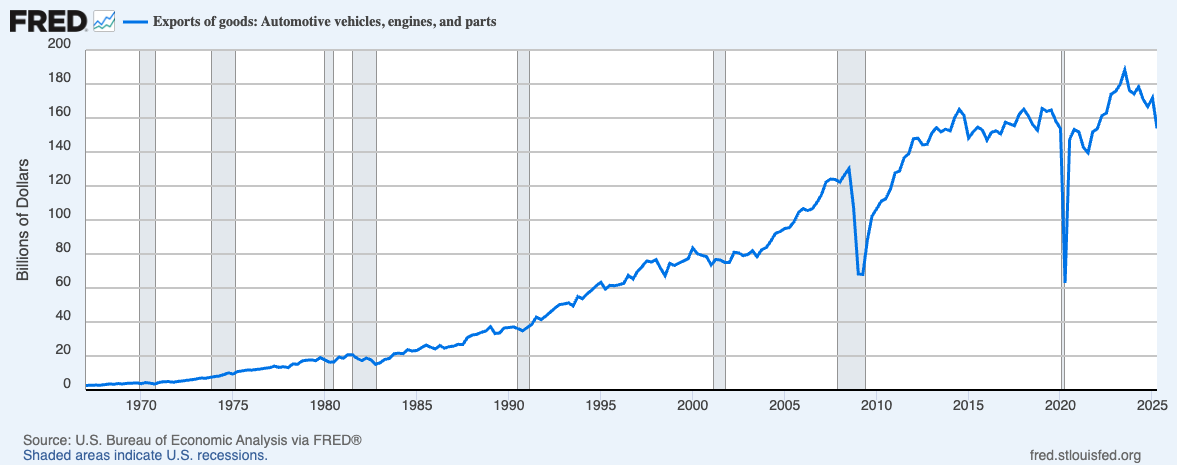
One of the major sticking points between President Trump and the rest of the world when it comes to automotive trade is that, for all the companies that do build cars here, we don’t export nearly enough parts, cars, engines, et cetera. If you look at the chart above, you’ll see that exports, by value, have gone up significantly in recent years.
However, you have to compare that to imports, which are much larger:
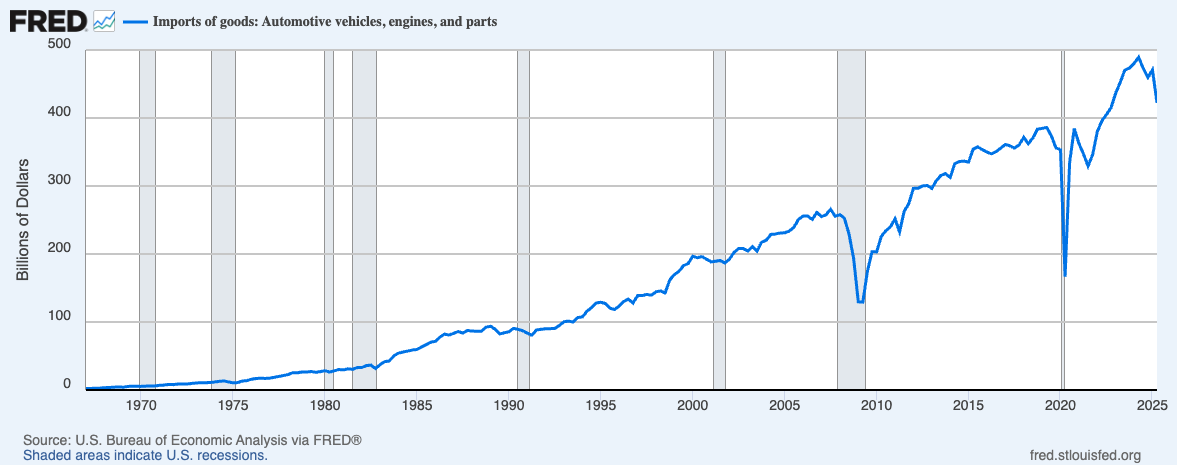
Some of this is practical. America is the second biggest automotive market in the world. We are a wealthy country. I’ve written before about the Theory of Comparative Advantage, but the TL/DR is: sometimes it’s better to let someone else make a product you can make yourself because you might get it cheaper and you can use your industry to create something of much higher value. We could all make t-shirts, but there’s more money in making the machines that make the t-shirts and the software that tracks t-shirt sales.
When it comes to cars, there are many models that might make more sense to build here (and no one is saying it’s a good thing overall to lose a lot of manufacturing), but for various reasons, there are some cars that are going to be cheaper and easier to build elsewhere. Smaller cars, for instance, are often imported because the margins are small and they’re more popular in lower-income countries, so building them there results in cars that are more affordable here, and more logical to produce elsewhere.
For all of the talk of the single, globalized car platform, there is a lack of harmony between safety and emissions regulations in North America and basically everywhere else. Clearing up that lack of harmony, in theory, would be good for the United States, and it seems as though governments like Japan are open to the idea of allowing in American-built cars.
But this is the pessimist’s view, so I’ll explain why that might not be a good thing. Perhaps governments in Japan and Europe are open to the idea of harmonizing regulations because they understand that American cars are already ill-suited for their roads and therefore might not sell that well?
If you drill down into what is being exported, by value, there are two obvious things that you notice. First, it’s that a lot of specifically American-style vehicles. For example, BMW builds many of its SUVs here and exports them to the world. It’s why Germany is one of the biggest importers of America-built cars.
Second, it’s that our biggest automotive trading partner is Canada. As mentioned yesterday, Canada isn’t exactly pleased with the United States at the moment. This is already showing up in trade, as Canada imported more cars from Mexico than from the United States for the first time since Vanilla Ice was an A-List celebrity.
There’s probably no future where Middle Eastern countries aren’t excited about importing Suburbans, but the rest of the world might not be into American cars at any scale (I mean, someone in Japan is definitely going to import an F-150 Raptor and it’s going to be awesome). The planned lowering of fuel regulations, the removal of anything that looks like an incentive to build electric cars, and the pre-existing differences in markets could mean that, rather than being a technological leader, America becomes a backwater of less competitive cars.
Sure, there will be more local production as companies trip over themselves trying to announce more plants here in this profitable market, but you know would benefit from that? China, of course, which is hoping to fill the void left by a suddenly more insular America. This is the view taken by Daniel Howes in The Detroit News:
Near-term, that looks like winning all around, right? Longer-term, as the realities of global competition inexorably reassert, maybe not so much. Retreating into Fortress America — where the rules are comparatively lax and automotive technology is at risk of falling behind China and other foreign rivals — risks losing the long game to win the short one.
By then, a new president presumably will be in the White House; automakers, starting in Detroit, will have decided whether they are content financially and technologically to be regional players in a global industry; and the smart folks from Washington and Solidarity House to the C-suites around town will know whether their potential retreat to capitulation was the right strategic call.
Detroit’s got more proverbial eggs in fewer baskets. More than anytime in at least the last 30 years, it’s banking a greater share of its profitability on a narrower slice of both its product line and geographic footprint. And it’s betting by what it’s doing that it can keep pace with the industry leader in EVs — China — by watching more from the sidelines.
This is what the announcement of all these trade deals (which aren’t deals, so much as outlines for potential deals) hides. Globally, people are fine to make deals with the United States because it’ll likely fall on consumers in the United States to pay them. While placating the Trump Administration, European automakers are going to balance Chinese imports by encouraging more local production for the local market.
As S&P Global Mobility points out in a recent report, that’s exactly what’s happening:
In early September, European Commission President Ursula von der Leyen signaled a renewed focus on small, low-cost cars as part of broader efforts to shape European car market trends in 2025. In addition to reviewing 2035 light vehicle emissions regulations, she announced that the EU’s executive body is working with automakers on a new “Small Affordable Cars” initiative aimed at supporting vehicles that are clean, efficient and price-conscious to meet the surge in global demand.
These “E-cars” would be environmental (clean, efficient and lightweight); economical (low-cost); and European (assembled in the region leveraging Europe’s supply chains). By doing so, the Commission hopes to create conditions which enable automakers to increase the availability of inexpensive European cars and bolster the competitiveness of cars in Europe.
The initiative also responds to the rising threat from vehicle and component imports from China and other markets outside of Europe, highlighting the Commission’s strategic interest in maintaining European strength in the small passenger car segment. Von der Leyen has said “[W]e cannot let China and others conquer this market. . . The future of cars—and the cars of the future—must be made in Europe.”
While there are always exceptions to this–like Tesla and whatever Ford thinks it’s doing with EVs–this is an America that can’t really be a global player. This is a future where Canada joins a European trade regime and eschews American imports for European ones. Toyota and Hyundai might be happy to build profitable and less-efficient cars here, but long-term, our allies could lower their tariffs to 0% and it won’t matter because American cars will be too far behind the rest of the world.

With higher tariffs also comes the reality that it’s maybe no longer great for car companies to give us their fun cars. Instead, we’ll get more specifically American-ized cars. This is the VW Atlas-ization of America. It’s a totally fine big crossover thing, but it’s not the fun cars we want. If the American market is a backwater of low-regulation gas-powered cars, then all we’re going to get is Atlases. Everything is going to become a VW Atlas. This potentially means losing out on both fun electric cars and even interesting gas-powered/hybrid cars like the Mazda3, Subaru WRX, and the BRZ/GR86 twins.
In this world, American car companies are not global players and are instead smaller, more regional automakers. Given the retreat from Europe and the downturn in China for American companies, this was probably already happening. Now it’s just going to happen faster.
While there may be an increase in manufacturing jobs, removing the United States from global trade is going to hurt suppliers and possibly shrink overall automotive employment. Just look at the shorting of supplier Adler Pelzer’s bonds that was reported by Bloomberg. Not great! While it’s a German company, it has operations in the United States.
In this world a smaller America is not a stronger America.
The Optimist’s View Of American Cars In Global Trade
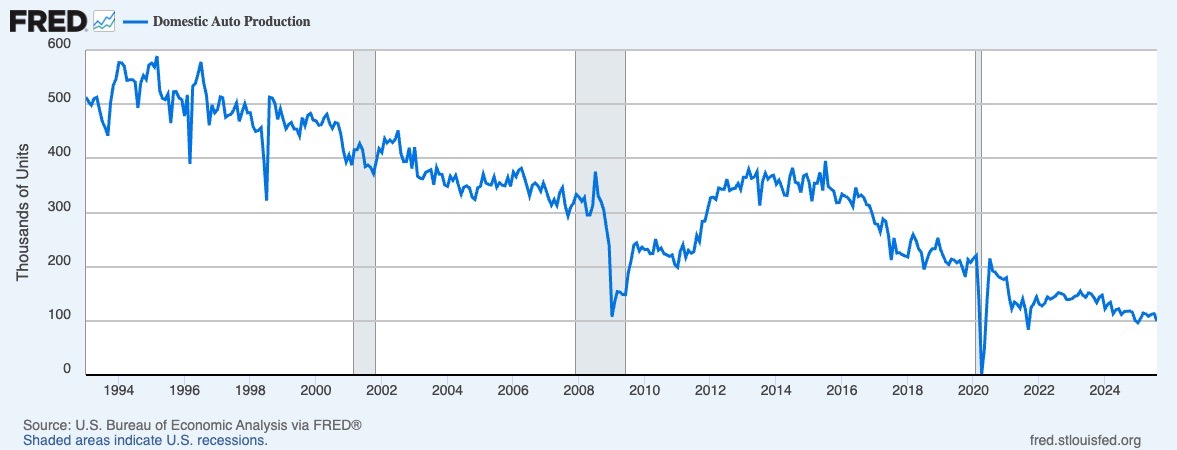
Even former President Biden realized that the loss of manufacturing in the United States, as evidenced above, wasn’t great. His plan was to incentivize the production of electric vehicles here so the country could compete with China.
Unfortunately, America was too late and too slow. China has essentially won. It can build more electric cars faster and cheaper, and, hey, they’re pretty good, too. While American consumers purchased a record number of EVs last quarter by share, with the tax credit gone, that’s going to stop. Even with the tax credit, the curve had already flattened out, and adoption is going to be that much slower.
America is still a wealthy country, and we could benefit in multiple ways here. First, companies building more cars in the United States is a win. That’s more jobs for more workers as we eventually offset imports from other countries with domestic production. While some of these cars aren’t likely to find homes elsewhere–I don’t see Belgium importing a lot of Grand Wagoneers–a RAV4 Hybrid is a RAV4 Hybrid, and it’s totally possible that Japan could find a way to import more of those.
Will those cars get more expensive? That’s the guess, but it hasn’t happened yet at the scale originally feared. Perhaps the increase in jobs in certain parts of the country will boost the economy and offset some of those costs if and when they come. UAW President Shawn Fain, long a Trump critic, has praised the move to end the “free trade” disaster:
This afternoon, the Trump administration announced major tariffs on passenger cars and trucks entering the U.S. market, marking the beginning of the end of a thirty-plus year “free trade” disaster. This is a long-overdue shift away from a harmful economic framework that has devastated the working class and driven a race to the bottom across borders in the auto industry. It signals a return to policies that prioritize the workers who build this country—rather than the greed of ruthless corporations.
“We applaud the Trump administration for stepping up to end the free trade disaster that has devastated working class communities for decades. Ending the race to the bottom in the auto industry starts with fixing our broken trade deals, and the Trump administration has made history with today’s actions,” said UAW President Shawn Fain.
As an enthusiast, this could be a huge win in the long term. The downside of globalized car platforms is that we get a lot of the same kinda boring cars everyone else gets. Without having to worry about as many fuel economy regulations or building cars for consumers in Europe, vehicles like the Golf R can not only continue to exist, but maybe get even better. That’s to say nothing of trucks. Not only will the Hemi V8 come back in the RAM, but there are all sorts of other vehicles that suddenly make a lot more sense.
It also doesn’t necessarily mean that American companies aren’t going to develop better hybrid systems, more EREVs, and even electric cars. Neither GM nor Ford has given up on the idea, and there are still plenty of consumers around the world who would probably rather have an American-built car than a Chinese-built one.
America is a huge car market, and you only have to look at companies like Ford and GM–which have both retrenched here–to see that there’s plenty of profits to be made here over the long run. We may not get all the EVs that the globe gets, but who cares? If EV demand gets strong enough, those countries with trade deals can just sell us their EVs. No one is going to out-truck America, and trucks are where the money is.
What I’m Listening To While Writing TMD
Who better than The Clash to sum up my inner conflict? “Should I Stay Or Should I Go” represents the constant question at the center of life. Also, please note that this famously British band also prefers a giant American car.
The Big Question
Are you an optimist or a pessimist?
Top photo: BYD, GM, DepositPhotos.com


The American truck market has “benefitted” from Trump style tariffs for over a half century, and were down to 4 big pickups, 4 midsize pickups, and 4 vans and most of them are interchangable. But thanks to fair trade we can choose from over a dozens sedans and hatches alone, a handful of minivans, and at least a dozen sports cars and hot hatches. Throw Trump’s killer tariffs on ’em and we’ll be lucky if the ‘Vette and maybe the Mustang survive.
The more isolated an economy is, the worse it performs. There are more than enough long-term observations and research to show this to be true. Anyone who tries to spin it in any other terms is an idiot trying to fool you. Most likely, they feel they have something to gain in the short term and give no shits about their community in the long term. Anyone who tries to both-sides the tariffs just doesn’t have the knowledge needed to speak meaningfully on the topic and should be ignored. Here is a decent read as a starting point.
The U.S. will become significantly poorer, not just in relative terms when viewed against other countries, but in real terms relative to what Americans can buy. Add in the economic idiocy inherent in every bit of MAGAt philosophy, the very real fact that there is already a brain drain happening that will cause a huge decline in U.S. innovation. The U.S. and most Americans understand it is dead; the body just hasn’t hit the ground yet.
I’m solidly on the pessimist side here. It’s going to take generations to undo the damage done to American manufacturing and innovation and the general tone of protectionist isolationism. Meanwhile, there are not enough enthusiasts with money to move the composition of the market away from the blandest of bloated crossovers and pickups with gigantism that we are plagued with.
Unfortunately, the US has a baked-in political system that promotes insular provincialism. And we’re gonna need a few constitutional amendments to fix that.
Why? It isn’t like the constitution is in effect in any meaningful way.
Through both the Senate and the Electoral college, the constitution tilts power toward rural areas at the expense of more-populated urban areas.
The constitution is about as meaningful these days as a tax form signed by Trump.
It was pretty meaningful last November.
There is a last time for everything, just ask the Weimar Republic. Oh, right, you can’t.
The EC is part of the problem. We have minority of people, dictating the futures of the majority. That almost sounds like a dictatorship. I’d rather have the majority steer the future, that sounds more democratic and free.
Just a few. Firmly cemented equal rights, a move to popular vote only and a reinforced and firm separation of church and state.
Yes to those, plus some tweaks to the Senate.
Sounds good, but it’ll need the rural states that don’t have much population to get on board and pass it.
What’s more likely is that a convention would bless white Christian anti-immigrant landowners and oligarchs, not equal rights, popular vote, or separation of church and state.
You’re probably right.
In my dream world, the bottom 10 states by pop lose a Senator, and the top 10 by pop gain one. 10 states with one Senator, 30 with two, and 10 with three.
Sometimes the only way to learn a lesson is the hard way.
Maybe its time for a big ol’ Constitutional Convention! This government is as worn-out as the Articles of Confederation.
I guess I have to take the optimistic position on this one, but I’m not really optimistic about it.
The products we will have in our market to choose from depend much more on consumer desire and preference than it does on politicians’ will to push us in one direction or the other. In this regard there should always be interesting and fun cars available.
The problem is, these were already dwindling in availability long before there was a gleam of tariffs in the president’s eyes. The country already decided that coupes, wagons, hatchbacks and sedans didn’t meet their needs and only two form factors will do; trucks and CUVs.
I also balk at the idea of falling behind technologically. We may pursue different technology but buyers here will always want efficient vehicles and auto manufacturers don’t make long term plans based on a single administration or law. Change has happened rapidly before and will again so the R&D direction will reflect a pretty diverse set of tech.
Our economy is largely powered by a desire to achieve more, reach higher etc (and of course spend as much as is possible). And meeting the consumer where their wants and needs are is a big part of those achievements. If we demand more efficient vehicles in large enough numbers someone will figure out how to get them here because the American consumer can largely be counted on to spend that money more (and more consistently) than other areas globally. Many times at great peril to our own financial health but that’s a separate issue, if very related.
Unless our overall system begins being tampered with, making us more like Europe or Japan or others I think the market continues to decide and manufacturers continue to service the needs and wants of the market. At the end of the day they want to sell cars and only one other area on the globe buys more than us so we’re good until more fundamental changes start to happen.
You say “buyers here will always want efficient vehicles.” But you also say the market wants trucks and CUVS… which are mostly gas guzzling beasts. Sedans are way more efficient on the highway with their much small frontal area… but sales are plummeting in the US.
So which is it?
Right now, with current gas prices, I don’t think the vast majority worry about fuel efficiency. If you can just sell a bunch of antique Hemi V8s that now no longer have to meet emissions standards, there is no financial incentive to improve what you have already. Just pump out rumbly burbling V8s and call it a day. The US car companies will just milk old technology to maximize profits.
There’s a reason hybrids are so popular and becoming more so.
EVs have a certain following.
But, yes, trucks are going to drive much of the market unfortunately.
My point is, govt intervention doesn’t drive where the investment goes and we won’t fall behind because we aren’t regulating new innovation. If consumers never demand a change that will drive stagnation but it hasn’t happened yet.
The thing is, most of the hybrid cars/CUVs are made by non-American manufacturers. I tried to think of popular Ford/Jeep/GM/Chrysler hybrids.
Ford is the only one doing well with the Ford F150 hybrid and Maverick hybrid. Those two are the only ones I can think of that are considered good and selling well. (I think 20-25% of F150 sales.)
The Jeep PHEV hybrid is a quality nightmare. The Pacifica PHEV is also a quality nightmare. The RAM EREV is on the horizon, but with the rapid switch to the Hemi, I kinda wonder if they are even interested in making the EREV in high numbers.
Outside of the Corvette eRay, GM does not make a single hybrid.
The innovation in hybrids is being done by foreign brands because they had to hit European emission and mileage standards.
Sorry but I got to push back on that. Government intervention is directly related to fuel economy. Historically manufacturers have only increased fuel economy when required by CAFE. In fact when CAFE was held steady in the 90’s CAFE steadily fell. You can look at CAFE requirements and average fleet economy and they track right inline.
Same with emissions. Automakers have never made care cleaner than required unless it was to book credits so they could continue making other dirty engines.
Automakers meet CAFE and emission regulation in the most economically method possible. We do so while attempting to meet the customer’s demand for bigger and more powerful vehicles.
Related points to consider or research in the big picture, likely many more:
Yes, Canada and Mexico are pissed. They’re beginning to look elsewhere for stable economic trading partners.The rest of the world is increasingly isolating itself from us, yes it’s a direct result of our actions and politics, not to mention the instability of TACO.Looking at economic principles of mass manufacturing and the economies of scale-if the US goes it alone, and the rest of the world moves towards electrification, the effect on spare parts and common components, oil infrastructure, and everything in between will see to it our costs begin to rise, while everyone else’s drop.
My post above had numbered bullet points. Looks like Autopian auto-formatting deleted them.
Yes, let’s start doing Protectionism. In a time of decreasing buying power for your average consumer, devaluing currency and over-valued speculative market. Let’s do the thing that has never worked.
The whole problem with protectionism is that there is this assumption that the market will continue to be valuable. Even in the article, it says something along “valuable for a long time”- not a direct quote. Which isn’t true, economies can and do fail. Ours has done it twice in last 100 years. Global liberalism for all it’s faults, is a hedge against rapid and sudden collapse. Apples to oranges, but you rather 2009 then 1929
Then there’s the obvious growth restriction. Ultimately, a de facto closed market will always be limited. In a time were say GM and Ford are our only producers. Naturally we’ll pay more for less as they seek out profit growth. Or they’ll take up arms against each other.
But, here we are taking economic policy from the military dictatorship of Brazil
I’m taking the pessimist view because it is the optimist view for Canada.
I also find it hilarious to imagine the US car market Lada-ing itself.
This was exactly my thought, this all makes the US sound like the communist bloc of last century. Innovation not required, just make what the government wants you to make that suits their political purposes, all of which will turn into punchlines in the areas of the world where progress is being made. Not great.
Pessimist by American standards could eventually mean optimist by Canadian standards. For me, the best possible outcome of the current economic warfare is Canada divorcing itself from US regs and trading with the EU instead, providing access to all those sweet small and cheap Euro-hatches. Can’t come soon enough. Maybe Renault can get a deal on an idle Chrysler plant or two?
Renault folks probably still remember where the washrooms are in the Brampton plant from the AMC days. On the other hand, there are probably too many Canadians that remember Renault’s product quality from those days.
They could probably really screw the market up by building Dacia here and doing something completely outside the box.
You’re giving me Renault Alliance PTSD.
Exactly – I’m thinking Dacia Spring and R5 EV. Former owner of two LeCars that were awesome.
Skoda should Bogart the plant and build cars here.
So right off the bat I don’t grant the premise, which makes it hard. There is no “everyone else”. Each car market was already different in hugely meaningful ways and carmakers had to adapt. We are moving back to a multi-polar world for the first time since the Cold War and the auto market reflects that. In fact, we’re entering Cold War II.
China is going to produce for themselves and eventually ban foreign companies from competing there, so that’s one huge market off the table. Their exports will be constrained as every other market with an auto industry tries to prevent dumping as the US closes to China for anything deemed politically critical. They’ll take over and dominate the market in South America and Asia (minus the Middle East, Korea, and Japan), but neither market drives big business for American companies.
Again, China does not give a single shit about the environment, they moved quickly on electrification because they lack large oil reserves and they had no previous competency in consumer ICE engines. What oil they do have needs to be saved and stockpiled for a conflict that might restrict their imports of petroleum products. Wars are fought and won with petroleum products.
The US has large petroleum reserves, and in a large scale conflict could ramp up to an extent that 0 imports would be needed. Therefore, we don’t need to move as quickly on electrification unlike China. The spat with Canada is a passing thing that will likely end before Trump leaves office but definitely after, our interests align long term and it will be fine. There is no anti-Canada constituency among the US populace. With that, Canada will be essentially part of our auto market again as they have been for some time.
The EU will continue to be its own market. They need to move on electrification because they also lack petroleum reserves. This has them literally funding Russia’s war in Ukraine. No one likes this fact and they’re moving away from Russian products but it takes time. For some things like home heating, US LNG will fill the gap.
Also, and this is truly not a knock on Europe as they prioritize different things, but they buy small cars there partially because of the geography, but mostly because they’re poor (from a discretionary spending POV). If the average European had the spending power of the average American, you’d see just as many SUVs, tiny roads be damned. You already do see more SUVs there.
We don’t have the refineries to deal with our oil. We import heavy crude, which we can process. Lighter crude, which we produce over most of North America, gets exported. China, having moved quickly into EVs, is already on the downward slope of oil use for transportation (2024). This should be duplicated in the EU any day now. Reduced use of petroleum for transportation use will have a global effect on the commodity.
That is true today. In a large-scale conflict, none of that matters. We’d be processing our own crude in no time. I suspect we’ll start doing it more in the coming years no matter if a conflict with China seems imminent or not. If subsidies are required to make that happen, they will be doled out. We have the technology and the skills to refine our own crude.
Are you advocating for an armed conflict?
No, but my hope is that there is no one left in the halls of power who don’t believe there could be one. Thus, preparations must be made. Much like Cold War I, the goal should be to avoid it.
I don’t really disagree with any significant points here, but I think you still outlined an overall “pessimistic” outcome, especially at the global scale. Maybe a mixed bag for the US itself, but humanity as a whole would be better off without Cold War II and the resulting economic policies.
Yes I sort of rambled. I kept the comment up but probably should have edited it to stay on topic. I think it’s overall an optimistic outcome with respect to cars.
In general, I think people need to remember that most things don’t meaningfully change the world. If you took a time traveler from 2019 to today, would they say the pandemic fundamentally altered the world? I’d say probably not and that was by far the biggest worldwide event in recent years.
As a sample size of one, this Canadian here is not interested in buying anything of high value that is made in the USA now and for a long time going forward. I explicitly made sure the Ioniq 5 I purchased was made in South Korea. If the model was made in Hyundai’s USA plant it would have been a hard no. (Which in hindsight is doubly awesome as the Ioniq 5s in the States have some quality issues apparently… and the South Koreans brought in to fix the issues have been kicked out of the USA.)
I put down deposits on the Slate and the Scout EV before this mess… now I will not be buying either car as they are made in the USA. I see no reason why I should help the US economy given the disgusting way the US is treating Canada.
I have also dropped any travel plans to the US and most of my friends have done the same. You would be amazed at the amount of advertising bombarding Canadian media begging Canadians to come to once popular US travel destinations. No thanks.
It is nice to say there is “no anti-Canada constituency among the US populace” but the reality is the US populace voted for the current government and their policies. Those votes were an endorsement of anti-Canada policies so hard pass on buying American.
Don’t blame me, I’m from California, the home of the resistance.
I don’t blame individuals. But the majority of American voted for your leader. Which has consequences. I cannot in good faith continue buying American/travelling to the States with the current state of affairs.
I have very good friends in California that I usually visit at least every year or two. I’m now going on a trip with said friends in Europe this year instead.
As an Australian just back from a holiday in Europe we saw a LOT of maple leaves sewn onto backpacks, on hats and everything, just so that every Canadian could make sure the locals knew they weren’t American. And I’m not kidding, that’s what they told us.
And the general vibe I got in Europe was that everyone else is in this together and we have to work together and protect ourselves against whatever happens in the US.
The car market is a microcosm for the failure of the tariff scheme at the concept level. To promote US trade and manufacturing, we should never have pushed away all our closest friends and partners. Zero tariff list: Canada, Mexico, Japan, UK, Taiwan. Almost Zero tariff list: Australia/NZ, Korea, Philippines, Viet Nam, all of Central and South America, all of EU. Tiny Tariff list: The rest of the world. 50% Tariff list: China. That way, there is an incentive to keep globalization-like supply chains with friends rather than rivals. That way, there is an incentive to build and bring raw material and rare material production into the US, and, importantly, friends and partners so we can all be safe and rich together.
I believe this is more or less what you’ll see in 5-10 years, perhaps less. With some exceptions. I don’t think incentivizing automakers to put plants in low-wage Mexico is ever coming back under any future administration for example. Also Vietnam and other places in SE Asia will have high tariffs to prevent transshipment.
I think you’ll see tariffs dropped to 0 on the UK and Australia first as our tightest allies. With AUS, that will come as part of a deal where we share rare earths.
It will be great I guess if you want a truck or have a ton of kids. Otherwise, choices will continually dwindle.
I expect Balkanization of the global automobile market to be honest. It would be a very American conception to consider everything a binary ‘us-or-them’ mindset when it likely will turn into something more complicated globally.
There will be automakers who can design/scale a product that works around the globe and that can manage to thread the needle of political ideology as to not offend most countries enough to allow reasonable access.
Japan and Toyota, South Korea and Hyundai, Germany and VW come to mind as examples. These are middle powers that are ‘compatible enough’ with the values of developed nations to keep things reasonably open, yet are companies that can cater their products to a wide variety of markets, even if those markets have, er, differing values.
The failure of US-based companies to adapt to the global changes is ironic, given their previous status as global giants. They were the first automakers to essentially produce global cars. I think speaks more to their management issues than anything trade-related per se. If General Motors can’t produce a vehicle Australians want to buy, I don’t know, man. The cultural/historical/built-environment isn’t that different to the United States. To me, where the bottom is for them is more the interesting (in sort of a melancholy way) question. Do they become a weird species that only produces trucks, SUVs, and the occasional sports car for North America? Or do they find a renaissance?
I expect developed world markets where automaking remains an important industry will continue to limit the penetration by China. Some of those reasons are justified IMO, given the geopolitical considerations of current times. The United States is just farther ahead on that mark than Europe, but I expect that to change as European automakers feel continued pressures.
You could probably write a treatise on this.
The problem with GM and Australia I think was LHD. That takes a huge commitment and they were always going to be at a disadvantage to the Japanese suppliers who have a much bigger market to amortize that effort over.
I’m an optimistic pessimist.
There are really only three countries in the world that have about the same automotive landscape as the United States – low population density, sprawl, and long, long, distances. And that whole “everybody thinks thier a cowboy” thing that sells trucks by the bushel. The US, Canada, and Australia. Only the US is big enough to command unique products. Canada rode on our coattails, while OZ is off by itself.
Australia’s car market is what I predict will happen to Canada. If we align with EU regs, we can just start bringing in the smaller global truck platforms like the Hilux. They have no real domestic automakers for their 27 million people, so they import.
We have 41 million, so we’re a decently larger market, and we’re well situated with opposing coasts that can easily import from EU or Asia. Canada has a history of importing models that the states never got, or importing them for longer.
Canada is the size of California, and California had enough size clout to steer the automotive industry.
Because California could bully DC & other states due to being part of the US.
If your statement is in regards to emissions and fuel efficiency regulations, those other states signed on board willingly. They too wanted to do the right thing.
… and nothing prevents them from switching from CARB back to EPA.
Canada is per capita a lot poorer than California – despite similar population, it’s a very, very different market.
Agreed. Cali is basically it’s own country with it’s GDP and population.
I think we’re a better comparison to the likes of Aus/NZ.
Same here – I think you are spot on. Canada aligned with the US because it was easy. They have no reason to do that anymore.
I’m pessimistic on this one. About every time in human history a group has isolated itself, it’s stagnated technologically. Japan for a long time up until 170ish years ago. The same thing will happen with vehicles. We may have 30 mpg V8’s but the rest of the world will have 150 mpge electric trucks that can charge 0-70% in 5 minutes. We may get the most efficient coal plants when the rest of the world has moved onto renewables plus storage.
All empires fall, many in this manner.
Time to join or accept the UNECE international standards. Mexico accepts both US and UNECE standards, for example. We should do that too.
Perhaps Europe’s EEE cars can somehow harmonize with Japan’s kei cars.
All of this *just after* Fiat/Stallantis stopped making the TwinAir.
Reading the headline I was thinking more of a different kind of “two car markets” that we’re heading towards in the US: New expensive cars, and austerity cars (like the incoming Slate pickup).
There are two car markets, but you’re slightly off: we have the new expensive cars, and used cars 🙁
Agreed, though those used cars will run out at some point. Though I guess we could end up like Cuba and just repower them over and over again.
That would mean that a lot of pre-2016 cars are kept running with whatever means necessary. Anything newer, and you’ll run out of parts that cannot be easily fabricated, with software locking the customer out of repairs. I could see a lot of DIY EV conversions becoming common.
Used cars don’t run out as long as people are still buying new cars. We are still buying 16 million new cars per year even with average transaction prices at $50K +/-. Those cars will trickle down through the used market over time.
New “expensive” cars all become cheap used cars eventually. With very rare exceptions. Cuba got NO cars for many years – big difference. We have a 12-16M new car a year market in the US, even with an average transaction price of $50K.
As I have said on here repeatedly, there is very little reason for hairshirt $20K cars to exist when you can just buy a much nicer $30K car used for $20K in a few years, and it will have a decade or more of life left in it. That is reality. The aberrational past few years are not the norm, lack of availability of new cars wildly skewed the used car market, but we are trending back to the norm.
And people very much get this, because the cheap cars that still exist barely sell. The KIA Soul is probably the best of the bunch, and KIA is killing it because it sells <1/3 of what it did ten years ago. If people really were dying for ~$20K cars, it should be a best seller – it is emphatically not, and neither are any of the other remaining cheap cars. Add that there is ZERO profit to be made on cheap cars and there is just no point.
….new expensive cars, and slightly less expensive used cars* ????
This sounds on paper like the perfect application for BEVs, but see how there is no mention of them? Seems like the European Automakers are throwing their weight around trying to pressure the EU to move away from their BEV goals, and it seems to be working sadly.
That’s because you can’t do a cheap, small BEV. The same thing that happened in the US has happened in Europe – the people who could have a BEV now have them. Remember, lots of people in Europe live in homes without off-street parking, so the current electric vehicles are a poor fit in a lot of cases.
European manufacturers have stronger unions and deeper legacies on ICE production than US manufacturers, and they’ve found it particularly hard to pivot. Additionally, the growing size of vehicles generally is becoming a problem, as some science has shown:
https://www.theguardian.com/environment/2022/jun/03/car-tyres-produce-more-particle-pollution-than-exhausts-tests-show
So a small and very efficient ICE car may not be quite so horrendous for the environment as an E-Canyonero.
China has multiple examples under $15k USD equivalent.
The technology needed to do a small, cheap EV is really 25+ years old. The desire simply isn’t there among US/EU/Japanese manufacturers, when they’d rather sell you a more expensive vehicle with fatter margins. They could have gotten them out well ahead of the Chinese, and chose not to.
None of them are European hatchback small though. The BYD Seal is about Model 3 sized and the MG is a small SUV. We don’t currently have anything smaller around and about, as the Ora Funky Cat didn’t seem to catch on.
The current best effort in Europe is the Renault 5, which is legitimately a small hatchback (it’s smaller than the ICE Renault Clio). The normal version has a published range of 193 miles, which seems to translate to about 160 miles in real world use.
As I mentioned above the sort of houses the owner of such a car has here doesn’t have any off street parking. So if your commute is more than 16 miles each way and you can’t charge at work (again not unlikely) you’ll find yourself spending a weeknight evening every week playing on your phone in the queue for a charging point.
That’s a big compromise for a lot of people, and so BEVs are going to remain the preserve of people with driveways until energy density and charging speed have both improved by about 20%. I have high hopes for the solid state batteries though.
China has a ton of them like I listed above, but most of the hatchbacky ones that will realistically be sold under €15k in the EU market are in the sub-4m category with reduced safety requirements, and would require heavy modification for the EU market (like the BYD Dolphin Surf).
China loves cheap sedans but despises hatchbacks seemingly more than even wagons which means there are few natively available hatchbacks that are built to C-NCAP/EuroNCAP regs. This is gradually changing as Chinese automakers start to make EU market specific models, like the Leapmotor Lafa 5, BYD Seal 06 DM-i Touring, and the Firefly. The crossovers/SUVs transfer markets more easily but are marked up to match existing pricing in the export countries.
China has lower labour and environmental compliance costs than even the cheapest parts of Europe stable and industrialised enough to support car manufacturing.
So instead of available in China by a Chinese automaker at $15k or less, it could be available in the USA/Europe from a USA/Europe manufacturer paying 1st world wages and abiding by 1st world laws and regulations for $25k or less.
But we don’t even have that as an option. If the goal is for EVs to take off on their greatest merits, something like this absolutely needs to be an option. EVs are supposed to be cheap and simple things that provide maximum utility and minimum drama.
Absolutely.
“Actually EVs are worse than ICE cars” Guy has entered the chat….
Wonderful, one of ‘those’ people. I suppose the world is flat, chemtrails are real and they were selling the blood of babies out of the basement of a pizza joint.
No, you have that all wrong. The world is a pizza, chemtrails are made of baby blood, and basements don’t really exist.
Not at all! It’s just that at the moment EV adoption in Europe and the US has stalled because the people for who EVs are great have now all bought EVs.
There are people whose circumstances don’t fit EVs for various reasons. I actually don’t think the straight argument about range is an issue – There have been (I think) two times in my life when I have driven non-stop for longer than the range of a mid-range EV, and I do tend to drive reasonably far.
The big questions are about infrastructure, and for a lot of Europe in particular it’s home charging that is the problem. Until we have a way to fix that – which is essentially going to be making visiting a charging station as quick and painless as visiting a gas station – there is going to be a limit on the people who can buy one.
EV adoption has not “stalled” in Europe.
https://www.iea.org/reports/global-ev-outlook-2025/trends-in-electric-car-markets-2
The IEA are generally pretty reliable about this sort of thing.
Not here. Their prediction of 2025 sales of EVs in Europe was wrong.
https://eleport.com/ev-sales-in-europe-2025-the-first-half/
From last month: “Despite the headlines often downplaying the momentum of EV sales in Europe, the real results across Europe in the first half of 2025 have shown strong growth in almost all countries. In fact, out of the 31 European countries we analyzed below, only 5 showed a decline in EV sales compared to last year.”
Regarding your last paragraph, I think you have completely 180.
How so?
In China, cars under 4 meters in length are subject to much reduced safety requirements, allowing for lower prices. These are not the same regs as LSEVs, which got banned I think. This has allowed for a burgeoning market of minicars/superminis that regularly top the sales charts, like the BYD Seagull & Dolphin, Geely Xingyuan & Panda Mini, Wuling Hongguang MiniEV, Changan Lumin, etc. These models I listed make up ~3-5% of China’s total car market alone. They’re usually used as secondary vehicles to run errands and drivers generally keep them off the freeways when there isn’t rush hour traffic slowing things to a crawl. I feel like I read somewhere that the last ICE vehicle that fell under this ruleset was discontinued in 2021, and since then they’re 100% BEVs to the point of inflating the adaption numbers a bit.
Europe, unlike Japan and China, doesn’t have this sort of regulatory cutout allowing for viably cheap small cars, and the European market doesn’t like the higher margin large cars very much, which is why the European carmakers are struggling and have been begging for these kinds of regulations. It seems like it’s finally happening.
I expect we’ll become more like Brazil of the 1970s and 80s, only with much less fun and cheap cars, because safety regulations. But we’ll have the protectionist part down. Maybe in 2055 years, you’ll still be able to buy a brand-new 2025 Durango, with several layers of visually clashing facelifts that will be applied over the next several decades
I’m an optimist on this one. Many American’s are all about keeping up with the Joneses. If the foreign cars stop coming in, and everything homogenizes, that will be a temporary position, not a permanent fate. If the vehicles are good enough and cool enough, those cars will still end up here, because American’s will want them.
The big three have not stated they weren’t making any more moves in the EV and hybrid sphere.. Ram is still building an EREV, GM has multiple EV options that are apparently pretty good, Ford is still working on the skunkworks cheap EV. Most large scale investors are also all in on EV production, so I don’t see the boards of these companies being able to back pedal THAT far, just slow down some. Otherwise, the board will be up in arms at the possible loss of future revenue. EV and Hybrid will continue coming along here in the States.
Keeping up with the Joneses requires a good paying job, which requires a stable economy. Both of those are in jeopardy, accelerating with the Trump administration.
Case in point – tariffs are suppose to be about increasing US manufacturing. Year to date us manufacturing jobs are down.
Something to consider, however, is that GM has given up on most of the rest of the world. Stellantis’ HQ firmly in Europe, and has now pivoted to selling Americans on “bigger is better” with all its other brands, servicing the rest of the world, being their bigger focus for EV/PHEV/HEV (considering most of Citroen/Peugeot EU models have an electrified version).
So hopes penned on Ford, I guess.
Ford pulled out of the growing Indian market which is one of the few that are insulated from Chinese automakers. They shared vehicles with Ford Brazil which were subsequently discontinued, leaving them stuck with only larger trucky vehicles which probably don’t sell in very high numbers.
Ford also canceled the Fiesta & Focus in EU and Australia and their SUV alternatives don’t seem especially compelling against the wave of Chinese vehicles in either region.
Ford China seems stable at least?
GMC/Chevrolet have pulled out of India because they didn’t have good sales (other than the Tavera, which was an aging MPV ).
They pulled out of the markets in SE Asia, other than Brunei, Phillippines, Cambodia, Laos- they don’t sell in Malaysia or Indonesia at all.
They left Africa as well. Its because of bad management, even though some of their cars were competitive. They still sell in South America though. And Eastern Europe to some extent.
I’m sorry I just don’t see GM and Ford purposely making their current vehicles less efficient, nor do they show any signs of stopping their development of EVs, PHEVs and REEVs. Yes they have slowed their roll based on what the market actually wants, but they fully expect CAFE fines and strict regulations to return and probably only expect them to get worse “to make up for the damage done in the last 4 years”.
Chrysler well yeah Chrysler is going to be Chrysler and will be totally unprepared for the future, but did anyone expect something different?
I think sometimes we forget that GM and Ford are international companies. Will they sell all of their EV and EREV models in the US? Maybe not at first. Will they keep developing them for all of the other markets where they operate? Definitely. Will they design them to easily port over to the North American market when the madness subsides? You bet your bottom dollar they will.
There is a very real chance that US manufacturing will be abandoned by foreign investors, however. I can’t see Hyundai wanting to fund anything for a long time, for example.
I’m not forgetting that Ford is a international concern, GM far less than they used to be. However if you look at Ford a lot of their ROW electrified vehicles are partnerships of one sort or another.
They make Trailblazers in two forms:
One is this one, which is the CUV:
https://encrypted-tbn0.gstatic.com/images?q=tbn:ANd9GcTmhZmqtEX9Pr9UzJlS3wYg7Mzm-1ZwFqHTAg&s
The other is this body on frame beast which is older than either the Fortuner or the Everest:
https://www.google.com/url?sa=i&url=https%3A%2F%2Fgmauthority.com%2Fblog%2F2020%2F08%2F2021-chevrolet-trailblazer-suv-officially-launches-in-brazil%2F&psig=AOvVaw0MzL8LQZMLPb-IgX9VkEHp&ust=1760872630534000&source=images&cd=vfe&opi=89978449&ved=0CBUQjRxqFwoTCIjq7afQrZADFQAAAAAdAAAAABAE
Which one would you prefer?
I’m not entirely sure what your point is.
Sorry. I should mention that as a global company (minus the markets they have left), they make other products such as the Aveo, Tracker and others.
So, which Chevrolet Trailblazer version you would prefer? Based on my initial post.
Okay but why are you asking the question? I was saying that, as a global company, it doesn’t make sense for them to abandon a growth market just because America is, and that the smart play is to have the EVs and EREVs ready for when the madness subsides. I’m not sure what the two types of Trailblazer has to do with that.
(And yes, I’ll take the ancient body on frame SUV over the fairly dismal CUV that I can’t imagine buying, but that’s more about the CUV being generally not great and slotting in between the good value Trax and the more useful Equinox.)
That is true. Bad management at its finest.
Slammed the smiley on this comment. People need to understand that despite the messaging, product development cycles are LOOOONNNGGGG. You will not see any major backsliding on emissions standards because people know you can now have cars that don’t pollute much, while still having huge power and good efficiency. They demand all three things now.
In the future? The F150 has been the #1 selling vehicle for years, and automobiles are almost gone in favor of CUVs/SUVs. What other country has that kind of market (Canada doesn’t count)?
Yeah, really, we’re pretty much there already, even most of the companies that do still sell non-truck models seem to be trending toward phasing them out, even if in slow motion. Mitsubishi just dumped the Mirage and became SUV only, Volvo just killed the S60 and S90 and became SUV only, Infiniti did that a couple years ago already, Nissan dropped the Versa, at this point probably every car is on borrowed time. Except possibly for the Mustang, since that’s Ford’s chairman’s pet, like what that hot dog deal is to Costco’s CEO, he seems committed to keeping it around on principle even if it isn’t making much money
For big sellers yes – we are our own market. However, the US still gets interesting cars imported. That could change if 25% or higher import tariffs stick.
This to me is the key point. If American consumers demand these vehicles, companies will build them.
As of right now, it definitely seems like there is demand for fuel-efficient and well built cars and trucks. There’s no reason why that should change in the future.
If arbitrary mandates get in the way of what people want to drive though, it’s not a great situation. As always, it’s easy for politicians and elites who fly everywhere and are insulated from the lives of Middle Americans to switch to an EV. It’s not yet easy for everyone to do so, and pretending the problem will go away or be magically solved by 2035 is just not evidence-based.
There was never a mandate. And current resistance is very much partisan and ideological. Prove me wrong.
It doesn’t matter how many facts I present if you say stuff like “there wasn’t a mandate”.
How many non-electrified cars or light trucks could legally be sold new in CA (or any state that followed its regulations) on January 1, 2035?
Whatever you want to call that, I call it a mandate. The fact that it’s now been struck down doesn’t make it less of one, or negate the fact that it existed.
According to CARB’s ACC II regulations 20% of new light duty vehicles could be hybrids in 2035 without paying a fine. About 40% of new vehicles are sold in CARB states. So roughly 1/3 of new vehicles sold in the USA would have been required to be EVs in 2035. (100% of vehicles can be pure ICE if a manufacture is willing to pay a $5,000 fine per ZEV credit missed – no different than what Stellantis has been doing for years)
Of course that assumes that California itself didn’t change their requirements between now and 2035 and that the states that freely chose to adopt CARB regulations didn’t freely decided to switch back to EPA regulations – (Which absolutely had no EV mandate)
Also ACCII is still in effect and still being enforced while the lawsuit plays out. (The US Senate broke its own rules and federal law to attempt to repeal it.) I work at an automaker and we are still following CARB regulations for CARB states as we assume CARB and the states suing will win.
IF ACCII does get struck down then CARB states would revert to ACCI – not EPA rules. It requires 36% of vehicles sold in CARB states to be ZEV in 2026 and beyond.
This seems like a lot of words describing a situation where the government is in fact mandating what the product mix of all automakers have to be, on pain of crippling fines.
Whatever you want to call that, I call it a mandate. There’s no malice or pejorative in the term, it’s simply a fact.
The people who go to great lengths to claim this isn’t a mandate always confuse me, because what is the practical difference even if I use a different word? My buying choices will still be constrained by government fiat. If you’d prefer me to use that clunky terminology instead of “mandate”, fine, but the facts are the same.
Words have meanings. A mandate means that companies have to make something just as a ban means they are not allowed to sell something.
Even if there was a real mandate that 1/3 of vehicles in the USA had to be electric that still leaves the other 2/3r for you to buy if you don’t want an EV.
Our economy is big enough that it can retain momentum for a while, but a big part of what gave it such momentum is that we were a reliable trading partner for most goods. Yes, you’d have asinine moves like the chicken tax but by and large we didn’t go about things with such arbitration as we have with these tariffs.
That’s what I see happening – the more capricious we are with large scale, world-economy-altering moves like this, the more everyone else will seek out the next big, stable, reliable trading partner. At that point we’ll still be huge, but we will be a freight train with rusted axles, gradually losing momentum. We would go out, economically, with a whimper.
What I especially worry about is when that economic whimper turns into a military bang.
It’s expensive to pivot all the time; it’s much easier and more profitable to have stability.
That last point is my fear. Historically declining empires engage is stupid conflicts that make no economic sense based on pride. Most empires don’t gracefully fade they go out with a bang. China passed the US a decade ago using the more accurate and common metric of GDP (PPP). The USA’s economic relevance continues to shrink as the rest of the world grows at a faster rate. Today we are 15% of the global economy. In 1960 we were 40%. We have leaders today that don’t want to admit that change and still expect the world to bow to our will.
The reality is the world can chose to ignore us and realign it we continue through tantrums and flip flopping trade policy, regulations, and treaties every 4 years.
There has been a gradual homogenization of car lineups in America for awhile now. Tariffs will simply speed up that process.