

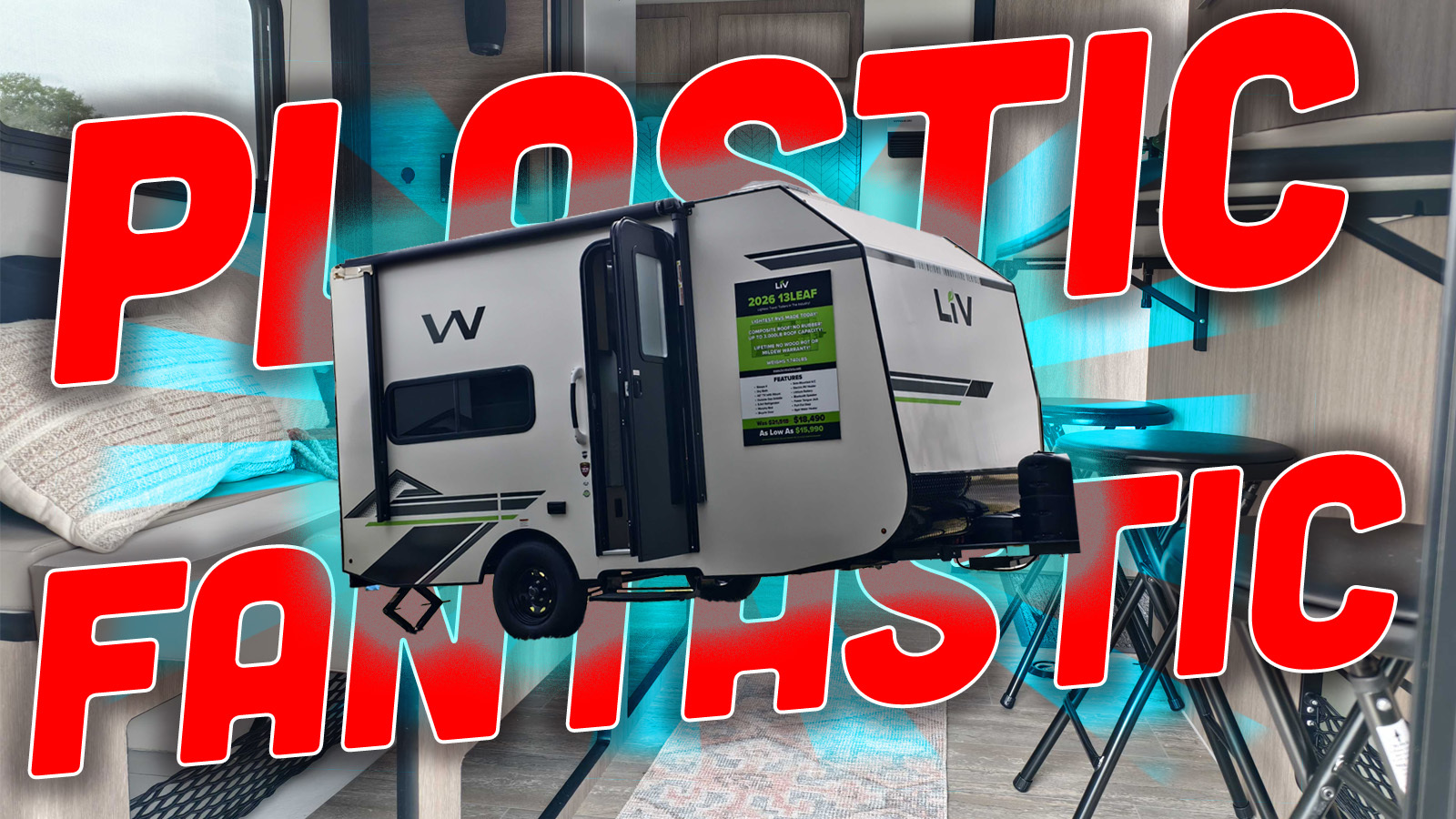
One of the greatest concerns that many buyers have with new travel trailers is that many units aren’t built particularly well. Ideally, you want a trailer that’ll last several years, not fall apart the moment you leave the dealership. There are robust campers out here, but they tend to cost a small fortune. One company thinks it can do both. This is the Leaf from Lightweight Innovative Vehicle, and it seems to have it all. It’s a tiny camper that doesn’t weigh a lot, appears to be made well, and doesn’t cost a million dollars. Oh yeah, did I say that this $16,000 camper is made out of plastic?
The RV industry typically isn’t known for innovation, but I’m happy to say that trends have been changing. There are a slew of new faces in the market that offer something different than the stodgy old designs from decades past. Much of the new RV development lately seems to be focused on self-towing travel trailers, all-electric systems, and EREV motorhomes. Some brands are even upping their quality. I’ve been finding myself saying “huh, that’s neat” far more often than usual, lately.


One brand that has been particularly bewitching for me is Lightweight Innovative Vehicle, or LIV. This startup company seemingly came out of nowhere, and its elevator pitch was wild. Instead of building a camper marketed with more AI buzzwords than can fit in a waste tank, LIV wanted to go in the opposite direction and build something crazy simple, but with a twist. Its campers are not made out of fiberglass, aluminum, steel, or wood like the rest of the RV industry. International RV says it wants you to sleep in one of its simple boxes made out of thick plastic.

Progress
I feel like I’ve been watching a kid grow up. When I first saw International RV’s LIV in 2023, the company’s display was tiny, and they couldn’t even get into the big RV show in 2024. International RV has come so far. It had a huge display at the 2026 Florida RV SuperShow with lots of models and a bunch of salespeople
LIV is the RV brand of International RV, which was founded in 2021 in Americus, Georgia. The company’s mission is to solve one of the biggest problems that RV owners face today: Poor longevity due to poor build quality and water leaks. The people behind International RV came from Factory Direct Marine & RV, a retailer specializing in boats, RVs, and their associated parts. This experience in boats trickled down into the RV operation. You’ll see what I mean later.

When LIV debuted in 2023, it made a splash with how it builds its campers. Every LIV trailer is built from top to bottom from a thick thermoplastic honeycomb that is ultrasonic-welded together, making for a “single-piece” shell. The floors and the interior furniture are also plastic and welded to the main structure, too. International RV proudly notes that there’s no wood to rot, no particleboard, no rubberized roofs, and no destroyed rainforests.
International RV says that its honeycomb structure, which is over an inch thick, is so strong that the roof of a LIV trailer can hold 3,000 pounds. The structure also forms a unibody, which negates the need for a large supporting frame. When you look under a LIV, you see a basic and rather small frame, and it holds the trailer’s tongue, tanks, and axle.

This construction has created remarkably lightweight trailers. The company says that its trailers are so light and so well sealed that they can float.
Of course, International RV doesn’t actually want you to use your camper as a boat, but that’s not stopping the company from advertising its trailers by putting them into a lake. International RV also likes intentionally pointing hoses into its trailers to show that they won’t rot out like the trailers of most companies.

LIV even gets funky with its braking systems. Optional on certain LIV models is a surge braking system, similar to what you’d find on a boat trailer or U-Haul trailer. Here’s how it works, from my previous coverage:
A surge brake system is self-contained, requires no modification to the tow vehicle, and requires no fine-tuning from a brake controller. In the tongue of a trailer with surge brakes, you’ll find a master cylinder. When you apply your tow vehicle’s brakes, the tongue of the trailer pushes a rod into the master cylinder, activating the brakes. The brakes work by using our old friend, physics!

Surge brakes do have downsides, like limited braking control going downhill, possibly applying the brakes when reversing, no adjustability, and no manual activation. Thankfully, it’s not a big deal if you don’t like surge brakes, as LIVs have electric brakes as standard. But you can definitely see the LIV’s boating roots.
Something else I like about LIV is that it’s a company that, at least for now, appears to be listening to its customers. Early LIVs had honestly pretty drab interiors, with just plain white walls, plain cabinetry, and plain black floor mats. Now, these campers look pretty darn cozy!
International RV also had to tighten up its quality control. I’ve been a member of the official LIV owners group for a few years, and some folks had a slew of small complaints. I have seen complaints about sticky roof sealant collecting dirt, moss, and other matter, sticking doors, amateurish caulking jobs, poor propane gas flow, frequent circuit breaker trips, and even missing parts. Some of the missing parts were honestly baffling, like stabilizer jacks that had missing bolts or cabinets that didn’t get a door installed. Lots of folks also complained about finding lots of condensation inside their trailers.

Then there were the odd design choices, like an entry door that could not reach its prop rod (above) when the awning was deployed. For all of International RV’s good ideas, it was sort of clear that they didn’t have a ton of experience building production campers, and some of the small details weren’t quite right.
In the time since then, LIV appears to have done a better job putting these things together. It’s still not perfect, but I’m finding that the vast majority of the people in the group are absolutely head over heels in love with their trailers. Most importantly, nobody’s complaining of roof leaks.
The Leaf

The newest LIV model is what I think is the coolest from the brand yet. This is the 13Leaf, and this little guy is supposed to be the cheap camper for a couple or a small family who want a step up from a tent or a tent camper.
Campers in the price range of this LIV tend to have wood framing, rubberized roofs, and frames that start rusting only a month or two out of the factory. Or, they’re built well, but have nothing in them. Alternatively, a $16,000 camper might be something that you cannot stand up in, like a teardrop. Remember, even the legendary Scamp 13 has a starting price of $25,000 nowadays.

The 13Leaf has the same plastic body as the rest of the LIV fleet, only it’s much smaller. The body is 13 feet long, while the overall length is 16’6″. You’re looking at 6’6″ of interior headroom and 8′ feet of width.
The simplicity starts outside, where there really isn’t much of a graphics package, no outdoor kitchen (just an outdoor griddle), no slides, no storage compartment, no ladders, and not much of anything, really. I mean, it also doesn’t have many windows either, giving you only three portals to look through.

You can see International RV’s improvements immediately. The door, for example, holds itself open through friction. Now, there’s no need for a prop rod that can’t reach the door. The exterior finish also looks less “plasticky” than previous iterations. You sort of have to get close to the panels to notice the honeycomb layer underneath.
Check out the underside and the minimal frame:

The minimalism continues inside. If you’re wondering how International RV can make these trailers so cheap, it’s because these campers have everything you need and nothing you don’t. The equipment is all about function over form.
There’s a residential window-style air-conditioner in the back of the trailer and an electric heater just hanging on the wall next to the entry door.

If you think that puny heater won’t do anything, you’d normally be pretty correct. However, something I have learned from LIV owners is that the trailers are pretty well sealed, so that tiny heater will probably keep you warm enough. Well, so long as you aren’t camping in the dead of winter, anyway.

Some of you might be wondering about my assertion about the trailer not having any wood when you can clearly see wood on the cabinetry. Ah, not so fast. Like the dashboard of your GM vehicle, the wood here is just more plastic. Everything in here is plastic.
The rear of the trailer has a couch that pulls out and turns into a bed. The bar seating on the other side of the trailer is a Murphy bed that folds down. Add the beds up, and there’s sleeping for up to four. Or, you can reel both beds in, pop open that back hatch, and park some bicycles inside the trailer.

The kitchen is also a nice little spot. Once again, almost everything you’re looking at here is plastic. You get a two-burner stove, a 5 cubic foot refrigerator, a single-basin sink, a portable Bluetooth speaker, and a microwave. Despite the simplicity, the trailer does have some neat features, like a dry bath, a lithium battery, a power tongue jack, and a power awning. There are ok holding tanks for a unit of this size, as you get a 20-gallon fresh water tank, a 30-gallon gray tank, and a 30-gallon waste tank.
The options list is also interesting. You can order one of these with a diamond plate rock guard, a lift kit, knobby tires, solar panels, a power step, a forced-air furnace, an aluminum chassis, a second propane tank, and more.

I won’t say everything was perfect with this trailer. There’s no storage compartment for stuff that you don’t want inside, and the beds didn’t feel particularly comfortable.
Since International RV is still a newer brand, it’s unclear what this plastic is going to look like 10 or 20 years from now. I’m told the exterior finishes of these trailers are made similar to boat coatings. But again, we have no idea for sure until one of these trailers gets old. Even with that caveat, I still think these trailers are a great idea.
Plastic Fantastic

You get all of this in a package that weighs only 1,740 pounds empty with a steel frame. The people at International RV tell me that this trailer currently costs $15,990. That’s before a freight charge and before options. The reps at the show tell me that after freight, you’re looking at around $17,000 and change. However, you should be able to get out of that freight charge by picking the trailer up at the factory in Georgia.
I was surprised by how much I liked the 13Leaf. When I saw the price, I stopped in my tracks and considered buying one. Then I remembered that I have a lot of big-ticket items to pay for this year, from a new car for my wife to dental work. I don’t need to add a new camper to that list. But for a brief moment, I was sweating because I was seriously thinking about it. Maybe one day, LIV.

But if you’re like me and you like affordable RVs, I do think a LIV is a compelling choice. So far as I can tell, most of the people who buy them love them, and most of the reported problems with them are minor. The 13Leaf can be towed by a huge number of vehicles, doesn’t have any wood, and doesn’t seem to skimp on the basic features that most people want in a hard-sided trailer. Sure, who knows what the plastic will look like 20 years from now, but it’s also only $16,000. I think you can buy one and probably have lots of fun. I mean, I almost signed on the dotted line myself.





A trailer that won’t leak is one that’ll hold its value longer.
But it seems most RV owners care more about size and subsidizing Indianas lack of workers rights with a meagre paycheck
There’s no excuse to not galvanise the chassis- it’s basically standard over here for any kind of trailer.
Compare this to the $10000 camper from earlier this week. For $6000 more you get.
1′ more length and thus more interior room. A microwave and an extra bed? Lighter weight and more insulated and of course no leaks.
If you were buying a camper to keep long term the no leaks would be a pretty big deal maybe even worth the big price difference.
I love the idea of these trailers, a well engineered, durable product that is lightweight, efficient and won’t leak. But I’m still a bit leery of the execution. It seems like alot of the used Liv trailers on the market are going for really cheap (especially the older ones) which isn’t a fantastic sign. Some also look pretty dogeared so far which considering their realtive age, (read: not too old) they really shouldn’t be yet.The low prices may be from the issues that the earlier trailers had as mentioned above and maybe also a factor of the company’s youth and lack of name recognition yet.
I’m actually still considering one of these (a larger one that this, probably in the 18-20′ range) for when we get a trailer (or maybe we’ll go with a full blow RV if the Mrs has her way, time will tell) along side of a (used) T@B 400 or maybe an Castia. I really like the Escape but they are generally just too expensive even used. The Liv has the price and lightness down but the longevity is still up for debate. I may take a chance if I the price is right (and I win the debate with the Mrs… which I probably wont.)
This actually looks interesting. Thanks for the write-up!
I just want more information about the material. Honeycomb plastic? The only thing I know of is Nidacore, which is used in the marine industry a ton for flooring, ceiling, etc. I rebuilt my twin tunnel hull modVP race boat hull with nidacore, and it’s an incredible material, a 4×8 sheet can be lifted with only a finger a thumb. It DOES, however, require resin and fiberglass, as you need to saturate the large planar surfaces w glass cloth, and bond it. I don’t know how you’d ultrasonically weld such a material tho. Have any more info on the material?
Dry bath again… someone’s been listening to my wife absolutely refuse anything with a wet bath. (Not that I like showering with a toilet, but I try keep an open mind.)
This is probably what we will buy once she gets her new vehicle. (Probably a Mazda CX-90, so lightness is key.)
A rear hatch to load larger items? Okay this is basically perfect for festivals and Burning Man.
This is fantastic. I’ve never seen plastic crack, crumble from UV exposure, or get brittle in cold weather and crack when it gets impacted, so I have no concerns about durability.
Side question, if plastic is so good at keeping water out, why do they need a “sticky roof sealant”?
The issue with condensation inside will be a constant issue when stored if you don’t set up some sort of air exchange system. Plastic isn’t known for breathing well.