

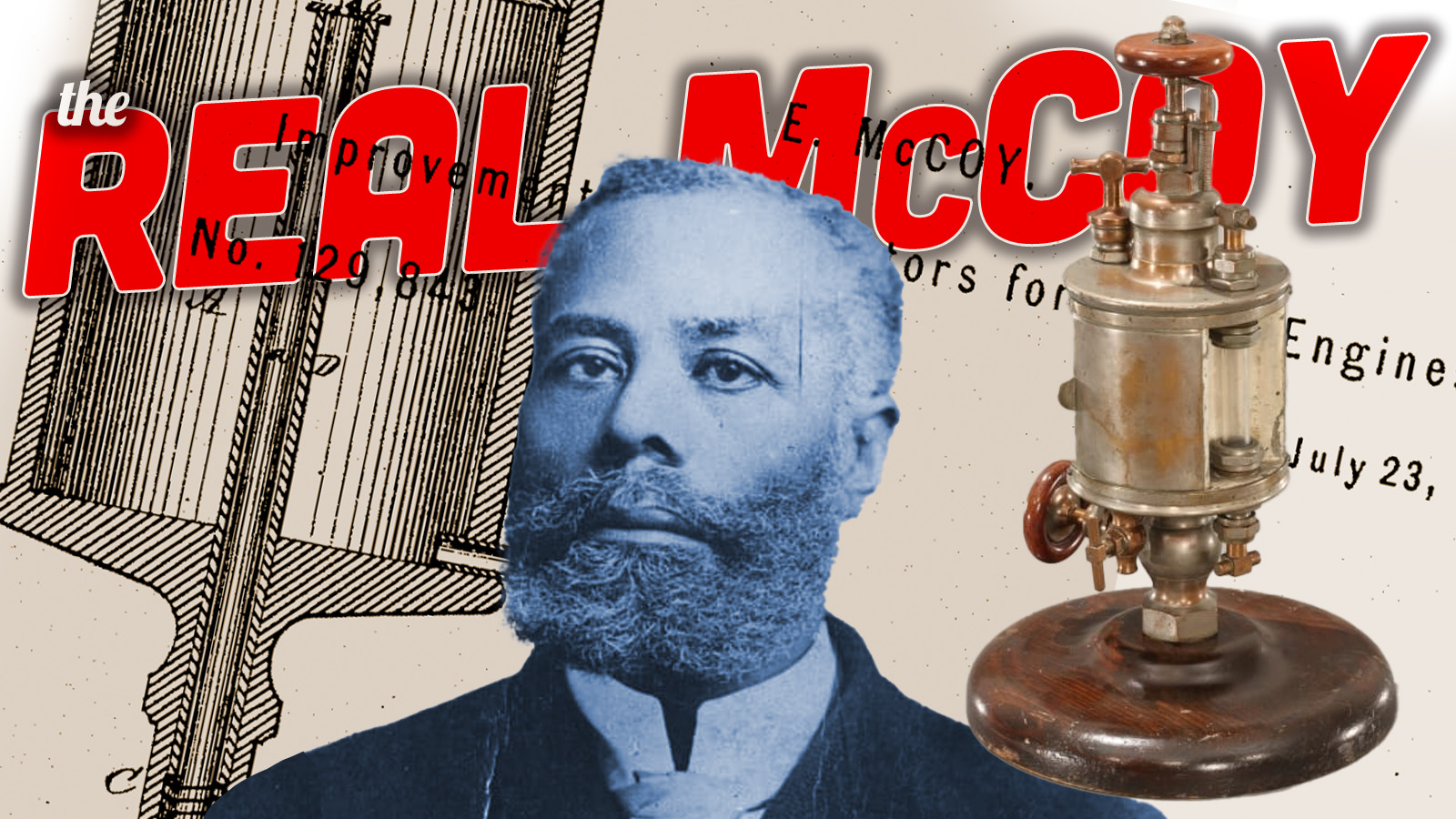
Have you ever used an expression or idiom and then taken a moment to actually listen to what you just said? And then noticed that, hey, I have no idea where the hell that expression comes from? I feel like I do that a lot. Or, alternately, I’m just simply wrong about the origin of some expressions. For example, I always sort of assumed “look a gift horse in the mouth” had something to do with the Trojan Horse, a very famous gifted horse. Of sorts. But it has nothing to do with that. It has to do with actual, literal horse mouths and the damp horse teeth within.
This recently happened to me with another expression, when things are referred to as “the real McCoy,” but this time I was just ignorant, not wrong, and was happily surprised to find that the origin of the expression happened to have something to do with mechanized transportation systems, which means I can use it as something to write about here on this very site. And, even better, it’s all thanks to a Black inventor, and it’s still Black History Month, which means it’s even sort of timely, or at least as timely as something 154 years old can be.


The inventor was a man named Elijah McCoy, and the invention was one of the first automatic oiler mechanisms for locomotives. You see, the early steam engines that powered railroad locomotives lacked any sort of automatic lubrication systems. This meant that on almost any journey by train, stops would have to be factored in to allow engineers the chance to lubricate all of the moving components of the engine so that friction wouldn’t cause everything to just melt into a huge smoldering pile of iron slag. The usual distance that a train could travel between stops for inspecting and oiling bearing surfaces was right around 100 miles. So, if we assume that train speeds of that era were around 30 mph, then we’re talking stopping the entire train every three hours. Given the distances of rail travel, especially in America, this is an awful lot of stopping, which meant longer travel times and a loss of time and money for everyone.
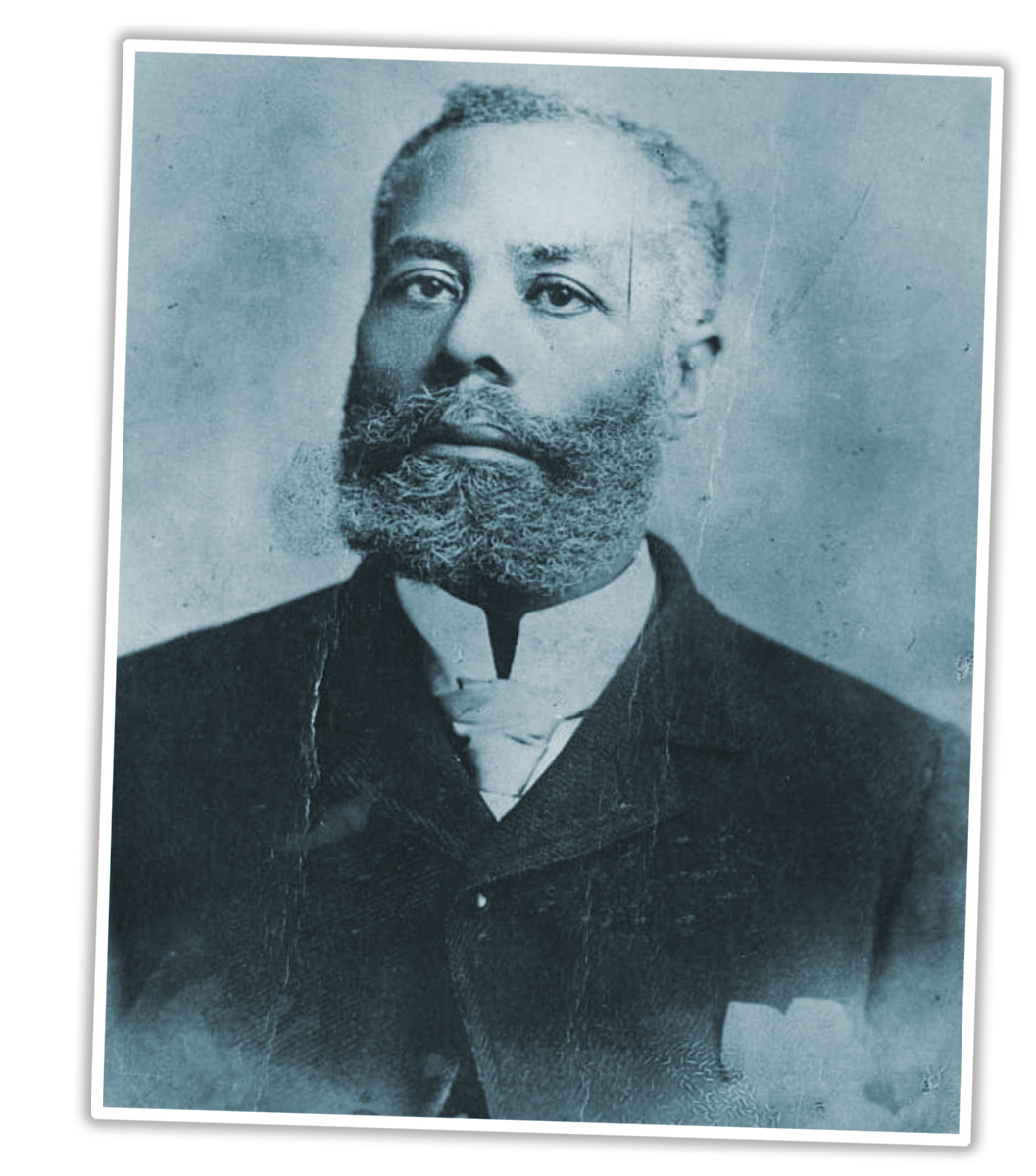
As you can imagine, a system that oiled these complex machines automatically, without requiring regular stops, was a very big deal.
Before we get into the details of the oiling system that would eventually bear his name, it’s worth recounting a bit of Elijah McCoy’s early life, because it’s an interesting journey. He was born to parents who escaped slavery in Kentucky via that famous metaphorical railroad, the underground one. They escaped to Ontario, Canada, where little Elijah was born. In return for enlisting in the British army, his father received a land grant.
Eventually, his family made it back to the United States, settling in Ypsilanti, Michigan, where he found himself fascinated by machinery. He was able to go to engineering school in Edinburgh, Scotland, and when he returned, he got a job working for the Michigan Central Railroad.
At that time, the railroad did not allow Black people to be engineers, so McCoy got a job as a fireman and lubricator, which was hot, sweaty, difficult work that put him in very direct and protracted contact with the workings of the locomotive. It was during this period that the need for some sort of automatic lubrication system became apparent to McCoy, and so he applied his considerable intellect to the problem.
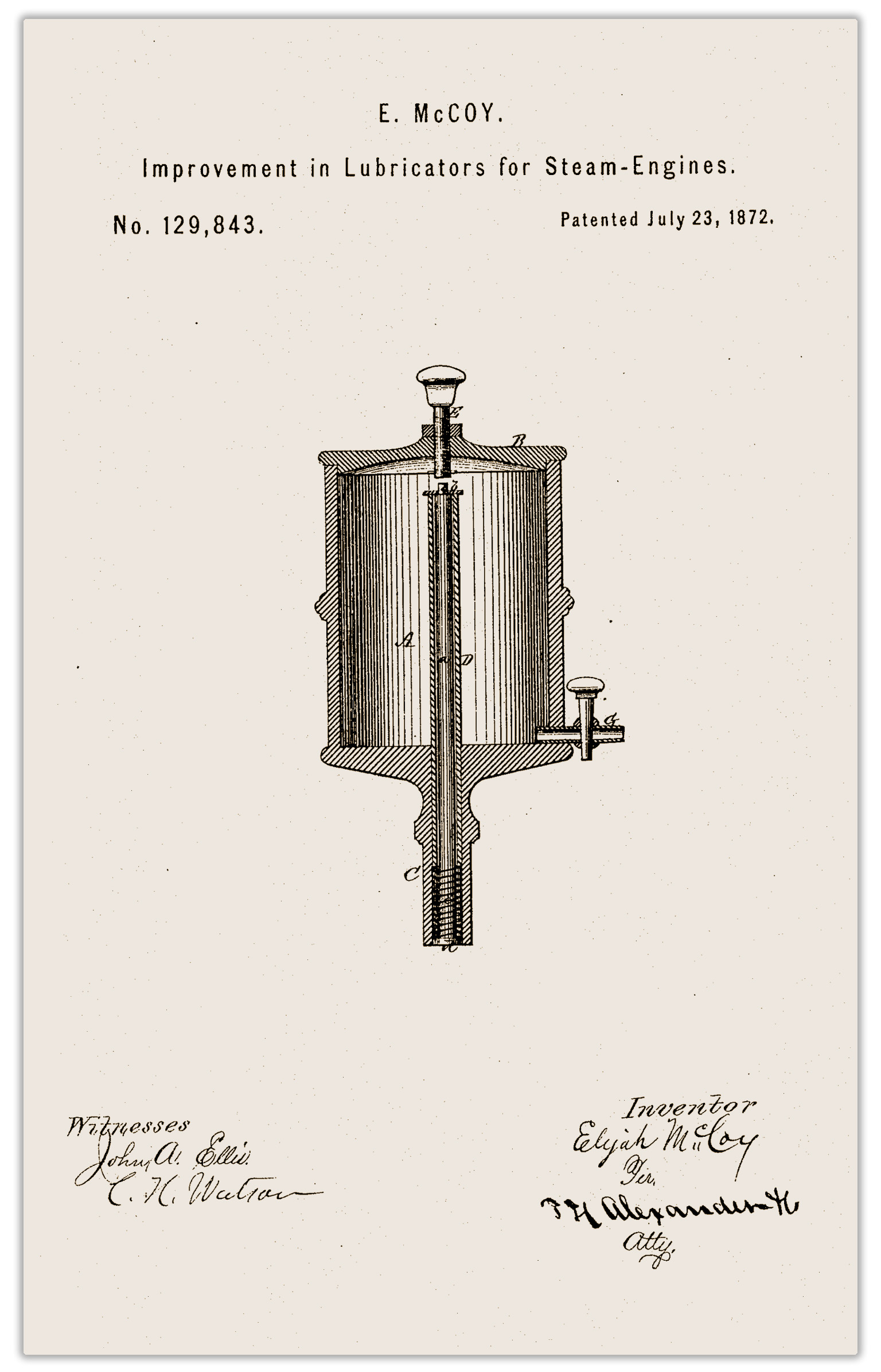
In 1872, he came up with an ingenious solution that used the steam pressure of the engine to help deliver the oil to where it was needed. Here’s how the patent describes the mechanism, illustrated above:
A represents the oil-cup, provided with the cover B. In the center of the bottom of the cup A is a downward-projecting stem, 0, to be screwed into the place where the lubricator is to be used. This stem is hollow, and from the same extends a tube, D, through the center of the cup. Within this tube is a rod, 1, having a valve, b, at its upper end above the tube D to close the same, and at the lower end is a piston or disk, d, within the stem 0. Around the lower end of the rod a, between the piston d and a shoulder in the stem, is placed a spiral spring, a, which forces the rod down, so that the valve b will close the upper end of the tube D and prevent the passage of the oil.When the steam presses upon the piston the valve rises and allows the oil or other lubricating material used to pass out.In the cover B is a thumb-screw, E, directly above the valve 1), by means of which the flow of oil may be readily regulated. At the bottom of the oil-cup is a faucet, G, for the purpose of drawing oil the condensed steam when necessary.
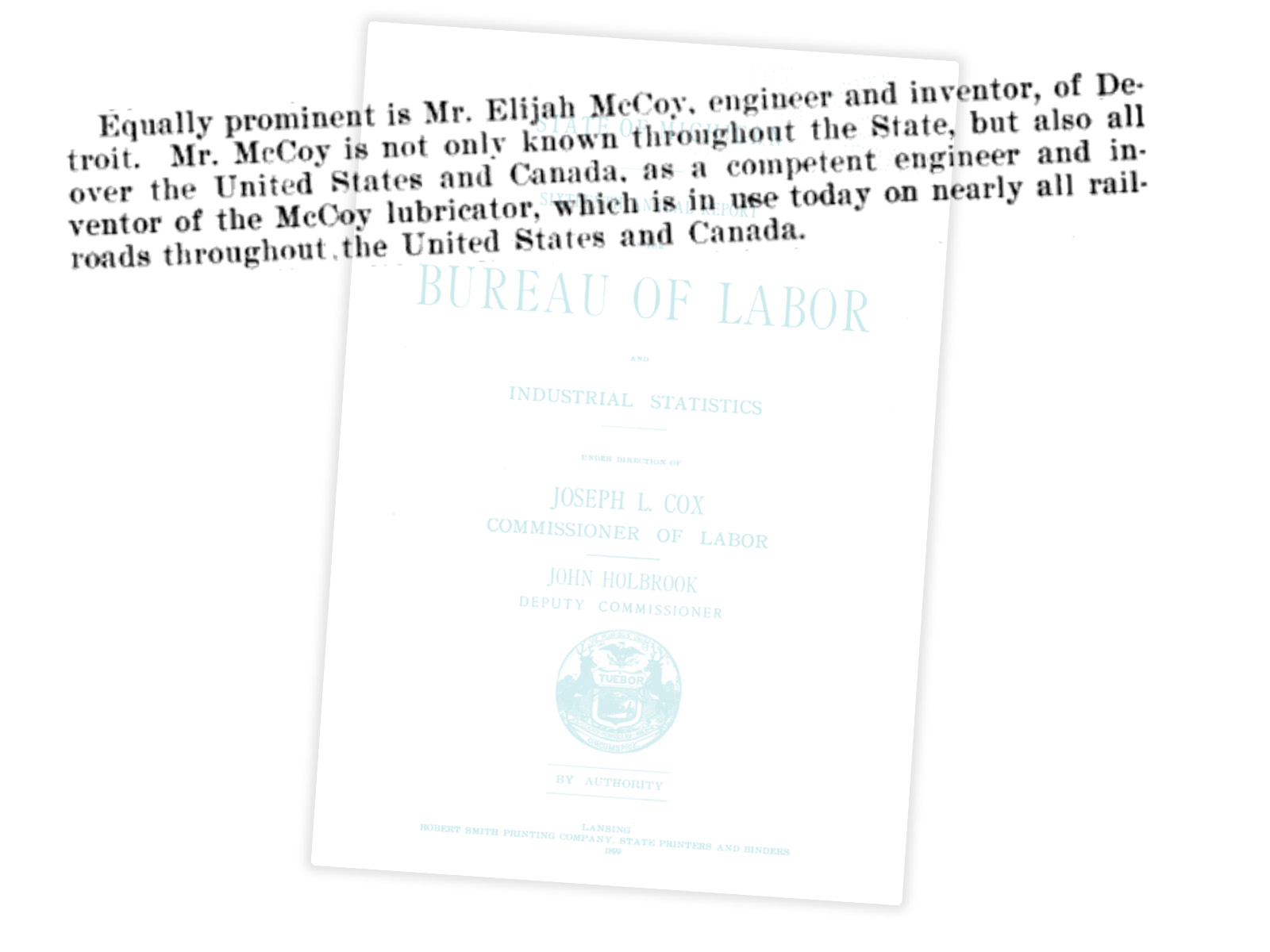

The widespread demand for such an automatic oiler and the relative simplicity of the design not only meant widespread acceptance, but also widespread copying of McCoy’s basic design. Knockoff automatic oiling mechanisms were rampant, but the original Elijah McCoy design was so much better than these Victorian-Era-Temu knockoffs that railroad engineers and mechanics soon began to demand the original ones – the “real McCoys,” if you will, which you will indeed, because that’s where the expression comes from.
Railroad workers were demanding the real McCoy so often that the phrase got picked up into the greater cultural lexicon, where it came to mean anything genuine and of real quality. That’s a pretty impressive cultural impact for a railroad engine oiler.
Here, don’t take it from me – here’s someone from the Oil Museum of Canada explaining it as well:
I know you’re already likely flooded with Oil Museum of Canada content in your various social media feeds, but I hope you’ll just accept one more. There are some actual examples of oil-drip cups there and, yes, they’re the real McCoy.
Now, I know what you’re thinking: if this guy was such a big deal, why hasn’t he been in an ad for booze? Oh, you sweet simpletons, he has! Look:
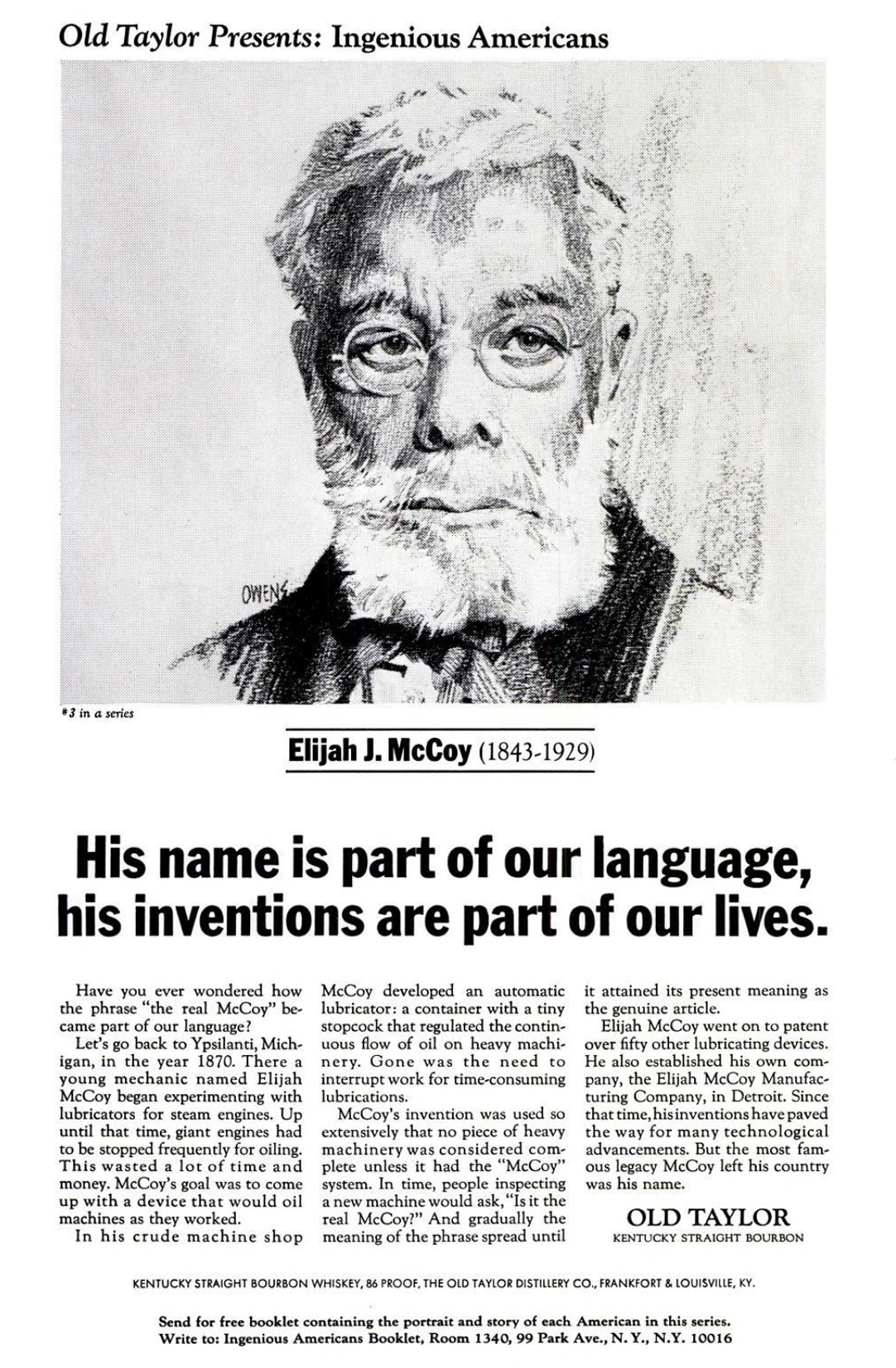
Yes, Old Taylor, what seems to be usually described as a “budget-friendly” bourbon, once featured McCoy in an ad! For most people, that would be how you knew you actually made it, but I think for McCoy, revolutionizing a nation’s transportation industry and inspiring one of the most enduring idioms probably eclipses the booze ad.
Top graphic images:




One of the benefits of living close to Henry Ford Museum is taking advantage of a membership. I never walk out of there without learning something new or interesting. One time many Februarys ago we happened to walk up just as a talk on McCoy was beginning and it was time well spent. After, when walking around looking at some of the giant machines (including trains) all the automatic oilers on them are impossible to miss and you know he absolutely had a huge impact on the world.
I assumed the phrase was due to the Hatfield’s and the McCoy’s. As in, “Yep, that’s a real McCoy, shoot him”.
It’s crazy how much the top shot reminds me of Luke Capasso (who incidentally does some pretty good stories during Black History Month).
Also, today I learned that the Canadian Oil Museum exists! That one is getting added to the road trip stop list for one of this year’s road trips.
Another African-American engineer worthy noting is Frederick McKinley Jones. He developed and patented lot of technologies that made the mobile refrigeration transportation in the 1930s and 1940s and the audiovisual system for cinemas in the late 1920s, leading to the “talking movies” possible. Too many inventions to list here…
Ypsilanti, MI mentioned in an Autopian article! Torch, I’ll give you a dollar if you can pronounce it correctly on your first try.
YEEEE-PISS-ILL-ANT-EEEEEE.
Home of the second-best football field in the nation, EMU’s with a nice gray surface. Who’s number 1? That would be EWU with their red field.
Ypsilanti is happy to see you.
Its pronounced “Yissiplanti” and i will take no further questions.
I hope it’s pronounced ip-see-lan-tee
Close! IP-suh-LAN-tee
It sounds foreign. Watch out or you get deported over there.
So getting featured in an Old Taylor ad was the equivalent of being on the cover of the Rolling Stone back in the day?
I bought 5 copies for my mother!
Shel Silverstein strikes again!
I had no idea he wrote that song! Interesting guy.
And here I am, learning stuff in the comments AGAIN!
I was expecting this to be a “balls out” post, but this is even better.
Aren’t you the discriminator…
Ditto. Would have bet money it was going to be about “balls out” – another rail-related idiom.
Dude changed an industry and the common lexicon. Sometimes I don’t change my socks. Bravo, sir. I am glad I learned this
Locomotives had to stop AT LEAST that often for water anyway, so having to run around and add lubrication was really no big deal – and even with automatic lubrication, some things still had to be done manually, or at least inspected to make sure the automatic oiler was going it’s thing. Steam locomotives are astonishingly labor-intensive devices, for something based on very simple principles. BUT, these mechanisms ensured that it actually got done, and more consistently.
They didn’t always have to stop for water. Express trains would drive over a water trough between the rails and drop a scoop down to ingest the water.
A later development, and quite rare in the US.
I hope the real (Mr.) McCoy got real(ly) wealthy from this.
Sadly I doubt it.
I know…
He sold his patent rights for pretty small lump sums of cash, and did ultimately die broke, unfortunately
He got Scammed… Likely…
Yes it would hard creating an oiling system that doesn’t require regular stops but since steam engines require regular stops what is the problem of regular stops for oiling while the train loads coal and oil. This has to be the most ignorant argument I have read on Autopian
Are you saying that trains could only carry enough coal and oil to go 100 miles, regardless of lubrication requirements? And that therefore this invention did nothing to make the 100 mile stops unnecessary?
Water was the big issue actually. Boiling off water to make steam. Locomotives carried more coal than water.
These enable visual inspection. Just a glance tells you if it’s working or not.
Water may limit distance between stops more
Maybe. I wonder whether there would be a town with water every hundred miles, out west. And regarding the assertion at the start of this thread, oil and coal available every hundred miles.
No I’m saying you can haul coal to run long term.
No but that it was a small step forward rather than a leap
You are a giant step backwards for man-kind
I think how reality worked out kinda demonstrates the automatic oiler was a good idea?
John Ramsbottom invented a system where a watering trough between the rails was filled with water that was scooped into the tender by a train at speed.
For some reason “the real Ramsbottom” didn’t catch on.
Oh, and John Ramsbottom also invented the metallic piston ring with a gap in it, and figured out that the best shaped ring for a round piston and cylinder was not round.
Ram-stein might just though! 😉
Interesting how was it filled?
A trough of water, and a scoop on the bottom of the train passing at 40mph.
Sort of a ram bottom if you will,
Sure it did, I’m always asking my butcher for a real ramsbottom
This guy does not live in our reality
You are absolutely the biggest jackass on this entire site. Add in poor and racist as well. What have you contributed to society you absolute wretch?
And now I have Another Night by Real McCoy stuck in my head, thanks 90s dance mix party to go.
Automatic Luber
Speaking of odd idioms, an elderly church lady in Nortb Carolina scarred me for life when she exclaimed in surprise: “Well, butter my buns and call me a biscuit!”
8^O
These types of oilers are still in common industrial use.
Indeed they are! Amusingly they have a lid that flips up which makes them kind of look like very small toilets.
In fact, I bet people in here have seen them and didn’t realize it. 🙂
Here’s one on eBay – 3/4″ diameter, for a lathe motor or similar:
https://i.ebayimg.com/images/g/KRUAAOSwR6RZ7PfA/s-l500.jpg
James Rogers, author/compiler of The Dictionary of Cliches I keep at my desk–because this type of discussion arises all the time–suggests that the Real McCoy was either a oft-imitated boxer (“Kid McCoy”), a Glasgow Scotch (“A&M MacKay”), or heroin from Macao. But this post is better-documented than that little blurb, so it wins!
You’re darn tootin’ I have!
Edit: And he invented graphite lube – in 1916. 😮 Sciencespeed, sir!
This will always be the Real McCoy to me:
https://www.youtube.com/watch?v=Pav2f4b-1ZE
I thought it was in reference to a liquor smuggler during Prohibition named McCoy who would anchor just inside international waters for runners to pick up his wares. Since he didn’t water it down or cut it with dangerous methyl alcohol or the like as others did, people wanted the “real McCoy”. This invention predates that period, so I’m apt to think this is more likely the true origin.
There’s a lot of explanations, but which one is the real McCoy?
I had just heard that recently when watching a documentary about salt marsh shacks off on Long Island, some of which were used as bases for the boats that went out to meet the run runners.
My guess is the phrase was already in use and common and got adopted to the new McCoy.
So now there would have been two “Real McCoys”.
I’d bet you’re right and the newer event ended up supplanting the old one in peoples’ minds. Like many of the common expressions we use today, most people likely didn’t even known where it came from originally.
My son did a report about Elijah McCoy years ago, and I am constantly telling people about him. Interesting note, we had read that Bones McCoy on Star Trek was named after him. Elijah was somehow related to somebody associated with the show. We were never able to verify this, so it might be B.S.
Dammit Jim, I’m a doctor, not a miracle worker. The REAL McCoy.
I believe I’ve driven by signs for that Oil Museum of Canada many times! It’s a funny area, because on top of that, there’s towns around by the name of Oil City, Oil Springs, and Petrolia, so they’re obviously big on fuel around there. Plus there’s a gas station around there we stop at, so they sell it too! South of Wyoming, Ontario, which I always thought was a surprising name for a town!
Huh, almost sounds like western PA. We have an Oil City and Petrolia as well.
Just don’t go to Centralia….
Interesting! Wikipedia tells me that there’s also Petrolia’s in California, New York, Kansas, and Texas. There also seem to be Oil Cities in AB, WY, CA, KY, LA, MD, MI, MO, MS, OK, TX, WA, and WI, so it’s a surprisingly popular name! (Well, actually there’s just a surprising amount of places in the US, so a lot of names get used)
Oil City PA is near Titusville, site of the first commercial oil well. Literally the origin of the modern oil economy.
Fascinating. Also fascinating is how the name helped. It sounds cool. “The real Smith” doesn’t sound as good and probably wouldn’t have stuck around. If your name isn’t right you may as well give up because you ain’t getting the booze commercials.
Indiana Smith just sucks… How ’bout Jones.
I’d always assumed it had something to do with the McCoys of the famous “Hatfield/McCoy” feud. And now that I know that Elijah McCoy’s family was from Kentucky, I’m left wondering if his father was related to (more likely “owned by”, although it pains me to even write that) the famous feuding McCoy family.
I’m pretty sure this post violates every anti-DEI rule currently put in force by Cheeto Jesus. So, good job and hats off to Mr. McCoy! Also, beware of Greeks bearing gifts.
Also, being a Canadian citizen (or, rather, a British subject born in Canada, since Canadian citizenship wasn’t fully a thing until 1947) doesn’t help, given current trade war and territorial expansion rhetoric
Can we please keep ALL political bullsh1t off this site? I come here for auto-related information and read the comments to learn. There are other sites for this type of stuff. This goes for lefty and right-wing weirdos that just can’t help themselves. Is it that hard?
As an engineer who has worked for a company that specializes in automatic lubrication systems, I find this very interesting. Thanks for this tidbit!
Farval or Trabon?
This is why I love Autopian. Wonderful little nugget of information. Thanks for the education.
Next up, want to give us the low down on “balls out”? Or are such things not discussed at the less seedy taillight establishments you frequent?
I’m guessing “balls out” could have an origin in an old, simple mechanical system as well, the mechanical speed governor- https://en.wikipedia.org/wiki/Governor_%28device%29. Running “balls out” would be with the governor at the max, with the balls out wide, before it cuts speed/power/whatever.
This is my understanding of “balls out” as well, as told by the old timers tending the steam traction engines at the vintage farm equipment festival near me. Most of those steam engines use a centrifugal governor like that, and they’ll spin into a disk-type blur at full speed.
In a related theme, “balls to the wall” came from the throttle levers on early airplanes, which typically had spherical knobs on the end of them (similar to a lot of boat engine throttles). Full throttle meant pushing the levers forward towards the firewall, so “balls to the wall” referred to pushing the engine power to maximum, and now generally refers to applying maximum effort in any situation.
Neither of those sayings have anything to do with the dirty connotations most people assume.
A pair of big brass balls?
Interesting, I guess something like “levers to the wall” just doesn’t have the right ring to it.
People love catchy rhymes!
Who Knows, knows! The most photogenic governor!
Bingo! A mechanical steam engine governor.
From what I understand, it’s a little more significant than the governor being “maxed out” – it’s that the ability to regulate the speed is removed altogether.
From what I know of the devices, they basically use the angle of the arms holding the spinning weights to limit the speed. As the centrifugal force increases with higher speed, the balls swing farther and farther out (and higher and higher, as the pivot for the arms is at the top). When the desired angle is reached, it will limit the machinery so it won’t go any faster.
At the extreme, the balls are flying around at 90° and there’s no more “room” in the system for limiting the speed. The speed can keep increasing more and more, but the governor can’t detect it because the balls are already as high as they can go.
At that point the machine is in a runaway state where it either runs out of power or something fails (frequently spectacularly).
I understand the mechanics, but I’d love to find out who coined the phrase.
Talk about having your balls in a ringer…
I would opine that this would be a damn sight better than having your balls in a wringer. But YMMV.
That would make sense, the limiter has reached its limit and is no longer limiting. Sounds like a good assignment for Jason to find out.