

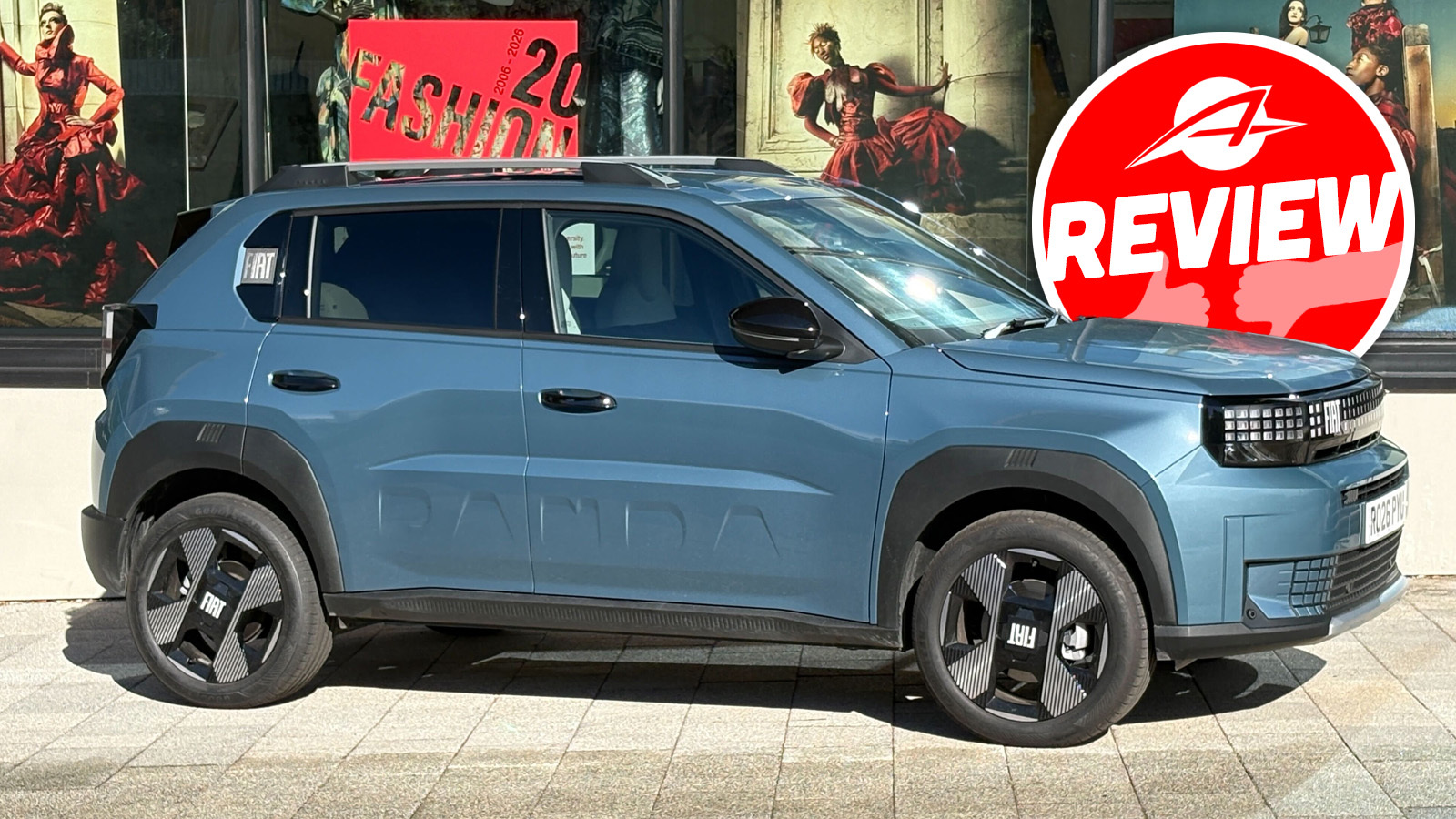
Way back in 2023, I turned fifty and the (soon to be departed) Mondial turned forty, so in celebration I drove across it Europe to see the Italian Grand Prix and to take it back to where it was born, Maranello. My base upon arrival in the Old Country was a lovely family-owned hotel near Lake Como, where I had the best spaghetti bolognese of my life. Away from the picturesque edges of the lake this area is quite rural and hilly with a lot of local businesses centered around burying various plants in the dirt and then yanking them out again several sunny months later.
During the three days I spent in the area, I counted seventeen Fiat Pandas out earning a living. Seventeen. And not the in-between second and third generation cars everyone forgets about. I’m talking about the original Fiat Panda that arrived in 1980. Over the remainder of the week, as I descended further into Italy, I had to stop counting. They were all over the place. Have you even been to Italy if you’ve not spotted a Panda haphazardly hammered into a tight parking space on a narrow medieval Italian side street?


The original Panda was a singular work of genius from Giorgetto Giugiaro. The brief was to design a cheap, classless modern car that both weighed and cost the same as the rear engined 126 it was replacing. What emerged was as pure a piece of industrial design on wheels as has ever been seen. Flat panels maximized the interior volume and made it economical to stamp out by the million. Flat glass all round was meant to achieve the same effect but hilariously Fiat struggled to find a supplier with the required expertise. The seats were modular hammocks that could be reconfigured in a variety of way, one of which was an impromptu double bed. Very Italian. Fortunately the seat covers were also removable, so they could be washed free of sin. Carry over engines from the 126 and 127 meant every mechanic, working in the shade of an olive tree in Italy, could fix a Panda with little more than a vermouth and a hammer.

Later versions spawned a four-wheel drive version with power-take-off, a van variant, and in 1990 even a battery powered model, the Elettra, with a 60-mile range that was unsurprisingly a failure. Overall Fiat sold about 4.5 million first generation Pandas until production finally ended in 2003, one of the longest ever production runs for a European car. No wonder the bloody things were all over the place. The follow up models were more conventional small five door hatches but not without their charms – as well as continuing with a chunky four wheel drive model, the second generation also gave us a hot skateboard in the 100bhp model which had a body kit, upgraded suspension and brakes, and a ride to put your spine through the top of your skull. There were also collaborations including tie-ups with homeware manufacturer Alessi and motorcycle gear company Dainese. Incredibly the third generation is still on sale in Italy as a basement special called the Pandina. Clearly there is a lot of merit in Giugiaro’s ‘plain steel box on wheels’ idea.
How Do You Improve On Perfection?
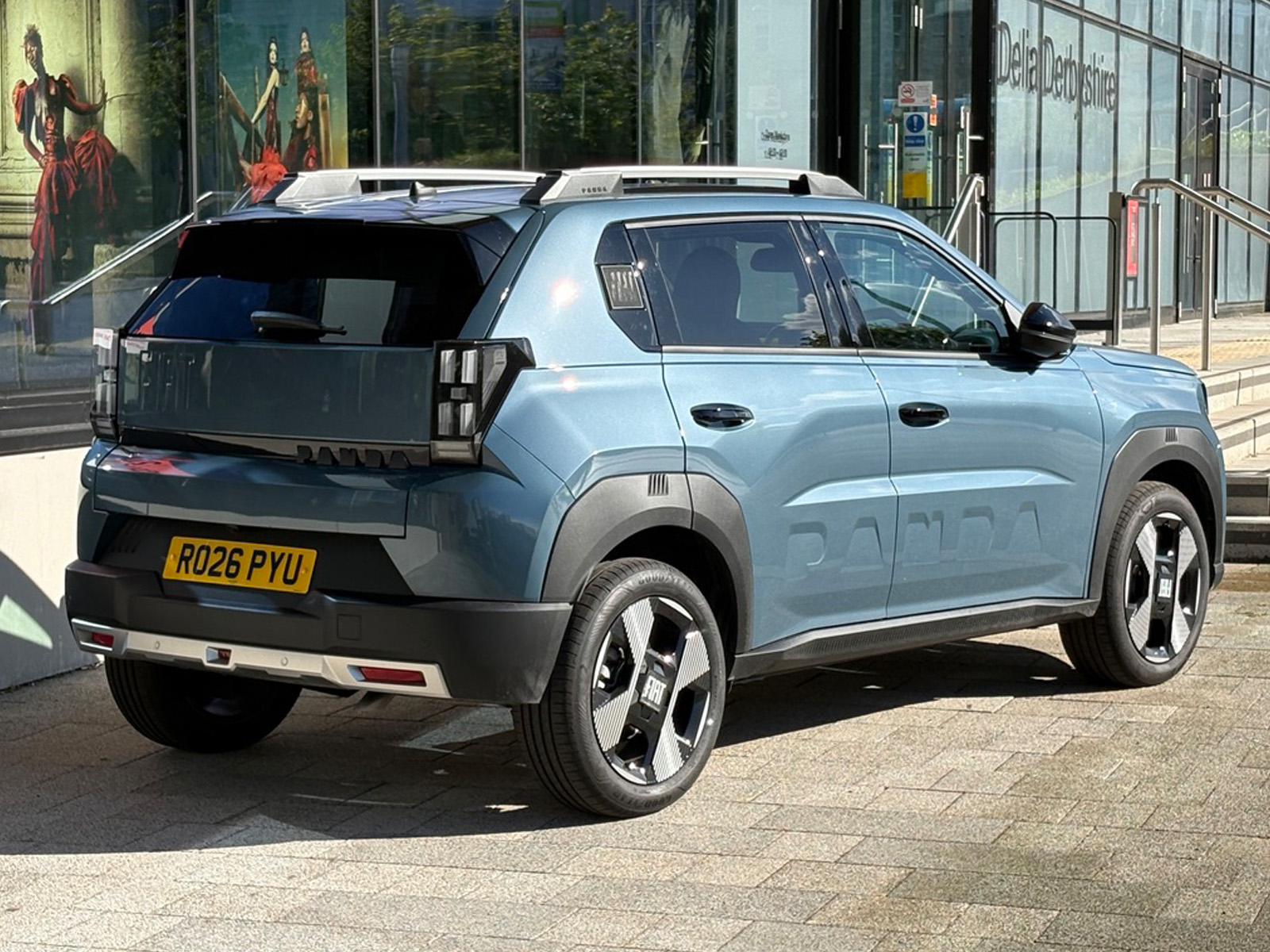
That the 1980 Panda is a stone-cold classic is undisputed but how do you recapture that magic in a brand-new model? The Nuova 500 was deservedly a runaway smash hit, but trying to spin the aesthetic of such an iconic car into a broader range proved tricky as Fiat, and also Mini have discovered. Likewise reverting to a purely functional design like the original wouldn’t work as the market has moved on the last four decades. If you’d have asked me a decade or more ago what features I required in a daily I’d have said room for my 34” inseam legs, a pedal box than can accommodate my size 11 feet, power steering, a decent stereo, electric windows and climate (or at least air conditioning). All I can really add to that today is wireless CarPlay. And if you hadn’t noticed, nowadays this is all pretty much standard stuff even in the basest of basest econoboxes. We’re all soft and coddled now, so a super stripped out car wouldn’t have enough appeal for the mainstream customer. No one wants crank windows apart from cranks. I may or may not have upset Slate design director Tisha Johnson over dinner with my thoughts on that approach to bringing such a car to market.
One of Giugiaro’s innovations in vehicle packaging with the Panda was the use of vertical space – reorienting passengers into a more upright seating position to reduce overall length and liberate internal volume for cargo. This is the defining characteristic that links the brand-new Grande Panda back to the original, and it’s probably the thing that causes lack witted people into commenting the Grande Panda is a big car, or an SUV. It is categorically neither of these things.

At under 4m (157”) long, 1.7m (69”) wide and 1.5m (61”) high this new Panda (I’m dropping the Grande bit because everyone else does) sits firmly in the Euro Sub-B category, roughly equivalent to the EPA mini-compact class. Dimensionally the Panda is slightly longer than a three door Mini and shorter than the dearly departed Ford Fiesta. Allow me to repeat this for the cheap seats: the new Panda is not a big car.
At the moment, you have two powertrain options with an enthusiast pleasing third soon to be added, which I’ll talk about later because I’m a terrible tease–for now you’re just getting a flash of thigh. Our friends at Stellantis UK offered me a Panda in either pure EV or mild hybrid flavors – I opted for the latter, not out of any anti-EV militancy but because there’s nowhere local I can charge on a timescale that doesn’t involve the date changing. When asked if I had a color preference, of course I said black, but there’s none on the press fleet. With hindsight it probably wouldn’t have photographed as well as the optional metallic Lago Blue (£650 or about $870) I did get, although that did mean my personal style suffered somewhat. Honestly the sacrifices I make for you people.

Under the Panda’s square hood is the familiar Stellantis 1.2-liter triple with a six-speed dual clutch DCT gearbox and an electric motor, for a combined total of 108bhp and rather pleasingly over 150lbs ft of torque. Which the Panda needs because its curb weight is a pass-me-another-plate-of-carbonara 1347kgs (2970lbs). This powertrain stars in a variety of Peugeots and Citroen tiddlers – in fact the Smart Car Platform the Panda sits on is directly shared with the Vauxhall/Opel Frontera and the Citroen C3 and is related to the underpants of the Jeep Avenger. All this component sharing allows for incredible economies of scale, but you must be careful to make sure platform buddies have distinct identities. And man alive have Fiat ever pulled that off.
Pretend You Are Michele Alboreto
You start the Panda by conducting a prehistoric ritual that involves inserting a length of metal into a slot on the steering column and twisting it, something that will either thrill or utterly perplex the Zoomers. If there’s enough charge in the battery this will have the discordant effect of doing absolutely bugger all. You simply click the center console mounted toggle switch into D and pull away in total silence. The Panda is a mild hybrid with only a vestigial battery – you don’t get far on pure electric power alone. Rather, the electric motor is used for reversing, regen braking, and to help the petrol motor under load.
At first I thought the transition from electric to petrol power was a bit abrupt and the regen was making the brakes feel grabby. The steering and pedal weights felt overly light as well. After my first day snatching and pogoing around Coventry, I realized the mistake was mine: I had forgotten the First Rule of Italian Driving – namely drive it like you are late for morning mass. This version of the Stellantis powertrain doesn’t have the ‘keep the grey bureaucrats in Brussels happy’ calibration found in its platform mates. Instead, Fiat have appropriately given the Panda the ‘Saturday afternoon qualifying’ powertrain calibration. Stomp the gas and brakes with a heavy foot, twirl the wheel like you’re Michele Alboreto whipping through the Variante Ascari and suddenly it all comes together. That switch between power units smooths right out, the eager three cylinder buzzes away in the best small Fiat tradition and the light steering means you can wind the lock on and off quickly with just one hand, leaving the one other free for making appropriate Italian hand gestures at other drivers. With its wheel at each corner stance and front corners visible through the windshield, the Panda is perfectly tuned for urban combat.
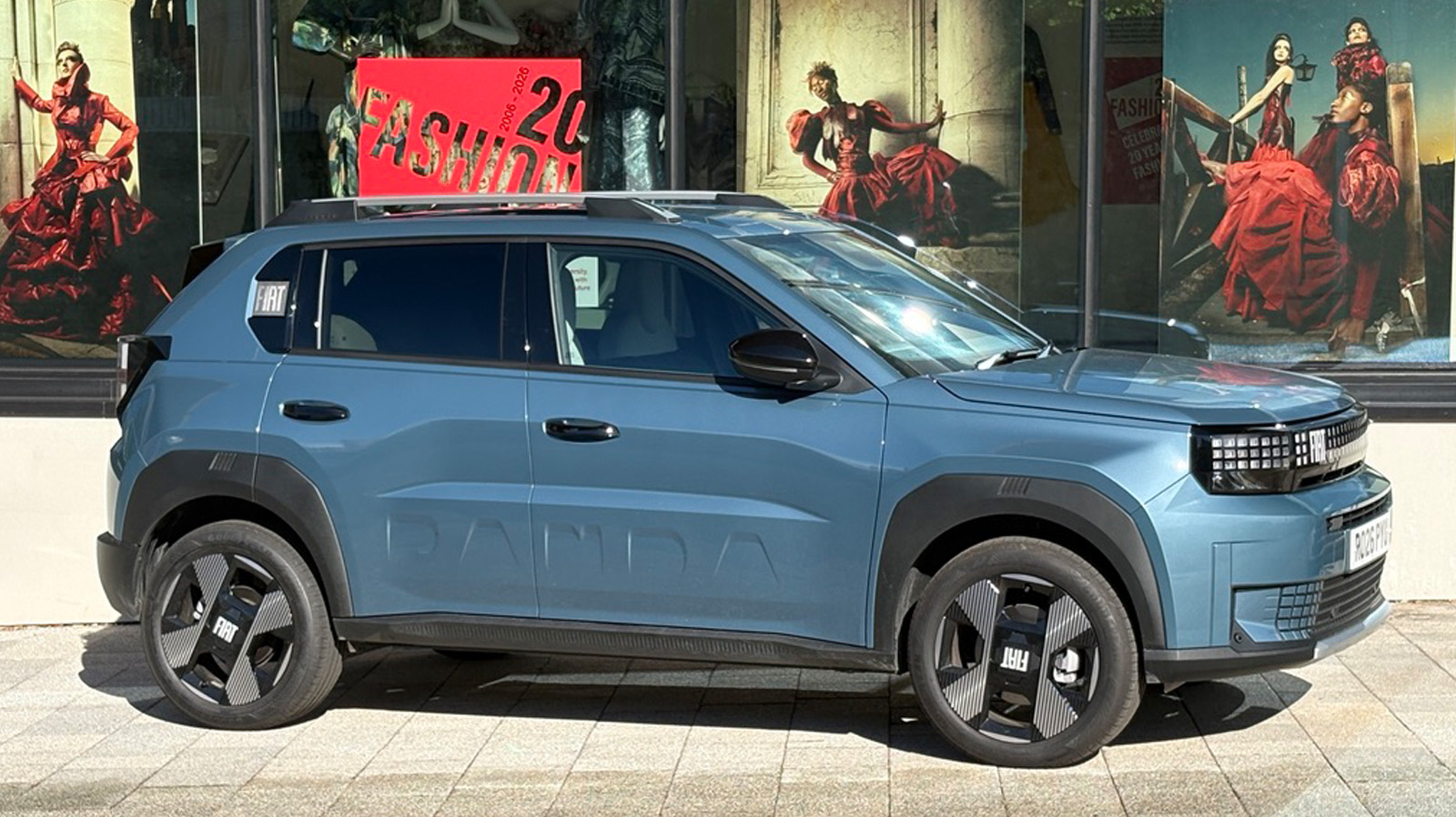
It’s surprisingly nippy, too. Although on paper the figures are not especially skirt raising, around town and on the open road the Panda gets going smartly. Thanks to the electric motor there’s plenty of step-off performance for the stop light Grand Prix and it’s not lacking on fast roads either. 0-60 is quoted as 10 seconds with a top speed of 99 mph, both of which feel extremely conservative. On one occasion when I was – ahem – running a little late, I had no problem romping past dawdlers on the A46 dual carriageway, and the ultra-dicey Coventry ring road with its stupid 100 yard distance between on and off ramps proved no problem. Spot a gap, aim, squirt and go. Driving in this Italian manner will still see you getting an easy 55 imperial mpg combined (46 mpg US).
We Heard You Like Pandas So We Put A Panda In Your Panda

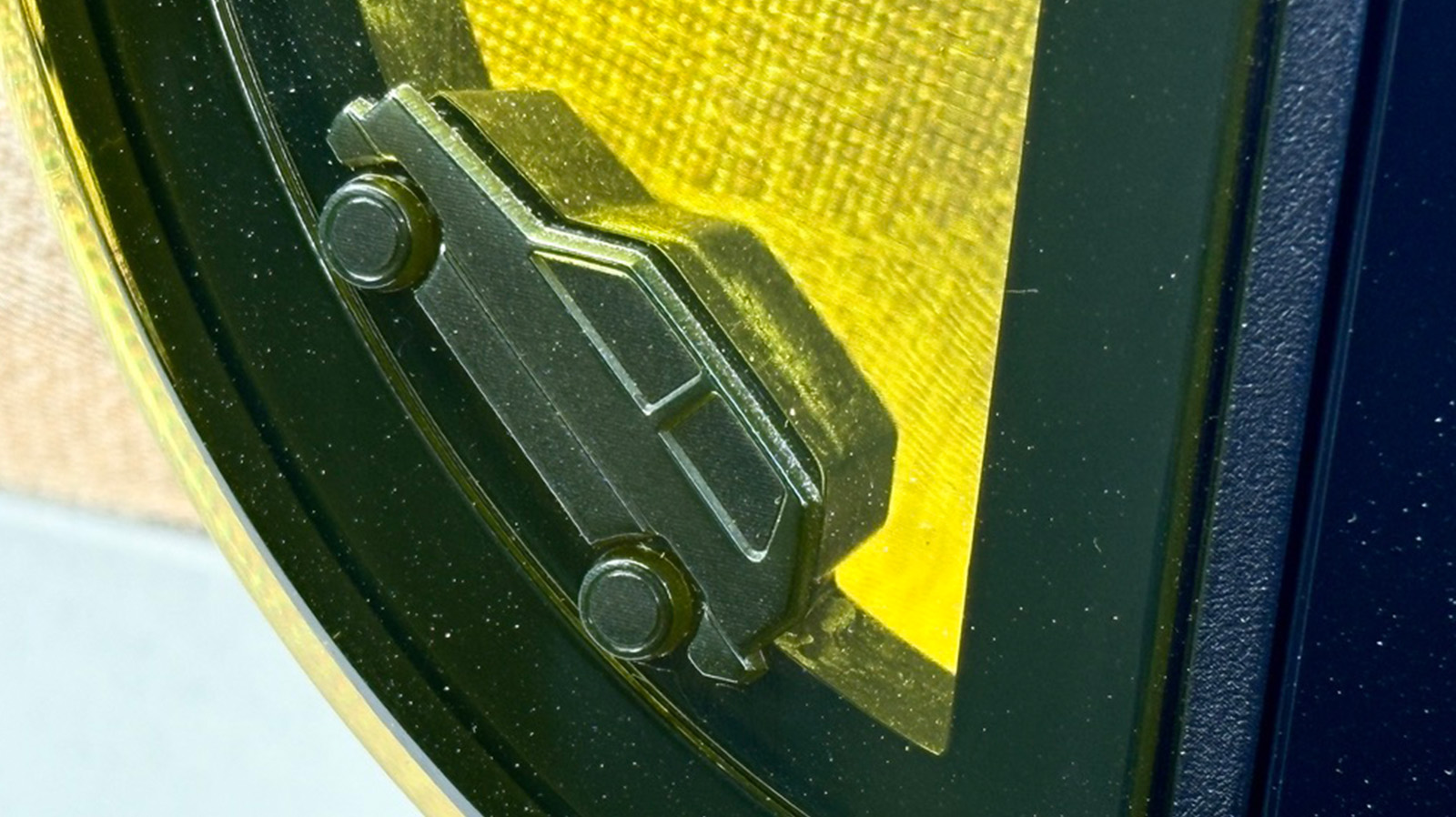
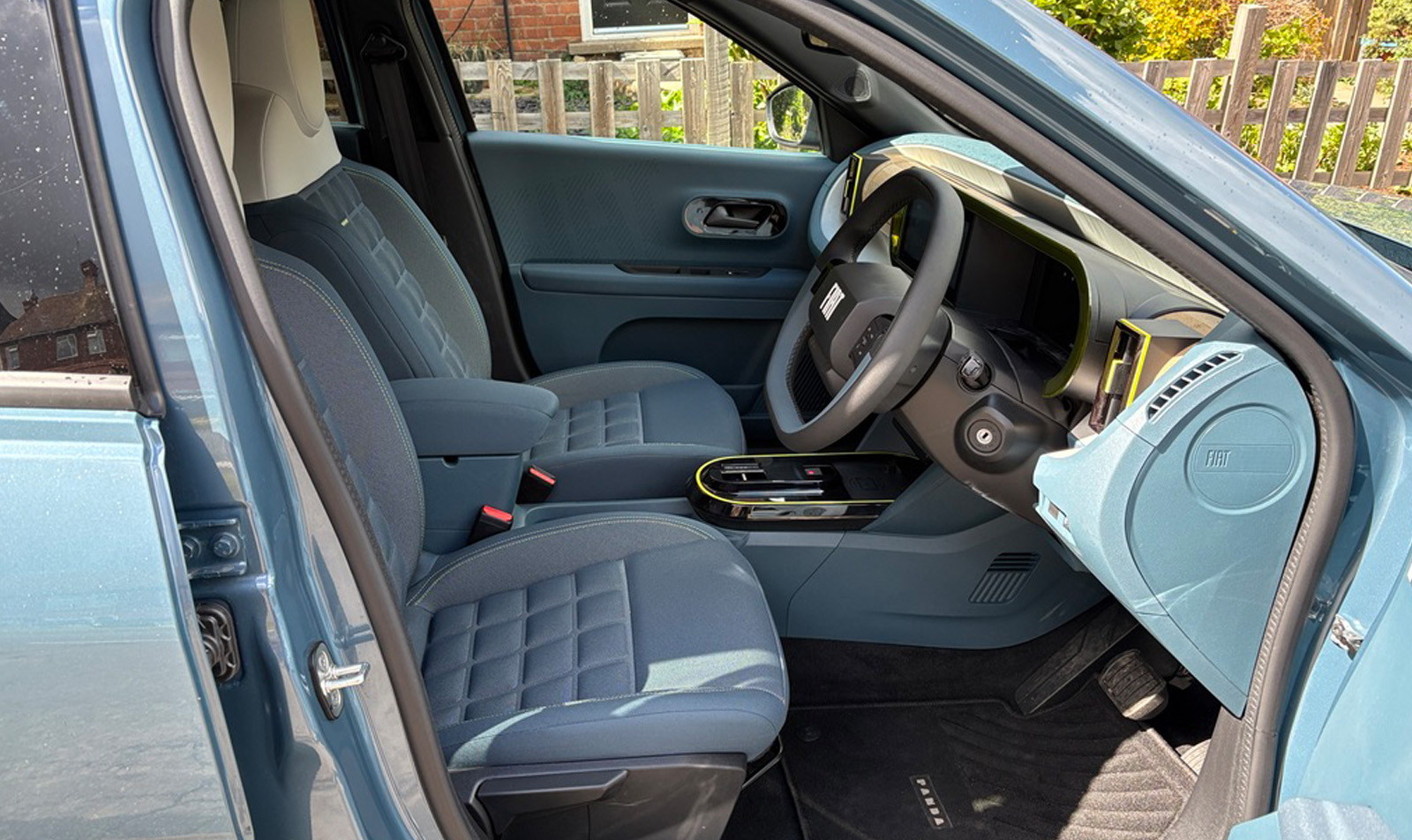
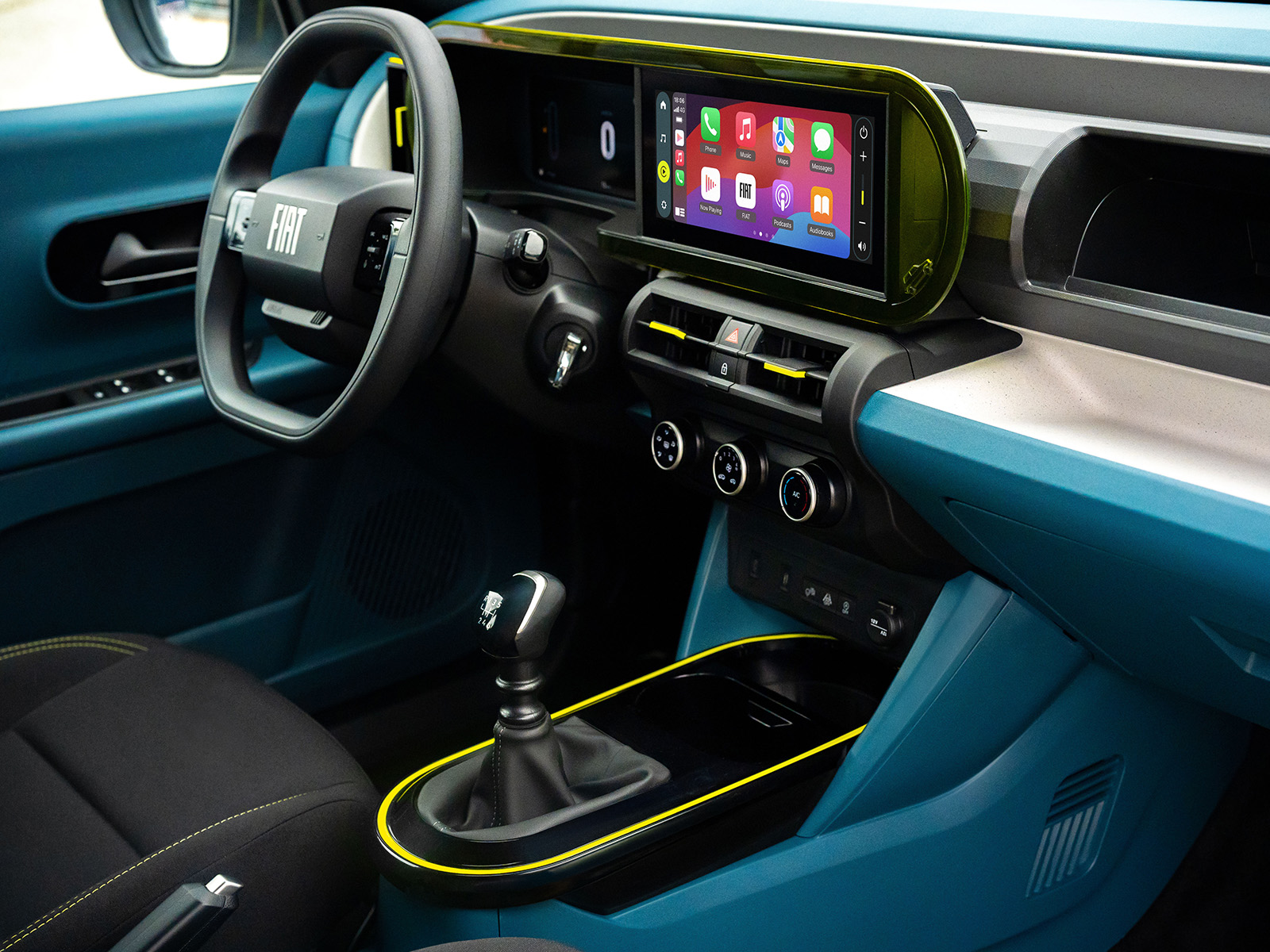
This fun attitude continues the inside as well, which is full of what us designer wankers call ‘surprise and delight.’ Your highlight color is neon yellow which contrasts well against abundant blue found on the seats and door cards, all made from recycled materials. A neon yellow clear panel wraps around the instrument displays and contains a tiny model of the original Panda. The rounded rectangle shape represents the test track on the famous Lingotto factory roof, and a similarly shaped neon yellow ring surrounds the center console and wireless charging mat. On the seat backs the words ‘Panda Made With Love In Fiat’ are written in same color, but the awkward syntax makes me think the interior design team woke up an actual Panda and let it loose on the keyboard. Even Italian models have the exact same text written in English; I didn’t expect Fiat to localize this little detail for every market but writing it in Italian would have been a bit more authentic. Running across the width of the dash there’s a sort of cylindrical bar, covered in recycled bamboo that contains an additional lidded storage compartment on the passenger side. With a storage shelf underneath, a conventional glovebox, capacious door bins, seat back pockets and center console storage there’s plenty of space to lose your rosary beads.
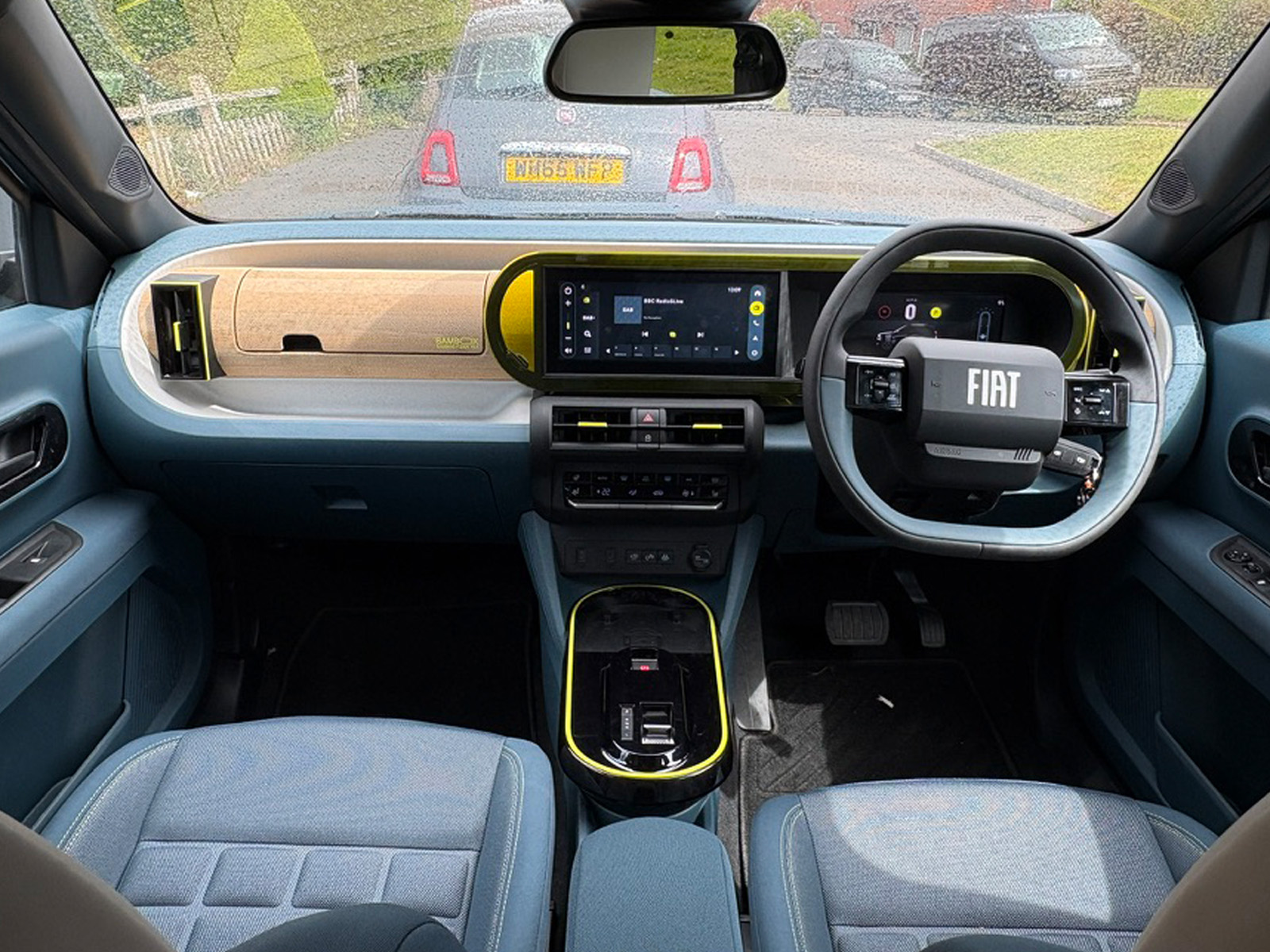
Remember my comments about needed enough space for my supermodel legs? Initially I struggled with the seat adjustment. Despite being tall I like to sit high in a car – something about subconsciously always enjoying towering over other people, I guess. Having the seat cranked up moved it too close to the steering wheel and left me with little to no under thigh support. Lowering the seat moved it back improving leg room and put the base cushion under my thighs better but left me lower than I ideally like. After a day or two it stopped bothering me–I was having too much fun to care.
Everything about the driving experience is just refreshingly straightforward–the controls on the chunky steering wheel are all haptic, as are the toggles below the center screen for climate, the heated seats and heated steering wheel. There are no confusing drive modes, no adjustable regen or daft added complication. The twin displays are crisper than a cold martini and cleaner than the thoughts of a nun. Being a brand-new car, the Panda has the usual EU mandated safety systems, but the Fiat is the first car I’ve driven where I didn’t need to turn them off – even the speed limit warning is completely unobtrusive. The only time they were slightly bothersome was waiting to back out of a parking space at the supermarket with a car right behind me. That was one layer of bleeping to which a second layer of blooping was added as punters walked behind the car, setting off the rear blind spot monitoring. Maybe the Panda was sick of my goth music and thought I should try some Italian disco.

Understanding The Design
The first time I clapped eyes on the Panda in the metal was at a Scramble at Bicester Heritage during the summer of last year. That car was a LHD base EV Pop trim with bright red bodywork and white steel wheels. It immediately struck me as just being a really funky, modern design – so much so that I went back later and took more pictures of it.
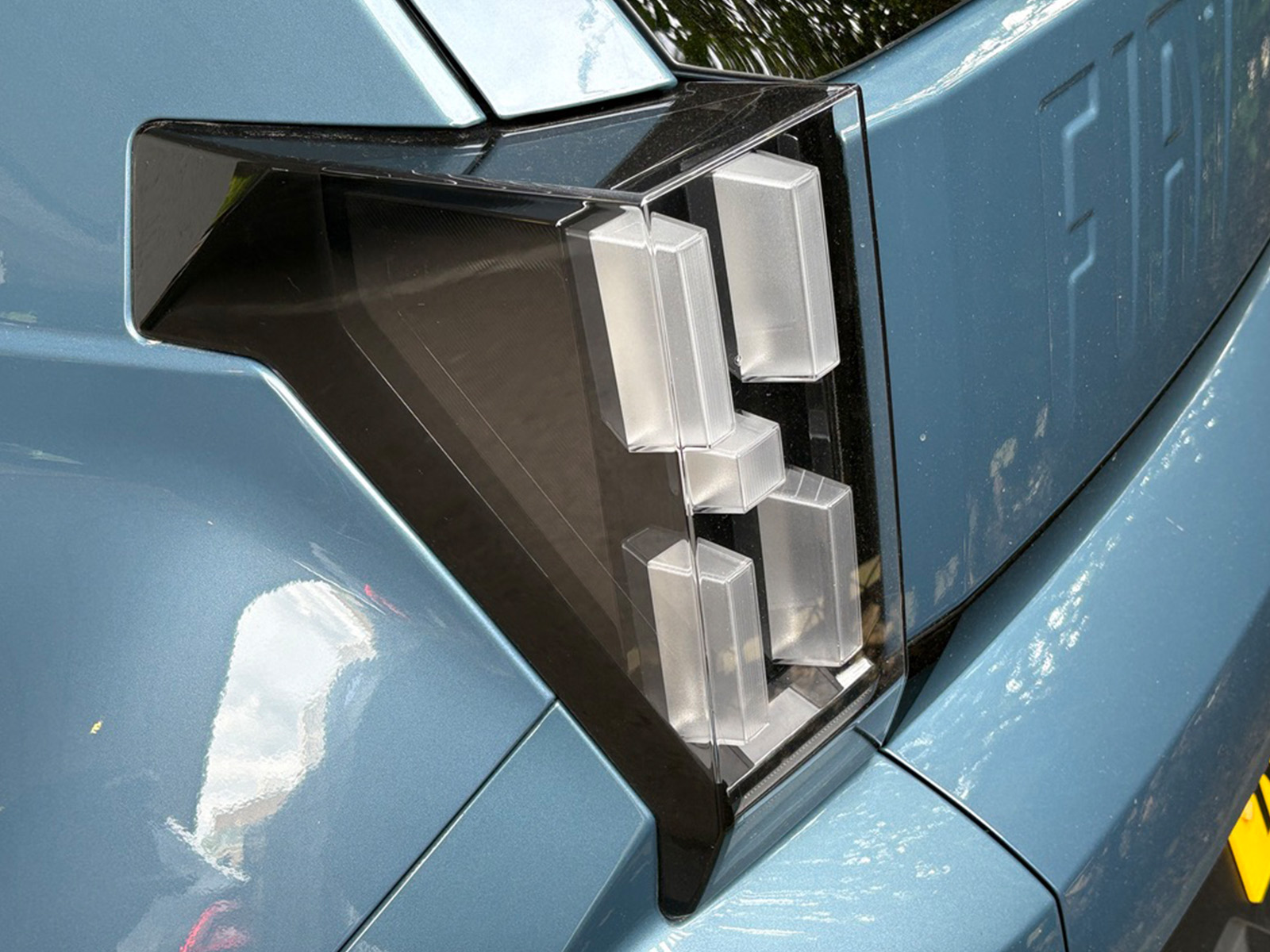
The main reason I think it all works so well is that it captures something of the original Panda’s virtues – its rugged simplicity, highish ride height and use of vertical space – without leaning into performative nostalgia. The cladding around the wheel arches and along the rockers helps hide some of the height and provides protection from bumps and scuffs. The sculpting of the bodyside allows the fenders to flare giving the car that wicked four-square stance – and what pain the designers went through to get PANDA stamped into the door panels I can well imagine. It’s a genuinely impressive bit of surfacing for something that’s going to be punched out by the hundred thousand.
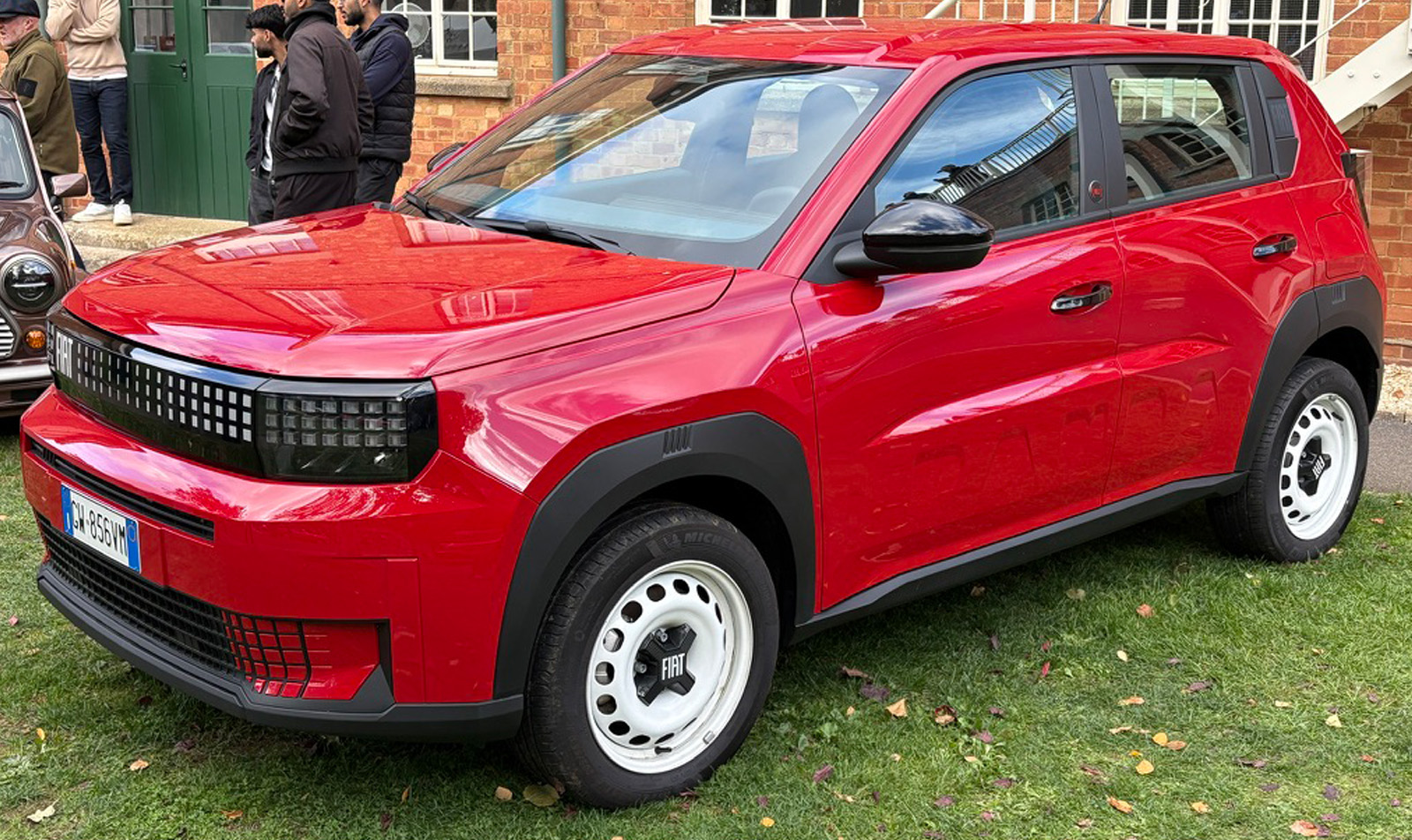
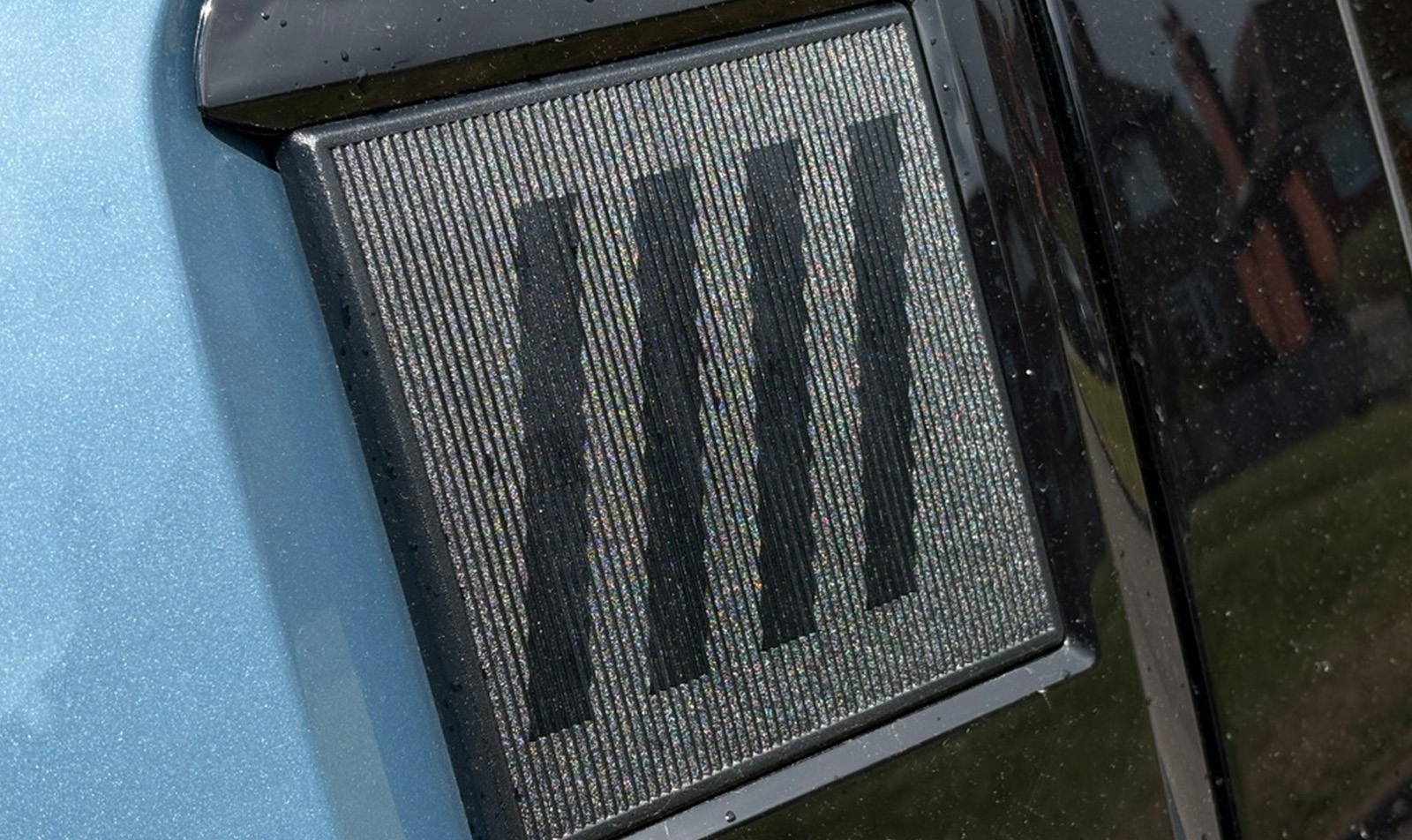
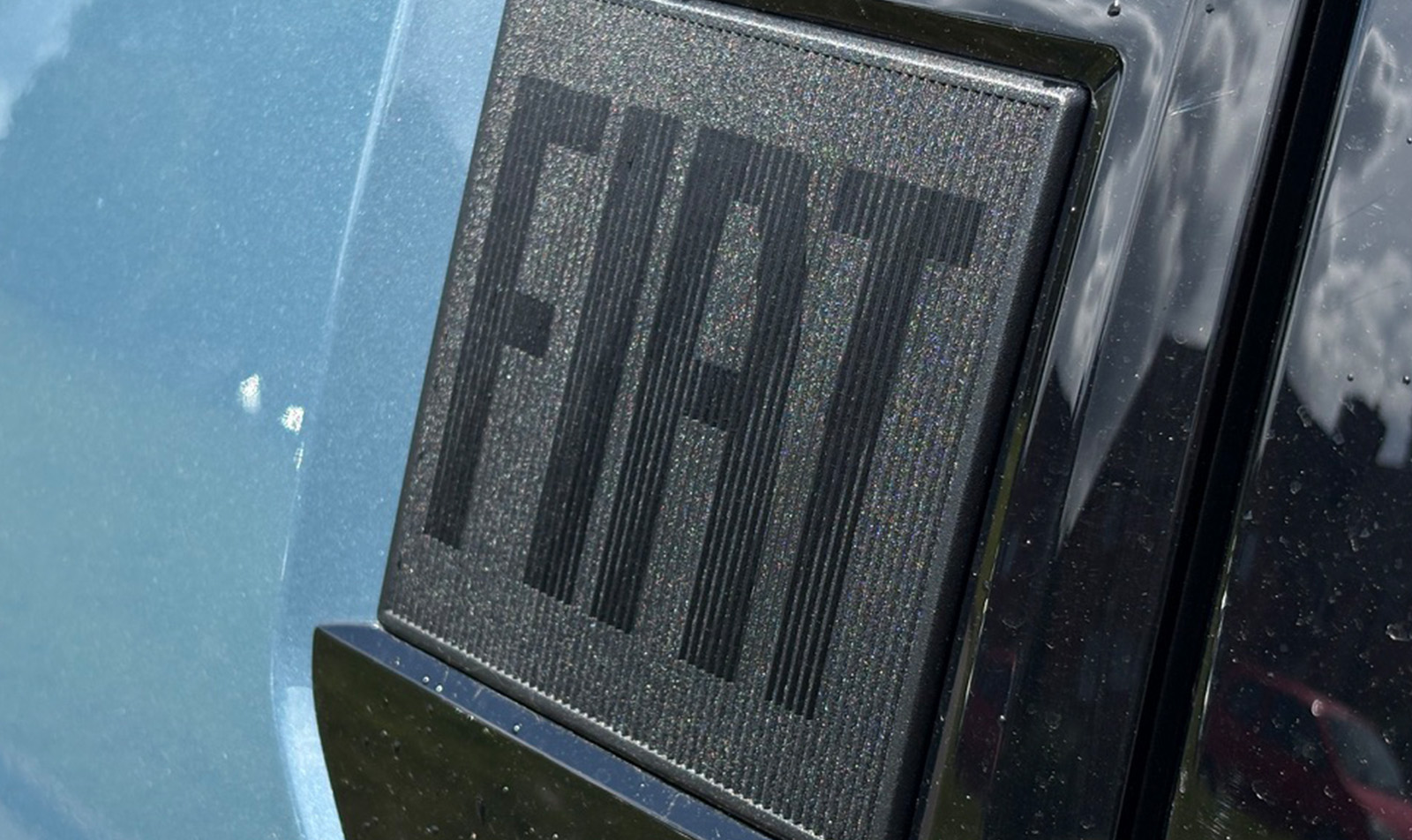
It would have been easy for Fiat Centro Stile to knock out a crowd-pleasing facsimile of the original with unpainted bumpers, naked steel wheels and ribbed bodysides but Fiat have already got the heritage angle covered with the 500. The 1980 Panda was modern Italian industrial design at its finest – and it’s the same thing with the new one. Someone online described it to me as ‘tiny Brutalism’ and I think that’s perfect. It’s a sharp rolling sculpture elevated by bold colors (Fiat has a ‘No Gray’ policy) and playful detailing – witness the lenticular badge on the C pillar that when viewed from one angle shows the classic Fiat four bar logo and from the another the FIAT wordmark. If I had one small criticism of the exterior it’s that it might be a little over-branded. The four bar Fiat logo appears 8 times, the Fiat wordmark 8 times and the word Panda 5 times.

I’ve managed to get this far into the review without mentioning the large French cockerel in the room so let’s get it over and done with, because the connection between the two cars runs a bit deeper than them being within farting distance of each other dimensionally and being modern interpretations of well-loved models from the past. They are both the work of one man –François Leboine. Another graduate of guess where – the Royal College of Art, he spent twenty years at Renault, seeing the 5 through to design approval before crossing the alps to Italy. Far from being a one trick pony, having reviewed both cars there is a clear difference in their identities. Despite being a fantastic design and a wonderful modern EV hatch, the 5 leans much harder on retro appeal than the Fiat does. Apart from that little 1980 Panda in the instrument panel, there’s nothing retro about the new Panda at all. Non-Fiat weenies are not going to get the Lingotto reference until the salesperson points it out to them. The 5 has a slightly more louche feel to it, both in seating position and general vibe. The Panda needed to be, by Fiat’s own admission, a pragmatic new hero car. It’s slightly roomier and has more trunk space than the 5 at 412 liters (14.5 cu ft.) although the EV model knocks that down to 360 liters (12.7 cu ft.). And of course the 5 is slightly more expensive and EV only.
What It Costs
The Panda I borrowed was, as the way press fleets always are, the top spec La Prima model. Putting this wheeled slice of Italian Modernism on your drive will require smashing the piggy bank open for a paltry £21,995 ($29,582 as of Thursday afternoon) including all taxes and delivery to the dealer. The free standard color is Limone Yellow – all the other hues are £650 ($874). Drop down to basic Pop spec and you lose the alloy wheels, roof bars, center console, heated seats and steering wheel, and the recycled bamboo trim on the IP is swapped for darker stripy fabric and the seats have a black material – both of which I prefer. You also have to suffer without front parking sensors, rear blind spot monitoring, a rear parking camera and the automatic climate control is ditched for old fashioned cooker knobs (although you still get air conditioning). That version costs £18,995 ($25,547) and my suspicion is at that price, this basic model is the pick of the range. Additionally, there’s a mid-range Icon trim slotting in-between top and bottom at £19,995 ($26,892). There are no option boxes to tick other than color.

I’ve said it before, but the Fiat back catalog is bursting with bona-fide small car classics. They’ve revolutionized the prosaic Euro small car many, many times over. The passenger car is a much more mature product now, so such packaging and mechanical revolutions are not really possible, but what Fiat have done is taken all that knowledge and flair and given us a brilliant new small hatch perfectly attuned to the needs of the 21st century European family car buyer. It’s superbly easy to use, unburdened with superfluous features, fun to operate, splendid to look at and crucially cheap to buy and run. More than that it adheres to the classlessness of the original car, cutting straight across socio-economic boundaries. My car designer mates all loved it, and I could have sold the Panda probably four or five times on the spot to members of the enquiring public. But none of this is the best bit.
Remember I teased you earlier on in the review? On the continent there’s an even cheaper version available. It comes with a pure petrol powerplant and a six-speed manual gearbox. And it’s coming to the UK.
That I cannot wait to try.
Authors note: It will not have escaped your attention that my output on these hallowed pages has not been as prolific in recent months. This is by design. Don’t worry. It isn’t, as it has been in the past, for medical reasons – thanks to the miracle of modern pharmaceuticals I’m currently feeling better than ever.
Over the last four years or so I have very much enjoyed writing long-form articles for you. The problem is those pieces take a lot of time, effort, research, networking and planning to put together, and over the last six months or so all that has become, for various reasons, much harder to do. I also realized quite some time ago that my glittering media career was not going to take off in the way I hoped it would when I started in this torrid business, and that my life needed more stability in every sense of the word. To that end I took a permanent job teaching automotive and transport design at Coventry University (it had previously been an ad hoc arrangement), which I started back in February – and it’s something I enjoy very much.
In future you won’t be seeing as much of my writing here as you have done in the past, but I will still be popping up from time to time; to quote the immortal Hugo Drax “with the tedious inevitability of an unloved season”.
Thank you for all for reading, your kind words and support over the last four years.




Adrian! First, great review. Someone mentioned that they wouldn’t think to give this thing the time of day considering the state of Stellantis these days, and that this review was a pleasant surprise. That sums this one up for me.
Second, oh man I will miss you! Can I take your quote to mean that you will be doing 4 articles for the Autopian per year? None of the four seasons is universally beloved after all.
Wishing you all the best
I’m not searching for a new car, but I was considering the new Panda just another Stellantis rehash. Until I read your article, for which I thank you: glad to know the car is not just the umpteen dreadful Stellantis Tavares era clone.
Too bad it’s made in Serbia and somewhere else, not in Italy.
But here in Italy we’ve lost p pretty much all automotive high volume manufacturing, anyway…
All the best to you.
Thank you Adrian for all of your wonderful writing here, and best wishes to you!
Wow. Best to you Adrian, as your writing is very entertaining and often educational.
I envy you the rich palette of cars you have access to and opportunity to explore compared to here in the States.
In France back in 2005 or so, we rented a diesel, stick-shift Peugeot 307 wagon for a few days, loved it. And saw Citroen C4 Picassos and wanted to bring one of those back as well.
Two years later, we rented a diesel, manual, Fiat Croma wagon in Italy and loved even more. And well, the Panda has come a long way since then. Our friends rented a gas one when we were traveling together, and what they saved on the rental, they paid for in fuel. And we had their luggage in the back with ours.
So, two relatively plain vehicles, but so well done. Here, I have a V6 Accord, which seldom sees its right foot pedal get half-way down. It delivers pretty atrocious fuel economy wafting around at barely idle around town, but on long drives at 70+ mph, it gets nearly 40 mpg (US gallons). And has almost ridiculous amounts of reserve power when needed.
But this Panda looks so cool. I’m waiting for Jason’s take on the taillights. And there are, to my eyes, some other very interesting design features. Not that we’ll get to seem there here. For another 20+ years as exempted imports.
Anyway, best wishes and my spirits will be lifted seeing a contribution with your byline atop it. Take care.
Thank you.
Maybe drop us a post sometime when you have no class.
No class? Adrian’s a classy guy! I’ll continue looking forward to his posts; this one is great. It’s too bad we won’t see this Fiat model in the U.S.
Paraphrased Rodney Dangerfield quote from Back to School.
Ok, now its time for an EV Multipla!
There is one. Search online for ‘Ferrari Luce’
I like the Luce, but it’s not nearly practical enough to be a Multipla.
My dad had one Multipla that we used to borrow for the family holiday. You couldn’t beat it for family practicality.
I don’t think he’ll buy a Luce though 😀
I think they juuuuust missed the utility/dollar (euro?) ratio there. LOL
another reason to snag an apartment in Europe. Regarding your articles: They are so good and well written that a few a year is probably more than we deserve. Not sure about the Goth music though, but then I am old.
The problem is you’re not playing The Sisters of Mercy loud enough.
as a fallen Catholic with 12 years of nuns, that bands’ name is triggering. Happy Reform Jew these days with Panthiest proclivities. Florence + The Machine for me.
Hey Now
Hey Now Now
“I love corrosion on Jeeps” – David singing along.
I’ll be sorry not to see as much of your writing, for sure. Good luck with academia, and I hope the high heid yins at said university are not as dickish as some I’ve known. Try not to make TOO many people cry 😉
Too late. I already made a student cry a couple of weeks ago.
Well, fuck.
Congrats on the new career, I’m glad you’re enjoying it! I’ll miss your articles here.
Spaghetti bolognese in a real Italian restaurant in Italy? That’s hard to believe. They normally make that only for tourists. Bolognese (or “ragù”, as it is properly called) is too heavy for spaghetti. Tagliatelle or papardelle match it better.
Yes it was spaghetti ragu.
I don’t want to be excessively picky here, but leaving the eternal discussion about ‘you can’t have spaghetti bolognese because real Italians only have tagliatelle or pappardelle with that’, in my humble but educated Italian born and raised opinion the really important thing is this:
Never ever say ‘spaghetti bolognese’ (or tagliatelle). You must absolutely say ‘alla bolognese’ or ‘al ragù’. Don’t forget the accent on the ù.
Besides, ‘gn’ in Bolognese is like the ñ sound in Spanish, and ‘gl’ in tagliatelle is like the ‘ll’ sounds in, again, Spanish, both being unknown in English I reckon.
You know. When there are no tagliatelle in the cupboard and the ragù is waiting, we may replace them with spaghetti at home. But like most family sins, they are kept within guarded walls.
Every day is a school day.
If they want to keep selling Fiats in America, maybe they should bring these over? It looks like exactly the car everyone should be driving.
They’d need to double the power, because anything that size with fewer than 200hp is dangerously underpowered. But only here.
I think the EV or hybrid probably punch above their hp numbers indicate, and it’ss plenty to get up to highways speed, if a bit languidly.
My Impreza does fine with 145 naturally aspirated hp, and is definitely longer than the Panda.
Trust me, I’m with you, my Mazda3 has 152 hp and our chubby Outback is the smaller 180 hp engine. But there are plenty of people who would find them completely unusable.
And the Panda’s weight is comparable to my Mazda, but with nearly 50 fewer hp…people would bitch.
I’d happily drive it though, especially with a manual.
I suspect people who want a ton of hp aren’t the target market for the Panda anyway. Lol
My old 95 Outback had a 2.2 and less power than my Impreza. I’m definitely glad I didn’t have more than that when I was doing silly stuff with it in HS.
Good point!
200 is overstating it, but I agree it would need more power.
*Snickers*
Starting a petition to make yellow the only free color for all cars from now on.
Sad that we won’t be hearing from you as much in the future, but glad the site had you while it did!
I’ll sign onto a petition for any color other than greyscale.
I’ll sign just for the chance that any car is offered in some form of yellow
I understand that the simple charm of the original would be a hard sell today and having to update it is non-negotiable, but the styling on this is a whole mess of noise. It triggers me the same way as trying to buy clothes that aren’t slathered/littered with logos. You want my money? No logos. You want me to be your billboard? You pay me rent. I don’t work for free and I have my own identity, I don’t need yours.
The rest of the packaging and size is near perfect though. This is a great example of good design/bad styling.
Same with me, I don’t wear stuff that is branded or has logos on apart from my Air Max 90 sneakers (black and grey colorway, natch). I have some t-shirts with printing (e.g. the black NASA one I got from KSC) but no corporate stuff.
One of my car designer mate said it was over branded, and while I agree after a couple of days I didn’t notice.
In one of my previous incarnations, I received a lot of tech swag, and I only wear either black T-shirts or ones that advertise dead products and companies. Or bands my son or his friends are in. Never a brand of clothing.
I love the interior, but the teeth marks on the wheel arches are perplexing, and the area between the wheels on the side is alarmingly bent. I suppose if you don’t wash it, the name of the car will become easier to read on the side, which is cute. Subtle encouragements to consider washing the car or not are laudable.
I have quite enjoyed your writing and the way you present your thoughts. I hope your students appreciate you as much as I have. I am sure you will be a great teacher. Who is taking over as the loveable curmudgeon? Pop in often enough to keep the sadness of your absence fresh and all that.
Thanks for another fun read of Adrian-isms.
Pity I’m not able to craft a more elegant and fun collection of words to praise your Autopian articles, though.
Best to you with the students. And, don’t be a stranger….
Cheers
You mean stranger than I already am.
Touché.
I really enjoyed reading your articles every time Adrian and it was nice to have someone catering to the European readers as well. I am glad you get to do what you like and I sincerely wish you the best. Fuck you sideways for leaving though.
I have repeatedly been fucked without having been bought dinner first. Getting fucked sideways would make a pleasant change.
I will put the kettle on..
Being a Yank, your articles aren’t always the most relevant to me. But as an ardent past watcher of BBC America (before cable TV prices went loony), you have been “my goth, auto-designer Alan Rickman (RIP).”
What I mean is that while I have my doubts that you would be the soft, huggable teddy bear persona that Sir Rickman apparently was when off-camera, your acerbic wit makes absolutely every one of your pieces appointment reading.
Will certainly miss your output, but ’tis far better to get the occasional pop-in from our favorite uncle than to have to go entirely without.
As for the Panda, 2900-ish lbs doesn’t seem bad to me for a modern car. This is only about 100 lbs more than the GC8 Impreza that I loved throwing around curvy roads near where I live. As long as the steering is somewhat communicative (but not too much – it makes the hands sore after long bouts of highway driving), cars in this weight class can be a fun hang.
I’m an absolute fucking delight in person.
Looks kind of like an R3 at a third of the price. I like cars with a personality. As long as I like the personality.
Thank you Adrian for your articles. I really like
dyour bluntness and your complete unwillingness in compromising your opinion. I think I agreedwith your views on car design as many times as I disagreed, but I consider that a good thing. I hope you will enlighten your students in many ways and that they may be provoked to total frustration by your strong opinions. (edited, I hope you stick around for a long time. You really fit here)As the former owner of an SX4 (also a Fiat Sedici) I would love it if Stellantis would actually bring you know, a sellable Fiat stateside, and the Panda would be the obvious choice. If they’re not going to do that, they might as well withdraw from the US.
I hope this reaches the local market here, there are few choices for small hatchbacks here, Kia Picanto or Mitsubishi Mirage, i prefer this Fiat.
Also, good to see you Adrian 🙂
The red one looks better.
The teal one has way too much Greeblling.
They all have the same amount of greebiling, but the red one doesn’t have roof bars or the skid plate.
They were losing me with all the little addons like the car in the window and the lettering on the seats but pulled me right back in with that steel-wheeled base model.
The gridded squares everywhere made me think it was a Hyundai.
I still want it.
Make mine a 6 speed manual.