

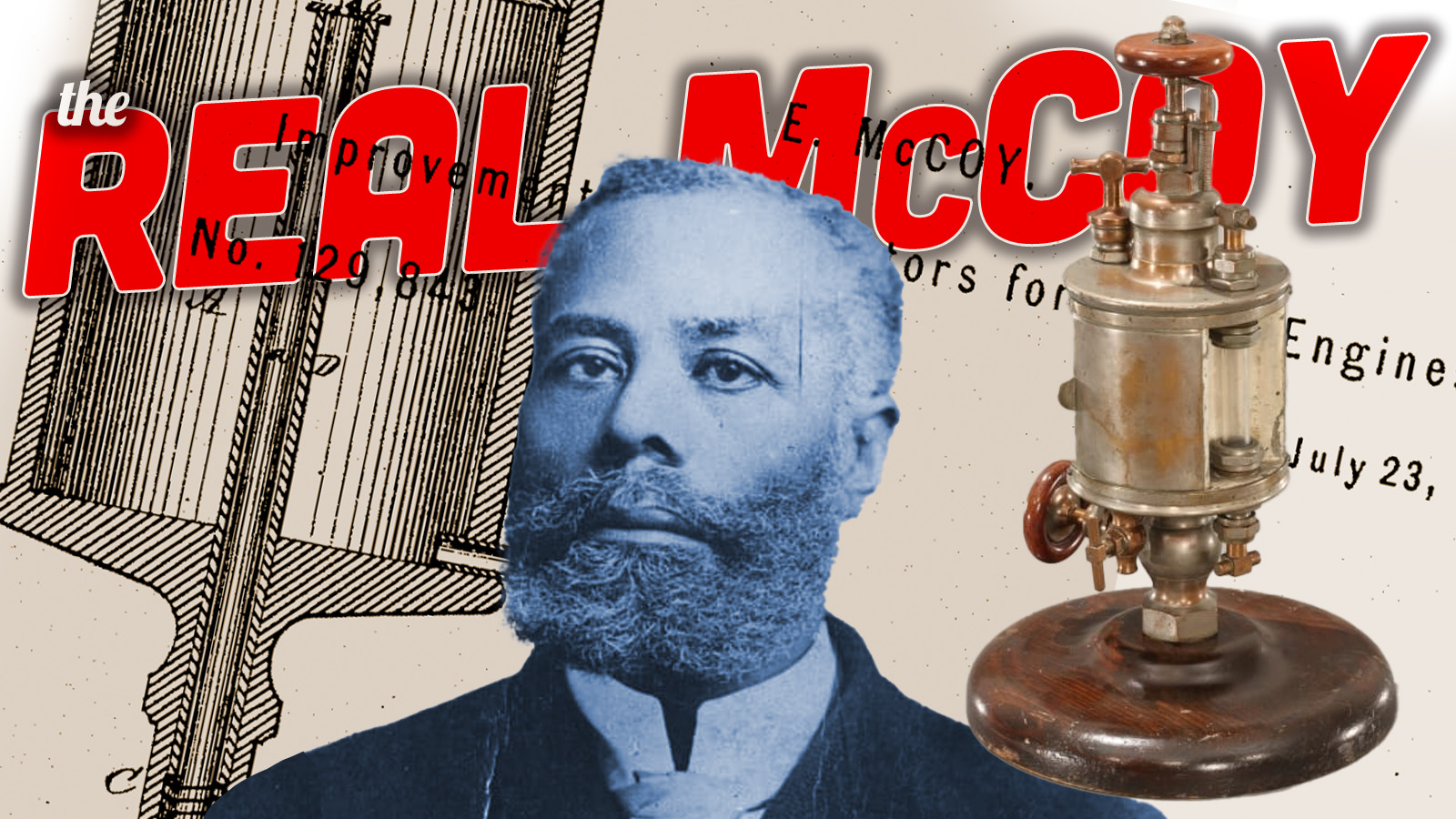
Have you ever used an expression or idiom and then taken a moment to actually listen to what you just said? And then noticed that, hey, I have no idea where the hell that expression comes from? I feel like I do that a lot. Or, alternately, I’m just simply wrong about the origin of some expressions. For example, I always sort of assumed “look a gift horse in the mouth” had something to do with the Trojan Horse, a very famous gifted horse. Of sorts. But it has nothing to do with that. It has to do with actual, literal horse mouths and the damp horse teeth within.
This recently happened to me with another expression, when things are referred to as “the real McCoy,” but this time I was just ignorant, not wrong, and was happily surprised to find that the origin of the expression happened to have something to do with mechanized transportation systems, which means I can use it as something to write about here on this very site. And, even better, it’s all thanks to a Black inventor, and it’s still Black History Month, which means it’s even sort of timely, or at least as timely as something 154 years old can be.


The inventor was a man named Elijah McCoy, and the invention was one of the first automatic oiler mechanisms for locomotives. You see, the early steam engines that powered railroad locomotives lacked any sort of automatic lubrication systems. This meant that on almost any journey by train, stops would have to be factored in to allow engineers the chance to lubricate all of the moving components of the engine so that friction wouldn’t cause everything to just melt into a huge smoldering pile of iron slag. The usual distance that a train could travel between stops for inspecting and oiling bearing surfaces was right around 100 miles. So, if we assume that train speeds of that era were around 30 mph, then we’re talking stopping the entire train every three hours. Given the distances of rail travel, especially in America, this is an awful lot of stopping, which meant longer travel times and a loss of time and money for everyone.
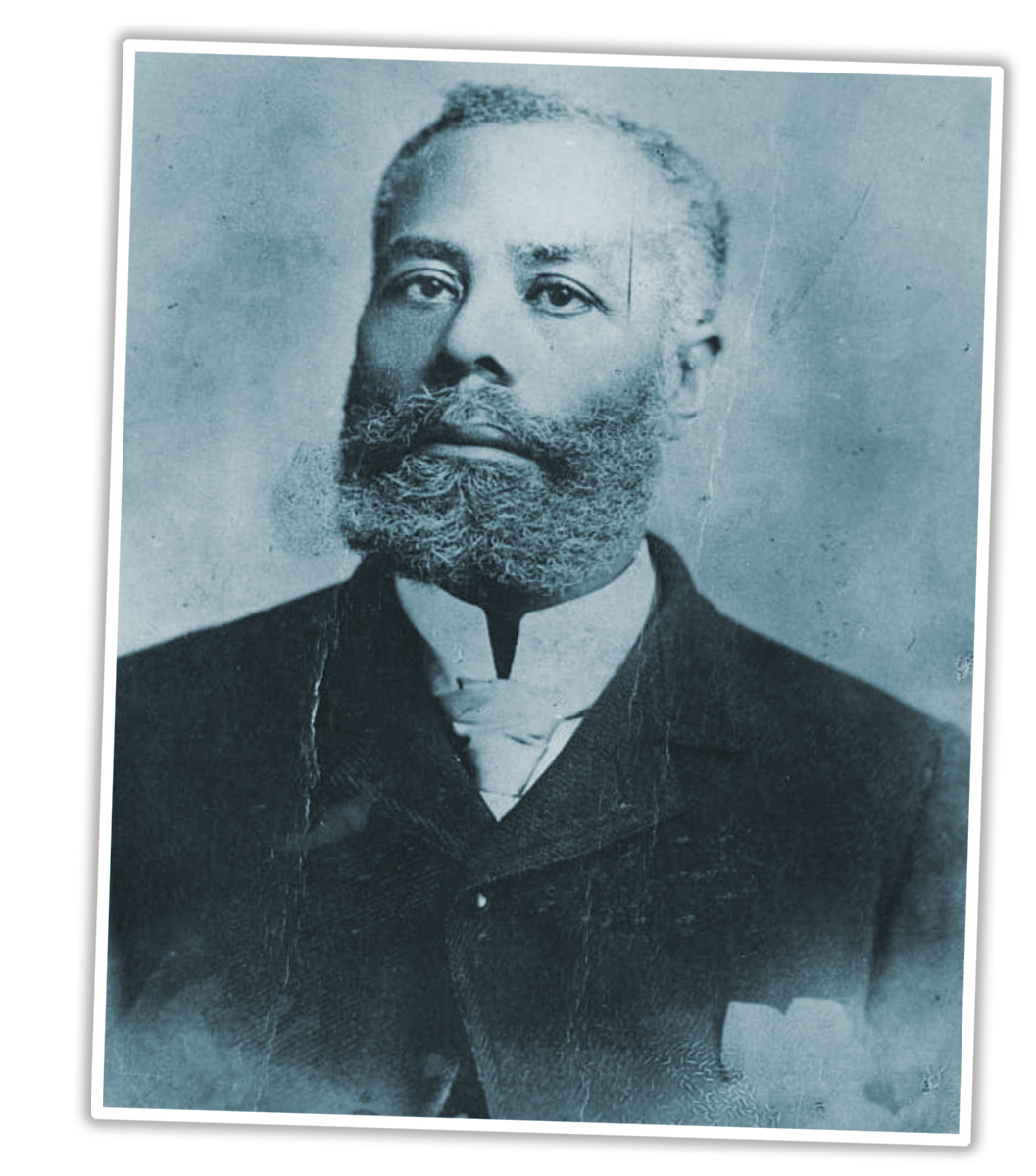
As you can imagine, a system that oiled these complex machines automatically, without requiring regular stops, was a very big deal.
Before we get into the details of the oiling system that would eventually bear his name, it’s worth recounting a bit of Elijah McCoy’s early life, because it’s an interesting journey. He was born to parents who escaped slavery in Kentucky via that famous metaphorical railroad, the underground one. They escaped to Ontario, Canada, where little Elijah was born. In return for enlisting in the British army, his father received a land grant.
Eventually, his family made it back to the United States, settling in Ypsilanti, Michigan, where he found himself fascinated by machinery. He was able to go to engineering school in Edinburgh, Scotland, and when he returned, he got a job working for the Michigan Central Railroad.
At that time, the railroad did not allow Black people to be engineers, so McCoy got a job as a fireman and lubricator, which was hot, sweaty, difficult work that put him in very direct and protracted contact with the workings of the locomotive. It was during this period that the need for some sort of automatic lubrication system became apparent to McCoy, and so he applied his considerable intellect to the problem.
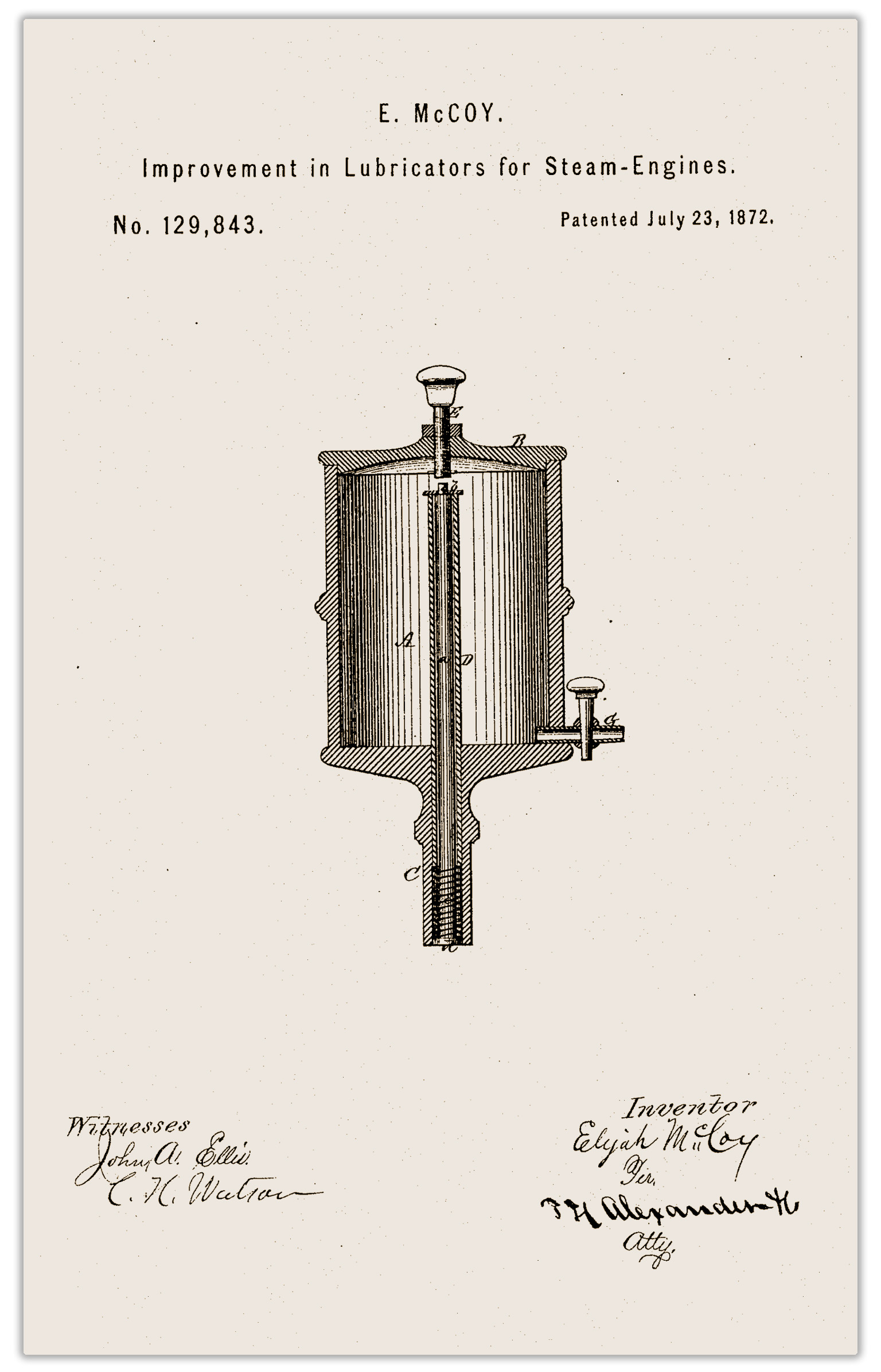
In 1872, he came up with an ingenious solution that used the steam pressure of the engine to help deliver the oil to where it was needed. Here’s how the patent describes the mechanism, illustrated above:
A represents the oil-cup, provided with the cover B. In the center of the bottom of the cup A is a downward-projecting stem, 0, to be screwed into the place where the lubricator is to be used. This stem is hollow, and from the same extends a tube, D, through the center of the cup. Within this tube is a rod, 1, having a valve, b, at its upper end above the tube D to close the same, and at the lower end is a piston or disk, d, within the stem 0. Around the lower end of the rod a, between the piston d and a shoulder in the stem, is placed a spiral spring, a, which forces the rod down, so that the valve b will close the upper end of the tube D and prevent the passage of the oil.When the steam presses upon the piston the valve rises and allows the oil or other lubricating material used to pass out.In the cover B is a thumb-screw, E, directly above the valve 1), by means of which the flow of oil may be readily regulated. At the bottom of the oil-cup is a faucet, G, for the purpose of drawing oil the condensed steam when necessary.
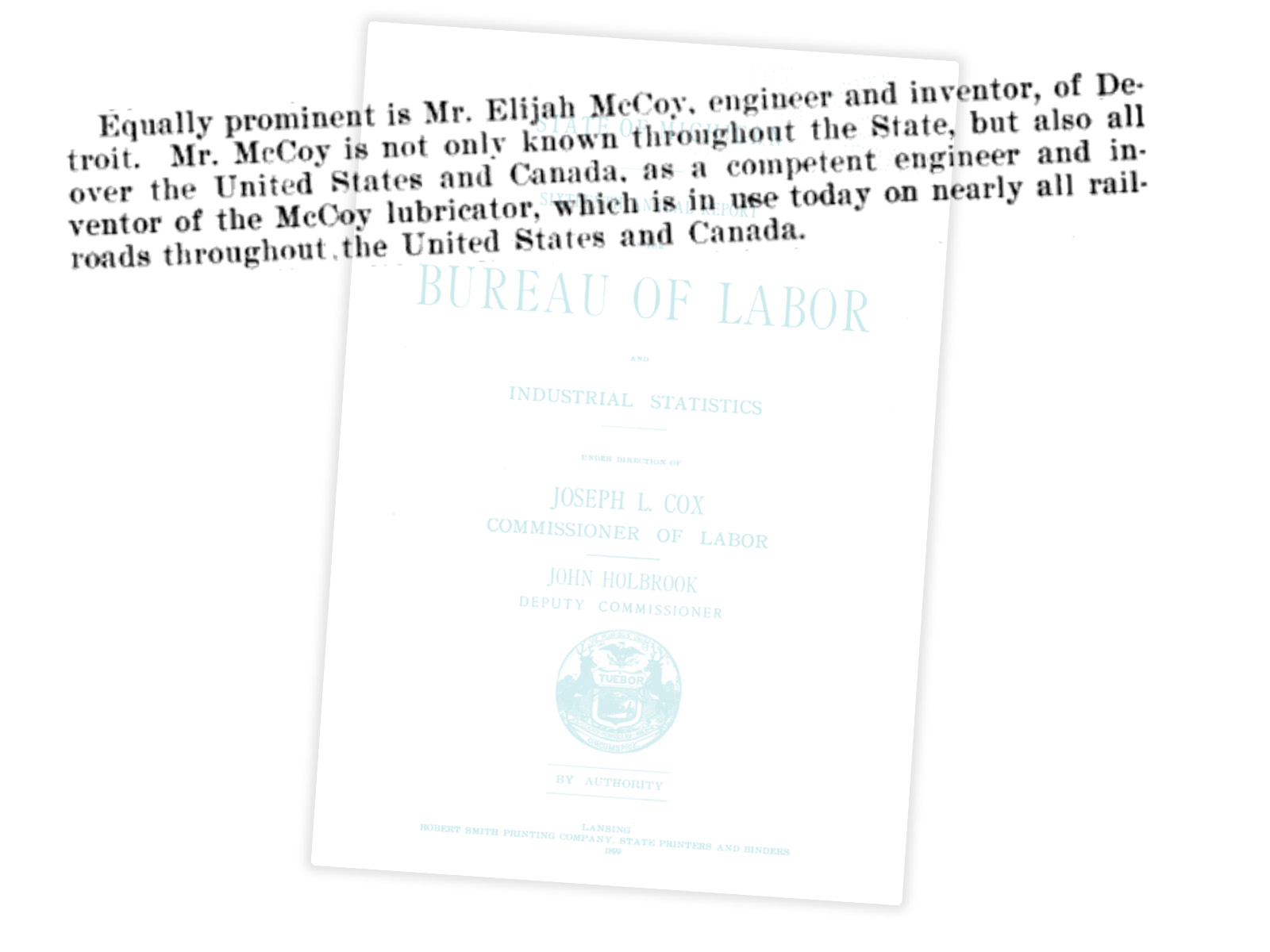

The widespread demand for such an automatic oiler and the relative simplicity of the design not only meant widespread acceptance, but also widespread copying of McCoy’s basic design. Knockoff automatic oiling mechanisms were rampant, but the original Elijah McCoy design was so much better than these Victorian-Era-Temu knockoffs that railroad engineers and mechanics soon began to demand the original ones – the “real McCoys,” if you will, which you will indeed, because that’s where the expression comes from.
Railroad workers were demanding the real McCoy so often that the phrase got picked up into the greater cultural lexicon, where it came to mean anything genuine and of real quality. That’s a pretty impressive cultural impact for a railroad engine oiler.
Here, don’t take it from me – here’s someone from the Oil Museum of Canada explaining it as well:
I know you’re already likely flooded with Oil Museum of Canada content in your various social media feeds, but I hope you’ll just accept one more. There are some actual examples of oil-drip cups there and, yes, they’re the real McCoy.
Now, I know what you’re thinking: if this guy was such a big deal, why hasn’t he been in an ad for booze? Oh, you sweet simpletons, he has! Look:
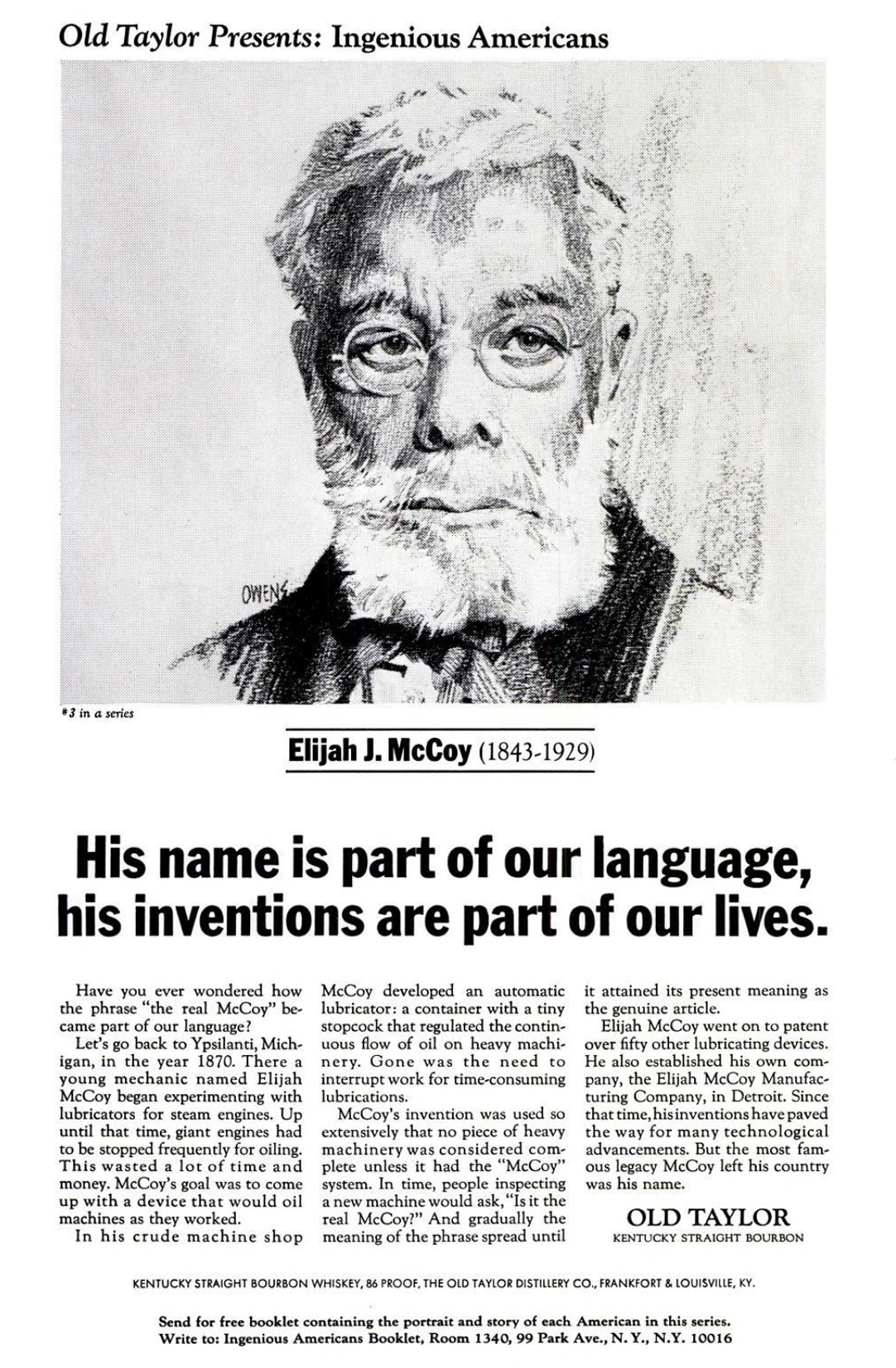
Yes, Old Taylor, what seems to be usually described as a “budget-friendly” bourbon, once featured McCoy in an ad! For most people, that would be how you knew you actually made it, but I think for McCoy, revolutionizing a nation’s transportation industry and inspiring one of the most enduring idioms probably eclipses the booze ad.
Top graphic images:


I learned something new today.
Thanks, Torch!
Hey, cool shout out to Ypsilanti! Other famous former residents included Preston Tucker, and Ypsi is currently the home to the Boggs’ gas station home of Boggs’ Famous Soup and Boiled Peanuts!!
Not to mention the best dang chili dogs and homemade root beer I have ever had. I mean, I’ve had better chili dogs elsewhere, but the root beer really elevated the experience.