

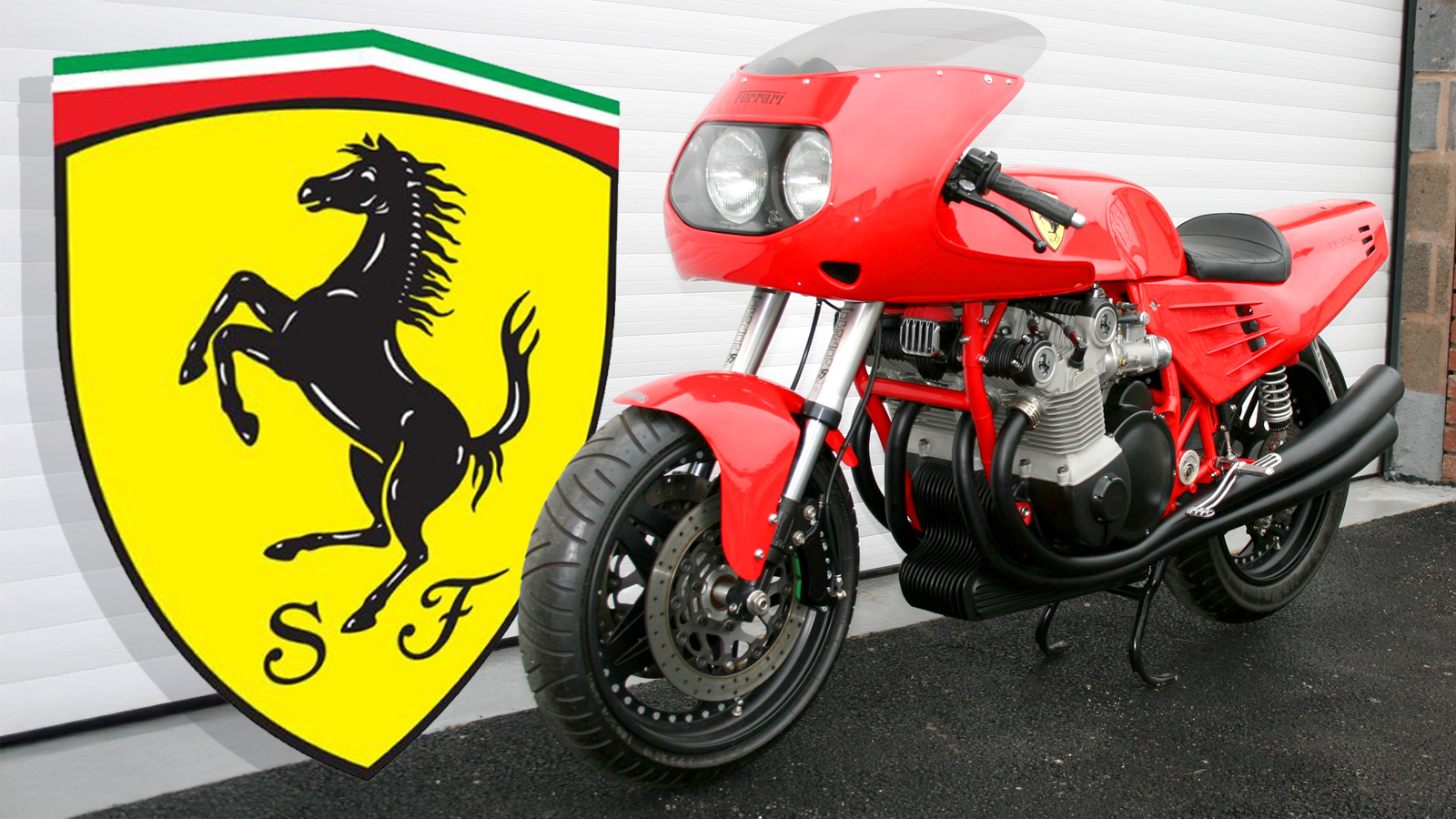
Ferrari is known for many of automotive history’s hottest cars, from the 250 GTO to the 458 Italia. Most recently, Maranello tapped Apple’s famed Jony Ive to design an interior. But Ferrari has never built a motorcycle, nor has it ever successfully commissioned someone else to build a motorcycle. There is one lone exception. This is the 1995 Ferrari 900cc, a crazy motorcycle that took over 3,000 man-hours to build and is the only bike ever officially allowed to wear Ferrari’s color and badging.
Ferrari is infamously protective of its brand. This is an automaker that has a reputation for sometimes suing its own fans for modifying their cars or using their cars in a way Ferrari believes violates its trademarks. Ferrari even sued a charity for the Purosangue name, even though the charity had the name first. Even if Ferrari doesn’t sue you for what it believes to be a trademark violation, its dealers may blacklist you from buying a new car.


If you want to buy a limited-run Ferrari halo car, you sometimes have to be an existing Ferrari owner and prove that you’re loyal enough to be deserving of giving Ferrari your money. Doing this allows Ferrari to curate its brand image.
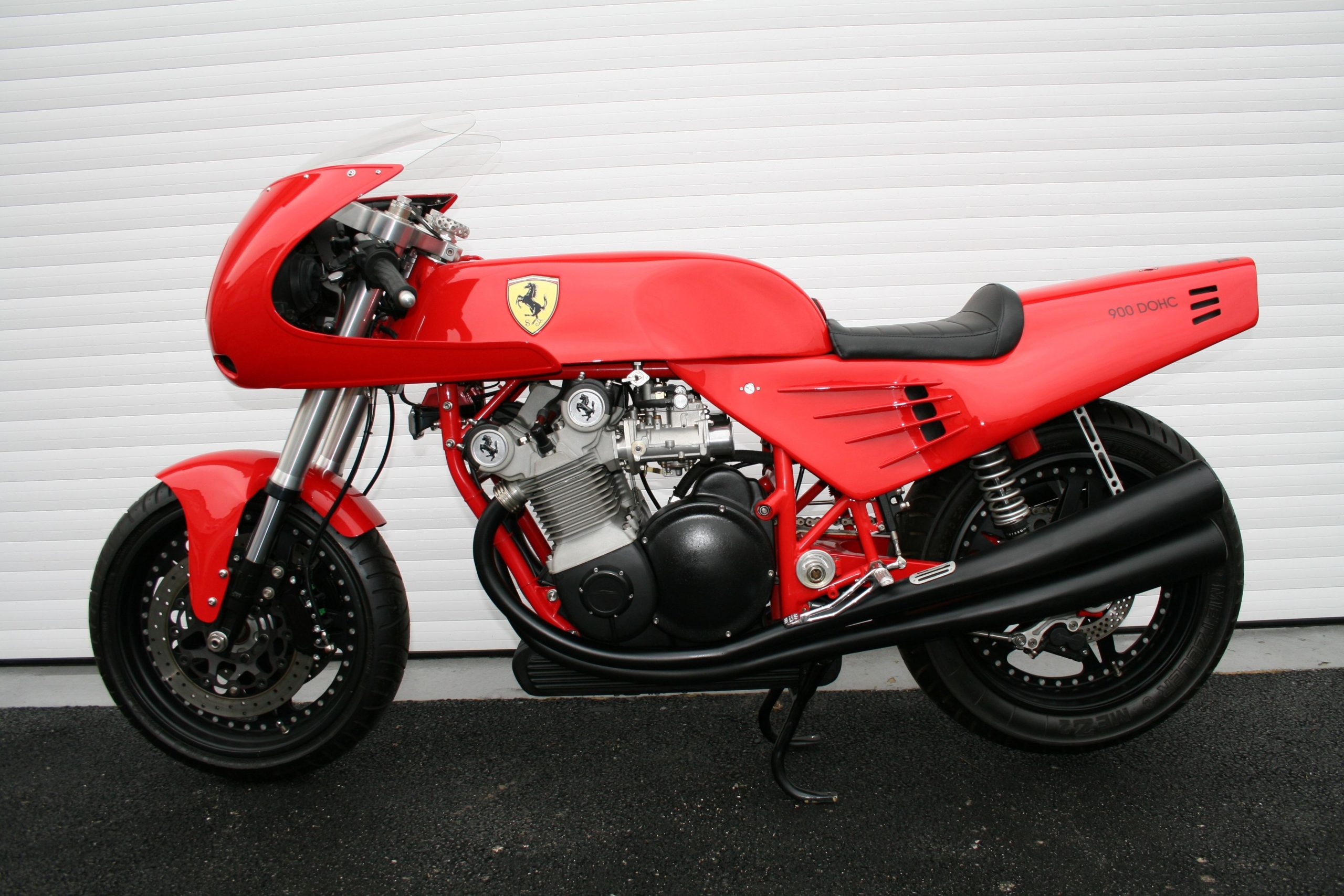
All of this is to say that it’s a big deal when Maranello doesn’t just let you build something with the trademarks of Ferrari, but also gives the project an official blessing. That’s what happened when David Kay reached out to Ferrari for permission to use Ferrari branding on a motorcycle he was building. The ‘scratch-built’ Ferrari 900cc would become the first and only motorcycle to proudly and officially display the legendary prancing horse logo on its tank. But it is far from the only motorcycle in Ferrari’s rich history.
Enzo Ferrari Loved Motorcycles
For many enthusiasts, Ferrari begins around the time when the enigmatic Enzo Ferrari sold and raced Alfa Romeos. The story about the founding of Ferrari has been told a million times, and if you haven’t heard it before, our friends at the Petersen Automotive Museum have a great primer:
Enzo Ferrari, a car enthusiast from Modena, Italy, worked for Alfa Romeo as a test driver and later founded the Scuderia Ferrari racing team in 1929, which served as a testing ground for his ideas and innovations. Enzo Ferrari left Alfa Romeo due to a disagreement over the direction of the company’s racing department. Despite the success of the Scuderia Ferrari racing team, which was sponsored by Alfa Romeo, Enzo felt that the company was not fully committed to racing and wanted to strike out on his own.
The agreement ending the association between Alfa Romeo and Enzo Ferrari forbade Ferrari from restarting Scuderia Ferrari within the next four years. The liquidation coming from Alfa Romeo helped Enzo to found his new company, Auto Avio Costruzioni, based in Modena, which focused on manufacturing aircraft parts and machine tools for the Italian government during the Second World War. In December 1939, AAC was commissioned by Lotario Rangoni Machiavelli, Marquis di Modena, to build and prepare two racing cars for him and Alberto Ascari to drive in an open-air race of the Mille Miglia. AAC created their first car, the Tipo 815. However, the 1940 Mille Miglia race was canceled due to World War II. Despite this, the 815 remains an important part of the history of AAC and Ferrari as it marked the beginning of the company’s foray into the world of sports car manufacturing.
After the war, the demand for aircraft parts declined and Enzo Ferrari turned his attention to producing cars. In 1947, he founded Ferrari S.p.A and AAC was eventually merged into the new company. Focused on producing high-performance sports cars. Ferrari created its first road car, the 125 S, introduced in 1947, based on a modified Fiat chassis and powered by a 1.5-liter V12 engine. It was followed by several other iconic models, such as the 250 GTO and the 275 GTB in the 50s and 60s. These cars combined racing-inspired performance with elegant design, quickly establishing Ferrari as a leader in the high-end sports car market.
Now, something that’s fascinating about the Petersen’s recollection of Ferrari history is that it completely skips over the period in which Enzo Ferrari was a motorcycle racer. Ferrari itself has a massive archive of the details of the company’s history, and some of those pages also skip over motorcycling efforts.
Scuderia Ferrari Moto
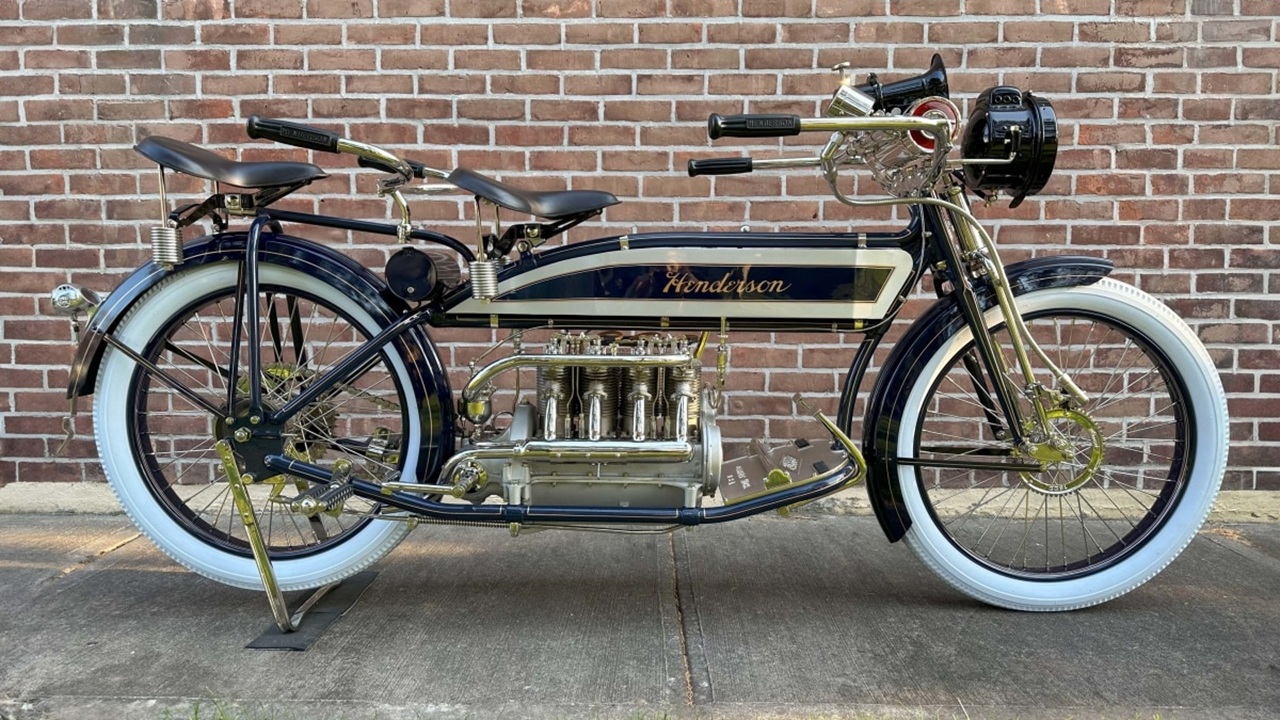
According to The Vintagent, Enzo Ferrari was an avid motorcyclist in his youth around the era of World War I. His steeds were real pieces of history. One of his motorcycles was an FN Four from Fabrique Nationale. The FN Four was famous for being the motorcycle industry’s first four-cylinder back in 1905. Enzo also had another famous early four-cylinder bike, the Henderson Four.
Enzo would fall increasingly in love with auto racing, but the motorcycle itch apparently stuck around. As The Vintagent writes, Scuderia Ferrari didn’t have just talented auto racers, but also motorcycle nuts. From The Vintagent:
Ferrari immediately had 50 full- and part-time members, a veritable Alfa army, which did very well at races, especially when another motorcyclist, Tazio Nuvolari, joined the team. Nuvolari had been racing with Bianchi for several years, and was exceptionally successful with their groundbreaking ‘Frecchia Celeste’ (Blue Arrow) model, one of the earliest double-overhead camshaft racing machines. Introduced in 1925, the 348cc machine was technically a decade ahead of the competition, using a shaft drive to power the cambox, and gears to spin the cams. A proper oil pump (at a time when most bikes used total-loss oiling) and unit-construction engine/gearbox with gear primary drive put the Bianchi on top of Italian racing through 1930, and ‘Nivola’ gained the 350cc European Championship on this machine in 1925 (there being no World Championship series until 1949). Nuvolari raced both cars and motorcycles from 1925, joining Scuderia Ferrari in 1929. By 1930, he had given up racing his beloved Bianchis to concentrate on the far more lucrative sport of automobile racing, for Alfa Romeo. He is considered among the Eternals of racing on two and four wheels, a champion at both (in rare company with Achille Varzi, Alberto Ascari, and John Surtees).
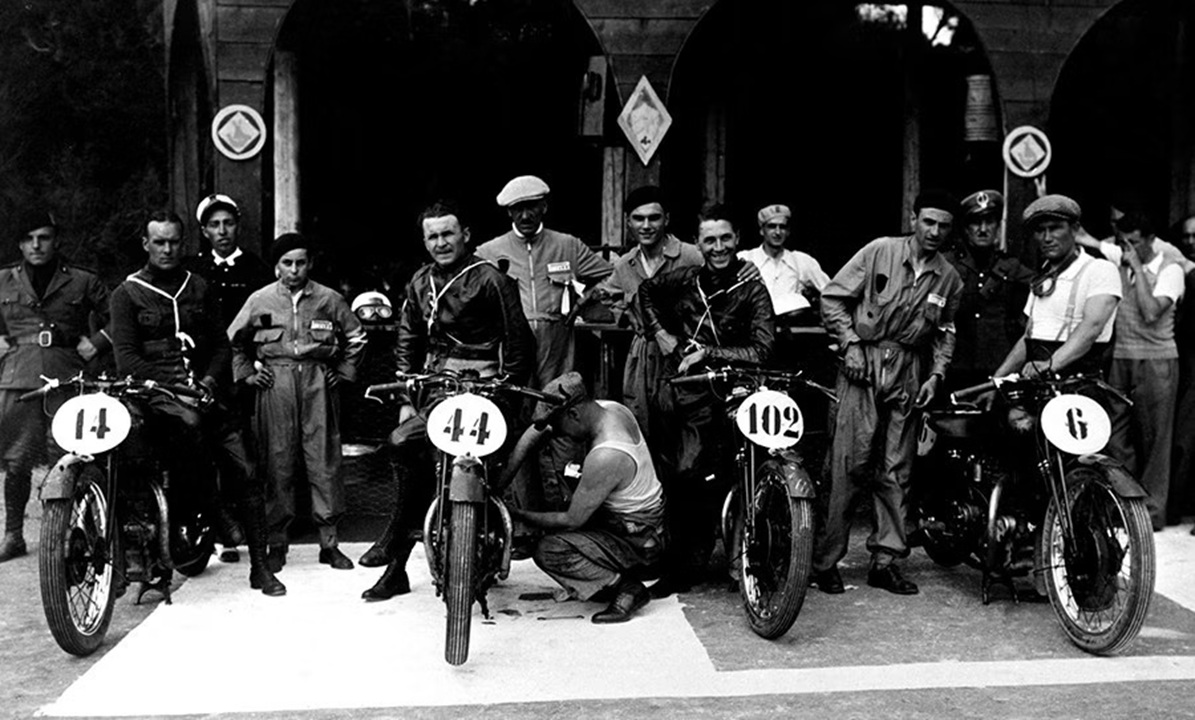
In 1932, Scuderia Ferrari, now an extremely successful racing team, employed similar tactics – supplying and delivering bikes, offering full support and entry fees – to create a motorcycle racing division. Enzo Ferrari felt motorcycle racing was an excellent training ground for racing drivers, as the two most successful members of Scuderia, Achille Varzi (who raced Sunbeams, above) and Tazio Nuvolari, were champion motorcyclists before turning to four wheels. It may have been hubristic to think an endless supply of such drivers as Varzi and Nuvolari can be cultivated to win Grands Prix in cars by motorcycle training, but it had been a happy fishing pond thus far.
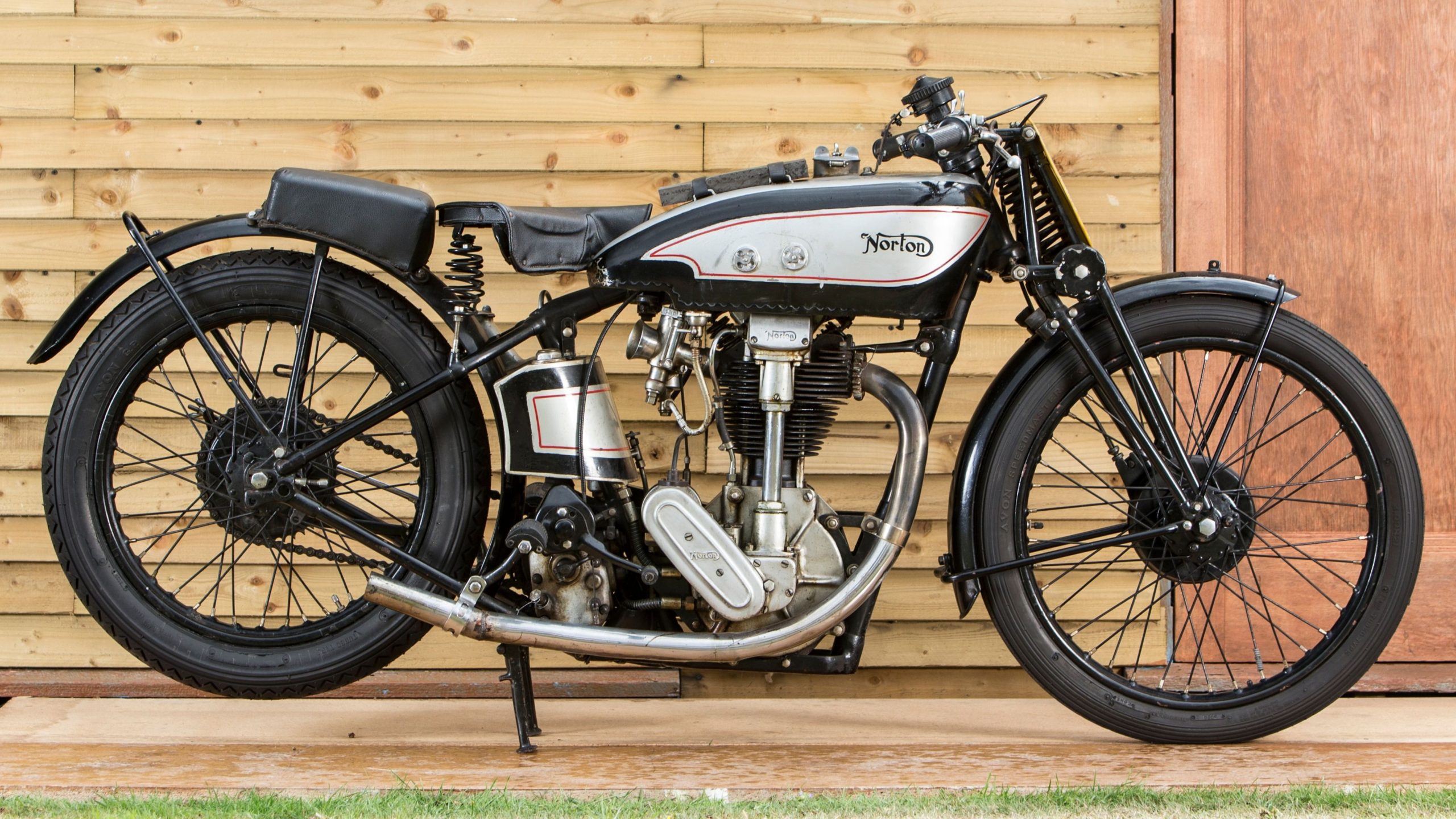
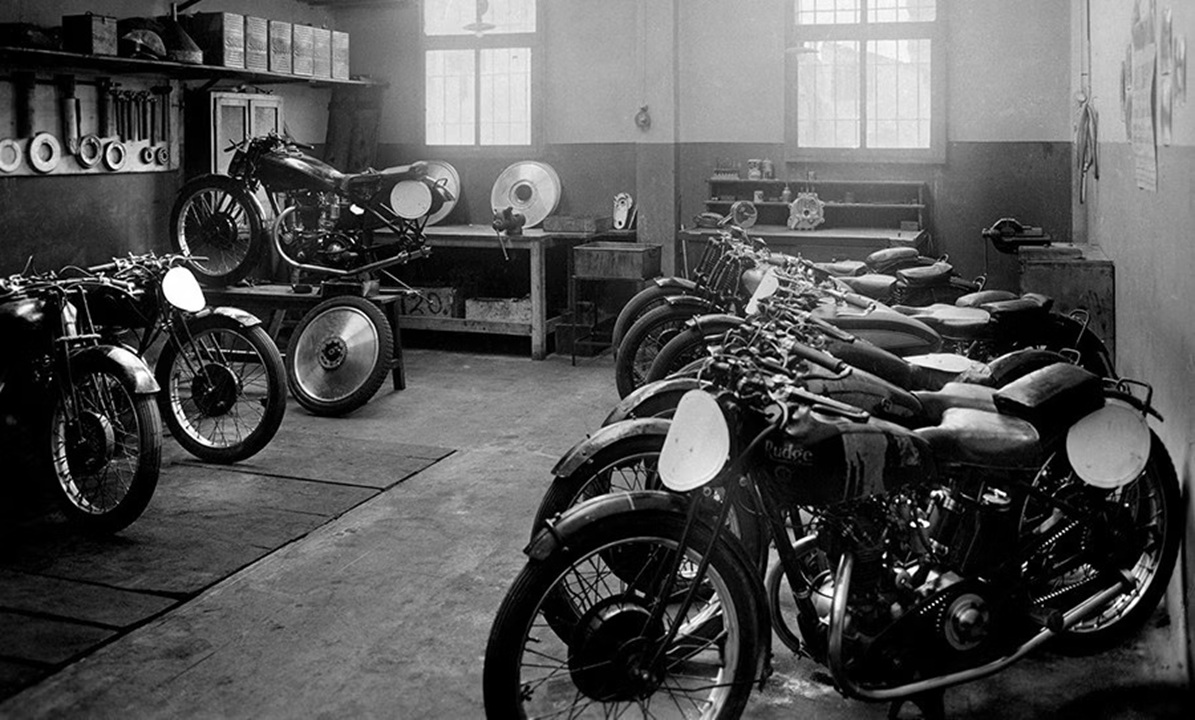
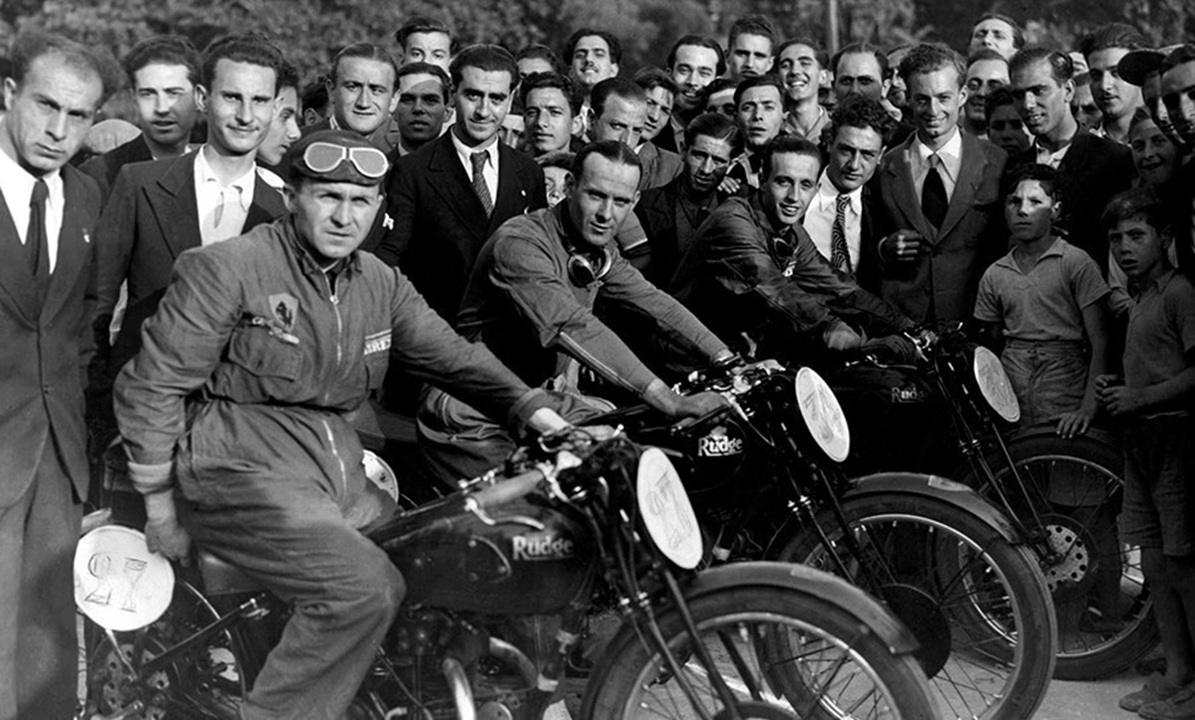
Not that the ‘Scuderia Moto’ was unsuccessful at motorcycle racing! They purchased two of the best available racing marques (and I use this term advisedly – there were amazing racing motorcycles at Moto Guzzi and Bianchi, but they were not for sale!) of 1932, Norton ‘Internationals’ and Rudge ‘TT Replicas’. Norton was at the beginning of a 30-year winning streak, and Rudge was at the peak of their racing success in 350cc and 500cc races all over Europe and England, a moment which passed very quickly, as the Depression curtailed any further expenditure in racing development beyond their pushrod four-valve engine.
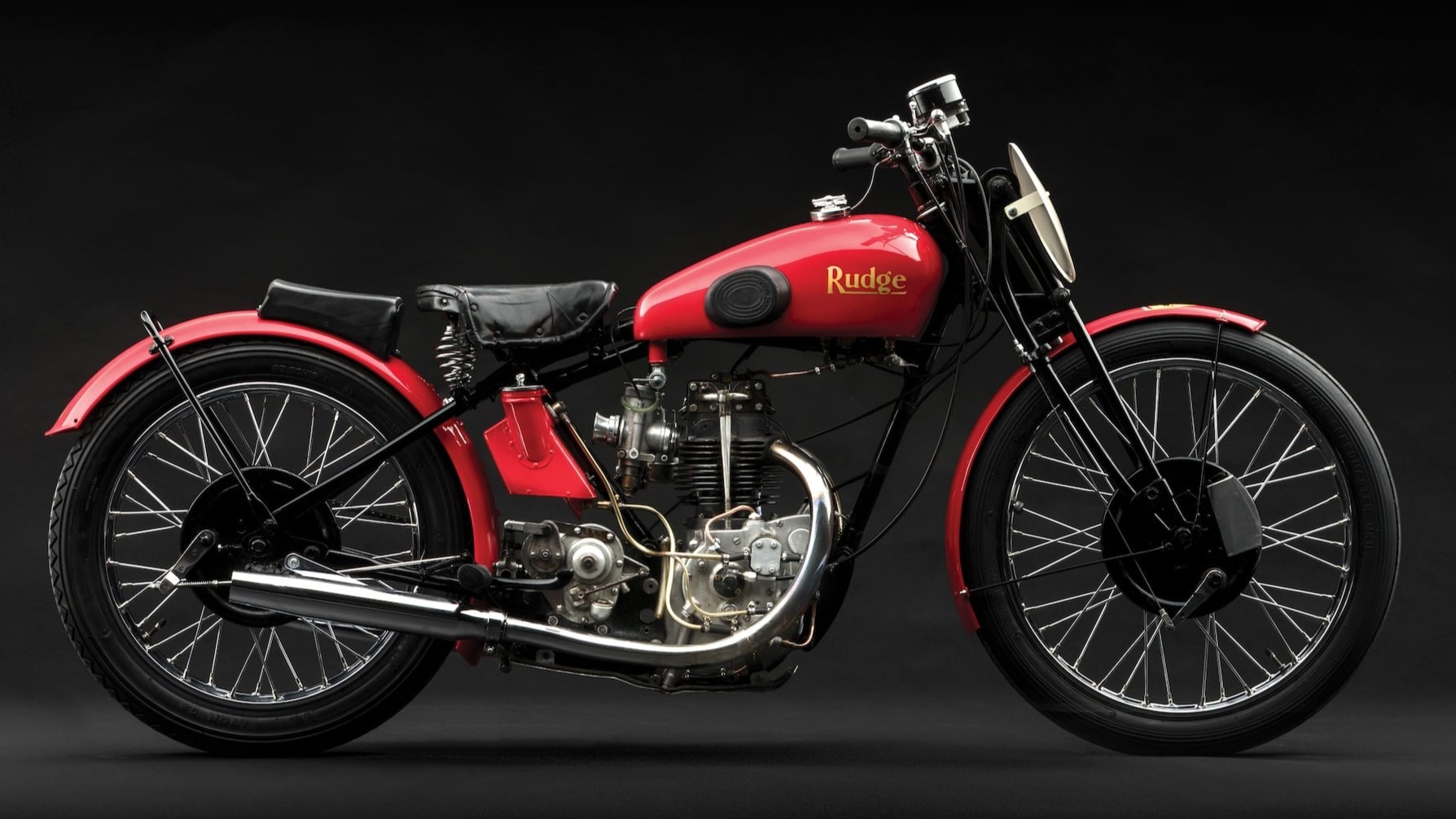
As Ferrari notes, Enzo Ferrari had encountered Rudge before in auto racing, as, in the 1900s, Rudge-Whitworth invented a quick-mounting wire wheel system. The system consisted of a hollow axle with splines and a central locking nut that mounted the wheel to the axle. Rudge’s rim-mounting idea made for seriously quick wheel changes during races and would later become commonly used equipment for many teams.
This story of Scuderia Moto is why the 1995 Ferrari 900cc is why, technically, it took until 1995 for the world to get the first motorcycle with true Ferrari branding. The bikes raced by Ferrari’s team were still very British, even bearing the names of their marques on their tanks for all to see. Ferrari did put his prancing horse on the mudguards of his racing motorcycles, but they weren’t Ferraris or Italian at all.
Reportedly, this came as a shock to the press and the people of Italy. Moto Guzzi, Bianchi, Benelli, and Gilera were putting out fantastically advanced motorcycles in the 1930s. Italian race machines had dual overhead cams, up to four cylinders, and even supercharging at the time. Why would Enzo Ferrari, a man who swelled with Italian pride, buy motorcycles from the British?
As Ferrari explains, the simple fact of the matter was that the Italian motorcycle brands did not sell their racebikes to private teams. So, Scuderia Ferrari had no choice but to do business with Norton and Rudge. As The Vintagent writes, the thought of Italian racers winning races on British bikes bothered him. As luck would have it, in 1931, Moto Mignon Modena had been developing a racing motorcycle with a unit-constructed single-cylinder engine running chain-driven dual overhead cams. This engine was paired with a four-speed transmission. Unfortunately, this motorcycle, while advanced, was slower than existing British bikes.
Undeterred, Ferrari entered into a collaboration with Mignon head Vittorio Guerzoni to build a new racing engine. A Norton International racer was purchased, disassembled, and studied. Vittorio Guerzoni, an engineer, partnered up with another engineer, Vittorio Bellentani, to make it happen. Out of the other end came a single-cylinder overhead cam engine that, once again, proved to be slower than the British engine that inspired it.
So, Ferrari had to swallow his pride and focus on winning races, regardless of what his team had to ride to do it. From Ferrari:
The Scuderia sometimes used Italian motorcycles but only in the less powerful classes: Benellis or MMs, built in Bologna.
Scuderia Ferrari motorcycles debuted with a win. It was 28 March 1932 when Guglielmo Sandri rode a Rudge 350cc to first place in the Spring Grand Prix in Modena. Forty-four victories and three national titles came in just three years thanks to the Milanese riders Giordano Aldrighetti in 1932 (250cc class) and 1933 (500cc class) and Aldo Pigorini in 1934 (350cc class). However, that season the Rudge proved uncompetitive in the other classes, so Scuderia Ferrari decided to abandon two-wheeled competition. Its final appearances were in August at the Trofeo Acerbo, in which Pigorini won his class, and at the Coppa Adriatico in Rimini.
Reportedly, Ferrari rarely talked about the short-lived motorcycle racing effort after he started building his own cars in earnest. As I said, some modern retrospectives completely skip over the motorcycle part, too. Yet, there was a time when Ferrari had race-winning motorcycles, but they just weren’t Ferraris.
An MV Agusta Legend
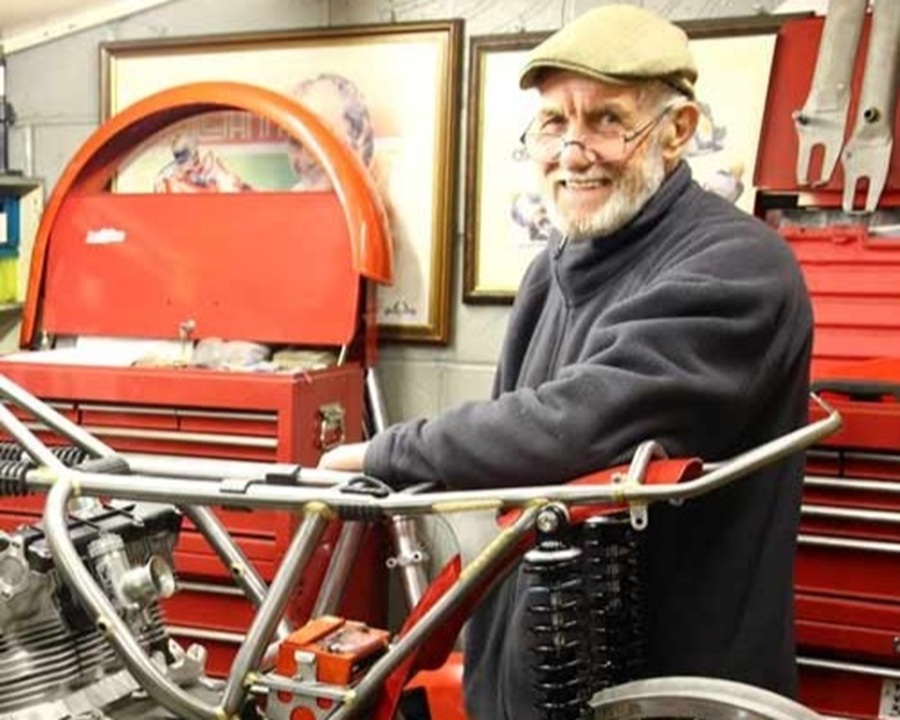
That’s where the 1995 Ferrari 900cc comes in. This motorcycle imagines a future where Ferrari succeeded in making his own motorcycles and decided to make both cars and bikes. Normally, something like this would be nothing more than just the fantasy of a builder, but Enzo Ferrari’s son liked the idea enough to give it the official Ferrari blessing.
The Ferrari 900cc was the work of a talented engineer, David Kay, who had an expertise in building incredible replicas of classic Gileras and MV Agusta motorcycles and parts using factory blueprints. He was the founder of MV Meccanica Verghera Ltd. in the UK, and its website tells Dave’s story:
1982
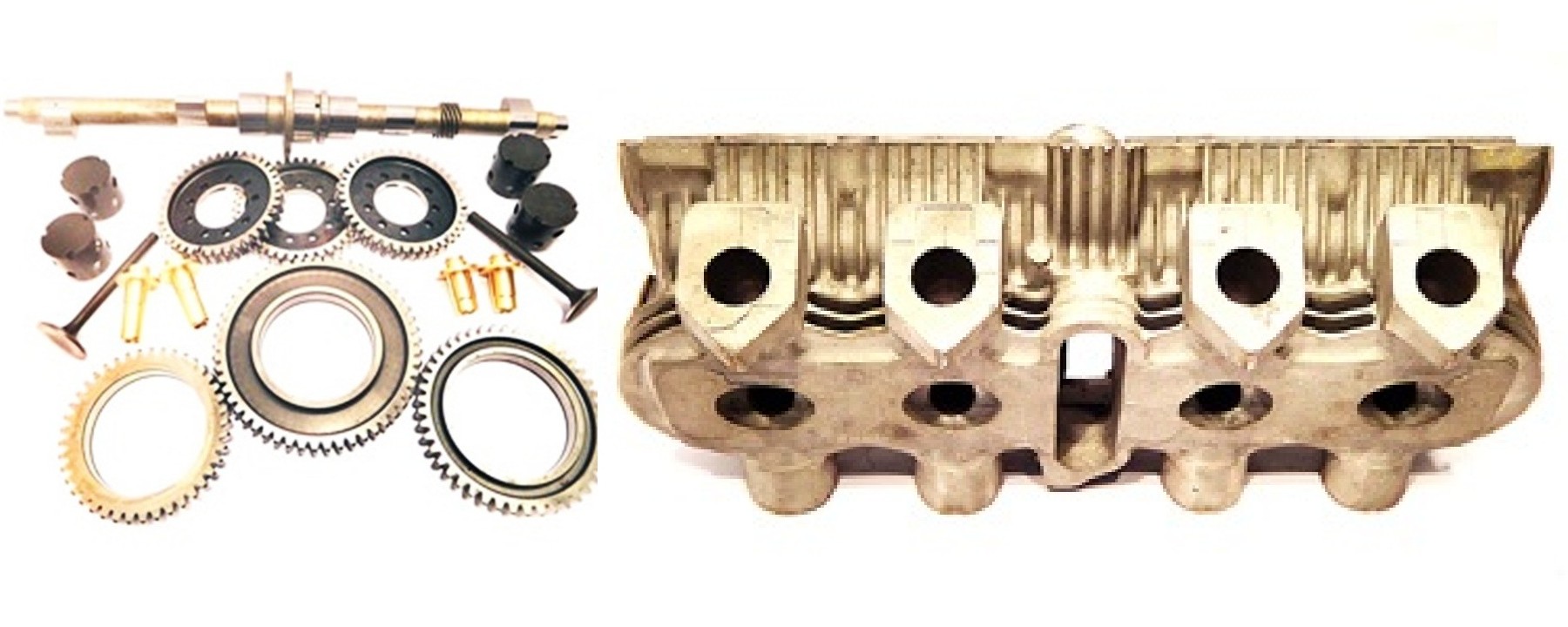
David and Mark Kay, along with many other owners, found replacement parts increasingly difficult to source. As a result, they commenced manufacturing high quality replica parts for their 750cc Race Bike and 900cc Sidecar. As accomplished engineers, they began to earn a reputation within the world of racing for the high standard of their work.1983
On a visit to the MV Agusta Race Shop in Gallarate near Milan the Kays’ MV motorcycle, which had been built from parts, was stolen. Mr Magni, Mr. Ubbiali and Mr. Laudi, the spares supremo, were devastated. Mr. Magni promised to replace the bike which he later did.
Mr. Laudi gave the Kays a complete set of 500GP 72 four cylinder engine unmachined castings.
It then took 30 years to obtain sufficient information to machine the 500 4cylinder GP engine.
1984
Dave and Mark Kay made a decision to build their own engine.
They manufactured and machined castings to enable them to build 500cc to 862cc engines.
1988
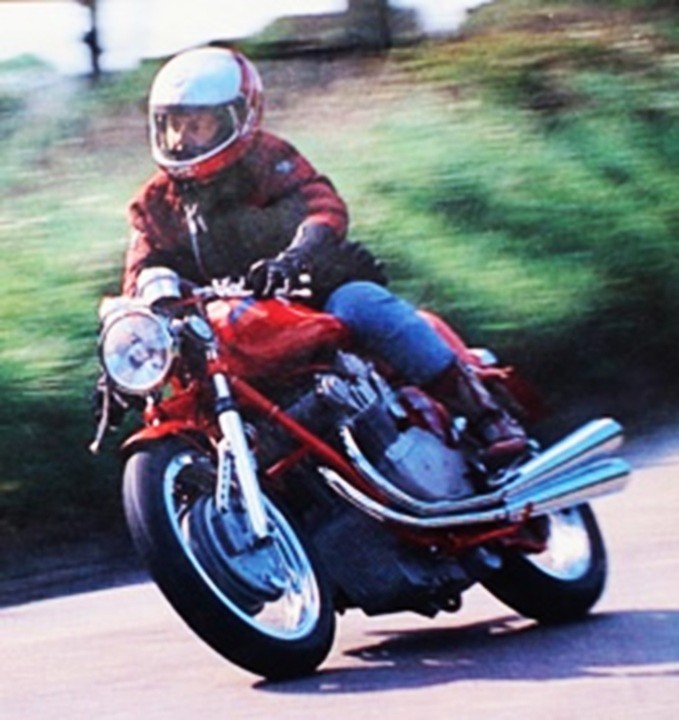
The Kays constructed the world’s first road going MV500cc 4 cylinder motorcycle.
This 500cc Eiger MV wins the Manchester Show.
On the death of Mr.Laudi, the Spares Department closed and MV Agusta went into liquidation.
The Kays MV 500cc Wins ‘Best in Show’ award at the International Manchester Bike Show and later, Stafford International Bike Show.
By 1990, the Kays had incorporated their business as MV Meccanica Verghera Ltd.
A Motorcycle To Honor Enzo
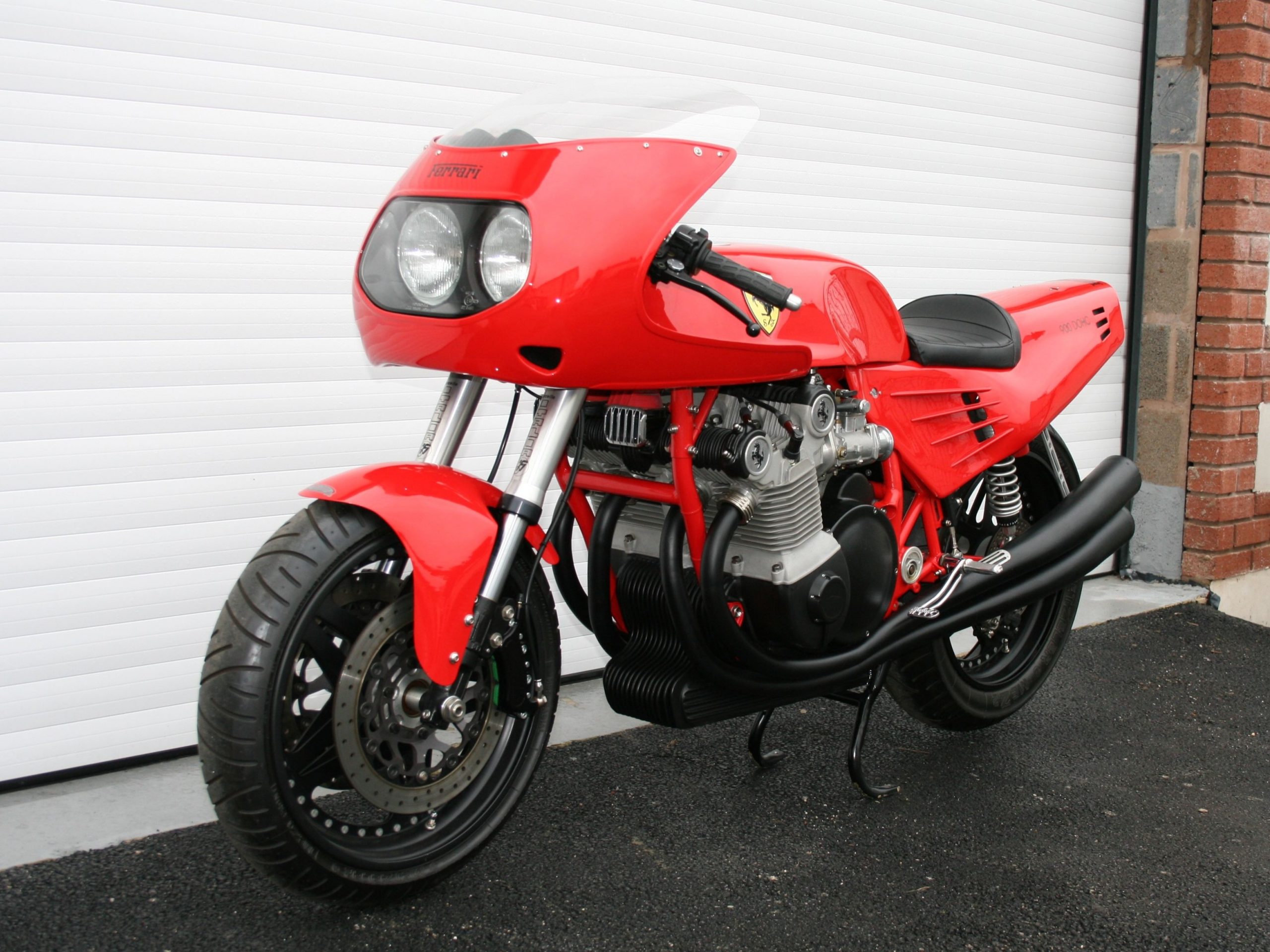
That year, David and Mark got a bit of a wild idea. They have been building engines and complete motorcycles for years, but they didn’t really have a showcase of their engineering capabilities. To rectify that, the Kays decided to build a one-off motorcycle around a concept that hadn’t been explored before.
The idea to build the world’s only Ferrari motorcycle came after the Kays spent considerable time determining what they wanted this motorcycle to look like. Enzo Ferrari passed two years earlier, and the Kays were aware of Enzo’s love of motorcycles. Of course, as we just established, Ferrari also attempted to make a motorcycle. The Kays say that Enzo loved motorcycles before he fell for cars. But there was one problem, as the Kays needed permission to build a motorcycle to honor Enzo.
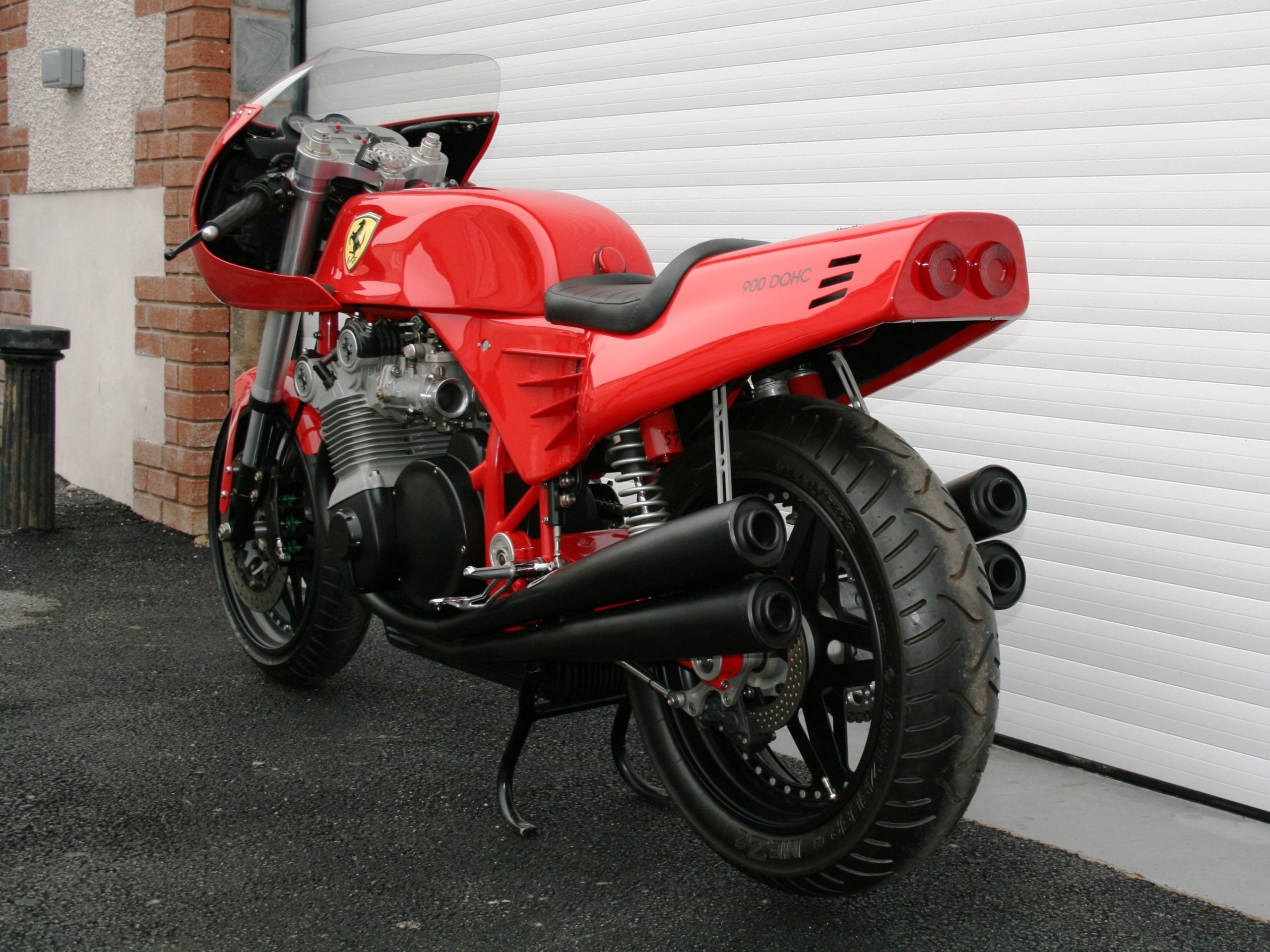
The Kays took a shot in the dark, penning a letter to Enzo’s son, Piero, for permission to build a motorcycle sporting Ferrari’s logo right on the tank. On May 23, 1990, Piero Ferrari penned a letter, stating, among other things, “the approval to place the Ferrari badge on your motorbike.” Piero then wished the Kays good luck in their endeavor. After the somewhat surprising approval, the Kays got to work. From MV Meccanica Verghera:
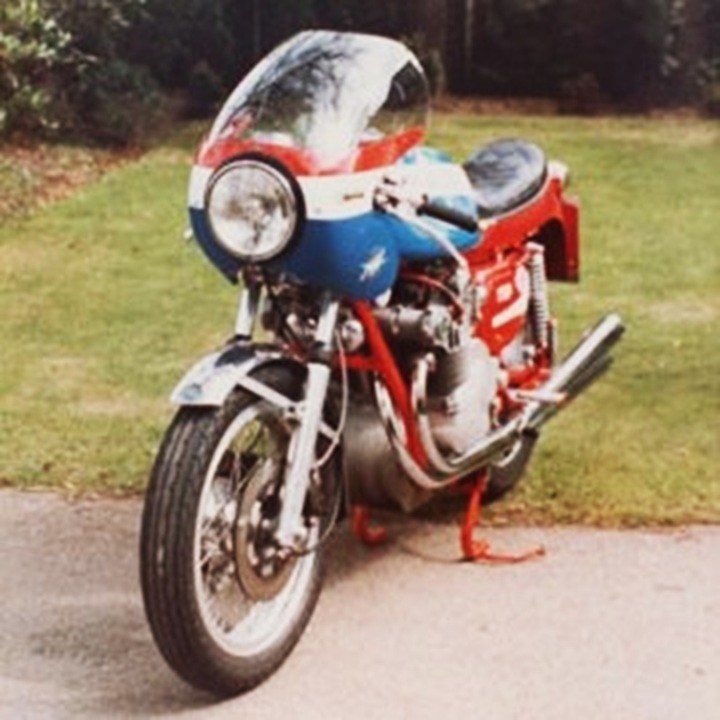
The project was commenced in 1990 with the basic idea it had to look like a two wheeled Ferrari. A machine which the factory could have built if they had gone into motorcycle manufacture at this time. Hence Twin Head and Rear Lights, Italian Weber dual Choke Carbs, as fitted to their cars installed on a four cylinder engine with 4 exhausts. After 5 years work Mark and David displayed the bike at Silverstone Race Track where they were guests of the Lamborghini car manufacturer. Lord Hesketh, on seeing the bike, insisted it be displayed in the Race Drivers Private Rest Garden. This was the first and only time a mechanical vehicle was allowed on this hallowed turf. Drivers insisted it be fired into life. Jack Brabham, World Champion, push started the bike to great applause of the other drivers. Was it worth the effort? You bet!!
Bonhams, which would attempt to auction the bike later, detailed the build:
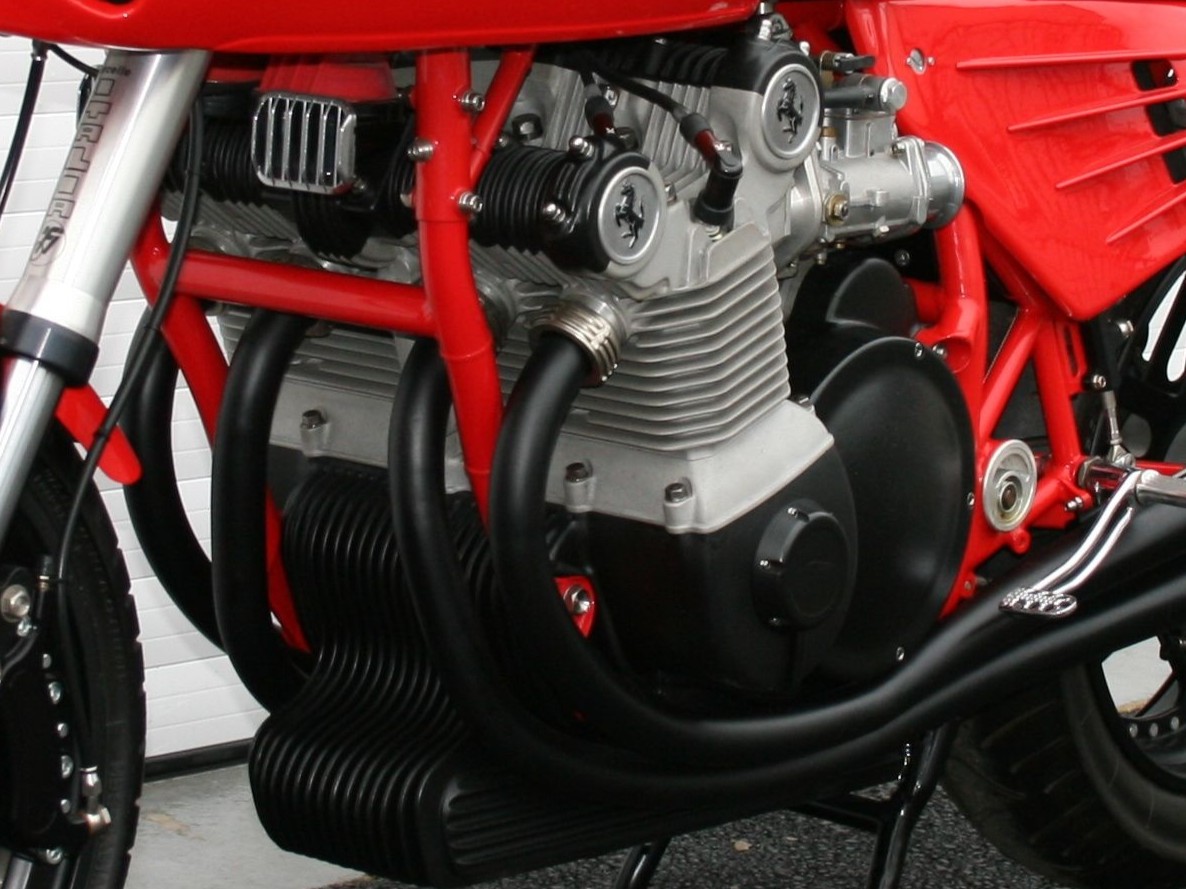
When highly reputed MV Agusta ‘guru’ David Kay set about building this unique piece of engineering from scratch, he looked towards both the future and the past, as he thought of what may have been if Ferrari would have decided to produce a GT or endurance racing machine. Kay was inspired by the fact that Enzo had started his racing on a Scott two-stroke machine and so a project representing over 3,000 man-hours of work was launched.
The engine is a ‘scratch built’ 900cc, transverse, double overhead camshaft, four cylinder, eight valve unit with magnesium and alloy casings, driven through a five speed gearbox. The tubular chassis is made of Reynolds 531 tube, engineering on the motorcycle is irreproachable and the detail is quite astounding. The attention to this is quite incredible, with the master cylinder built into the obviously one off digital instrument panel and is again portrayed with the exquisite steering damper. Terry Hall, who also produced the double curvature reverse cone megaphones, made the entire bodywork out of aluminium. In Kay’s own words these are too beautiful to merely funnel exhaust gases from engine to atmosphere; ‘the noise is like a Messerschmitt chasing a Spitfire’. The front end is very contemporary in conception with Forcelle Italia upside down forks, massive twin piston Brembo disc brakes front and rear (6 pot calipers to the front, 4 to the rear) and special 17 inch hand spun Astralite wheels. WPS twin rear shock absorbers complete the basic specification.

The Ferrari 900cc made its public debut in 1995 at the Classic Bike Show, where David Kay proudly advertised his creation as the world’s first Ferrari motorcycle.
Honestly, Bonhams doesn’t go far enough to describe how neat this bike is. The bodywork was beaten into shape by hand, and was designed to be a nod to the Ferrari Testarossa. The Weber dual-throat carbs onboard this beast aren’t really meant for motorcycles. However, this is supposed to be another nod to Ferrari cars.
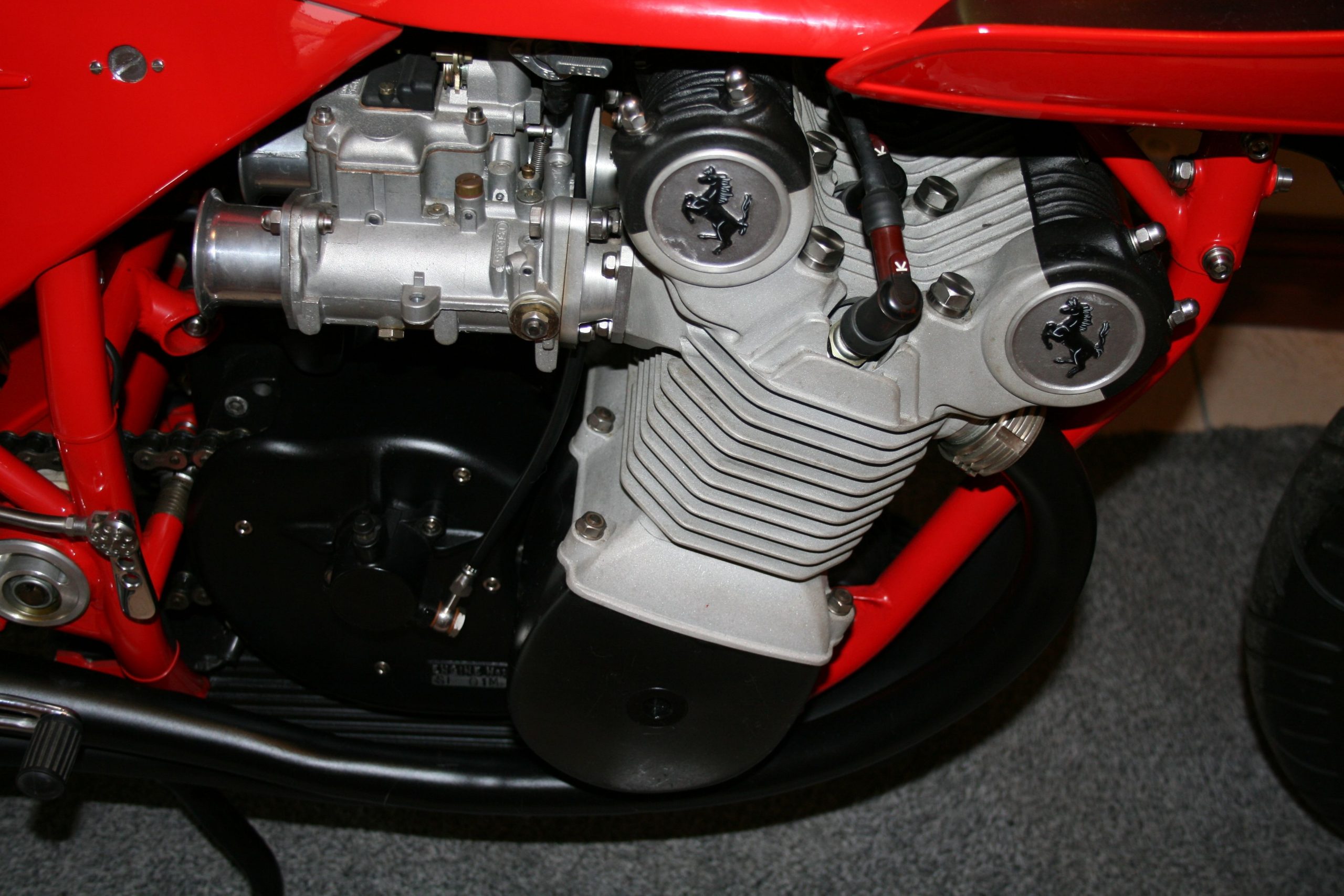
Most of the parts in the Ferrari 900cc are bespoke, including its pressed crankshaft and the bike’s five-speed transmission. The engine, while impressive for coming out of the Kays’ family business, wasn’t even really the headlining feature. It looked similar to MV Agusta’s transverse fours and even had MV-style pipes.
The motorcycle was dyno-tested, and the result was 105 horsepower at 8,800 RPM. The bike weighed only 379 pounds thanks to lightweight parts like carbon fiber mudguards. The motorcycle was never road tested to its limit, but it was believed that the Ferrari 900cc could hit a theoretical top speed of 165 mph.
It’s been reported that this motorcycle has shown up on all sorts of print, online, and video media. Sadly, these stories seem to exist in that Internet dead zone where nobody bothered to archive the media before it was deleted.
Bidders Gave The Official Ferrari Motorcycle The Cold Shoulder
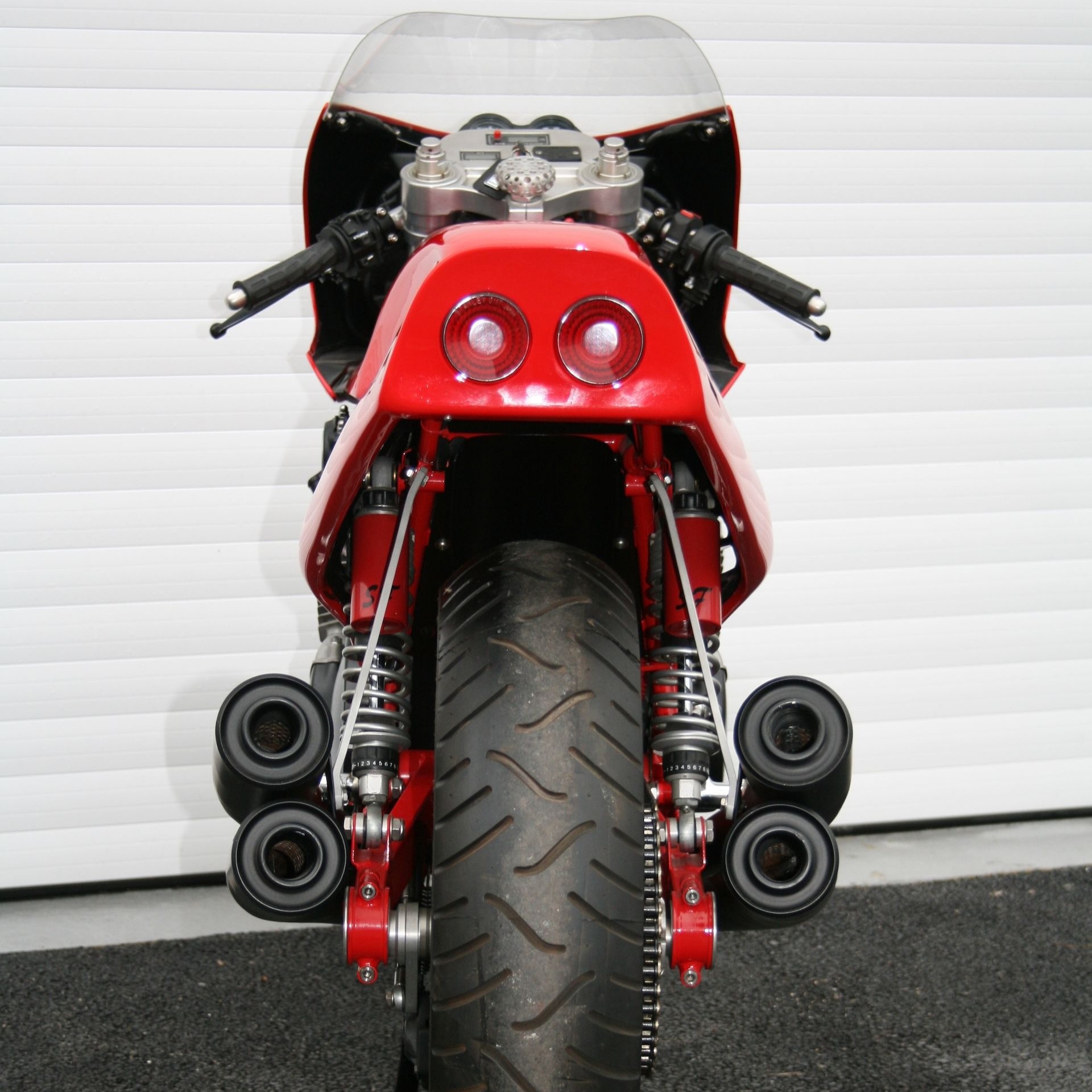
Though the Ferrari 900cc is technically the only officially Ferrari-branded motorcycle in existence, Ferrari fans didn’t fall over themselves to buy it when Kays put the motorcycle up for sale in December 2008 as part of the Bonhams Ferrari et les Prestigieuses Italiennes auction in Switzerland. The motorcycle was expected to sell for between 325,000-375,000 Swiss francs, but didn’t even clear the 180,000-dollar reserve. The Ferrari 900cc then appeared on eBay, where it failed to sell for its £250,000 reserve.
In 2012, the motorcycle was sold to a private owner for £85,500, or $110,481 in 2012 money. Along with the bike, the buyer got the letter from Ferrari confirming its authenticity. At the time, various automotive and motorcycle publications guessed that the problem was that the motorcycle wasn’t particularly exciting outside of the Ferrari badge. Ouch.
Whatever the reason, the buyer was clearly happy, because the world’s only official Ferrari motorcycle disappeared from the public light and hasn’t been seen again.
Other “Ferrari” Motorcycles
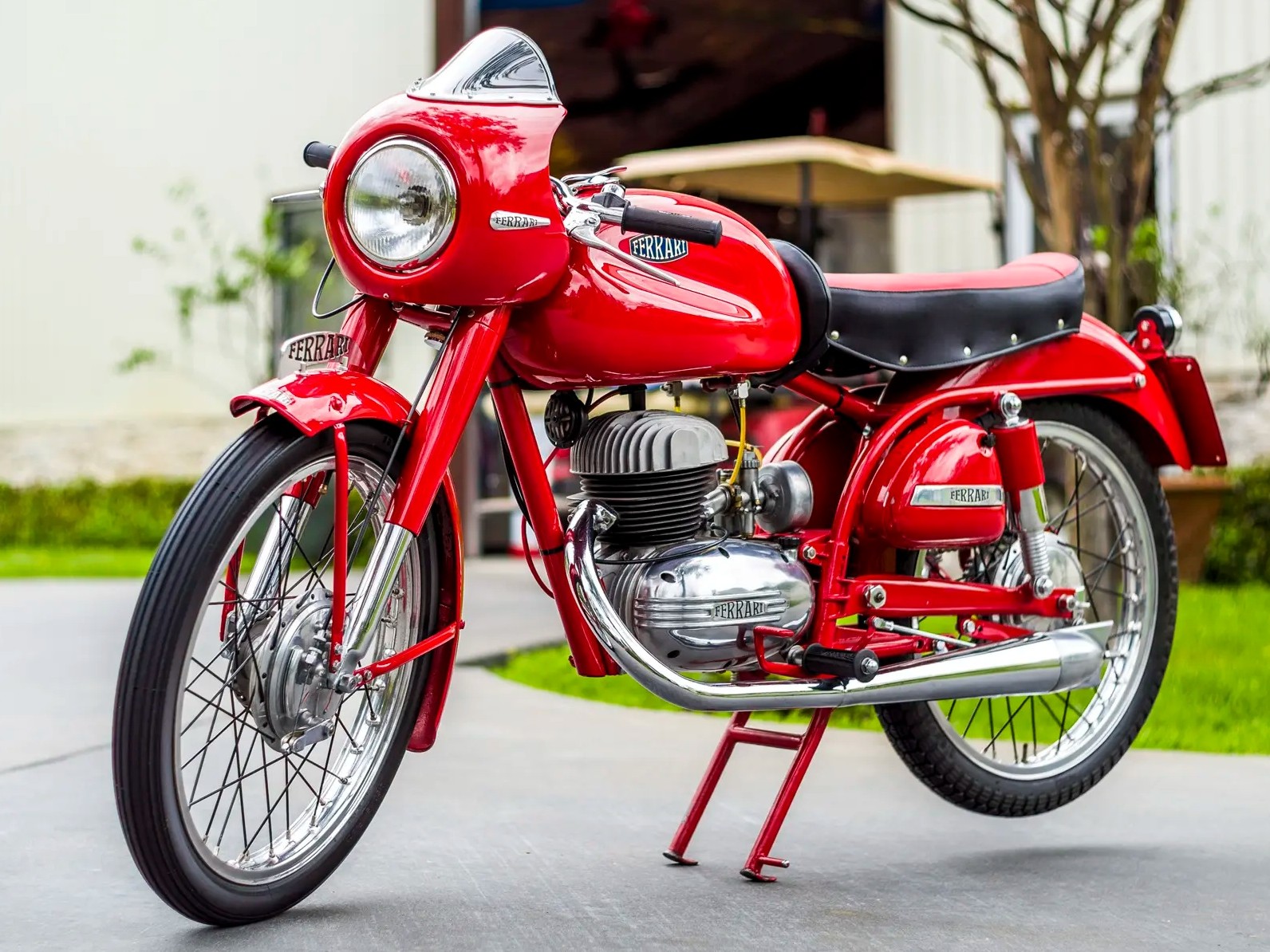
Amusingly, while there has been only one official motorcycle of the Ferrari S.p.A. concern, there was a Ferrari motorcycle brand. In 1952, engineer Signore Amos Ferrari launched Meccanica Italiana Fratelli Ferrari in Milan. The brothers behind the business simply placed “Ferrari” on the tanks of their motorcycles, which ranged from 125cc to 175cc units. Reportedly, in 1953, this caught the ire of Enzo Ferrari, who took the motorcycle concern to court. Enzo won an injunction, which forced the motorcycle company to change its branding to Fratelli Ferrari, which translates to “Brothers Ferrari”. Sadly, the company couldn’t keep its momentum and shuttered in 1955.
Technically, there were two more times when the Ferrari name got involved with motorcycles. In the 1990s, Ferrari assisted Cagiva in the construction of the F4 by trickling Formula 1 technology down into motorcycles. The bike had a 750cc inline-four, with a central chain distribution, radial valves, and a removable transmission. As Pirelli notes, Ferrari was dissatisfied with the test results from the engine and forbade Cagiva from using Ferrari’s name on the project.
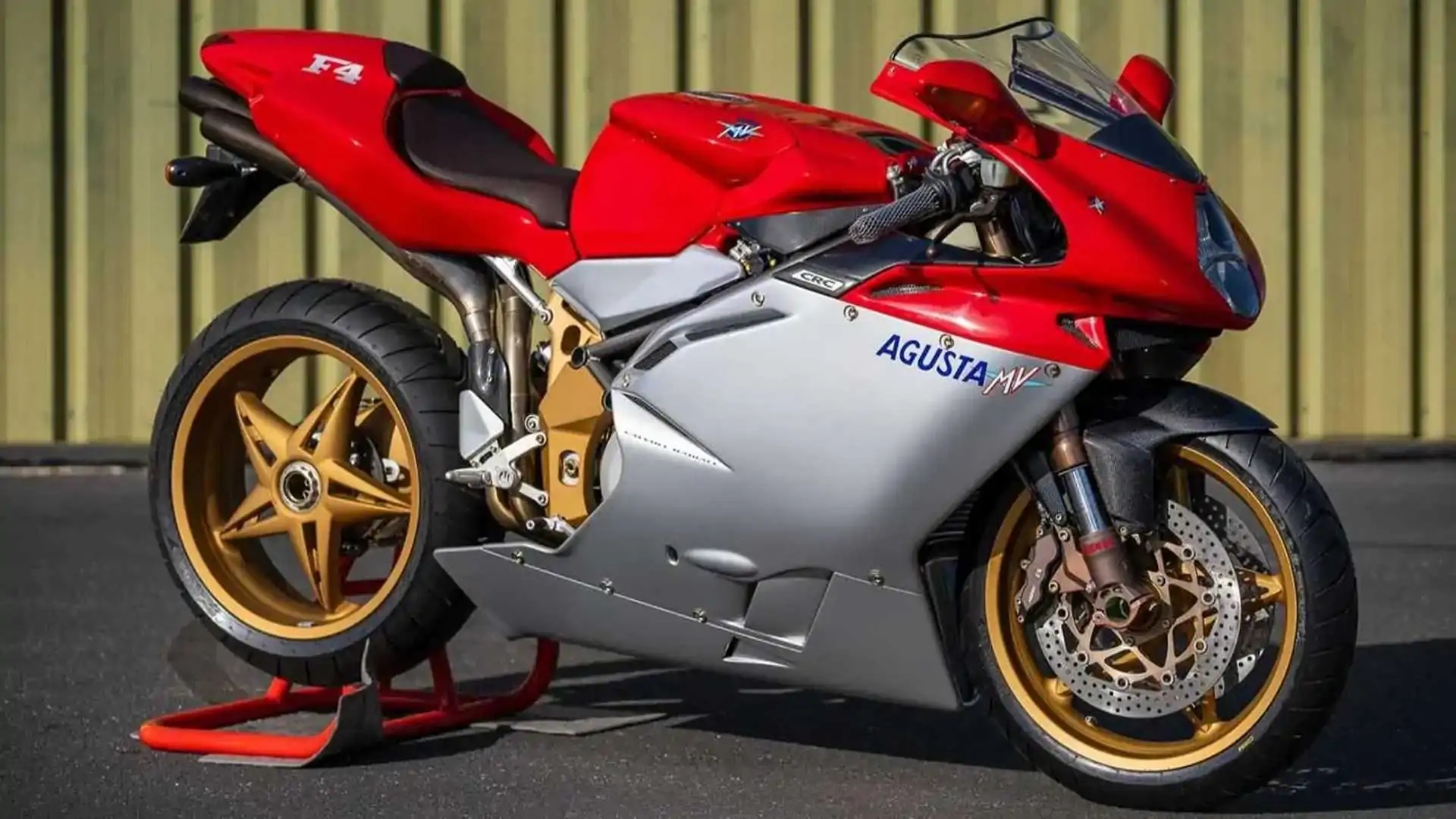
Later, Cagiva would acquire MV Agusta and create the MV Agusta F4. The F4 ditched most of the Formula 1 and Ferrari tech except for the radial valves. As Pirelli notes, the “F” in the F4’s name and parts stampings are the only nods to the Ferrari development.
In 2014, Ferrari would also patent a V-twin motorcycle engine. But, like so many corporate patents, nothing came of it. Thus, despite Ferrari’s many flirtations with motorcycles, only one bike in the brand’s history officially has the prancing horse on its tank. David Kay passed in 2022 at the age of 82, and based on his website, the Ferrari 900cc was one of his favorite projects.
Still An Awesome Achievement
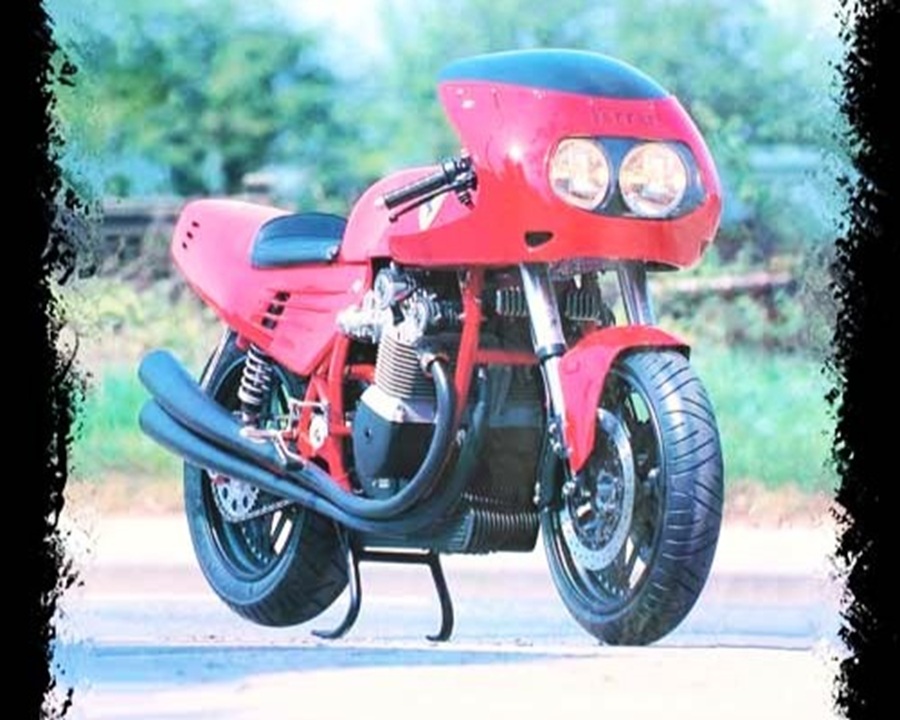
It’s wild to think that Ferrari’s one official motorcycle wasn’t even built by Ferrari. Indeed, there have been Ferrari-inspired motorcycles and, no doubt, people have slapped the iconic logo onto bikes that had nothing to do with Ferrari. But only one motorcycle out there has Ferrari badges because Ferrari actually approved of it.
At the same time, the motorcycle world isn’t really hurting without Ferrari in it. Moto Guzzi, Ducati, MV Agusta, Aprilia, and Vespa represent some of the greatest motorcycle brands still in operation. They’re all unapologetically Italian and oh so hot. MV Agusta itself has a reputation for being the Ferrari of motorcycles.
Still, that shouldn’t diminish what David Kay and his company achieved. Not only did he build a bespoke motorcycle with parts that he made himself, but David somehow convinced Ferrari to put its name on his bike. Both of those are incredible achievements, and one that I hope won’t be forgotten anytime soon.
Top graphic image: Bonhams



Now we wait to see how long it takes Ferrari to sue itself for allowing itself to infringe on its own copyright.
Very cool that it was a one-off.
The rear 3/4 reminds me of a Honda NR750 or VFR750RC36 – both predating this bike, so I wonder if his styling inspiration for a motorcycle was influenced by other bikes of the era.
These detailed articles are great.
I’m going to be honest, I like the looks of that Fratelli Ferrari a whole lot more, even if it’s not actually a Ferrari.
A single cylinder out in space and a bikini fairing are all I need. 2 strokes aren’t really my bag, but that’s ok.
I’m right there with you! I would adore dressing up in period-correct garb and taking the Fratelli Ferrari for a spin. Shoot, I could probably just set up a chair in the garage and stare at it all day.
I mean, it’s not that surprising why the Ferrari 900cc didn’t sell for anywhere close to the expected price.
I’ve seen a Quattrovelo with a Ferrari badge on it:
https://www.youtube.com/shorts/nQyGt8aWVcU
The owner(or previous owner, don’t know if he sold it to someone else or not) has a manual transmission Ferrari F430 Spyder.
8-bit computers and motorcycle history on the same page. I love this site!