

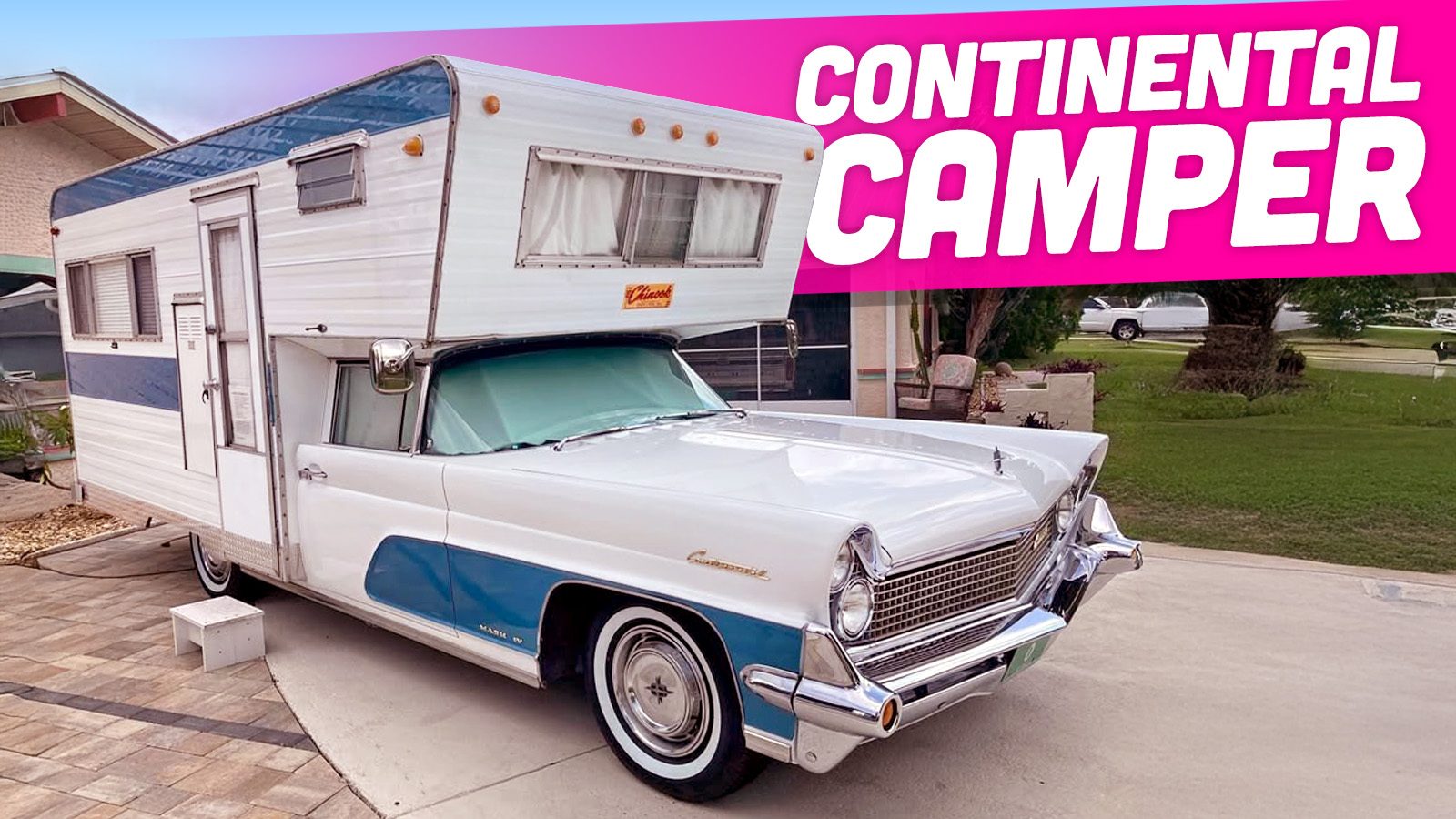
The 1950s were an evolutionary period for the RV. Back then, the “house car” was becoming more of a mass-produced commodity, one that would later be known as the motorhome. There were all sorts of weird house cars, many of which were built on trucks. Some house cars, like this 1959 Lincoln Continental, were built atop full-size sedans. This Lincoln motorhome is a time capsule to where the RV industry was in the 1950s, and it was built by none other than the iconic Chinook RV.
The concept of the RV has been around for longer than some of the earliest cars. Back in the 1800s, the idea of tossing some provisions into a covered wagon and then sleeping out in the wilderness for fun gained traction in England and America. As the automobile rose to power, recreational vehicles traded horses for gasoline engines. Eventually, companies sprouted up to build the things, too. But early RVs were largely custom-built and were cranked out in low numbers.


Pinpointing the first mass-produced motorhome is a bit hard, as it seemed everyone got into building house cars during the early decades of RV history. A good example of an early modern-style motorhome is the 1937 Hunt Housecar, which did go into production. Another one is the 1929 Studebaker House Car, which is an early example of a self-contained motorhome that could camp away from shore power and other hookups.
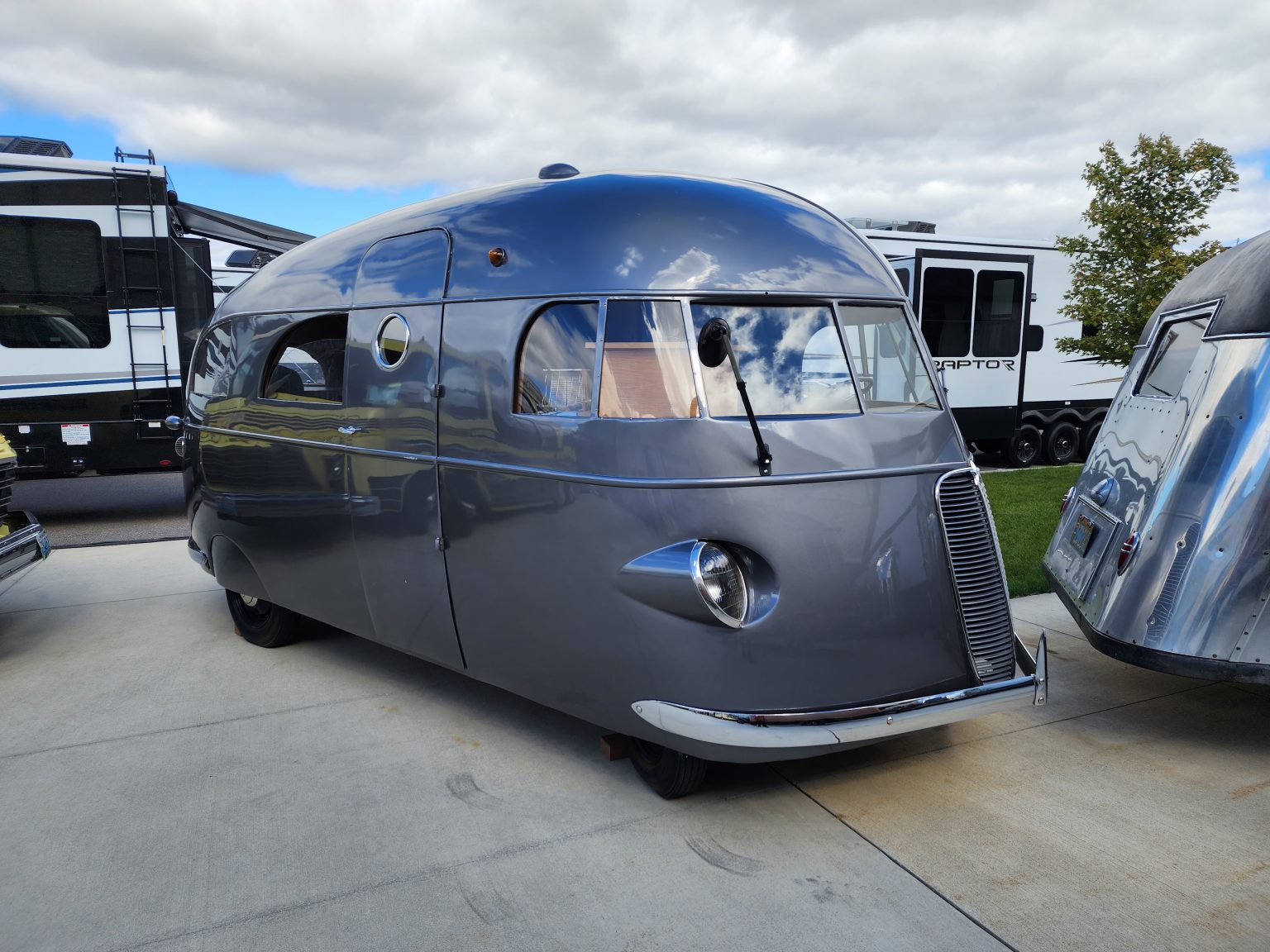
Certainly, RVs were a sort of Wild West back then, as there wasn’t really a standard layout and everyone tried to do their own thing. That was until about the 1950s, when the RV industry started getting really serious about mass production. Perhaps the most iconic ’50s motorhome was Raymond C. Frank’s “Frank Motor Home.” This coach would become so popular and so hotly desired by Americans in the late 1950s and early 1960s that the term “motorhome” would eventually replace “house car.” Most motorhomes built today still more or less follow the template laid out by the Frank Motor Home.
This Chinook was built during those years when the RV industry was still experimenting with the ideas that would eventually become today’s standard RV classes. The predecessors to today’s Class C motorhomes are also pretty wild. For decades, some companies built their motorhomes by taking professional cars or full-size cars, cutting off everything behind the front seats, and then dropping in a camper body.

This was the method employed by the likes of the Great Dale House Car, the Superior Coach Company, and the predecessor company to today’s Chinook RV. In building campers out of full-size cars or professional cars, these motorhomes enjoyed better driving dynamics and style than campers riding on the backs of trucks, while also being lower to the ground and more accessible. It also wasn’t too outlandish, either, because the cars of those days had body-on-frame construction and were powered by large V8 engines.
Yet, this part of Chinook’s history is almost entirely forgotten.
Lost History

When you look up Chinook’s history, the company’s first three decades of existence are barely a footnote. Here’s Chinook’s history as told by the company today:
Chinook RV’s story began in 1938, when [Cyrus] and Rose Mair founded Mair & Son, Inc. in Orange County, California. Their vision, to combine craftsmanship, comfort, and innovation, would ultimately shape an entire industry. By the 1950s, as mass-produced motorhomes started rolling onto America’s highways, Chinook RV was already setting new standards for quality in recreational vehicles. Early models were known for their sturdy construction, smart design, and thoughtful features that appealed to a new generation of travelers.
In 1966, Chinook RV debuted the Chinook 1400, a sleek, fiberglass-bodied motorhome that was ahead of its time. Just a few years later, in 1971, the company changed the industry forever by unveiling the world’s first one-piece, all-fiberglass motorhome shell, a breakthrough in design and durability.

Even setbacks couldn’t stop Chinook RV’s momentum. After a devastating plant fire in 1967, the brand rebuilt and refocused, expanding into lightweight, efficient Class B and compact RVs that met the needs of a growing travel culture. The 1970s saw the rise of innovative models like the Toyota-based Chinook 18 Plus, Mobilodge, and the unique Big ‘Nook built on a Chevy K5 Blazer chassis, proof of Chinook’s creative engineering spirit.
Mair & Son, Inc. was an enterprise that built the Chinook Camp Coach and the Chinook travel trailer in addition to truck bodies and refrigerated vans. Sadly, I could not find much information about the company’s early years, aside from the fact that, at some point, the company moved from California to the Yakima Valley of Washington. In 1960, Mair & Son joined the United Brotherhood of Carpenters and Joiners of America. In 1961, Mair & Son also spent $95,000 on a new 5000 square-foot facility to build truck campers, travel trailers, and commercial truck bodies.
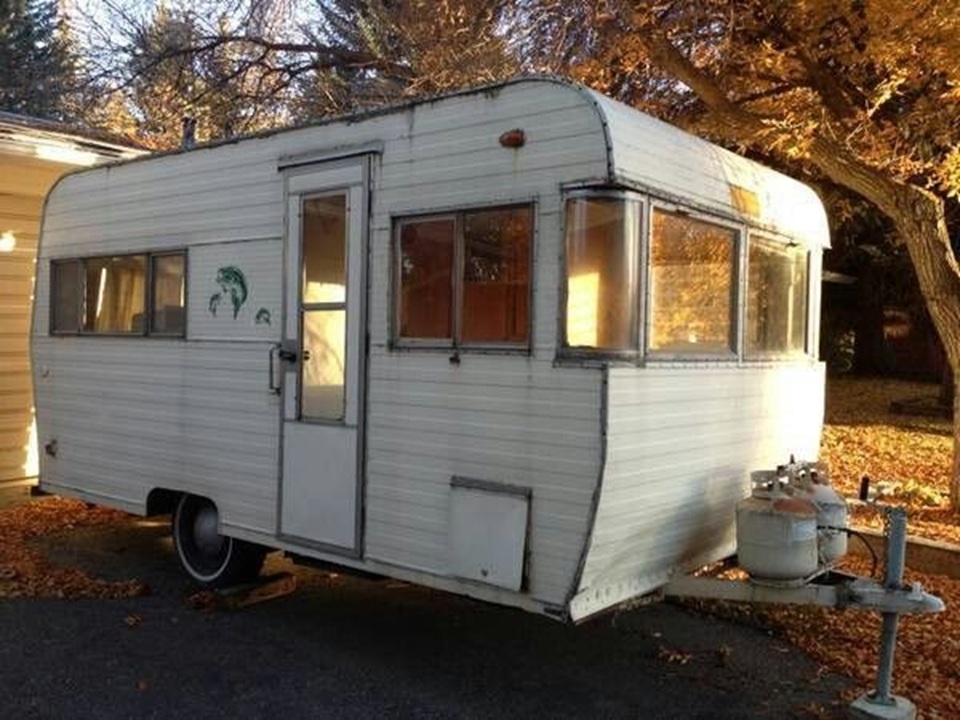
What’s fascinating is how little of this past has been preserved. Not even the Internet Archive has much about the existence of Chinook prior to the creation of the Chinook 18 Plus. However, what I’ve been able to gather is that Chinook didn’t always build campers out of fiberglass, which it is most famous for today. Instead, in the past, it built wood-framed, aluminum-sided campers like the rest of the industry. Fiberglass would be phased in over time, with Chinook’s truck campers of the 1960s getting fiberglass roofs before Chinook went all-in on full fiberglass bodies. Later, Chinook would even build large fifth-wheel trailers and sizable Class A motorhomes.
But I think it’s what Chinook built in the 1950s and the early 1960s, before it started using fiberglass, that might be the most fascinating. Check out the Chinook travel trailer above.
Glamping In The ’50s

Chinook also built this ridiculously rare Continental Mark IV-based motorhome. Apparently, only four of these were built in 1958, four were built in 1959, and two more were built in 1960. With some digging, you can find imagery of some of the others online today. None of the other survivors looks as nice as this one, however.
Sadly, I could not find any information as to why Chinook chose to build a handful of motorhomes out of Continentals. Likewise, there’s no published information as to why Chinook built fewer than a dozen of them or what they cost. However, building motorhomes out of luxury cars was something that some companies did back then. After all, a Cadillac-based motorhome would be comfortable, powerful, and ooze class.
Here’s some information about the 1958 and 1959 Continental from the Motor Cities National Heritage Area:
The 1958 and 1959 Lincoln models by Ford were massive in size, simultaneously liked by some and disliked by others. The vehicles were so large that some suspension and chassis parts would sometimes malfunction, forcing drivers to the side of the road to call for service. The 1958 and 1959 Lincolns were designed by John Najjar, chief stylist and a great designer with Ford Motor Company from 1937 to 1979. It should also be noted that Najjar designed many other great looking vehicles during his years at Ford. Other design staff members included David Ash; Bud Kaufman; Art Miller; Herbert Todd, Lincoln’s design supervisor; and Bill Mills, Lincoln’s general manager. The models were also designed under the direction of George Walker, who was Ford Motor Company’s vice president in charge of design.
Ford called the 1958-1960 Lincolns, the massive, slab-sided Lincolns. Some 1950s automotive designs were inspired by that Buck Rogers futuristic style consumers would see at the movies. For the 1958-59 Lincolns, the design was influenced by a motorized scale model in the advance styling studio from Alex Tremulis called the La Tosca. Automotive historians over the years have said that the 1958-1960 Lincoln models were the largest unit-bodied cars and longest six-passenger vehicles ever mass-produced anywhere. However, Ford would find out that bigger was not necessarily more marketable.

The publication continues by noting that Continental sales fell in 1958, and in 1959, the response was to cut two inches from the Continental and to give it a restyling. The changes didn’t save sales.
As Mac’s Motor City Garage writes, Ford also didn’t do itself any favors with how it marketed the Continental. Ford created the Continental Division in 1955 and then decided to dissolve it only a year later. Continental, as a division, lasted into the 1957 model year, or only 20 months after its creation. Continental was transferred to Lincoln, which built the 1958 Continental Mark III, 1959 Mark IV, and 1960 Mark V. From 1958 to 1960, you could have read a brochure that identified a Continental as belonging to the Continental Division, the Lincoln Division, the Lincoln Continental Division, or the Lincoln-Mercury Division. In 1961, Ford got its head on straight and came up with a single name, the Lincoln Continental. Today, whenever Ford looks back on these older cars, it just calls them Lincoln Continentals.
What’s interesting is that, perhaps unexpectedly for a motorhome build, the 1959 Continental is not a true body-on-frame design, but a unitized welded body and frame structure. Power comes from a 430 cubic-inch V8 good for 350 horsepower and 490 pound-feet of torque (these are gross power numbers), and reaches the rear wheels through a three-speed automatic.
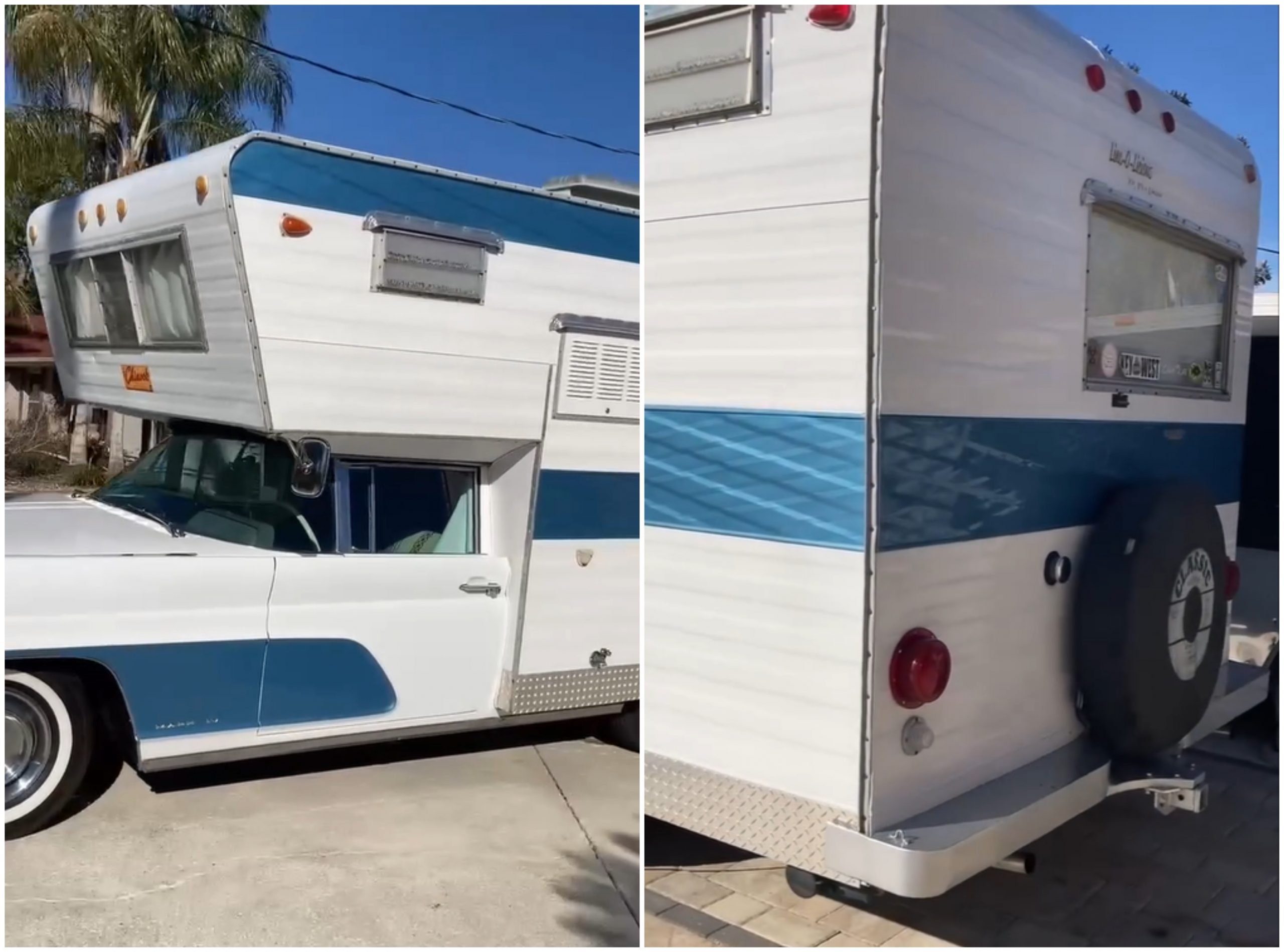
The seller, Mike, says that the body doesn’t have any rust and is in excellent shape. Indeed, from what I can tell in the low-res photos on Facebook, the body is straight, the paint shines, and even the camper portion looks fantastic. Take note that the roofline of the front clip of the car is flat. This did not start life as a professional car.

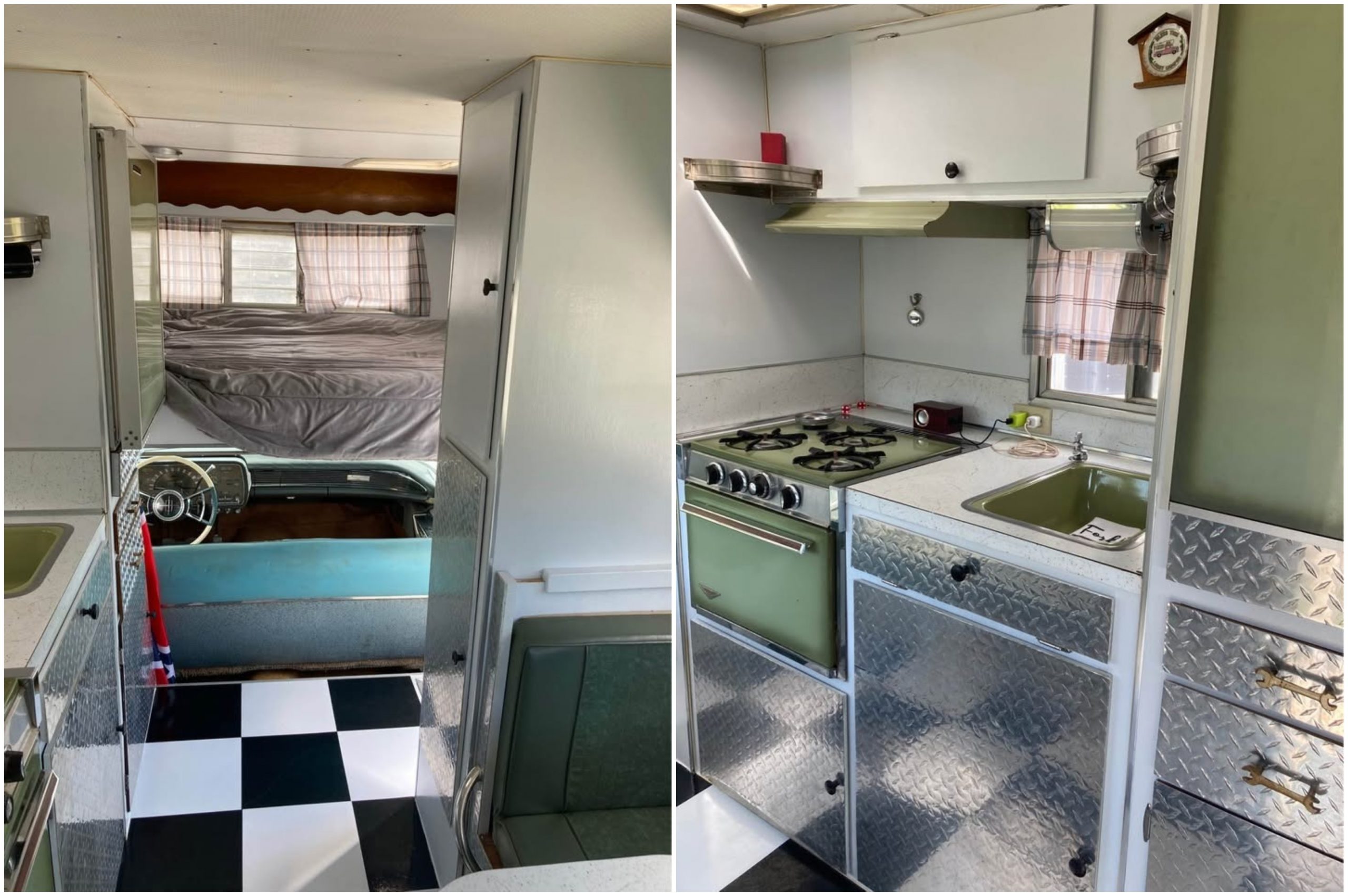
Mike provides no information about the camper itself aside from “has been updated so that it is usable today.” This appears to mean that it was restored. Photos show the drivetrain removed from the vehicle, and the interior photos of the camper show several feet of diamond plate that wasn’t there when the camper was new.
It’s unclear who did the restoration, but the diamond plate might look a bit out of place, depending on your tastes. The camper has diamond plate cabinet doors, diamond plate drawers, a diamond plate wardrobe door, and even a diamond plate dinette base. Some of the handles on the diamond plate drawers are wrenches.

Yet, weirdly, the restoration wasn’t total. The original three-burner stove and combination oven are still there, as is the original sink and the original refrigerator. It would appear that the interior was originally green, and it was partially converted to blue to match the exterior. I wonder if the outside was also green at some point in its life?
A Piece Of History

Anyway, Mike says that the camper has 48,000 original miles, weighs around 6,440 pounds, and is 19’8″ long. That makes it short enough to fit relatively well in a normal parking space! Mike, who is based out of Spring Hill, Florida, wants $50,000 or best offer for this rig.
This camper is a fascinating piece of history. It comes from an iconic company from before that company became a legend. It’s also seriously rare, being one of just under a dozen. I also like how it seems that you could actually use this motorhome for a camping trip today. But you’d also have to be careful. This beauty isn’t made out of fiberglass like a more modern Chinook. There’s lots of wood, lots of places for water to seep in, and, if you were to use it for real camping, it would require ongoing maintenance to keep it in top shape. So, I don’t see this being someone’s main camper.
What I do see, however, is a time capsule back to the days before terms like “Class C” and before the ubiquitous camper built out of a cutaway chassis. This Chinook is a great example of where the RV industry came from. History like this should be preserved, and besides, you’d have the coolest thing at the car show that nobody else will have.
Top graphic image: Facebook Marketplace





The diamond plate gives it a sort of food truck/diner feel. Neat!
I built a 1956 Custom F-series 1.24th scale model as a kid with a chopped to, Chevy rear fenders, and the front grille off of this model Continental. Painted it Metallic Forrest Green. The topshot took me back. That’s all I’ve got to say.
The windshield doesn’t mean that it wasn’t built on a Commercial Chassis, though I don’t know if Ford actually offered a CC Lincoln in those years. The tall windshield or even a windshield wasn’t standard. Here is a Caddy from the 70’s rolling off the assembly line. https://www.curbsideclassic.com/wp-content/comment-image/1030435.png
Look at my avatar, and believe me when I tell you that you don’t want this.
You can’t leave us hanging like that. It sounds like you have an experience, please tell.
This beast is awesome and beautiful. Now it makes me want one like this but make it a 79 Mark V Bill Blass edition!
This is clearly a case of both going big AND going home.
RVs were cool when the speeds were slower.
The decor makes me want to rewatch “The Long, Long Trailer” movie.
I love that movie. When the Mercury is struggling to pull the trailer through the mountains, I actually feel sympathy for the car.
And all the rocks Lucy collected!
They actually switch it out for a Lincoln for the mountain scenes, as the Mercury really couldn’t do it.
Yup, I can’t believe that they expected the general public to not notice that the car switched back and forth between a Mercury and a Lincoln. I noticed it when I watched the movie the first time in the 70’s as a kid. OK sure I was a car obsessed kid but of course wasn’t around when those cars were in the showrooms and on the streets.
The scene where they get stuck in the mud in the rain pretty much scared me from ever wanting a huge RV/trailer.
That thing is really cool, I don’t even mind the diamond plating that much!
That has got to be one of the most obscure not-one-off vehicles I’ve ever heard of.
Makes sense. Until 1965 or so, Cadillac and Lincoln had more powerful engines than you could get in any light-duty (1 ton and under) pickup truck. It takes power to move a rig like this.
This one is as beautiful as a 58-60 could get, and it looks like a decent and sympathetic resto-mod. I’d say the ask is fair.
Many years ago I saw a Cadillac camper much like this, rotting away next to a decrepit tobacco barn in NC, there was an ambulance nearby. Sadly, neither were worth trying to save. My brother and I owned a 59 Cadillac at the time with the giant 390 – I am confident that it could have handled a camper conversion.