


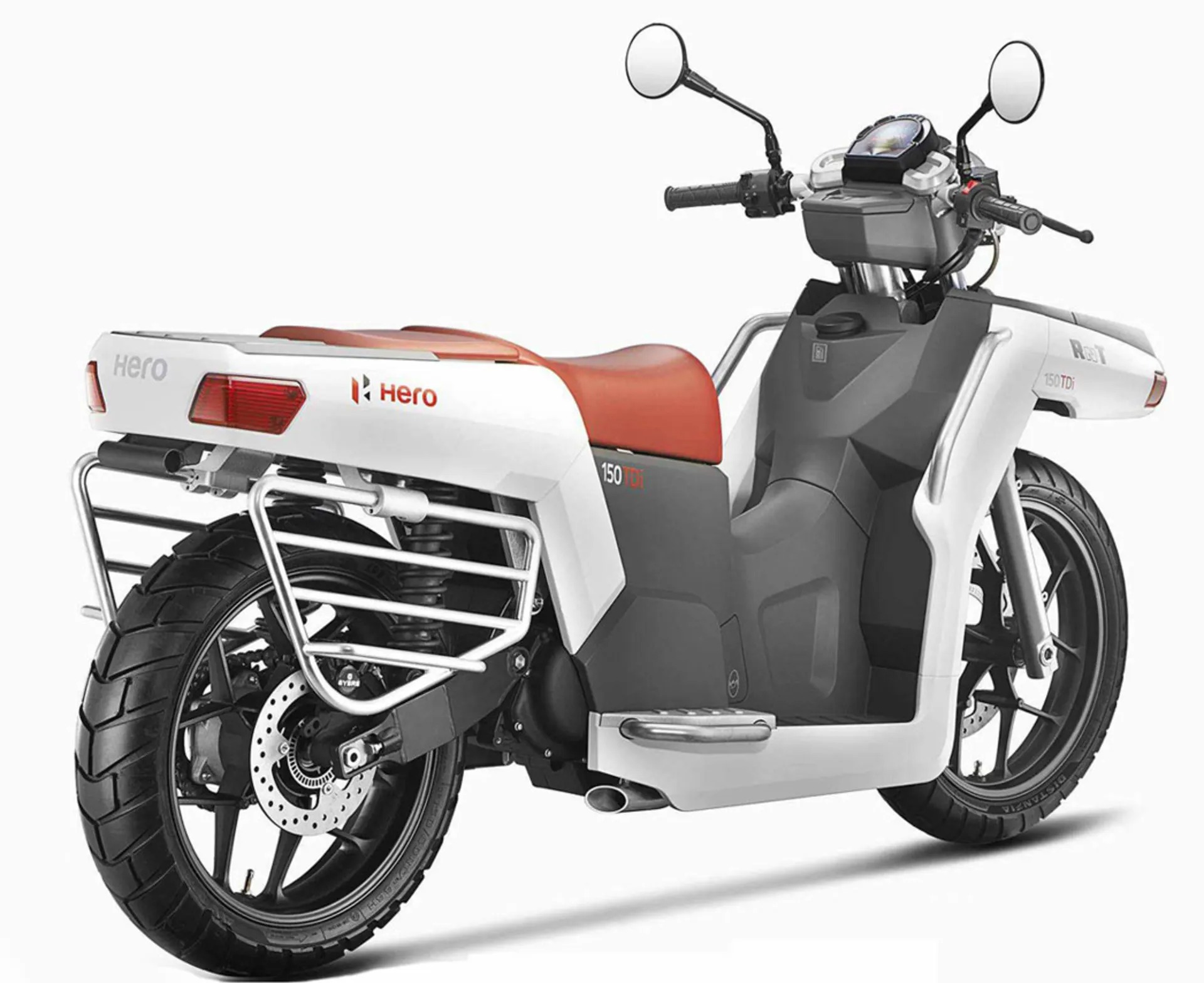
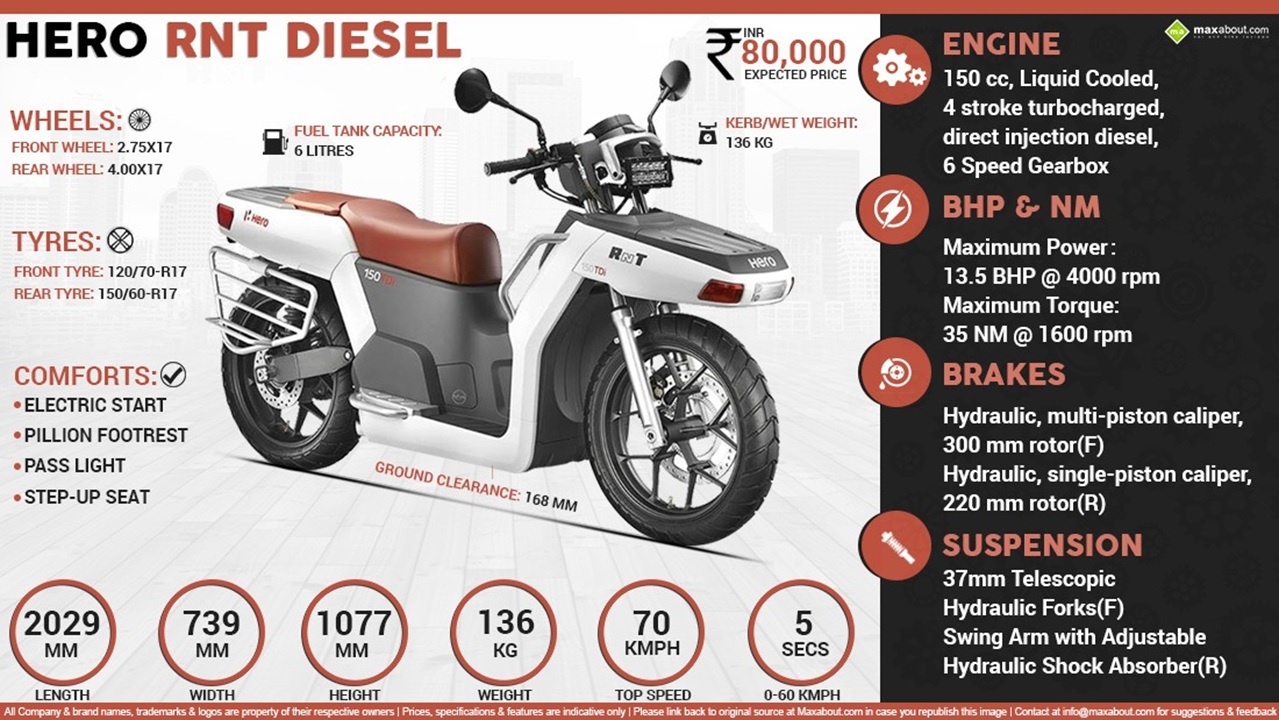
Much of the world depends on motorcycles and scooters, not just for fun, but for affordable daily transportation. If you live in a place like India, a motorcycle or scooter might even be your only vehicle. Companies in these regions are always looking for the next big thing on two wheels, and in 2014, Hero MotoCorp unveiled what wasn’t just the craziest scooter in India, but what might have been the most ambitious scooter in modern history. The Hero RNT 150 TDi promised 298 miles of range on a single tiny tank thanks to a ridiculous tiny mid-engine turbocharged diesel engine working in tandem with an electric motor to create all-wheel-drive. Then, Hero disappointed everyone.
I have been building an extensive catalog on the history of diesel motorcycles. I have written about the world’s only mass-produced diesel motorcycles, the Royal Enfield Diesel and the HDT M1030M1. I have also written about the time when a guy tried to prove the worth of diesel by making diesel sportbikes. There was also that one time when a man tried to make the ultimate adventure motorcycle using the engine from a diesel Smart Fortwo. Then there was also that time when a man made a sporty-looking diesel motorcycle that wasn’t at all about fun. There’s even a man in America right now who is trying to make the Harley-Davidson of diesel motorcycles.


The diesel motorcycle is a concept that has been explored countless times throughout history, and only the Royal Enfield Diesel has been sold in any real numbers. Yes, the HDT combat bike was considered “mass-produced,” but fewer than 1,000 examples were made. The Royal Enfield Diesel’s success was because it came at the perfect time. It was a cheap motorcycle that got 200 mpg at a time when diesel was substantially cheaper than gasoline. It just made perfect sense for countless riders in India. Yet, even the Royal Enfield Diesel ended production once India started taking emissions more seriously.

Diesel motorcycles have to overcome several hurdles. Diesels tend to rev lower and slower than their gasoline counterparts, and depending on design, may shake significantly more while being heavier. Add in the high cost of diesel fuel today and emissions, and you have a great recipe for failure. The Royal Enfield Diesel? It had a top speed just north of 40 mph, depending on the rider, and it took eons to get there. It existed entirely because of its good fuel economy and cheap diesel fuel in the 1990s. Today’s tiny motorcycles, with their efficient and cleaner gasoline engines, are capable of 150 mpg or better without the use of diesel, anyway.
Despite that, some companies keep trying to make diesel a thing. Hero MotoCorp’s diesel scooter was simultaneously the most ambitious and most disappointing modern diesel project.
A Big Deal
Hero MotoCorp of the Hero Group is a big deal in India, but most folks in America have never heard of it. So, I’ll give you a quick primer. Here’s what Hero says:
The success of the Hero Group lies in the determination and foresight of the Munjal brothers, who shared their vision with their workers and led the Group to a position where its name has become synonymous with top-quality two wheelers.
The flame kindled by the Munjal brothers in 1956 with the flagship company Hero Cycles; Mr. Satyanand Munjal, Mr. Brijmohan Lall Munjal and Mr. O. P. Munjal continue to carry the torch and are actively involved in the day-to-day operations of the Hero Group.
The saga is being continued with the same zeal by the second and third generations of the family and by the large working force of the Hero Group. The spirit of enterprise which dominates the progress of the Group is characteristic of the land where it all began – the City of Ludhiana, in Punjab – home to some of lndia’s finest workers and entrepreneurs. The Hero Group is a thriving example of three generations of a family working and striving together to ensure quality, satisfaction and extensive growth.

The company says it got its start in 1956 with the Hero Cycles bicycle shop. By 1963, Hero was exporting bikes out of India, and by 1975, Hero became India’s largest producer of bicycles. Then, in 1978, Majestic Auto Limited was formed and began making Hero Majestic Mopeds. Hero’s biggest break would come in 1984 when Honda, which was looking for a way into the Indian market, created a joint venture with Hero. The result was Hero Honda Motors Limited, which started producing Honda-derived motorcycles for the Indian market in 1985.
Hero, with the backing, engineering, and naming of the juggernaut of Honda, would see rapid growth and become India’s top motorcycle manufacturer in 2001.
Unfortunately, the Times of India writes, conditions within the joint venture didn’t stay positive for long. In 1999, Honda formed Honda Motorcycle and Scooter India, which meant that Honda’s own products would compete with Hero Honda’s products. Allegedly, Honda also became reluctant to share technology with Hero Honda, which meant that Hero Honda’s bikes were technologically behind Honda’s bikes. Other tensions came from the Munjal family’s dislike for paying Honda’s high royalty fees, and Hero Honda’s refusal to merge its parts business with Honda Motorcycle and Scooter India.
Ultimately, the bike manufacturers could not resolve their differences, and in 2010, Hero and Honda split. Hero became Hero MotoCorp, and Honda began charting its own course in the region. At the time, Hero Honda held 59 percent of the market, and so it was still in a strong position.
Hero Flexes Its Muscles, Sort Of
In the years after the split, Hero MotoCorp tried to position itself as an engineering powerhouse that didn’t need Honda’s technology. The greatest, and perhaps most disappointing example of this happened in 2014, when Hero MotoCorp announced a lineup of mind-blowing motorcycles, and then said that most of them would go into production.
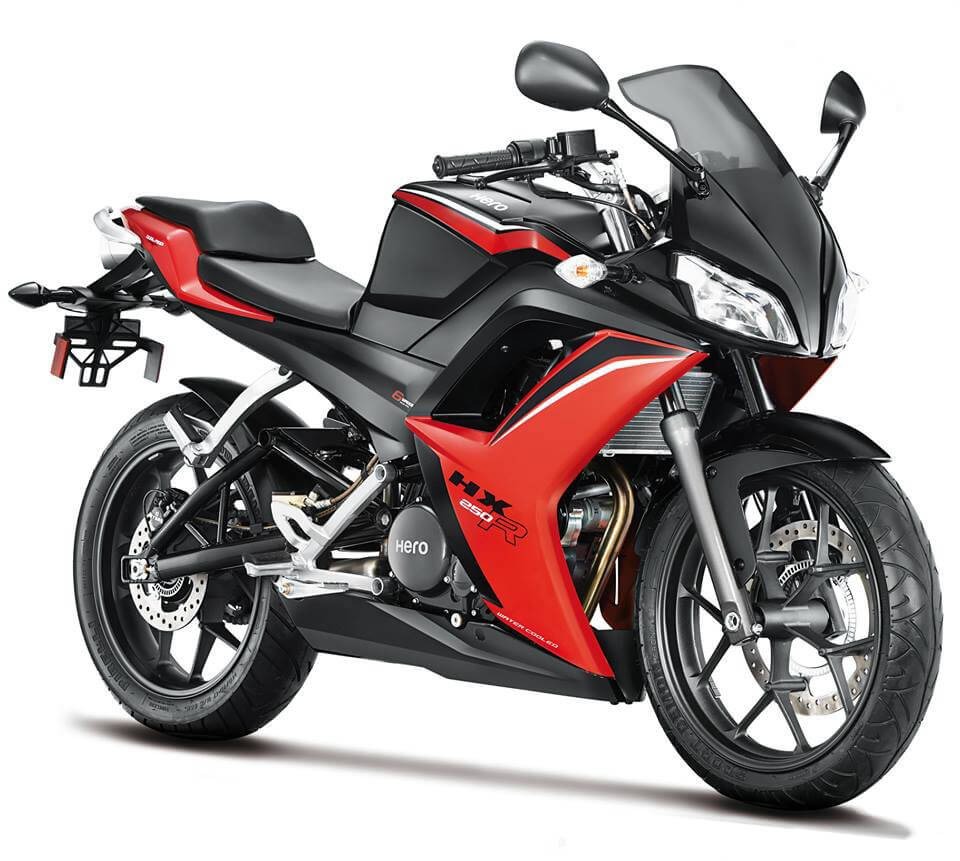
In January 2014, Hero MotoCorp announced its next generation of motorcycles. These motorcycles included the RNT 150 TDi, Leap, HXR250R, Dash, and Xtreme Sports. We’ll get to the diesel in a moment. I just have to point out just how ambitious Hero got.
The Hero HXR250R was touted as a small-bore sportbike that had some Erik Buell DNA. Hero said that Erik Buell Racing, which Hero had a 49.2 percent stake in, had a hand in the design, but it wasn’t clear just what EBR did. But it didn’t really matter, because the spec sheet spoke for itself. The HXR250R had a claimed output of 31 HP and a wet weight of only 306 pounds. To put it another way, this is a 250cc-class bike with specs closer to a 300cc.

The Leap was ambitious in another way, as it was a series hybrid scooter. Seriously, the gasoline engine was used only as a range extender, and Hero claimed that the scooter got an impressive 235 mpg.
The other two bikes, the Dash and the Xtreme Sports, were spicier versions of existing motorcycles that didn’t really have any headline-grabbing specs to speak of. The headliner of the quintet of new motorcycles was this, the RNT 150 TDi scooter.
The Diesel-Electric AWD Scooter

The RNT 150 TDi wasn’t just weird by Indian motorcycle standards, but it was so bombastic that it made headlines all over the world. This was the scooter that would prove that, maybe, Hero was actually better off without Honda.
Right off the bat, this thing just looks weird. The motorcycle press described it as something that looked like it could have been ridden in World War II, and I see it. Paint it olive drab and give it some fleet code, and it’ll look like something a soldier might have ridden out of the back of a plane on. Like a platypus, the RNT 150 TDi wasn’t winning any beauty contests, but it was striking.

The weird looks were honestly only a small part of the whole package. Hero claimed that this bike had a 150cc direct injection diesel engine rated for 13.5 HP at 4,000 RPM and 25.8 lb-ft of torque at 1,600 RPM. This mid-mounted engine could propel the RNT 150 TDi to a top speed of 43.5 mph. A turbocharger was said to be optional for more power and speed.
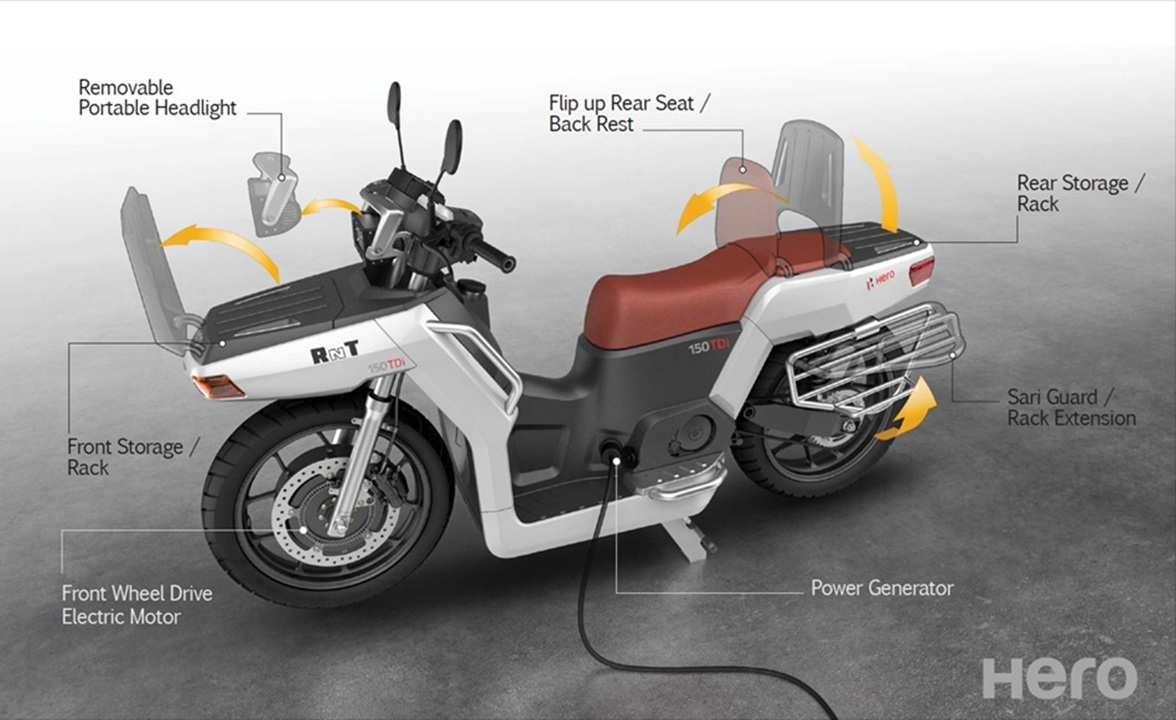
If that wasn’t crazy enough for you, Hero said that the RNT 150 TDi would also get a 1.3 HP electric motor in its front wheel. The diesel engine charged the battery that powered this motor, and Hero said that it would be possible to turn off the diesel engine and run on the front hub motor alone. The RNT 150 TDi promised a 298-mile range on its 1.6-gallon tank, or 186 mpg. You got all of this in a package weighing 306 pounds.
That fuel economy part is interesting. Hero touted all of the tech in this thing, and yet the proposed specs suggested that it wouldn’t get any better fuel economy, nor go any faster, than a Royal Enfield Diesel from two decades earlier. But, honestly, it sounds like Hero MotoCorp just made a scooter that would be pure enthusiast bait today. I mean, you read my headline!
It somehow got cooler from there. Hero said that the diesel engine onboard the bike could be used as a 1.5 kW, 230 V generator. Likewise, its second, upper headlight was removable to become a flashlight. There were still plenty of parts of the developing world that did not have access to an electrical grid. In theory, this scooter could have provided power and lighting to anyone anywhere.
What Happened To The RNT 150 TDi

When asked about producing more than just a show bike, Hero claimed that it was actively developing the RNT 150 TDi for production. Hero CEO Pawan Munjal said, “We will have to do much research before we bring it to the commercial arena.” Hero would also say that it was putting the other four motorcycles into production.
The Dash and the Xtreme Sports did go into production. However, as I noted earlier, both of these were based on existing platforms. The Leap, HXR250R, and RNT 150 TDi all died before reaching production. In 2016, Hero would announce more ambitious concepts, just to fail to deliver on those, too.

In 2021, one of India’s popular motorcycle blogs, Bike Advice, wrote a story detailing just how disappointing Hero was in its post-Honda era. None of its innovative concepts ever became reality, and, as the blog said, the hottest bike in the Hero lineup made a measly 18 HP. Bike Advice went as far as to openly wonder if Hero was just pulling a fast one:
Funnily, after 2014, Hero has never talked about the RNT ever to the media. So, the question that I have is – was RNT a prank … ?
It’s unclear why Hero never put the bikes into production, but so far as I can find, Bike Advice is right. Hero took these concepts on a big media tour, and then never talked about them ever again. Instead, the brand focused on improvements to its smaller models.
What’s even sadder is that, as the India Times wrote in 2024, Hero lost so much ground in India that its old partner, Honda, surpassed it in the wholesale market. Hero was still number one in retail sales, but its lead was eroding. By July 2024, for example, Hero MotoCorp held only 29.4 percent of the market, a long fall from where it was 14 years prior. Thankfully, Hero has been on the rebound and reclaimed its crown in September 2025.
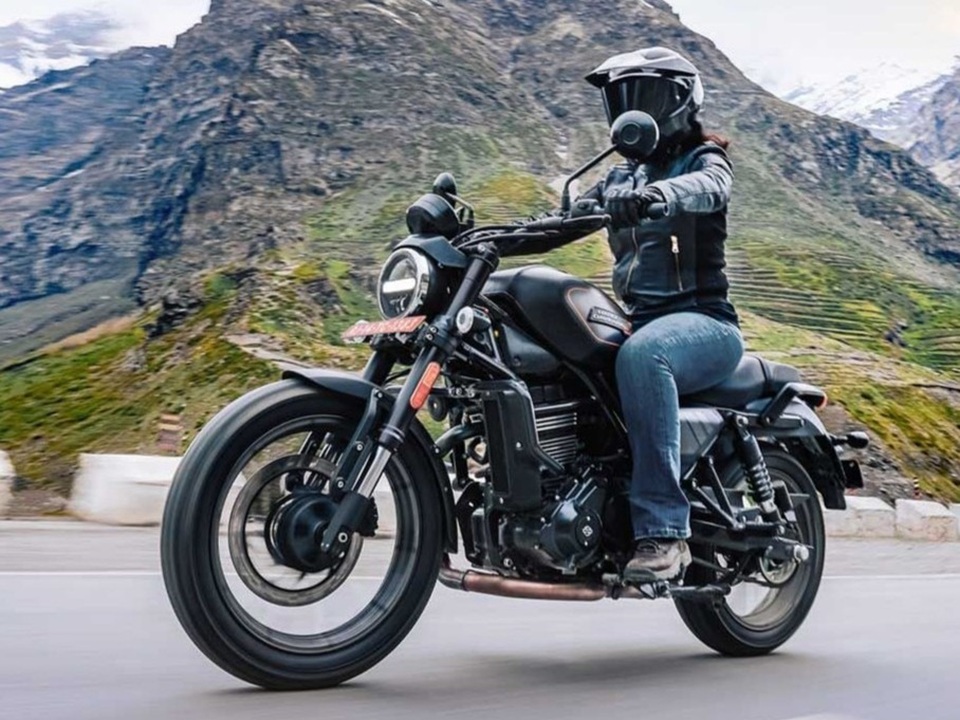
So, if you were like me and read about this scooter some 11 years ago and wondered what happened, now you know. Hero had ambitious plans, and then never saw them through. That’s a shame, because I would have loved to ride the RNT 150 TDi. But I suppose it’s not all bad, as Hero has partnered up with Harley-Davidson, and that relationship appears to be paying off well for both parties. Harley gets small Hero MotoCorp-designed bikes while Hero gets to distribute Harleys in India. Hero has also been positioning itself well in India’s lucrative electric moto market, too.
I think the most fascinating part about this story is that the diesel motorcycle is a concept that refuses to die, no matter how many times it doesn’t work out. We’ve now seen diesel motorcycles fail to work out in almost every segment. Yet, I can’t wait until the next time someone gives it a try, anyway.
Top graphic images: Hero Motocorp




Thank you, at the time this was everything I wanted in a bike, and I always hoped it was made somewhere in the world. Too bad timing, tech, and business partnership killed it off. I think we might be past the time of the diesel bike now with the advancements made in fully electric bikes, but maybe someone will figure it out. A diesel Rokon would be very cool…
Dang that is cool! Unfortunately, too good to be true.
“Hero said that the diesel engine onboard the bike could be used as a 1.5 kW, 230 V generator. ”
I really enjoy hybrids that also work as generators; if you already have all that emissions equipment and electronics, why waste more money buying a carbed generator? (one more thing to maintain too)
My EREV’s engine cranks out 10KW max when parked, but the real bottleneck is in the on-board charger, which only manages 3.5KW (220V 16A) in inverter mode. Not a lot but you don’t really need to run much in an emergency. Real efficient too, squeezes out 3.3kWh from one litre of gas, or 12.5kWh per gal.
Maybe I’m blind, but I didn’t see anything that looked like a front hub electric motor. What were they doing? Electromagnetically driving the ABS ring?
My Honda ADV 160 will (eventually) do 70 mph and gets, eh, almost 90 mpg on gasoline around town.
I had a 2001 Jetta TDI 5M that would get about 50 mpg on the freeway, but my ’17 Honda Accord V6 gets about 40 mpg on regular on the freeway, which makes it about a wash on fuel costs. At least on long trips. And the VW needed a lot more maintenance. The Honda, admittedly, is far thirstier around town. But here in the PNW, diesel is a dollar more expensive than regular.
The Jetta was a stick. Which automatically (ha!) made it fun to drive. I loved the Jetta. But I also love the Accord. I had a friend out from Boston this week and he has a 2008 Audi S4 that is starting to attack his wallet. Riding around in the Accord, he went online to find a car like mine. Five years ago, it was the other way around.
We are both in our late 60s, and climbing out of low-slung sedans is not as easy as it used to be. His S4 is a couple of inches harder to climb out of than my stock Accord.
The lede photo and the same image used about 2/3 of the way through the article definitely does NOT have a front hub motor.
Also, aren’t all scooters “mid-engine”??
Also, $900? Seems too cheap for all that tech, no matter HOW CHEAP you make every component and how much final assembly is expected of the final owner!!
yea, and the other image render that mentions the front motor looks like a completely different front wheel/hub setup than those other images.
I remember hearing about Hero when they partnered and then later walked away from EBR. They are pretty much the reason why EBR went bankrupt the first time. (not to be confused with Buell Motorcycle Company that went away in the late 2000s)
Don’t forget to add the diesel KLR650 to your list.
That removable headlamp looks suspiciously like a flashlight.
What does a powered front wheel on a two wheeler feel like? Significant impact on the steering feel? Do they use that on stuff like Dakar racing bikes?
A Yamaha 2wd bike won in 2004
https://www.mcnews.com.au/yamahas-wr450f-2-trac-two-wheel-drive/
Very interesting! Thanks for posting.
Turbodiesels are turning up in light vehicles as performance engines, which seems to justify the weight.
It would seem that would apply to bikes as well.
There is at least one diesel Lotus race car that is competitive.
Seems the smaller load of fuel and extra power make up for engine weight.
I would think a diesel bike would work once its performance was proven.
Aren’t all motorcycle engines, by definition/design, “mid-mounted”? Or, IIRC, do some scooters, like a Vespa, use hub-mounted ones?
I think mid-engine is the default for motorcycles; the Solex and a few clones have the engine over the front wheel, driving the front wheel through a friction roller. There were some rotary-engine bikes in the early 20th century where the front wheel was attached to the cylinder heads, and the crankshaft was the axle. None of those was a mainstream design.
One can only imagine what riding a bike where the engine was spraying oil in your face, especially the castor oil preferred in rotary engines, which is a powerful laxative
I suppose “mid-engine” might have been a poor descriptor. I would describe a Vespa as being closer to rear engine. Many typical scooters have engines integrated with their transmission and swingarm. A typical motorcycle also has its engine much closer to the front wheel than this. In this case, it’s almost exactly right in the middle!
The prototype RNT 150 TDi. was built in the UK, Rather more specifilacally (never ask me to spell that word) in a workshop in Kingsclere, Hampshire. An old council depot that is now a retirement home for ex- jockeys. If you want to ride one, I am able to help, I think it might be number three, it just works, chugga chugga chugga. I believe the problem was that unit production cost was going to be too high, and they were designed to be unbreakable. Sel one once and the customer will never bother you again. Not a good bit of capitalism.
WOAH! I absolutely want to ride that! Plus it gives me an excuse to go to the UK for the first time ever.
Feel free, there are terms and conditions, most of which involve steam engines.
Oh, I can’t wait to read this!
On a scale of bad ideas this one gets well into the red, I live in half a castle, the other four fiths of it are sort of missing although some of it might be the sheds, most of it is recycled Hadrians wall anyway and, while I can type, the non typing me is rather different. The whole looking like Rasputins evil twin stuff is easy to explain, I am, obviously …. etc. The Steam engine Nic is just that, yess, the toys are big real things, I am not sure about Me though!
But aren’t bad ideas sort of a theme here at the Autopian?
There’s more to be learned from bad ideas sometimes.
At least that’s what my therapist keeps reassuring me of.
My family motto is; Life lessons are learned from your mistakes. An education is learning from other people’s mistakes. If you’re going to make mistakes, try to make new ones
As a mentor/trainer for the past 2 decades, I concur with your entire post, but particularly the above part.
Thank you! That means a lot a lot to me.
The other motto relating to leadership is; You can’t push string.
But, you can’t tell people that, you have to do it.
When I had a job that involved telling people what to do, I had a big ass whiteboard which was customary for people in my position. The company I was working for had all these motivational posters that read “Failure to plan is planning to fail” which I loathed. I had that written on my whiteboard, but vigorously crossed out, and under it wrote “Have a plan for failure”
and
“Always make new mistakes”
I could pretty quickly figure out my working relationship with anybody by their immediate reaction to reading that.
Color me surprised that they actually built a prototype! I figured it was vaporware.
As a working motorcycle, I don’t find the design offensive. Replace the entire drivetrain with a ~2000 watt electric motor and a reasonable battery, and I think it could have been a successful cargo e-scooter.