

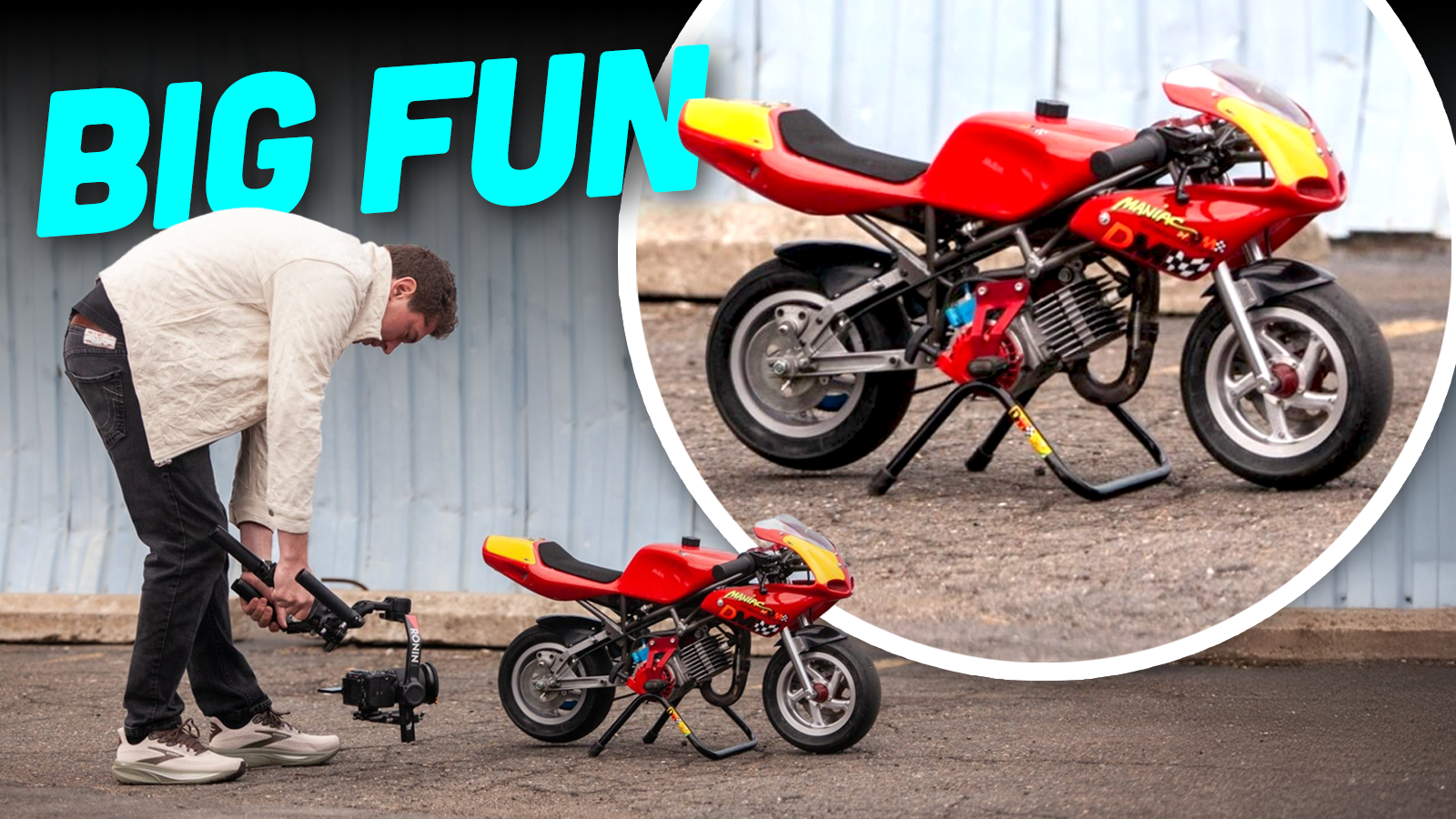
The pocket bike was a wild fad that captured the hearts of riders of all sizes, all around the world. These tiny motorcycles weren’t toys, but real bikes, seemingly hit with a shrink ray and squeezed down to about a quarter of full size. And they weren’t just novelties; serious, professional racers even took pocket bikes on the track. You can still experience pocket bike fever today. This is the 1995 Nuova DM DM1 SS, and it comes from the golden era of pocket bikes. This tiny machine has a 40cc two-stroke engine, a trellis frame, disc brakes, and oh yeah, it can carry a full-sized adult at speeds of 40 mph to 60 mph.
Pocket bikes were once all over America in the 2000s. When I was a kid, I remember my parents driving by powersports dealers and nearly every single one of them seemed to spill over with colorful electric ride-on scooters and tiny motorcycles that stood barely a foot tall. All of these motorcycles, which weren’t road legal, had engines as diminutive as their frames and featured relatively low top speeds. For many kids, these tiny motorcycles were their first experience on a powered two-wheeled vehicle and were a gateway to them becoming motorcycle fans as adults.


Many of those pocket bikes of the 2000s were cheap imports from China that were closer to being toys than they were machines built to last. You can still buy one of those pocket bikes today for only a few hundred dollars. But the miniature motorcycles that inspired the flood of cheap imports were far from playthings. When you look past the adorable looks, you’ll notice that serious pocket bikes are designed and built like full-size racing motorcycles, but come in a far more accessible package.

These are motorcycles with complex, lightweight frames, souped-up engines, a race bike riding position, and even adjustable suspension. That’s what this 1995 Nuova DM DM1 SS Pocket Bike is. This Italian-built machine looks like a toy, but it’s far from it.
Two Wheels Tiny
Japan was obsessed with the miniaturization of motorcycles in the 1960s. Famously, in 1961, visitors to Tokyo’s Tama Technical Center amusement park were invited to try all sorts of experimental Honda vehicles at the park’s Motorland section. There, Honda had a bunch of kid-size vehicles, including hot rod cars, cars that looked like flying saucers, and mini motorcycles. Honda also brought full-size motorcycles to the park, too, and visitors were encouraged to wring those little engines out to their heart’s content.

One of the tiny vehicles was the 49cc Z100. Honda built the little motorcycles as an easy rider training tool. But as it turned out, everyone from all age groups just had a total ball riding them, and expressed interest in having a Z100 of their own. In 1964, Honda started selling the CZ100 in Asia and Europe. In 1968, America finally got Honda’s pocket bike with the Z50A. You might know these bikes better by their nickname, the Monkey, which is a nod to what their riders look like.
Tiny motorcycles would become extremely popular in Japan in the 1970s, with the Monkey being followed up by the Honda SL70, the Honda Trail 70, the Yamaha Mini Enduro, the Suzuki Trailhopper, and many more. Lots of Japan’s tiny bikes were road-legal micro versions of off-road machines, but the motorcycle manufacturers also built tiny versions of racing motorcycles, too.
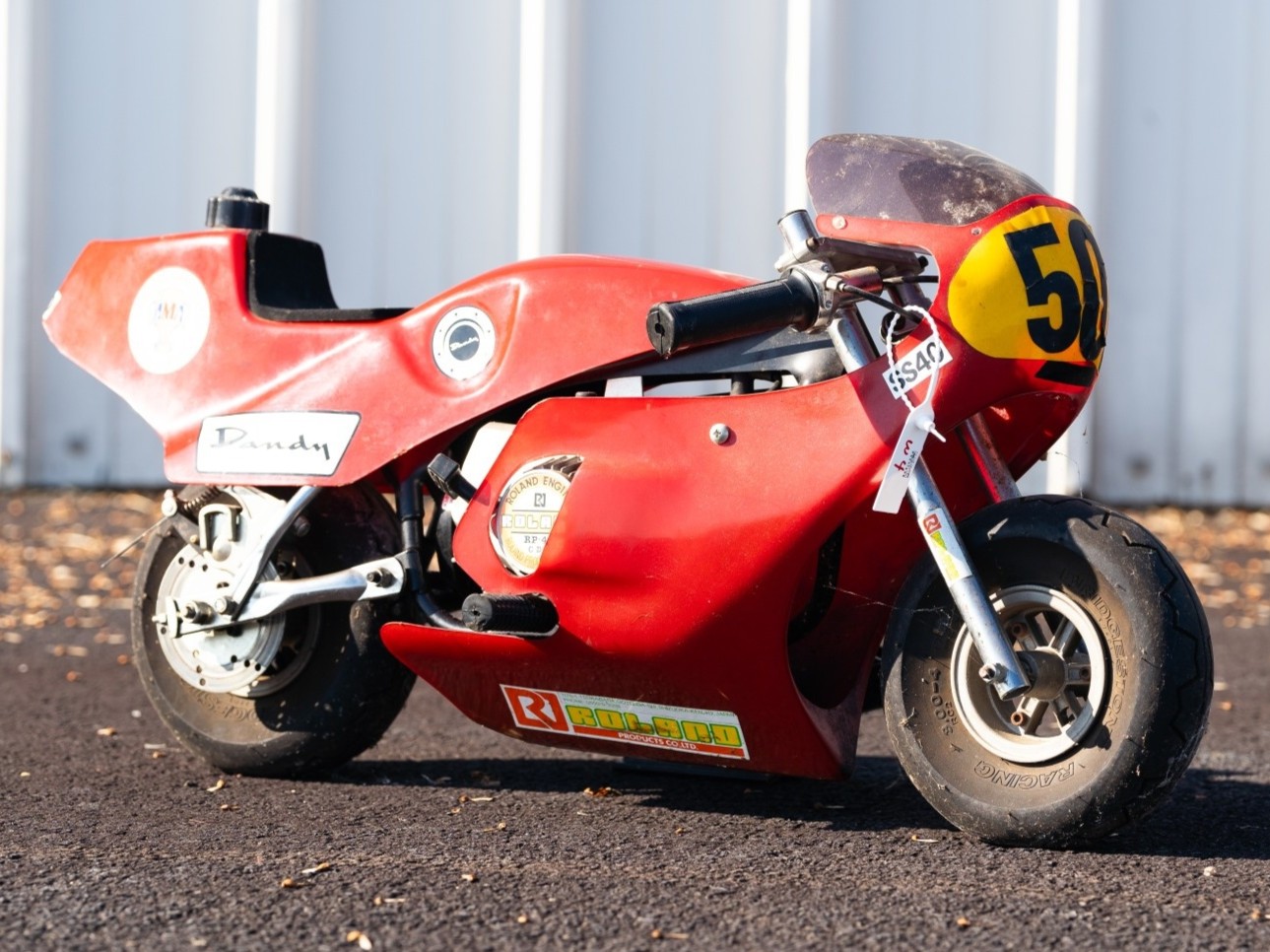
One of the most famous Japanese pocket bikes of the era was the Dandy MR40 (above). Built starting in the 1970s, this motorcycle looked like it was a toy, but the idea was that the youth would take the 40cc 3 HP two-stroke cutie racing.
A competitor to the Dandy MR40 was the Bullet 308, which featured a 33.6cc single-cylinder engine. These motorcycles were surprisingly detailed despite being much shorter than two feet tall. They featured racer-style fiberglass fairings, tiny windshields, clip-on bars, and a motorcycle-inspired frame.
Pocket Bikes Went Racing
The genre of pocket bikes would explode into a full-blown racing series. As Cycle World wrote in 1981, pocket bike formula racing was born in the 1970s and had become such a big deal that 18 motorcycle manufacturers were cranking out pint-sized racing machines that raced on over 100 tracks around the nation. There were even classes where racers could field stock pocket bikes or modified ones.
As Japan miniaturized its motorcycles, a different kind of tiny motorcycle took off in America. The minibike and the pocket bike might be similar in size, but they’re technically different motorcycles. America’s minibikes were very simple affairs featuring basic, open frames, lawnmower-style engines, no suspension, and a more relaxed riding style. These bikes were incredibly practical machines for covering a decent amount of ground off-road on a vehicle that could fit into the back of a car. But, notably, they weren’t really made to work like a full-size motorcycle at a third of the size. Pocket bikes, however, featured some of the same engineering and technology used in full-size motorcycles.
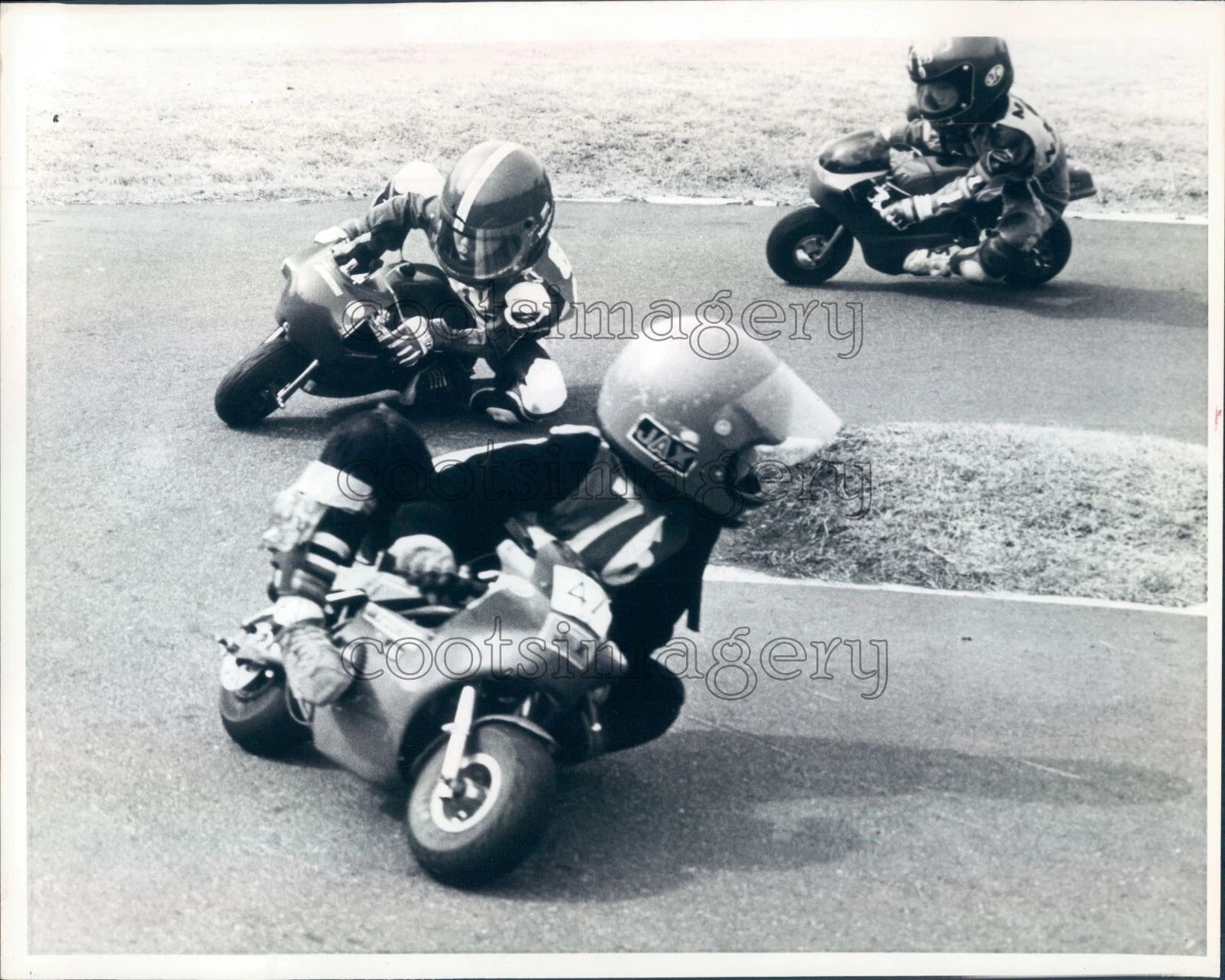
Italy began taking pocket bikes just as seriously as Japan did, and Italian motorcycle companies started miniaturizing the tech in their racing machines for bikes that had only 50cc or less. Pocket bike mania also reached the United States, where importers began scooping up as many Japanese pocket racers as they could. From Motorcycle Classics:
Standing about knee high to most adults, a typical Pocketbike looked for all the world like a mini road racer. The frame had no suspension other than the cute little air-filled donut tires connecting the bike to the pavement. Engines were single-cylinder 2-strokes, usually displacing less than 50cc and good for about 1.5 to several horsepower. No need for shifting gears, either. The direct-drive centrifugal clutch allowed for twist-and-go riding, making the bikes especially popular among youths. In fact, racing was intended for children of all ages, and as you might guess Peter Pan adults (read: dads) often joined the action, too (for safety’s sake, classes were segregated to the respective age groups). And speaking of Peter Pan adults, as Sport Editor for Cycle Guide magazine at the time, I was invited to sample a Pocketbike for a magazine “Track Test” article. My mount was a Dandy MR30, a thundering beast powered by a vicious 2-stroke engine that belched 1.98 horsepower, translating to a top speed of 35 OMG mph.

Japan would also apply the micro bike treatment to race replicas, too, creating such awesome machines as the Yamaha YSR50, Honda NSR50, and the Suzuki RB50 GAG.
Italy Takes Pocket Bikes Very Seriously
The pocket bike madness flourished through the 1980s and the 1990s. MiniMoto racing would grow to become a worldwide phenomenon, and it would become so serious that MiniMoto racing became a proving ground for who would become great motorcycle racers. Riders looking to break into 125cc and 250cc Grand Prix racing started on MiniMotos first.

Before Valentino Rossi became one of the most famous names in MotoGP, he cut his teeth on karts and pocket bike racing. Other greats that started on MiniMotos included Loris Capirossi and Nobuatsu Aoki. The late Marco Simoncelli also rode pocket racers before he became famous. Basically, while Japan might have come up with the idea of micro racing bikes, Italy supercharged it as a sport.
The pocket bikes became more extreme, too. Manufacturers put even greater engineering work into their tiny bikes, producing lighter, faster machines that, depending on the rider and the tune, could exceed 40 mph and possibly reach as fast as 60 mph. Over in Italy, Blata, GRC, Polini, and others outfitted their tiny bikes with racing-inspired frames, hydraulic disc brakes, and more. One of these machines was the 1995 Nuova DM DM1 SS, which was pretty much just a racing bike that spent too much time in the dryer.

Italy’s DM started off as an engineering firm that built prototype racecars, race motorcycles, sidecar rigs, motocross bikes, and even mountain bikes. In 1991, the firm took note of the rise of MiniMoto racing and decided to launch DM Minimoto as a brand to cater to the Minimoto racer.
Since then, DM says that it has won 59 championship titles in Italy and more in Europe. Further, the company claims, nearly 700 MiniMoto riders have raced on a DM-branded racing machine, making DM one of the largest Minimoto players in Italy.
Honey, I Shrunk The Race Bike

In 1995, the company, which branded itself as Nuova DM, marketed four different versions of its DM1 MiniMoto.
Nuova DM said that the DM1 starts with a molybdenum chrome trellis frame, which the company says guarantees the highest resistance, elasticity, and lightness. Molybdenum chrome makes a return for the forks, and the swingarm is made out of aluminum. Steel is used for the handlebars, and the 40cc two-stroke single functions hangs from the frame, just like a modern bike!
DM doesn’t publish a weight for the DM1, but other racing pocket bikes have weighed in the range of 40 pounds to 50 pounds. That’s right, it weighs less than some car batteries!

That engine, which was available with air-cooling or water-cooling, pumps out 9.8 horsepower at 10,500 RPM and runs at a compression ratio of 14.5:1. Power reaches the rear wheel through a dry-plate centrifugal clutch and a chain final drive. Other neat spec sheet notes is a magneto ignition, a Dellorto PHBD 14 BS carburetor, and a recoil pull start, like a lawnmower. The DM1 rides on 6.5-inch wheels with 110/50 tires and uses Polini mechanical brakes in front and rear.
The four versions of the DM1 in 1995 included the DM1 SS, the DM1 S, the DM1 PSS, and the DM1 Super Motard. The S version came with 7.5 horsepower and the option for six-inch wheels. The PSS reduced output to 6.2 HP and gave the rider the option of five-inch wheels or six-inch wheels. The Super Motard featured five-inch wheels, 6.5 HP, and no front fairings.

The one up for grabs today is a 1995 DM1 SS, and it has the 6.5-inch wheels, the 9.8 HP engine tune, and a full body of fiberglass fairings. According to the Bring a Trailer listing, the original owner of this motorcycle was quoted a price of $1,365 ($2,944 in 2026) to buy it new. Apparently, the buyer also got a DM1 SS water-cooled pocket bike in the same order for $1,511 ($3,259 in 2026). Then, the buyer shipped both to America, paying $534 ($1,151 in 2026) in import charges. One of the benefits of buying a competition vehicle is that they are usually exempt from the 25-Year-Rule. The documents suggest that the bikes were imported as motorcycles for children.
But the owner apparently didn’t do much racing with the machine, as it’s noted that it sat on static display with its first owner until being sold in 2021. Unfortunately, since there is no odometer, it’s unknown just how much the bike was ridden. But the fact that the motorcycle doesn’t even appear to have a scratch on it would suggest that it probably wasn’t raced much, if at all.
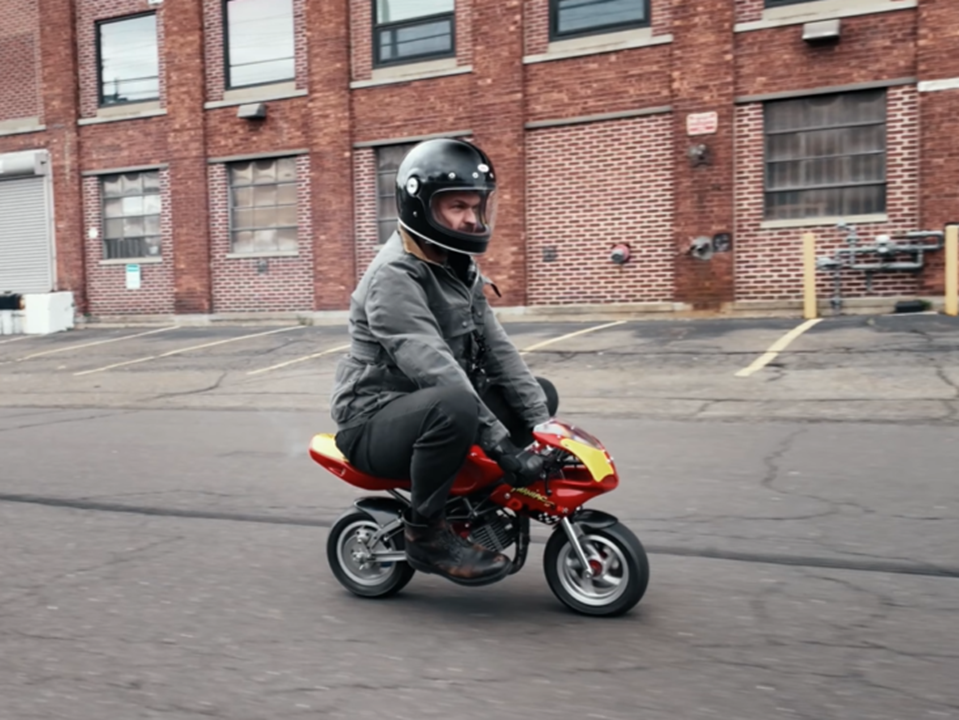
The amazing part is that the current seller has provided a video of not just the motorcycle running, but scooting around with a five-foot, 10-inch-tall adult riding it. The image is just as silly as you think it is.
As of publishing, the 1995 Nuova DM DM1 SS is bidding at $700 with five days to go on Bring a Trailer. Should you get this bike, you’ll have an interesting piece of motorcycling history that represents a different era.
A Fun Piece Of History, But Wear Gear

In the 2000s, Chinese pocket bikes flooded America. Many of these bikes weren’t really sportbikes at a quarter scale, but were made as cheaply as possible. That drove down the prices of pocket bikes from the thousands to as little as $185, but it also meant that there were lots of kids and teens buzzing around neighborhoods on these things.
In 2004, the Los Angeles Times detailed a number of cases where youth riding pocket bikes in the street were tragically killed by trucks and other motor vehicles. In 2003, the Consumer Product Safety Commission estimated that America’s hospitals treated some 2,345 injuries related to accidents involving minibikes, trail bikes, and pocket bikes.

Consumer advocates were reportedly concerned because even the cheap pocket bikes went as fast as 40 mph, which was already pretty fast for a kid who might not know how to ride, but were also so tiny that they’d easily disappear under the hoods of America’s trucks and SUVs.
Still, pocket bikes did find a grassroots competition niche in America, too. But as a consumer product, the pocket bike fad eventually faded in America. The people who might have bought pocket bikes in the past are now riding pit bikes or something like a Surron electric bike. MiniMoto racing continues to be popular in Italy, Japan, and Spain.
That just means that this DM1 SS is a time capsule of what used to be. It represents the pocket bike racing genre at some of its hottest. It’s a small bike that wants to be a literbike when it grows up and packs the power of a Honda Grom into something a quarter of the size of the average sportbike. Can you legally ride it on the road? Absolutely not. But I’m not sure there’s a smaller motorcycle out there capable of generating bigger smiles for all ages.
Top graphic image: Bring a Trailer Listing


Back in the mid-00’s I raced a hack job YSR50 with an XR100 engine around OH/PA. Still have it and another YSR.
I had an Italjet M5A when I was in middle school. I could barely fit on the thing and it was crazy fast for its size.
This takes me back to the early 2000’s, when I was the part owner of an indoor gokart track in Switzerland. With my partner, we decided to spice up the offering at the track, and bought some 15 Polini Mini Supermotard ( https://moto-trips.com/motorcycle-catalog/polini/mini-supermotard/2004/ ) as an alternative to the karts. At first customers were a bit reluctant to have a go, and so I would offer to ride together with them to teach them the basics. This way, they would very quickly get the hang off getting your knee down in the corners, and then they were all hooked!!
Eventually we started a local championship with these, and I would race for fun the first season. We had a blast! For a motorcycle rider to be able to safely scrape your knee in every corner, and begin to learn how to slide the rear while exiting the corners just like we would see the racers in MotoGP do was just incredible.
The bikes worked great, but it is true that we had quite a lot of repair work to do on them most every day.
Along with tiny cars, Shriners ride lots of tiny motorcycles too. I’m curious if they’re riding these, or if there are other sources.
“full-sized adult” for very small values of “full-sized”
I’m just saying that my 6’6″ 2## lb body is not fitting on that.
She might have edited the title, but I noticed it said “adult” no qualifications of “full”, “half”, “hobbit” or “human” for that matter.
I quoted from the body of the article:
“This tiny machine has a 40cc two-stroke engine, a trellis frame, disc brakes, and oh yeah, it can carry a full-sized adult at speeds of 40 mph to 60 mph.”
But yes, a hobbit or a gymnast is most likely.
With a proctologist on speed dial..
The average height of an American male is 5’9″. The rider in the screenshot was 5’10”. I can’t imagine the adults who race these things are much shorter. Full-sized adult is technically correct, though entirely impractical for someone of your stature. 🙂
Technically correct; he best kind of correct.
You’d be surprised. If you can sit on the floor with your knees bent and arms wrapped around your shins, you’ll fit about as well as any normally-sized adult. Which is not very well, to be clear. No-one is saying it’s comfortable, just that if you can somehow perch on top and cling on, it’ll go.
I managed to ride one of these about 20’ once – 6’5” 230, defensive tackle build. Back in the 90’s a friend had a gaggle of these. The looked like shrunken sport bikes. I was just too big to fit and operate the thing with any degree of safety. A group of us used to get together and everyone would rat around the neighborhood on them. I’d relax in a lawn chair in the garage and guard the beer.
7.5hp from a 40cc works out to 187.5hp/liter. Pretty much on par with modern literbikes.
I’d like give one a try, just to be able to scrape a knee fully upright
A guy in my neighborhood has one of these style bikes, I remember riding it about 23 years ago or so. I don’t recall the brand but it was similar in appearance to this one. Man that thing was interesting to ride. First gear got to you walking speed before you had to shift, but it was fun to tear around the neighborhood streets for sure. Can’t imagine how slow it’d be now that I’m 50 LB heavier….
So this is what Big Fun did as a follow-up to their late-80’s hit song “teenage suicide: don’t do it.”
The combination of low ride height and non-folding pegs led to me having a 2-stroke era MotoGP-style highside that totaled mine. Luckily I “only” had a lot of road rash, and it convinced me that it was probably a good idea to stick to full-sized bikes.
These things were all over the place in my town about 20 years ago, people were using them as transportation and running amok, they promptly got banned. I remember once seeing an adult and two kids riding down the street on one.
Weight doesn’t seem to be published, but the seller of the one on BaT thinks it weighs about 45lbs, which against my kid’s 110lbs CRF50, is pretty impressive.
I haven’t had mine for a while, but 45-50 lbs sounds about right.
I remember pocket bikes being everywhere when I was in high school in the early 2000s.
One memory is forever burnt into my brain:
I was sitting in one of the hallways by one of my lockers, near one of the rear exits of the school.
I can hear what sounds like a chainsaw outside, and a screeching brake.
All of a sudden, the door flies open and some dude picked up his pocket bike and just started running with it, still idling.
About 20-30 seconds later, the maintenance staff barged through the door in hot pursuit.
I can’t remember if they ever caught him, but there was an announcement the next day about how they’re banned from school property.
As an avid downhill skateboarder: This looks like an absolute riot. These things would probably be a ton of fun on a pump track too!
They would very briefly be a ton of fun on a pump track, before briefly being fun above the track, and then perhaps not so much fun in the rapid transition to beyond the track.
Paul Newman did a funny ad for American Express with a pocket bike back in the day:
https://www.youtube.com/watch?v=uXmWHMmne5g&pp=ygUicGF1bCBuZXdtYW4gcG9ja2V0IGJpa2UgY29tbWVyY2lhbNIHCQkECwGHKiGM7w%3D%3D
Those car ads without cars have nothing on this card ad without any cards.
No-one complains about tampon ads without any tampons…
Friend of mine used to do YSR50 racing at the local kart track. Big hoopy fun.
I would rather have the old YSR50. Too Bad the 5 speed trans made it a motorcycle in the moped registration crowd.
Maybe I am not fit enough to fit. Certainly I would throw a fit when I don’t fit. Or maybe I don’t have the appropriate fit to fit. either way, I am not fit to fit.
I would imagine watching these race must be quite a sight.
And when they’re coming around the first bend at full chat, my lizard brain would probably immediately start screaming “IT’S A BUNCH OF MONKEYS HUMPING HORNETS NESTS! GET IN THE CAR!! GET IN THE CAR!!! WE GOTTA GET OUTTA HERE!!!”
“he’s hunched over like a monkey fuckin a football!”
I took a Honda RC51 toy replica and retrofitted a 24Volt battery set and controller along with a larger motor. I then put a pair of car stereo capacitors under the tail with NOS energy drink bottles over them so it looked like it had nitrous, but also gave you real-world oomph for a 185 lb rider on takeoff. I’m retrofitting it with a lithium battery for my 11 yr old son now. Pocket bikes were fun times.
The number of kids that I used to see riding up/down the street years ago with just a t-shirt and shorts in the midst of residential traffic with nary a worry – I have to wonder how many of them took a trip to the hospital emergency room.
Usually it’d end up with someone calling the cops, and that would have the kids reigned-in for the rest of the day.
Today those kids are on the Sur-ron style “ebikes”. I see kids on those things all over suburbia and they seem to use sidewalks, bike lanes, or the street interchangeably. Maybe 50% of them have a helmet on, 100% are wearing just a t-shirt and shorts, and 0% of them are doing any actual pedaling.
I’ve been on my motorcycle in a 45mph zone and a 10 year old on a Sur-ron was “racing” me on the sidewalk keeping pace. There’s already been a few high profile accidents/deaths related to kids on ebikes on the local news and the gears of bureaucracy are slowly grinding to life on new legislation surrounding it.
I am all for the democratization of “motorcycles”, but these kids are absolutely reckless and then think they can get away with it all. More of the bikes should be impounded when they are doing stupid shit. I know most those kids didn’t buy those bikes themselves. Hold the parents responsible.
Even if you just hold the parent’s insurance liable: my parents would have reacted quickly to a change in insurance rates due to my choices as a child.
My hot take: if you don’t need to pedal, it should be classified and treated as a motorcycle/moped – no different than if it had an ICE.
I can’t disagree with this one. Or with the insurance premiums. I think california more or less just banned those types of bikes? Or at least amazon won’t sell them anymore.
Just another example of why we can’t have nice things. It sucks because Sur-rons are actually pretty cool when used properly…
Yes, it doesn’t really matter how the motor is powered.
That’s how it is in the UK. Pedal assist is fine up to whatever the speed and power limits are, but if it can go without any pedalling at all, it’s a motorbike, even if a very slow one. Not that the law is heavily enforced, but it suffices to keep a lid on things and allow the more ridiculously blatant offenders to be dealt with.
In SoCal a woman is being charged with manslaughter after giving her kid a emoto that he used to run over and kill a Vietnam veteran.
https://abc7.com/post/oc-mom-tommi-jo-mejer-appears-court-being-charged-death-ed-ashman-man-struck-teen-boys-motorcycle/19088212/
How could it be her fault?
From the article to save you a click if you’re not able.
Orange County prosecutors contend that the 51-year-old woman allowed her son to use the motorized cycle despite being warned of its dangers multiple times. Mejer is also charged with child endangerment and being an accessory after the fact to a crime, along with misdemeanor counts of contributing to the delinquency of a minor and providing false information to a peace officer. She also faces an infraction for permitting an unlicensed minor under the age of 18 to drive a motor vehicle.
“We have her on body-worn camera talking about and understanding the dangers and the illegality of this particular vehicle,” Orange County District Attorney Todd Spitzer said in a recent interview with Eyewitness News. “I’m charging the mother because she provided the motorcycle, she was aware of it, she was warned on a prior occasion that this was a dangerous vehicle that her son could not legally possess, and certainly couldn’t ride. And, irrespective of those admonitions and warnings, she continued to allow him to do so.”
Sad situation all around.
Squid kids
I would love to have one of these to put in small Motor Home and use it to ride around RV parks, instead of a golf cart, not to mention where I live, on a private lane.
These look like a hilarious riot but just looking at the pictures makes my knees hurt.
Signed – a guy coming off 12 hours of riding this weekend with a limp
I had a friend who collected Ducatis and full dresser Harleys, and he raced one of these. In full leathers on a race track. I love how as humans, we’ll race anything with an engine.
I knew guys who’d ride them around in the paddock between track runs
Do you have any idea how much fun a toddler could have with this, once they learn how to operate it? Change the gearing and with them riding it, it would perform like baby’s first liter bike. Except it wouldn’t be a liter bike. Baby and daddy could even go riding together on the swim team in traffic!
Then this happens https://www.tmz.com/2026/03/22/alan-ritchson-punches-neighbor/
This is a great case of two wrongs not making a right.
Or FAFO depending on where you land on this.