

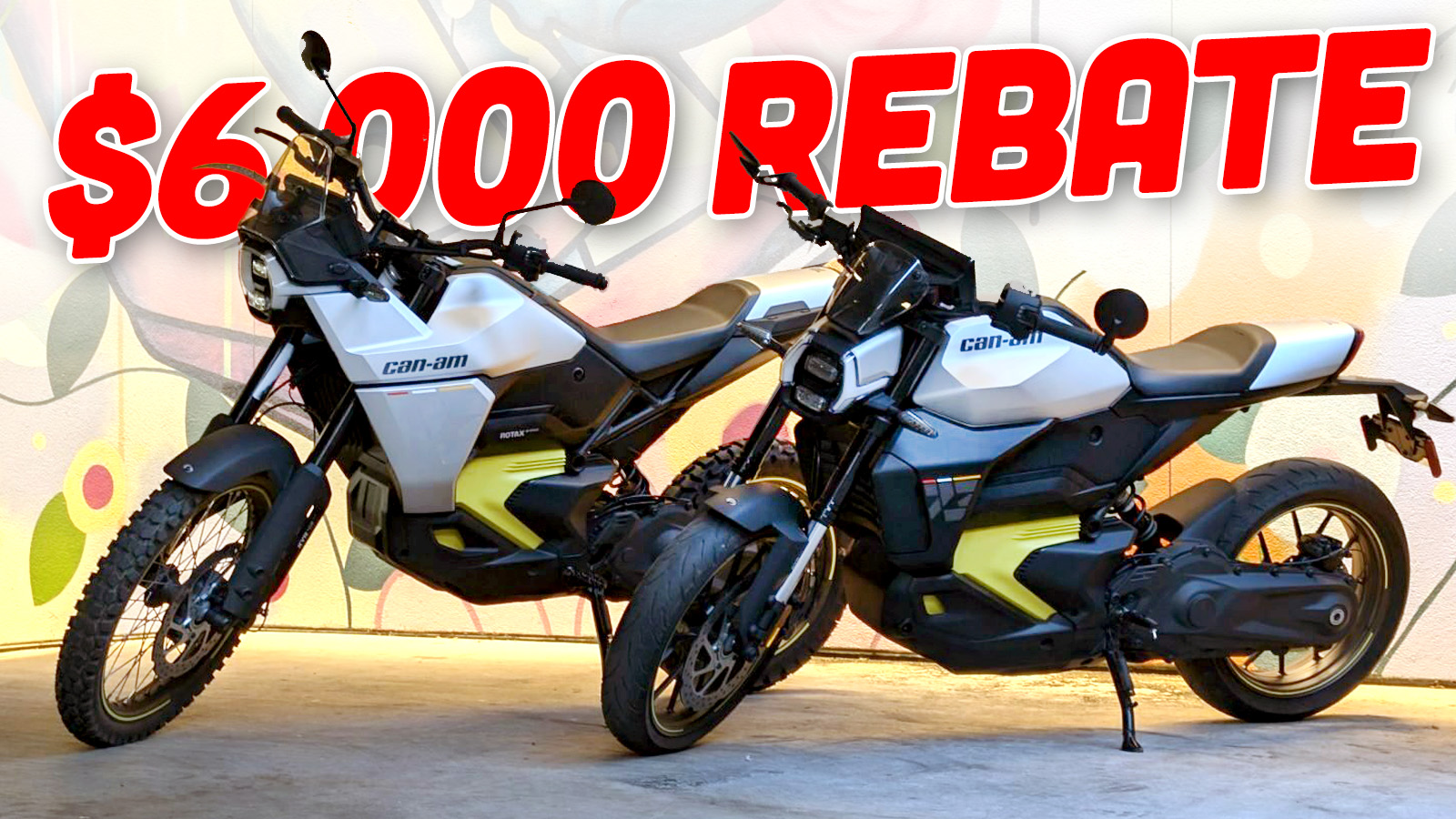
Back in 2024, Canada’s BRP made history by making its first motorcycle in 38 years. The Can-Am Origin and Can-Am Pulse weren’t just a return of Canada’s iconic red and orange motorcycles, but a step forward in electric motorcycle technology. Can-Am is doing something legitimately different from everyone else, but these bikes have been plagued by one major issue, and it’s that Can-Am demanded up to $14,499 of your money for a motorcycle that couldn’t reasonably leave a city and return without running out of juice. The company is changing course, and it’s offering $6,000 to anyone who wants to buy one of its bikes.
I had the privilege of riding both the Can-Am Origin and the Can-Am Pulse in 2024, and came to the conclusion that, quote: “The New Can-Am Pulse And Origin Could Change The Electric Motorcycle Game, But There’s One Problem.” I still stand by my statement today. In engineering the platform that underpins both the Origin and the Pulse, BRP’s engineers packed all the important parts of an electric motorcycle’s powertrain into a sealed swingarm. This resulted in a platform that, in theory, was wildly scalable and adaptable to different types of powersports vehicles. Can-Am’s platform also cuts down on maintenance, too.


Sadly, BRP’s launch vehicles for this brilliant platform were electric motorcycle twins that have the same kind of fatal pairing that has led to slow sales at other companies. As LiveWire can readily tell you, there isn’t a huge number of American buyers lining up to buy an electric motorcycle that costs well over $10,000 that can’t even get near 100 miles of range on a single charge. BRP is trying to get more people into its showrooms by pulling the lever that matters most to so many American motorcycle riders, and it’s offering a hefty $6,000 rebate to buy an unsold example. But what are you going to get in a discounted Can-Am?
A Motorcycle Contained In A Swingarm

In 2022, BRP announced that Can-Am was getting back into motorcycles for the first time in 35 years. This time, the brand wasn’t aiming to make the fastest motocross bikes, as it did in the 1970s. Instead, Can-Am’s new bikes were going to be road-legal all-electric steeds. But it did want to produce some game-changing innovations just like Rotax did in the 1970s.
In 2024, Can-Am’s new motorcycles hit the scene, and Rotax’s contribution to the electric motorcycle world was an innovative powertrain. My review details what engineers did:
Most electric motorcycles follow one of two designs. Companies wanting to simplify their builds might just slap a hub motor onto the rear wheel. These look futuristic, but put a lot of unsprung weight on the rear wheel, which is something you don’t want on a motorcycle. The other way is to build an electric motorcycle like a gasser is made. These bikes have batteries where a gas engine would be and directly behind these batteries, but still on the bike’s main frame, is the motor. The motor then drives the rear wheel through a chain or a belt. This is similar to how most motorcycles in history have been made.
[…]

BRP figured out how to turn a swingarm into more or less an entire motorcycle. Zoom in and you’ll notice that the front of the swingarm of the Pulse and the Origin is a tiny Rotax motor. On the other side of the motor is what BRP calls the chaincase. This is a sealed drive unit containing a self-adjusting chain that is constantly bathed in oil. In other words, BRP figured out how to cram the most important parts of a motorcycle into a swingarm. BRP envisions a future where it can build an entire lineup of motorcycles and development of these bikes is easier and cheaper thanks to the chaincase. BRP’s engineers tell me it’s scalable, too, so it can be lengthened or perhaps shortened to fit different applications. BRP is so confident in this tech that at the event it showed two off silhouettes of what looks like future motorcycles. The company says this drive system is really only the beginning of something much bigger.
The benefits don’t stop there. BRP says that since the chain tensions itself and is always bathed in oil, maintenance is dead easy. There’s no having to lube the chain like with a typical motorcycle or having to adjust tension. BRP just wants you to change the oil every 10,000 miles and to crack open the case and inspect the internals at 25,000 miles. The first service is at 5,000 miles, but the longer intervals begin after. BRP also touts the chaincase as being a better way to ride off-road. You no longer have to worry about rocks getting caught in a belt or chain, you no longer have to worry about dirt messing up your final drive, and perhaps most importantly for some is the fact that the chaincase is completely independent from the rest of the motorcycle.

The smart Rotax drive system is always perfectly tensioned and has the trick feature of shoving the wheel down into the pavement or dirt when the throttle is applied.
Both the Can-Am Origin and Can-Am Pulse are essentially the same core motorcycle, but with different riding styles. From my review:
Both motorcycles get the genius chaincase drivetrain. This frees up the rest of the motorcycle to store the batteries and the electronics necessary to get the bike to run. Like other modern motorcycles, the battery is a structural component with subframes attached to it. Here are further details from my earlier piece:
The Pulse and Origin share a platform that includes a Rotax E-Power drive system plus an 8.9kWh battery. That Rotax drive system features a 47 HP and 53 lb-ft torque electric motor capable of accelerating the Origin off-roader to 60 mph in 4.3 seconds and the Pulse city bike to the same speed in 3.8 seconds. The 47 HP is a peak number and the motor is able to put out 27 HP of continuous power.
This drive system includes liquid cooling for the battery, charger, motor, and inverter. The idea here is that by liquid-cooling everything the Can-Am electric bikes will be able to mitigate battery degradation. BRP also says this system also allows for faster charging. How fast? The battery will go from 20 percent to 80 percent in 50 minutes on a Level 2 charger. A full charge on a Level 2 charger will take around 1 hour and 30 minutes. If you have nothing but a household outlet nearby, expect a full charge to take over 5 hours. There’s also “Passive” and “Active” brake regeneration. BRP says the Passive mode is supposed to work like typical brake regen while Active mode, which is activated by twisting the throttle backward, offers up to four times the regeneration power.

While neither bike put out particularly amazing numbers on the spec sheet, their near-instant torque from their electric motors meant that they were more than capable of doing enough wheelies, burnouts, and drifts to satisfy any hooligan. BRP markets these motorcycles as being the size of a 300cc with the launch capabilities of a 1000cc and the overall performance of a 600cc.
The Pulse sliced through urban traffic with poise while the Origin ate up the dirt like it was born for it. I loved how both of these machines had some weird quirks. I found the regen settings to be lackluster and distracting, the seats too uncomfortable, and the range too short.
Fun, So Long As You Don’t Go Far

BRP says that the Can-Am Pulse can go up to 100 miles in stop-and-go traffic, or 80 miles in traffic that gets up to a little bit of speed before coming to a stop again. Ride at a steady 50 mph, and range plummets to 55 miles. After 40 miles of semi-spirited riding on a Pulse with some stops, the bike’s range estimator claimed I had 20 miles of range left.
The situation was worse when I switched to the Origin, which BRP says will go up to 90 miles on a charge or 52 miles at a constant 50 mph. I made it 43 miles of spirited riding before the dash displayed only 9 miles of range remaining. Also, it was so hot outside during the press event – temps ranged between 106 degrees and 114 degrees Fahrenheit –- that my Origin first deactivated active regen before turning off all regen. As the bike continued to get even hotter, the computer derated the motor until I had to keep the throttle pinned just to maintain the speed limit.

Yet, despite all of that, the Can-Am twins were some of the most fun I’ve ever had on two wheels. I was even smiling from ear to ear after crashing the Origin off-road. Both motorcycles are so perfectly good at their stated missions, and the technology behind them could be game-changing one day.
But then there was the price. At $14,499 for the Origin and $13,999 for the Pulse, BRP was asking people to cough up a lot of dough for bikes whose best selling point was their engineering. The Origin’s range is so low that, realistically, to ride it off-road, you’ll have to haul it to the off-road area, plan your off-roading around being near chargers, or live near an off-road area. I know this from experience. The Origin I rode to the off-road park wasn’t the one I took off-road because it didn’t have enough range left once I got there.
I still hope that BRP also does more with this platform. I’d love to see BRP make something small and cheap with this platform, or maybe do something silly like make an electric Ryker.
BRP’s $6,000 Rebate

BRP has never announced sales numbers for its electric motorcycles, but Can-Am’s competition has found it hard to sling electric motorcycles for well over $10,000. I would not expect much different here. As such, it’s unsurprising to see BRP trying to move stock.
This year, BRP dropped the price of the 2026 Can-Am Pulse to $10,999 while the Origin is going for $11,499. But if you want to save even more, there are plenty of 2025s out there. Earlier this year, BRP offered a $4,000 factory rebate. That expired in August and has been replaced with a $6,000 rebate.
BRP says that if you buy a 2025 Pulse or Origin, which have not gotten manufacturer price discounts, you’ll get a $6,000 rebate plus a $1,500 accessory credit. Alternatively, you can get a $5,000 rebate, zero percent financing for 36 months, and a $1,500 accessory credit. The terms and conditions of the rebate do not say how you will receive the rebate, but dealers are already advertising it as getting $6,000 off your purchase of a Pulse or Origin. BRP says that the offer “applies to the total amount invoiced, before taxes and installation fees.” The offer ends on September 30.
Will dangling $6,000 in front of buyers be enough to get them into showrooms? Electric motorcycle manufacturers are finding out that people do want their bikes, just not at the price they’re listed for. It’s hard to say, but I think BRP is making moves in the right direction.
Top graphic image: BRP



The charging is the real issue. 50 minutes to go from 20% to 80% on a level 2. But it’s cheap nough if you wanted something for around town and alot of fun starting to be a price point that starts makes sense. Plus there are enough level 2s around shouldn’t be a huge issue to find one to top up. I guess in many ways it’s really a modern cafe racer. Ride for an hour take an hour brake. They needed to be under $10k from the start. $8k is probably about right. I’ve heard some people get even deals on them because the dealers are sick looking at them. That tends to be for all the emotos.
I would love to know which 600 bike they indexed that comparison to, because if you’re getting 27HP out of a 600 it’s probably running on one cylinder. Yeah yeah, electric power delivery vs revving out an ICE, but it still sounds like wishful thinking.
So their discount puts a Pulse at $8k? That’s indeed a hell of a lot cheaper than the recent Livewire One price drop. Sure that bike is quite a bit more powerful, but since EV bikes are still slim pickings, it’s hard not to compare.
If my kids were old enough to drive themselves to school, I would be all over this deal. At that price, it’s perfect for an around town commuter. I don’t even care that the range is 100 miles on a good day.
I wonder if the Bombastic Trumpkin’s attack on Bombardier’s jet business extends to all BRP products? If so, that $6000 rebate might quickly become irrelevant. Better act fast.
So still around $7k, plus some fun money for gear.
I have a trade in that could probably get me around $2k, but even at $5,000 out the door it would still be almost 2x more than the most I’ve ever paid for a motorcycle.
The used market makes it so hard to justify buying a new bike.
This, I suspect, is another major factor in why electric motorcycles struggle so much in America. There are so many low-mileage used motorcycles out there that you can get for around $3,000. I recently saw an old Harley V-Rod for $4,000!
Or, you could be like me and buy a new motorcycle that’s been sitting on a dealership floor for 5+ years. New motorcycle at a used motorcycle price!
Their pricing does not seem to make sense, why would the 2025 be $14,000 and the 2026 be $11,000? Seems like the 0% financing is just a gimmick to cover the difference in sales for the older one. $250 a month for a electric bike for 3 years is still a lot of money.
Maybe their component cost decreased, but more likely is that “$6,000 rebate” is a more impressive number than “$3,000 rebate.”