

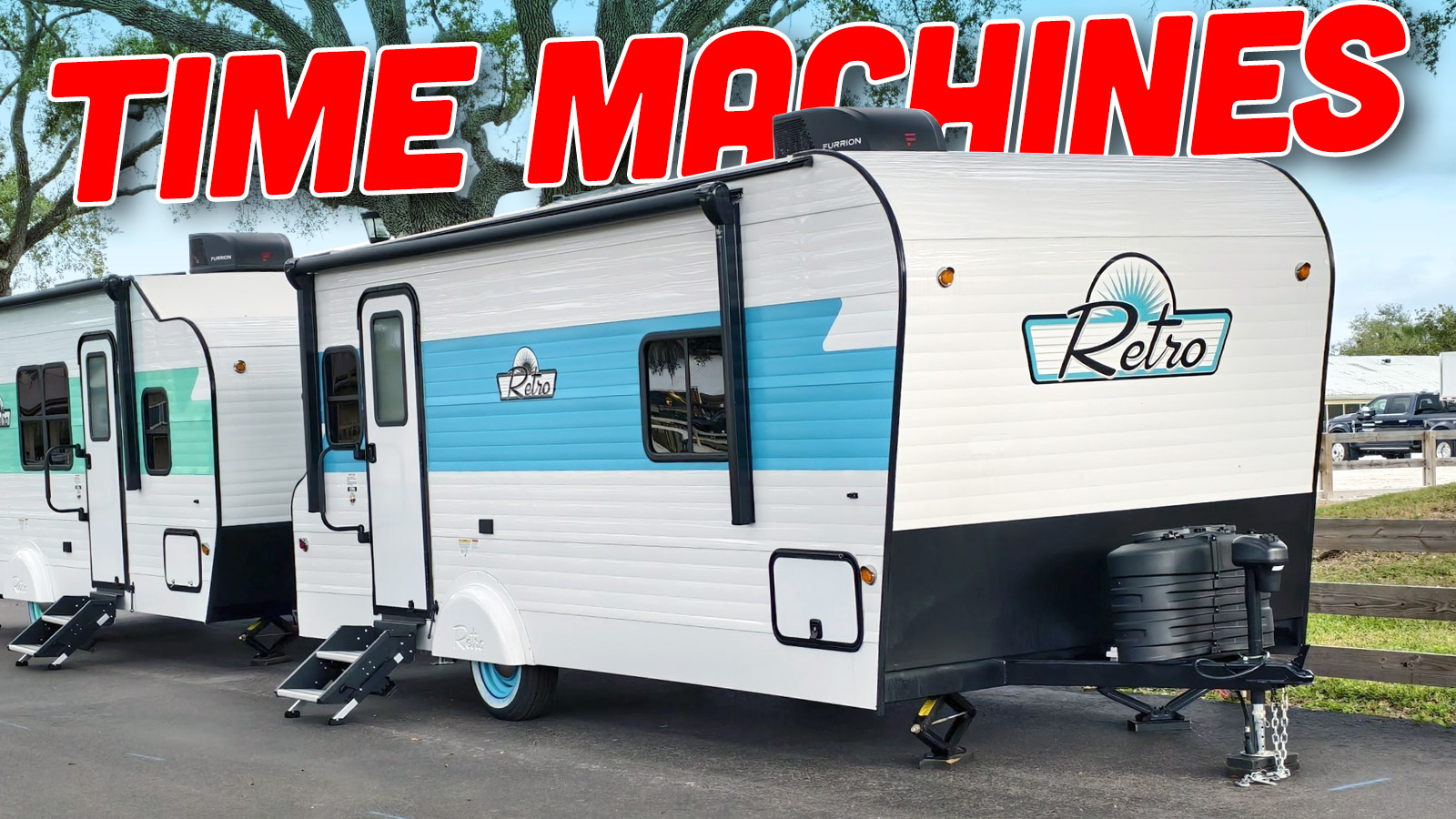
Retro things have been in vogue for quite a while now. You can buy a vintage-style motorcycle to go with your retro SUV, retro clothes, vintage-style electronics, and retro home furnishings. The recreational vehicle world hasn’t missed out, and lots of brands offer new RVs that look old. Not all of these trailers really commit to the theme, but that’s not what you can say about Sunset Park RV’s new Retro line. These trailers look old inside and out, and have some good attention to detail. They’re also shockingly affordable, coming in well below $30,000. But there’s an unfortunate twist, and it’s how they’re built.
The retro-style travel trailer is hardly anything new. Airstream has been trading on classic style since forever, and the reborn Bowlus really leans into past design. Many fiberglass camper brands like Scamp and Happier Camper embrace the past with open arms. But not all retro campers are created equal.


Some RV buyers dig the aluminum-sided travel trailers of the mid-20th century, trailers such as old Shastas and Scotsmans. Some of these trailers resembled canned ham containers, and many were painted in bright exterior colors, had warm wood colors inside, and were adorned with brightwork all over. Vintage trailers like these are a bold contrast to the monochromatic trailers of today.
Not All Vintage Is Equal
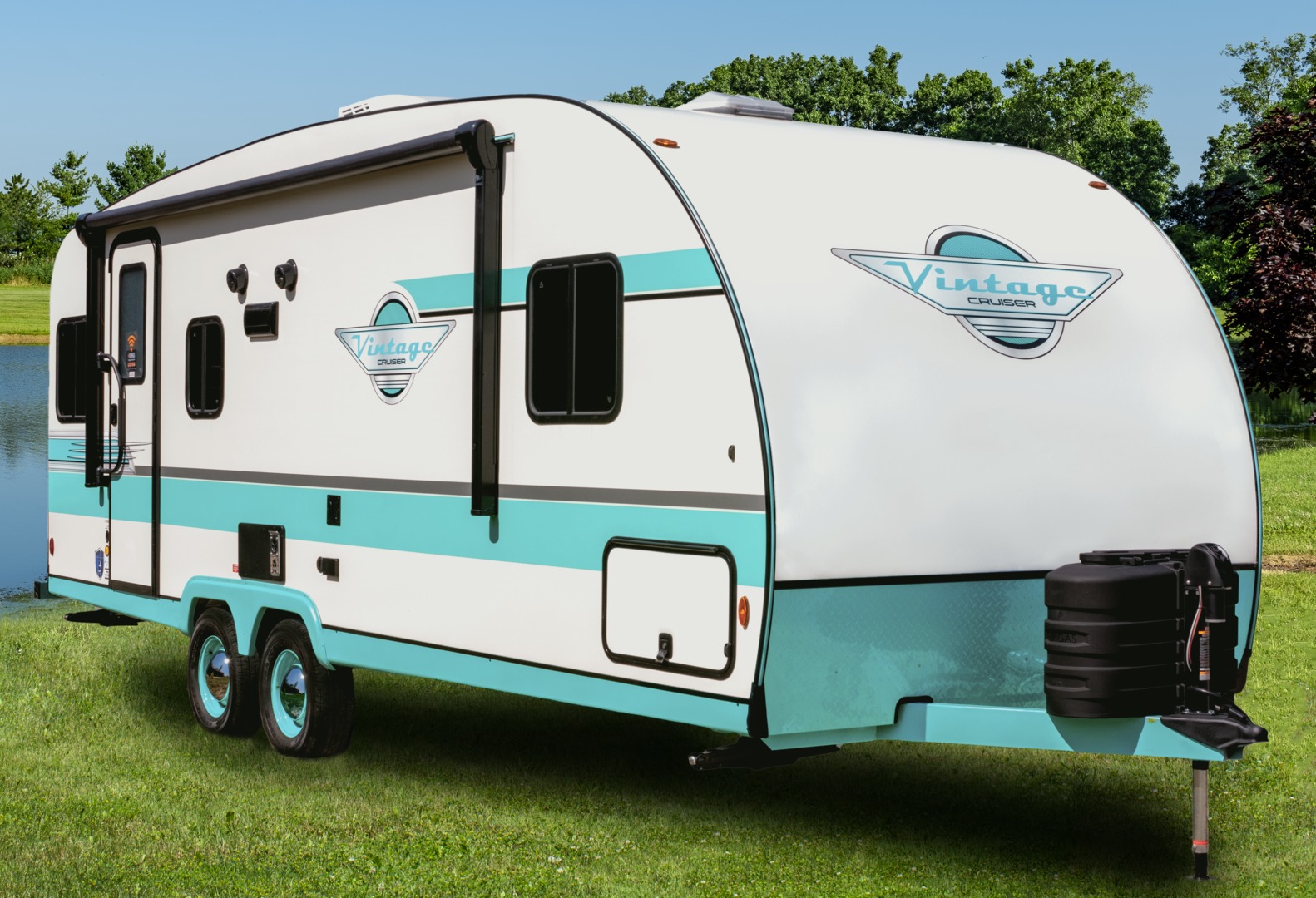
A lot of vintage trailer survivors are lucky enough to get a modern restoration. But if you’re not into getting your hands dirty, you can buy a modern trailer that looks like it came from the 1950s or 1960s. The only problem is that most of them are half-baked. For example, Gulf Stream Coach sells its Vintage Cruiser line of trailers (above), and they have the colors of old trailers, but they don’t actually look like an old trailer.
There was also the Riverside RV Retro line of travel trailers. I thought that a couple of models of these looked a bit closer to the trailers they got inspiration from, but I was never impressed with the fit and finish of the interior materials. Some Riverside Retro models had even less theming effort put into them than the aforementioned Vintage Cruisers. Here’s one of the better Riverside designs:

There have been exceptions to my observations. The short-lived modern Holiday House trailers absolutely looked like the old ones, but the best was probably the 2015 Shasta Airflytes of the 2010s. Shasta RV created limited-edition replicas of its old trailers, but with modern appliances. They nail the mission so well that, to the untrained eye, the new Shastas are the old ones!
Seriously, take a look at a modern Shasta:

I was pleasantly surprised by Sunset Park RV’s latest offerings. The independent RV manufacturer scooped up another indie company, Riverside RV, in late 2024, along with its factory and the Retro brand. Now, Sunset Park has its own Retro line, and I think it commits to the theme even better.
One Of The Independents
I last wrote about Sunset Park RV Manufacturing back in 2024 when I toured the absurdly affordable Sunray 109 Sport. Sunset Park is not one of the brands owned by Forest River, Winnebago, or Thor Industries, but is an independent that does things its own way. Here’s what I wrote in 2024:

Sunset Park RV Manufacturing was founded in 2007 by Merle Schmucker. At the time, Schmucker was just 19 years old, and he was already a successful businessman, having founded a luxury home construction company in Florida two years prior. He moved to Indiana, the home of RV manufacturing, to raise his kids and to start an RV company of his own. Like many entrepreneurs in independent RV manufacturing, Schmucker sought to provide the kind of innovation and unique designs that you don’t often see with names like Thor or Forest River.
Today, Sunset Park RV says it’s the 11th largest manufacturer of travel trailers in America, and it’s done this on the backs of a whole lineup of tiny single-axle trailers like Sunray 109 Sport. Sunset Park RV believes that single-axle trailers are great due to their reduced weight, reduced tire wear, and lower entry cost compared to multi-axle trailers. The company says its customers are a little bit of everyone, from the couple looking for a weekend getaway to off-roaders looking for somewhere remote to camp.

Sunset Park says its acquisition of Riverside RV now makes it the fourth-largest RV company in America. Something I’ve appreciated about this brand is that it pays attention to what people are saying. Sunset Park thinks that a major reason why RV sales continue to struggle is that people just can’t afford to buy new RVs anymore. So it wants to make fun RVs that won’t cost an arm and a leg.
Sunset Park has leveraged the Retro branding from the Riverside acquisition to create its own line of Retro trailers for 2026. These are both better and sort of worse than the Riverside trailers.
New Retro

The new Retro line has four models, starting with the 16′ R126 “Ruby,” and ending with the 22’6″ R196 “Betty.” I toured the 23′ R186 “Cha Cha” and the Betty. All of these trailers start off with a fairly standard build. They ride on a typical steel frame, have torsion axles, have typical wood framing, and have a typical PVC rubberized roof membrane.
This is an interesting, and perhaps unfortunate, departure from the Riverside Retro trailers, which eschewed old-school wood framing for a more durable aluminum superstructure. In a weird way, these new Retro trailers are old-school in more than just one way.

The bodies of these trailers mostly nail the vintage look. They have the same weird and goofy shapes as real vintage trailers have, and there are neat touches like white wall tires, retro fenders, color-matched wheels with moon caps, and even vintage-style lights. These trailers definitely stick out in a crowd.
However, they don’t commit as hard to the bit as a Shasta reissue. You’ll still find modern windows, a modern awning, and modern storage compartment doors. These can be forgiven, I think, because of how affordable these units are, which we’ll get to in a bit.

I was also impressed with the theming inside of these trailers. Betty’s door is at the rear, and you step right into a galley kitchen and dinette. This area featured a dual-basin sink, a three-burner stove, a 17-inch oven, a microwave, a refrigerator, and a table that converts into a bed. This room did feel a little small, and I didn’t find the cushions very comfortable.

The interior also had a bit of a funny quirk, and that was that the refrigerator had to have a stopper put into its door so that swinging open the bathroom door doesn’t dent it.

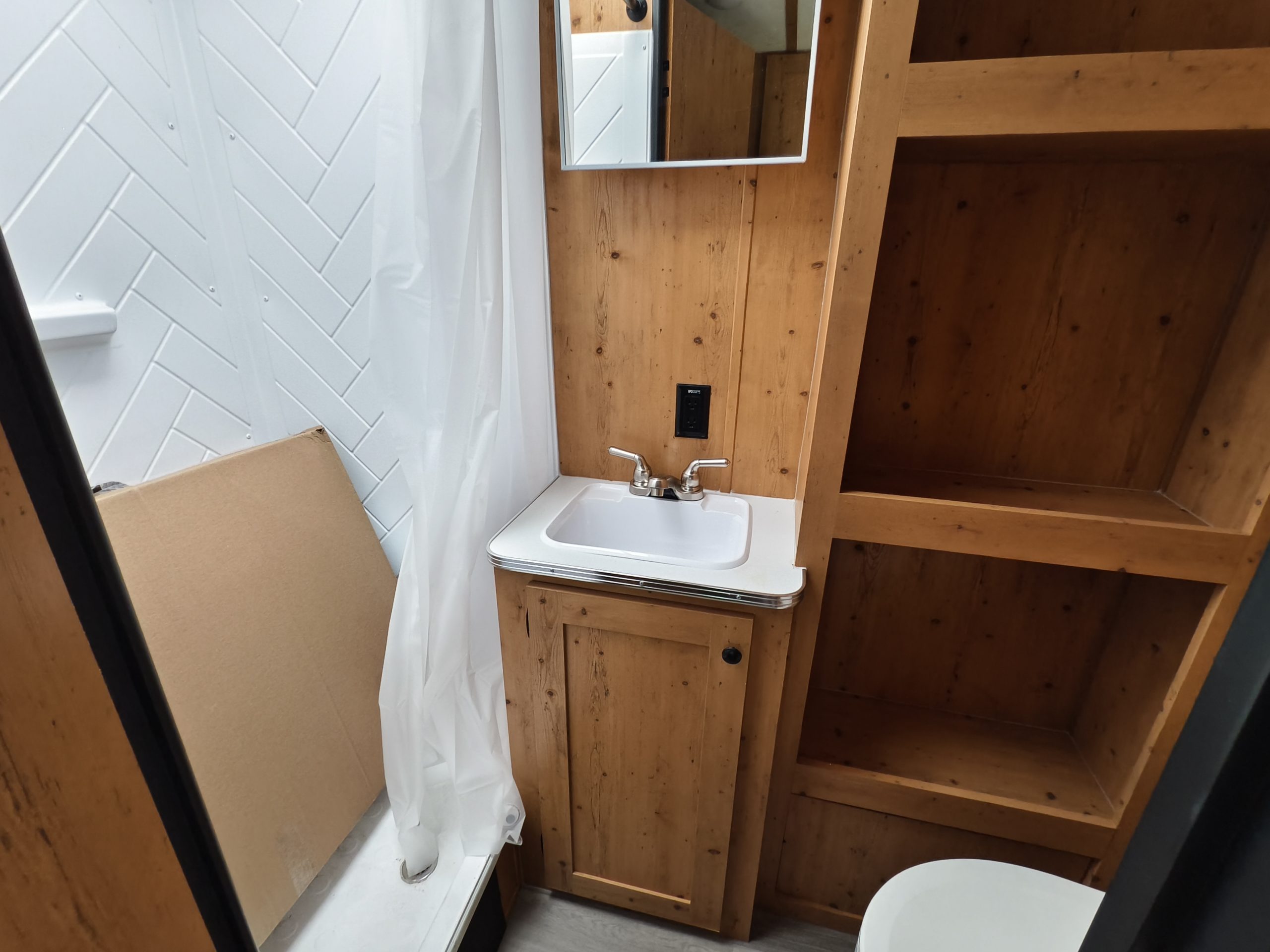
The center of the trailer features a fairly standard dry bathroom, and I don’t have any real notes here. Like most typical travel trailers, the shower sits on a little platform. The walls of the shower go all the way up the wall, but the shower itself is pretty shallow. The room inside the shower is pretty good!

Something I do like about the bathroom is that, since it’s in the middle of the trailer, it effectively turns the kitchen area into a bedroom. Finally, we reach the bedroom, and, theming aside, this bedroom feels roughly similar as the typical trailer bedroom. The 60″ by 74″ bed is on the thinner side, but it will get the job done.

I adored the theming. I loved the bright colors, the metal trim on the countertops, and how the inside walls made me feel like I had stepped into an old house. Sunset Park’s designers understood the look they were going for.

Quality was about what I expected for the price. The walls are thin, and the interior feels pretty low-buck. The oven and microwave are pretty small. The baggage compartment doors use outdated plastic holds, which are known for breaking, rather than more reliable magnets. The list of additional features mirrors this. You get only 100 watts of solar, a gas-only water heater, and a marine-grade wood floor. That said, there are some nice touches in the design, like EckCo acrylic windows and a black tank flush system. Holding tanks consist of 35 gallons for fresh water, 30 gallons for gray water, and 30 gallons for waste.
Same Thing, Different Flavor

The Cha Cha is a very similar trailer; however, its six extra inches of length afford it a better floorplan.
The front door opens up to the bedroom, which has the same bed as the Betty. The dinette is also in this room, which is also the same dinette that’s in the Betty. What’s new here is a 56-inch sofa that sits across from the dinette.

The rear of the trailer is dedicated to the kitchen and the bathroom. The kitchen and bathroom specs are exactly the same in the Cha Cha as they are in the Betty. The only functional difference here is where everything is placed. The Cha Cha also has a different shape, too. Even the tank specs are largely the same, except for the gray tank, which rises to 43 gallons in the Cha Cha.

The 23-foot Cha Cha weighs 3,380 pounds empty and loads up to a total weight of 4,000 pounds. The 22’6″ Betty weighs more at 3,640 pounds empty, but has the same gross weight of 4,000 pounds. This is due to both trailers having only a single axle. The good news, at least, is that these trailers can be hauled by all sorts of modern crossovers or vintage cars.
The other good news is that, while the construction methods are thoroughly unimpressive, the quality of the work appears to be a cut above the typical wood-framed trailer. The seals look like they were applied with steady hands, and all of the parts are fitted straight and snugly. The frames also didn’t have surface rust on them, which is a thing that does happen with affordable trailers. It doesn’t seem like these were pushed out of the factory as fast as humanly possible.

The dealership representative at the 2026 Florida RV SuperShow claimed that he gets far fewer quality complaints and has to perform fewer defect repairs with these Sunset Park trailers than he does with wood-frame builds from Thor or Forest River. That’s a good sign, at least. Still, the build of these trailers is pretty bog-standard, so expect to have to pay attention to that roof and try your hardest to prevent water leaks. Also, this trailer does use lauan plywood.
Under $30,000
However, I can cut these trailers some slack because they’re quite cheap. The Sunset Park R196 “Betty” currently runs $23,000 to around $28,000, depending on the dealership. Meanwhile, the Sunset Park R186 “Cha Cha” runs in roughly the same price range. That’s not a lot of money to pay for a neat vintage theme!

I think there’s a lot to like here, so long as you temper your expectations. You’re not getting something built like a Scamp. You’re not even getting the Retro how they used to be built. Technically, if price is all you care about, a Liv plastic camper is built better for less money. But if you like this vintage look and don’t want to pay a lot for it, I can see a Sunset Park Retro being an option. The low price comes with the caveat that this trailer is built as though it came from the past, too.
All that aside, I’m still stoked to see that several companies are catering to the cheaper end of the market. Not everyone has six figures to spend on an RV, and not everyone wants to spend a ton of cash on an RV, either. Yes, these cheaper rigs come with compromises, but I think they might be worth it for a buyer who wants fun without paying a ton for it. Just make sure you keep on top of maintenance.
Top graphic image: Mercedes Streeter


Oh, that makes me sad to see my old shasta here. I miss it, but unfortunately it was just too small. We had exactly the Matador Red one shown here. It’s 16′ but between the micro bathroom and we’re both 6′ tall it’s just too tight inside. But we had a good year trying to make it work right after covid (3rd owners, 2015). We sold it in 2021 for exactly the same we paid for it. I think they made 2k of each colors, seafoam green and I forgot the name of the yellow. There was a 19′ too, but it was just as narrow so wouldn’t have helped us.
We parked it in the front yard so we’re still known as “the people with the red camper” out front by the whole area. We aren’t super outgoing, but boy did that bring in people at the state parks who wanted to know ALL about it.
This is a joke, right?
The Betty dry is 3,640lbs….with a GVWR of 4,000lbs?
2 normalish adults walking into the unit would take you over the GVWR…..
You could take almost no cargo. Especially if that dry weight doesn’t include propane, battery, water, etc.
It is like no RV is built by anyone with any engineering background.
That is unfortunately, correct. I have seen quite a few of these cheap single-axle trailers with alarmingly low payloads like that.
Probably intentional. If there is a failure you try to claim warranty on, well sorry, you overloaded it.
I’d love to see some sort of buyers guide or article about which older trailers are safer bets to buy. Seems like everything post 2020 is riddled with quality issues, are there any older models that are solid or at least worth putting money into repairs?
30k-ish for a new one may sound reasonable, but if it’s worth half that in a year, then requires a bunch of maintenance the following year, is it better to just puy an older one?
“Some of these trailers resembled canned ham containers”
I’m sure if Jason got his mitts on one it would soon resemble a container of canned ham even more.
Hey Hormel or Underwood! I have a marketing idea for you!
The real story here is that Shmucker was 19 years old and had a successful housing development company and already had children??? I want to know more about how he managed this and less about trailers
i believe its called, “daddy’s money.” a tale as old as time.
Yeah that math was a little gobsmacking to me.
I just can’t get past my distrust of single-axle camp trailers. It’s one thing on a basic utility trailer but with any real profile and weight – nope, I’m out.
I rebuilt a 13ft body Shasta last year into a business for my wife. Its a 1961. That 2015 looks like a dead ringer for mine.
As much as I hate “Live, Laugh, Love”, “Eat”, “Sleep” and “Laundry” signs in people’s houses…
…I think I hate big decals that say “Retro” and “Vintage” even more.
To me, that just seems lazy. Obviously this is a retro, or vintage; the design speaks for itself. Do a little research, find a name that seems period correct, maybe something that sounds western.
Exactly. A trailer from the era wouldn’t have that on there. So by adding “Retro” decals, you’re making it look fake.
Yeah – Like “El Camino” or “Ranchero”!
Oh … wait …
I had fun counting all those signs at open houses while I was shopping last year. Always liked to joke that the realtors couldn’t rely on buyers knowing what to do with a space, so they installed those signs with the fancy script to make it clear.
We have a little vacation house in Vermont that we also Airbnb to help defray some of the costs. When visiting recently, my friends had a sign made that says “Live, Laugh, Poop”. It hangs proudly in the downstairs bathroom.
I have one that says “Please don’t do coke in the bathroom” in that fancy script font. It’s usually good for a laugh.
I think a big ol’ decal that says “RADIUM” on the light green accented one or “Cosmos” bracketed by 4-pointed 50’s stylized gold stars would be much better.
Make some of those stars trefoils.
“Live, Laugh, Love” is so 2010s. I have “Like, Follow, Subscribe” hanging in MY living room.
“In this house, we ring that bell.”
Something about Retro trailers just always ends up putting them in the Uncanny Valley.
It feels like a product for people who yearn for an earlier time, but for the wrong reasons.
To be clear, that’s not me! I just love the look of old vehicles. 🙂
To quote CCR, “It ain’t meeee, I ain’t no fortunate oneee”
“It’s not nostalgia, I just really like The Incredibles“
What is an example of a wrong reason to yearn for earlier times? At least, with relation to any kind of vehicle? I can think of wrong reasons for other ideals, but not vehicular.
Prime example would probably be the 1950s era of America that gets romanticized. Which these trailers evoke the feel of.
The reality is that time sucked for a lot of people for a lot of different reasons. There’s been a significant push to bring that dynamic back (see: Trad Wives, for example). I’d argue that the past, by and large, should stay where it is.
I’m afraid I have to disagree with the premise. I do not conflate a love of an aesthetic with a desire to repeat the mistakes that can be identified from ANY given time period. I don’t see a way to distinguish your statement from saying that liking a tri five Chevy that means I want to bring back 50s racial segregation.
I’d be interested in how you define Trad Wives to understand why you find it problematic. To me the definition is a woman who stays at home, manages the household, takes care of the kids. Do you define Trad Wife as different from “Stay at home Mom” in some significant manner that makes it problematic for society as a whole?
These are not restorations, these are recreations that miss the mark.
Restoring a Tri-Five is reviving a piece of history.
Building your own image of a tri-five, sharing nothing but the basic aesthetic of 50s cars, it’s just cherry picking an era. And it’ll probably look weird and uncanny because it shares no ACTUAL history.
The trad wife movement is an entire discussion on its own that I’d gladly tackle over a beer or 12, not in the comment section of my favourite car website.
I know many folks across the gender spectrum who are either much happier being trad wives than worker bees or are unhappy worker bees who pine for the trad wife life.
Is it the particular lifestyle itself that people pine for, or is it the fact that an average joe working a factory job was able to afford it at that time?
I grew up in the 80’s and none of my friends had stay at home mom’s, they all worked.
My parents were born in the 1950’s, and they had the stay-at-home moms.
Both. Way too many people work because they have to, not because they like to or want to.
One of my favorite commercials of all time was for the California lottery. The setting was an office goodbye party for one of the worker bees who had won the lottery. In her speech she looked at her former coworkers and said ” I wish I could tell you how much I’ve enjoyed working here but I can’t, I just can’t.”. The meaning was very clear and boy did it hit home for me.
I can totally identify with that.
I think most of us would agree that having to spend the majority of our waking hours at work is total garbage.
How is someone expected to do this? Keep a waterproof tarp over it? Store it indoors?
$23,000 works out to $5,750 per week of my available 4 weeks of vacation. I can go just about anywhere with a cheap flight and a hotel room for that money. I won’t be travelling in style, but with a trailer like this, I won’t be doing that anyways. Cramming my two teenage sons and partner into this thing for a week also sounds kind of terrible.
You pretty much have to get up on a ladder and clean/scrape/re-seal all the roof seams. Every. Single. Year.*
*For seams on the very top of the roof that can’t be seen from the ground, you can usually get away with “permanent” (Read: will last at least 5 years, maybe even 10 or more if you apply it right) waterproofing tape. But for the edge seams where the sides meet the roof, you ‘ll have to do the annual clean/scrape/seal routine. This is why higher-end RV’s and motorhomes usually incorporate some sort of wrap-over covering, preferably with integral seals at all the roof edges. If they show any signs of opening up on the top surface, overlap them with the sealant tape and they’ll be good for years.
Thanks for the info!
There’s no way I’m gonna be expected to screw around with sealing the roof on a camper that I’m still paying for. I would have hoped that by now, campers would be constructed in a way that won’t leak (at least for a very long time) or rot. Regardless of the styling. I might as well just buy something old and keep covering and resealing it.
Looks like one of the main benefits here, is you can have a vintage looking camper that’s allowed into all these 10 year old limit campgrounds.
I’m curious why we don’t see these standard designs with a sort of molded cap plopped on the top. It seems that this would at least mitigate many of the leaking issues.
As a carpenter, I would also imagine it would be better if the seams were larger and more functional like traditional flashing.
And the fact that the industry keeps using luan is beyond me. I do a lot of tile work and there are a number of perfectly waterproof 1/2″ and 1/4″ substrates that would do a much better job avoiding rot and breakdown than luan. Look up Schluter Kerdi board, GoBoard or Wedi board.
The ones that do have the right-angle moldings over the edges are typically higher-end (read: more expensive) designs. I suspect it’s more common on motorhomes, too. The right-angle moldings generally have some sort of sealant where the roof and wall surfaces meet (and possibly overlap in the case of some EPDM/TPO roofs) and then have a coating of adhesive sealant on the underside of the molding which is contained in a slight recess molded into the underside, and applied with pressure to the length of the seam. Properly applied, the sealant is completely covered by the plastic molding which should meet flush with the roof and wall surfaces. Additionally, there’s usually silicone sealant applied to the edges, especially on the roof.
Sounds like a pretty permanent way to seal a seam, right?
Given the expansion/contraction of the roof and wall materials from weather and direct sunlight, plus the shock and vibration of road travel, it can still leak. About the only semi-permanent solution that motorhome owners swear by is adding a layer of the long-life sealing tape (“Eternabond” and similar) to overlap the roof-to edge cap joint. The tape uses essentially the same kind of sealant that’s underneath the cap trim — but the tape is more flexible, so it moves with the surfaces instead of resisting motion. It just doesn’t look terribly pretty. Although if you’re careful, you can lay it down neatly so it looks like it might have been a factory job — just big, four-inch wide strips of white or black overlaying all the sealed joints. Lay it down straight and trim the corners to line up and overlap perfectly, and it looks pretty good. It just takes more time and care than what’s typically available on an assembly line.
The tape is considered a “permanent” solution and my experience with it has been good. I’d consider “permanent” to mean anywhere from five to ten years before it might need attention — either spot repairs or complete replacement. But it lasts a heck of a lot longer than even the best silicone sealant from a tube. I’ve used it on a very old (1980s) motorhome roof that had previous leak problems. With the tape applied to every single roof penetration (vents, antenna, plumbing and refrigerator vent stacks) plus all the edges, it never, ever leaked again.
The other issue with RV roofs is that the roof material itself can crack. It’s not common, but it has happened. Membrane materials like EPDM and TPO can be damaged by both abrasion and harsh sunlight. Fiberglass panels can become sun-damaged and crack. Vintage campers often had aluminum roofs; they could leak at the overlapping seams and the aluminum itself was thin enough that impacts from tree limbs or just stress could cause cracks/tears. It takes enough in terms of layers and construction techniques to keep a house’s roof from leaking. Making a leak-resistant roof light enough for a vehicle is challenging and fraught with failure modes. Add the RV industry’s cost-cutting to the mix, and it’s just not a good situation for lower-end, mass-market RVs.
Thanks. Good info.
It’s all about what’s cheap.
For outdoor storage, you should definitely be putting some sort of tarp or cover over just about any RV, would save a lot of problems down the road if more people just did that
Or else looking at putting up a prefab steel carport, they’re not crazy expensive compared to the cost of the vehicles they’re protecting. My 21×24 was $3500 installed, for an RV, you’d have to go a lot taller and a bit longer, but half the width so the price should about balance out
Yeah, on top of the cost I also don’t have a viable place to park a camper, or anything to tow it with at the moment. My property doesn’t even have a street accessible driveway, so I’d have to get real good at backing up or down an alleyway, and not hitting the garage to pull into my backyard.
I’d have to pay storage, which google says is $140-$440/mo… That’s a lot of nights in a hotel over the course of a year.
People in my neighborhood street park them in front of their houses and hope to not get a ticket for the 47 weeks of the year it sits there.
Yeah that won’t float here, the last time I had to street park on trash day because the alley to my yard was blocked by utility workers I got a ticket in less than an hour.
I wouldn’t mind if our parking enforcement were a bit more vigilant. Would certainly make visibility easier.
I would hope the trailer lasts more than one year. I know they are shabbily built, but that’s ridiculous.
Maybe they are outliers, but my kids are MESSY 🙂
I hate that is says “Retro” on it in big letters.
Sort of like the cheap Woolworths Halloween costumes with a picture of the character printed on the shirt so people would know who you were supposed to be
Hopefully they don’t cut your tongue too!
I’d like to claim my wardrobe and home furnishings are retro, but really, they’re just old.
Do these retro re-run trailers have the same potential structural weaknesses (leaks, rot, etc.) as actual vintage trailers?
This one? Absolutely. Scamps and other vintage-style builds with better materials? Those stand a better chance at lasting.