

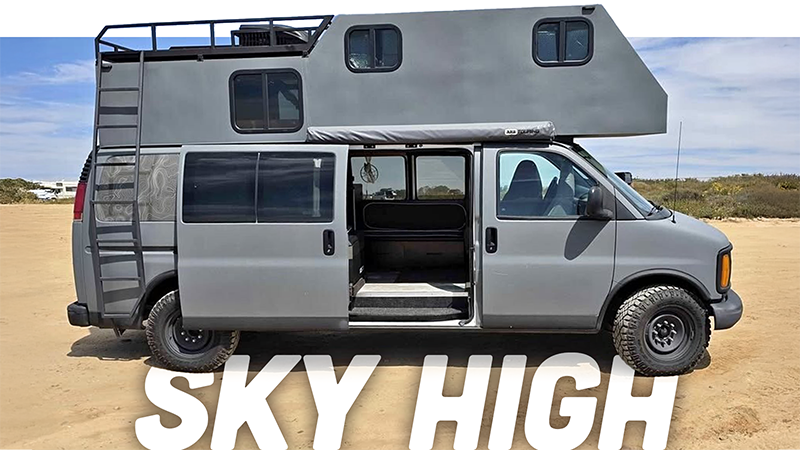
The camper van is one of the most accessible RVs on the market. They’re easy to drive, can fit in parking spaces, can camp in places large motorhomes cannot, and can sometimes be had for a relatively affordable price. But many camper vans tend to be somewhat cramped inside. Here’s one that isn’t. This 2001 Chevy Express 2500 has a roof so tall that the van’s interior seems almost deceptively large. It’s almost as if it’s a camper van with the roof of a Class C motorhome, and it gets even cooler from there.
The compact size that makes the camper van so great can also be a downside sometimes. Some floor plans can feel a bit compact, especially if you’re a bigger person, as I am. Yet, upgrading to a Class C motorhome might be too much, as those tend to be a little bigger and are often built more like a typical motorhome.


There does exist a sort of middle category for people who think a Class B camper van is too little, but a Class C motorhome is too much. That’s the so-called Class B+ camper vans. These vans borrow some traits from Class C motorhomes while staying closer to the van form factor.

That’s sort of where this Chevy Express van sits. It’s a bit more elaborate than your standard high-roof van and even has an overcab area like Class C, but it’s still a van. This one was also built by people who seem to know what they’re doing, too, which is promising.
The Builders
This van, which is named the Rhino, was built by Camplife Customs in San Diego, California. The company has a nice little story about its history:
Back in 2018, in a small garage in Ocean Beach, California, Bobby, a welder known for both his expertise and his heart, and his co-founder Adam brought their shared vision to life.
Bobby wasn’t just passionate about the challenge of starting a project from scratch; he saw it as an opportunity to showcase their skills and innovation. He was confident that their finished product would be a significant improvement over anything else on the market, helping people get out and explore safely and with unique style. It was this passion for both the craft and the customer that fueled their early success.
As word of their quality and service spread, Camplife Customs quickly outgrew its humble garage origins. Now located in Point Loma, San Diego, Bobby and Adam have recruited a team of highly skilled craftsmen who are passionate about design and helping others connect with the great outdoors.
Adam and Bobby have a combined 60 years of experience in construction and fabrication. Bobby’s pivot to building RVs came when he didn’t want to work in his field anymore and wondered where else his skills could be useful.
That’s when he found out that the camper van market was growing, and, at the time, the buyers of custom vans sometimes had to wait two years before they could finally sleep in the RV they paid $75,000 for.

Today, Camplife Customs is known for its Mercedes-Benz Sprinter and Ford Transit conversions. Something the company prides itself on is using steel framing and handmade cabinetry.
But the business had to start somewhere. In 2019, Camplife Customs built its first custom camper van, the Rhino, which rolls on the bones of a 2001 Chevrolet Express 2500.
The Towering Camper Van

The Rhino didn’t start its life as anything that impressive. When the van rolled into the Camplife Customs shop, it was little more than a plain white contractor van. The Chevrolet Express has been in production since 1996 in a single generation and has seen only evolutionary updates in all that time. I wouldn’t be surprised if we still see these vans in production in 2030.
If you’re interested in reading about the full history of the Chevrolet Express, click here to check out my previous coverage. But the short version is that when General Motors began the process to replace its aging G-platform in the 1990s, the plan called for a van to be built from the ground up to be dependable, but also easier to drive than the vans of the past. GM saw both families and tradespeople buying these vans, so they had to work for both.

The new GM work vans were versatile. There was a 15-passenger version, while the 3500 could tow up to 10,000 pounds. The barn doors on the rear even swung 180 degrees so you could shove increasingly large items into the van with little interference.
In the three decades since, the Express has proven to be a reliable, if dated, workhorse. Sure, the Euro-style vans are better in most ways, but some folks still cling to the cockroaches that are the GMC Savana and the Chevy Express. I wouldn’t be surprised if factories still churn these vans out long after humans are gone.

One of the challenges that most Express vans pose for camper van builders is the fact that it is not a high-roof van. Camplife Customs rectified that by cutting the entire roof off.
Then, they welded a steel cage on top of the body. This new roof cap was finished with insulation, windows, and steel sheeting. Camplife Customs says that the finished height of the van is 10 feet tall. The builders say that they chose an Express because they wanted to make a lofted bedroom, and didn’t see a Mercedes-Benz Sprinter supporting such a feature.

You might think, as I did, that the extra space might have been used to create a small upper deck. Instead, most of the extra space is simply headroom for tall people. The builders say that a 6-foot, 6-inch person can stand inside with ease. Something I love is that this roof runs the whole length of the van.
But not all of the space is just for your noggin. By building an overcab section, Camplife Customs was able to take the bed that would normally take up valuable floor space and place it above the cab.

The build team didn’t do anything out of this world with the extra space. Behind the front seats is a bench, and across from that is an Iceco refrigerator.
Aft of there sits two long countertops and two long high shelves. Camplife Customs says that the wood used in here is bamboo, and the Ruvati sink is stainless steel.

The van comes weirdly short on features. The bathroom is large enough for a shower, but it doesn’t have one. Instead, there’s only a cassette toilet in there. You do get an outdoor shower, at least.
Those bathroom walls also aren’t marble, but FlexLite composite made to look like marble.

Likewise, there’s a Dometic roof air-conditioner, but no heat. No cooking equipment is listed, either, but I do see an induction cooktop. The van also has a 200Ah lithium battery and a 2000W inverter, but no solar. The features begin thinning out from here. The builders note the RGB lighting all over the interior and a walkable roof with a wooden patio.
The build is capped off with a queen bed in the overcab area, plush walls, and the requisite truck bedliner paint job that so many custom vans get. Power comes from a 5.7-liter V8 with 255 HP and 330 lb-ft of torque on tap. That reaches the rear wheels through a four-speed automatic. I wouldn’t be surprised if this unit didn’t get any better than 12 mpg.

Overall, the Rhino seems to be a pretty cool build. I love the amount of space inside, and I adore the real wood. I’m also a huge fan of how the windows have been left intact, as too many RVs feel like dungeons inside with a lack of natural light.
Moving the bed over the cab was clever, but it seems like Camplife Customs could have gone further with all of the space. It’s a little disappointing to me that the van gained all that extra space, yet you still have to shower outside. Then there’s how the interior looks like a luxury apartment, but it doesn’t even have heat.
To be fair to Camplife Customs, this was the company’s first build, and the subsequent vans look even more amazing. So, it’s fine.
Maximum Points For Creativity
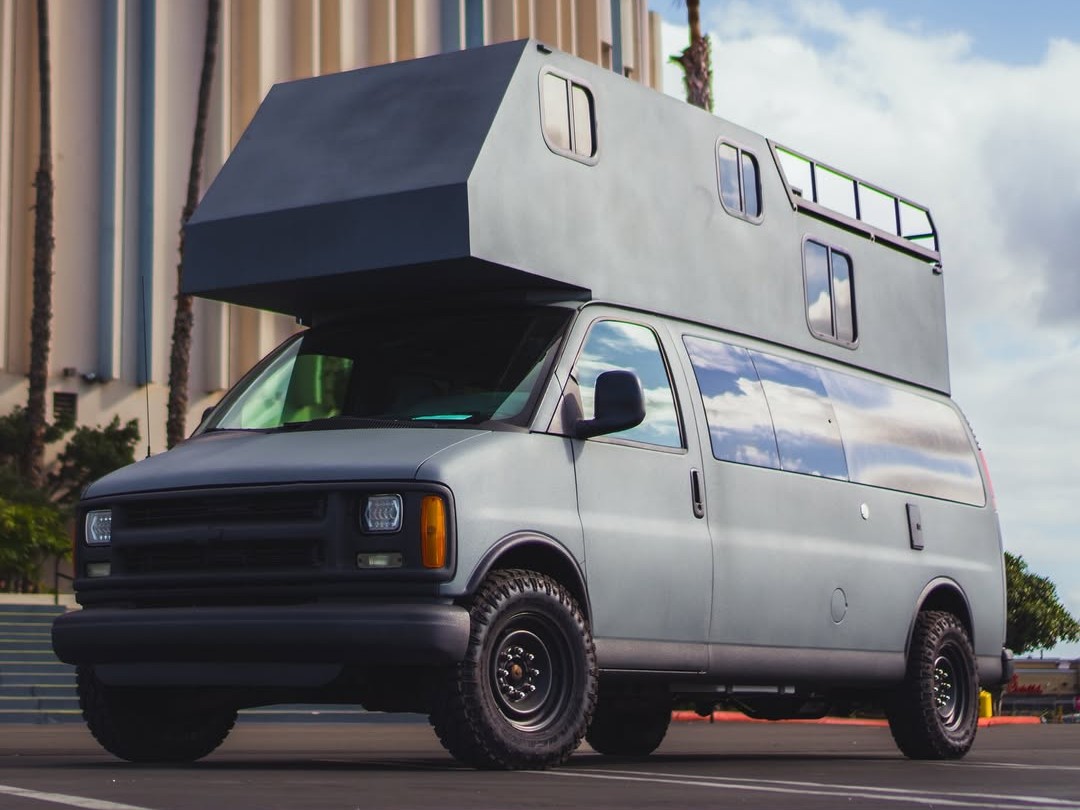
This van has shown up for sale a few times over the years. Camplife Customs tried selling it in 2020 and then again in 2023 and 2024. The current owner bought the van in 2024, and now it’s up for grabs again. Camplife Customs wanted $55,000 for the van when it was for sale in 2023 and 2024. Today, it’s up for $40,000. The seller, who is based in San Diego, says the van has 28,500 miles and just passed smog.
I like a lot of what I see here. It looks like the build was done well and that it should last a reasonably long time. I also like how the van costs much less than a new camper van and even less than other custom builds I’ve seen. But it looks like you’ll have to figure out your own heat and showering situation.
Quirks aside, this van is yet another example of why I think the custom RV is the coolest kind of RV. This thing looks weird on the outside, but it seems relatively cozy inside. All of it came from the idea to make a camper van with a bed over the cab. I hope RV builders never lose this sort of fun creativity.
Top graphic image: Facebook Marketplace





Lemme see…350 miles per day. 10 miles per gallon. $5 per gallon. So $175 in gas….Its hotel time.
This is more for people who want to camp near the activities that they enjoy. This makes a lot of sense when the nearest lodging is over an hour from where you want to be at 6am. Or when you want to wake up to sounds of nature.
Pop tops are the answer to vans. Better Aero and you only need the headspace when you are stopped.
But with all disadvantages of tents that I hate: no protection from noise from the outside, thermal issues, in case of wind you’re getting issues…
Thought about it on my last van but knew I would hate it.
You can get quilted / insulated popup fabric now that works pretty well and probably better than the windows. I guess my VW Westy isn’t really trying to emulate a luxury apartment though. My needs are comfortable although fairly clean and basic.
At that rate, I’d just drop a slide-in truck camper onto a chassis cab. Assuming I could make the overhang work of course.
Looks very instagrammable from the outside, so If that’s what you are going for, I guess it is worth every penny.
But not much goodness going on inside, with both the porta potti and the fridge box just standing there in all their plastic’ness.
I do like the color and the chunky tires. And the ladder! Cool looking inspiring details, I want on my own VW Eurovan diesel based dream camper (I have bought the base car, just need more spare time and more money at the moment…)
I’d like to watch a video of this high-roofer trying to navigate Big Penny in Lansing, Michigan.
Heading out to destroy drive-thru awnings near you.
(clutches at pearls) And thank goodness for that.
I suspect they chose a used Express because it was the cheapest platform for their science experiment.
Mercedes (the writer) mentions a lack of amenities. I see that as a plus. Fewer things to break and a canvas for the users to add in their own customizations.
The roof rack is engineering malpractice — the center of gravity on this must be several feet higher than stock — and putting anything up there would make matters worse. Solar panels can be heavy, which is perhaps why they didn’t put them on the roof.
I think the roof rack is just a railing for the patio. I’m sure it’s now more top heavy than usual but contractors can and do put up to 2,000 pounds on the roof of these vans. I’d be surprised if this addition, even with steel sheeting, weighs more than that.
I would hate to be in this with a hefty crosswind, however.
The inside is finished sooooo much better than the outside.
The biggest problem I have with this is what you said about fuel economy. If I’m gonna struggle to get double-digit fuel economy, there are roomier vehicles with not much bigger of a foot print, for less money.
As long as it’s less than 11 feet 8 inches
Have some rather specific bridges you plan to pass under?
Just one
It’s now known as the 11-foot-8-plus-8 bridge. The railroad was able to add some additional clearance a few years back.
Source: https://en.wikipedia.org/wiki/Norfolk_Southern%E2%80%93Gregson_Street_Overpass#Raising
That is a lot of steel to have perched so high up on a vehicle. Going round corners must be an exciting experience.
I hope the builders beefed up the suspension with springs from a G4500.
….and any crosswind over 20mph
No heat and a portable toilet is terrible. I love a camper van and I don’t get this thing at all.
Depends on the expected use case. If the owner/user expects to stay in southern California or Baja California, then no heater and an outside shower makes sense. This is a beach van with lots of space for surf boards and the like.
Fair. I guess I don’t get it at that price.
This looks pretty good for boondocking out here in the west.
Bit of a beastie in the crosswinds I would imagine, and that 5.7 is going to work to move this along. 255hp is a decent cavalry until you combine it with this much weight and wind drag, and elevation gain.
Jesus, it’s got the aerodynamics of a brick. It can’t get anymore than 10 mpg.
Just put along at 50, enjoy the quiet, enjoy the view, enjoy the better fuel economy (11mpg now!), enjoy the mile-long line of furious drivers behind you plotting your murder…
Well my class A motorhome uses a similar engine (5.7 Vortec) and is quite a bit larger and heavier than this thing and it can do 10mpg pretty consistently on mostly interstate trips (65mph). For slower county highway trips I’ve seen as high as 11.5. Not great but it is essentially a self-propelled house.
It would be interesting to compare the aero on that weird-looking topper piece compared to a more traditional A or C motorhome. My A would have more frontal area but is a rounded edge brick compared to whatever we’d call that van’s shape.
That’s pretty, good for what it is. I once rented an Econoline based motorhome with the 6.8L V10. It got 5mpg. Luckily, I only drove it about 150 miles.
12 mpg?!?! I’d be shocked if it broke 10.
So would I.
I know this style stuff appeals to a lot of people, but I genuinely don’t get it. Hotels… those are nice. I prefer toilets that stay in place and beds that only move the right amount.
“I prefer toilets that stay in place”
I have to work this into a future article, somehow, because it’s gold.
Yeah, these things aren’t for everyone. I like to go places where there are no hotels, and I don’t like tents as much as I used to. So a small camp rig is appealing to me. 🙂
Even traveling with main roads, there’s something to be said about being able to load up cheaply on food and cook wherever you stop. Even being able to meal prep ahead and simply heat/assemble. Especially if you have a self-contained rig with power and water onboard.
That’s true, and everyone else’s points are valid as well! Growing up, in the very early 90s my father converted a full-size school bus into a camper that we took all over the Ozarks- one place had an old washed-out bridge that he’d back the bus out over the overhang and we could dive out of the back door into the river (these are low bridge areas, it was probably like 1m above the river but felt like a lot as a kid). Had a checkerboard painted on the inside of the roof with magnetic checkers that stuck to it so we could play checkers from the upper bunkbed. So I guess saying “I don’t get it” is incorrect, I completely get it- I should have said I couldn’t picture myself personally wanting to live those style experiences again. This sounds so snobbish but I like being professionally taken care of when on vacation lol. I prefer city skylines, toilets that stay in place, and riding on elevators to dirt and scorpions and “found in a remote area” vibes.
Hotels aren’t close to the places I plan to visit, and I don’t like lugging all my crap into and out of a hotel every morning. Nor having to pack all of that stuff into my vehicle.
That being said, I’m much more in the “haul a small trailer behind me” segment, than the conversion van life.
Hotels can be nice. They can also be filled with bed bugs, or “Sir, we don’t have that reservation number in our system” or non-smoking rooms that have been smoked in. We tend to boondock, so the only howling neighbors we experience at 3 AM are coyotes.
But I get it — some people camp and some don’t. Viva la Différence.
Bed bug scourge, dog only knows who was in there last and what they did. I’ll take the gray brick, and when is the last time anyone stayed in anything that was 175/night. perhaps 175 per nightmare is more appropriate.