

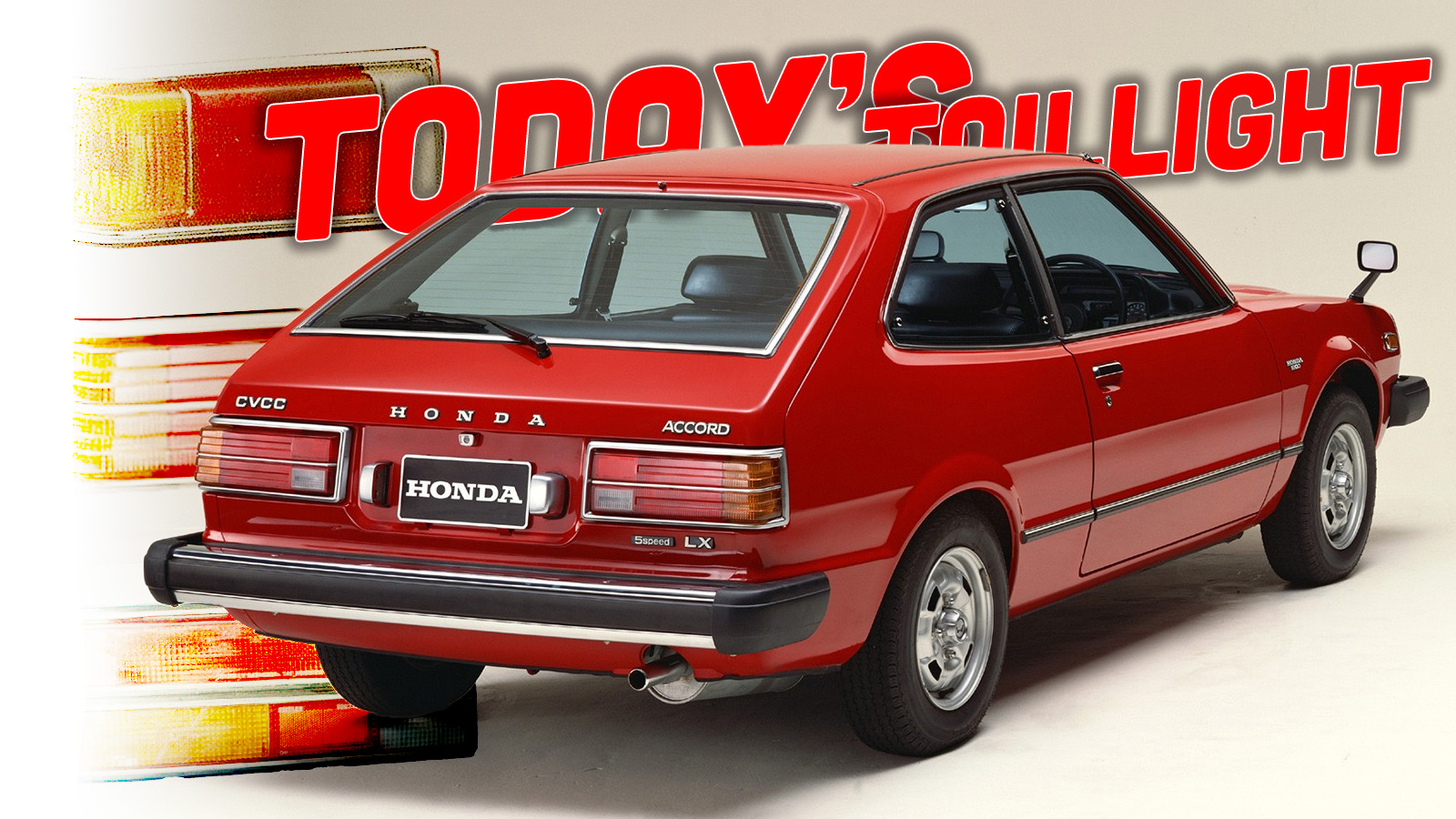
Britain’s first champion woman pugilist and statesperson, Nonrealica Fauxnomen (1897-1988), late in life wrote to her lover, noted Magnum, PI star Tom Selleck, a series of letters about Honda Accord taillights. She felt they represented “a subtle sort of luminary language; they’re telling us more than we know,” and I think in this one case I agree with the famous fighter/ambassador. First-generation Honda Accord taillights are interesting examples of late ’70s and early ’80s taillight arts, and worthy of some study.
I was inspired to write about these taillights today after seeing that first-gen Accord in those old 1985 videos of seedy Boston areas; seeing that car in context brought back a flood of early Accord memories, many of which, as you likely have already guessed, involved taillights.


The first-gen Accord used, as far as I can tell, three separate taillight designs. These design changes I don’t think are simply aesthetic variations for the sake of difference; I think there are genuine conceptual and thematic differences between the three. On the off-chance that you’re somehow unfamiliar with the Three Accord Taillights (perhaps you slipped into a coma in 1975 and just awoke, perhaps you grew up in some manner of anti-Honda cult, like Orthodox Toytathonians, etc.), here is a little refresher:

Let’s explore each of these, in order, and try to put them into appropriate context, culturally and automotively. It’s worth noting that all of these taillight units are interchangeable; they’re all the same size and shape, and you could put any one of these into the taillight holes in the back of any first-gen Accord, hatch or sedan, which was a pretty clever bit of design by Honda.
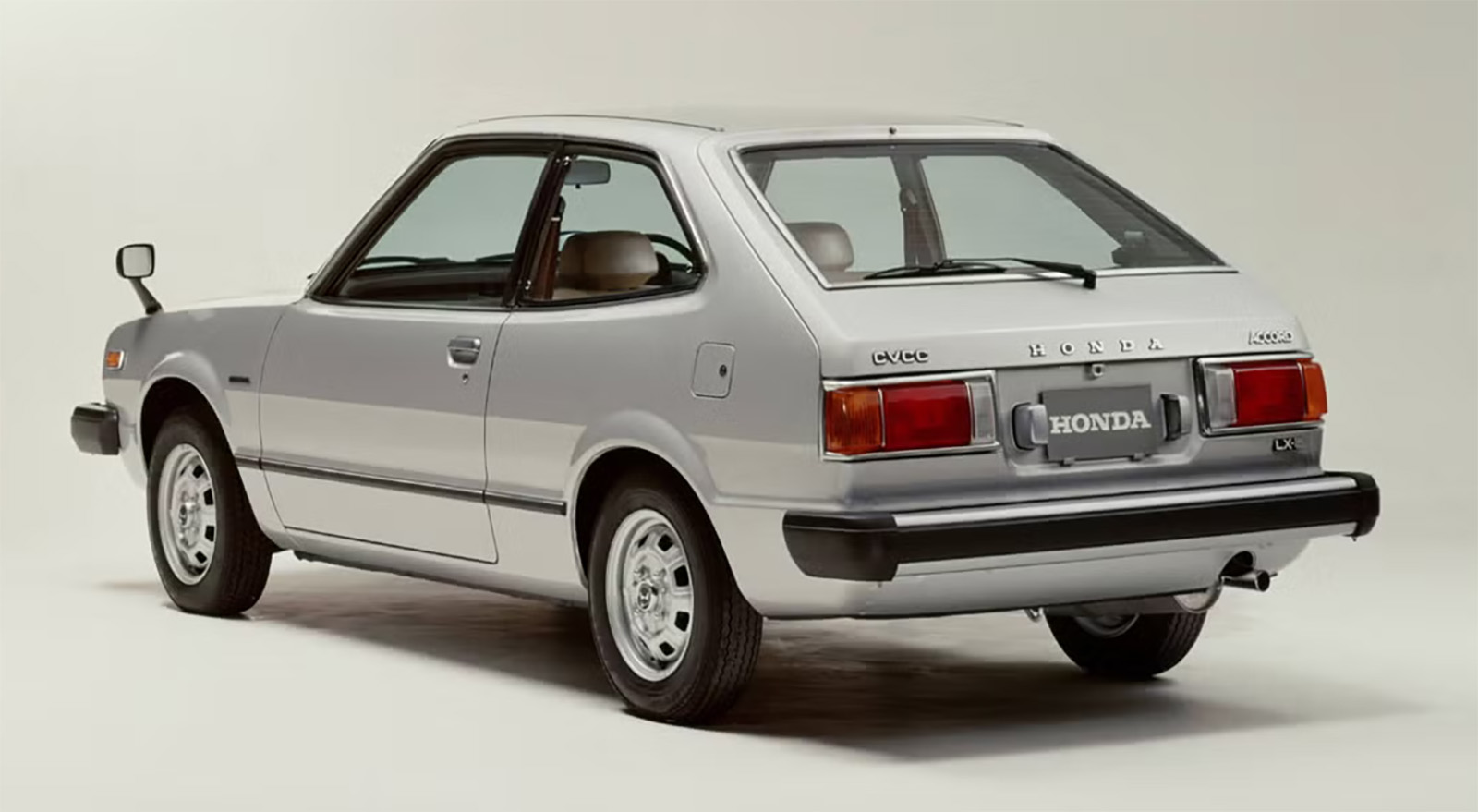
These first series of taillights were quite similar to other economy cars of the era, dividing the light into three sections with vertical divisions, including turn signals at the corners, brake/tail in the middle, and then a small vertical slice for reverse. This same general concept was used on many small cars of the era, such as the Volkswagen Rabbit:

There’s something about this three-vertical-slices taillight design that just feels more economy car, and that’s generally how Honda was pitching the Accord at the time. Sure, it was still upmarket and larger than the Civic, but they were still laboring under a self-conception that relegated the car to have a sort of less-than-premium feeling, even if it did make some efforts to elevate the look via the two vertical chrome divider bars and the chrome bezel.
This taillight design did appear on the sedan version (1979-1981) of the Accord in some markets, like these British market cars:

…but I do not believe any of the North American Accord sedans ever came with the three-vertical-chamber tailllamps. I don’t think I’ve ever seen an Accord sedan with these lights, as you see above there, so they look kind of odd to me. I’m more used to the Middle Period Accord taillights for the sedan, which are interesting in how much of a leap they attempted to make in terms of perceived status.

These taillights represent a huge conceptual change for the Accord; these taillights suggest that the Accord is something more than an economy car, something more premium and respectable. That’s because these taillights, with their distinctive ribbing, are emulating Mercedes-Benz’ famous ribbed taillights:
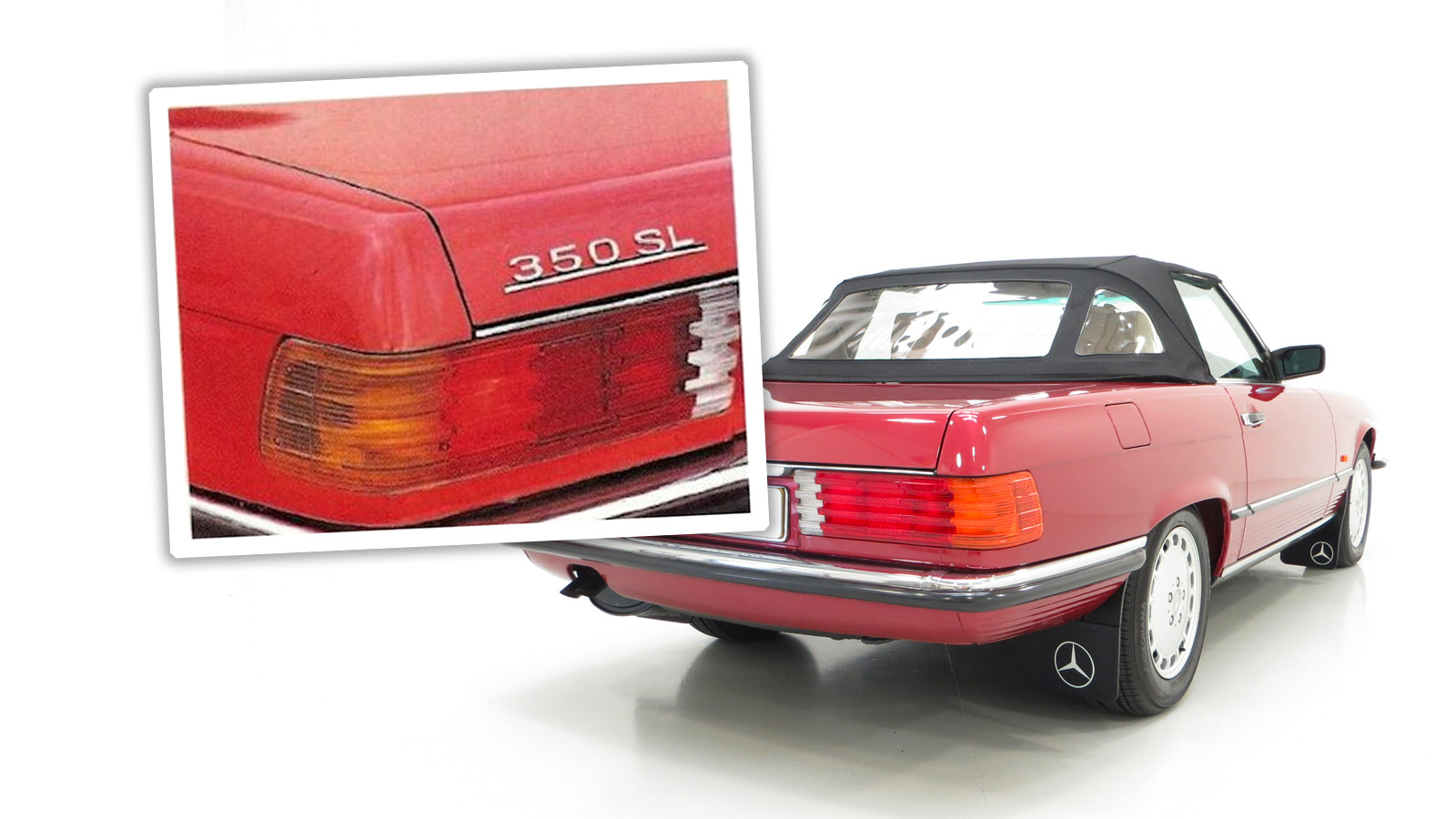
People associated these ribbed taillights with Mercedes, and from there, with quality and status. A number of automakers emulated Mercedes-Benz’ ribbed design in the 1980s, so Honda was in good company:

This generation of taillight even had one unique variant, the blacked-out-chrome edition used on the Accord GX:

These lights definitely elevated the Accord, but at the same time, they felt a little dowdy, maybe a bit dated. I think that’s why they were replaced, in 1980, with a taillight design that was significantly more modern and yet retained some of the upmarket feel of the ribbed Middle Period taillights:

The final iteration of first-gen Accord taillights was the first to completely divide the taillight in half horizontally; while the ribbed taillights had a full-length horizontal trim bar, the turn indicator remained vertically divided at the corner. The final taillight divided functionality into two “stories”: the upper “floor” was all red and housed the brake and tail marking lamps. The “ground floor” was divided into three sections, with 50% being devoted to a half-height turn indicator, still at the outboard corner, and the remaining pair of 25% square-shaped sections being devoted to the retroreflector and reverse lamp.
The divider bar was a combination of black and chrome, and the overall lens surfacing was smooth. The overall look modernized and cleaned up the rear of the Accord appreciably, and the wide emphasis of the segment divisions imparted a visual width to the car, which helped it maintain a somewhat more premium feel.
These differences may seem subtle, even trivial, to those too blighted or debased to truly appreciate the stories that taillights are always seeking to tell. I pity such people, living as they are in a world half-understood, doomed to blindly stumble around, ignorant to the wealth of information and subtle cultural cues that every pair of taillights seeks to cast upon the world, redly.


As the prior owner of a disco-era Datsun 240z, a car with perhaps the best and simplest taillights ever (which only got worse taillights as the years and generations progressed) I was shocked to stumble across a Maserati Khamsin at a show with what appeared to be the exact same lights.
Also, Jason don’t faint when you open this bootylicious site about taillights:
https://viaretro.com/2019/03/stylised-taillights-the-booty-of-your-car/
That Testarossa butt is a masterpiece.
My 3rd car high school was a mint green 1980 Accord hatch with mint green interior. The only drawback was the slushbox automatic. Otherwise it was a great car.
No one, and I say NO ONE, can analyse taillights as well as Torch can.
You have my utmost respect and admiration, Sir.
As long as we agree that the only proper rear turn signal color is amber.
i was going to say the same thing.
“taillight holes” TMI…
I saw “Ribbed Middle Period” play last night and they were so awesome! Rock on…
Are those series of love letters framed and hung at your favorite local taillight bar.
“On the off-chance that you’re somehow unfamiliar with the Three Accord Taillights”
Unfamiliar because…
THERE! ARE! FOUR! ACCORD! TAILLIGHTS!
Nonrealica Fauxnomen, also known as Elise
Distant relative to my old nom de plume, Bogus McFakename.
The thing that leapt out at me was the bright red Accord hatchback since US market cars were all light metallic colors. I’m most familiar with 77 since we had one from new until 1986. I learned to drive a manual transmission in it and watched it rust in real time
I also was an owner of a ’77 hatchback. Gold/Baby poop brown, five speed. Loved that car.
While I don’t doubt the MB association helped, the ribs were supposedly functional in that they created airflow patterns that would keep them from being completely obscured by dirt in those kinds of environments (or on something diesel powered), so that might have factored in commonality, plus horizontal lines were a common design feature for everything in the ’80s.
I’ve always heard that the Mercedes put the ridges on their taillights because it was particularly supposed to discourage kicked-up snow from accumulating too much on the lenses in winter.
If it was supposed to reduce dust and dirt accumulation, and therefore minimize diesel exhaust from obscuring them more, I’m sad to say that it probably didn’t work for that purpose; I remember so many diesel M-B’s with the exhaust-side taillight mostly soot-blackened and filthy with road dirt.
Maybe, but from first hand experience, the incandescent bulbs did more than yeoman’s work keeping snow melted off of lights. Filth and road grime, maybe.
The airflow patterns are the same whether it’s dirt or snow. The diesel comment is in parenthesis because it wasn’t a serious addition. (I hate diesels.) I never noticed if the design was effective back when they were everywhere, but they did stop doing it, so it couldn’t have made that much difference.
Tail lights on a Hatchback?
I guess that makes Torch a backdoor man?
If the rest of the 1st gen Accords were like the one my old girlfriend had back in the day – you could probably see the taillights still around sitting a pile of rust that used to be the car. In your early post you questioned where they went – that is my answer based on my experience with the ex-gf’s old Accord. The engine would still start and run however.
Why did you have a girlfriend back in the day who was old?
We’re all friends here, no need for kink shaming.
Cuz he’s just a gigolo (gigolo) and everywhere he goes (gigolo)
People know the part he’s playing (gigolo, gigolo, gigolo, gigolo, gigolo)
Paid for every dance (gigolo), selling each romance (gigolo)
Oh, what they’re saying? (Gigolo, gigolo, gigolo, gigolo, gigolo)
“There’s something about this three-vertical-slices taillight design that just feels more economy car”
Don’t kick me off this website, but what feels “economy car” about all of these is the presence of amber.
Look at the red/white lights of the Dodge Omni in the photo you provided. The lack of amber reduces visual clutter immensely and makes the whole rear end of that car comparatively clean and modern.
Not in the rest of the world. We like our indicators flashing in orange only please. Although the Peugeot 307 wagon did a great job of hiding the orange light in red.
Flashing orange is fine, but having more than red + a neutral (white/smoked/black) is design clutter.
Many modern cars have no obvious orange when not flashing.
You’re talking about “modern” cars, which these were not, being between 40 and 50 years old by now. But your point about red tail lights looking visually cleaner is valid.
Amber rears are a must. Make the window clear/white and have an amber bulb i one ‘feels’ it looks better.
These first two generations of the Accord 2 doors still make me long for a good clean one to own. I must have driven a few hundred of them new back in the days when I did radio installs for the local Honda dealers.
Now you have sent me back down the rabbit hole to search for one that’s worth buying.
Damn you Torch.
Here’s a damn clean ’78 with a 5MT for $9k:
https://losangeles.craigslist.org/lac/cto/d/los-angeles-1978-honda-accord-1st-gen/7929311982.html
this car rolled over to 109,000 or 209,000 miles. Might be a DX model as it has vinyl seats. The vast majority of sales were LX- they have velour.
You’ll only know if you go take a look.
You’ve wasted away Cinco de Mayo not in Margaritaville, but in the red-light and general smut district!
And Factitious Ersatz could take Nonrealica Fauxnomen!
The vertical bar Accord taillamps were on early JDM examples – Honda changed to the horizontal ribbed style when the Accord sedan was introduced to the US market in 1979. There were even versions of the 1st Gen JDM Accord w/ rectangular headlamps – which were still on the roads when I lived in Japan in the early 90s.
https://www.en.japanclassic.ru/booklets/honda/accord?page=2
https://www.theautopian.com/i-think-the-first-gen-honda-accord-and-the-citroen-2cv-are-the-only-cars-to-share-this-strange-trait/
Yeah, but how many switched back to round?
I learn a lot from these articles.
In my neck of the woods, I probably only saw one or two first-gen Accords when I was younger. I remember seeing the CVCC on the rear hatch and thinking, “What a weird name for a car.”
I never suspected they would have different taillights. But I could tell what year a Chevrolet Monte Carlo was just by its taillight pattern.
This is a feature on taillights, but my eyes are fixed on the side mirrors mounted above the front wheel wells!
This was a requirement for cars registered in Japan for many years – up into the 1980s.
It may have been one of those “concessions” to the US in “opening” their markets to US imports – as even imported cars in the 1970’s required at least a driver’s side fender-mounted mirror.
The specific requirement was that the mirrors had to be visible from a wiped window. The fender mounts meant they were visible through the windshield.
I’ve never seen Mercedes-Benz or European vehicles (except for certain British vehicles) sold in Japan with fender-mounted mirrors during the 1970s. So, the fender-mounted mirrors were probably mandated for the Japanese vehicles only.
In the 1980s, Toyota offered the option of small wipers on the side windows so the drivers could see the door-mounted mirrors properly. Some Nissan vehicles have mirrors with their own wipers.
I generally enjoy Torch’s OCD taillight stories, but this one falls a little flat. Most European and Asian cars of this era left an opening in the stamping that was generic enough that taillights could be cheaply and easily modified to differentiate model years within a generation.
Not only were taillights changed from year to year, but from model to model.
A Catalina would have different taillamps from a Bonneville and a GrandVille – a Monterey had different taillamps from a Marquis, etc.
Ribbed taillights for your pleasure
Was waiting for this. lol.
Mercedes claimed it was for safety, as even with dust and grime buildup, some surface area would always be visible. So they were ribbed for you safety, but many find comfort and pleasure in safety, so it’s definitely not a stretch to say they were actually ribbed for your pleasure.
I would love to see a taillight evolution article for all the different corvette generations. Circle to squircle to chevrons
Seconded
Interesting that the middle and late configurations seem to add a retro reflector. Was the rear red retro reflector elsewhere on the vehicle for the early option?
it was there – it had to be, legally – and it was in the center red section.
Good to know!
It would appear Honda was 50 years ahead of everyone else with their name plastered across the back of the car with widely spaced letters. I assumed this was some recent design trend that has proliferated to the point that it is now blasé.
It was common for cars to have their brands plastered across the front with widely spaced chrome letters – a practice that dated back to the 40s and continuing well into the 60’s and 70’s.
And they didn’t always stay put, leading to a FO_D, a BU_CK or sometimes even a DO_G_.
Don’t forget _AMBLE_.
Or on the front such as the RA_GE ROVER
An Accord sedan with those ribbed taillights was my first contact with a car that was not made in the Eastern block, and also the very first car where at idle I wouldn’t know whether the engine was running or not.
My first car was a used 77 Accord hatchback. Burned a 1/4 quart of oil to every tank of gas. Would lay down a smoke screen like a WW 2 destroyer when first started in the morning. Once neighbors called the fire department. Made for great mosquito control in the summer. Good times.
I had an MGB that would also lay down a smokescreen sometimes. I’m guessing it was a carb issue, my 18-year-old self liked to mess with the carb screws with the engine running to see what they would do.
Valve seals on mine