


Any writer who uses the old “like a go-kart” trope to describe the Gazoo-breathed-on GR Corolla and GR Yaris models (if not others) can be forgiven, but it may be time to retire the old saw now that there’s an actual Gazoo Racing go-kart, ready to give you the experience of donut-sized-wheel-to-donut-sized-wheel racing with a machine that fits in a minivan – if you live in Japan, that is.
With Gazoo Racing behind the new machine, I was expecting a premium-spec (and premium-priced) maximum-performance kart. But that’s not what Gazoo Racing is going for here. There’s a more noble mission in mind with the GR Kart project.


From the ToyotaRacing.com press release:
Racing karts offer the thrill of controlling a vehicle hands-on. But hurdles such as kart costs, transportation, storage, and maintenance await those who want to get into karting. By offering a price point and system for the GR KART that makes competing easier, GR aims to make direct involvement in motorsports possible for more people.

GR Kart launched today at kart tracks and GR Garage locations in Japan with the goal of “broaden[ing] hands-on access to motorsports for children and families.” According to GR, the program represents Toyota Chairman Akio “Morizo” Toyoda’s long-held “desire for motorsports to be an activity more people can take up, like baseball or soccer.”
A fine goal indeed, and karting is a great entry to motorsports. Lest anyone think GR is merely slapping logos onto an existing kart, you’ll be glad to know the GR Kart has been designed specifically to spread the go-kart gospel:
As a “carmaker-made kart,” each GR KART is carefully crafted, incorporating experience and ingenuity honed through Toyota automotive manufacturing. Gamagori GR KART Workshop, Gamagori, Aichi Prefecture, produces the GR KART, and the workshop’s small scale makes it ideal for tackling challenges and quickly testing innovative ideas and technologies. Guided by Toyota Production System (TPS) principles, the workshop is committed to ensuring quality and continuously improving its manufacturing processes. Through these initiatives, GR is working to reduce costs and aims to create products that make it easier for newcomers to start and continue karting.
The GR Kart has these features, as described by GR:
- [Low] pricing for ease of starting and continuing
- Packaging that fits in a family minivan and can be stored upright
- Driving position adjustment mechanisms that allow everyone from children to adults to share the same kart
- A design that minimizes the hassle of maintenance and preparation, allowing focus on driving
- Durability for long-term use and a safety design tailored to beginners
I’m sure we can all get behind those, and they’ll undoubtedly make it easier for folks to get into karting – but I want to see some cool stuff. So let’s move in for a closer look …

The throttle and brake pedals look a lot more substantial than what I expect of a go-kart, with plenty of room to accommodate adult-sized feet. I also like the way the side brackets are curved, presumably to help prevent the driver’s feet from sliding off the controls.

The pedal assembly can be slid fore and aft to suit the driver’s height. Note the hydraulic cylinder for the brake; we’ll get a look at the caliper and rotor a little farther down.

The steering wheel position is also adjustable to fit a wide range of driver heights. According to GR, the kart is sized for drivers 4′ 5″ to six feet tall.
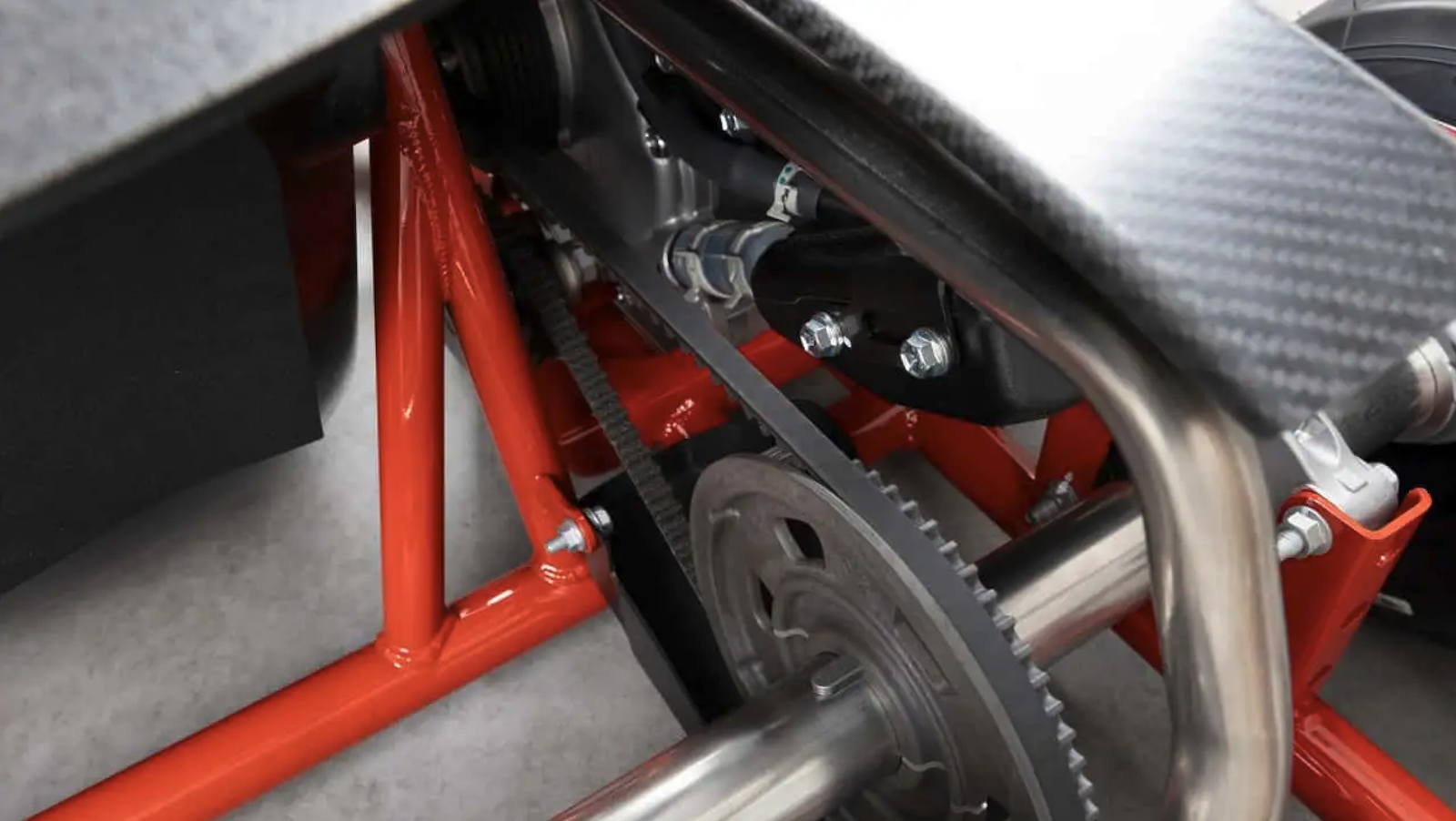
At the business end, belt drive replaces the expected chain and sprocket, eliminating messy chain lube. Belt tension is self-adjusting. Note the carbon-fiber shield that helps protect drivers and handlers from accidentally touching hot engine parts.

A single-piston caliper puts the squeeze on a drilled rotor. Since the axle is live, only one brake is required to apply stopping force to both rear tires. GR notes the axle is stainless steel to resist rust.
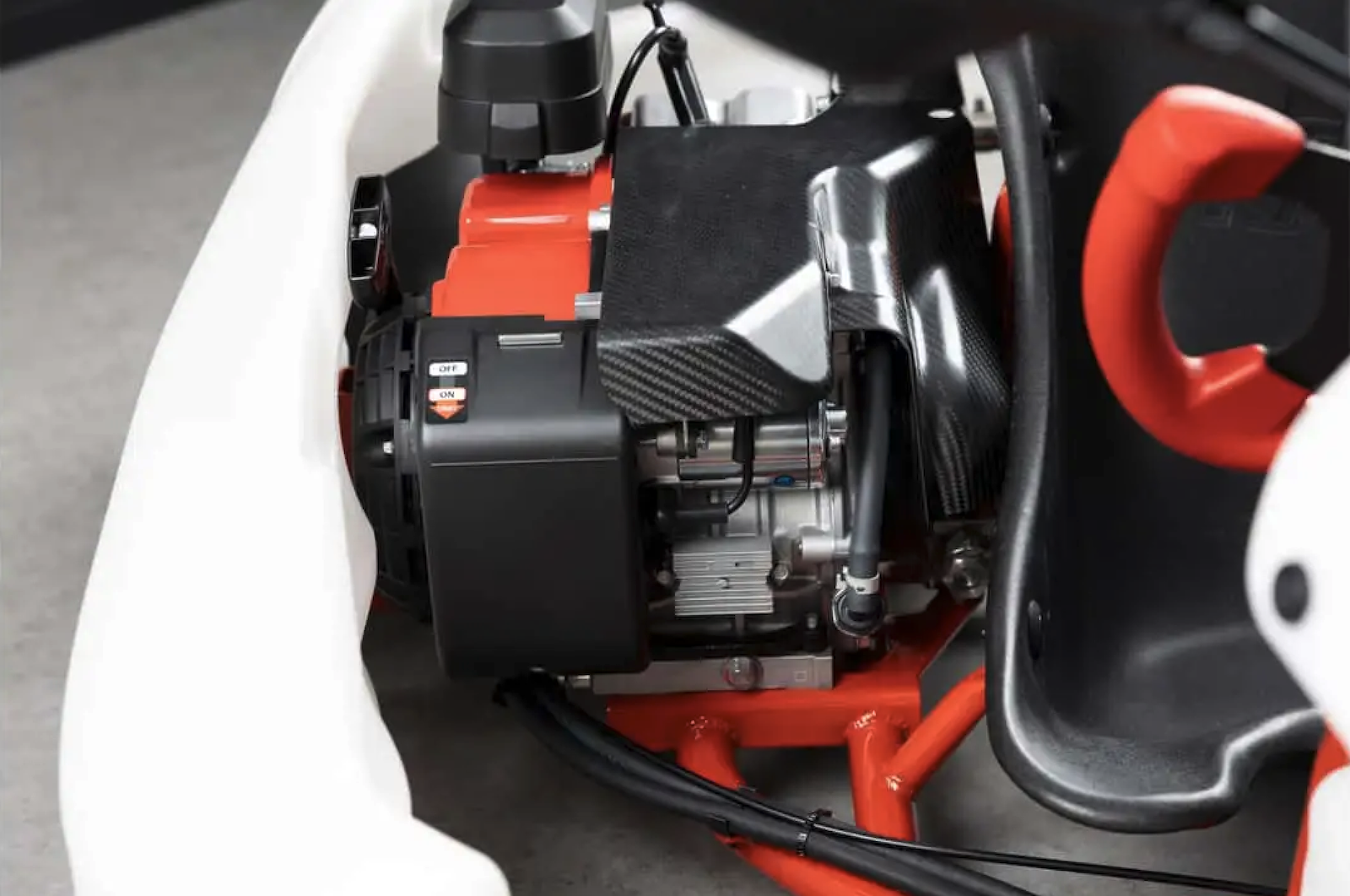
The engine is an overhead-valve single-cylinder displacing 215cc, but GR is otherwise tight-lipped on the specs.
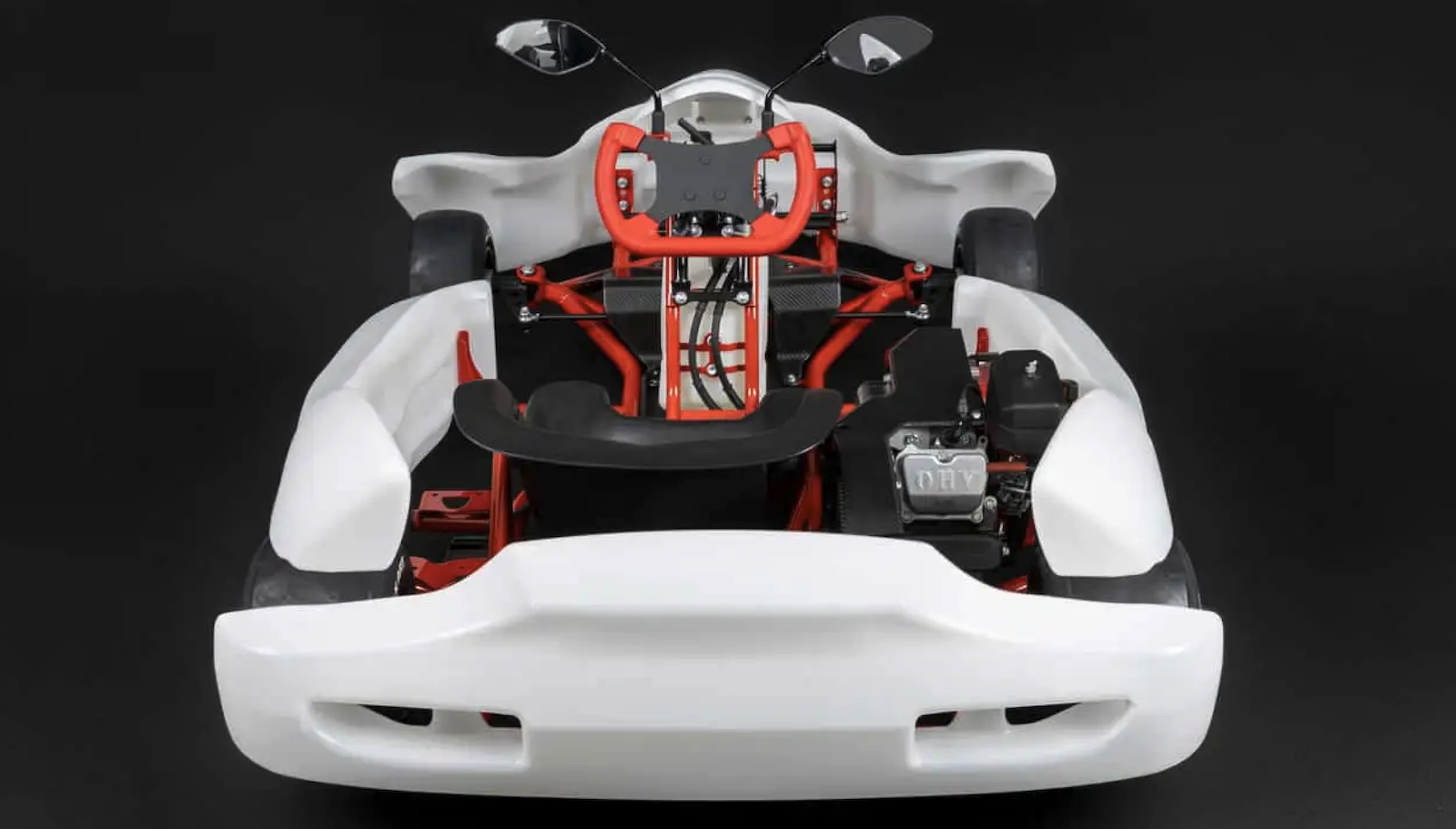
The rear bumper is designed to prevent other karts from riding up onto a rear tire in the event of a collision, says GR.

If you want sponsor decals on there, you’re gonna need to knock on some doors, kids.

A minivan is all you need to get your GR Kart to and from the track, with no disassembly required. GR calls out the Toyota Noah and Voxy vans as capable kart haulers. Will it fit in a Honda Odyssey? How dare you.

Storing the kart vertically minimizes the garage space required between race days. “But what about the …” Settle down, GR has it covered:
An upright-storage-compatible engine oil catch tank, a float-chamber-free diaphragm carburetor, and a fuel filler opening orientation that minimizes fuel leaks even when the kart is upright make upright storage possible without first draining the kart’s gasoline and engine oil.
So, no problemo with the vertical storage.
In addition to all that good stuff above, GR supports its karting initiative with an app to guide wannabe racers from merely dreaming about karting all the way to the finish line.
The “GR app”, as a dedicated app for the GR KART, is available, providing support from pre-purchase learning to post-purchase driving. The app includes information on the GR KART and instructional content to build the knowledge needed to drive. Users can register on the app to obtain and manage a driver’s passport, which serves as proof of eligibility to engage in sports driving with a GR KART at participating kart tracks.

There are currently 36 tracks participating in the GR Kart program across Japan, so there’s plenty of opportunity to get in on the fun if you’re on the island. And the cost? A GR Kart will set you back 385,00 yen, or about $2,500 dollars – that sounds like a real value to me, given my shopping search results for “competition g-kart” revealed prices starting at roughly double that price and going up from there.
I should move to Japan.
Top graphic and story images: Gazoo Racing


I notice that nobody is complaining about the all-white livery. It’s ok here but not on the Cozu Coupe?
Gordon Murray’s Brabham BT44, and the Shadow DN12 both looked nice in white.
$2,500 seems like a lot of fun for the money. Heck, a 160cc scooter is $4,000+
living here in Japan. Working with a friend to start up a racing esports club with a track towards getting younger generations into both racing and mechanics. We’re hoping to grab a couple of these to take to our local small track with regular members.
The Chevy Vega was set up for vertical storage too. GM could have used that development for some other things I think. Makes lots of sense for a Kart though.
Hopefully these make it’s way to the US as a spec series. Rental spec series would be fun, right now rentals are $500+ a day + entry fees. Kart test\track days are cheap, kart race days while still much cheaper than getting into a series like spec Miata, is still relatively costly.
That instruction graphic can scarcely be more Japanese, aside from it all being in English.
I hate the “handles like a kart” cliche. If you want your car to handle like a kart you have to weld up your diff (to get the chronic wet-track understeer) then have all the suspension removed, then do something horrible to the steering to make it uncomfortably heavy. And throw the front brakes away to make corner entry more exciting.
Having had several cars with a welded diff I really can’t recommend it. Massive rear brake bias wasn’t fun either.
“A single-piston caliper….”
It’s not a sliding calliper, so there will be another piston on the other side.
Having the inside rear wheel not touching the track is essential. Given adequate power, you can go from understeer to opposite lock steer by throttle quite quickly, the frame is designed to flex enough for the engine to have adequate power.
As for brakes, they are sort of superfluous except for being at a complete stop, just like Speedway Bikes that have no brakes at all.
Put a tow hitch on my GR Corolla. Buy a Harbor Freight utility trailer. Profit!
Super cool. Anything that lowers the barrier to entering motorsports is a win.
It’s also another great argument for automakers branching out into other forms of transportation, specifically mobility aids. They’re all ridiculously expensive for what you get. While I’d guess that a lot of the cost has to do with meeting all kinds of certifications (since it’s a medical device), it’s not like automakers don’t have experience with that. It’s an underserved market that decent, competitively priced products would scope up (in my mind at least).
I think this is my new favorite ride on toy.
I raced karts in the regional championship here in Switzerland some 20 years ago. Had a great time back then, and when I started out I would load my kart in my Toyota Previa to get to the tracks. Eventually I got a trailer for it as I needed to bring some more equipment along, but I get the idea Toyota is showing here.
Just wanted to mention here that I so wish we could get the Voxy and Noah in Europe. Having driven the Voxy in Japan, I just love the car for the space it provides, and the genious of it not being too wide. It has all the advantages of a good sized mini van, with the added benefit of easily fitting in parking spaces and just so nimble to drive in traffic and tight streets. Unfortunately the mini van has totally disappeared from the European market as we can’t even get the Siena here.
Japan seems to be the only country that still recognizes the value of minivans.
We just got rid of our 2009, 500,000 km Noah YY. The main reasons we kept it so long are the ones you mentioned, plus the YY (and Voxy Trans X) were the only two-row full-size minivans: we don’t need 8 seats, just space for dogs and stuff and occasional passengers.
Toyota stopped making the YY after the model change in 2014, so we replaced ours with… a 90,000km 2013 YY.
I would go with a new Voxy with four individual seats and simply remove the third bench. That was the setup I was driving when in Japan, and it was just perfect for four people to travel and haul whatever we needed in the back. It would be my dream car back home in Switzerland. It is crazy to think that a modern Toyota Camry is 10 cm wider than the Voxy at 183 cm vs 173 cm.
A couple of decades ago I had a friend who was a semi-pro kart racer. He was pushed into it by his dad (who dreamed of his son going on to F1) and had the right body size and a natural talent, but no ambition. He raced for about eight years before he gave up at the ripe old age of 20, having tested for Indycar but never made a team. I was consistently blown away by just how incredibly expensive it was, to the tune of several hundred thousand per season AFTER the purchase of the kart, the gear, the spare parts, and the trailer to carry all of that in. What Toyota is offering here is an absolute bargain by comparison.
I’m not all that familiar with karting, but this seems like one hell of a deal for what you get. It’ll probably be relegated to a spec series as it’ll be too heavy for an engine displacement based class, or too underpowered for a weight based class, but as an entry point and as a toy this seems like a bargain.
It would be awesome if Toyota let their dealers here in the US special order them even if they’d end up costing $4000 as I expect they would.
The Noah and Voxy are among the narrowest “full-size” minivans in Japan, only 1730mm (about 68″), so other makers’ vans shouldn’t be a problem.
I need it ! to this day i have no idea why karting is not more popular. in these trying financial times this seems like more fun than spending dozens of thousands of dollars in a car. side by sides are super popular why not karts?
For me, it’s track availability. It’s a bit of a hike to get to a track, and I don’t imagine too many of those tracks are all that profitable (meaning little incentive for more of them)
Some sort of hybrid of karting and autocross would cheap and fun.
yeah karting has been religated to “family fun” centers where the tracks/ equpment are very low quality to mid but its a riot if your a preteen to teenager. there is a more serious karting center in a nearby town but the prices are absolutely eye watering $50 gets you .. 10 minutes ish worth or driving. on their equipment and no “bring your own” option.
Well, I’d rather have a couple of hours with crap than 10 minutes with something good enough that it takes more than ten minutes to figure out.
I can’t figure out if there’s any reason for brakes in those cheap Karts, though. Maybe if I entered the corners with a little less speed, I wouldn’t get as sideways and burn off so much speed. Braking transfers weight to the front and makes for more turn-in and loosens up the rear, two things I have plenty of already.
So maybe enough power to need to brake would be fun, smoothing things out or just being on the power all the time and slowing by getting sideways doesn’t seem to be very different.
it would seem a bit .. criminally negligent to NOT install brakes no?
Well, I want one.