


I attended a brunch with the leadership of Volvo Cars yesterday, and the frank and plain-spoken CEO Håkan Samuelsson captured my attention with the answers to two questions. The first was whether or not we’ll ever get a wagon again and the last, my question, was what the hell the company is going to do with its South Carolina factory.
Being frank and plain-spoken doesn’t mean spilling all the beans, and Samuelsson managed to not commit to any specific body styles, but there’s a way to read his responses as an admission that wagons are in Volvo’s future. It’s also basically confirmed that a three-row vehicle is coming to America, designed for America. That probably means an SUV, but I’m hoping it’s a van.


I am en route to a Ford event this morning to see something Bronco, and the Ford people might be cheering the fact that the company’s new energy company, Ford Energy (clever!), has found a customer for its batteries. The world is a strange place these days, and while everyone was concerned about Chinese brands infiltrating Canada, the most obvious outcome is non-Chinese brands importing Chinese-built cars.
That’s not the case in Australia, where BYD is absolutely cleaning up in a world of high gas prices, and companies like Toyota are losing.
Volvo Won’t Just Be SUVs In Five Years
Yesterday’s event was ostensibly about the US debut of the Volvo EX60, a capable-seeming and fast-charging electric crossover with a super cool charging door. There was a lot of talk about the EX60, of course. That wasn’t all the talk, though.
Credit to Road & Track‘s Will Sabel Courtney for grabbing the microphone early in our brunch-side conversation (I had a juice) and asking the question everyone wanted the answer to: Will Volvo bring back the wagon?
The last Volvo wagon is on its way out in the United States and disappearing globally, being replaced by a bunch of crossover-like objects. As an enthusiast, this is not ideal. It’s very easy to say ‘Oh, no one will buy these,’ but Volvo has always done well by finding niches in the market. Constantly trying to compete in the most competitive market segments is going to be a tough game.
Samuelsson, who was CEO and then not-CEO and then CEO again, was excited to grab the microphone and answer this question, stating that in ten years he doesn’t think “We’ll only have SUVs from Volvo.” That’s not quite saying that they’ll all be wagons in the future. He then added that the lower air resistance is a big reason why wagons are appealing from an EV perspective. Later he sped up the timeline by stating “I think we will not only have SUVs five years from now.”
There’s some interesting timing to this question. Unlike a lot of European automakers, Volvo has a factory in South Carolina. A factory that, for various reasons (EVs, sedans), has been underutilized. Exactly what’s going there has been a little vague.
I got the last question at the brunch and, having ingested a spicy Thai flatbread, I realized as I was about to speak that I had a huge lump of phlegm in my throat. Would I be able to talk at all? Suppressing panic I attempted to speak and no sound came out. I made an awkward throat-clearing sound and asked about the South Carolina factory’s under-utilization and what might be done about it.
“I agree with you,” Samuelsson said, adding that “You either use your factory or you don’t have a factory.”
“We need to fill the factory, that’s the first option and best option. We will bring in the XC60 at the beginning of next year.”
That much was basically known. What he added was well-speculated, but I’m not sure I’ve seen confirmed.
“We are developing a car with the US market in sight, which should be a big seller, [a] bigger car probably, probably a third-row, family-oriented, which also needs to be multi-fuel execution,” he said. “With such a big car it’ll be difficult to go directly only to electric, so this is a car we’re looking into.”
The obvious guess here is that it’s a three-row crossover. Everyone loves a three-row crossover, and right now Kia, Hyundai, and Toyota are owning the hybrid three-row space. Can I suggest something else fun? If we take the answer to the first question, that people are tired of just having SUVs, could it not be a van?
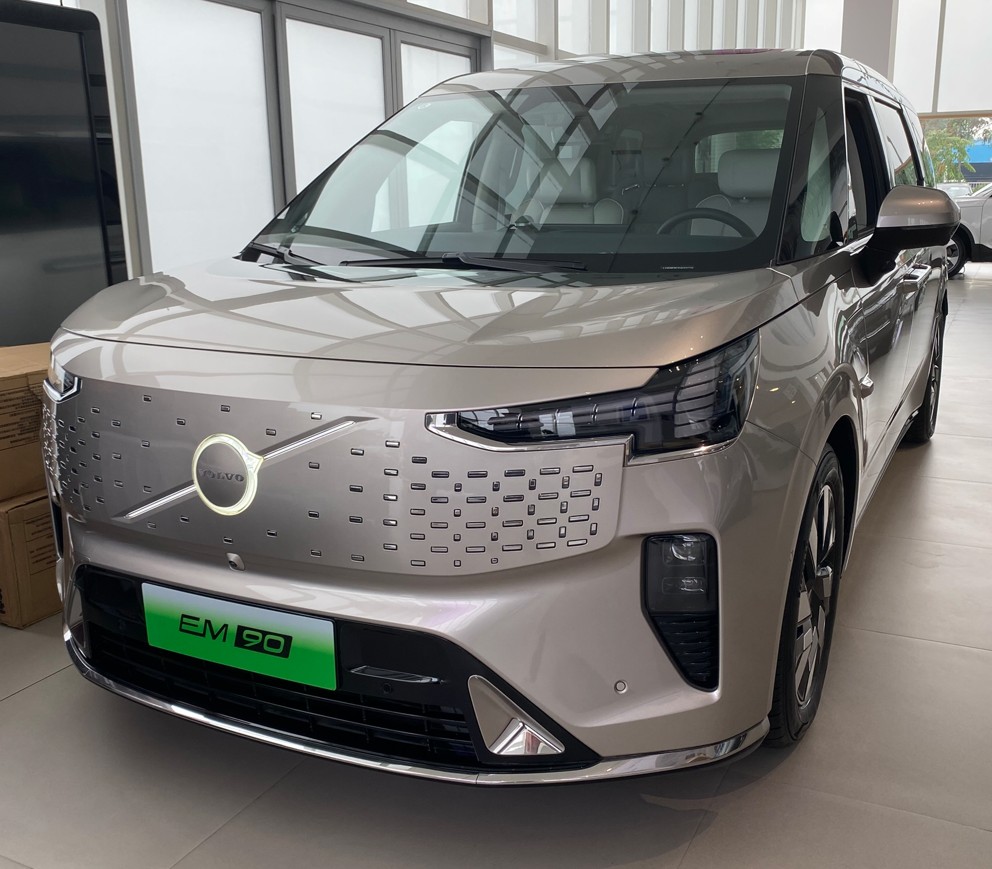
For the Chinese market, Volvo has already made a Zeekr rebadge that’s called the Volvo EM90. Chinese cars exist in their own development universe, so it’s unlikely that the Zeekr-badged EM90 will be sold here. Whatever we’re getting is going to be built in America, for America first (although, as Samuelsson pointed out, the tariff deals now mean that it’s almost free to export cars from South Carolina).
Why not a van? It’s an open space that Volvo hasn’t historically filled but that there might be an appetite for. This could just be journalist-brain, but imagine an ID.Buzz that’s a hybrid or EREV? That might be the ticket.
Nissan Could Bring Chinese-Built Cars To Canada

Canada has decided to allow Chinese cars into the country under a special program, and while it’s not a huge number of cars to begin with, I think the expectation has been a lot of Chinese brands like BYD and Geely showing up. Instead, it’s maybe Lotus and Nissan who could get there first given the existing dealer network.
For Nissan, that could be cars from its JV with Dongfeng. Here’s Bloomberg on that possibility:
The Japanese carmaker aims to tap demand for low-cost, electric vehicles manufactured with Dongfeng Motor Group Co. in several markets, including Brazil and Mexico — and potentially including Canada, Christian Meunier, Nissan’s head of the Americas, said in an interview.
“In Canada, the government has opened the door for some Chinese products,” he said, although he didn’t specify which Nissan Dongfeng models were under consideration for possible export to Canada, or how soon that might take place. “We’re looking at this.”
Get ready to buy an N6!
Australia Loves Chinese Brands, Everyone Else Is Hurting

Gas prices in Australia are incredibly high, and with that price increase have come with an appreciation for Chinese cars and trucks. Now data is showing that Chinese brands are growing way faster than pretty much everyone else.
China’s BYD logged the biggest increase in unit sales in the January-April period, according to recent figures from Cox Automotive, selling 13,269 more cars than the same period a year ago. Chinese peers Chery, Geely, GWM and Jaecoo rounded out the top five.
On the other side of the ledger, market leader Toyota saw the steepest sales decline in the period, of 17,502 units, followed by fellow Japanese manufacturers Mitsubishi, Nissan, Mazda and Ford of the U.S.
“There’s a cost-of-living crunch and more and more people are trying to buy something with electrification, and both of those things are so suited to the Chinese brands,” said Mike Costello, an industry commentator at Cox Automotive. “They’re cheaper than everybody else and they do hybrids and EVs really well.”
Obviously, Japanese brands still make up 40% of the market, and Chinese brands have the most room to grow, but they’ve been here for years and these are becoming larger and larger numbers.
Ford Energy Gets Its First Customer

Realizing it might not quite need all the battery capacity it built up, Ford shifted some of its domestic battery production into Energy Storage Systems (ESS) under a new company called Ford Energy.
Now, they’ve got a first customer, as the Detroit Free Press reports:
On May 18, Ford Energy, a wholly owned subsidiary of Ford, said it signed a five-year “framework agreement” with EDF power solutions North America to make battery energy storage systems for EDF.
EDF power solutions North America is an entity of the EDF Group, a French government-owned multinational electric utility company that produces low-carbon electricity. It especially focuses on using nuclear and renewable energy.
Ford Energy President Lisa Drake said the agreement with EDF power solutions validates the market’s need for a battery energy storage supplier such as Ford, which combines its industrial-scale manufacturing knowledge and experience with accountability.
While there’s been a general distaste for renewable energy in the current White House, the reality is that it makes a ton of sense. The major negative argument against renewables is that solar, for instance, is diurnal. Having energy storage mitigates a lot of this challenge.
What I’m Listening To While Writing TMD
It’s Skin Cancer Awareness Month and our friends at XPEL are celebrating with National Don’t Fry Day, so I’m going to do a week of beach songs. Today, it’s “Summer Babe” by Pavement.
Observed annually on the Friday before Memorial Day, National Don’t Fry Day raises awareness about the dangers of ultraviolet (UV) radiation and promotes sun-safe habits as Americans head into summer. In recognition of the occasion, XPEL is offering 15% off automotive window tint installations at participating authorized dealers and company-owned stores across the U.S. on May 22 only.
The Big Question
What non-SUV should Volvo build next?
Top photo:Volvo


Volvo, with its reputation for safe family haulers seems like a no brainer for vans, especially with minivan sales on the rise again.
I’ve got tickets to see Pavement in Chicago in July, pretty pumped for that one!
I salute their efforts to bring back wagons. Had a 740 wagon back in the early 90’s when my kids were learning to drive. Still the best seats I’ve ever driven and both kids are good safe drivers to this day. Make mine a PHEV and it’s a deal!
Show me a word that rhymes with pavement.
Engagement?
Savement: an obsolete word meaning “salvation”.
How about another one?
The French word for “enema” is lavement.
You now have the last words for the first, second and fifth lines of a limerick.
It’s your turn!
Volvo should make a dune running luxury sport truck obviously. /s But in seriousness an S60 convertible phev or erev runabout would be nice. I’m curious what a Volvo van would end up like. Whatever it is I hope it has physical controls.
100% sure it’s just gonna a be just a bigger SUV fitting in above the 90. What I’d like to see is a new Duett, which is kind of a mix of van/station wagon and it was possible to install bench seats in the back. Lovely design.
Oh, that’s so 40s! Reminds me of a 48 Ford panel van
The big question? They should build this.
https://www.volvocars.com/us/cars/legacy-models/960-estate/
RIGHT??? I prefer the looks of the objectively inferior early 90s 940 (and 960s have never been within my purchasing power anyway), but this really is where Volvo wagons peaked for me. The 850/early V70 was ok, and the R versions are legendary for a reason, but to me that’s when they started to give up on reliability – plenty of cheap broken 850s around here that no mechanic wants to touch with a 10ft pole.
A new station wagon coded number 666. Jet black exterior, Jet black interior, maybe paint the roof hellfire red…it MUST have backward facing 3rd row seats for the little devils in your life.
Honestly to me the 850, not 960, was peak wagon. A band friend had one in the mid 1990s and I am still envious.