

It’s no secret that numbers are a big deal to gearheads. Horsepower, 0-60 times, torque specs, ground clearance, top speed, cubic volume of luggage space, if it can be measured and expressed with a number, chances are that some car-lover has memorized it and is bragging about their particular car’s number to some bored person they have cornered at a party. These numbers are especially important for sporty and performance-oriented cars, where people can get really obsessive about them. Sometimes, these numbers are why people buy a particular car in the first place. That’s why car ads like to tout them so much. And, usually, the numbers those ads tout make sense.
But not always.


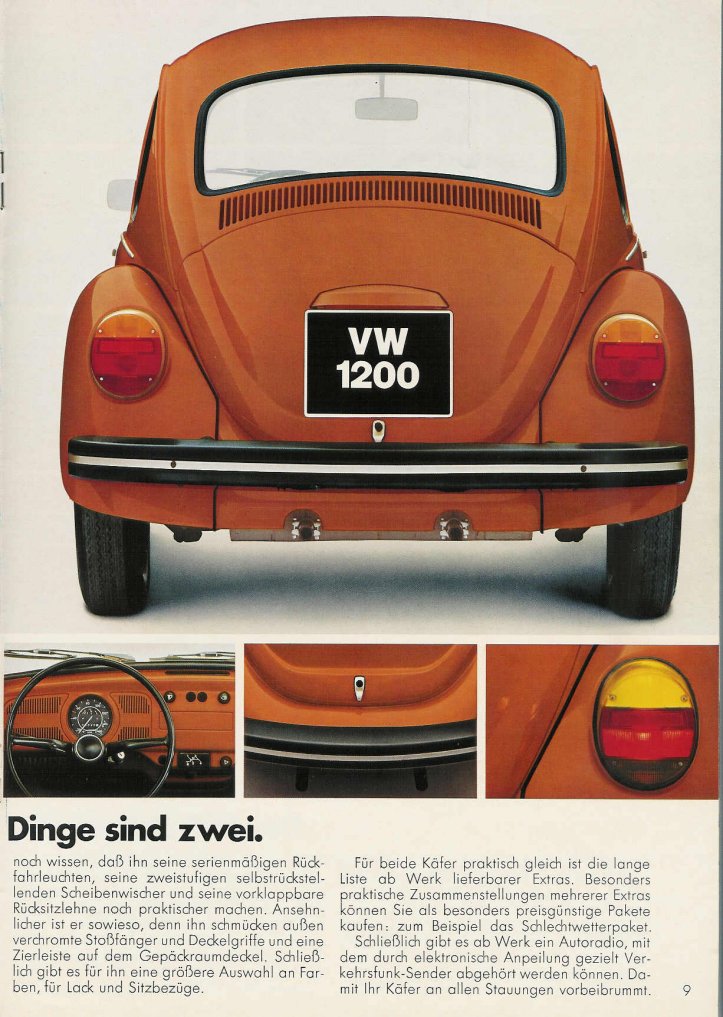
I think the most remarkable example of a number touted and showcased in a car ad or brochure that really, genuinely makes no sense has to be in this brochure for the British-market-only Volkswagen GT Beetle. Let’s see if you can spot it:
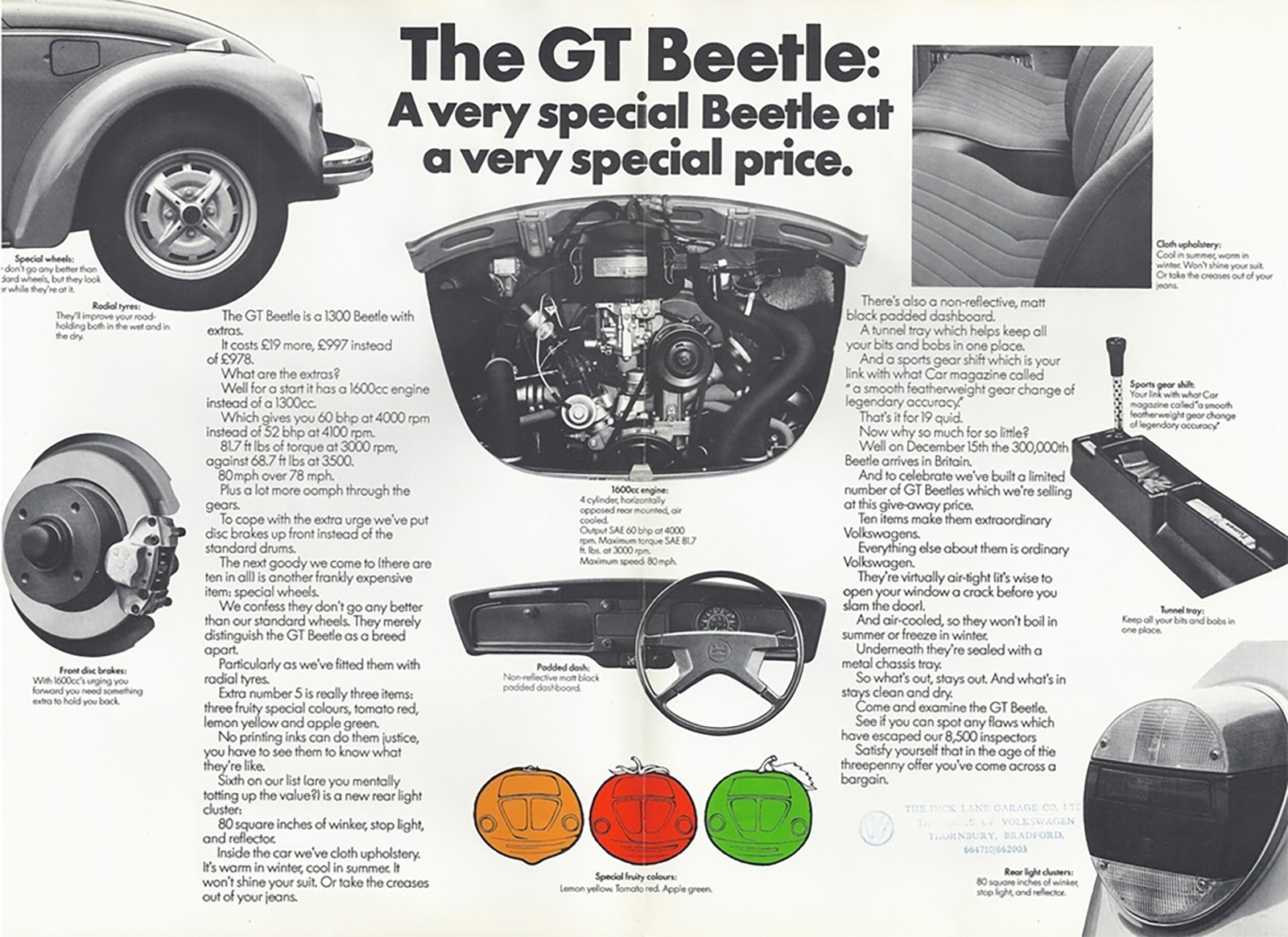
Before I come out and just tell you what it is, let’s talk a bit about the GT Beetle. These were 1973 model year special edition Beetles, with only 2500 made. They came in Lemon Yellow, Apple Green, or Tomato Red (I’d kind of have guessed a lime green and apple red but maybe the Brits have different default color associations with fruits and vegetables). The GT Beetle was supposed to be a sportier version of the Beetle, and as such came with the biggest, most powerful engine available to Beetles, the 1584cc dual-port engine known as the 1600, which made a ravenous 60 bhp.
In America, this was the only engine sold with Beetles since 1971, but in Europe, you could still get a 1300 Beetle that only made 52 bhp. Oh and those are old-school horsepower numbers, so if you want more context, I wrote about all that before.
There were also special GT Beetle badges for the rear decklid, though it seems those were optional, because if you put them on, it could affect your insurance rates, at least according to legend.
This GT Beetle could make a face-melting 84 mph top speed, and had disc brakes up front to slow down, along with a fancy shifter, center console tray, special upholstery and door cards, sportier hubcap-less wheels, and the new, larger, “elephants foot”-style taillights that were introduced in the 1973 model year.
And that brings us to my favorite numerical spec noted in the brochure, actually brought up twice, which is double the amount of times horsepower or torque are mentioned. Here it is:
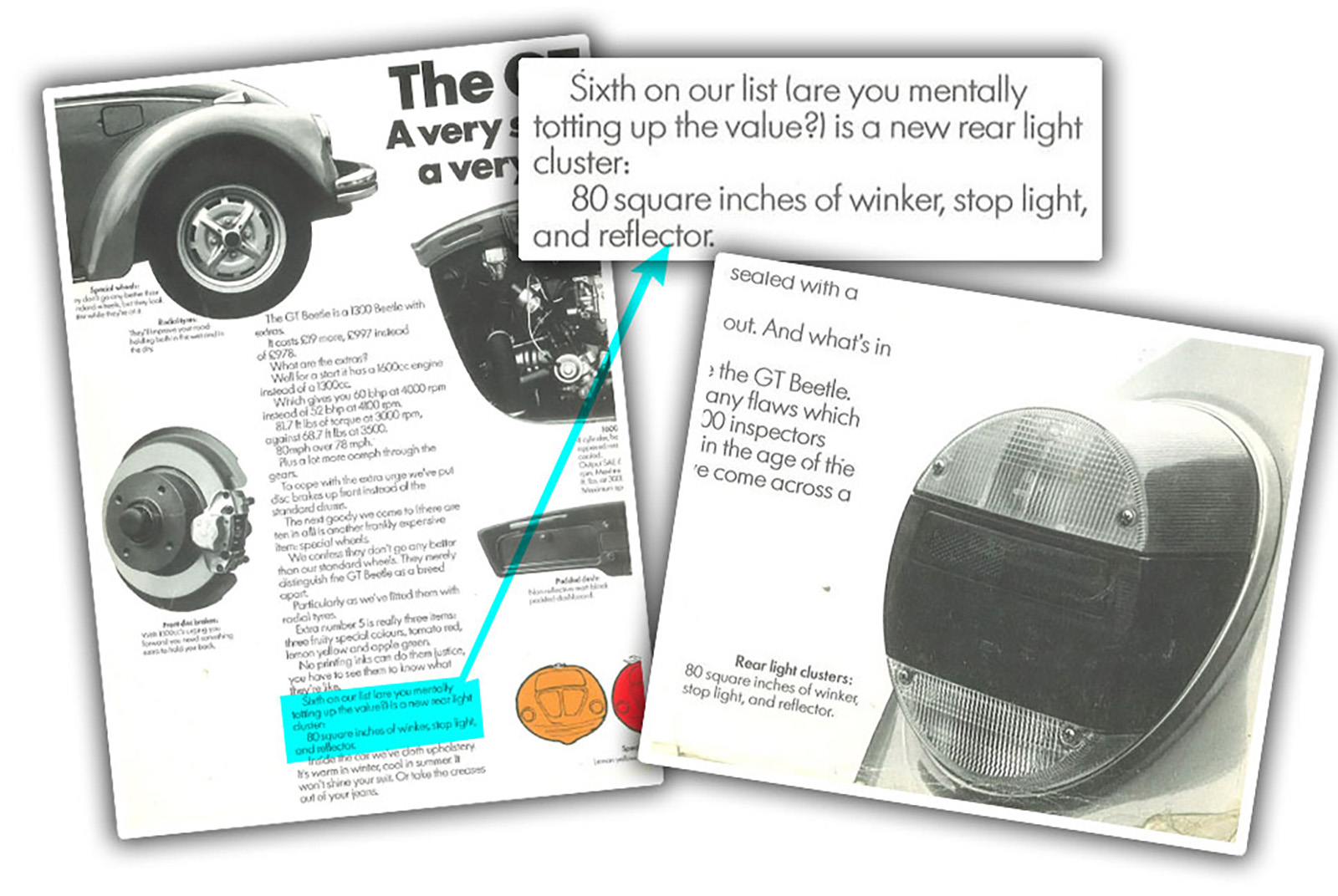
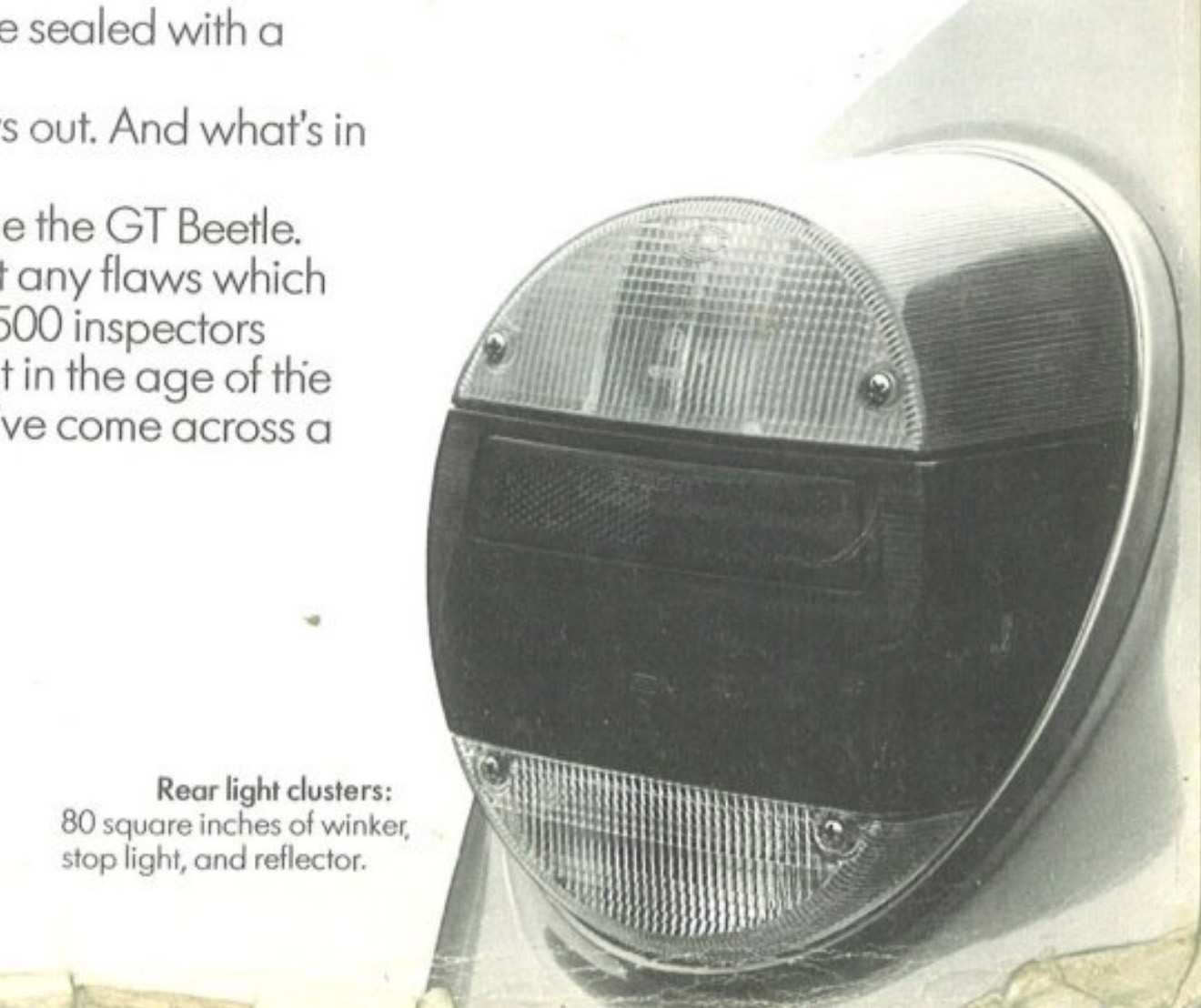
80 square inches. That’s the number so important they mention it twice on a two-page spread. It’s the area of taillight lens that the new big light clusters have, described in the brochure as “80 square inches of winker, stop light, and reflector.”
Twice they mention this! Twice! Like taillight lens area is some big thing that gearheads are always going on about. You know how you’re with your friends and you hear the low rumble of a V8 and you see, say, a mint GTO blast on by? And then you watch it go past you, and you squint your eyes and really peer at the rear of the car until you bellow out “holy shit, did you see that? That baby had to have at least 120 square inches of taillight lens area back there!” and then you get so worked up you have to retreat behind a fire hydrant and furtively pleasure yourself until you can hold a rational thought again. We’ve all been there, right?
It’s such a bonkers thing to point out in a brochure for a sporty car. Or, really any car. It’s just not something that anyone has ever actually demanded to know about a car. Who was asking for those numbers? Oh, and even better, the numbers are sort of deceptive! That’s because the GT Beetle didn’t come with the reverse lamps (clear section at the base of the taillight) wired up!
Now, to be fair, they don’t mention reverse lights in the description of what those 80 inches cover – it’s just winker, stop light, and reflector mentioned – but since those taillights have the lens area for the lights, and they’re mentioned so prominently, VW Britian actually had to put these disclaimer stickers on the brochures:
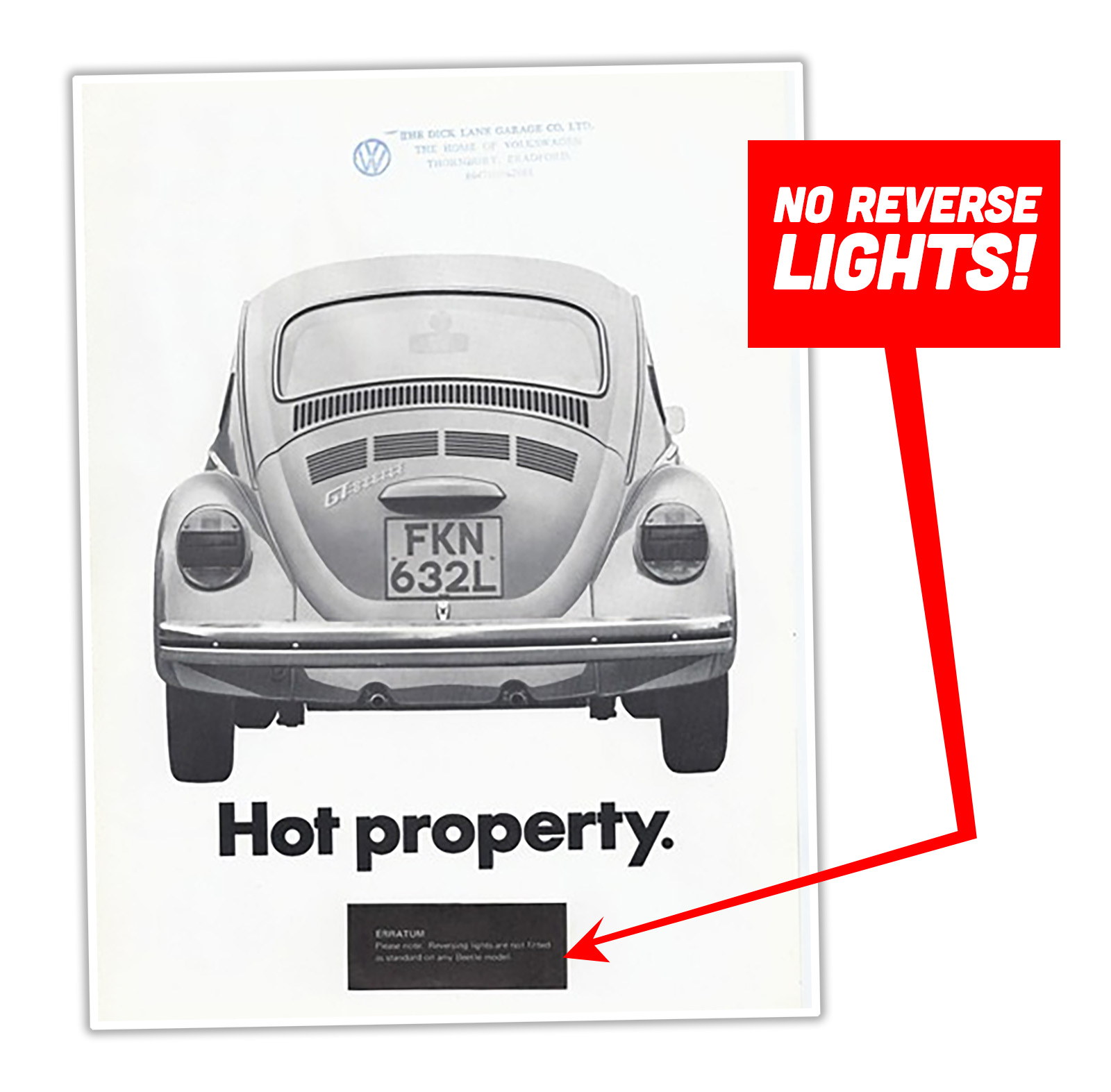
Those say: “ERRATUM: Please note: Reversing lights are not included as standard on any Beetle model” though you could get them as an option. I still think it’s weird they had the lenses there, but nothing behind them? There were these large elephants foot taillight lenses available without the clear section at the bottom, too, if they really cared about honesty:
But they didn’t use those, even though those would be 80 square inches as well. Actually, considering that the lower clear area really shouldn’t count in those 80 square inches if there’s no bulb behind it, maybe the number itself isn’t really accurate!
There were other ads for the GT Beetle that decided that maybe the square inches of taillight area weren’t as important:
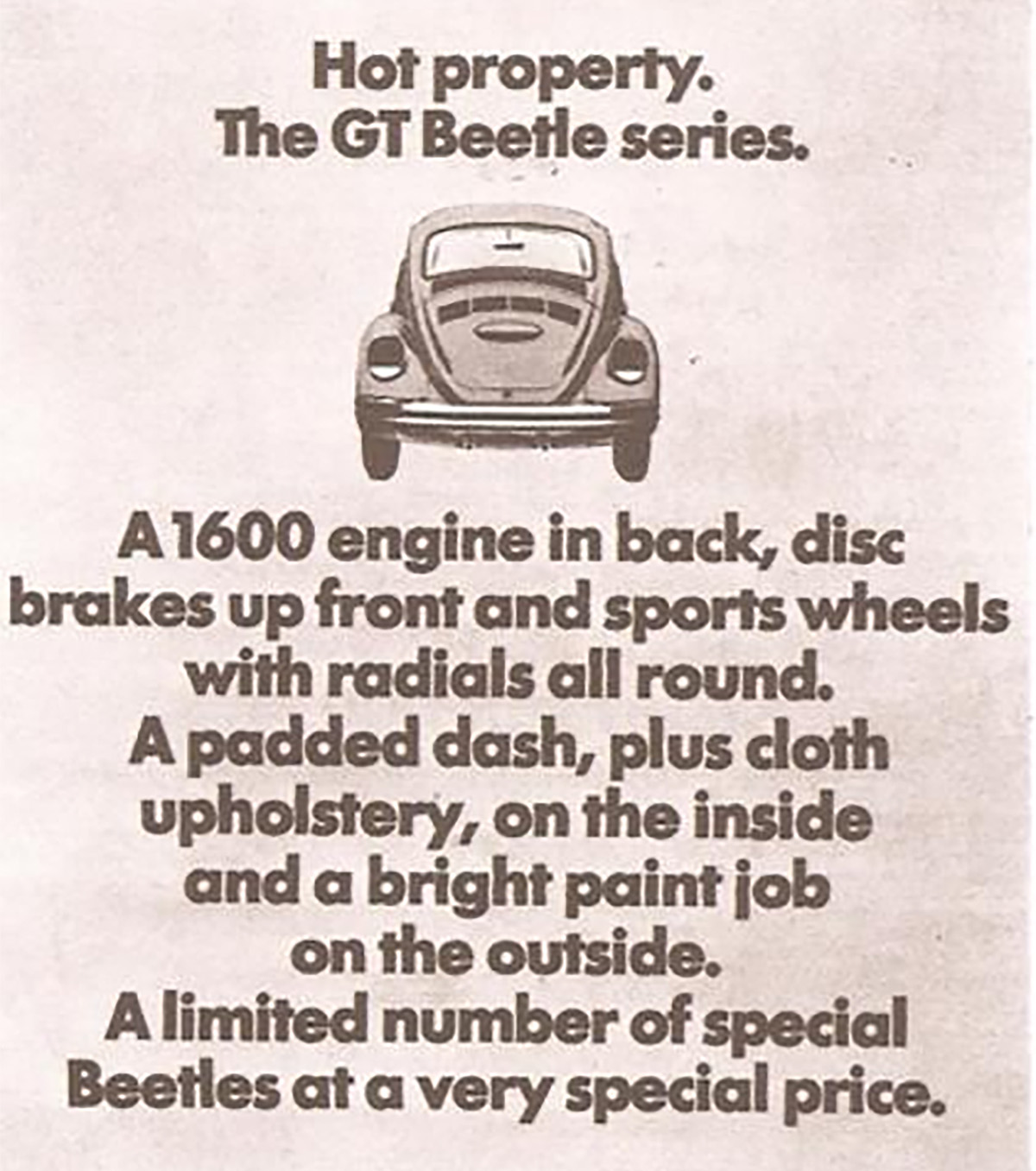
Radials, cloth upholstery, 1600 engine, those all did make the cut, at least. But there is one more taillight-related bit of weirdness in the GT Beetle advertising:
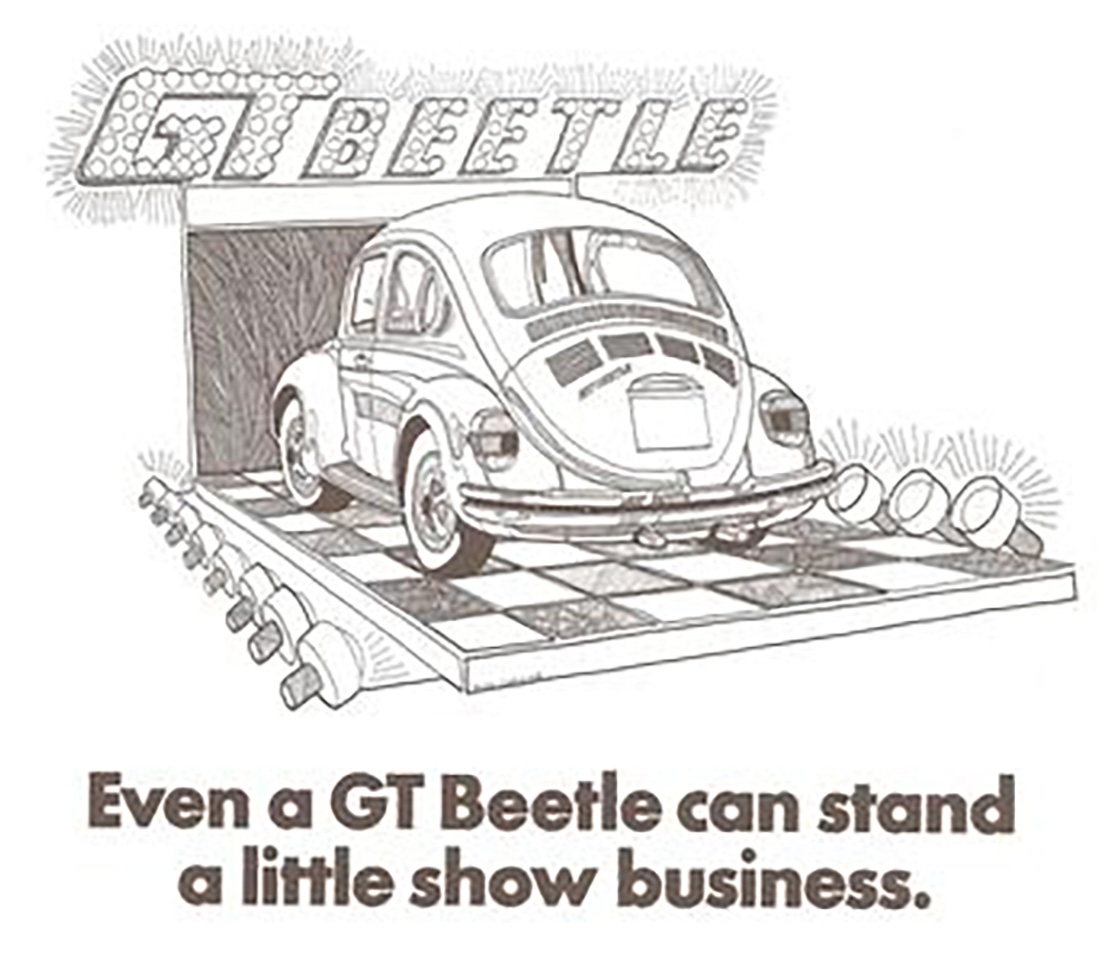
See this ad? That’s a pretty good cartoon rendering of the GT Beetle, but there is one notable issue: those are North American taillights! Look here:

See how the drawing divides the middle section vertically? Only the US-spec lights did that, as US-spec lights had a differently shaped retroreflector, and separate bulbs for stop and taillight, where the global version used one double-filament bulb.
80 square inches, though! Sure, modern sporty-marketed cars may be more powerful, faster, quicker, safer, more comfortable, efficient, and, well, pretty much everything else, but how many square inches of taillight do they have?
Probably more, also. But I’d still take a GT Beetle.


Only Torch is able to retreat behind a fire hydrant…
Does the 80 sq in include the sides, or just the flat part that’s visible from the back?
Hey, now. This is my hydrant. Get your own.
in 73-74 vw offered a sports bug in the usa. super beetle with black trim. loved them
Did they misspell “wankers” in that ad? Never heard of winkers.
You’re thinking of Mazda.
I kept looking at FKN 632L and trying to figure out how 632 liters could possibly relate to the taillight pictured. That would be some massive FKN taillights, that’s for sure.
VW was channeling the at time very young Torch. 3ish in ’73? IIRC you are a 1970 model year, but I can’t quite recall. ’69 myself, just predate men walking on the moon. Watched it live with my Mom at age 2 weeks. Though I’m told I was otherwise occupied with an er, “homemade” dinner and not paying much attention.
I always find it funny that reverse lights were an optional extra across the pond until surprisingly recent times. Googles says finally mandated in the UK in *2017*! The US mandated reverse lights in ’66 I believe. I think even after most countries required a rear fog light. And then many cheap cars had one rear fog and one reverse light, on opposite sides in the same position. Assume late Beetles just had the afterthought rear fog light bolted under the bumper, or had they died by then? That seemed to be SOP on cars that still had separate metal bumpers.
I’ve driven a ’60s Beetle convertible that a friend had a nuts and bolts NOS full restoration done on for a sum he refuses to admit to. So a completely as-new car. They really were delightful. Simplicity and quality in one little round package.
“See if you can spot it”
I couldn’t even tell those were words until zooming my browser 150%.
Why don’t images open full screen when clicked? It’s happened a couple of times but isn’t default?
open image in a new tab
You’re my hero!
“Extra number 5 is really three items”
No. No it isn’t.
I feel like you must’ve made friends with a Time Lord at some point, and they wrote this ad copy specifically so you, Torch, would find it.
I read that as 80 square inches of wanker ha ha
I wouldn’t be surprised if the confusion was intentional.
I absolutely do NOT like the elephant style light. Give me a clean and well proportioned taillamp from the late sixties please.
I love my 68 Beetle tails. Still small wit 60’s charm, but they were the first year of reverse lights in the bottom.
The elephant’s foot tails are just awful to me.
My dad had a ’68 in an off-white eggshell color. Loved the Wolfsburg emblem in the steering wheel. I loved that car so damn much; in my mind, it is the platonic ideal of a VW Beetle.
I love the 68 as well. It’s the perfect combination to me of the charm of the earlier cars, but with the improvements of the later examples (12v, external fuel door, highback seats, irs, etc.) Mine is a very early 68, so I still have a swing-axle, but I love my Bug dearly. 8 years into owning and restoring it, and it never ceases to make me smile.
https://www.thesamba.com/vw/gallery/pix/2623602.jpg
Oh god, I remember jeans with creases. People ironed their “status jeans.” So painful in retrospect.
I reckon older gents in Texas still do.
And by that I mean they have their wife or housekeeper do it, of course.
What a strange country (Texas).
To quote the great Sir Mix-a-Lot, Beetle got Back.
Now i need to know, what car has the most square inches of taillight? Especially the ratio of back/light
I feel like the Buick Rendezvous has to be high on the list.
Wait! Car ad? Beetle? Tailight as Winker?
Jason Torchinsky is the perfect wanker for this winker ad!
If you’re going around bragging about your massive 80 square inches of taillights, you’re clearly compensating.
To a taillight enthusiast like yourself that brochure must really get your winker stirring.
“(I’d kind of have guessed a lime green and apple red but maybe the Brits have different default color associations with fruits and vegetables).”
Wondering if the recently established Apple Records company with its green Granny Smith apple logo had an influence? After all, the record label was founded by the Beatles who were experiencing Taylor Swift-levels of popularity in the 60s & 70s…
That is definitely tomato red, not apple red. It’s too orangey, I’d say “apple red” would be more of a true red.
Men do like to boast about inches, even when it’s proportionally just a very small part of the whole thing…
I’ve heard of blinkers, turn signals, and indicators but never winkers.
You’ve been hoodwinked!
Same here, but now i can’t help but think…this is a better name?
You’re usually signaling a turn, so just blinking with one eye, as it were. They’re only blinkers when you use the hazards!
“It’s such a bonkers thing to point out in a brochure for a sporty car. Or, really any car.”
That kinda talk is going to be severely frowned upon at the local taillight bars.
The top image gave away that you’d be talking about the taillights. That, and general experience reading the writing on this site…
But what caught my attention was that a 15% increase in HP, a 19% increase in torque, moving the powerband peaks lower on the curve, and even putting better tires on it, only increased top speed by 2.5%, from 78 to 80 mph (per the ad). I would have expected more.
I’m thinking they were more concerned with the 0-60 than the top end – the 1300 seems to have taken 22 seconds to get there, but the 1600 was nearly 3 seconds faster.
This is a car where adding a small rear wing reduced drag, (see, Herrod Helper,) and these engines were also fairly carb-limited the way they were specced from the factory. 80 seems to be as fast as VW wanted them to go. Besides, remember that note about the rear wing? The shape of the car also happens to create considerable lift at high speeds!
Yeah, it always seemed like the shape of the Beetle was such that without rear spoilers & other aerodynamic accoutrements the top speed was pretty much just a practical 80 mph.
My family had a well-used but fairly new SB when I was growing up; one of my older siblings would take it to college a few states away. After the first engine blew up after some 100k-plus miles a new (& stock) engine was installed and after its break-in period it was a bit faster than the old engine. One time my sibling was driving home from college and it was late at night with virtually no traffic on the long straight highway so he had the accelerator pedal floored and was just cruising along with the speedometer at between 80 and 85 mph (that gauge was actually surprisingly accurate as per those speed limit signs which flashed one’s speed which my sibling would frequently check, lol.) Then he wanted to change lanes when nothing happened in response to turning the steering wheel. He kept turning the steering wheel in both directions but kept going straight whereupon he belatedly figured out the SB’s front wheels were most likely in minimal to no contact with the road, lol. So he slacked off a bit on the accelerator pedal and regained steering. Yeah, good thing nothing worse happened…
“ SB’s front wheels were most likely in minimal to no contact with the road, lol.”
Yeah I recall hearing about that phenomenon on the old Beetles. Yeah you could make them go faster, but you wouldn’t want to… at least not without adding some ballast to the front.
My parents had a ’58 Beetle and a ’71 Super Beetle. I doubt they ever exceeded 60 MPH in either of them.
My mother was always the slowest driver on the freeway. To her, it would have been a mortal sin to exceed the speed limit by a single mile per hour.
I was in college taking Mechanical and Aeronautical Engineeing courses and driving my ’67 squareback with the dual port 1600 engine. We came to the basic horespower, front area, Cd value equation, so I applied the calcs to my squareback. Lo and behold, the calcs matched my actual top speed of 84 MPH!
Now that I think about it, it would be interesting to back calc my ’64 VW bus that maxed out at 54 MPH to figure out the approximate HP that engine provided. The answer = not much.
Remember when C&D used to have a table in the back of their magazines listing the 1/4 and 0-60 and HP and other figures of their cars? What’s stopping Autopian from publishing a Taillight Area Table?
Brilliant suggestion. Although it could increase the number of Autopian members retreating behind a fire hydrant and furtively pleasuring themselves until they can hold a rational thought again.
Imagine trying to, um, “shine the headlight” while perusing scandalous photos of a Disco Volante’s backside.
I know we’re probably talking about the Alfa but when I see Disco Volante my first thought is the Mr Bungle album.
Furtively or furiously? Why not both?
If you go to Torch’s favorite taillight bar, they have a giant Solari (split-flap) board listing the taillight area measurements of currently produced automobiles as you suggest (except for Stellantis products for some weird reason). It was recovered from the Charlotte airport when it was decommissioned in favor of smaller monitors installed all throughout the concourse in the 80s. When the display is changing, you have to pause giving your drink order to the bartender because it’s quite loud.
If you’re ever in that area… be sure to order their signature cocktail the Blinker Fluidtini. It’s made from vermouth and malort and instead of an olive for garnish, they use a sardine on a toothpick.
Alas, I’d try this but I’m fresh out of Malort. A 50/50 mix of Fernet-Branca and Ferro-China with a cigar butt garnish might do the trick.