

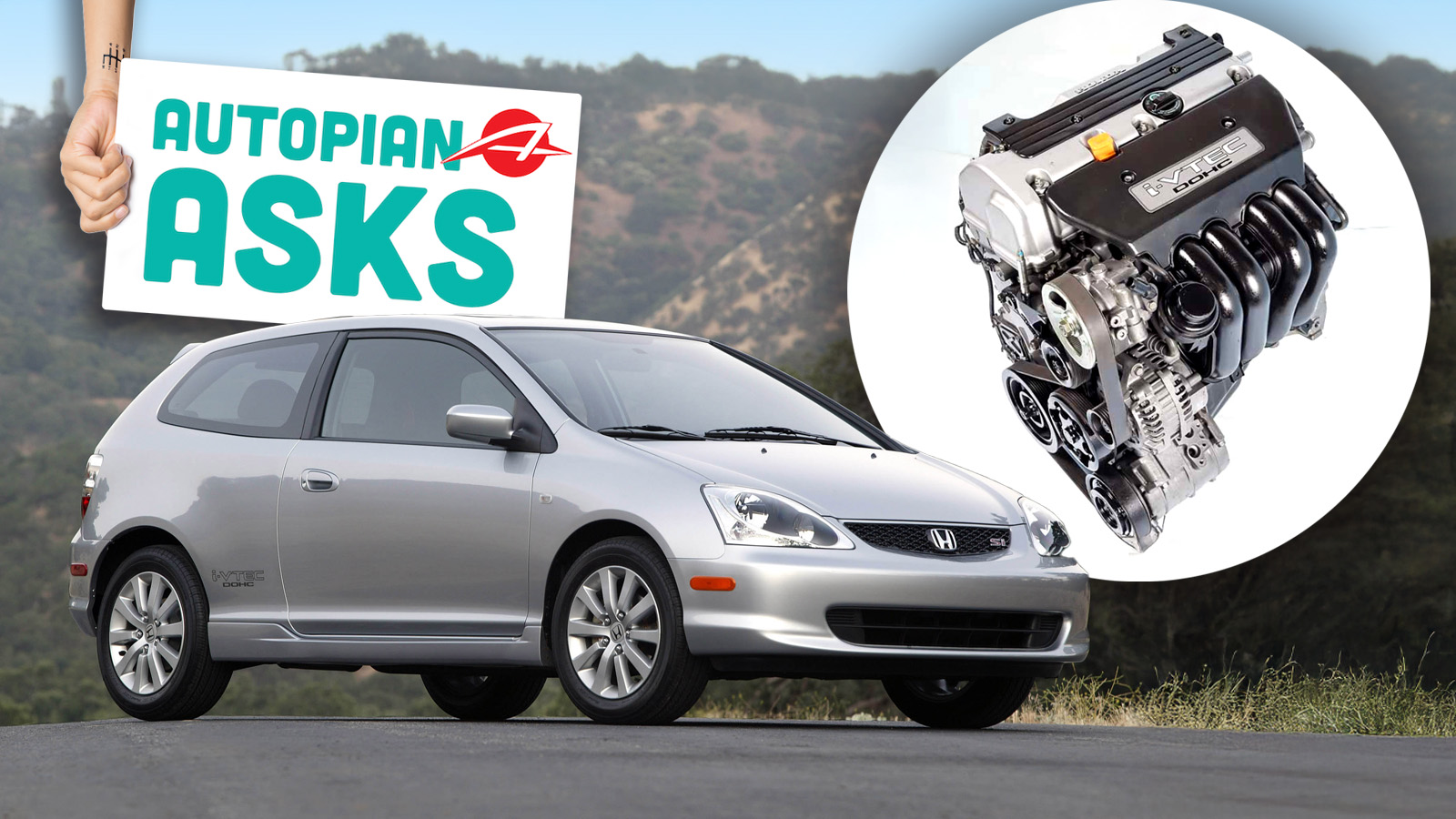
Most automakers today are known for some fabled engine in their past. The General Motors small block V8 has moved so much of the world, while Toyota has built several different fours, sixes, and V8s that sometimes outlast the bodies they’re bolted into. Ford, Honda, Nissan, Mazda, all of them, and so many more have decorated histories building reliable mills. However, times have changed, and some automakers struggle today. What automakers are still making overbuilt engines? What’s the most overbuilt engine of the modern era?
This question was inspired by a similar question that was recently pitched to the Opposite-Lock car enthusiast community. If you’re looking for a group of folks who are like your fellow Autopians, I highly recommend Oppo! The site is independent and is run and funded by enthusiasts.


Anyway, General Motors and Toyota have generated headlines in recent years for unexpected goof-ups with their engines. We’ve written pretty extensively about the GM L87 V8, a small-block V8 that has thus far failed in the tens of thousands. If you’ve missed it, the short version is that more than 28,000 of these engines failed before GM issued a recall, and, allegedly, some of the fixed engines are failing, too. GM has also been fiddling around with the engine’s oil specifications in this still ongoing saga.

Toyota had its own truck engine troubles when its twin-turbo V6 V35A-FTS engines began failing due to reported manufacturing debris left inside engines, triggering a massive recall. This continues to be a headache for Toyota, and people are still reporting engine failures nearly two years after the recall was announced. Toyota recently expanded the recall, bringing the number of potentially affected trucks to well above 200,000.
To be fair to Toyota and General Motors, picking on engine failures and recalls can be low-hanging fruit. These engines could go on to live fine service lives after they’ve been fixed. But what about other engines?
When this question was posted in Opposite-Lock, I mentioned the Ford Coyote 5.0 V8 as a solid engine. The 5.0 has proven itself to be a pretty sturdy powerplant and is even receptive to modification. People actively seek out Coyotes to build tons of power out of. It is noted that the truck version of the Coyote has one of those infamous wet belts. The good thing is that it does appear that wet belt failures are uncommon with this engine. Update: To be clear, this is not a timing belt, but a belt to drive the oil pump.

Other contenders, I think, could be something like a Honda K-series. Some of these engines have popped after people dumped tons of power mods into K20C1s, but lots of other folks report getting lots of miles out of stock engines or mildly tuned ones.
Heavy-duty pickup truck diesels also seem fairly sturdy, though some of their emissions equipment might not be.
This subject has been stuck in my head for days now. Is there an engine that’s currently made in 2026 that can pile on the miles with usually just regular maintenance? Are there engines out there that are receptive to mods without heavy changes? What’s the most overbuilt engine of the modern era?
Top graphic images: Honda; EngineWorld




The Honda J series has been in a lot of vehicles (including boats) and it’ll keep running past the chassis’s expiration date.
yup.
the GM 2.7T 4 looks fairly solid from the teardown I’ve seen of it.
I don’t know what’s under the hood of U-Haul F-350s, but I’ve taken two of them from Seattle to Houston and back, pulling a car on a dolly each time. And they never missed a beat. Transmissions didn’t hiccup either. Not fun to drive, but they get the job done.
If it’s a recent one (2021+), then it would be the 6.8/7.3L Godzilla V8.
If it’s one a few years old (2017-2020), then it could be the 6.2L OHC Boss V8 or the 6.8L Triton V10.
If it was from 2005 to 2016, then it would have had the 6.8L V10.
The first move was in 2016 and so, the V10. The return trip was late in 2022 and in a low mileage truck, so a V8 of some sort. Thanks.
2GR-FE Toyota V6 is a gem of an engine, same power as the old 1uz fe v8 of the 90s. But much better on gas, the one in my Lexus ES350 does 26 in mixed driving. They have proven to be rock solid reliable as well.
Also going back a few years, the 2JZ-GE in the 1990s Supra, Lexus SC300 and GS300. The one with no turbos, before they introduced VVT-i. 1992-1997. They used all the same forged rods, pistons, crank, etc as the 2JZ-GTE twin turbo motor. Swap a beefier headgasket on the 2JZ-GE and a big turbo, you can make 700whp without modifying any engine internals.
I struggle to think of an engine that had a wider range of applications than the 2GR-FE. That V6 was used in the Sienna and the Lotus Evora. I agree, it is a really nice engine, especially in vehicles one wouldn’t expect to have that much power—Sienna, Camry, and Rav4 for example. My family growing up had one, and I can still identify them by the starter noise when I’m walking through parking lots.
The Lotus Emira still uses the 2GR-FE, supercharged up to a solid 400ps on stock internals. I was lead powertrain designer on the 400 V6 project, we were all very proud of how that turned out.
I used to get to see the powertrain warranty data, it’s a great engine.
The Emira GT4 race cars use it with a 1900 supercharger on it, and even then it’s pretty reliable.
Very lucky to be involved with one of my favorite cars.
I felt pretty lucky to work there.
I’m sure you have some variety of NDA, but I’m wondering if you could write some interesting articles for this site. Be pretty cool to hear about the awesome stuff that went into some of the more recent Lotus offerings.
Before they thoughtlessly ended my employment I checked with legal to see what I could and couldn’t write about.
I did write this:
https://www.theautopian.com/i-was-so-bored-at-work-i-redesigned-a-tiny-engine-part-for-fun-and-accidentally-saved-22000-pounds-of-aluminum/
And DT has another couple of stories in his inbox. I’m working on the drafts of a few more.
Yo, that’s awesome! I didn’t know that article was you. Super good stuff. Keep it up!
Honda K24, no doubt. They will give the venerable 3800 a run for its money. I think at this point they may only be used in new cars in Japan, though.
Can confirm. I checked the valve clearance on my K24A3 for the first time since new 20 years and 170k ago and every single valve was still dead in the center of spec.
Plenty of problems with the GM 6.2, but I haven’t heard a bad word about the basic 5.3 V-8 from GM. I believe it is descended from the original Vortec V-8, and those could withstand abuse and upgrades.
You’re going to get commenters crying about the DOD lifters, but the truth is they fail at a very-very small rate.
5.3 is good. 6.0 is better.
the ones that aren’t turbo LOL
There’s something to be said for a quality naturally-aspirated setup.
Nissan SR20s could take a lot of boost back in the day.
Toyota’s 2GR engines are still technically in production – I think in one or two Lexus models, so I’ll go with that.
The problem with current production engines, is the infestation of plastic. Plastic valve covers, plastic intake manifold, plastic coolant outlets and housings, plastic water pumps, radiators tanks etc, etc. Combined with with the current practice to turbo the heck out of tiny engines, and you’ve got a broiler oven of an engine bay and a bunch of scorched plastic part waiting to break off. So I hate to say it, but don’t expect any of these modern turbo engines to last.
A good friend has a 3 cylinder turbo Trail Blazer and refuses to change the oil until the service oil light comes on.He won’t be happy when it starts knocking.Funny thing is he spends $23 a day on cigarettes but won’t spend the money for a 5k mile oil change.There will be 2 smokers in that thing soon enough.
Jeez, that’s over eight grand a year on drags. I always knew they were expensive, but that’s borderline outrageous. It will never cease to amaze me that people still pick up smoking cigarettes.
And buying in is the cheap part.
I suspect the answer to this question depends on what people consider ‘normal maintenance.’ It seems like people have maintained their previous views on maintenance even as its meaning has changed. Oil change intervals are much further apart now, but few people do the requisite belts/seals/etc maintenance at the recommended intervals — especially people who are using their vehicles for severe duty but not part of a fleet.
Probably also has something to do with dealerships burning all their trust with consumers by constantly trying to tack on unnecessary services, meaning people don’t even do the mandatory fixes when they’re due.
So, it went out of production a couple of years ago, but the Ford 6.2L V8 seems to have proven to be a pretty stout engine. The 6.8L and 7.3L V8 engines also seem pretty beefy and generally seem to have good reports on longevity as well as responding well to modifications.
Any gas engine used in an HD truck is going to be this way; regulations are less strict and the duty cycle compels the engine to be rock solid. Someone who buys a gas 3/4 ton and uses it like a half ton will get hundreds of thousands of miles out of it.
Diesels used to be that way, now not so much.
Oh, nothing to do with regulations (yeah, people are all too quick to blame the EPA for anything and everything), just the fact that manufacturers know how mad people will get if they have to endure down time in their businesses if their HD trucks break down. So the amount of regulation is simply irrelevant since the manufacturers tend to have a strong interest in ensuring that every component, whether it be emissions-related or not, that goes into their HD trucks can hold up under the…heavy duty expected of their trucks. To be sure, there may be exceptions where particular HD trucks have reliability issues but that’s just pretty much true across the board in the entire automotive industry regardless of emissions regulations and lack or perceived surfeit thereof…
I admit the dizzying array of standards, reversals, implementations, etc have me confused about what applies to what anymore, but HD trucks don’t carry fuel economy numbers on their window stickers, don’t have nonsense like auto start/stop, and are still all powered by large iron block naturally aspirated V8s. Whether that’s entirely customer demand driven, entirely regulation driven, or most likely a mix of both, the result to the owner is the same.
A shop I know is getting orders to convert fleets to older version diesels strictly to avoid downtime.
Toyota Hybrid Atkinson cycle 4 cylinder engines. I have 2 in the fleet with over 250k.
As for durability legends – the Ford 300 I6, Jeep 4.0 I6 and Chrysler Slant 6
The 3MZ V6 used in the RX and Highlander Hybrids is also very reliable — the derate compared with the ICE-only miles seems to have made it much less susceptible to failure.
The Honda K is a great engine, but from what I’ve read on the forums since getting a boosted K20, the older NA ones are much more bulletproof.
Any of the N/A Skyactive engines. Dealer techs say they basically only ever do regular maintenance on them.
One of the reasons I switched to mazda. I will say, spark plugs at 60k seems to be important. My 1.5 was running rough until I changed them.
My parents 2.5 SkyActiv finally kicked the bucket at 247k miles. Thermostat failed and mom wasn’t watching the gauges. Cracked the cylinder head.
Can confirm. At my shop where we see nearly every major make and model on a regular basis, we see the fewest problems with Mazdas overall, especially the powertrain. They’re also realistic with their oil changes, and the 5,000 mile service interval strikes the right balance of longevity and frequency.
I love the premise of this question, but I’m not sure any current production engine qualifies. I’m thinking of things like the Volvo Red Block, you know designed on paper before advanced modeling where engineers didn’t know exactly how strong it needed to be so they over did it. I’m pretty sure there wasn’t a bean counter at Volvo telling them to remove strengthening ribs from the block to save 4 ounces of iron on each one. Modern manufacturing doesn’t allow for very much wastage. And overbuilding is wastage.
I suspect the overbuilding is directly responsible for the lifespans, by suppressing vibration most companies don’t consider.
When you are only making ~112hp out of 2.3L, it’s really not that hard to make the thing last forever. And the late ones are NOT as good as the early ones, suffering from piston slap. The turbos are worse for that. And of course, the red block 16V is a whole different kettle of fish.
Slightly off topic, but it so happens that the 6-speed manual in the NB Miata is good for more than 400 horsepower, compared to the 5-speed which is good for only about 250. That’s quite something for a car that came stock from the factory with 140 horsepower.
Meanwhile, the stock 6-speed manual in the current ND Miata is a known weak point.
Somewhere on the forums, I remember reading that a common mod for high-horsepower ND builds is to swap in an NC trans.
The Fiata used the NC transmission. It doesn’t shift as nicely, but it also doesn’t break.
Honestly wouldn’t know, but I think that the Ford Ecoboost 2.7L with compacted graphite iron heads and a compacted graphite iron oil pan would make it a lot beefier, and frankly I think it would make for a better base engine for most of the Front engine RWD/4WD Ford Lineup
Make a naturally aspirated version, make a supercharged version, make a turbocharged version.
People think aluminum engines are the hot shit till it pisses out all its coolant and you still gotta keep driving. All Iron engines can go further on no coolant than they have any right to.
I’m really not sure how my aluminum Suzuki G16 engine in my Tracker has survived as long as it has after a couple incidents had me unwittingly driving it without coolant!
I’m going to go with the 4.3L V6 in the Chevrolet Express/GMC Savana.
Key Specs & Features:
Engine: 4.3L V6 (LV1) EcoTec3
Horsepower: 276 hp @ 5200 rpm
Torque: 298 lb.-ft. @ 3900 rpm
The LV1 engine is essentially the same as the LV3, but without Active Fuel Management technology.
I would say they’re more overbuilt nowadays since they got rid of the AFM.
I have the 4.3 Vortec in my Astro and man I hate that engine. The common saying is “the power of a 4 cylinder with the fuel economy of a v8”.
For the record, I get 13mpg. City, Hwy, Mixed, 13mpg. It has iridium plugs, fresh cap/rotor, fresh fuel filter, all synthetic fluids, etc. 13mpg is a joke.
The Ford 4.0 pushrod V-6 was in a similar vein. How they managed to choke 4.0 fuel injected liters down to 160hp is amazing. Getting 12-17 mpg out of it in a Ranger seemed silly.
But it was probably overbuilt. It sounds like it’s still chugging (fuel) along after 20 – 30 years.
BTW, I drove a bunch of Blazers/Jimmys/Bravadas and Astros as rental cars back in the early 2000s and I can confirm that they sucked fuel. You could almost watch the fuel gauge go down as the speedometer increased.
I made the same joke about my 3rd gen Tacoma, but it got 16mpg. 13mpg from a 20+ year old extra-medium van somehow seems more acceptable vs 16mpg on a 3+ year old midsize truck.
The 4.3 in your Astro van is a very different beast to the LV1 they make now. Yes, both are cut-down pushrod small-block V8s, but that’s where the similarities end. The LV1 is based on the gen V V8 with aluminum block & heads, and direct injection. Meanwhile, your Astro’s V6 is based on the original Chevy small-block, with an iron block & heads, and throttle body injection.
That lv3 was a beast in a Silverado 2wd I had for a work truck. I’ve been thinking about looking for an lv1 powered van. But I can’t decide if the older 8speed or the 10speed will be more reliable. I’ve seen some claims that an 8speed with a tune can be rock solid. But the 10speeds require a billet torque converter.
The old GM 4.3 was generally a solid, reliable workhorse that, if even decently maintained, could easilly plug along (slowly) for over 300k. It was basically a cut down 350 so the block was pretty overdone for it’s smaller power output. Like the 3800 mentioned below, the old GM adage proves true, “It might not run well, but it will run badly forever.”
Ugh, I didn’t read the last line about ‘current’. Just ignore me, I only got 3 hours of sleep last night and it shows.
In a way, the 4.3 was around up until at least 2023 in the Silverado 1500. Later years were just a cut-up LT engine instead of the older engine, but they’re plenty long-legged. My wife’s ’21 has the 4.3 and it’s a good little motor.
You are right, however. I’m a fan.
I’ve come across a great many old Massey Fergusons for eras long ago still happily running along.
I can’t help to think they are well overbuilt.
Some of the old Perkins engines had a “fun” feature where they’d split between the 2-3 or 3-4 cylinders. The block, that is. Often they would still run, though. I had a MF35 with the Continental gas engine and that little tractor was a tank. My lower back hated the seat though.
3800. There, we can all go home now.
Wow! I didn’t realize it was still around – what is it in?
It bowed out in 2007 or so. I figured that was modern enough. It’s a legend, though.
Damn. I was hoping there was some random, not sold to the public GM van or something that still had it, like the final run of fleet-only Crown Vics.
I know, right? Thanks to the buff books and Consumer Reports “pushrod” is a dirty word that GM still catches flak for. Despite having packaging advantages over OHC. The 3800 Series III was the first SULEV V6, IIRC. There was a lot of life left in it but it got pushed aside for “more modern” engines. A shame in my opinion.
Thanks to the buff books and Consumer Reports “pushrod” is a dirty word that GM still catches flak for. Despite having packaging advantages over OHC.
I think the Corvette alone has proven OHV designs still have a tremendous argument in their favor. Not many cars can boast both 350+ HP AND 40 MPG*, especially without VVT and other trickery and definitely not within this price range.
https://www.roadandtrack.com/car-culture/a30170594/chevy-c5-corvette-40-mpg-tune-video/
*mild tune required, literally YMMV.
Check out commercial vans, if you’re inclined.
Might find something.
Funny that. I inherited my dad’s 95 Riv, SC 3800. Cannot for hte life of me figure out the idle, which bounces all over the place. Has to be a vacuum leak, but man it’s hard to figure out. Gave it a tune up, no change.
Idle air control valve.
Dark horse, but I’ll nominate the 1-liter 3-cylinder in the first generation Honda Insight as one of the most durable modern engines. These had all kinds of tricks to lower friction and stress. One of my favorites was offsetting the cylinder bores so the pistons pushed straight down on the crank throws during the power stroke, rather than pushing at a little angle in the bore.
The Integrated Motor Assist was a motor/generator in a flywheel pancake. The engine/IMA combo was one of the first stop-start applications and saved wear when sitting still. The grunt of the electric motor helped at launch and low speeds, taking more stress off the engine.
I had two of these Insights getting close to 300k, and the motors were still running great. Insights with 400-500k aren’t uncommon, and one is sneaking up on the million mile mark – though I saw it may need a head replacement to hit the milestone.
NAILED IT. I’m at 290k on mine, and it still gets 55-70mpg. I pulled the valve cover at 250k, checked the valve clearance and everything was still in spec.
That said… pretty easy to be ‘over built’ when it only makes 70hp or so.
I chuckled at the “overbuilt” comment. Everybody says the old 7.3 Powerstroke was overbuilt…I love em but they made like 250hp on a good day. Not exactly a high-strung motor.
I have seen several examples over +900K miles, mine is sitting at 260K miles and feels solid.
Friend’s Insight is at 300000.
Only gets 50 mpg instead of 80 now though.
Mine has revved to 10k rpm and had a serious porting job done after having the cylinder head off. Still my daily.
My tdi 1.9 with an hy35 at 31psi was throwing down 330whp from the same internals that the stock 90hp came with…
I don’t think the 5.0 in the F-150 uses a timing belt.
It doesn’t use a timing belt, but it does use a wet belt to drive the oil pump.
So much for that engine. What a mistake.
I’ve heard that the Mazda K-series V6s are way overbuilt. I always thought it would be a cool Mx-5 swap but I don’t think there’s a ton of aftermarket support for it.
The IHI supercharger used on the Millenia S is supposed to be a seriously high boost and decent high volume proposition when used on an Otto cycle engine instead of the delayed intake valve design (Atkinson cycle?).
Miller cycle. It’s an Atkinson with forced induction to counter the Atkinson power loss.