


If you’re looking for a cheap, reliable car, choosing one with a manual transmission usually eliminates a lot of potential headaches. Automatics need care and feeding to keep them healthy, and you can never tell how well someone took care of one. With a manual, as long as it goes into all the gears and the clutch doesn’t slip, there’s not a whole lot that can go wrong. But convincing someone who isn’t a car person to choose a stickshift car is often an uphill battle. Nevertheless, we’re going to take a look at a couple of user-friendly manuals today that might fit the bill.
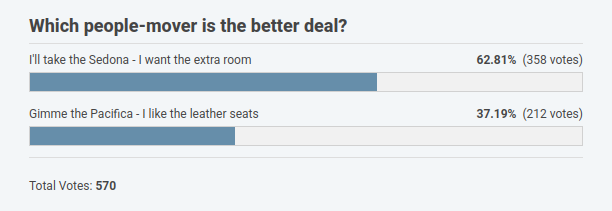
Yesterday was all about seating capacity, with two seven-passenger vehicles battling it out. I couldn’t tell from the comments how this one was going to go, but in the end, the Kia Sedona won by a pretty sizeable margin, despite having some confusion over its title status.


I think that’s the right answer. The first-generation Chrysler Pacifica is a neat car, but if someone needs capacity for cheap, it’s hard to recommend anything other than a good basic minivan. It’ll do everything you need it to, and shouldn’t cause you much trouble along the way.
Only once in all my years of friends coming to me for car advice have I convinced someone to buy a stickshift car instead of an automatic. The car was a Ford Escort wagon, and it served them well for a good long while. Many other friends have chosen cheap cars with automatics, because they either couldn’t or wouldn’t drive a manual, and without fail, the component that gave them problems was the transmission. Manuals are just more durable, and if you don’t have a lot to spend, you don’t have a lot to spend on repairs. So why not eliminate that particular failure point? Today we’re going to look at two wagons that are common, practical, known to be pretty reliable, and have three pedals on the floor. Let’s check them out.
2003 Subaru Outback – $2,495

Engine/drivetrain: 2.5-liter DOHC flat 4, five-speed manual, AWD
Location: Gladstone, OR
Odometer reading: 194,000 miles
Operational status: Runs and drives well
Here it is, the unofficial official car of Portland, Oregon. They’re as common as Labradors, craft beers, and fledgling bands. Walk down the side streets of southeast Portland and, among all the old Crafstmans, you’ll see an Outback in roughly every third driveway, often parked next to a Toyota Prius. What you won’t find, however, are a lot of manual transmissions; like most cars in the past thirty years or so, if you wanted an Outback with a stick, you had to specifically seek it out.

The Outback is, of course, powered by Subaru’s trademark flat-four, a generally stout engine with the unfortunate habit of springing leaks from its head gaskets. It powers all four wheels all the time through a five-speed manual transmission. This one is approaching 200,000 miles, which probably means the head gaskets have already been replaced once. It’s being sold by a dealer, so don’t expect any maintenance records. Check for leaks on the underside of the heads, and make sure there’s no water in the oil, before signing any papers.

It looks nice inside; someone obviously took care of this car, and didn’t trash it. Even the back cargo area, where the dogs ride, looks good. The ad lists a whole bunch of options on the inside, but of course, since it’s a dealership,it doesn’t actually say how many of them still work. As always, push all the buttons on the test drive.

It’s remarkably clean outside, and it’s one of Subaru’s better color combinations. I personally prefer the dark green, but this pale green is nice too. It has the requisite Yakima bike rack already installed on the roof rails, so you’re good to go there. I have to think, as much of a demand for these cars as there is in the Pacific Northwest, that the only reason it’s so cheap is that it’s a manual.
2003 Toyota Matrix – $2,400

Engine/drivetrain: 1.8-liter DOHC inline 4, five-speed manual, FWD
Location: Portland, OR
Odometer reading: 228,000 miles
Operational status: Runs and drives great
Some cars just inspire owners to keep them forever and ever. The Toyota Corolla, in its wagon form, seemed to be such a car. I remember more than one regular customer at the garage I worked at in Saint Paul bringing in a Corolla wagon they had bought new, and now had a ton of miles on it. When it finally did wear out, they replaced it with another Corolla wagon. I can only imagine the dismay those loyal owners felt during those couple of years after the Corolla wagon was discontinued, but before the introduction of the Matrix.

The Matrix is, in fact, a Corolla wagon; the official name is Toyota Corolla Matrix. It’s part of the “tall wagon” class of cars that became popular in the early 2000s, not quite a crossover, but significantly taller than a typical station wagon. It’s powered by Toyota’s 1.8-liter 1ZZ-FE four-cylinder, which is a reliable engine, but has a tendency to burn oil after a while. This one has reached well over 200,000 miles, which means someone was careful about keeping the oil level topped up; a new owner will have to do the same. It does run and drive well, though.
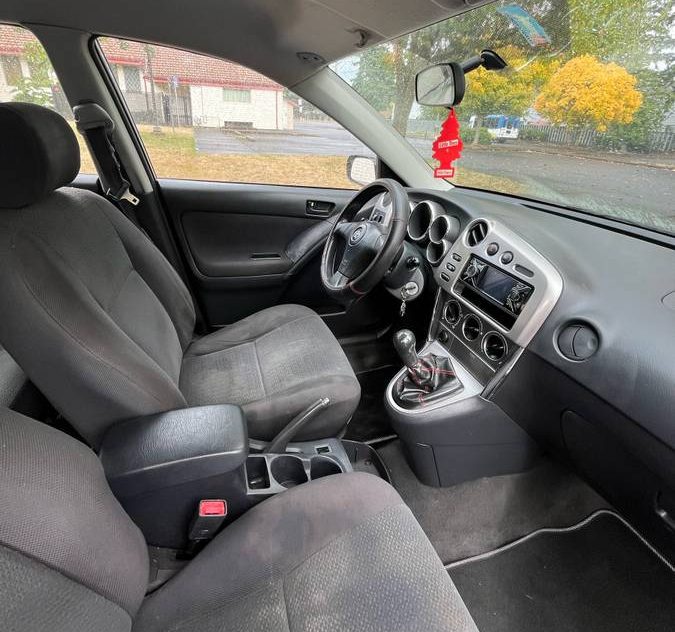
It looks good inside, with very little wear to show for its high mileage. The tree-shaped air freshener hanging from the mirror is a potential bad sign, though. Those things never actually remove funky odors from cars; they just add their own chemical weirdness to whatever melange is there already. Give it a good sniff and make sure it’s something you can live with.
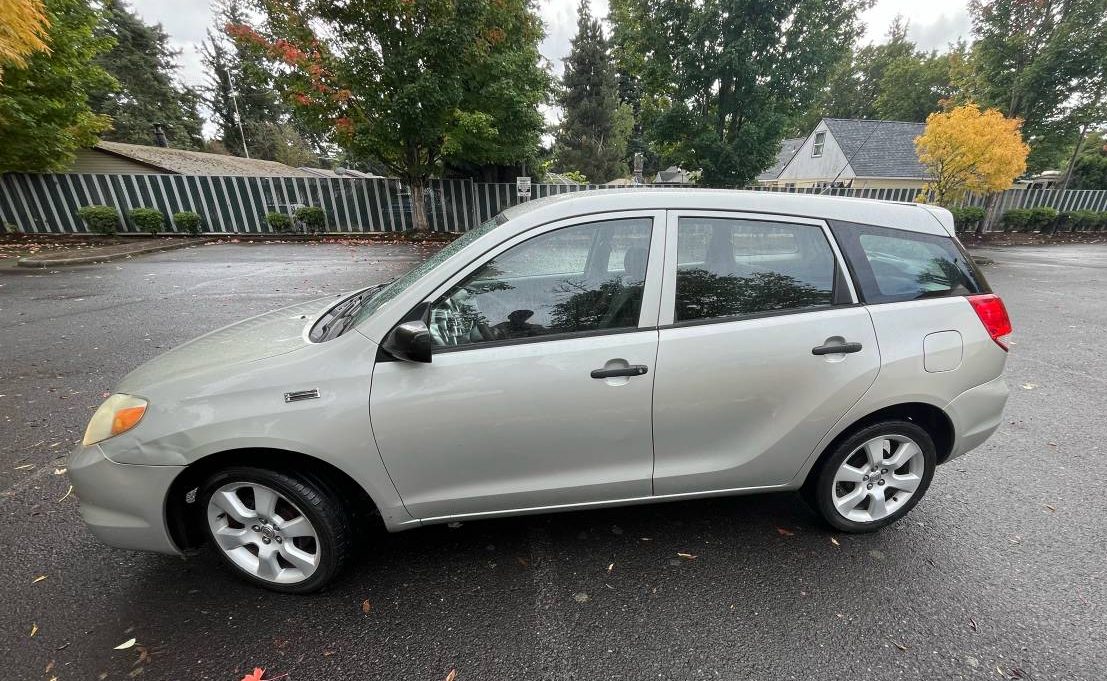
It’s pretty clean outside, but there’s a little wrinkle in the left front fender, and some fake plastic vents (or something) stuck on both sides. I’ll never understand the appeal of those things. But at least they just stick on; a plastic scraper and some Goo-Gone will take care of them.
Stickshift cars are a hard sell among the general population; that’s why they’re disappearing. But if you’re willing to drive one, you’ll be rewarded with not only a better driving experience, but better reliability, and often a cheaper price of entry. If you had a friend looking for a good inexpensive car, which one of these would you try to talk them into?




10 years ago I would have said the Subaru. But I am done with changing headgaskets, replacing axles, oil leaks, torque bind and rust. I’m off the Subarus. So Toyota.
I used to be afraid of Subaru head gasket problems until recently. I mean first who is going to pay to do the head gaskets on. Subaru with over 200,000 miles. Having just gone through this with a 238,000 mile Camry I picked up at a dealership during the lean times for $3,000 out the door. It had a Xmas tree on the dash. A good idea with Real olg high mileage cars is go to a parts store on the test drive and get a print out. It shows all possible issues and is very good negotiating power. Anyhow among the issues was oil spraying out on one spot that landed on the windshield wipers reservoir. So I knew the location. So quick as a bunny I just kept adding a quart of oil every 2 weeks, then I got a brainstorm. I’m not paying for a valve gasket replacement so I cleaned the shit out of the side of the motor head gasket where it was sprayed out. Then after letting it dry I applied a liberal amount of JB WELD and let dry. Still waiting to be sure but haven’t had the oil level decrease in a week so far.
Never owned either brand, never sat in or driven either of these models, so only thing I can go on is condition and miles. The Subaru wins this one on both accounts.
“Manuals are just more durable, and if you don’t have a lot to spend, you don’t have a lot to spend on repairs. So why not eliminate that particular failure point?”
I would go another step and eliminate the AWD, too. Another failure point. Tire replacement becomes less expensive, too.
With that bizzare Matrix/Pontiac dashboard, the stick on ventiports, the “wrinkled” fender and the tree shaped air freshener, it’s just too much for me. I’ll take the nicely detailed Subaru with 34,000 fewer miles.
It isn’t a Miata but that is the answer
I owned an Outback with a manual. Loved it. We pulled our 14’ camper with it, and I hauled my Crosley on a trailer too. Had to do some repairs here and there, but overall it was a hard-working, fun-to-drive wagon.
(https://itisgood.org/auto-biography/#05Subaru)
The Matrix is nearly unkillable. But that air freshener and the fender wrinkles give me the heebie jeebies. I’m voting ‘Ru today.
Never thought I’d vote for a Subaru but I couldn’t live with that Matrix dashboard. What a convoluted mess.
I really don’t want to deal with Subarus anymore so the matrix they haven’t grown on me that unlike most of the Toyotas of that era but it’s a cockroach and probably needs nothing but oil and the occasional $15 part probably just for convenience not function. I almost bought someones project impressa a few months because it was dirt cheap but I realized I didn’t need that negativity in my life.
From personal experience, a Gen 1 Matrix on the freeway is LOUD. Gearing, lack of soundproofing, small engine. The Outback is nicer to live with in almost every way, and this example presents in much superior condition to the Toyota.
I get that Toyota has an excellent reputation, but at 200K miles you should be buying on condition, not reputation. That Toyota could easily require a timing chain or clutch in short order. At just $2,500 it’s a reasonable gamble but so is the Outback.
What I really want is the Matrix drivetrain in the Legacy chassis.
Toyota did market an AWD version of the Vibe/Matrix (Gen 2) but transverse-based AWD systems weren’t good back then.
I had a 2003 Vibe AWD in 2009-2011 and put 44,000 miles on it in the 14 months I owned it. The AWD system wasn’t Subaru quality but it got me down some sticky dirt roads and through some deepish snow. Never got it bogged down. These systems aren’t as helpless as they’re made out to be.
And while the 1.8 in the Matrix is durable it’s wretched on the highway and probably wouldn’t love hauling an extra 300-400 pounds of Outback.
pretty much this. I know I wouldn’t want such little power in a medium sized AWD wagon
Matrix for me. Simpler and better fuel economy due to not having the extra weight and driveline friction of AWD.
Matrix! I have no interest in Subaru at all and would not recommend them to anyone…if they are interested then enjoy owning it when you could have got a car from literally any other better brand. Enjoy your head gaskets blowing a million times ha ha. Toyota is just better and they will enjoy it more and it won’t break down as much. The yoda will work fine and at least it’s also stick and wagon…after they learn it they will have an epiphany of “what did I ever do w/o a manual in my life? This is so fun and I’m never going back to a damn boring auto!) They will probably not listen anyway and go to “Outback” Steakhouse ha ha, so maybe I’ll use some back and forth reverse psychology; recommend the subie and hope they get the yoda (“No! Subaru not. Yoda. Or do Subaru. There is no Yoda.”)
Also, Subaru just took the Outback…
Out Back ha ha
“You’ll find one in every car. You’ll see”
“No! Try not. Do. Or do not. There is no try.”
Here in the Front Range, that Subaru would fetch $4500 easy. Might be a fun roadtrip to make a quick $1500…
Having owned & maintained a version of both of these for a time (2006 Subaru Outback, but with the auto, and 2003 Vibe GT with the 2ZZ & 6-speed), my heart lies with the Subie more because of the project potential (RWD conversion?), but my money would likely go to the Matrix for ease of maintenance & close to 30% better fuel economy
How does one convert an Outback to RWD?
I like both, I prefer the Outback but I’d buy the Matrix for reliability and easier maintenance. I love opening the hood and seeing the spark plugs right there in a neat row.
It’s such a pleasure to have a showdown with both cars being good (to me). Sometimes we get one where I wouldn’t want either car, even if given to me free of charge, and I feel sad(der than usual) for at least the rest of the time it takes me to finish my coffee.
I’ve driven a Matrix (auto) and it’s fine. A Corolla wagon that will be cheap to run for many, many years. Tons of room inside: even the front passenger seat folds flat/forward. My buddy stuffed his full of music gear on a regular basis and finally wound up giving it to his gardener. Lucky gardener! 🙂 BTW, GM sold the Pontiac Vibe version towards the end with a slight lift, the usual plastic lower-body cladding, and this metallic green-brown color that is really cool. Don’t see ’em on the road anymore… maybe they all hit 350Kmiles and were scrapped?
But I’ve never owned a Subaru and I really liked them from when they still had wagons that looked like wagons instead of generic butch small penis SUVs. Plus, that’s a good green and roof rack. The price is good too. If that dealership were in LA instead of Portland, I’d probably be shaving right now before heading over to give it a look. 🙂
PS: I know there are zillions of weird concept cars announced that will never see the light of day in any form (at least in America) but this one from Dacia caught my eye on Youtube recently: https://www.youtube.com/watch?v=T2FsMM5wC40 …maybe it’s all the purple bits, but I dig the little boxy shape, clip on interior bits, likely shortish range is fine for an urban runabout, etc… I mean, it’d have to be well under $20K… closer to $15K would be better, but as long as it provided some protection in an accident, I could see childless urbanites being up for something like this.
Like me. 🙂
Love the looks of that Subaru but if I’m buying a high-mileage car and looking for reliability and ease of maintenance, AWD and a boxer are not what I’m looking for.
In Missoula, MT either of those cars at that price would be a steal; I bought a 2006 Outback with manual at 195,000 miles for $4,000 and that was about 75% of the price others were asking for similar Outbacks. Any Subaru with that many miles would have had the head gaskets replaced with ones that last forever. However, I know from experience, that at that advanced mileage, the clutch (an $1,800 job from the best Subaru shop in town) will soon be in need of replacement.
I would have taken either. That Subie is clean and gets my vote on that alone.
I think the 1ZZFE had the oil issue fixed after 2002. The early ones had small oil drain holes in the pistons so un-maintained sludgy oil would plug them up, stick the rings, and then you’d have an oil burning fiesta. I *believe* they corrected this for the 2003 model year.
My wife’s (then girlfriend) 2007 did not have this issue fixed. Burned a quart every 4-500 miles with nothing on the ground.
I tried to de-gunk the rings only to find that being low on oil continuously for some time had gracefully eroded the bearings to the point there was no measurable oil pressure below 3000rpm – but no rod knock. The scrapyard gave her a pretty decent check for a 112k mile Toyota that “ran and drove”
Definitely a both week, but push comes to shove I have more of an affinity for the Matrix, funky smells or not. Just take the interior apart a bit, air it out, and you’re probably good to go for another 200k of basic maintenance.
I agree. I voted Toyota because there is no both option, but I liked both choices equally this time.
I’ll go with the Outback, but not for someone who just wants a cheap car. It would make a great hauler for someone who appreciates manual transmissions and can have some money set aside for a future head gasket or whatever. Either of these cars could need some sort of major work soon given their age and mileage, so I don’t see the dreaded Subaru head gasket failure as disqualifying.
yes to reliability of Toyota.
No to head gasket, wheel bearing issues with Subaru.
Whenever I see complaints about Subaru wheel bearings, I have to chuckle for two reasons: 1. I also experienced wheel bearing problems with my 2000 Impreza 2.5RS, but 2. According to the service tech at the dealership that serviced my car, the long-term fix was to replace them with the equivalent Legacy part. And I didn’t have any more wheel bearing problems during the remainder of the time I owned the car.
That said, it’s possible that the Legacy wheel bearings also developed issues, it’s just that it would’ve happened after the car was no longer owned by me.
My wife’s 2013 crosstrek had 8 wheel bearings replaced in 100,000 miles all on Subaru.
When I owned a repair shop we made a lot of money on Subaru wheel bearings so I’ve been down both sides of the issue and that’s why I choose not to buy Subarus anymore.
Now this makes me slightly curious about what the difference is between the Impreza and Legacy wheel bearings, especially if one could serve as a drop-in repacement for the other back in the early 00’s.
Is it from material composition choices made by Subaru? Is there a size difference that affects clearances/tolerances? It’s so weird that this would be an ongoing problem for them, when it should be solveable.
Oddly enough it always seemed to be the right rear that went first.We live in Wisconsin and a lot of salt gets used so we would normally see the left side of the car rust sooner than the right ( due to salt being dropped on the center of the road ) so in my logic I would think the left side bearing would get more salt exposure than the right as the seals wear out .
Obviously that isn’t the issue and it makes no sense that the right rear would go first but that’s what we observed in the Subarus we worked on .
Strange …..
I had an Outback similar to this. During the 7 years that I owned it, just about everything that could have possibly broken, broke – except the automatic transmission.
So, Toyota.
The Toyota wins by default.
Fuck Subaru head gasket shit and Escalade gas mileage LOL
Check out my Fuelly for my Legacy version of this exact car. 30.0 mpg average for the last 10 fill ups, 28 mpg lifetime of my ownership. On a 10,000 mile road trip in the car at the moment. . . I trust it 100%. With MLS head gaskets that are known to be permanent fixes, that’s a known reliable engine that can go a million kms.
https://www.fuelly.com/car/subaru/legacy/2003/lightningracer/934504
What did we do to deserve two solid choices?! I’ll take retro Outback that’s still a wagon.