

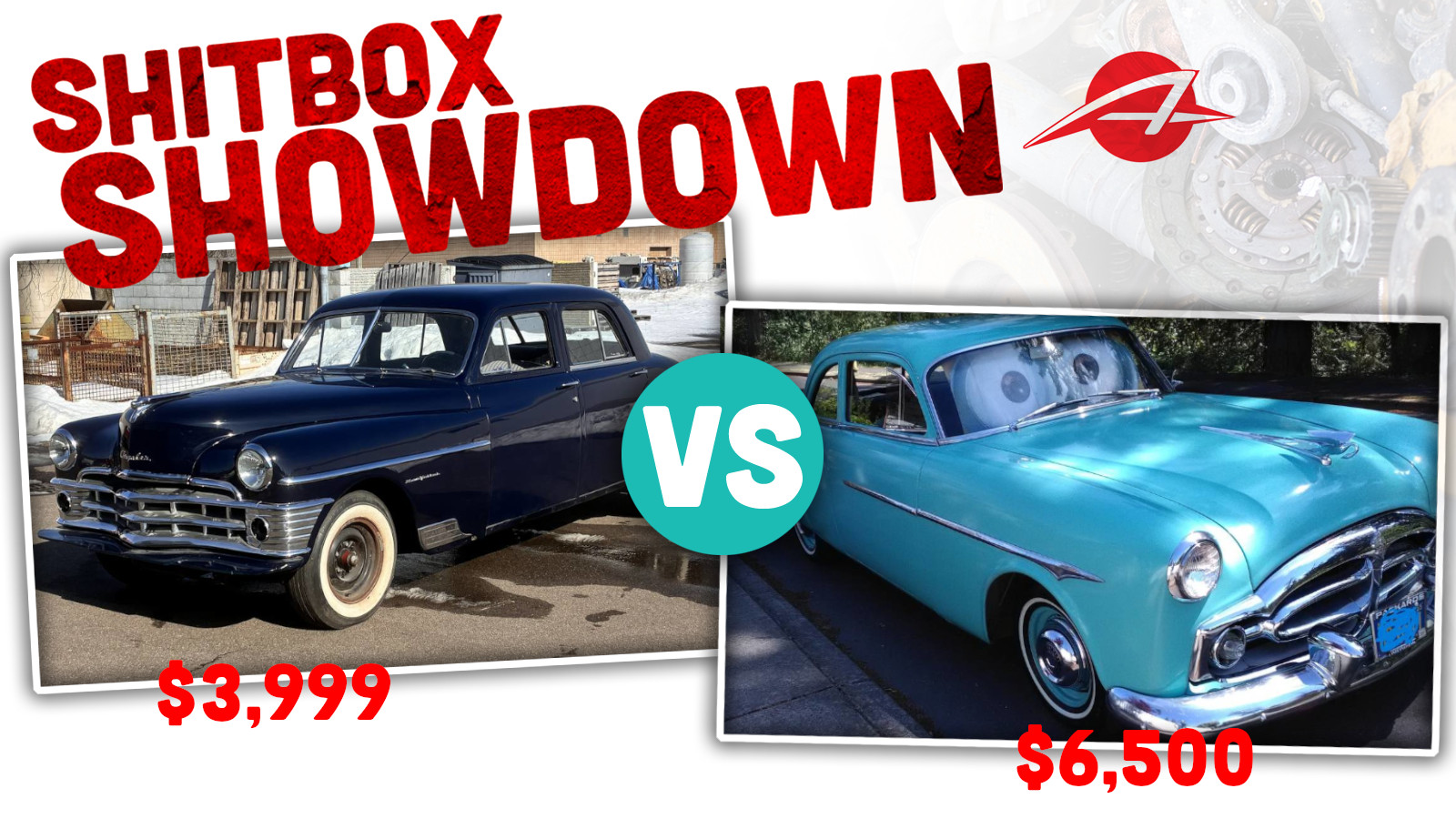
A lot of times, you can tell the approximate age of a car just by hearing a description of its mechanical specification. Oversized V8, three-speed automatic, and drum brakes? You’re talking ’60s. Transverse overhead-cam V6 driving the front wheels through a manual? 1990s-2000s, and probably Japanese. If I told you, without showing you photos of them, that today’s cars both had flathead straight 8s, six-volt electrical systems, and primitive automatic transmissions, you’d probably be able to guess they were from the early 1950s.
Yesterday we looked at two little cars in my least favorite color. The Pontiac Sunfire sold before most of you even got to see the ad, but my description, and its far lower price, was enough to give it an easy win. That Dodge Shadow would be a decent deal for the same $1,500 as the Pontiac, but for two grand more, it was hard to swallow.


I guess I’d reluctantly agree. I really like Shadows, but that one has too many questions for too much money. The Pontiac really is the better deal here. Personally, I’d rather combine the best attributes of both cars, and hold out for a Dodge Shadow convertible with a manual. Preferably not red.

A lot of automotive components from the late 1940s and early ’50s were holdovers from before World War II. Automakers rushed to create modern styling for the post-war era, but mechanical design lagged behind. Both of today’s cars use engines that date back to the 1920s and ’30s. They both, however, have state-of-the-art (for the time) transmission designs, semi-automatic in one case and fully automatic in the other, that addressed Americans’ increasing desire to not shift gears unless they absolutely had to. Let’s take a closer look.
1950 Chrysler New Yorker – $3,999

Engine/drivetrain: 324 cubic inch flathead inline-8, four-speed semi-automatic, RWD
Location: Plymouth, MI
Odometer reading: 70,000 miles (but odometer is broken)
Operational status: Runs and drives well
There is a point in any history right before everything changes, when the old stuff seems just fine, until you get your first look at something new. Think of hard rock music right before Nirvana released Nevermind, or action movies just before The Matrix. You didn’t know you needed them until they arrived, and suddenly the stuff that came before felt stale and unsatisfying. The 1950 Chrysler New Yorker is the last of its breed; a year after this car was built the straight-8 would give way to a Hemi V8, and two years after that, the flat-glass split windshield would be replaced by a one-piece curved wraparound unit. And just a few years after that, cars wouldn’t look, or drive, like this at all.

Chrysler’s flathead engines came in four, six, and eight cylinder varieties, and powered everything from cars to combines to tanks over the years. 1950 was the final year for the eight-cylinder, making only 135 horsepower but gobs of torque. It drives the rear axle through a “Presto-Matic” transmission, a truly weird two-speed semi-automatic with a low and high range, for a total of four forward gears. The way I understand it, you selected low or high gear with the lever, let the clutch out, and then the transmission would shift between underdrive and direct drive automatically, based on speed. For normal driving, you left it in high gear, but you could shift to low when it was needed. It’s another one of those bizarre setups I’d love to try driving someday, if I got the chance, just to see what it’s like. This one’s engine and transmission have just been rebuilt, and it runs and drives well.

Most of the interior has been restored, and it looks pretty good. I see bare metal on the passenger’s side door, so that door panel is either missing or was removed to be redone. The center cap on the steering wheel also appears to be missing. But that dashboard, the final gasp of Streamline Moderne before the Jet Age took over, is magnificent.

It was repainted a few years ago, in the original color, and looks nice and shiny. The hubcaps are included, but the bumpers are MIA. But I kind of like it without them, if I’m honest. The seller says this car “never was rusty,” and that the underside is nice and clean. I wish they’d included a couple pictures to verify that.
1952 Packard 200 – $6,500

Engine/drivetrain: 288 cubic inch flathead inline-8, two-speed automatic, RWD
Location: Estacada, OR
Odometer reading: 94,000 miles
Operational status: Runs and drives, but needs new rear brakes
The history of the automotive industry in the US is riddled with startups, mergers, acquisitions, and bankruptcies. Small companies merge to become big ones, big companies buy up new small ones, and before you know it, there are only a handful left. Packard was never a really big company, but it was a well-respected one, especially in the upper end of the market. Sadly, its purchase of Studebaker turned out to be a really terrible idea, and the brand wouldn’t see the end of the 1950s.

Packard hung on to its straight 8 longer than other companies, all the way through the 1954 model year. In 1955, it was replaced with an all-new overhead-valve V8, which was only in production for two years. The straight 8 was an anachronism even in 1952 when this car was built, but it was also kind of Packard’s signature. The 200 model was Packard’s entry-level model, with a smaller 288 cubic inch engine. This one is equipped with an “Ultramatic” transmission, Packard’s own design. It’s a two-speed transmission with a torque converter that usually operates in high gear only, but can be shifted to low gear for climbing hills – or, you know, out-accelerating a box turtle. This one runs and drives, and is currently registered. It has had a bunch of work done, but the seller says it still needs new rear brakes.

This is the only photo we get of the interior. The seller says it’s in fair condition, and the front seat needs reupholstering. It has a couple of wool blankets thrown over the seat right now, a time-honored way of covering up the seats in an old car. Hopefully the blankets are included, so you can put off the upholstery job for a while.

This one was repainted back in the ’70s, and it seems to be holding up well. Again, the pictures aren’t great or numerous. It’s a three-owner car, with all the original paperwork, which is uncommon to get with a car this old. I bet it would make an interesting read.
There aren’t many cars like these left, which is probably good, because there aren’t many buyers interested in them left either. They’re relics, but interesting relics, and not all that expensive. If you’ve ever wanted to experience a postwar car, either one of these would be an affordable way to do it, and then sell on to another curious party when you’re done with it. Which one catches your eye?


Man, tough choice today.
I ended up choosing the Packard because of the paperwork and the completeness of the car.
It depends on if you want a straight driver or fix it up as you go along. Provided there’s no rust on that new yorker. Bring a Magnet! Make sure you’re buying metal and not bondo
I like the Packard more, but I doubt that I am the right owner for a true orphan car. I feel like I would need to get myself neck deep in the Packard community before even buying one because of the challenges of finding parts. It should be easier to find parts for the New Yorker, and I would also love to learn how to drive that wacky transmission.
Tough call. I think I’d go Packard but it’s really a coin flip. Having owned a two speed automatic that was perfectly happy to go with just the one gear at all times, I reckon the Packard’s approach is adequate.
I had a Powerglide that wouldn’t upshift that wound up on the Garden State Parkway for a few miles. It got a bit loud but not as horrible at 45-50ish as you might think.
Have I mentioned recently how much I still miss that Buick’s 215 aluminum V8?
A Chrysler in Plymouth? Sold!
I’ve got a nickel in my pocket and want to see if it will continue to stand on end during a smooth straight-8 Packard start-up. Plus, as rare as it is to see a Packard of that vintage these days, it’s even more rare to see the coupe version. Once those rear brakes are attended to, I’d happily rotate it in with my daily-fleet.
Nice price on the Chrysler as well, but finding the bumpers would be a headache, plus they’re expensive to ship, may need re-chroming, etc. Possibly even worse would be trying to find the “…few other small pieces…” as per the add.
I’ll take even a declined bottom end Packard over practically any Chrysler and that’s without trying to see what it takes to source bumpers that don’t look terrible. Upholstery, OTOH, isn’t too bad to do/get done and doesn’t need to be done immediately.
The Packard has its bumpers.
So I want that one.
Has the Packard spent its life in Oregon? Are there rust issues in that part of the country?
Generally no, at least nothing compared to the rust belt.
East of the Coastal Range – no. You don’t want a coastal car that has sat in that salt spray.
In Oregon we don’t use salt on the road – even the passes that get 450 inches of snow per year. Here in the Willamette Valley it is common to see cars from the 70’s and 80’s as daily drivers because they didn’t rust away. Go farther east past the Cascade Range and you are in the high desert.
People think of Oregon as rainy because Portland is rainy but about 2/3rd of the state is very arid.
Chrysler by a slim margin. I have an affinity for inline engines, and I’ve never gotten to drive a straight 8, a 4 barrel, squeeze in a torqueflite, maybe bigger exhaust and that ole girl could be a great time.
Good deals both. I went for the Packard because it’s more ready to use, yet the Chrysler is very appealing if you don’t mind hunting for bumpers and whatnot, and likely paying a rechroming bill.
I voted the Packard looks to be overall better shape, the flat head V8 is really cool and similar color to my dad’s Bel Air also my uncle’s owns a 1932 Packard so would be a cool car to sit next to that at cruise nights.
The Packard, but only if the sunshade eyes come with
If I ever get the chance to build a hot rod ground up (a dream of mine) it’s getting a straight 8 for sure.
With flames on the fenders!
Tough one. My brother has a ’51 Chrysler Windsor with the 2-speed “Fluid Drive” so I at least have a reference for that. But this one doesn’t have bumpers, and the transmission sounds like it’s even weirder than the Fluid Drive with its “safety clutch.”
Besides, that’s a Packard, and it’s a fun color. And it has bumpers. I will go with the bright blue Pack.
You spend all your time experiencing the interior, so the Chrysler gets it. Some nice period-correct alloys and white-letter radials and you’re in business.
The Packard is also pretty great.
Could be a both day, neither seem like a mistake.
I also remember the twin flathead Chrysler Marine sixes we had in the family cabin cruiser (when decrepit old wooden boats were going for pennies). My favorite part of the boat, deeply imprinted on my memory, hearing those things roar across the marina when started up. So, Chrysler.
“…period-correct alloys and white-letter radials…” What period?
Period correct alloys, like Halibrand.
White letter tires were a later thing, but I think the combo would look cool.
Packard all day – “ask the man who owns one”
The New Yorker seems honest and clean. The Packard seems nice too but I’d want to see more pics. For the prices, these are both really neat!
Wish one of these straight 8s had a column shift manual so it could check 2 boxes on my list. Picked the Chrysler for the funky trans and it seems like a really good deal for something where all the hard work has been done.
went entirely by appearances here and voted for the more expensive Packard, but the Chrysler is pretty close to me, is cheaper, and seems to be more road ready.
No real build plans other than keep things going and replace what needs mending, new bumpers for the New Yorker (eventually when I can find them) or rebuild the rear brakes on the Packard (eventually, when I can find them)
I’ll take the Packard because, well, because Packard. That New Yorker is pretty sweet, too, so it’s a close race.
I don’t know why but I always had a thing for the cars of that era. So much chrome and character. I never really looked but I didn’t think there were examples around for those kind of prices.
The blue of the Packard is just so perfect. But they’re hiding the interior and I’m turned off by sellers who cannot take 10 additional minutes to snap enough pictures to judge the condition of the car.
I’ll take the New Yorker. The transmission would be very interesting to drive and the interior is likely in better shape. It’s got a bit of menace to it.
Two speed auto? Sounds …. less that ideal. Go slow, or go just as slow but sound like you’re really trying…
“Go slow”
Absolutely. Lap belts only and that massive metal-hubbed steering wheel? Damn right I’m going slow. I don’t want to rearrange my face with that “last gasp of Streamline Moderne”
no belts is more likely for these 2
Oof. That sharp-edged open hub looks like an apple-corer for your heart, then. We shall be driving not only slow, but on empty streets only.
Many of these early postwar cars also don’t have very much power and a lot of weight. You’re not going fast whether you want to or not.
My dad’s 57 bel air is a 283 with a 2 speed powerglide and surprisingly it does not feel slow though I know those transmissions were one of the go tos for drag cars. Though not sure how the power glide compares to the Packard transmission.
Keep in mind that probably also makes close to double the power the Packard does
Ah yeah right true true just I looked up the original power ratings for the 283 it was either 185 or 220 depending on if it was a 2 barrel or 4 barrel carb while these packards with the smaller 288 were at a whooping 135 hp haha.
Horsepower skyrocketed through the ’50s. It’s easy to forget that the decade started with basically inter-war flathead sixes (and occasionally eights) making 100hp plus/minus 30 when the overhead valve revolution and tetraethyl lead started appearing.
With both of these cars, the torque at 1000rpm is the number they were designed for.
Packard is cooler in my eyes. For these old cars, less chrome is bad. Those missing bumpers are a HUGE detriment.
This is one of those flip a coin days.
I guess the Chrysler, it’s cheaper, different, and I do like the photo from behind. (Yeah I sound like a creeper.)
I’m going with the Packard. May as well save an orphan today.