

Spend enough time driving a manual transmission, and odds are you’ll eventually slip your car’s shifter into the wrong gear. Most of the time you’ll catch it, but if you don’t, and downshift when you meant to upshift, you can risk “money-shifting” your car. Inadvertently going from a higher gear to a lower gear while accelerating can, at worst, cause catastrophic damage to your engine as it over-revs to keep up with the wheels. It’s called money-shifting because the shift causes damage expensive enough to empty your bank account.
If you’re lucky, and your engine can handle the revs, you might just get away with a tire-chirp as the engine slows down the rest of the drivetrain to match revolutions. I’m not ashamed to admit this has happened a couple of times in my driving career, and I’ve learned from it.

Automatic transmissions usually don’t have this problem, since they have computer logic that shuffles the gears in sequence as the car accelerates and decelerates. But what if that software goes haywire? Well, a bunch of Ford F-150 owners have apparently found out first-hand.
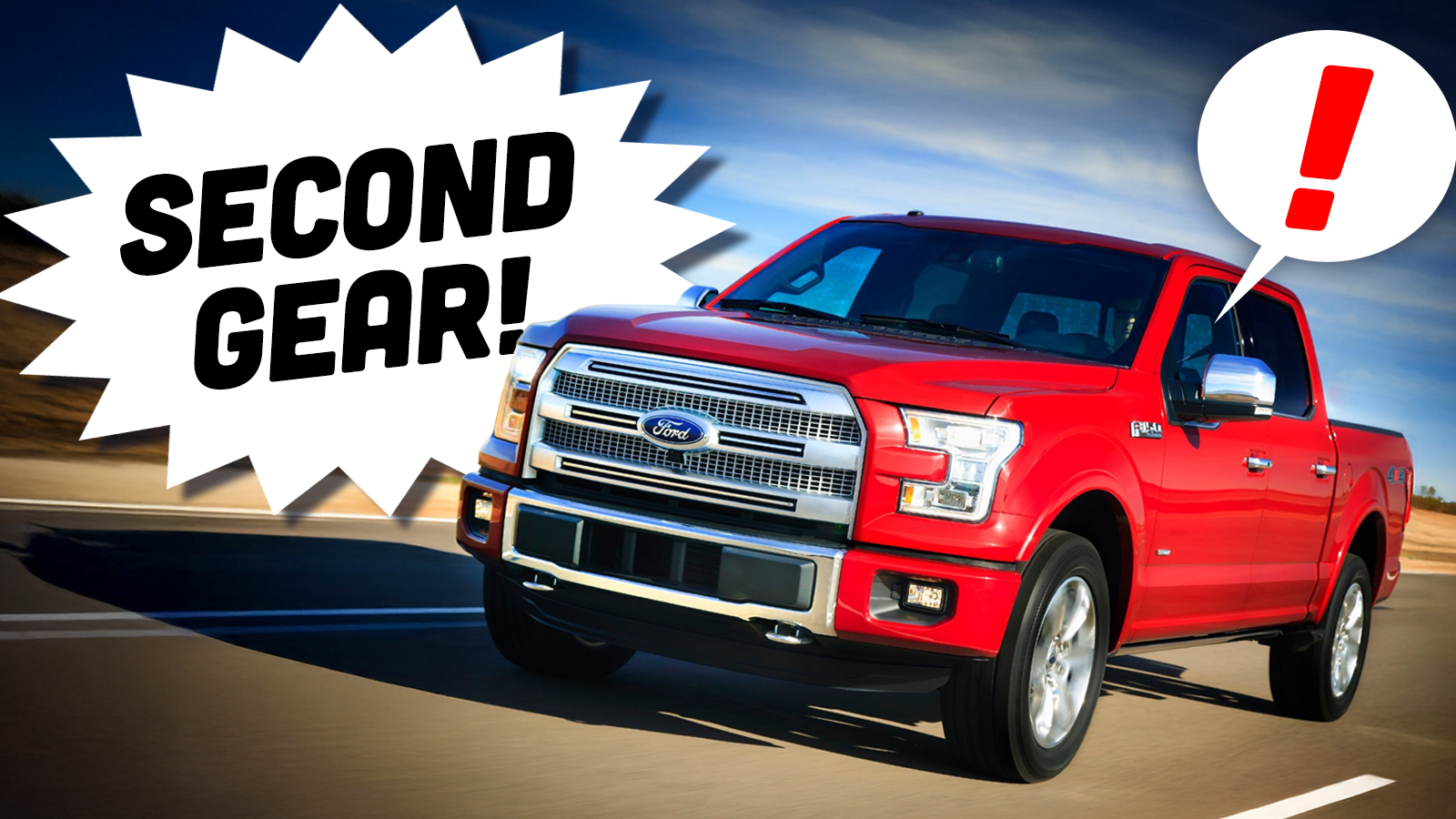
Following an investigation launched in February, Ford is recalling nearly 1.4 million F-150s built in the mid-2010s over worn-out electrical connections in the transmission’s computer system, which could send incorrect signals to the gearbox, ordering it to suddenly shift from sixth gear all the way down to second gear without warning. It’s like a money shift that you have absolutely no control over.
The recall, published to the NHTSA’s site this morning, targets 1,392,935 F-150 pickups built between 2014 and 2017 and equipped with the six-speed 6R80 automatic transmission. Specifically, the problem lies with the Transmission Range Sensor (TRS), which tells the car’s ECU which gear the transmission is in. This is part of the transmission lead frame, a molded plastic piece mounted to the gearbox that’s sort of like a circuit board for the transmission, connecting all of the valve bodies to the solenoids.

According to Ford, it’s this lead frame piece that causes the problem. From the recall document:
Degradation of the electrical connections in the transmission lead frame due to thermal cycling and vibration can result in a momentary detection of incorrect TRS signal positions by the PCM. A faulty TRS signal can lead to an unintended downshift.
Basically, the faulty sensor is giving the wrong data to the ECU, communicating incorrect positions that make the transmission think it should be in second gear, not sixth. This is pretty scary, because usually you’re only in sixth gear when you’re already moving at highway speeds. And as anyone who’s nearly money-shifted a car knows, dropping your car into second gear while moving at high speeds is a bad time.
Like I mentioned before, in addition to over-revving the engine, shifting from sixth to second forces the wheels to match the engine’s speed (which is suddenly much higher due to the 6-to-2 downshift). This is where things can get really sketchy, especially if you’re moving quickly. From the recall doc:
An unexpected downshift to a lower gear may cause an abrupt wheel speed reduction for a short duration, which in some situations could cause the rear tires to slide until the vehicle speed slows. This condition could result in loss of vehicle control, increasing the risk of a crash.
Ford predicts that only 1% of the nearly 1.4 million potentially affected trucks actually have a problem with their lead frames (around 14,000 vehicles). The company says that in the U.S. alone, it’s received 444 warranty claims, 121 field reports, 105 customer service reports, and 316 complaints through the NHTSA. Despite the scariness of the fault, only two injuries and one crash are potentially related.
Interestingly, this isn’t the first time Ford has had to deal with this problem. Back in 2019, it recalled a bunch of 2013 model-year F-150s with the same transmission for a similar sudden downshifting problem.

The fix is pretty simple. Anyone with an affected F-150 can take their truck to a dealer to have the software updated. Ford says the updated software includes “additional time for the control system to recognize failed or failing TRS hardware prior to commanding the downshift during this unique shift command fault.”
And if your truck comes into the shop showing signs of a failing lead frame, like trouble codes from the ECU, Ford says it’ll simply replace that part altogether, along with the new software.
My advice? Even if your F-150 is running perfectly, just get the damn recall done. This is one of those things that, if not addressed, could cause huge damage to your car and even yourself if you end up in a crash. I wouldn’t want to know what a 6-to-2 downshift feels like if I were piloting something as big as an F-150 at highway speeds, much less while potentially towing a huge trailer.
Top graphic image: Ford




My 2012 exhibited very similar behavior. Cost almost $1,000 to drop the tranny and replace the “output shaft speed sensor” (or whatever they called it) because the stupid part was mounted on the top of the transmission instead of on the side or bottom where it would be more easily accessible.
A year to two later we got a recall notice for a “fix” – same as here, it was a software update to teach the computer how to recognize and deal with the bad sensor readings, rather than a fix to the physical part itself.
I own a 2014 Expedition with a 6R80 transmission. I’ll be calling the Ford hotline number to see if it is one of the covered vehicles or not, but in general I’m wondering – why would this not be a ‘6R80’ recall rather than an ‘F150’ recall? These transmissions were used in Mustangs, Expedition/Navigators, Transits and Rangers in the date range in question as well.
my only guess is that the F-150 body/use cases might be putting the most wear and tear on the part, bringing the issue to light more frequently than those other cars
Could be something to do with how they routed the connector, where it’s located, or they’re just not getting reports of this in other cars and are crossing fingers on them.
While it wasn’t recalled, my Focus ST engine went due to a closed-deck Ecoboost 4 coolant passage issue, but it was not listed as an affected model in the TSB nor the CA suit. Recently, I found out that it seems some of the cars got this affected engine while others did not and there didn’t seem to be any way to tell unless you start it one morning and kills the entire neighborhood’s mosquitoes (good riddance). Being mainly familiar with mainstream Japanese cars, this is not something I expected, but (being generous here) maybe with Ford’s larger sprawling global network and number of factories, some locations use slightly different parts and the models that are built in those other factories or the transmissions coming from different plants that primarily go in other models and use different connectors.
Cue Friends opening song.
I had to roll through too much of that song in my head to pick up the reference. Then when I did, I groaned.
It certainly wouldn’t be your day, month, or even your year. Thankfully, Ford recalls are there for you.
OK Autopian, it’s time for a little field test to bolster your journalistic credentials. Find a cheap high-mileage F150 from this generation. Set David on rigging the sensor. Get Torchinsky behind the wheel on a closed track. Drop ‘er into 2nd at 75 mph. Film it from multiple angles inside and out (Jason’s reaction and commentary could be golden).
Then conduct an autopsy on the F-150, because I’m curious what part of the driveline and engine internals would get wrecked by this.
Not an automotive engineer, but I do have significant related knowledge on automotive systems, you can’t really “rig” a sensor to fail, what you COULD do is perform a UDS attack to knock the TCU offline then command second gear at the desired speed, however this will probably cause the vehicle to go into limp mode as soon as the TCU goes offline negating the intended consequence.
As to what happens when something money shifts at 75 MPH, in a RWD truck, those wheels are going to force the engine to over-rev immediately as the wheels are “mechanically” connected to the engine’s crankshaft. The weakest link will fail, catastrophically. IF the gears in the trans properly synch, that will likely cause bearings in the engine to fail and quickly re-purpose internal parts as external parts. This is worse in an interference engine as the valvetrain cannot keep up with the crankshaft RPMs, and valves will meet pistons. The rear wheels will lock and the truck will probably skid to a halt.
In a 4wd truck, this will be worse, as all four wheels will lock up causing a skid.
Either way, this is just intentional destruction of a working vehicle, and not something I can endorse, and proves nothing but what is already known, over-driving an engine will cause it, and things connected to it; to fail.
You know I’m not serious about this, right? The safety aspect is far more important than ruining a high mileage pickup.
But I do appreciate the detailed response on the mechanicals.
Sorry, I didn’t catch the sarcasm, I’m too analytical 🙂
One of my friends had his 2013 F150 money-shift at around 65 on a 2 lane road. Fortunately he was able to wrestle the truck into the shoulder. The downshift was so hard the driveshaft got detached from the whole thing. It was a scary thing.
Glad he was OK, that would be a few seconds of startled terror.
Ford:
Job Number One – Quality
Job Number Two – Second Gear, Always.
Jobs Number 3-6: See Job Number 2
Of course they money shift! Most 10-13 year olds can’t even drive a manual transmission!
Sounds about right. This “Luddite old man” can’t wait for DBW steering to take over the industry. Corrosion, manufacturer error, vibration and strain over time? Inconceivable! Wires chewed by rodents of unusually small size? I don’t think they exist.
Our family fleet has 2 Toyotas with over 250k. The other 2 Toyotas are in the 150k range. This is unacceptable – cars MUST wear out and need replacement at regular intervals to keep the economy churning.
As I just replied to someone else, a vehicle that was actually built to last, not just long enough to retain customers to buy another one, would be far more mechanical. They wouldn’t be as efficient, but we’re talking a theoretical economical operation for decades, not the realities of meeting CAFE or top tier emissions and, more importantly, “line always goes up” demands (this could lead to a whole rant about the bike industry’s current woes in contrast and comparison).
I’m not advocating carbs and distributors, just pointing out that some things are better as mechanical systems than electronic especially when that less reliable and unpredictable electrical system doesn’t improve anything for the customer experience or are safety issues, where the benefits are pure marketing nonsense used to sell an inferior feature because it’s cheaper for the OEM, like DBW steering. One could argue, hur dur this is Ford, but hur dur any of the companies, particularly one offering DBW steering without redundancy right now. Things like this are the potential reality for any manufacturer and the consequences of failure extend well beyond the owner of the particular car and aren’t generally predictable and can easily hit without warning and without as much potential mitigation that a mechanical system could offer (they often failure more gradually so that some control is maintained and they most often come with warning before hand).
So many of us have become a bunch of pansies obsessed with safety to the point of allowing constant tracking, monitoring, and nannying and readily trading daily joy for increased safety that might not even be needed or effective enough during statistically very highly unlikely events, yet let very real risks to not only car occupants, but those outside and without warning with no benefit to the customer go with a shrug? What that tells me is that we’re also stupid and easily controlled by marketing BS, not that I needed cars to tell me that. When I was a kid, it was the peak toy age and they’d advertise all this plastic crap in these cool settings and have kids using them all different ways, then you get the thing and the boat sinks and the parts barely hold together, and your yard doesn’t have streams and cool rock formations, but that’s good because sand and grit would only get in and wear out joints all the sooner like that time you stupidly brought them to the beach. Point is, I learned at a very young age not to believe what I’m shown or told (would have been cheaper to just listen to the lyrics of I Heard it Through the Grapevine, but I never was one for Motown even if I respect it). What the hell happened? Was it later helicopter parents who didn’t let kids learn anything on their own or think for themselves? Whatever it was, I’m glad I was a latchkey kid and my father was a psychopath (though not that bad of one, so he wasn’t excessive).
To the point of Toyota, they tend to keep older tech around longer than most because it’s perfected and it works and that’s what their (many) customers want. If they had only made them corrosion proof, I don’t doubt that I’d daily spot their cars from the ’80s around here.
Or analog “logic” in ye olde autos that would pop the transmission into neutral in a bad overspeed event. Sounds like maybe they need to dust off some old ideas.
I hit some road debris in a car with the venerable 700R4 and the chunk hit dead-on the shift bracket and shoved it into 1st at 75mph. The engine blipped up a little and then went to idle. When the car coasted down to something livable in 1st gear it reengaged.
A vehicle built with the intent of indefinite lifespan would have more mechanical features, not more electronic. They wouldn’t be as efficient, but they would be far more resilient, more accommodating to aftermarket support when old, and they’d be more customer serviceable with predictable failures and wear points that often give warning well before the issue is serious.
I often argue peak reliability was ’95 – ’10. OBD2 but not full ‘systems integration’. Cars of this era will run forever with care.
*Some restrictions apply. Offer not valid for Land Rover, BMW, Mercedes, or Volkswagen.
Completely agree. Electronics have their place, they worked well, were robust enough and had enough redundancy that failures gave warning, yet they were still very serviceable by someone who wasn’t a professional and they certainly didn’t require a diagnostic scanner (and a subscription, of course) that still can’t figure out that a bad LED in a tail light is why the car is bricked because that stupid shit simply wasn’t possible. Insane canbus BS aside, how much power does an expensive f’n LED array used for an intermittent lighting situation really saving, especially if failure requires entire unit replacement at very high cost vs a simple bulb that cost $5 for a pack of several that probably lasted over a decade* and could be replaced in a minute by pretty much anyone**? The other thing is that manufacturers had to get things right in regards to programming (other stuff, too, but that’s a separate rant) as there was no OTA crutch to rely on and I think programmers were actually competent then or were held to account or both where neither appears to be true today.
*Early ’00s VW excepted. **VW excepted here, too, specifically the New Beetle.
There was once a thing called a valve body. Full of squiggly fluid paths and orifaces… and they WORKED.
It was hard to money shift a ’94 SHO since they rev’ed to the moon anyway. Now get off my lawn!
Ok, everything on a car wears out, what then necessitates a recall for THIS but not for other wear items that can cause safety issues after 10-15 years?
This recall seems to track with Ford’s recent “better safe than sorry” type approach, where they’re simply deciding to recall anything that might cause an extra liability down the line
I appreciate getting ahead of an issue and helping the customer. But this shouldn’t be an issue to begin with.
The engine can be destroyed, which can be a safety issue as well as a “never buying a Ford again” issue and this isn’t a typical wear item that the customer can monitor, nor would it even be covered in the manual under a maintenance schedule most owners ignore. These are essentially expected to be lifetime parts, which, OK the engine blows, that might mean the lifetime of the truck is up, but that’s not the intent of the term.
Ford saw GM screwing up their bread and butter V8s and said hold my transmission fragments.
I have an f-250 and the shifting is horrendous. It basically, even in tow mode, won’t let you get rpms over 1500-2k. So when I am going down big hills (constantly where I am) I am forced to use my brakes way too much, or manually shift my entire drive. I am extremely disappointed in the programming points. I WISH my truck knew what 2nd gear was. It goes right to 3rd, and I don’t know if I’ve ever seen it in 1st without forcing it. I will be going 5 mph in Tow mode and it has me in fucking 3rd gear.
I love the truck overall, but Ford really sucks right now, and Farley needs to go. I don’t give a shit how fast he drives a car around a track.
(around $14,000 vehicles)
Is that the going rate for crappy trucks?
nah that’s just the most I’d pay for any F-150 (that’s been fixed, thank you!)
No wonder Jim Farley wants protection from Chinese imports –
He can’t compete – His company can barely even build cars.
Find Open Recall Daily.
Our 25 Maverick is a year old and has already had 4 recalls. I’m somewhat conflicted about it.
One one hand I think it’s ridiculous that the vehicle has been on the market for 4+ years yet still has manufacturing and design bugs. That’s some pretty poor quality up front testing and engineering.
On the other hand, 3 of the 4 recalls were taken care of with software updates, and all so far have been done in my garage by a Ford dealer’s mobile service tech. All done at no charge, and in about 10 minutes each. In that regard it’s been no hassle at all, and I am thankful that Ford is actively fixing these issues
I am sure they wouldn’t even acknowledge they existed if not for the (actually still working for now ) government safety regulations, but glad to get the fixes. Since this defect/design problem is potentially life threatening, they have no choice. If it just grenaded the transmission in your driveway. I suspect it just would be an out-of-warranty expensive repair.
If I had an affected F-150, I’d try to get the recall done at home and not waste time going to the dealer and waiting around.
Sigh – what happened to them? We had a number of ’80s -’90s Fords and they were honestly great cars. Better than my one GM experiment. Are they Toyota? NO, but they were once the best of the domestics.
They do seem to be more cyclical over time than the other domestic brands.
Early 2000s Escape and Focus were recall-heavy, by 2005 Consumer Reports had the Focus as their top pick small car and then their products by the end of the decade seemed to be all pretty good. ~2010 +/- a couple years Fusion, Escape, Edge etc are still common sightings for me.
Then after that the early EcoBoost + MyFord years tanked it (PowerShift just assumed in there).
“All done at no charge” – at no charge to you directly on that day in that place.
However 4 recalls costs someone money and that money WILL be recouped somehow, perhaps via the price on your next Ford. Or it was already built in by the 50% increase in Maverick base price over 4 years. It will also affect (perhaps minutely and unmeasurably) your resale value as enough people become aware of the mass recalls and just avoid the car (or Ford in general), thus reducing the number of buyers and therefore the demand which affects the value. Again, not really a problem the Maverick in general suffers from due to its limited supply and rapid increase in new price but it is a thing in general. No different really from why people might value a Camry higher than an on paper equivalent Altima etc.
Fix Or Repair Daily…
Found On Roadside Dead.
Fill Oil Repeat Daily.
I had a supervisor in the Navy in the late 80s that loved his Mustang, he countered with Cheap Heads Every Valve Rattles Oil Leaks Every Time. I had to give him credit for that one.
