

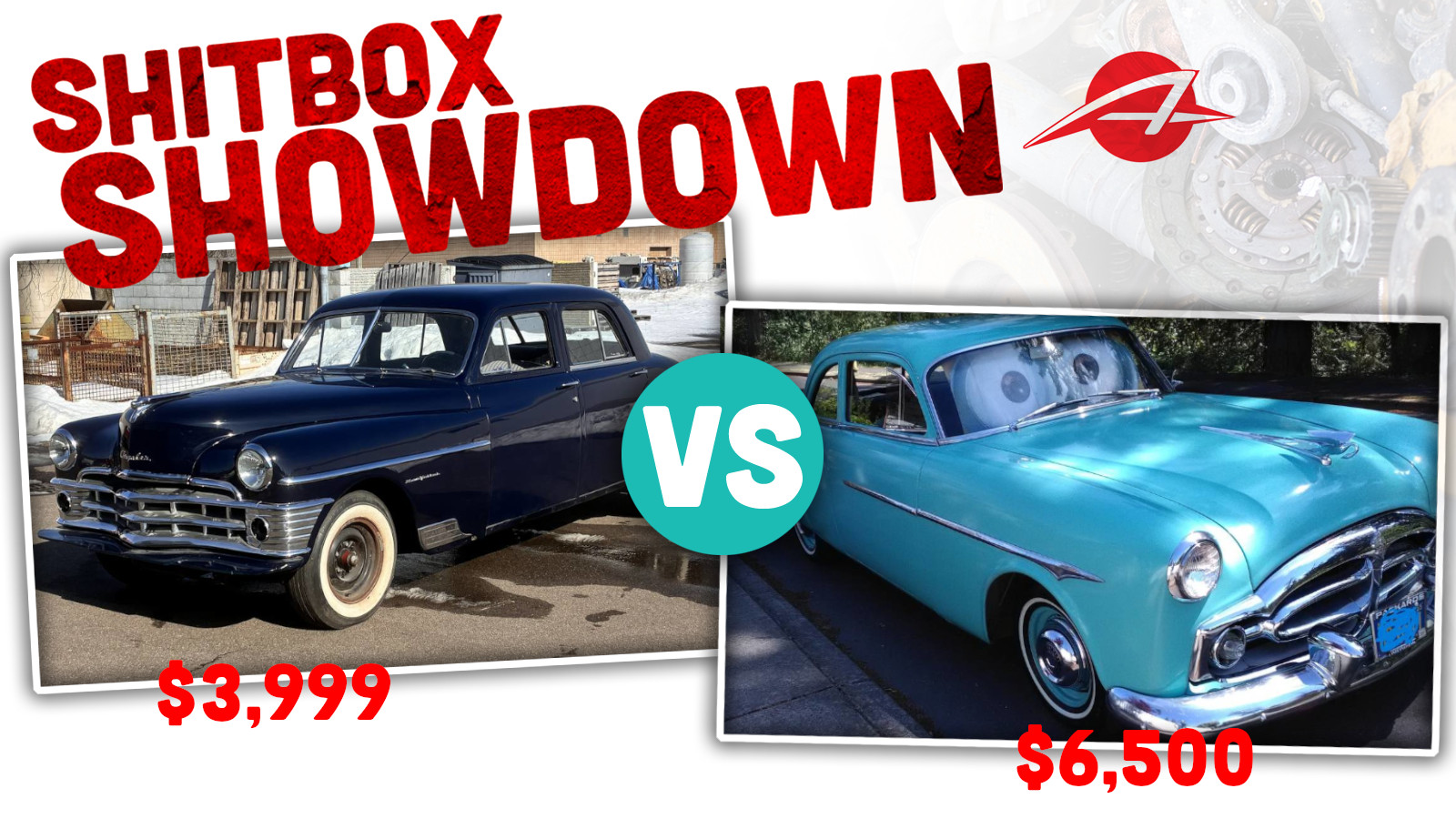
A lot of times, you can tell the approximate age of a car just by hearing a description of its mechanical specification. Oversized V8, three-speed automatic, and drum brakes? You’re talking ’60s. Transverse overhead-cam V6 driving the front wheels through a manual? 1990s-2000s, and probably Japanese. If I told you, without showing you photos of them, that today’s cars both had flathead straight 8s, six-volt electrical systems, and primitive automatic transmissions, you’d probably be able to guess they were from the early 1950s.
Yesterday we looked at two little cars in my least favorite color. The Pontiac Sunfire sold before most of you even got to see the ad, but my description, and its far lower price, was enough to give it an easy win. That Dodge Shadow would be a decent deal for the same $1,500 as the Pontiac, but for two grand more, it was hard to swallow.


I guess I’d reluctantly agree. I really like Shadows, but that one has too many questions for too much money. The Pontiac really is the better deal here. Personally, I’d rather combine the best attributes of both cars, and hold out for a Dodge Shadow convertible with a manual. Preferably not red.

A lot of automotive components from the late 1940s and early ’50s were holdovers from before World War II. Automakers rushed to create modern styling for the post-war era, but mechanical design lagged behind. Both of today’s cars use engines that date back to the 1920s and ’30s. They both, however, have state-of-the-art (for the time) transmission designs, semi-automatic in one case and fully automatic in the other, that addressed Americans’ increasing desire to not shift gears unless they absolutely had to. Let’s take a closer look.
1950 Chrysler New Yorker – $3,999

Engine/drivetrain: 324 cubic inch flathead inline-8, four-speed semi-automatic, RWD
Location: Plymouth, MI
Odometer reading: 70,000 miles (but odometer is broken)
Operational status: Runs and drives well
There is a point in any history right before everything changes, when the old stuff seems just fine, until you get your first look at something new. Think of hard rock music right before Nirvana released Nevermind, or action movies just before The Matrix. You didn’t know you needed them until they arrived, and suddenly the stuff that came before felt stale and unsatisfying. The 1950 Chrysler New Yorker is the last of its breed; a year after this car was built the straight-8 would give way to a Hemi V8, and two years after that, the flat-glass split windshield would be replaced by a one-piece curved wraparound unit. And just a few years after that, cars wouldn’t look, or drive, like this at all.

Chrysler’s flathead engines came in four, six, and eight cylinder varieties, and powered everything from cars to combines to tanks over the years. 1950 was the final year for the eight-cylinder, making only 135 horsepower but gobs of torque. It drives the rear axle through a “Presto-Matic” transmission, a truly weird two-speed semi-automatic with a low and high range, for a total of four forward gears. The way I understand it, you selected low or high gear with the lever, let the clutch out, and then the transmission would shift between underdrive and direct drive automatically, based on speed. For normal driving, you left it in high gear, but you could shift to low when it was needed. It’s another one of those bizarre setups I’d love to try driving someday, if I got the chance, just to see what it’s like. This one’s engine and transmission have just been rebuilt, and it runs and drives well.

Most of the interior has been restored, and it looks pretty good. I see bare metal on the passenger’s side door, so that door panel is either missing or was removed to be redone. The center cap on the steering wheel also appears to be missing. But that dashboard, the final gasp of Streamline Moderne before the Jet Age took over, is magnificent.

It was repainted a few years ago, in the original color, and looks nice and shiny. The hubcaps are included, but the bumpers are MIA. But I kind of like it without them, if I’m honest. The seller says this car “never was rusty,” and that the underside is nice and clean. I wish they’d included a couple pictures to verify that.
1952 Packard 200 – $6,500

Engine/drivetrain: 288 cubic inch flathead inline-8, two-speed automatic, RWD
Location: Estacada, OR
Odometer reading: 94,000 miles
Operational status: Runs and drives, but needs new rear brakes
The history of the automotive industry in the US is riddled with startups, mergers, acquisitions, and bankruptcies. Small companies merge to become big ones, big companies buy up new small ones, and before you know it, there are only a handful left. Packard was never a really big company, but it was a well-respected one, especially in the upper end of the market. Sadly, its purchase of Studebaker turned out to be a really terrible idea, and the brand wouldn’t see the end of the 1950s.

Packard hung on to its straight 8 longer than other companies, all the way through the 1954 model year. In 1955, it was replaced with an all-new overhead-valve V8, which was only in production for two years. The straight 8 was an anachronism even in 1952 when this car was built, but it was also kind of Packard’s signature. The 200 model was Packard’s entry-level model, with a smaller 288 cubic inch engine. This one is equipped with an “Ultramatic” transmission, Packard’s own design. It’s a two-speed transmission with a torque converter that usually operates in high gear only, but can be shifted to low gear for climbing hills – or, you know, out-accelerating a box turtle. This one runs and drives, and is currently registered. It has had a bunch of work done, but the seller says it still needs new rear brakes.

This is the only photo we get of the interior. The seller says it’s in fair condition, and the front seat needs reupholstering. It has a couple of wool blankets thrown over the seat right now, a time-honored way of covering up the seats in an old car. Hopefully the blankets are included, so you can put off the upholstery job for a while.

This one was repainted back in the ’70s, and it seems to be holding up well. Again, the pictures aren’t great or numerous. It’s a three-owner car, with all the original paperwork, which is uncommon to get with a car this old. I bet it would make an interesting read.
There aren’t many cars like these left, which is probably good, because there aren’t many buyers interested in them left either. They’re relics, but interesting relics, and not all that expensive. If you’ve ever wanted to experience a postwar car, either one of these would be an affordable way to do it, and then sell on to another curious party when you’re done with it. Which one catches your eye?


Good luck finding those missing bumpers!
Sorry that I missed this one. I would have thrown my lot in with the Packard crowd.
Both!
“Yes, and now you heard my strange proposal
So get that Packard up and let’s move”
J. Buffett
Way back in the day, rich people collected custom rail cars, even as the railroads were losing out to the highway system (especially for passenger travel).
Today’s selections remind me of those old rail cars – totally impractical for the modern era.
Oh, I have to pick one? I’ll go with the one that looks like a character from Cars, whichever that is.
Oh man I’ve been on a Packard kick of late so the swan takes the win!
Well deciding between two oddball cars neither one will be driven that much I have to go based on price so Chrysler it is
Both. Definitely both. But if forced to choose one, I choose Packard.
I voted Chrysler because it was cheaper, but I would have preferred a both option as well
My late father-in-law had a 1949 Deluxe Eight Touring Sedan. It had a three-on-the-tree transmission and was fun to drive around town when we visited. Despite that, I went with the Chrysler. It’s got four doors, which I prefer, and the ignition key is on the left! Just like a Porsche.
That the Chrysler’s owner was able to find someone who could rebuild the transmission(s) is amazing. Pity about the MIA hubcaps and bumpers.
Yesterday, the cars offered were in my least favorite color. Today’s Packard is offered in my second least favorite color.