


Before the widespread adoption of electric vehicles, storage space underneath the hood of a vehicle, known as the front trunk or “frunk,” was a fairly obscure feature. Because most cars have their engine up front, the average buyer has probably never had that space available to store things. The only way to have a frunk would be to have a car with the engine in the middle or the back of the car.
Now, though, the frunk has become far more mainstream. Because electric vehicles don’t need that space to keep their floor-mounted batteries or compact electric motors, many manufacturers have opted to use it to add storage space. Peek under the hood of most electric cars, and it’s likely you’ll at least find a cubby to store your charging cable.


As it turns out, people might not be using their frunks as much as automakers thought, at least going by Ford’s decision to eliminate the frunk from the Mustang Mach-E’s list of standard equipment.
Now You’ll Have To Pay For That Extra Storage
Ford Authority was the first to catch the news that the Mach-E will not have a frunk as standard. If you want a frunk in your four-door, all-electric Mustang, it’s now a standalone option that’ll cost you an extra $495. And it’s not like you get that level of a discount if you don’t option the frunk; the 2026 model is only $150 cheaper than the 2025 model, which got the frunk as standard. So if you match the two model years spec-for-spec, you’re paying $345 more.
The reason, according to Mustang Mach-E brand manager Teddy Ankeny, is that owners simply weren’t using the frunk as much as the company expected. Here he is in a video interview with the Electric Duo YouTube channel revealing why Ford made the swtich:
Here’s the relevant quote, in case you don’t want to (or can’t) watch the video embedded above:
“[W]e were learning that customers were using their frunk, but perhaps not as much as we had originally intended. And so, in order to kind of preserve that customer choice, we have made it optional for the 2026 model year.”
Personally, I’d think “Customer choice” would mean keeping the frunk standard and letting the customer choose whether to use it, but that might just be me.

It’s a shift in tone for Ford, which touted the Mach-E’s frunk as one of its most interesting features back when the car was new. Back then, there was 4.7 cubic feet of storage space available, and even a drainage hole at the bottom allowing ice to melt through so you could use it as a tailgate cooler. That press photo above of people eating shrimp from atop a frozen pile of ice in a Mach-E frunk is seared in my mind forever.

For the 2025 Mach-E, the frunk shrank by 40%, to 2.6 cubic feet, thanks to the installation of a standard heat pump for the batteries, and lost its signature drainage hole. And now, it’s not even standard equipment anymore.
Maybe The Germans Were Right?
In any case, Ford’s move feels like a case of cost-cutting and trying to squeeze more dollars out of customers by paywalling previously standard equipment. But it’s not worth dismissing the company’s analysis entirely.
There are a couple of reasons I could see someone fully ignoring the Mach-E’s frunk for the entire length of their ownership. The most obvious is that there’s a much bigger, easier-to-access storage space in the hatch that takes just one button-press to open (versus two clicks on the key or two pulls of the interior latch for the frunk). And if I’m carrying a bunch of groceries, I’d probably just go to the rear hatch area if I’m not sure everything will fit in the much smaller frunk.
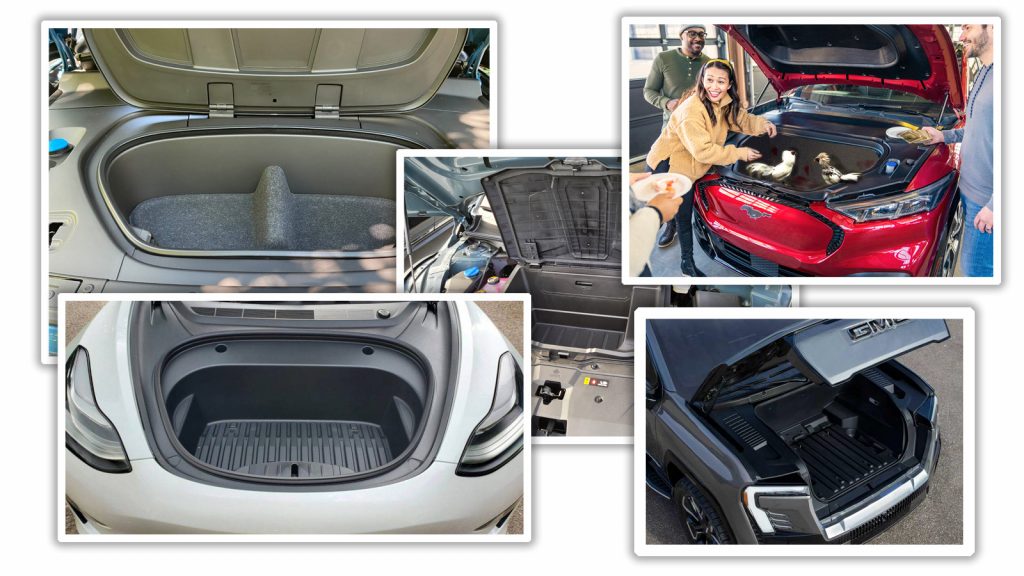
Let me play devil’s advocate for a second: If I’m an automaker looking to optimize cost through design, every inch of the car is under a microscope. And if the folks from the data department are saying people aren’t using their frunks, that allows carmakers to reassess how to use that space more efficiently.
In the case of the Mach-E, designers simply decided a heat pump for quicker charging was more important for customers than 2.1 cubic feet of storage space. Then, for 2026, they figured so few people used the frunk that they wouldn’t mind if it weren’t there at all. And the people who do want one are willing to pay for it. That’s a few extra hundred bucks in my pocket that wasn’t there before, or a couple of hundred bucks saved in parts if the buyer doesn’t choose the frunk.
There’s a packaging angle here, too, at least according to Nissan vice president of global design Alfonso Albaisa, who told Green Car Reports back in 2020 that engine bay space can be used for stuff that was previously inside the cabin, rather than for extra storage:
“The HVAC [heating and air conditioning], all the guts that used to live in the cabin, we shoved them in the engine bay, which has no engine,” said Alfonso Albaisa, regarding its upcoming electric crossover, closely previewed by the Nissan Ariya Concept first shown in the U.S. last month at CES. “Actually if you open the hood on Ariya, it’s full of stuff; that’s what’s given us this completely open cabin.”
All the way back in 2022, my colleague Jason wrote a piece calling out German automakers for not installing frunks on EVs when they very clearly have the engineering know-how to do so. One paragraph stands out with this new context of Ford’s move:
I’ve asked representatives of BMW and Volkswagen about this, right to their faces, and I got essentially the same answer from both companies: what the hell do you need a frunk for when we have so much room in back?

Personally, I couldn’t imagine not using the frunk if I had the option. Sure, it’s usually a small space, but it’s perfect for stuff I don’t want flopping around in the normal trunk area, like charging cables, snow brushes, ice scrapers, first aid kits, and miscellaneous tools. And if my EV were a hatchback, having a storage space that’s truly hidden from view would make keeping valuables in my car, which I park on the street, far less nerve-wracking. In the case of pickup trucks, frunks are even more useful because they provide a lockable, sealed storage space on the vehicle’s exterior that wasn’t there before.
In the case of normal car- and crossover-shaped EVs, automakers think differently, and if Ford’s analysis of how often customers use their frunks is to be believed, the average buyer does, too.
This all leads me to ask: If you have a car with a frunk and a traditional trunk, do you use the frunk? If so, for what? And how often?
Top graphic image: Ford





Use the frunk in my Boxster every track day. Both it and the trunk are filled with stuff. Use the frunk at other times, too.
I have had a frunk for 1.5 years. Never put anything into it and I don’t store things in it. I open it to refill the washer fluid and to wipe the underside of the hood when I clean the car since water can work its way around the edge (but not into the compartment). The rear storage in a Model Y is so useable and large, I have no need.
I use my car’s frunk. It’s where I store my gas tank.
Frunks are great This is where you mount the largest speaker possible. Then get a sound track of your favorite V8. Next you hook up the volume to your acceleration pedal Now you have the sound you crave so much, with the acceleration of an EV!
Problem Solved!!
Former Ford Vehicle Line Brand Manager checking in here – I got a chuckle out of the spin, which is probably the most interesting thing but maybe not for the reason it’s made out to be. But first, know that every vehicle engineering team (Chief Engineer, Vehicle Line Director, etc.) has a regular cadre of program engineers who, among many things, are also responsible for developing and owning a list of MCRs or Material Cost Reductions for their program. They need the Brand Managers at these meeting because sometimes the MCR could mean a lower revenue call (all pricing is handled by Marketing) for making a change to equipment and options. But here, not only did the team take cost out for the part, and presumably a manufacturing save as well, but they found a way to reintroduce as an option that probably nets more margin then it would have gotten as standard equipment. These are the best kind of MCRs. That said, this will never be driven by consumer demand because no one ever orders a car “from the factory” – the dealers order and manage their inventory and thats what the customers get to pick from.
What IS interesting, at least to me, is wether or not they have actual customer use data, or if they have customer reported data. Reported data (e.g. surveys) is the old way to build a business case that then would be used to drive alignment among all the stakeholders to make a program decision like this (in addition to the financial ones of course). However, Marketing longed for the day we could record actual use patterns and behavior frequency data on a part or option basis. The new *gamechanger* electrical architecture in the Mach E was supposed to be a huge step forward in developing this holistic view of customer behaviors – how many times has the frunk release button been pressed? or its rate relative to a certain customer profile or trait? To me that was the Holy Grail and the intersection of vehicle engineering, electrical architecture capabilities, and enterprise-level data science ability. Unfortunately I left the company for a start-up before the theoretical data started to flow.
Are they also downsizing them so that they don’t have to put in the extra hardware to prevent kidnapping?
I have about 15 years worth of daily driving the MR2s that had a frunk and a trunk (although as I’m in the UK the trunk is technically the boot, which makes the front storage a froot).
I used the froot a lot, but not as much as the boot. Froot access required pulling the bonnet release in the car, then undoing the safety catch. The boot I could just open with the key.
In a car with a boot that wasn’t tiny I’d probably not bother with the froot unless I was packing for a road trip.
My Lotuseseses didn’t have froots, but they have space in the front for a few tools/tyre inflator, which made more space in the back. It was appreciated.
I would like at a minimum to be able to place the charger in the frunk. that way you don’t feel like you “lose” space by going ev. also you can’t accidently bury it in cargo and have to go dig for it.
This is the real use case for a frunk. I use my portable charger a few times a year only, so it lives in the spare wheel, under the floor of the trunk. When I get to the family cabin I have to unload all the stuff that would normally stay in the car for use at the cabin to be able to charge the car.
It isn’t a big deal, but having the space for the charger and an emergency kit up front would be great.
In almost 10 years of driving EVs I haven’t come up with a reason to carry a 120v charger around. Charging at 1.4 kW is just too slow. If I need to charge away from home it will be on a public charger.
it really depends on how far away you are. but i would consider it like “jumper cables” get you 10-20 more miles to make it to a quick charger or back home. there has been horror stories of public chargers being down for maintenance when you need them most and then you are stuck.
For my Bolt the factory 120v charger adds about 2 miles per hour at 8 amps and 3 at 12 amps. Best case that extra 10 miles is going to take 3 hours in good weather. In cold weather maybe double that. Cold enough weather and it won’t charge at all because the battery heater consumes all the available power. (Bolt has a 5 kw heater)
Nissan (and Chevy) have the right idea. Put mechanical components in the front to give the owner a larger passenger / rear cargo area. Don’t split that storage between a trunk and frunk.
As to where to put things in a hatch out of sight. Under the floor divider in the hatch of course. That magical board that can either be used to hide away infrequently used items or removed to make the rear hatch cargo area even larger. In my Bolt I have my spare, jack, tools, tire chains, and some extra winter clothes tucked away in the back. (Same as my Acura wagon)
As a Mach E owner who has opened my frunk exactly once to throw charging cables in….this article hits close to home.
Perhaps one day I will need the charging cable and will get a 2nd use.
I have placed my charging cable under the floor in the back and its existence is similar to the status of Schrödinger’s cat.
I use the frunk in our Lightning CONSTANTLY. Granted it’s huge and so more versatile than that in the Mach e. I also second an earlier commenter that the Lightning frunk is just so much easier to access than the Mach e, so that probably makes a difference. We just test drive a Mach e and it took us 10 minutes to figure out how to open the frunk. But the Lightning frunk is our go to spot for groceries, fully loaded coolers, laptop bags, backpacks, food for a weekend, loose shoes, and God knows what else. It’s incredibly handy, and there is even a bonus sub-frunk under the main frunk deck!
Same. We use the Lightning frunk practically daily.
The Lightning frunk is a gamechanger and a huge QOL improvement over gas trucks.
One, it’s absolutely massive, so it can handle tons of different uses.
Two, trucks have minimal enclosed storage that isn’t the floor of the back seats, compared to CUVs, so it’s even more important.
Three, it’s powered. I used the Tesla frunk way less partly because you were supposed to be careful re-closing it.
I think the use case for the frunk in a truck is a lot higher as it’s secure storage and larger.
Agreed. That is points #1 and #2 in my comment.
As the owner of a few EVs (granted of the PHEV variety) and also a previous owner of a 911, I have to say I just cannot understand the automotive press’ obsession with frunks. I never used my 911 frunk and the argument about how a small frunk allows someone to carry charging cables ignores the fact that I cannot imagine an instance (even driving a BEV) where carrying charging cables is useful. The charger will either have a cable attached or it’s a 120 outlet and not useful for a BEV.
You can store other smaller items, but most BEVs are warm weather sales so items such as ice scrapers are not a consideration. Ultimately, most frunks are some combination of (1) too small and weird shaped to store items that people tend to throw in their trunks, (2) inconvenient to use because of high liftover height (as someone with a bad back, lifting something over the front of the vehicle adds a level of danger to my cargo loading), or (3) just not that attractive to use when there’s a much bigger space in the back that is much easier to load.
Ultimately, the argument that the consumers can choose whether to use the feature or not ignores the fact that the bits to define the frunk, and cover up the other mechanical bits around it, are not zero cost. If a frunk is never used, why would you keep it on the BOM?
Not sure about the US, but here in Europe most if not all public AC chargers (11kW/22kW, I believe you call them Level 2) don’t come with a cable, you need to bring your own. Plus many EVs come with a charging brick for home charging from a normal wall outlet. That is a lot of equipment to carry around in your trunk. In some cases you can store it in the trunk below the “false bottom”, but that makes it pretty much inaccesible when carrying luggage.
Definitely not the case in the US. Every public charger in the US has a cable, which makes it annoying for Level 2s depending on whether they’re J1772, NACS, CCS, ChaDeMo etc. (can only have one type of plug per charger). Also, I want to say most of the build out these days in the US is DC fast charging, which definitely comes with their own plugs.
There is no better place for the spare tire & related equipment than the frunk.
That’s where the spare is stored in mine. Right there along with a little tire iron, and the fuel tank right behind it!
First, how did they determine that frunks were not being used enough? focus group? spyware data recording how often you use features? (creepy).
secondly, what is involved in the delete? different sheetmetal? no hinges or latch mechanism? no icon on infotainment screen? can it be reversed afterwards?
Rented a Mach E last summer. With four adults and all our luggage for a week long trip, we HAD to put at least one bag in the frunk just to get it all to fit.
It’s just money. Why give away a frunk when you can charge $500 for a plastic liner? From the same people that think floor mats are worth $200. Like you said, “miscellaneous tools.”
Floor mats at $200 are a lot better deal than wearing a hole in your carpet under the pedals. My only request is they offer just a driver’s floor mat without having to buy the other 3, as the driver’s one is the only one that gets wear.
Ford executive, 2027: “[W]e were learning that customers were using their passenger and rear seats, but perhaps not as much as we had originally intended. And so, in order to kind of preserve that customer choice, we have made seats optional for the 2027 model year.”
I’d be perfectly fine with no rear seats in my Escape – it’s a delivery car that at most 1 other person sits in.
Would you be fine with it if it didn’t give you any cost savings and you had to pay an extra $300 for the passenger seat, though?
To me it’s not that they make it optional, it’s that they make it an additional cost option with no break on the base price.
My PR BS-ometer just rocketed the needle through my monitor. I would say I’m irrationally angry about it, except I’m pretty sure what he’s saying there is “We realized we could charge people more for it” which means my anger isn’t so much irrational as completely justified.
And the thing is, I’d absolutely pay it because I love having these little separate storage spaces in my vehicles. There’s so much stuff I want to have around for emergencies or emergency picnics, but don’t want it rolling around my regular trunk space.
It’s one thing if they packaged everything into that space in order to free up the cabin like Nissan did, but when the space is there and completely unutilized it just offends my min-maxing personality.
Whatcha gonna do with all that junk inside your frunk
…but also don’t know that that tiny space shown in the Mustang is all that useful? To the point of the Arya designer I’d rather see it used up in the name of better interior packaging-especially if that allows the main cargo area to be larger.
Had a first year Boxster and found the frunk was useful, but not all the time. However, when I put less commonly needed car and travel items up there for storage until ‘if needed’, it worked out well.
I think I would use the frunk for items that I want to have in the car but don’t necessarily have another space. Ice scraper, 12 inflator, jump box, basic hand tools, blanket etc. Basically it would be nice to have, but I wouldn’t access it everyday, and I get by just fine without one now….
If it’s not big enough to haul at least two yards of mulch and a couple bags of ready mix, which I would always do if I owned a truck, what’s the point? Might as well use the space to make the hood lower.
I think the frunk is great on pickups since they don’t have a trunk, but on vehicles with a trunk, I’d rather use the trunk. It’s nice to have at times, but easy to live without.
THIS
I wish all EVs had them because that’s where I keep my Frunky Cold Medina.
It’s an American thing: but what if I need the extra storage? Goes with but what if I need the offroad capability, but what if I need a bed to carry a sheet of plywood, but what if I need to travel 500mi in a day, but what if I need to carry seven people mindset that has lead to the death of automobiles in favor of heavy and large trucks, SUVs and CUVs that are used to carry one person, and nothing else.
Maybe but what if I need to travel with 7 passengers in the car (picked up at Home Depot)to help me install the 4×8 sheathing (also from Home Depot) in the bed and my house is 500 miles away in the mountains with no roads?
The passengers ride in the back so the plywood doesn’t fly out.
Brilliant