

As a person who writes a daily industry news roundup, I’m always at risk of oversimplifying complex issues. It is a hazard of the job, and I think EV charging may be one of the most underestimated challenges, both here in The Morning Dump and in the world at large. Part of this might stem from the fact that Tesla has built a robust, successful, and smart charging network in the United States. Elsewhere, it’s less straightforward.
Given Europe’s requirement for electric vehicles and its heavy investment in chargers, you might assume that the increase in electrification has made charging networks more profitable and necessary. Nope. It’s way more complicated than that. As reported yesterday, Polestar is probably not long for the United States, though the explanation for what happened is just creating more questions. That is complicated, too. Why did the UAW’s court-appointed monitor put out a scathing report on the current UAW president right before the election? Also complicated.


How to end the week on an up note? Hmm… I don’t have an up note. Sometimes them’s the brakes. Unless you’re making an autonomous vehicle, and then you maybe don’t need brakes at all.
Germany’s Charging Network Is A Bit Of A Mess
Tesla really did it right when it comes to charging. It did it so right that, in North America, everyone switched to their standard. I’ve taken a new Kia to a Tesla Supercharger and it worked just fine. One of the benefits of Tesla’s approach was that having a standardized interface and a lot of similar cabinets, the company managed to maintain a very high up-time compared to the experience many used to have with Electrify America. Lately, I’ve had fewer issues with fast-charging, and many cars and networks are plug-and-charge now, which is to say that it doesn’t take a lot of work to make a transaction happen. (Just to make things easier, I’m going to exclude home charging from this conversation, as it is a pretty solved problem at this point).
The growing reliability of charging cabinets solves one big problem people had with chargers, while leaving a whole host of other complications. This isn’t to say it all won’t work out. I’m sort of thinking about it like the railroads: by the middle of the 19th century pretty much everyone knew that it was going to be a thing, but the actual process of it all being built-out and deployed was a huge mess and many companies and investors failed (analyst/investor Jeremy Grantham made a similar point about AI on a recent “Odd Lots” episode, which is probably why it’s in my head).
Is this a real estate problem? If you can afford to build 10 fast chargers, do you put 10 in one super popular location on a busy highway, or do you put two chargers in five locations that are slightly less popular? For profitability, the super popular location might be more important, but if you want to increase the popularity of EVs you might want to spread them out. Again, Tesla benefits directly from more EV sales, whereas it’s slightly less direct for companies that are just charging companies.
Building out charging cabinets isn’t cheap, especially when governments are starting to require more local content in the cabinets, as opposed to just buying them from China (and in Germany, bureaucracy plays a role). Charging speed expectations are also increasing. Where 150 kW used to be a big number, it’s now 400 kW at minimum. If you’ve built out a cabinet two years ago it may be obsolete before it’s become profitable. In the USA, you’re now juggling the transition from CCS to NACS.
What about electricity costs? In the US, the early lead that Tesla got with Superchargers created a slim majority, and that’s probably been helpful for the market as a stabilizing force in what pricing should look like. In Europe, there are even more charging companies and they’re locked in a pricing war that few can really win, giving an advantage to big companies like Ionity (partially owned by a bunch of automakers).
As Manager Magazin points out in this big report, being profitable is hard if you can’t spend a ton of money:
Tesla is considered the benchmark in the industry, but an internal analysis by the Tank & Rast group sees only Ionity as performing well along the highways. The report states that a “hypercharger,” meaning a charging station with at least 150 kilowatts of power, is only economically viable if at least 240 kilowatt-hours of electricity are drawn from it per day. According to the analysis, Ionity achieves an average of 300 kilowatt-hours. Providers like Fastned (200), EnBW (140), and Aral Pulse (110) fall significantly short. A report by the electric vehicle data specialist Elvah also supports this ranking: According to their findings, the five fastest-charging locations with the best utilization in Germany were all recently operated by Ionity.
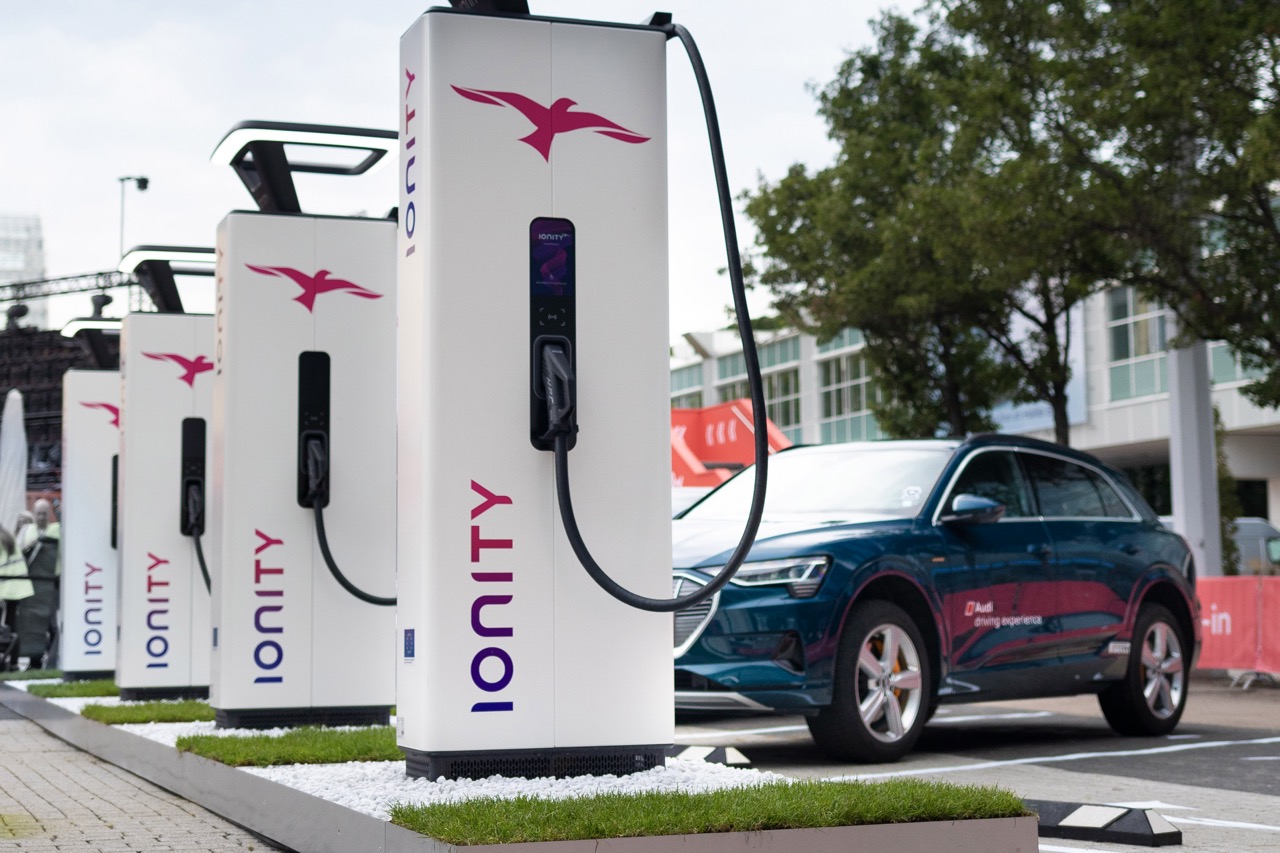
While competitors often have to direct their customers off the highway, Ionity chargers are typically located at rest stops directly on the expressways. “Large locations, short detours, high speed,” is how CEO van Tilburg describes Ionity’s formula for success, pointing out, among other things, that unlike many others, they focused on fast chargers with a minimum output of 350 kilowatts from the very beginning. As a result, although they only provide 4 percent of all German fast-charging points, they sell 8 percent of the total energy.
Germany, like most markets, is seeing more and more chargers, preparing for a future with more electric cars. Unfortunately for most charging companies, there just aren’t enough electric cars yet and utilization rates remain below profitability. That means that companies are cutting charging fees to the point that they lose money while also trying to expand.
And, as the report mentions, there are other threats out there:
Lidl is currently making headlines. The discount supermarket is enticing users of its Lidl Plus app to its own DC fast-charging stations. At 27 cents per kilowatt-hour, it’s incredibly cheap – at least until the end of June.
Lidl is the main competitor for Aldi if you’re not familiar with budget European supermarkets. This is another company that’s now competing in the larger marketplace for public charging, but one that doesn’t have the same incentive structure. Lidl wants you to come in and spend money, not charge and get the hell out of there.
We’re in a slightly better situation in the United States, and right now the need for chargers is high enough that companies are seeing increased demand every time they install a new charger (on average, there are definitely underused spots). But even charging companies here are seeing competition from companies like Walmart, which is rapidly increasing the number of chargers at its stores.
My general assumption is that more chargers will be needed to combat range anxiety, even as cars get more efficient and charging gets faster, although that creates another wrinkle: If you can charge faster you need fewer chargers per vehicle, right?
Like a gentle Nancy Meyers comedy, it’s complicated.
Did Polestar Die So That Volvo Could Live?

It was reported yesterday that Polestar was not going to be permitted to sell new cars in the United States next year due to the Department of Commerce, which used the Biden era Connected Vehicle to determine that Polestar’s Chinese ownership structure meant it went afoul of this rule.
What about Volvo? As I wrote at the time, Volvo got a reprieve from the same law, although it had to agree to comply with various regulations. Volvo and Polestar have essentially the same ownership and sell similar cars. What’s going on here? That’s what dealer Matthew Haiken, of Polestar Short Hills in New Jersey is also curious about.
Haiken wants to know the implications for sister brand Volvo, which received authorization in May but still must comply across its lineup.
“If it can happen to Polestar, why can’t it happen to Volvo?” he said. “I want answers from Volvo Cars CEO Hakan Samuelsson, who started [Polestar]. It’s not fair.”
This is a reasonable question. Polestar currently makes cars in South Carolina alongside Volvo, and CEO Hakan Samuelsson made it clear to me at lunch in March that the South Carolina plant needed to be more utilized.:
“I agree with you,” Samuelsson said, adding that “You either use your factory or you don’t have a factory.”
“We need to fill the factory, that’s the first option and best option. We will bring in the XC60 at the beginning of next year.”
Polestar makes a fraction of the cars that Volvo does. Given the difficulties Polestar has had in the market and other changes, it feels entirely possible that Geely could have made a deal at the top to fully utilize the South Carolina facility (thus pleasing the President and Republican politicians), resulting in a game of musical chairs where Polestar was left without a seat.
Court-Appointed Monitor Alleges UAW President Fain Retaliated Against The VP Now Running Against Him

The saga of UAW President Shawn Fain and Vice President Rich Boyer had a big moment earlier today when the court-appointed union Monitor, Neil M. Barofsky, essentially backed up Boyer’s claims that he was the victim of retaliation from the President over his unwillingness to, among other things, help out Fain’s future sister-in-law.
You can read the whole report here if you’re interested, but the Detroit Free Press has a good summary:
In a report filed on Thursday, June 25, the monitor says Fain, based on faulty pretenses, unfairly stripped Rich Boyer of oversight of the union’s Stellantis Department. The monitor concluded that none of the stated reasons offered by Fain justified the removal of Boyer’s responsibilities and that, instead, Fain’s actions fit into a recurring pattern of retaliation against perceived union foes.
All told, the monitor said, none of Fain’s accusations are verifiable or amount to dereliction of duty by Boyer and may in fact be the result of Fain’s and his team’s shortcomings as contract negotiators.
In reading the report, the Monitor credibly alleges that many of the excuses Fain used as reasons for removing Boyer–who was in charge of the union’s relationship with Stellantis–were either bogus or caused by Fain’s own team. So why did Fain remove Boyer (who has since been reinstated)? While there’s no smoking gun in this report, the Monitor clearly intimates that it was Boyer’s reluctance to intervene in matters specifically tied to Fain that were the cause:
President Fain inappropriately used the powers of his office to pursue a personal matter on behalf of a family member, an abuse of his authority. Fain took a matter in which he had a personal interest—the treatment of his fiancée’s sister’s injury—and pursued it through the powers of the UAW presidency, pressing it on Stellantis’s senior management and on senior Union officials who ultimately reported to him. In doing so, he expended Union resources—his own time and that of a Vice President, an Assistant Director, and his Top Administrative Assistant—to seek relief from requirements that apparently applied to other Stellantis UAW members injured on the job.
Fain, for his part, put out a statement implying that the report is political (via the Freep report):
“Now, more than two years after becoming aware of Vice President Boyer’s allegations, and on the eve of our election, Mr. Barofsky has chosen to publicly release a politically charged and false report about me,” Fain wrote. “The most reasonable conclusion is that he is playing political games and abusing his power.”
This should be an exciting election.
Autonomous Vehicles Might Not Need Brake Pedals

It continues to amuse me that Zoox–the company that Jason once called Vaporware Horseshit–named their vehicles VH-XX in reference to Jason’s missive. Next time we’re in Vegas we gotta get Jason a ride.
The current administration is trying to simplify the rollout of robotaxis and, according to Reuters, may remove the requirement for a brake pedal in vehicles that don’t have other controls:
The National Highway Traffic Safety Administration proposed on Thursday to end a government requirement for manual brake pedals in self-driving vehicles, a move that would make it easier to deploy such vehicles on U.S. roads.
The proposal would not apply to vehicles with human driver controls and NHTSA said it would not drop braking performance requirements, including strict stopping distance standards for self-driving vehicles.
It is one of a number of changes proposed by the agency to facilitate the roll-out of self-driving vehicles. NHTSA is in the process of developing safety performance tests for self-driving vehicles as part of a separate standard.
So long as the cars have a giant, deployable anchor, I don’t see what the issue is.
What I’m Listening To While Writing TMD
Many of us are hitting the road so we can meetup at Watkins Glen and then Lime Rock. So, sure, Ray Charles with “Hit The Road Jack”
The Big Question
What are your weekend plans?
Top photo: Ionity


Public charging and dwell time I think will continue to be an issue. What is lidl or Aldi’s dwell time maybe 45 minutes to an hour? At most. They aren’t exactly big stores don’t have a place to eat at least at the ones I’ve seen. The big American style stores that have a place to eat dwell time could probably be a few hours if you wanted it too. Especially if they have a sit-down restaurant and bar like many Wegmans do.
Walmart is calling some of their stores charging and convince in Google maps. It appears they are merging their old cafe concept with various chains then have their deli next door and welcome you to eat your Walmart ready to eat food in the Walmart cafe / Walmart operated chain. They even have some subways with special Walmart deals. I suspect other chains they operate will follow. It still feels like the should offer the option for a 30 minute dwell time but you could easily spend 2 hours eating grocery shopping and shopping in all the rest of store. Level 2 would add maybe 25% on most vehicles now but maybe they should offer free level 2 though their app. Then have some cheaper slower chargers. Maybe 50 to 150kw.
Cheap level 2 charging where you park you vehicle is really the only way evs make sense and work for people. But the grocery store weekly or bi weekly decent price fast charging will probably be a big part of it for a while. Maybe the solution for the time being is cheap all in one DC chargers that can output 25kw to 50kw. Replace the old 480v vappr lights with led and take that extra power to use for the charger.
Replacing old streetlights with more efficient LEDs plus charging ports , is a good idea, but the old sodium vapor street lights are only about 400watts each. . Maybe enough for a few e-bikes?
Sure, mercury vapor can be a few thousand watts. But more about the three phase and conduit already there. There are a few company like voltpost designed for utility connected street lights. The Chinese have some very small all in one DC chargers and some that can easily be attached to bank of batteries.
About charger locations:
From the operators point of view, the ideal situation is that all the chargers are being used all the time. From the customers point of view, the ideal situation is that there is at least one charger open when they arrive and they don’t have to drive around a bunch of locations looking for an empty charger. So the ideal configuration for both the operator and the customer is to put lots of chargers in one place and not spread them around and added benefit is that it would be profitable to put some sort of business that people waiting for their cars to finish charging could patronize like a convenient store or a restaurant or a pool hall or whatever. Scattering chargers all over the place in ones or twos is the worst possible scenario. Not only from an efficiency standpoint, but apparently unattended chargers attract various jerks and criminals.
There is no technical reason that gasoline can’t be sold from individual ears operated pumps, and in a few places in the Midwest it is, but nobody in their right mind would scatter individual gasoline vending machines all over a market.
Turning every parking spot into a low speed charging point is an excellent idea. Just provide the minimal connection and bill the same for parking as for charging, but scattering fast chargers in ones and twos is a terrible idea,
I think lots of “level 1” standard ports would supplement range more than people realize.
There is a technical reason to not scatter gas pumps though, since it’s easier to have them all feeding from one large reservoir that you can manage deliveries to. Imagine the predictive network logistics we’d be doing to supply scattered gas pumps. Probably using some terrible gig economy app.
Since Limerock is to far from me, I’m going to Atlanta to see The Obsessed and Pentagram.
My weekend, aside from regerts of not making it to Limerock, is very automotive: cracked windshield appointment (thank you Geico for $0 glass) and installing brand new face (grille and headlight bezels) on my 1987 truck. Cant wait.
My weekend plans involve me wiping away tears because won’t be at Limerock.
What are your weekend plans? Well, my wife’s on the Board of a bird conservation non-profit which is having an event this weekend and it’s very clear I should be there, so I won’t be on our Porsche Club’s drive over the Sierras to CA Gold Country. But at least they’re holding it at a local brewery so I can drown my sorrows and regrets…
And fixing sprinklers before the lawn turns to toast.
Ah, this weekend! Going to a local Repair Cafe here in Grass Valley CA to help repair whatever folks bring in. I’ll be tending the bicycle repair location. Last month we had 12 fixers and 50 things to fix during our 3-hour event. If you don’t have one locally, see what can be done to create one! There is a large-scale organization that supports locals: https://www.repaircafe.org/en/
Thank you for sharing this, I didn’t know these exist.
Wow, that great!
I haven’t been in grass valley since my sister lived there when her husband designed Video editing equipment at Grass Valley Group. That was a long time ago.
I worked for Grass Valley Group for a couple of years!
Did you know Bruce Robertson?
I think For-a poached him pretty early on, then we worked on a couple of add ons for the video toaster
“Where 150 kW used to be a big number, it’s now 400 kW at minimum.”
In my view, 150kW is still a decently big number, just not class-leading anymore.
And not everyone will care about having the fastest charging because not everyone will have a vehicle that supports the fastest charging.
Also, not everyone is in a super-rush all the time.
And many/most will be able to get by with level 2 charging at their destinations.
I can see eventually charging network providers charging more for a higher charge rate and giving consumers 2 or more options at different per-kw price points for charging.
And the reason for this is because faster charging hardware is more expensive and I’ve heard some utilities will have surcharges for high current draws
“What are your weekend plans?”
Nothing special. Seeing the GF, gonna do some grocery shopping, have some stuff to do around the house, plan on doing a bit of work on the car. The spark plugs and rear shocks need replacing. Also need to rotate the tires. And my car could use a good cleaning as well. I’ll likely do some but not all of those things.
The cars are filthy, so I’ll try and do something about that tomorrow. We’re moving in July and this week I’ve been packing the garage up. Most of the house is already in boxes. Can’t wait to get this place sold and off the books.
I’ll make some time to get out on the lake Sunday, definitely need a bit of non-work “me time”.
More L2 charging would be immensely helpful. It would basically mean you only need to L3 charge during the day on road trips. Overnight you just plug in to the L2 at your hotel or whatever and in the morning you’re ready to go, just like you would be at home. Everybody still wants to treat EVs as gas-powered cars where you need every fill up to be as fast as possible.
Yes, and?
If I’m a voter, I’d like to know if one of the candidates abused the power of his position on multiple occasions, including punishing his political opponent simply for being the opposition.
The complete absence of a denial in that statement also speaks loudly, unless this is out of context and he said more than is shown here.
TBQ: Headed to Grandma’s for a summer festival in her town, then trying to get the trailer ready for my first camping trip, hopefully next week. Had to fix a fender liner that got trashed by a tire blowout, and need to run wiring for the new backup camera I just installed.
I’ll be installing a bunch of new parts on my riding mower and then probably mowing the lawn. I also have a bunch of trees that came down over the winter that require some chainsawing.
I hear Torch is handy with chainsaws…
He could come in handy. My chainsaw is electric, and I never know when that battery is going to get stuck.
Electric chain saws are awesome. Just keep oil and an extra battery handy.
I haven’t graduated to battery versions, still using my corded ones. The Alligator is great for small stuff.
The torque is unexpected. They seem to cut better than gas, and of course are more reliable. Battery life is pretty good (better than a leaf blower). I’ve gone with 40v Greenworks for our chainsaws, mower, leaf blower, trimmer and also portable fan and large LED light (great light for under the car oil changes).
Best deals are during Prime days – sometimes you can get a trimmer/blower with battery and charger for about the price of just a battery.
Leaf blowers seem to consume batteries very quickly for not that much result. I have a Ryobi leaf blower that can kill a battery just blowing off the deck. Recently bought a Ryobi hedge trimmer and the same battery seems to run forever in that by comparison.
I bought a gas-powered backpack leaf blower for actually moving leaves.
My Milwaukee chainsaw goes through bar oil faster than any of the gas powered saws I’ve had. I keep plenty on-hand since I seem to lose it between uses and buy more every time.
I finally have a weekend to put new spindles on the mower and rent the wood chipper from the local hardware store. I do kind of wish it wasn’t going to be 96 both days though….good luck on your projects.
I have new spindles too. Hopefully they’re not hot garbage and I don’t have to do it again next weekend.
I’m also glad we’re not going to break 90s this weekend.
Yep. I put some Amazon spindles on over the winter. They cut 3 times and 1 seized. I’m going back to sealed oem this time. An experiment and learning experience I guess.
I bought a small HF woodchipper years ago. Useless thing. I should have just rented a real one when needed.
Considering all the brush piles I’ve made since then, I should probably just rent one before I’m the center of an awesome bonfire.
FWIW yeah you should get on that 🙂
My cousin’s brush pile spontaneously ignited and nearly caused a forest fire. Big fine incoming from the authorities, and to my cousin’s credit, they’re not dodging responsibility.
The biggest barrier to charges in western Washington isn’t any of that, it’s meth fueled copper theives and polticians.
https://www.youtube.com/watch?v=RqmythK_b6Y
TBQ: Building a Power Wheels Bronco for my daughter’s 4th birthday that is on Monday. Plus her birthday party on Saturday. Took advantage of Prime day, saved $50 and got the 24V one so her and her little sister can ride around in until her sister is big enough to drive the Miata ride on car we already have.
Also take it with a grain of salt because I saw it on the interwebs, but the reason Polestar can’t sell for MY27 in the US is because its connected vehicle data reports back to China. Volvo’s still reports back to the EU which is how they can skate by. However, that doesn’t get the grabby headline or push political narratives either side wants.
“How to end the week on an up note? Hmm… I don’t have an up note. Sometimes them’s the brakes. Unless you’re making an autonomous vehicle, and then you maybe don’t need brakes at all.”
And right above that line was a photo/video of David standing in front of a Slate with the $24,950 price featured.
Missed opportunity to end on an up note, since it was literally right above that text. 🙂
Exactly what I was going to say! Let’s be optimistic about Slate until, well, until we see what happens.
Crewing on a Hobie 33 for a race tonight, resting tomorrow and installing the intake manifold on a Goldwing on Sunday after we replaced the choke/throttle cables and cleaned the carbs.
Random factoid on Hobie Cats: I worked for the first guy who sold them in southern california in the ’70s. He wanted to do some advertising and tried to hire a model to sail one around in a minimal bikini for a photoshoot, but couldn’t find any models that could sail. Ended up hiring Hobie Alter’s partner’s daughter, who was an ace on Hobie Cats: Bo Derek (and could do the bikini part even better). A star was born!
So interesting timing on chargers.
Yesterday, one of my snowbird friends, who owns an EV6 and is very happy with it, had to fly back down here to GWR for one day for a medical appointment. Since the appointment was only going to be a couple hours, the plan was for him to fly in early, head down to visit me for the afternoon after, have dinner, and then head back up to Tampa to fly home later in the evening. About a 240 mile round trip from Tampa International, plus running over to USF for his appointment, so probably more like 260+ in reality. Being an EV afficionado, of course, he reserved an EV. And Hertz gave him a KIA Niro with only 1/3rd charge on it. Bit of a problem as even with a full charge that car isn’t officially able to go that far. And compared to his EV6, the Niro charged at the speed of smell. So he ended up spending more than two hours of his afternoon sitting at chargers to get enough electrons to get here, and then get it back to Hertz with barely the same 1/3rd charge level to avoided getting zapped with a hefty charging fee.
I was pleasantly surprised that the chargers at the local Costco don’t use any app nonsense, just tap your credit card and plug in, just like a gas pump. Progress, that.
I sure see why Hertz’ big purchase of EVs to rent was a debacle though. I could have warned him, but he didn’t tell me his plans (I actually thought I was going to meet him in Tampa, not him coming down here). I guess it was pretty cheap for the one day rental, but he wasted a lot of time. Certainly not the car’s fault, I am sure the Niro is a fine commuter mobile if you can charge overnight at home, but definitely the wrong tool for this mission. I rented Teslae from Hertz back when they first started and included the electrons with no recharge fee – but only for one or two day trips where I knew I was only going to put a handful of miles on the car running around local to the airport. Now you have to charge no matter what or pay the price.
My weekend plan is to get ready for my next weekend plans. The seven interior pocket doors for my new house FINALLY all arrived at Big Orange, and I picked them up last weekend. They need to be prepped for install. A slot routed into the bottom for the guide, the door handle holes drilled, the slot for the end handle routed, and the hanging hardware screwed to the top. So I need to make some jigs for that and clean out my garage and get setup to do it all. The cleanout, setup and jigs are this weekend, plan to do the doors next weekend, and at least test mount one of them. I don’t want to really mount them until after all the painting is done, and I can’t install the lower guide fin until the floor is installed. Looking forward to making some sawdust, and really hoping I don’t screw up any of these $250 solid-core doors!
“The Big Question What are your weekend plans?”
Funny that you’re working on doors. Last night I took an external metal door off the hinges, put it on sawhorses, and stripped all the chipped and peeling paint off one side. Today I stripped the other side, sanded both sides down to bare steel, and primered one side already. I’m hoping to get both sides completely painted by Sunday so I can get the door reinstalled and get our vehicles back under the carport before the thunderstorms hit.
Nice job! I did that for both doors on my current house last year. Though I only had to do the exterior sides, the interiors were fine. Lot of work sanding all the old paint off – yuck!
I am soooo locking forward to having a garage I can put both cars AND all my woodworking stuff in. Wish I had gone bigger though. 28×36, and I should have gone 28×40 or 42. And 12 feet of headroom on the high side for a lift is going to be really nice too. Currently a barely 1-car garage, and I have to play tetris with the saw and whatnot to squeeze a car in.
Supposed to have a garage door on the new house next week!
I have a 2-car garage. It has two vintage vehicles in it. In front of that is the 2-car carport. That’s where we keep our daily drivers. We also have two single-car carports connected end-to-end in a second driveway. That’s where we keep our seasonal vehicles. The 4X8 trailer has to sit outside year-round.
Like the T-shirt says, I don’t have a vehicle problem, I have a storage problem. 🙂
LOL – still makes two of us. At my place in Maine I have a 32×40 garage and it’s not enough either. But ultimately, I plan to get down to just two cars here (daily and toy) and none up there, since I am going to sell that place. Currently two here and three there.
My master plan is once the financial bleeding from building the house is over, I want to add a 20×14 or so addition to the back of the garage for my “hobby shop”, and have the main garage JUST for cars and storage.
You lucky ducks with your cavernous garages. Just bought a 1929 bungalow in Milwaukee. And TBQ, fixing it up will be my weekends for the foreseeable future. We were pretty lucky to find a house with a two car garage. At 19×19’ it’s typical or even large-ish for Milwaukee.
Summers, my wife’s Bolt and my Crosley hobby car will fit inside nicely, with space for tools and work (The Crosley is just 12×5’). My Maverick will be street parked.
Winters, the Crosley and tools will go into a storage unit, and the Mav will squeeze into the garage, with just enough space to walk around it. I have no idea how people cope with monster trucks (aka F150, Silverado, Ram) in the urban situation.
The only reason I built a new house down here was to have a properly sized garage. It didn’t make sense to just build a garage. Still wish I had gone bigger, should have done 28×40 or 42.
Crosleys are such cool cars!
Crosleys are great hobby cars for the space-limited. A two-car garage is a 3-Crosley garage.
Parts are small too. Pistons wouldn’t look out of place in a lawnmower. The transmission is smaller than a toaster. One of the major parts vendors packs everything he needs for his booth at the national meet in an old Econoline.
Much like my Spitfire, LOL. Though the engine and transmission are surprisingly large. The transmission was shared with MUCH bigger cars, and mine has a Laycock Overdrive unit on it, so it’s REALLY long.
I’m thinking of going the other way. I have a 40×55 barn, but it’s a barn. It’s impossible to keep critters out, so I can’t really put a long term project in there and expect all the wiring to remain.
I’m tempted to replace it with something smaller but better-sealed so I could heat/cool the space. I’d also like ceilings high enough for a lift.
The fact that rental companies can give you an EV that’s not near fully charged is the real failing of the EV rental program. I’d love to rent an EV only if I’m sure I’m not going to need to charge it immediately
Seriously. You are expected to return a gas car with a full tank of gas, which only takes a few minutes. Hertz should absolutely be charging those up for rental, regardless of charge level upon return; an no surcharge for the battery level at return. Hertz may not have gas pumps on-site to refuel cars, but they have electrons.
The last time I rented an EV (EV6 from Avis) it came with about 85% charge with the stipulation that I return it with at least 80% charge. I assumed it was due to the nature of batteries not liking to sit at full charge and the rolloff in charge rate above that. 1/3 charge is completely unacceptable! (EDIT: it was Hertz so not exactly a surprise I guess)
Quick review on the EV6: it was a pre update model so no Supercharge capability. Other than that, it was a very pleasant car to drive. Really no complaints.
Hertz absolutely has their own pumps at the larger locations, and of course the smaller ones inevitably have multiple gas stations right down the street they can zip a car over to and fill it up. But the issue isn’t jsut availability, it’s the TIME necessary for them to do it. And fast chargers are a heck of a lot more expensive to install than a gas pump and tank (if you can even get the electric supply to support the number of them that a big rental agency would need), while still being MUCH slower than the time it takes to top up even the largest gas tank. And the slow chargers are REALLY slow.
I think either way returning the car at the same level you took it is fine. That is how U-Haul has always worked for example.
It still wouldn’t have mattered in this case. Either way, he would have had to do a FULL charge to go the 260+ miles no matter what state of charge the car was in. It was some very poor planning on his part, and he admitted that. He got complacent because he has one of the faster charging EVs, normally only goes far in a day when migrating from FL to OH and back (they charge overnight at hotels and during their lunch stop every day), so didn’t stop to think what a slower charging one plus an area that really only has slower chargers anyway meant. There IS a supercharger in my area, but it’s 20 minutes in the wrong direction, so not terribly helpful even if this car could use it. If it had been full, he would have had to return it full or pay. Some time wasted either way, or even more money to return it if less than full. But it did mean he was an hour plus later getting to me than he planned. But he would also have had to stop near the airport to charge to return it “full”, as we had dinner almost a half charge away from the airport. He still had to stop near the airport and charge it for a few more minutes to avoid the fee.
The charge time problem is compounded for the rental agencies. Ideally, they want to clean the car and ship it right back out with another renter. They can’t afford to have them sitting on chargers for hours, and they are unlikely to ever have enough chargers for the number of EVs they would like to have rented. Hertz was spectacularly dumb about it – most of their locations had no chargers of their own at all when they bought that huge pile of cars from Tesla, and of course back then there were a LOT fewer chargers “in the wild”.
It’s extra garbage that rentals always charge 2x avg gas price if you return it not full, and theoretically they then fill it. So to hand an EV off not fully charged is peak hypocrasy.
Hertz is not a great rental company imo. Expensive and have lots of gotcha stuff. I settled on Avis long ago after migrating from Budget and it’s awesome and super affordable. Sorry to hear all the wasted time, we ain’t got enough of it to waste!
Hertz was great pre-bankruptcy, used them extensively for years. They had the BEST frequent renter program bar none. Since the bankruptcy, they suck donkey balls, and I have also gone back to Avis with vanishingly rare exceptions. But Avis’ frequent renter program kind of sucks.
Try Enterprise and get in their Emerald Isle club. Super easy, no hassles, and just walk out, pick your ride and drive off at most airports.
I’ve used National, but I don’t rent quite enough anymore to keep their top-tier status and access to the Executive Aisle. Without it, it’s just a choice of dreck in the “Emerald Aisle”. I get President’s Club with Avis via my airline status, and remain Pres Circle with Hertz due to hotel group status.
National/Enterprise’s frequent renter program is basically the same as Avis, and now that Hertz’ has ruined theirs, no reason to put up with their BS for that anymore as I did for a few years. Hertz works the same as National/Enterprise as far as pick your own car, but since the bankruptcy it’s just “which crapcan would you like today”, even in the President’s Circle area. When the BEST car you have to choose is a K4, life is not good. Avis treats me FAR better than that, but Avis was sold out at DCA last week.
Got to play the game.
My mistake, I meant to say National. National/enterprise have the same parent company but National caters to the business traveler a bit better. Super easy in and out and NO BS in the many years I used them.
Not a great reward program but the no hassle experience, especially the walk up the emerald or executive isle, pick a rental, (Mazda if they have one), and drive off was just too easy.
I’ve been traveling for a living for more than 30 years. I’ve used all of them. There used to be very little in it, and for years Hertz was excellent, but the pandemic bankruptcy killed them. There is no hassle with Avis, and they hook me up with MUCH nicer cars. Like I said, if I could still maintain Exec Aisle access, different story.
Installing AC level 2 chargers is orders of magnitude cheaper than installing dc fast chargers. I guess it’s not as sexy because you almost anyone can do it, and you don’t have a bunch of companies clamoring that their fancy new product is the best product. Malls, supermarkets, offices, A, level 2 chargers should just be everywhere so that you can charge your car whenever it’s stationary.
Level 1/2 chargers should be in all residential parking lots as well, every apartment complex with numbered parking spots ought to have one for each resident’s spot. Level 1 (a 120V outlet) is fine for overnight charging, and would get a lot of renters into an EV that couldn’t consider one before..
Landlords really shouldn’t be on the hook for residents’ vehicle fuel, and installing a setup that tracks usage and bills residents is a whole lot more complicated. If you sign up with some half-assed charger company that will handle all that for you, you are still the one who is going to get the calls / complaints when the chargers aren’t working properly.
If I were a landlord, I would consider the chargers just another potential hassle and wouldn’t mess with them unless / until I was required to do so.
It creates a crappy situation, since the housing where a low(er) range EV would be great generally does not allow for home charging.
My idea would be the metered plugs that you said would be tough. What I had in mind is that, for reserved spots, there would be a plug physically installed, and the resident could activate it via the same utility company that handles their apartment. Might still be a hassle, but if it was commonplace I could see myself not batting an eye about it.
“Hello Power Company, I just moved into 123 Sesame Street, I’d like to activate an account for this address as well as unit 453A, which is my remote charger”.
A good amount of apartments have power in remotely-located individual garages that tenants can rent, I could see it as a worthwhile addition to car ports.
Either way, level 1 is far easier to wire up than level 2 or 3, regardless of that method of metering/payment is used, and would be more than adequate for overnight applications if they could figure out how to manage the basic ownership of the outlets.
At level 1 charging you could probably roll the cost into the monthly rent for an apartment complex. Put a lock box over any plugs not in use, and unlock the plugs at reserved spaces. They wouldn’t need to be on fancy metered systems. You might have a few fights over people using the plugs for non-EV stuff, but I can’t imagine that any one person would be able to use that many electrons to abuse a $50? $150? flat fee per month charge to fuel their EV. It depends on the area. I think I could commute on ~$30 per month of electricity around here in a Slate.
I like that solution, and at any rate it would increase the appeal of the apartment complex. Even those with weekend cars/bikes that they keep on a battery tender might find that nice, especially if the service is tied to the covered car ports.
Most of the housing around here is very old. Adding chargers in any quantity could open a can of worms, which would make it hard to justify unless you have residents who already own EVs or you’re having a difficult time finding residents for lack of chargers.
For commuters going less than 40 miles or so a day, a common 120 outlet may be more than enough to keep their EV topped off (say with 200+ miles), so even on weekend trips they’d be okay. So every day you start with a ‘full tank’.
I prefer level-2 (220v), but assuming your EV gets only crappy 3 miles/kWh, and your 120v charger delivers only about 1.3 kW (being conservative here), you’ll get 13 kWh if you plug it in for 10 hours/overnight = 39 miles of range added.
In the real world, in city driving, you’ll get more for most EVs + level-1s.
I’ve had an Ioniq 5 for two years and have only used level 1 charging. I get about 5 miles of range added for every hour it’s plugged in.
It runs a deficit on office days, but catches up on wfh days.
I’ve seen some apartment complexes where you can pay a little extra each month for a reserved space with 240v for a BYO level 2 charger, and are billed for the electricity used. That seems reasonable to me. The landlord makes a little premium on the parking space, and the charger and electricity used are the tenant’s responsibility.
Maybe joining a group for some off-roading nearby
I’m working all weekend and it’s supposed to rain.
I can only wonder why Polestar was ever a separate brand with a separate sales channel in the first place. Sort of like the end of Saturn, part of me was sad to see their sales model go, but mostly I thought the original SL series should’ve been a Chevy all along.
They had to have a separate sales channel because they did no-haggle pricing. Scion did the same thing.
Nobody coming into the showroom specifically to avoid the typical car salesman wants to be confronted by the guy who just sold double tru-coat to the last sucker.
Weekend plans. The usual. Pay bills, go grocery shopping, do laundry and sneak in a nap. Oh, and cleaning up an epic crap ton of dog turds and pee.
However.. I do get to play with 4 new puppies and 1 older puppy that might be part pony based on his size.
Dogs are really the best!
Pics or it didn’t happen!
So, you think we need the Chinese to build it for us?
The irony is that both the railroad comparison and your comment are extremely applicable.
That is the joke I was going for! Perhaps my dry delivery killed the punchline. Happens to me all the time.
I did actually laugh at it. I’m thinking my inexplicable need to explain humor might have stepped on it…
Finally, the tides and the weather are sync on a weekend (maybe a few showers, no lightening) to launch the kayak for a few hours. Then scrub down the slimy wood deck with bleach and water. And grilling animals too.
It’s my buddy’s birthday, so the time has come to once again mercilessly whoop his ass on the local Karting track.
We’ve had EVs for almost 3 years now, and got our level-2 outlet installed (courtesy of GM) in the garage just a few weeks after we picked up our first EV (23′ Bolt EUV Premier). My experience with level-3 charging is limited, but I have thoughts…
The issue for us in the US using level-3 is NOT just the cost, (sometimes 5x-10x compared to home charging), but cost transparency.
I recently wanted to ‘top-off’ on the highway on an extended trip. I’ve a Hyundai Inonq 6 AWD that gets pretty good maximum range (300 ish miles in town, about 260 or so on the highway). It has the older style J1172 socket, but I’ve 2 adapters for NACS (both level-2 and level-3), so I had my choice of level-3 chargers to pick from.
… and what an absolute pain in the buttocks it is to price shop for level-3 charging.
1st there’s multiple ways to find charging stations, and not every charging station appears on every app/map…
Hyundai’s built-in maps and navGoogle mapsA Better Route Planner app and websitePlug ShareIndividual EV charging companies have their own apps and maps
Then once you find a potential charging spot, then depending on the EV charge company, you need to use their specific app to find the cost… things get stupid complicated there too IF you want to price shop.
Most have 2 pricing tiers… a regular price and a discounted price if you ‘subscribe’The discounted price looks great until you take into account any sign-up and monthly fees for a subscription that you pay whether you use the chargers or not.Some have an additional connection feeSome have an extra idle feeSome charge by the kWh (most common), some charge by the minuteSome have charging rates that are based on time of daysome have charging rates that vary by grid use/demandAnd since it looks like most have variable real-time pricing, so any price shopping you do before the trip may may be meaningless once you get to the charger
But wait! There’s more…
Finally, when you DO pick a spot to charge,
maybe the charger location will be open (some are at car dealers that are only open during business hours)maybe the charger will not have someone ahead of you.maybe the charger won’t be out of servicemaybe the charger will actually work once you plug it in.The easy way is to just pick only one, single, popular, well maintain, extensive charging network (god how I hate Musk) , bite the bullet, pay the subscription and not bother price shopping.
Otherwise it’s wild west. Imagine if gas stations only showed prices on their individual apps, didn’t post signs, and when you got to the pump, the price was dynamic. That’s what it’s like with EVs in the US right now.
What the US needs is (unfortunately) regulation stating that EV level-3 pricing must be posted publicly in a similar fashion regardless of location, host or charging company. Large signs ($/kWh) would be great.
Until then, it’s not at all user-friendly or often economical to level-3 anywhere. I’ve read horror stories of EV users connecting to chargers and paying over $2.00 a kWh once all the fees and crap added up.
Charging companies don’t want you to compare. They want to LOCK YOU IN to their app and their service, and that SUCKs.
I’ll keep charging at home using those sweet, sweet residential rates ( ~ $0.12/kWh for us right now). Won’t level-3 ever again if I can help it.
Great comment, all too true. Which is why we went PHEV because we do take road trips fairly frequently. Meanwhile my son went EV and we have done a couple of road trips in it and experienced all those things you noted. The good thing with EA at least anyway is that you can do the subscription by the month and on a road trip you’ll come out ahead vs paying the rack rate.
Thanks.
As an aside, do you see separate lines with bullet points in the post? There were there when I posted, but now they are gone and I can no longer edit it to add them back. Allmywordsarerunningtogether 🙂
Yes, I can see the bullet point formatted and other portions correctly.
I do not see the bullet points. Is it my browser?
I could tell that was your intention but the jam kinda helps with the point you’re making.
The problem with a standard pricing model is that electricity pricing is regulated at the state level in the USA. When it comes to EV chargers some require it to be priced by the kWh while others specifically do not allow a company that is not a utility to sell electricity by the kWh. So in those states it has be be priced based on time. Some allow both.
I get your complaints but I use DC charging so infrequently that I really don’t bother trying to price shop. Around here it will cost between $0.50 and $0.60 per kWh. None of the subscriptions will pay back with my limited use. I’m also saving so much vs gas on the 95% of charging I do at home that the other 5% really doesn’t matter.
What I want to know is: Where is the charger and it is available to use
Yep that was my experience too. Didn’t bother with a subscription since this was a one-time event.
FWIW I had no desire to give Musk any money, so I wound up at a Mercedes Benz fast charge station near a restaurant (not near a dealer). Was less than tesla and was able to charge up at near 250 kW. Only was there for 5 minutes. New, fast, took my CC, had both NACS and J1772 nice long cables. No other users on the 5 bays (including one pull-through). Was an easy experience but still 10x the cost of doing it at home.
The current price regulations (npi) for electricity are a nonissue. Because walled gardens and dynamic pricing maximizes profits, charging companies will have to be forced to a transparent model legislatively. Any such legislation requiring them to post gas-style $/kWh signage would inherently preempt earlier laws regarding who can charge by the kilowatt hour.
Of course new laws can be passed but it has to happen 50 times because the sale of electricity is regulated at the state level.
I’ve had my Ioniq 5 for two years and have charged at public chargers twice – once to see how it worked right after we got the car and again on a short road trip.
I use them so rarely that I don’t really care about the cost. Also, we got 2 free years of public charging through Electrify America when we got the car.
Air sealing and insulation. Not sure what the R value of rat shit is, but I have plenty of it!