

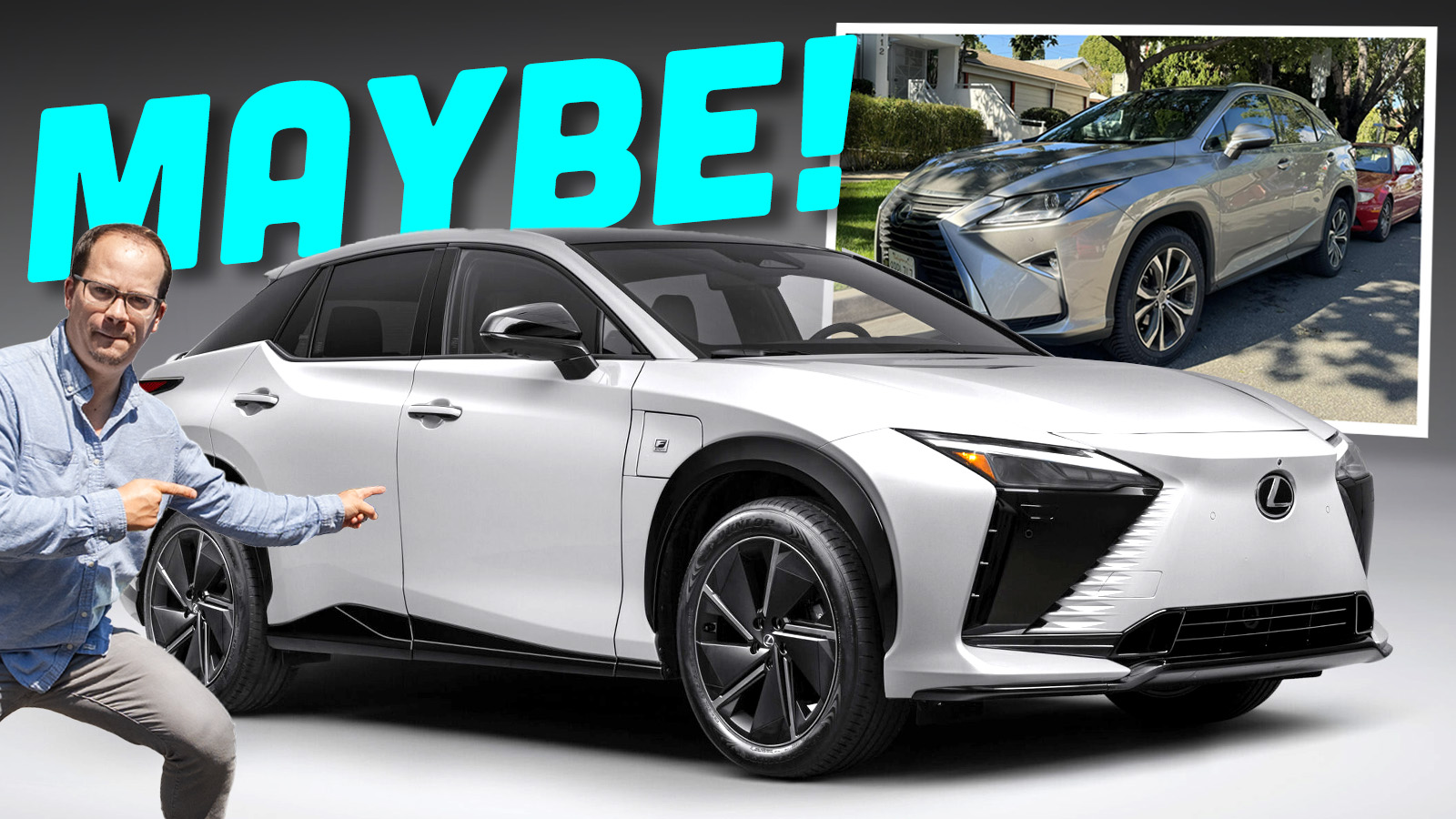
Gas prices are high, and that has lots of folks making knee-jerk car decisions. I’m an enginerd, so I don’t do “knee jerk” (unless I find a holy grail, of course); I’m the kind of person who likes to run the numbers. So let’s dig into whether my wife (and I; we’re a unit, you see) should trade in her excellent 2017 Lexus RX350 for a vehicle that most car reviewers don’t like — a Lexus RZ450E.
The last-gen Lexus RX is a car that, I have to admit, I used to find a bit boring. But then, as part of a “One Car Challenge” in which my city paid my wife and me to drive only a single vehicle for a month, I started driving the Lexus, and I began to realize that a vehicle that fulfills its intended function this well is worthy of respect.


Here’s what I wrote after I drove my wife’s car for a few weeks:
The leather seats are comfortable and feel durable — they’re heated, cooled, and power-adjustable with memory function. They’re excellent seats in an excellent cabin in a car that floats quietly like a magic carpet…
It’s an excellent car, and Lexus should be commended for building something that perfectly aligns with what [my wife] and so many other consumers are looking for: The ultimate no-bullshit luxury SUV. That’s what the Lexus RX350 is. You buy it, you’re comfortable, you’re confident, you’re safe, you rarely have to worry about significant mechanical issues, the dealership will give you a great service experience (my girlfriend actually enjoys going to the Lexus dealer, which says a lot about what Lexus is doing right), and the car just demonstrates its competence every time you’re behind the wheel. It fades into the background, and lets you live a life where cars are not at the forefront.
I wrote that review two years ago, and to this day I maintain that her car is excellent. The only major issue we have had are the front brake rotors, which are hideously warped after being changed only two years ago. But that’s not the car’s fault, that’s the fault of whoever did the repair. [Checks notes; oh crap, that was me using Advance Auto Parts components!].

Anyway, we find ourselves deciding whether or not we want to trade in this magnificent machine, not because gas prices are high, but because my wife, Elise (not her real name), likes the idea of going electric after driving around my i3, and she would like something newer.
In The Eyes Of Many, The Lexus RX Is The Hero, The RZ Is The Zero
If you read reviews of the fourth-gen Lexus RX, you’ll see a lot of journalists singing the car’s praises, just as I did. But if you read reviews of the Lexus RZ — Lexus’ first electric vehicle — you’ll see the opposite. People deride it. And the reason, primarily, is the range, which sits below 200 miles for the RZ450E on 20″ wheels. In the winter, 150 might even be a stretch.
This may have you a bit confused. David, why would Elise ever think about trading a universally beloved SUV for a universally loathed one that, by the way, is actually a bit smaller?
Well, hear me out.
An EV Might Be The Cheapest Way To Upgrade To A Newer Car

Rather than fearing the Lexus RZ’s range limitations, I think my wife and I can actually take advantage of them. Specifically, I think we can leverage the RZ’s dramatic drop in resale value — something that seems rather common for modern EVs sold in the U.S. — in our favor, especially considering our lifestyle that works well with even a mediocre-range EV.

Check out the two depreciation curves above from Car Edge. The first is that of an RZ, the second is that of an RX350. Despite being nine years old, Elise’s $50,000, nine year-old Lexus’ value is somehow not that far off the value of a $60,000, three-year old Lexus RZ — largely because the RX’s curve not only lacks that initial steep drop, but also features a shallower slope over the span of 10 years.
She’s been offered over $20,000 for her car, while Lexus RZs are trading all day for between $27,000 and $30,000:

Being able to trade a 2017 gas SUV for a certified pre-owned 2023 electric SUV (with a six-year, unlimited-mile warranty) from the same brand without having to pay even $10,000 is pretty remarkable. And yes, the RX is a bit bigger inside, but it’s not that much bigger.
Still, $10 grand is nothing to scoff at, and it’s worth analyzing whether it’s worth it. The goal with the RZ is twofold: 1. My wife wants a new car. Some of that has to do with her car’s lack of modern infotainment (it has only basic Bluetooth capabilities with no CarPlay or Android Auto), and some of that may have to do with the car just feeling old for aesthetic or other reasons. To be honest, I’m not entirely sure I fully understand the desire for a newer car if that desire isn’t based on specific features, but I also buy a new junker every few years, so who am I to judge? The second reason we’re considering the RZ is that we have a Level 2 charger at home, and she’s a stay-at-home mom with no commute, so we’d like to avoid having to spend money on gas and maintenance.
So let’s just dig into those two reasons and see if the RZ makes sense.
The RZ: A Huge Step Up In Modernity For Shockingly Little Money
Viewed through the eyes of a Lexus fan for whom range isn’t a huge concern, the RZ seems like an amazing proposition. Here’s a look at the Lexus RX’s cabin:

And here’s the RZ’s:
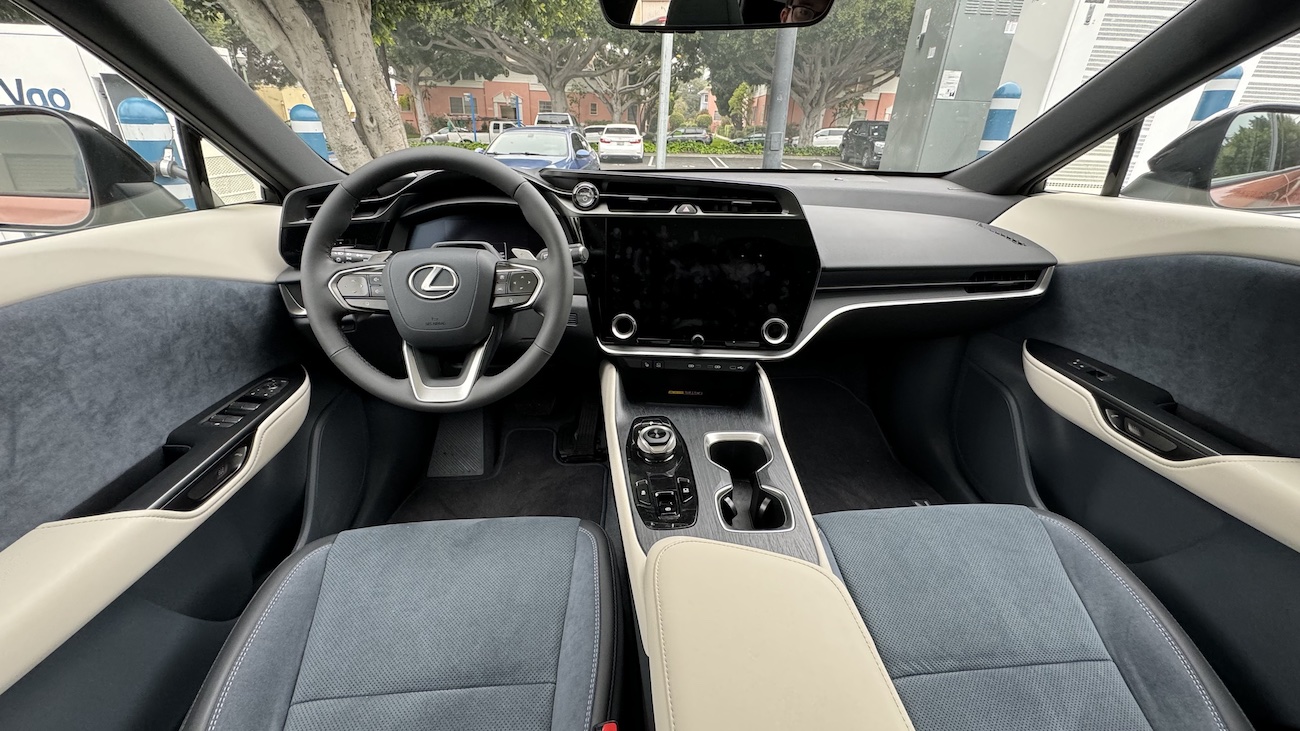
The RX’s cabin was developed for the 2016 model year, and I have to hand it to Lexus — it still looks nice, and its standard “PRNDL” shifter works well while offering no discernible disadvantage over the RZ’s rather large dial+button shifter. As for features, the RX has Adaptive Cruise Control, Heated and Cooled Seats, Lane Departure Alert, a nice 12.3-inch color display, but a fairly primitive infotainment system that allows for Bluetooth connectivity to a phone, and a super basic backup camera. Here’s a look at the vehicle’s infotainment screen:

Meanwhile, the Lexus RZ features a lot more active safety features that annoy the everliving bejesus out of both my wife and me (constantly beeping and booping all over the place), but crucially, it has a great 360-degree camera and a 14-inch infotainment screen that comes equipped with Apple CarPlay.
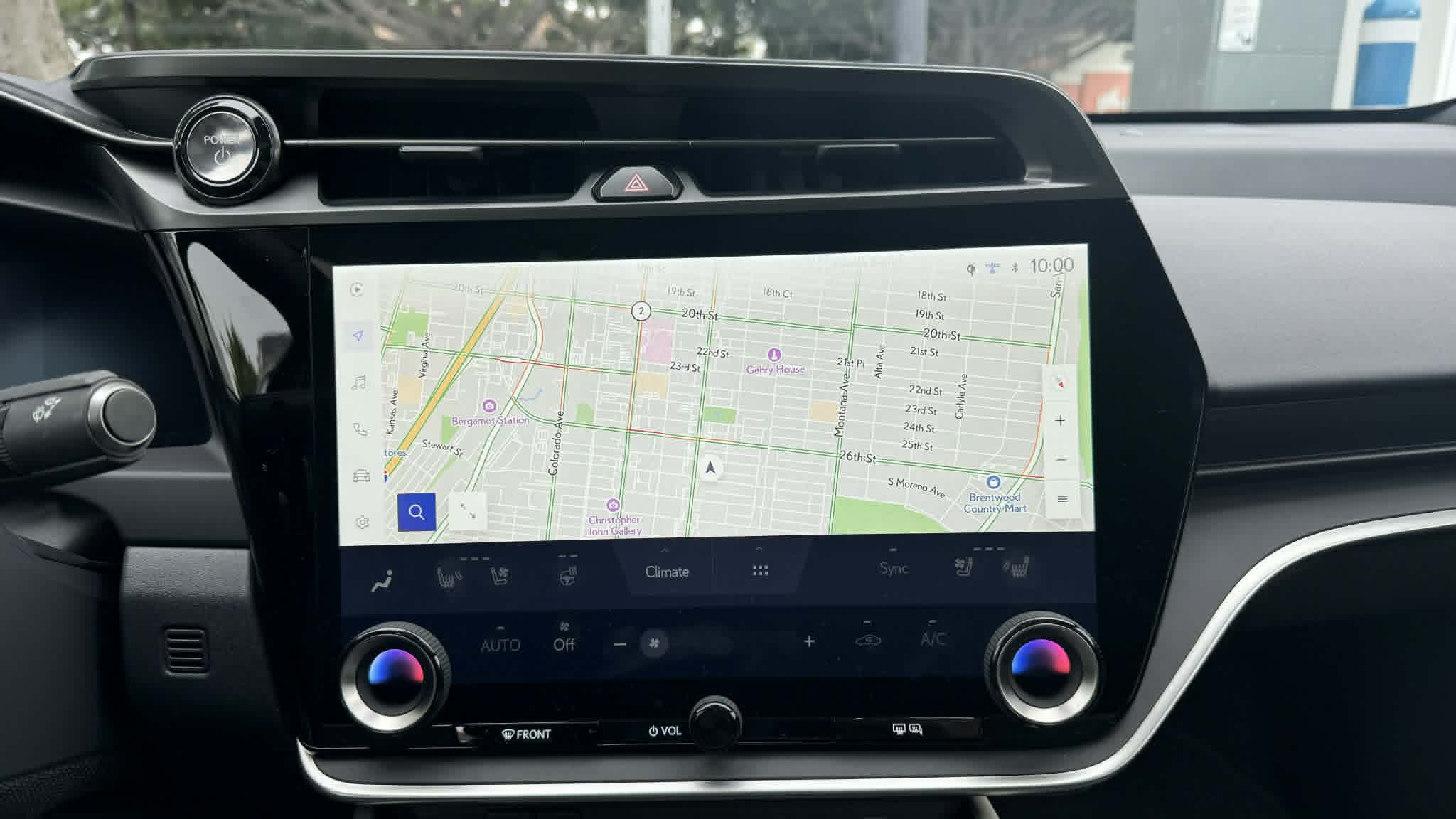
Now, this might lead you to say: “Well, why not just get the RX detailed and upgrade the infotainment system?” That’s a good point, and after talking with our resident infotainment nerd, Thomas, I learned that there is a kit that would upgrade the RX to have Apple Carplay:

$600 to bring a nine-year-old car into modernity? Seems like a good deal, because powertrain-wise, the Lexus’s V6 and eight-speed automatic seem modern enough for a gas, non-hybrid car.
What’s more, this would fix my wife’s biggest complaint with her RX, without adding all the fussiness of the RZ’s infotainment system. From my RZ review:
And in many ways, the RZ feels just like an electric version of her RX. The ride quality is exceptional, the cabin is quiet as a confessional, the seats are cushy, every surface feels high-quality, front visibility is great, the seating position is high enough, acceleration is decent — it hits all the high spots a traditional Lexus driver would want. But sadly, I think the infotainment system falls short.
Notice how there are only a few physical buttons — two climate control temperature dials, a volume dial, a couple of defrost buttons, a park assist button, and a camera button. For conservative, well-heeled (and usually older) Lexus buyers, this just seems like a misstep. Which 30 year old is buying this Lexus RZ whose technology is years behind the likes of Lucid, Tesla, Hyundai, and others? Nobody. This car is being purchased by people who drive Toyotas and other Lexuses; they want the vehicle to be luxurious, reliable, and simple to use. Maybe I’m wrong and Lexus has customer clinic data that disagrees with me, but it seems to me that the last thing a Lexus owner want is to have to deal with all the controls being on a touchscreen, a shifter that require a how-to video, and a bunch of beeping and booping electronic nannies.
What About The RZ’s Running-Cost Savings?

Now let’s talk about the money side of things. To trade Elise’s $20,000 RX for, say, a typical 2023 RZ, would cost us $9000. But is it worth it? Ignoring all the emotions of it all, will we recoup these $9000 in savings somehow?
Let’s assume Elise drives 8,000 miles a year, which is a bit lower than average, but makes sense for the suburban lifestyle we’re living here outside of LA. Her RX, realistically, gets about 20 MPG around town, and with fuel at $5.50 a gallon and climbing, that means we’re spending $2,200 a year on fuel.
Meanwhile, energy prices sit around 25c per kWh, and the RZ can easily manage 3 miles per kWh. Again, assuming 8,000 miles per year, that’s 2666.67 kWh, which cost $666.67, for a savings of $1,533 annually in fuel costs.
Add maintenance to the gas car, factor in increased tire wear for the RZ (on 18-inch wheels), and factor in the RZ’s higher insurance costs and registration costs, and we’re probably saving about $1000 a year at least. If we own the car for nine years like we have her RX, then yeah, we basically make up the cost of buying the RZ, and all the while my wife enjoys a new car that has integrated CarPlay, a nice overhead 360-degree camera, drives incredibly smoothly, and is theoretically helping the environment a bit.
Of course, then there’s the resale side of the equation, and that’s where the business case for the RZ falls flat. It may save us money in terms of operating costs, but if in nine years Elise wants another car, that RZ is likely to be a fairly weak trade-in. In fact, I’d venture to say that, by 2035, her 18-year-old 2017 Lexus RX350 will likely be worth more than the 12-year-old RZ. How much more? I’m not sure. The longer we keep the RZ, the less that matters, because both vehicles will eventually be worth so little that the delta will be negligible. But my point is: Buying the RZ to save money may sound smart with high gas prices right now, but in reality, the numbers aren’t going to work out.
Still, Elise could significantly upgrade her daily driver to something she’ll probably enjoy driving more each day, and it’s basically going to be a negligible expense in the end, if any. And that alone has me convinced this is probably the right move, as I suspected it would be when the two of us went on a romantic birthday drive to wine country a few years ago. From that review:
In a year or two, I bet these will dip into the $20,000 range. And Elise’s 2017 RX only has 42,000 miles on it; she should be able to trade that thing in for $20 grand at least:
All in, she’d pay probably less than $10,000 to upgrade from a 2017 to a 2023, she’d save money on running costs, and she’d finally have Apple Carplay and other modern tech. As someone who has a place to plug in at home, and who regularly commutes only a few miles a day, she just doesn’t need a gas car. The Lexus will be perfect for her; she became a fan after our Solvang trip (she didn’t find the bings and boops and nannies too bad), and assuming she enjoys driving it (I drove the whole trip) and the car keeps depreciating, why the heck not?
We’ll have to make sure the RZ’s size works for her, but the range shouldn’t be a concern, and I have no doubt she’ll be delighted driving electric all day, as I myself find it to be a lot more relaxing than commuting in an ICE car.
So we’re probably going to pull the trigger, though maybe we should do so soon, because if fuel prices keep rising, maybe RZs will actually appreciate a bit.


Two things you won’t get with the new car: Rear wiper, and opening sunroof. Just in case those are secret bummers you haven’t thought of. I have a different ev and took advantage of the used depreciation and boy, do I love it. Best of luck in your decision.
I’m sure you could er “request one” for a week from Lexus to have her drive around…
Honestly I feel like that RX should be worth more than 20 grand if anything…good luck with the decisions! And make sure to get a quote from Carvana. They often (not always of course) offer pretty good trade-in/purchase prices.
If it were me, I’d do the CarPlay upgrade, redo the brakes again with good parts, and drive that RX into the ground. Keep up the maintenance, and it could last long enough to be your kid’s first car. EVs just feel disposable to me, and I’m not sure if that’s a rational thought, but they feel like mobile phones with wheels. Like you’re not supposed to keep them forever. A gas engine, especially one from Toyota, feels more future-proof to me. (unless, of course, the gas runs out…)
But then, I’m wise enough to know that ultimately it’s not your decision. If she wants a new car, you’re getting a new car.
It’s the longevity of the electronics that worries me the most. As some one in the Semiconductor Industry, we see Chips and SW, as will as communication standards changing over time. Will everything still be available in 10 years?
I bought one used EV, and eventually traded it in after trying to sell it and also shopping dealerships for trade offers. Used EVs that are more then a few years old have a steep depreciation curve depending on the market and location (and model). I think the used values are artificially inflated just like corporate stock prices. All hot air. Your current Lexus will always retain decent value while the EV version will plummet like a stone. I also have no faith in EV battery packs lasting that long. Many dealerships only recommended leasing EVs. They are now just another disposable electric gadget.
As illustrated in the article, they are already taking the depreciation into account.
I fell like you’re making an apple to oranges comparison here. Leasing new VS buying used are to very different value propositions, especially when the transaction cost is $9,000. Even at the cheapest end of the lease new model, of $500/month that’s $18,000, which is double the price.
I NEVER do what any dealership recommends, their best interests are in selling me a vehicle at any cost, my best interest is in not buying a new vehicle.
My main point is that I don’t think the Lexus EV will follow that curve that was listed. I think the market will not bear it when they have battery packs out of warranty and are a few winters away from being bricked. Ours had a new replacement battery (done under warranty) and nobody wanted to buy it. I don’t belive the hype that dealers recommend either, but if I absolutely needed another EV, I’d probably do my first ever lease.
Yeah, you absolutely have a point there that I missed yesterday, remember how hard it was for DT to sell his i3 that also had a brand new battery? (I’m saying this mostly to myself)
Those depreciation curves look like tea leaves in a cup in this uncertain world. Our warrantied battery was a $14,000 line item. We traded it in for $7000. Also, the second battery did not have the same 10yr warranty like the first. It was only ONE year. Let me tell you, when you start your fully charged EV and the range says 25 miles…not a great feeling. Needless to say we don’t own another one.
Thanks for the perspective, I keep eyeing used EVs, and this isn’t really discussed often.
One of my character flaws is thinking I’m clever enough to get around things like this, but I think I need to be brutally honest with myself on this one.
If you are just going by the numbers…
Remember it could be cheaper to swap your wife for a lady that already drives an EV.
Just know that your SO has choosing power as well. Even though cars may be your thing.
I used the same kind of math to swap our 2009 Prius to a 2021 eNiro a few years ago. Back when I saw some big expenses on the horizon for the Prius.
Both the missus and the kids still complain they miss the Prius. Mostly because it was so easy to sleep in while being driven.
Guess what. Sleepability was not in my spreadsheet.
Ironically, my GX 550 is in the shop right now and I’m in an RZ 550e F Sport loaner car. I’ve also owned a 2016 RX!
Alas, the RZ is far superior. 99% of RX drivers only drive over 100 miles maybe two days a year. My local Lexus dealer will also let you borrow a hybrid whenever you want if you buy an RZ from them even though Lexus stopped that perk after added 20 miles of range to the 2026 (you used to get 30 days of loaners during your first 36 months).
The RZ is actually a great to drive car. It’s not the quickest EV, but it is actually pretty fast. The range is completely fine 99% of the time. It’s dramatically more engaging than the last gen RX, which feels like you’re driving a magic carpet and steering with two pairs of mittens on at the same time.
I get about 13 mpg in my GX 550 with 35s on it. It’s nice seeing an over 90% reduction in fuel costs these last few days.
We’re actually doing something very similar to this (but going with an Ioniq5). By my math we should save $150 a month with a small 4 year note of under $300 and between $350-$400 once it’s paid off. It will replace my wife’s 2019 Accord full time and we’ll move my 4Runner to just roadtrips, when I take my daughter to/from daycare, and my one day a week office day. The Ioniq5 will also be used for roadtrips in some capacity.
I’m sure numerous people will point out that this is a dumb financial move and that the Accord has at least 10 years of trouble free life in it. From a financial perspective it certainly isn’t the smartest but we liked the way it drives better than the Accord and liked the idea of more predicable operating costs (electric rates are regulated in my state and can’t just increase randomly).
Cars are an emotional thing, get what you like and enjoy it. Life is more than just spreadsheeting expenses and costs. As long as you’re appropriately saving for retirement and for your kiddos financial future there is nothing wrong with spending money on yourself within reason. What you’re proposing seems logical to me DT (but I’d suggest looking at some other EVs).
It’s interesting that despite the middling specs, missing incentives and general doom & gloom surrounding electric cars, these Toyota / Subaru / Lexus EVs all seem to be finding buyers.
There is definitely a significant subset of the car-buying public who just want a ‘Toyota crossover SUV’ etc. and the details don’t matter. They aren’t cross shopping Fords or Hyundais. When it came to EVs, it was never really about range, infrastructure, features, they just want an appliance from their favourite brand.
While Toyota didn’t come out swinging with EVs, they were early to the hybrid game, and as such have a significant and loyal base of thrift & eco-conscious customers. I guess it shouldn’t be a surprise that a lot of would-be EV buyers are Toyota people. It makes sense that they were simply waiting for a viable Toyota product to make the jump.
Ironically, I think Honda has the same customer relationship and could be doing the same thing if they had properly committed to EVs instead of wasting time selling GM’s products.
This is what happens when you get married. Beware!
The smarter move in the short term is swap out the head unit for one with car play and android auto and replace the warped rotors with OEM or better parts and wait for the RZ to depreciate even more or for a better Lexus EV to replace it at that price point and hold onto the $9k for the future.
However if the misses really loves the RZ now and it’s not impossible to swing them so what makes her happy.
This is my thought as well- even better EVs are right around the corner, and the RX is hardly falling apart- Other than David wasting money on cheap brake parts.
That said, if your daily drive is like 3 miles, maybe having the best possible EV doesn’t really matter.
You don’t even need to swap the headunit. The upgrade that Thomas suggested is most likely a GROM audio module that plugs into the back of the existing equipment. It’s seamless and all your steering wheel controls continue to work.
Regardless of what physically needs to be modified the crux of the message still stands as a recommendation to keep the car she loves and invest in fixing the brakes properly as well as adding the missing tech and ride it a bit longer. Low mileage and low anticipated usage with the ability to lean on the i3 for local commuting while the price of fuel is elevated doesn’t seem like the right time to spend $9000 or so on a first year and first gen RZ over the RX.
Yes, I was underscoring your point…
I have actually installed GROMs in three different Lexuses. They work great.
Can someone explain why RX has always had so tiny trunk? I mean it was designed for american market, surely car this large should have larger trunk than Golf? It really bums be, as this would be great family car, except for the useless trunk :/. Also why he hell doesn’ toyota/Lexus make wagon Camry/ES? Would sell like hotcakes here in Europe. With current lineup they only have NX that sells a bit, othervise not so much. Most of the premium cars (especially here in nordics) are sold as wagons, not sedans.
There’s always the resale value argument and pretty much all current EVs even the nice ones will be essentially worthless in a few years. If y’all do pull that trigger I suggest planning on driving it till the wheels fall off
They are already counting on that diminished resale value as they are buying used, and as the article points out the math is based on 10 years of ownership. IT even points out that the math doesn’t equal a resounding “white hot deal” as David is inclined to opt for, but he notes that ENHRN wants the newer features/vehicle after ten years of owning her current one; and that worth a lot more than a few thousand dollars.
It’s not like the car is rusting. Upgrade the RX to have CarPlay. It’s in good shape and doesn’t need much. Put the $9k towards young Delmar’s education, or save for when you NEED a car.
Or, sell the RX privately for a lot closer to the price of the RZ.
I know ultimately it isn’t your decision. Just presenting options.
Wait how did you warp the rotors?
Because he used cheap parts.
https://www.theautopian.com/my-fiancee-taking-her-car-to-the-lexus-dealership-for-service-is-killing-me/
Lol, it sounds like Elise needs to keep taking her new RZ to the Lexus dealer and keep David’s greasy hands off it.
We recently had our F150 brakes done at an independent automotive shop. When I asked for OEM parts, they gave me a big song and dance about their budget brand being ‘just as good’- But when we got 100,000km out of the factory set, why would we go with anything else?
Interesting, why would a independent mechanic care about using OEM parts? It’s not their money. Makes me think they might have been playing games with the numbers on their parts or worse, using used parts and passing them off as new.
The closest I can think of is what we time customers to ward off bring-your-own part: we can’t warranty the work when you show up with whatever you think should fit, and it doesn’t or fails or wears out or whatever.
They probably also had their margins built on the parts they knew they could get for cheap.
But, of course, these are both conjecture and strike me closer to excuses than reasons.
Thankfully I don’t think it’s that deep. His argument was that his usual parts (from a well-regarded national parts chain) were great, cost like 1/2 and had a lifetime warranty. Fair points, if you care about a warranty on wear parts.
His incentive to use the 3rd party stuff was same-day delivery, (He had to wait a few days to get the Ford stuff shipped to the dealer) and I’m going to assume a better margin based on his relationship with the parts supplier. I’m sure offering a ‘warranty’ on the parts helps to build repeat customers.
He also operates in a small town in a relatively low income area. He does work on nice cars, but I’m sure he’s used to dealing with a lot of cheapskates in a regular basis.
We work in construction, and I’ve noticed a some of our local trades have a hard time getting their head around the idea that our clients are okay to spend extra money for fancier stuff even if it isn’t strictly the most pragmatic choice.
If they use OE parts, they have to double their price which suddenly makes going to the dealer more appealing all other things being equal. There are many tiers of non-OE parts (some being OEM) which are both cheaper and also identical quality.
This cuts both ways. Auto makers rarely produce their own brake parts so you can absolutely get identical quality (OE vs OEM) for cheaper. However, you can also get worst quality (Non-OE/OEM) for cheaper and that I suspect is what or man David did.
For whatever it’s worth, you can also just get your OE rotors tossed on a brake lathe and have them refaced by a local mechanic and get quite a bit more life out of them. Usually several refacings even!
It kind of sounds like you don’t really need to replace this car at all?
I know cars are emotional things, we’re on the Autopian for god’s sake, but it kind of sounds like she doesn’t care as long as it’s a different new shiny. Otherwise any rational basis for changing it out is pretty flimsy, at least as presented here.
Wait 20k for her RX?! Im pretty sure my sure my wife would fly out to buy that RX at the drop of a hat. She loves her ‘14 and only wants to upgrade to get a bit more tech like a backup camera.
“ Add maintenance to the gas car, factor in increased tire wear for the RZ (on 18-inch wheels), and factor in the RZ’s higher insurance costs and registration costs, and we’re probably saving about $1000 a year at least.”
This doesn’t add up to me.
I’m trying to consider this from a place of practicality, but you’re all over the place with your use-case scenario; at first I’m reading this:
“The second reason we’re considering the RZ is that we have a Level 2 charger at home, and she’s a stay-at-home mom with no commute”
So I’m like, why care about what the infotainment system is like, if you’re not in the car for any appreciable amount of time. Then I get hit with this:
“As someone who has a place to plug in at home, and who regularly commutes only a few miles a day”
So which is it? If she isn’t in the car every day, that’s one thing, but if she is, it’s another.
Side note; that infotainment system in the non-electric Lexus is the same as in a Mazda.
Possibly the rustiest idea you have ever had David. Low mile RX350 is a holy grail. It’s one of the exemplars of vehicles that serve families for two generations or more of reliable dependable service and then STILL live on.
Carplay integration is available aftermarket upgrade on your RX350. Do I think it’s important? Nope. For you and your wife’s happiness it’s the holy grail of upgrades.
I say do the CarPlay upgrade and hold out for longer.
I don’t get the feeling you will have the car for 9 years before needing or wanting to change it out for another vehicle, which further screws with the math. I guess RZs could be at the bottom of their depreciation curve, but as you said, the RX depreciation will probably remain pretty slow especially with low mileage accumulation. Lexus is also about to unveil a larger 3-row EV which obviously won’t be depreciating on the same level for some time, but could further depress RZ values (but could play in your favor more).
Even if you do continue with the plan for an RZ, there shouldn’t be scarcity of these if you wait. The screengrab of used RZs were all 2023 models. Lexus moved 5386 units in 2023, but nearly 10k in 2024 and 6400 in 2025. There will be more coming.
And if that time shows an RZ maybe isn’t the best move, RX & TX have PHEV options that will likely pop into the used market in a couple years (granted these are more complex powertrains overall). Plus the regular hybrids too.
“The only major issue we have had are the front brake rotors, which are hideously warped after being changed only two years ago. But that’s not the car’s fault, that’s the fault of whoever did the repair. [Checks notes; oh crap, that was me using Advance Auto Parts components!].”
How does any modern factory screw up something so basic as cast iron parts, especially in such a critical application as a brake rotor?
Secret revenge from the supplier and iron mine for all the tariffs. Using inferior and contaminated blends for the mold in the first place.
Reminds me of the 70’s.
They aren’t complex, but…David bought the cheapies. Getting premium rotors or popping for the Toyotexus parts probably would have saved him money in the long run.
I used to get warped rotors too, until I learned that lesson. I also change rotors when I change brake pads. This philosophy hasn’t let me down yet.
That’s only if the rotors are actually the problem. A pulsing brake pedal can also be the result of brake material deposits on the rotor or a bad install:
“Brake pedal shudder and steering wheel vibration are among the most dreaded sensations for drivers—usually pinned on “warped” brake rotors. But for most modern cars, actual bent metal is rare. Instead, the culprit is often uneven brake pad residue, heat stress, or poor installation habits. This in-depth guide lays out the real causes of rotor surface problems, how to identify and address them, and pro-level strategies to keep your brakes responsive and safe for the long run.”
https://www.icartea.com/en/news/the-truth-about-brake-rotor-warping-what-really-causes-vibrations-how-to-prevent-them-and-when-to-repair-or-replace
I expect its not a bad install since its DT were talking about but if he went with cheap rotors he probably went cheap on the pads too. That’s worth looking into.
Spending $9K on a car you don’t love sounds foolish. Other than dealer experience, why go for such a mediocre option?
Volvo and Rivian have good EV crossovers, you already have a BMW and apparently don’t mind their, er, styling, and they have some EVs. The Mach-E is well regarded, though the rear doors got sacrificed at the altar of design so are a bit short, but maybe that doesn’t matter for car seats as much? Similar story with the I-Pace.
I know waiting for the Scout probably seems a bit quixotic at this point, but you do already have a deposit on it.
A. What matters is that Elise loves it. This isn’t David’s car.
B. None of the vehicles you listed are a Lexus.
Correct on both points. Right now my wife is feeling the call of middle-aged Asian women to drive a luxury SUV (it’s a thing, not even she can explain it) and is looking to replace her perfectly fine 2020 RAV4. I’ve been gently nudging her toward how much value there is in lightly used Luxury EV’s, plus she has about a 50-mile round trip daily commute so the fuel savings would be fairly significant.
I’m more of a maintain and repair it until it’s beyond hope kind of person as reflected by my first gen Tacoma and 2011 XB daily, but this isn’t going to be my car and isn’t really my call. The best I can do is my best to keep her from making a truly tragic decision (for example a cheap Audi).
I’m quite aware none of them are Lexus models, but she also doesn’t seem to love the car. She likes the dealer experience, which isn’t necessarily exclusive to Lexus. There are other options, and even waiting for Lexus to debut some more and newer models might be advantageous as the current RX isn’t necessarily due for replacement.
There are plenty of people here on the west coast that will only buy a Toyota or Lexus. I’m getting vibes that Elise is one of those people.
Because OMG IT HAS CARPLAY AND I CAN’T LIVE WITHOUT THAT!!! lol
People get so moist over Carplay and I’m like, what about the rest of the car?
I think there’s a really useful hypothesis in here:
Conjecture: If the thing you care about most in a car is CarPlay, you don’t care about cars.
Corollary: if want to change your car to get CarPlay, change your head unit.
I see this all the time at my work. You’d think the owners earn some sort of merit badge or BS social currency by having it, when what I mostly see is that it causes more issues than it solves.
Customer complaints that I’ve witnessed about Android Auto are probably one to a thousand acp complaints. It’s usually mostly the phone or the user, not the vehicle/infotainment system.
Rivian doesn’t currently have a crossover. The R1S is BOF. The closest thing would be the R3 but that’s not out yet. The R2 is unibody but it’s very much a full SUV. Rivian’s are also not cheap with used R1S’ still at around $70k.
The R1S/T – like most EVs – is built on a unibody platform that incorporates the battery pack. It’s not “body on frame” in the same sense that, say, a Lexus GX, LX, Toyota Tacoma, Tundra, Sequoia, 4Runner, Ford Ranger, F-150, Bronco, Crown Victoria, etc. are. Same with the R2 and R3.
I use “crossover” in the sense that Rivian are not as rugged and BOF like a typical truck-based SUV – nor are they meant to be, even as capable as they are – but I wouldn’t call them a car, either. Yes, crossover is typically a car-based tall hatchback/wagon, but it’s also a catch-all term that I believe is slightly more accurate than “SUV” in this case.
Nope, that’s incorrect. The R1T/R1S is a body on frame construction just like all this vehicles you listed.
Here’s a video showing the frame construction:
https://youtu.be/hGYY1bC5Ncs?si=sNm3hkKhR75Gkv3_
Dave, I don’t believe your California electric bill is less than my Mass one. And my mass one is well over 30 cents per. Please give us real numbers.
edit: I checked, you gave 10 cents less per as your math. You are basing this all off false information and its sad.
Not sure about CA, but our NC electric coop has overnight rates of 6 cents per kwh for EV owners, along with a variable peak rate depending on the season. So long as I charge after 10 pm, I get a super low cost charge. This was a primary driver for having two EVs.
That is 100% a place to own an EV. I think there are places where it makes sense for homeowners with lower rates like you describe, or a fully covered bill by solar. Those rates are a dream in New England! Our “super low” rate from sourcing our power is at like .14, but with state fees and taxes we are over .30 in reality.
What’s sad? It’s approximately 25c/kwH
Well now I am sad because A) Google lied to me B) We are getting the short end out here and C) I was just wrong.
SCE’s cheapest off-peak EV rate is $0.26/kWh. LADWP is a little cheaper at $0.23/kWh.
What’s the equivalent in $/gallon? Multiply by 8 for a quick estimate. This means SCE’s rate is about $2.08/gallon, much cheaper than the $6.18 (per AAA.com) at the local gas station on average in the LA basin (we’ve all seen the $8/gallon places there too).
As mentioned about, buying a car is as much emotional as it is rational, but the $ savings by switching to an EV – especially since David can charge at home – is not trivial in California (and other places across the U.S.).
appreciate the deep dive.
For a European, the notion of a stay-at-home mother with no cummute racking up 13,000 km of driving per year is absolutely mind-boggling.
A Belgian friend was amazed that the 45 minutes drive to see relatives in the next Ohio county would put him in the next country.
There’s lots to see and do in the U.S., and vehicle travel is very easy.
With a toddler?
Sure! Just strap them on the fender like a harvested deer.
(Joking)
Our toddlers can do 3 hours before a little break is needed. So can all their cousins. It’s pretty normal.
Yeah, unlike Europe where there is absolutely nothing to see… and your only option for getting from place to place is walking….
Or to rephrase that, there is so much exiting stuff to see that you don’t have drive insane distances, or at all, to see it.
There’s lots to see all over the world, which is a wonderful thing. People should travel and see more of it.
However the U.S. – having its established infrastructure that’s only been around for perhaps decades and at most centuries compared to Eurasia and Africa – it is a bit more vehicle-friendly, and there’s generally not areas where you’re “too far” from the infrastructure or a functional fuel station among the interstate highway system. There’s no passport required to travel from one side of the continent to the other while remaining in the U.S., no checkpoints, and the laws and currencies – financial and social – are generally the same (with minor variations, but nothing as great as changing what side of the road to drive on, for example) from state to state.
So while your knee-jerk defense of Europe is amusing, it’s not particularly relevant.
You just described the EU.
EU is *checks notes* not a continent. It covers much of Europe, yes, but it’s not all-encompassing.
One could also say that Europe itself isn’t really a separate geological continent, as it’s part of the Eurasian landmass.
The US *checks notes* is also not a continent.
But it spans the width of one (not even including Hawai’i and Alaska, though including them further reinforces the point), and a good chunk of the height as well.
You are right. The USA is the ONLY country IN THE WHOLE WORLD that spans an entire continent width-wise (ignoring Canada and Mexico) with lots to see and do where vehicle travel is very easy and anyone who suggests otherwise is an irrelevant knee-jerk European apologist.
You’re putting a lot more emotion and concern into a geography discussion on a car site than it really merits. Maybe dial it back a few.
It’s also more than acceptable to recognize that your initial sardonic reply was poorly-intended and spiteful, and not conducive to good conversation. Your continued use of sarcasm further reinforces the hollow stance you’re championing for some inexplicable reason.
I know; I worked from home for 5 years, and apart from hitting the gym, visiting my mom, and going to a bar on Fridays, I maybe put 4 or 5k on in a year. I did do a few road trips to Toronto and DC, but for the most part, 5K was a lot for me to do in a year.
And that’s someone living in an American city (though a pretty darn car centric one).
I have a coworker who lives in a rather rural area. His wife… well I guess we wouldn’t use the term stay-at-home because she’s more or less the family’s personal Uber, puts 25k a year on their van. While he puts 25k-30k a year on their truck. My wife and I have pretty substantial commutes, but those numbers are pretty crazy for you know, one job.