


America’s market of Class 8 semi-tractors used to be very different. In decades past, it wasn’t just icons like Peterbilt, Mack, International, Freightliner, and Kenworth, but automakers jockeyed for market domination. Ford was once a big player in the semi truck market, and to try to keep pace with trucking innovation, Ford built its most aerodynamic semi in its history. The Ford AeroMax L9000 looked like the future and beat the efficiency of Ford’s previous rigs by 23 percent, but so few buyers cared that Ford didn’t just kill the AeroMax, but its entire heavy truck program entirely.
America’s truck fleet used to be far more diverse, with brands like GMC, Chevrolet, Chrysler, Ford, White, Diamond T, Reo, FWD, and more all roaming the highway. Listing out all of the truck manufacturers that didn’t make it to the modern day would probably add up to the length of a feature article.


A few of those makers, namely the Detroit Big Three, are still around today. Yet, none of them make big rigs like they used to. The 1987 GMC Brigadier and the GMC General were the last semis to be produced solely by General Motors’ heavy truck division. Volvo, which had control of White, would merge with GM’s truck division, creating White-GMC, which built trucks into the 1990s. Dodge left the big truck market earlier in the mid-1970s after bowing out with the Big Horn.

Ford soldiered on longer than its Detroit colleagues, building semis well into the aerodynamics era of big rig design. This new era was a challenge to truck builders who were used to designing very square rigs. The multiple fuel crises of the 1970s forced the trucking industry to adapt. Truckers couldn’t change the fact that the price of diesel had skyrocketed, so the only way to win the battle with the diesel pump was to visit it less often. A fuel economy average of 5-6 mpg became untenable, but truck designers found a way. If trucks cut through the air better, they’d get better fuel economy, and thus cost less to run than before.
While there had been aerodynamic semi-truck designs deeper in trucking’s past, like the Paymaster and NASA’s aero experiments, the 1984 Kenworth T600 often gets the credit for being the first mass-produced semi that was built from the ground up for improved aerodynamics. The T600, as well as NASA’s findings, are often credited as laying the groundwork for today’s slippery semi-tractors.
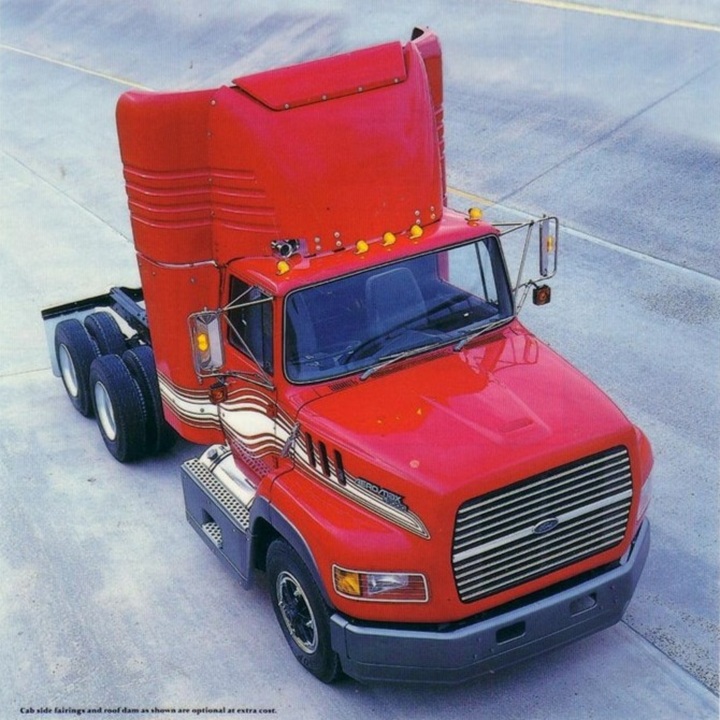
While many truck manufacturers responded quickly to the new aero era, Ford fell behind the curve. It didn’t launch its first true aero semi, the AeroMax, until 1988. Ford’s truck promised big gains — around 1.7 mpg, or 23 percent — but instead of dominating the truck market, buyers looked elsewhere. Ford would fail so hard that it pulled out of the big truck market and hasn’t returned since.
Ford Gets Serious About Big Trucks
While Ford has had commercial trucks since 1917, it didn’t develop dedicated heavy trucks until the 1950s. Ford says that when it decided to separate its heavy commercial trucks from the F-Series line, they would become a part of the C-Series commercial truck unit. It would go on to produce C-, H-, L-, N-, T-, and W-Series models.

As Curbside Classic notes, telling the full history of Ford commercial trucks would be difficult, as the Blue Oval had so many lines in production at the same time. From Curbside Classic:
Over the next two decades, Ford introduced several series of heavy-duty trucks. There’s no easy way to describe this truck ancestry, since Ford produced many of these series concurrently. The 1957 C-series cabovers brought a dedicated heavy-truck cab design, though these were produced alongside conventional F-series heavy trucks. In the 1960s, the H-series debuted, as did the N conventionals, and then the W-series replaced the H. By the late 1960s, Ford was a major player in North America’s heavy truck market, accounting for about a quarter of total production. However, its biggest play was yet to come.
Ford began planning for a new line of heavy trucks in 1963, due to forecasts of strong growth in this segment. The truck took a long time to bring to market, since the line was intended to include everything from urban delivery trucks to extra-heavy-duty long-haul tractors. In a rare move for any vehicle manufacturer, Ford developed both a new product line and a new factory simultaneously. At this point, we can take a brief detour and talk about Ford’s site selection process. As with all major corporate decisions, this involved several competing priorities, and many people involved in the process. Among those people was John Van Vactor. A Kentucky native, Van Vactor left school as a teen in the 1930s to work on a Ford assembly line. Throughout the 1940s and 1950s he rose through the ranks as foreman and production manager at various plants, eventually becoming the manager of Ford’s Fern Valley Road plant in Louisville, which produced both cars and trucks. Van Vactor, who described himself as “virtually self-educated” was unusual among Ford management, who were largely products of elite schools.

He also had a different approach to site selection than did most executives. Van Vactor pointed out that from a human capital perspective, the new truck plant should be in Louisville, where his existing employees had considerable experience building trucks. Explaining that truck manufacturing had many unique attributes, and shouldn’t be thought of as simply car production on a larger scale, he was key in persuading Ford upper management to locate their new truck plant in Louisville. Management was impressed enough with Van Vactor that they appointed him the new plant’s first manager. And what a job that was. At 2.7 million square feet, the Kentucky Truck Plant was the world’s largest truck factory when it opened in August 1969.
The bones of the AeroMax come from the Ford L-Series, which was also known as the Louisville Line, a nod to the Louisville factory.
The Louisville

The Louisville Line was an incredible step forward for Ford. This was a dedicated commercial truck line built in its own special plant. Launched in 1970, Ford was rather proud of its Louisville trucks in its advertising, praising the rig’s deep-dip, electrocoat prime painted-frame, cross-flow radiator, fiberglass hood, quick-release dashboard, easier servicing, and more.
Ford claimed that, with all of these innovations and more, the Louisville Line was the most extensive product change in semi-tractor history. Ford also claimed no other truck maker in history has implemented so many ideas to make their rigs work better and be more comfortable.
This marketing blitz worked. Ford had 4,900 orders for L-Series trucks before they even went into production. The L-Series had a mind-boggling number of variations. At launch, the Louisville Line had 22 different models with 650 variations. L-Series trucks covered everything from local delivery straight trucks to over-the-road semis. The biggest and baddest L-Series trucks weighed up to 80,000 pounds when hauling a trailer.

If you lived in America in the 1970s, there’s a very good chance you’ve seen the face of an L-Series attached to a box truck, a cement mixer, a flatbed truck, a dump truck, or, yep, a semi-tractor. While Ford’s nomenclature for the L-Series seemed a bit random, every letter and number combination had a meaning.
All L-Series trucks had an “L” for their starting letter, which meant “Louisville”. From there, you had models like the L, the LS, the LN, the LT, and the LTL. An LS had a setback front axle, while the LN had a short hood. Tossing a “T” at the end of a combination meant that it had a tandem rear axle. After the letters, a Louisville Line truck then had either three or four digits. Three-digit trucks, like an LN-700, had gas engines. Four-digit trucks, like the LN-7000, had diesel engines.
Engines were wide and varying, too, ranging from Ford gasoline V8s to an array of V8 and straight-six diesels from Caterpillar, Detroit Diesel, and Cummins.
Ford Loses Ground

At first, things were great for the L-Series line. Truckers were scooping them up, and Ford didn’t even feel the need to update the rigs in any meaningful way for the first few years. Ford even expanded the line with the extra-large long-haul LTL-9000 in 1976.
Ford held a 15 percent share of the big truck market when the Louisville Line launched, making it one of America’s most popular truck makers. The decade would bring headwinds to the entire industry with a weaker economy, fuel shortages, and fuel price hikes.
The trucking industry continued to struggle in the 1980s. The Motor Carrier Act of 1980 (MCA), signed by President Jimmy Carter, deregulated the government’s price controls on shipping rates. The idea was that, without the government getting in the way, trucking companies would compete with each other, eventually lowering the cost of transportation.

The Act technically worked as designed. Between 1977 and 1982, truckload shipment rates fell by 25 percent. The trucking industry itself was sent into turmoil. As the New York Times wrote, 72 trucking companies closed between 1978 and 1983. By 1986, the Washington Post wrote, some 4,000 companies and operators were out of business. Yet, despite the shocking loss of thousands of companies, the trucking industry actually doubled in size due to the lack of market entry controls. As trucking became aggressively cutthroat, the wages of drivers suffered as companies tried anything they could to get an edge.
Class 8 truck sales also took a battering, with sales falling by 25 percent through the first half of the 1980s. Trucking companies held onto their existing rigs for longer, squeezing every little drop they could get out of their existing fleets. The standardization of tractor-trailer lengths in 1982 also paved the way for the conventional semi to finally beat the cabover for supremacy.
In building the T600, Kenworth didn’t just make a revolutionary aerodynamic semi-truck, but it gave trucking companies an exciting reason to buy new again.
Going Aerodynamic

The events of the 1980s would put Ford in a difficult place. Truck sales were down, yet Ford’s competition was still holding the line by coming out with fresh designs. Ford’s lineup began to look stale in the face of the era’s new aero trucks. By 1987, Curbside Classic writes, Ford’s heavy truck market share had fallen to 10 percent, and some speculated that Ford might exit the market.
But Ford didn’t give up. Instead, in 1988, it came out with its own aero truck, the AeroMax L9000.

The AeroMax was an extensive overhaul of the L-9000. In Ford’s marketing, it said that, in the past, 50 percent of the power required to get your rig down the road was wasted on air drag. The AeroMax had the same cab as an LS-9000, but that was one of the few external similarities between a regular L-Series and the AeroMax.
To help the AeroMax cut through the air, Ford made dramatic changes to the truck’s nose. Perhaps the most prominent change was the headlights, which were now integrated into the hood and curved with the front fenders. The front bumper was now an air dam designed to direct air around the truck. Even the fender flares were designed to route air over the wheel wells rather than let too much air into them, causing drag.

Other aero measures included rounded mirrors, aero coverings for the fuel tanks, and a smooth fairing above the cab. Ford also added Michelin 11R22.5(G) tubeless low-rolling resistance radial tires to further aid in the mission of increasing efficiency.
The AeroMax wasn’t just about aero. Ford identified some remaining pain points in the trucking industry. Namely, drivers complained about poor visibility out of their cabs. The AeroMax did have the same cab as the existing L-Series trucks, but a sloped-down hood for aerodynamics and a little more visibility. Ford also moved the fuel tanks forward in an effort to transfer more weight to the front axle so that a trucker can better optimize axle loading.

Ford was confident about the AeroMax. It was supposed to help bring production back to the Louisville plant, which was running at half of its capacity at the time. According to Curbside Classic, Ford said: “We plan to be among the leaders in the heavy truck field.”
Ford had some evidence to think so, too. The company contracted an independent agency to run an SAE Fuel Economy Test against a typical Ford LNT-9000 versus what Ford thought most customers would choose for their AeroMax trucks. The AeroMax had a Cummins L-10 10.0-liter straight-six diesel with 300 HP, a Fuller BT-11609A nine-speed manual, a Rockwell SQ-100 SQ-100 with a 3.55 ratio rear axle, and the aforementioned Michelin tires.

The LNT-9000 had a Cummins Big Cam III 14.0-liter straight-six with 300 HP, a Fuller RTF-11609 nine-speed manual, a Rockwell SQ-100 SQ-10 with a 3.9 ratio, and the same tires as the AeroMax.
In the test, the LNT-9000 was loaded down to 80,000 pounds while the AeroMax was loaded to 63,000 pounds. It’s unclear why the AeroMax had a lighter load. Both trucks drove 55 mph for the test. In testing, the AeroMax scored an average of 8.27 mpg while the old square truck scored 6.58 mpg. The 1.7 mpg gain was about a 23 percent difference between the two trucks.

Unfortunately, Ford’s optimism didn’t translate to success in the trucking market. Ford was able to stabilize its 10 percent market share, but found itself unable to gain ground against market leaders International, Paccar (Peterbilt and Kenworth), Mack, and Freightliner.
It’s unclear why truckers didn’t latch onto the AeroMax, but it could have been because Ford’s effort came four years late and didn’t bring anything new to the table. Kenworth was advertising 9 mpg with the T600 four years earlier. When you read Ford’s brochures for the AeroMax, the wording is very careful. It talks about how the AeroMax is the most efficient Ford Class 8 ever built. Even in the fuel economy comparison tests, Ford only compares the AeroMax against other Fords.
Ford Tries Again

Yet, once again, Ford wasn’t ready to throw in the towel. In 1996, Ford launched its first clean sheet truck design in 25 years and the first to be designed specifically for long-haul truckers.
Automotive News wrote about Ford’s big plan:
What’s the highest compliment someone could pay Ford Motor Co. about its new Louisville heavy-duty work truck? That it’s more powerful? More rugged? Comes in nice colors? Try that it is much more comfortable for the driver. At a press preview for the Class 7 and 8 trucks, which will eventually replace the 25-year-old L series design, Ford executives stressed that the Louisville was designed from the inside out. Why? Because driver comfort is key to trucking companies keeping drivers, said John Ochs, a Ford spokesman.
Gang of 67:
So Ford assembled a group of 67 commercial fleet truck owners, not all of them owners of Ford trucks, to serve as a sounding board for the designers and engineers developing the Louisville. In addition, Ford brought in more than 5,000 truck drivers to evaluate designs, sit in interior styling bucks and place gauges and controls to their liking. The Louisville’s cab is four inches longer than the current L series. Seat travel was increased to 7.5 inches for individual seats, 9.5 inches for bench seats. The steering wheel is smaller and the steering column is closer to the windshield. The dashboard has a smoother, wraparound look to it with gauges and switches similar to those in Ford cars and light-duty trucks. In fact, the heating and ventilation control unit was lifted from the F-series pickup. The doors are about 20 percent larger than the L series, to make entry and exit easier. The windows are larger and dip down at the front edge to give the driver a better view of the road. Engineers used a Pontiac Fiero as a target vehicle in working to expand visibility in the Louisville. Because drivers usually customize their trucks with additional lights, citizens band radios and sound systems, designers added receptacles on the dashboard and spare power connections at fuse boxes. Initially, the cab will be built of galvanized steel. But in the future, Ford will offer aluminum cabs.
Stronger and Lighter:
The cab was designed using the resources Ford brings to bear on its cars and light trucks, making it lighter, stronger and quieter. Ford claims the cab will be the quietest in the Class 7 and 8 markets. The Louisville carries virtually the same engine and transmission lineup as the L series, and even the side rail design is carried over. But the user-friendly approach extends under the Louisville’s hood. The hoses, clamps, wiring, fuses and bulbs used are all of standard design and lengths, making it easy to find replacement parts at truck stops and auto parts stores. Wiring harnesses are bundled and routed on top of the frame rails to protect them from road splash, yet are strong enough for a technician to stand on without damage.

Ford had a lot riding on the line here, and it didn’t want to miss. Making an aero truck alone wasn’t good enough. It also had to be lightweight. A different Automotive News piece details that the AeroMax had 450 pounds of plastic composite covering the hood, fenders, grille, cowl panels, roof, chassis fairings, doors, and wind deflector. Reportedly, by weight, the AeroMax had more than twice as much plastic as the average Class 8 truck, and several times as much plastic as the average passenger car of the 1990s.
Yes, the second-generation AeroMax really did have composite doors, albeit with steel reinforcement.

Building a light truck wasn’t good enough, either, as the new AeroMax had to fit modern drivers. Ford admitted that, in previous trucks, it had relied on military statistics on the size of the average male to design its cab interiors. Those statistics were 50 years old by the 1990s. Ford found that male truck drivers had become bigger than they were in the 1940s. Meanwhile, an increasing number of female drivers were joining trucking, and they were often shorter and lighter than male drivers in the 1990s. To compensate for both, the AeroMax was given big seats with a lot of adjustment travel, a dash that’s close and easy to read, and easy-to-climb exterior steps.
According to Automotive News, the astoundingly roomy cab and the stylish, but easy-to-read dashboard earned Ford the highest customer acceptance rating in the company’s history. Apparently, the dashboard was rated higher than even any car dashboard in Ford’s past.

Another part about the AeroMax was that there wasn’t really a “typical” powertrain. Ford offered buyers a choice of 115 engine tunes, 85 transmission variations, and 63 fuel tanks. Engines came from Caterpillar, Cummins, Detroit Diesel, and Ford, while those fuel tanks ranged from 55 gallons to 150 gallons, each. The flagship engine was a Cummins N14 14-liter straight-six with 500 HP and 1,650 lb-ft of torque on deck. Advertised configurations had Eaton transmissions, Rockwell or Eaton axles, Spicer or Rockwell clutches, and Hendrickson suspension.
Ford Failed, Again

Ford spent $500 million ($1,028,700,934 today) developing the AeroMax and more or less bet its heavy truck unit on the success of the second-generation Louisville and AeroMax semis. While AeroMax buyers seemed to like their rigs, the second-generation trucks suffered from slow sales. In the year following the second-generation Louisville’s and AeroMax’s debut, Ford’s heavy truck market share dipped to 9.7 percent.
One problem was that, by this point, Ford had fallen so far behind that it just couldn’t keep up with the competition. Freightliner held 25 percent of the truck market in 1995, and managed to gain its market share to 29.4 percent in 1996. Ford was struggling to exist at all, and the only other major truck manufacturer doing worse was Volvo GM Heavy Truck Corp., which had only 9.1 percent of the market.
Update: A good point made by a reader was that these trucks had so many parts that weren’t from Ford, which cut into profit after suppliers got their cut. Indeed, Ford repurposed its Louisville plant to build far more profitable SUVs.

By early 1997, only a year after the new AeroMax trucks hit the market, Ford was done. Ford sold its heavy-truck business to Freightliner for only $200 million ($411,480,373 today). Basically, Freightliner got a whole new platform for a discount price. Later that year, Volvo ditched White and GMC, rebranding to Volvo Trucks North America.
Ford kept the Louisville plant in the deal, and to build its new Louisville trucks, Freightliner owner Daimler set up shop in Ontario. The new trucks would lose the Blue Oval and would instead be called Sterlings. Daimler positioned Sterling Trucks as a sort of middle child between Freightliner and Western Star. Sadly, Sterling never really found its footing and would cease operations only a decade later.
So, the AeroMax is one of those sad stories of not just failing once, but twice. It’s a shame because it is a good-looking rig, and people did seem to like their interiors. But the market spoke, and Ford lost.
A Fading Part Of Trucking History
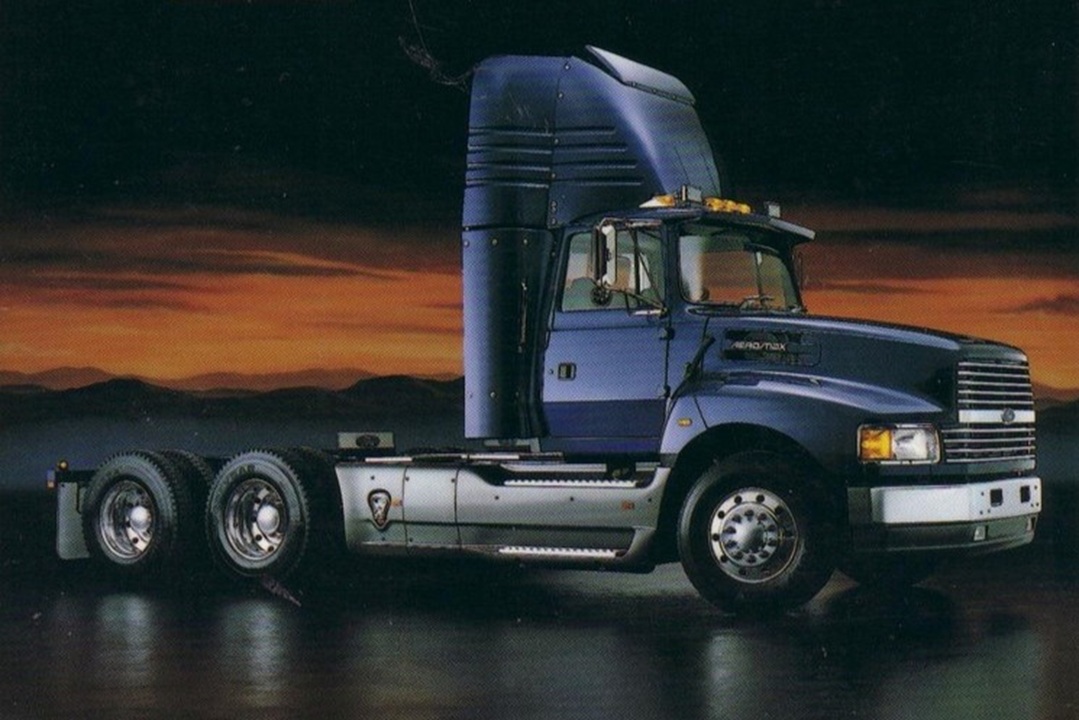
To be fair to Ford, it’s a little unclear if the second-generation AeroMax was going to be a failure in the long term. Ford waited only a year before dumping the rig, and Sterling didn’t really get the kind of marketing power of the likes of Ford or Freightliner. How many people even knew that Sterling existed?
I think the most surprising part of this story is that none of the Big Three has dared enter the heavy-duty market again under their own brand names. Ford basically washed its hands of big trucks and never looked back. Meanwhile, General Motors ditched its locomotive operation, bus operation, and heavy truck units. Sure, each of the Big Three does build medium-duty trucks today, but you will not find a Ford-branded or GMC-branded Class 8 truck on the road now unless you find one of these vintage units. Instead, automakers sometimes invest in truck companies with existing presence, which makes sense in the modern era.
Still, late to the party or not, the Ford AeroMax was such a cool rig. It was a truck built to fit a variety of drivers and could be ordered basically any way an owner wanted it to be. The truck even seemed to get tangible increases in fuel economy. But sometimes even the best efforts by the largest manufacturers end up as a big failure.
All images: Ford


The L-series and Aeromax trucks are still in use today. There are a couple in my family still running strong.
As far re-entering the commercial heavy duty truck market, Ford has more recently made and sold 650 and 750 trucks. They can have up to a GCWR of 50k lbs.
Im curious what kind of miles those trucks have on them today.
When I was in college in the early 2000s, I worked for the city water department for a summer. Their sewer jet/vac truck was a tandem axle Sterling straight truck with little Ford logos on some of the windows. The fact that the Sterling logo was also the same shape as a Ford logo made me assume it was some kind of weird rebadge. Now I know it was much more complicated than that.
The 1970’s Dodge Big Horn with the massive grill and hood, but comparatively small cab (looks like a 1960’s Dodge pickup cab), presaged the future of pickup truck designs compensating for what may be lacking elsewhere. The Big Horn name says it all.
I drove a truck for 3 years in the early ’90s until I came to my senses. I got a brand new AeroMax in ’92 and I really liked it. It wasn’t a rattle trap like the KW I had previously and it turned better and was lighter than the Freightliner I had as well.
The reason the Ford got a lighter load than the competition during the fuel economy test was the same reason the Ford got a 10-liter & a 3.55 axle while the competition got a 15-liter & a 3.90. I’m guessing these didn’t sell because they didn’t deliver in the real world.
The competition was a l9000 ford
You can still find a few remnants of the Semi-truck equipment inside of Kentucky Truck Plant to this day. It’s gone through a few major overhauls since it ended though. The change to Aluminum Body trucks gutted most of that equipment that was left. It is also now Ford’s largest factory under one roof building still building Super Duty, Expedition and Navigator. I used to work there on the SUV side of the shop. Interesting to learn about how the site was chosen, it is about 25ish minutes from Louisville Assembly Plant (Fern Valley), and at the time that area was all farms and it is right off the interstate. The rumor I always heard from the people that started when Commercial Light Truck (Now called Super Duty) was brought down in 1993, was that Henry Ford had an illegitimate family in Louisville, and they pulled the strings to get the 2nd plant in the town.
And building F550’s that can and sometimes do haul more than any Aeromax ever could.
Very enjoyable read but what is the case for it being a failure? The modest loss in market share? Are there sales numbers available? Did Ford state their target market share?
I didn’t even know Ford made big rigs. I’ve seen their big box trucks of this era but never an actual full on rig.
I believe the Ford F-Max cabover is considered a class 8, but they obviously have no plans to sell it in North America
My uncle worked on the L9000 would go from Dearborn to Louisville. He retired during the design phase of the Aeromax. I never got the full story but when he did it was pretty negative about the whole program and too many hands in the pot. Alot of the retired guys he knew were mad the hit their pension from the failed program. They seemed to do well in Australia and new Zealand. As did the later sterling branded units.
I was reading the article thinking that 9-10% market share was reasonable until you mentioned that White-GMC was at 9.1%. Granted, I wasn’t alive back then, but I could probably count the number of times I’ve seen one of those definitely-not-a-Volvos in the wild on one hand. So yeah, maybe not so reasonable.
I read in the truck maker press back then, that Ford’s share of the heavy truck market was all of FIVE percent by the time Ford pulled out. The irony was that 10 or so years later, Sterling’s share was…five percent when Daimler-Benz called it quits on Sterling.
Part of the problem with Ford and Sterling was that the Aeromax wasn’t too popular with trucking fleets. Ford had Consolidated Freightways, Roadway Express, and Central Freight as fleet customers, but they didn’t buy AeroMaxes in big numbers, and all three customers went bankrupt anyway. Owner/Operators tended not to be big Ford customers, compared to PACCAR, Mack, and Navistar.
Umm. When giving us the inflation adjust price, it’s totally OK to just round it to a couple of significant figures. You don’t have to give it to us down to the dollar. LOL
The old L Series were everywhere in my late Gen-X childhood. Doubt I’ve ever seen a Ford badged Aeromax in the wild.
As a kid in the early 90s i used to see these off and on here in hoosier land.
Most of em, even when sterlings ended up beat to shit. But was always working, most were overnight express trucks.
Sterling was one of the companies I applied for a job for as a late ’90s Mechanical Engineering grad.
Nice.
Bummer they disappeared off the earth basically
I always thought these were great looking trucks, and had no idea they were considered a failure.
A friend’s farm bought a first-gen Aeromax for hauling duty (both crops and cattle). They apparently got a smoking deal on it new from Ford, and to be fair it was pretty nice compared to the old 70s GMC they had before it. Ford may have been behind the curve in releasing it, but if all the jealous truckers that came to load crops and milk were anything to go by, it was not a bad truck.
Let’s play pedantic!
The term ‘truck’ has historically referred to the wheeled rolling assembly, usually including brakes and suspension. Think the assembly under a railway car/carriage. The pulling (sometimes pushing) is provided by a locomotive or tractor. So…
…These should be considered tractors. The trucks would be under the trailers.
Sorry. I don’t get out to meet girls much these days.
While we are at it, has anybody seen any updates on the Tesla ‘tractor’? Have they tried to fire one into space yet?
Indeed, they are technically a kind of tractor!
They’re also commonly called a truck and a few other variations, even by trucking publications. I use a mix of all of them so that you don’t end up read “semi-tractor” 88 times. Ha. So I’ve been told by a mentor editor years ago, that kind of repetition gets annoying for an average reader. 🙂
Wouldn’t the proper term, when warranted, be semi-tractor-trailer?
Ford sold both truck and tractor versions of their Class 8s.
Technically and legally speaking, they are road tractors, and typically as part of a tractor-semitrailer combination. ‘Semi-trailer’ differentiates from trailer because a trailer has all its own axles, whereas a ‘semi’ trailer relies on the tractor’s rear axles instead of its own front one! If you have the time, reading up on the history of road tractors is really interesting, and a surprising number of tractors meant both for farm and road duty were made all the way up through the middle of the 20th century!
(The most famous of course being the Minneapolis-Moline UDLX, but that was really intended to be a farm tractor and a car and not a highway tractor, but I digress.) Anyway: https://www.youtube.com/watch?v=YXVvy7jPttQ
TIL the modern tractor and “road tractor” share a common ancestor.
I did big truck aero for my senior thesis project in college, and what I found MOST interesting is that a ton of the drag reduction available is on the TRAILER. This was back in 2009, before you saw ANY aero enhancements of big rigs on the freeway. Today, they are a lot more common but still underutilized.
Adding a tapered fairing to the rear of a trailer can reduce drag by 13% alone, adding skirts to the trailer is also a significant difference.
If you’re interested here are some slides:
Aerovation Slide 1
Aerovation Slide 2
Aerovation Slide 3
Aerovation Slide 4
Aerovation Slide 5
I was going for a quasi inflatable almost kit like rear fairing, could obviously do a way better job styling it but I was working 32 hours a week and going to school full time so I really didn’t care about polishing this project when I could put real products on the shelf instead.
Nice ideas.
Aero in trucks is a big focus today but there are lots of challenges that make it hard to take some big hitters from the lab to the road. Drive wheel fairing are complicated by the need for truckers to do daily DOT checks and also install tire chains. The gap between the cab and trailer is a huge opportunity but needs to accommodate varying distances because the 5th wheel slides for weight balancing.
Anything on the trailer is complicated by the economic reality that many trailers aren’t owned by the same company that owns the tractor pulling it. At our factories there is a steady stream of truckers coming, dropping a trailer in the yard, and then rolling out. Sometimes they take an empty from the yard.
Big fleets that haul the same thing every day do generally own their trailers and you see aero aids there: Walmart, FedEx, etc.
Thanks! It was a fun project.
Fairings seem like an easy solution, use toolless quick release dzus fasteners or the like. Would take less than 1 minute to remove them for inspection. For snow chains, they’d just need to be removed and stored behind the cab, because you’re getting crap MPG in the snow anyway.
The gap between the cab and trailer in this concept was sort of based on spring loaded/rolled up white blinds you see on windows; I was thinking instead of fabric the material could be a polyethylene sheet more like those roll up snow sleds you see sometimes. You could incorporate stiffener ribs on the edges and in the middle to keep from buffeting, but the idea was you’d grab the rear edge, extended it back to the trailer front edge, and latch it on a rearwards facing L-groove. Maybe secure with toolless fasteners.
I’m really interested in aero that changes with speed; the McLaren Longtail uses a composite tail that flexes to change drag/downforce, idk why would couldn’t do something low tech/passive on the front bumper. Mold the lower front lip of the bumper jutting up/forward but but a thin section so as speed/drag increases, it flexes the lip downwards, reducing the drag. Seems like somethign that would be easily achievable; when you slowed down, the lip would raise back up and give you more clearance.
When I did this project, those big uniform fleets you speak of existed, but they had zero aerodynamic aids. I knew it was coming, as Cali was going to require either Aero or LRR tires, but I was just a student with no connections to the industry. Still, was fun to come up with something to solve a problem, and a few years later some of the stuff I came up with is a common sight on the roads today. 🙂
One of the big problems with drive wheel fairings is weight. Every pound added to a truck not only reduces fuel economy but also the amount of freight that can be carried. Anything added also has to durable enough to last 800K to 1 million million miles on our bad roads. Make a fender or fairing durable enough to last and it is heavy. Which means heavy brackets to hold it. That also means it is likely too heavy for the driver to remove and reinstall to do inspections and to chain. All of the above also increases cost, which reduces the chance that a fleet owner will buy that option.
So instead of one piece fairings the industry uses multiple piece fairings that fill the gap between the drive wheel and fairing behind the rear wheel. Even those are a pain to chain with so many fleets don’t run them.
Strapping things to the back of the cab or deck is simply a no go for fleets.
I like your idea of retractable cab fairings. Sliding would not work due to the trailer swing (90 degrees or more) but a roller might work. The key would be making it last for years and hundreds of thousands of miles.
Front air dam height is limited due to road debris. Truckers can’t dodge things in the road nearly as easily as cars they just roll on over it. You might notice a lot of aero trucks today on the road with missing front air dams and side skirts.
I read somewhere that, environmentally speaking, it’s better to focus on the tractor that’s on the road almost all the time rather than the trailer that spends a lot more time parked.
Tractors rarely drive around without trailers, so you read wrong.
That’s not the point. It’s that tractors drive hundreds of thousands of miles a year vs trailers doing a fraction of that.
some quick googling tells me there’s something like 5 million trailers in the US vs 3 million tractors. So, putting aside doubles and what not, 40% of the trailer fleet is parked at any time (or out another way, the average trailer spends 40% of its life parked). That still doesn’t clarify whether the efficiency gains on trailers are enough to overcome the lower utilization (per dollar spent on aero improvements).
Can’t help but thinking about this rad song about big trucks, sung by NC’s own Jonathan Byrd:
https://youtu.be/cdB-tUYlFaM?is=-o6y0gFpsGNuw9nk
I never paid much attention to trucks, but I remember seeing the Sterling logo and wondering what connection there was to Ford as it seemed there was an obvious rebadge.
Sounds like Ford didn’t go far enough when trying to play catch up, and no doubt the fleet managers picked up on the load difference associated with the fuel economy improvements.
I’ve also heard of trucking firms to search far and wide to find a used replacement truck that with specs identical to their existing equipment, just to simplify servicing.
That four years spent falling behind the curve probably meant they needed a world beater to properly rejoin the fray, and the didn’t have it.
Too bad. I remember lots of those Aeromax cabs on dump trucks and spud trucks back in the day, but not too many semis, at least until they got Sterlings logos.
I’m not entirely sure that the hypothesis that Ford got out of the heavy-duty trucking sector as a result of the failure of the second generation Aeromax.
If you look at the Ford Tractor division and the Genesis tractors, Ford spent a pile of money ($30-35 million) to develop the line with the main driving factor to make it enticing for another company to buy the division.
I think that something similar happened with the Aeromax…they wanted to build a class-leading (or class competitive) truck line that they could sell off and get out of the sector altogether.
But that’s just my thoughts…
The Sterling badge was also in the same shape as the Blue Oval, so they could just slap it in the same space.
Also, due to corporate synergies, HD Dodge Rams were also sold with the Sterling badge for a brief period of time…talk about weird.
I’ve always though the Sterling branded Ram 4500’s looked odd. Same with the Dodge and Freightliner Sprinter vans.
esp when they are USPS branded.
Can’t say I’ve ever seen a USPS branded Sprinter.
USPS did buy tens of thousands of the Mercedes Metris.
Well, technically their website says they operate 98 of them but yeah, I got them mixed up. My bad.
All Ford needs to do is update the SuperDuty F450 (which has a max towing capacity of 40,000) to re-enter the market.
Why not the F-750? It is a bargain starting at only $72,000
I didn’t realize the F650/750 still existed!
But you’re right – The GCRW for the straight-frame diesels are 50,000 lbs.
Add a tag-axle on the rear…
With the 2016 model year Ford brought the 650/750 back in house after ending their joint venture with International. They also started exclusively using their own powertrains which is a huge factor for profit margins that can also be used for aggressive pricing.
They have been steadily gaining market share in the Class 6/7 space and last I looked are up to 15%. The interiors are so much nicer than those from traditional commercial truck manufacturers like Freightliner.
The International partnership was dead long before they put the 6.7 Powerstroke in the 650/750. From 08-15 you had Cat or Cummins, then eventually just Cummins as your medium duty diesel option
From 2004 to 2015 the F650 and F750 were made by Blue Diamond Truck Company. A joint venture between Ford and International.
Starting in 2016 Ford didn’t offer any third party engines. If you bought a Ford F-650 it had a Ford engine.
Yep and it made my job a hell of a lot easier because now I had access to service info for the whole truck instead of just the Ford bits.
The worst part of the later Cummins trucks was that the after treatment system was half Ford, half Cummins but I only had access to info on the Ford parts and never had the whole picture on how the system worked.
That sounds horrible. Even worse than dealing with a full Cummins powertrain in another truck.
The problem wasn’t low sales, it was lack of profit and commitment to big trucks by Ford top management. Most of the powertrain of the Louisville trucks came from suppliers and after their price was paid there wasn’t much profit left for Ford. SUV sales were starting to take off and unlike most Ford plants, Louisville’s assembly line could accommodate taller vehicles like the Excursion that were more profitable.
Correct – it’s difficult to make money when so much of your vehicle content is from suppliers. And your assembly operation has UAW labor costs and work rules.
I think this has really shaped the nature of truck building in the US for decades now. The Paccar brands (Kenworth/Peterbilt) really had a hand in it; they grew steadily and helped cement the truck builder as mainly the builder of the frame and cab — Virtually everything else came from outside suppliers. It was the options flexibility, assembly quality and support that generated their business… with a hefty dose of marketing both to dealers to get their place on the lot and drivers/fleet managers to get them asking dealers for the product.
The Big Three automakers’ particular vertical integration model didn’t match up to the rest of truck building industry’s combination of some vertical integration along with a diversified supply chain-based model. One by one all three exited because, especially if they weren’t supplying unique engines that had something more to offer than the “other guys”, they were just another truck assembler. And one that increasingly couldn’t compete on price because of their inherent manufacturing cost structure.
Mack is a notable victim but also survivor of this as well. The brand is still doing well, but Mack also had to change their manufacturing from being at least partly in-house with their own engines and transmissions to sourcing from suppliers like everybody else — and in the process wound up becoming a subsidiary of Volvo which restored a more vertically-integrated manufacturing process.. (In the past, a gold bulldog hood ornament was only applied to a Mack with a Mack-built engine and transmission. Today, it’s applied to ones with Volvo-built/Mack-branded engines and transmissions.) Mack was fortunate to hold on long enough to be merged with Volvo; the European truck makers tend to still be more vertically-integrated.
Freightliner was originally an assembler — they started out as a White spinoff (White-Freightliner) building custom fleet trucks under contract for Consolidated Freightways. Eventually they expanded on the open market and were ultimately spun off as just plain Freightliner, and as the market became increasingly competitive, they were snatched up by Daimler-Benz. Today, they’re really Mercedes-Benz truck division’s North American-specific brand, building trucks with both North American suppliers’ components as well as Mercedes-Benz components and tech.
International is the odd outlier, having gone through multiple incarnations as International Harvester, Navistar International, and now just International. They’ve built some of their own engines through most of it, but now they’re contracting with Scania as well for International-branded engines. They’re kind of still straddling the fence as they always have with in-house parts and outsourced ones.
A lot of the manufacturing cost difficulties may come down to the rather adversarial relationship between the manufacturing corporate offices and the unions in the US. The Big Three automakers entrenched relationships stood in the way of streamlining operations and cutting costs because the corporate side always targeted employee wages first to save money. Meanwhile, the other truck manufacturers which were primarily non-union or had different relationships with smaller union workforces and were able to be more competitive. And the European manufacturers (Volvo, Daimler-Benz) which were vertically-integrated like the Big Three also had a different standing relationship with their European workforces… but also moved into non-union shops in North America to sidestep the potential difficulties.
Before anybody asks “What about DAF?”, they’re sort of special. Their relationship to PACCAR goes the other direction. US-based PACCAR basically runs the PACCAR-DAF consolidation. This let them offer competitive vertically-integrated solutions with “PACCAR” engines which are really DAF designs, as well as entire smaller “Kenworth/Peterbilt”-badged DAF trucks to compete in the urban-delivery small cabover market. It’s the Big Three’s captive import method all over again.
A couple of notes, Freightliner started as an in-house operation and the White Freightliner branding was a distribution deal with White that was ended in 1978, a few,years before both companies were acquired. Ford also had a big presence in Europe but sold the Cargo product line to Iveco in 1987, and makes nothing bigger than the Transit themselves. International’s connection with Scania is a result of their acquisition by Traton, VW’s heavy truck stable of MAN, Scania, and VW Brazil’s medium and heavy truck operation.
All good info. A small detail. Every vehicle manufactured by Daimler Truck North America is union built.
There have been a number of advances for organized labor since the European investors bought up or bought into US truck names. Originally, they tended to move operations to southern states where there was little or no union presence, much in the same way that foreign automakers were tending to build plants in the South for the same reason, and why US automakers began making a concerted effort to build new, non-union facilities in the South.
There’s been a slow trend toward organizing efforts in the South since then, so now we have a less clearly defined union North/non-union South divide in auto and truck manufacturing. And relationships with organized labor are more varied, with some of the European companies having more constructive relationships versus the more adversarial tendencies endemic to the Big Three automakers. But it still varies, and wages are typically overall lower in the southern states even where there’s organized labor — something that the foreign investors recognized and capitalized upon.
Freightliner was early in the unionization process. First North Carolina plant unionized in 1990 and the last in 2004. They are UAW, the relationship is adversarial, and wages as high as the Detroit 3.
Very good point! My original draft of this was 5,000 words, and I might have gotten too lost in the weeds to remember the profit problem. But that makes perfect sense. Why keep selling a low-profit vehicle when you can cash out, retool the plant, and start cranking out SUVs?
Unfortunately this is what happened to the Fiesta, Focus, Fusion, etc and so forth.
Also helps that KTP was already home to Ford’s Commercial Light Truck line which became Super Duty in 1999. It moved there in 1993.
from what I recall, Jacques the knife wanted to use the heavy truck manufacturing capacity for higher profit SUVs at the time (Explorer). so, dump heavy truck division at fire sale prices. wouldve looked better with the mercedes 3 pointed star logo than that silly sterling brand. but the sterling oval fit the blue oval grille, coincidentally. 🙂
“Jacques the knife”
Next time maybe provide a trigger warning for any semi drivers that might be reading here?
Man I love seeing a well written article that covers a myriad of the events and situations instead of just one point beaten to death. The weight difference on the test, the years behind the competition this tells the story with enough information.