

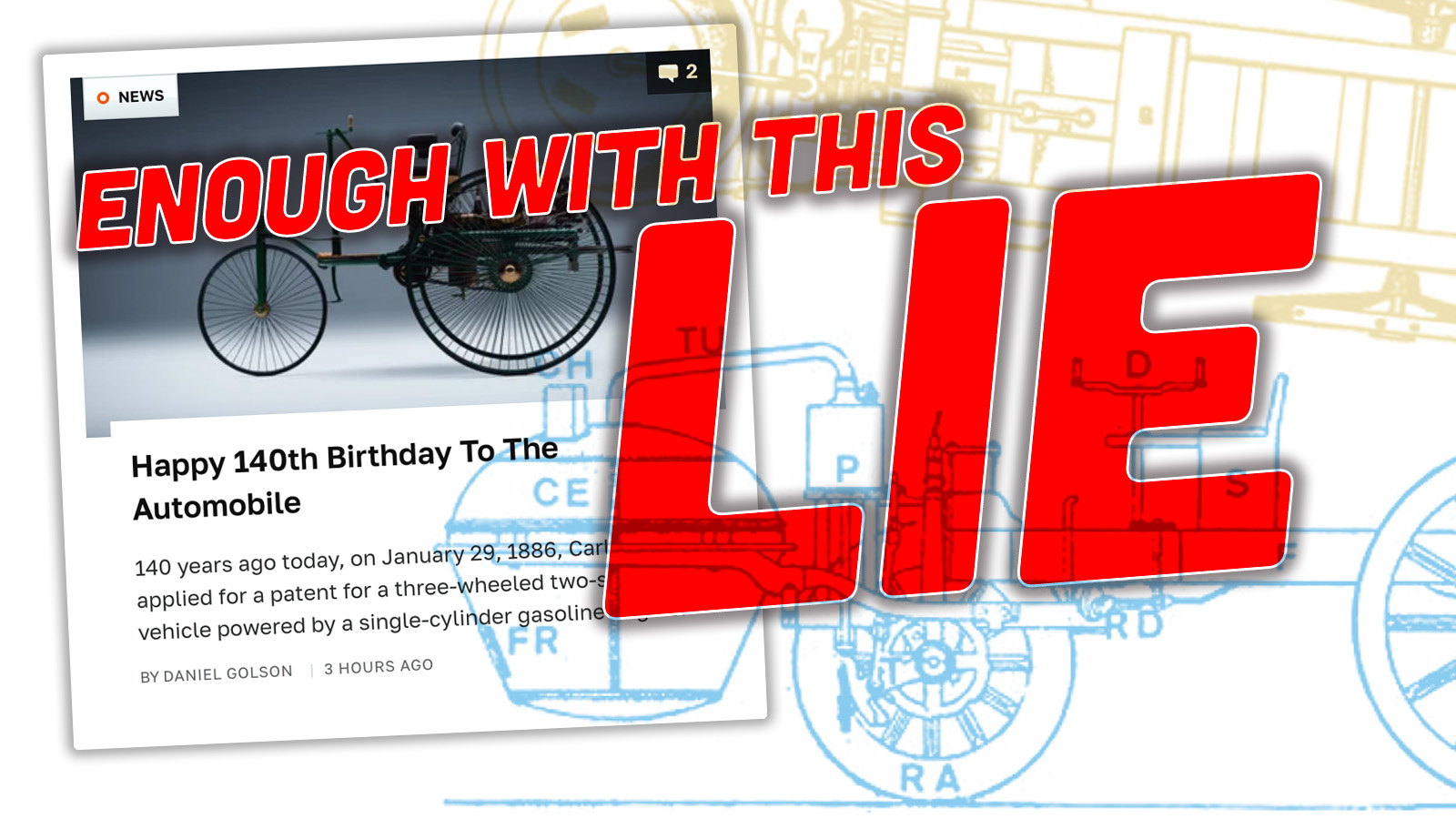
Look, I’m not trying to get into a micturating contest with our pals over at The Old Lighting Site, but there was a story on there repeating Mercedes-Benz’s lie that I simply cannot abide, something that, during my many years at that site, was a lie I repeatedly sought to dispel. The story is called, simply, Happy 140th Birthday To The Automobile, and that headline, and more importantly Mercedes’ claim, is wrong. The claim is wrong by 117 years, wrong about the automobile in question, wrong about the country of origin, and wrong about the person behind that automobile. It’s all wrong, and while our friends at Jalopnik are being fed, just like everyone else, this lie by Mercedes-Benz about the birth of the automobile, they should know better, because while I was there I wrote about how Mercedes-Benz’ claim of inventing the automobile is just plain wrong. Many, many times.
The article is referring to Mercedes-Benz’ claim that the Benz Patent-Motorwagen of 1886 was the “first automobile.” It absolutely was not. This isn’t even a matter of opinion or some pedantic splitting of hairs; if we define an automobile by what it actually is – a wheeled, motorized land vehicle capable of propelling itself – then the Benz machine was beaten to the punch by over a century, because Nicholas-Joseph Cugnot built such a machine – an automobile – way back in 1769. Some say 1770, but still.


[Ed Note: We changed our original headline, “A Car Website You All Know Is Pushing Mercedes-Benz’ Lie That They Invented The Car And I’m Not Having It,” because some of our friends at Jalopnik were upset, even though this was really meant to be a tongue-in-cheek joke about how Jason obsessively wrote about this lie 100000 times while he worked at Jalopnik! Regardless, we’re not here to offend our friends (and in retrospect, we should have just given them a heads up), but rather to call out Mercedes-Benz first and foremost (and anyone who spreads that lie last and lastmost). -DT]
Keep in mind, this wasn’t some hypothetical thought-experiment, only existing as paper and ink: this was a real, running machine, designed to be something to haul artillery for the military. It didn’t work well, and it was involved in the very first car wreck ever because it was so hard to steer:
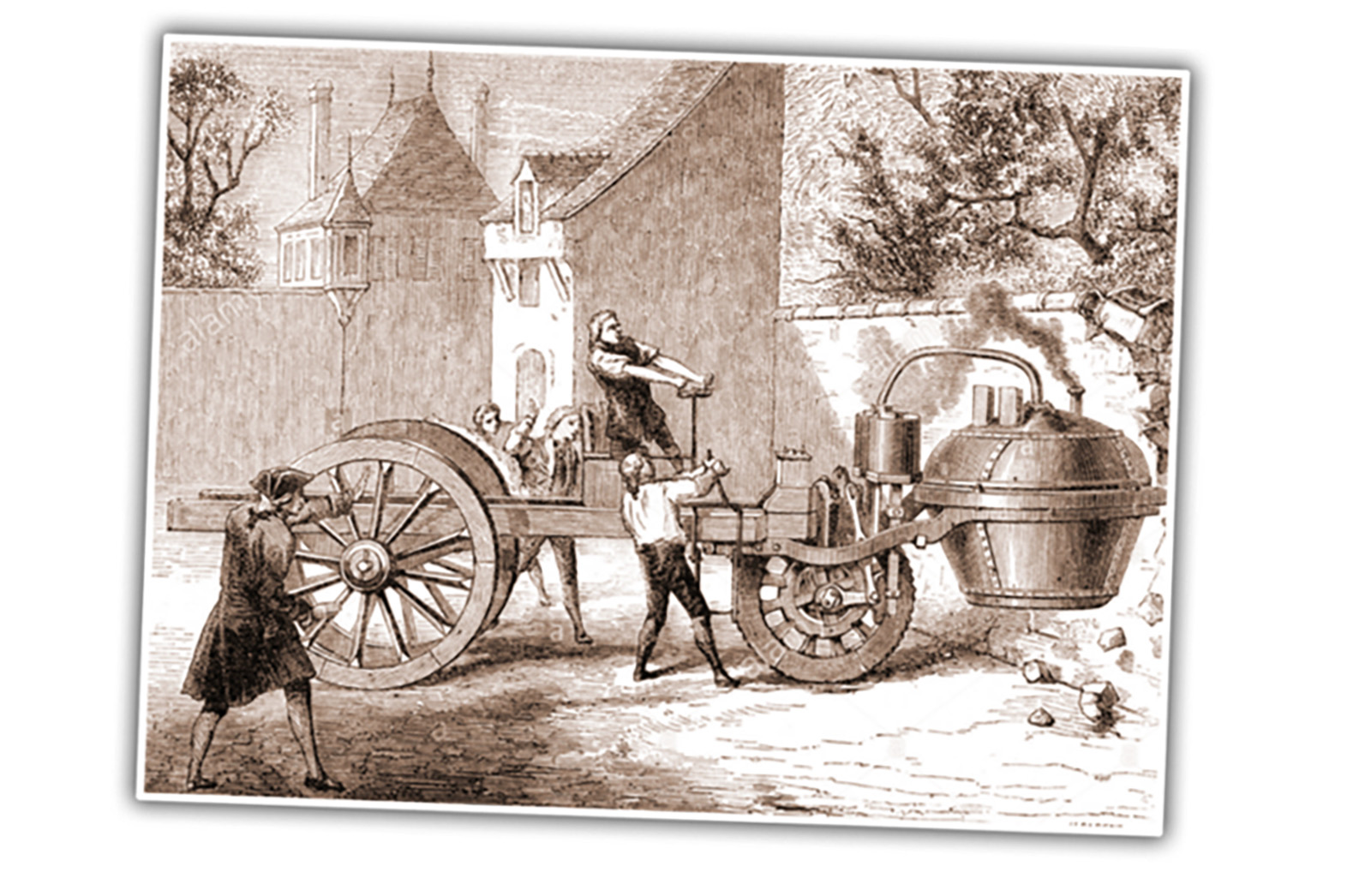
It wasn’t a good car, but it was absolutely a car. And it still exists! You can go see it in Paris, at the Musée des Arts et Métiers, if you’d like. Maybe someone from Mercedes-Benz can go there and carbon date it, if they want.
And look, if somehow Mercedes-Benz wants to be all weasely and try to say this was a machine for hauling, not moving people, then you know what? Fine! It doesn’t matter, because there were plenty of other cars, yes, actual, genuine passenger automobiles, after the Cugnot steam drag.
Take the London Steam Carriage from 1803, for example! This was a steam vehicle specifically built to be a passenger car by Richard Trevithick, and I wrote about it for Jalopnik back in the day, too.

If anyone at Mercedes-Benz would like to explain to me how this motorized, wheeled, trackless, road-going, passenger-carrying vehicle was not a car, I’d love to hear it.
You know what else the London Steam Carriage had? A patent. A patent from 1802. So if Mercedes-Benz wants to qualify the “first car” as the first one with a patent that was then subsequently built and driven, then our pal Rick there beat them to the punch by about eight decades.
The patent part is interesting; Carl Benz seemed to think it important enough to include it in the name of his Patent-Motorcar, but patents for automobiles go back much further than you’d think. James Watt – yes, the guy the watt is named for and an early steam engine pioneer – patented the idea of engine-driven cars sometime after 1784, but the purpose was just to try to keep people from building steam cars, because Watt thought they were a bad idea. He was a patent troll, and I wrote about that for Jalopnik, too.
In America, there was an attempt to patent an automobile in 1790, by someone named Nathaniel Reed.

Read was able to secure patents for steam engines, but Congress found the idea of a self-propelled automobile too absurd and essentially laughed him out of the place. Here’s a National Archives summary of a letter about it that was sent to Thomas Jefferson (emphasis mine):
Nathan Read (1759–1849), a minor New England inventor, presented his petition to Congress for a patent on his inventions on 8 Feb. 1790, some time before TJ received the present letter: these included plans for both a steamboat and steam road carriage. The latter was ridiculed to such an extent that he abandoned it and the former was based on a paddle-wheel arrangement not original with him, in consequence of which he presented a new petition on 1 Jan. 1791 and seven months later was granted letters patent for “a portable multitubular boiler, an improved double-acting steam engine, and a chain wheel method of propelling boats” ().
What’s really bonkers is that Read was given a patent for a steam-propelled ship, another sort of automobile, really. Water travel seemed fine, but road travel was too far? How strange.
And then of course there was the famous American George B. Selden who filed for a patent on an internal combustion car in 1879. Selden was also sort of a patent troll, though, holding back his patent until 1895 when the automotive industry was picking up, so he could get royalties from carmakers.
The point is, if it’s the patent part that Mercedes-Benz is hoping makes their automobile “the first,” then I don’t think that holds water. It may be the first patented internal combustion Otto-cycle car, though, and I think that’s a pretty big deal on its own.
We’re just getting started here, though. There was something of a boom in automobiles in England in the 1820s and 1830s, when enterprising people were building motorized omnibuses and establishing regular bus routes from London to Bath and all sorts of other places. There were many, from people like the aforementioned Trevithick and Goldsworthy Gurney and Walter Hancock, all motorized, driving automobiles, hauling paying customers from one place to another at speeds sometimes approaching 20 mph or so.
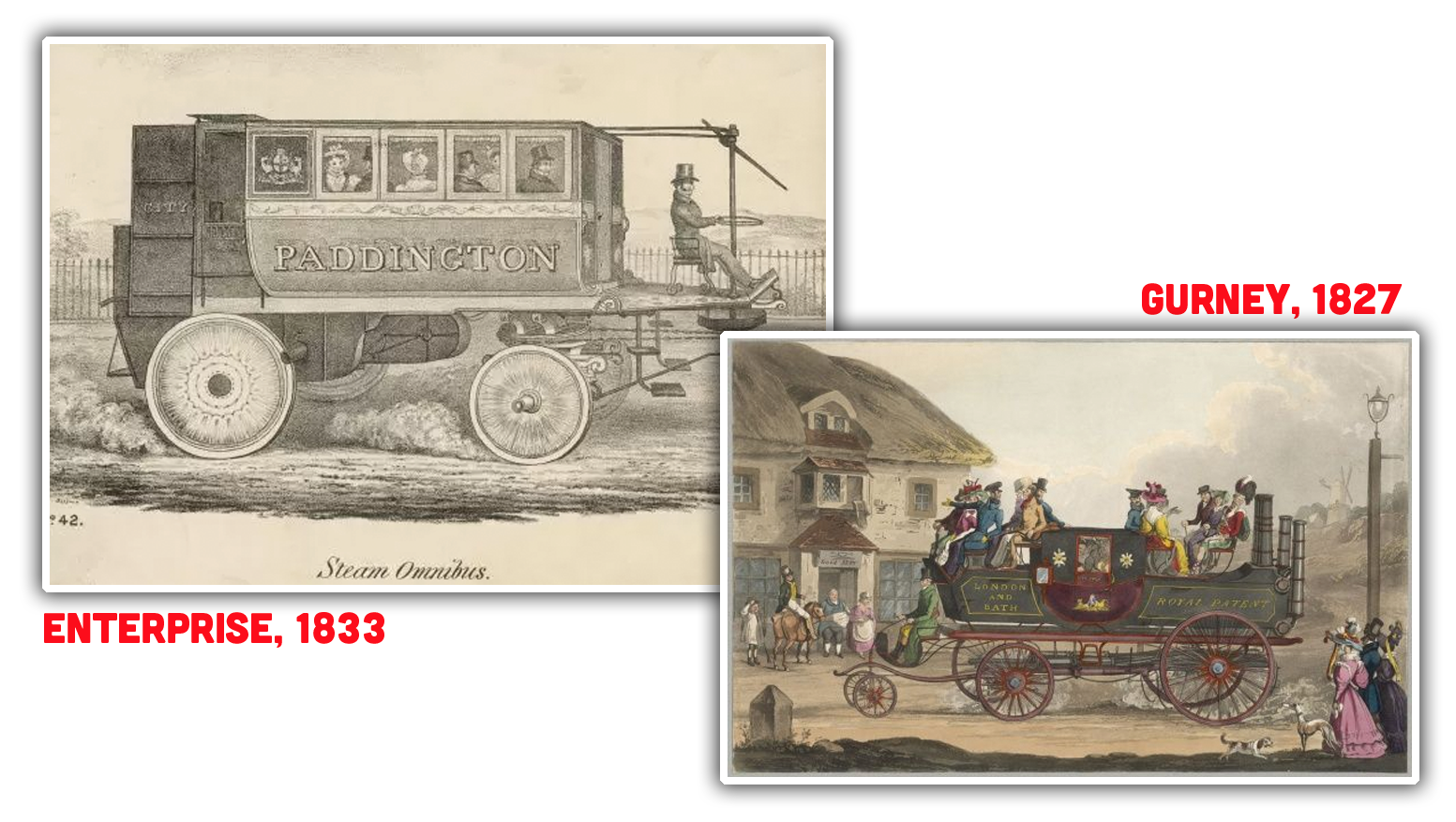
There was such a boom of these automobiles that what I believe to be the very first comic/cartoon to feature cars was drawn and published around this time, in 1831:

As I said when I wrote about this cartoon before – even correcting myself from when I wrote about it for Jalopnik:
“The cartoon is titled A View in Whitechapel Road and was drawn by H.T. Aiken. It shows what is, essentially, a traffic jam, of automobiles, buses and private cars and commercial vehicles, some of which have names like The Infernal Defiance and The Dreadful Vengance, and there’s a hot bread-vending truck that I bet smells great.”
So, if Mercedes-Benz actually invented the automobile in 1886, how is it possible that they were plentiful enough for a freaking cartoon to be drawn about them in 1831? Something doesn’t add up, and it’s Mercedes-Benz’ math. Well, I should be more fair here: math and lies.
Mercedes addresses a mere five predecessors to their car on a page called “Forerunners to the Automobile”, one of which was Cugnot’s steam drag, and the other four were internal combustion cars like theirs, one of which, built by Frenchmen Edouard Delamare-Deboutteville and Léon Malandin in 1883, even used the same type of Otto cycle engine of the Patent-motorwagen.
Why are these called “forerunners of the automobile” and not just “automobiles,” which is what they were? The hell do they mean by “forerunners?” Mercedes tries to justify it in this paragraph:
Carl Benz was the first inventor who not only had the idea of creating an engine-powered vehicle, but also designed, built and tested one. His great achievement lay in the consistency with which he developed his idea of a “horseless carriage” into a product for everyday use, which he then brought to market and as a result made his idea useful for the entire world – unlike the other inventors mentioned here.
This is such a guilty and half-assed explanation. Take that first sentence there, the one that says “Carl Benz was the first inventor who not only had the idea of creating an engine-powered vehicle, but also designed, built and tested one.” That sentence is absolutely false. Plenty of other inventors had the idea of an engine-powered vehicle, designed, built, and tested them. I’ve mentioned a bunch of them already, like Cugnot to Trevithick and Gurney and Hancock. That sentence is an outright lie.
And the second half of that paragraph? What do they mean by the “great achievement” of “consistency?” I don’t know what they’re getting at there? And the idea that the Patent-Motorwagen was “a product for everyday use” is really a stretch. If anything, that level of refinement and usability for the automobile probably didn’t truly come until the Ford Model T in 1908, especially if we count Mercedes-Benz’ phrase “made his idea useful for the entire world.”
Mercedes-Benz even having this “Forerunners of the Automobile” page at all seems like deep down they know their claim doesn’t hold water, and they’re trying to hedge things a bit. It’s not working, though. Again, the Patent-Motorwagen was a huge achievement in the automotive world, no question. It just was not, by any stretch, the “first automobile.”
I’m still not done. Let’s hop back to America, where there was plenty going on. There was Oliver Evan’s deeply strange Oruktor Amphibolos, an amphibious car/dredger thing:

Even if we don’t count that one, there were people trying to start car companies in America as early as 1851:

That never got off the ground, but others actually managed to pull off building workable cars. There was Sylvester Roper building steam-powered cars and motorcycles in the 1860s:

…and Richard Dudgeon, who built his Red Devil passenger car back in 1855:

America also hosted the first automobile race, in Wisconsin in 1878. I wrote about that for Jalopnik, too.
Maybe Mercedes-Benz is going to try to say that none of these count, because they’re mostly steam-powered cars. If that’s the case, I’d ask them what they’d call the EQS 450 or any of the other electric vehicles they sell. Are those not cars because they don’t use gasoline? Of course not. They’re cars, just like a Mercedes-Benz 230SL Pagoda is a car. But even if they wanted to play that stupid game, there were other non-steam-powered cars around.
There was Etienné Lenoir’s Hippomobile of 1863, which I also wrote about for Jalopnik, and that was an internal-combustion car that could run on a fuel like gasoline.

In 1807, Issac de Rivaz built an experimental internal combustion vehicle, and Mercedes-Benz even mentions it on their guilty-feeling page about “forerunners to the automobile,” that I mentioned earlier, all of which are actual automobiles that were developed before the Benz Patent-Motorwagen. On that page, they also mention one of their most interesting predecessors, Siegfried Marcus, who built at least two internal-combustion, gasoline-powered cars, one in 1870 or 1875, and another in 1888.
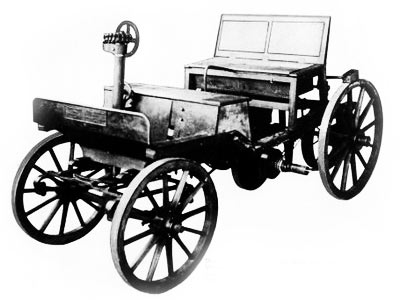
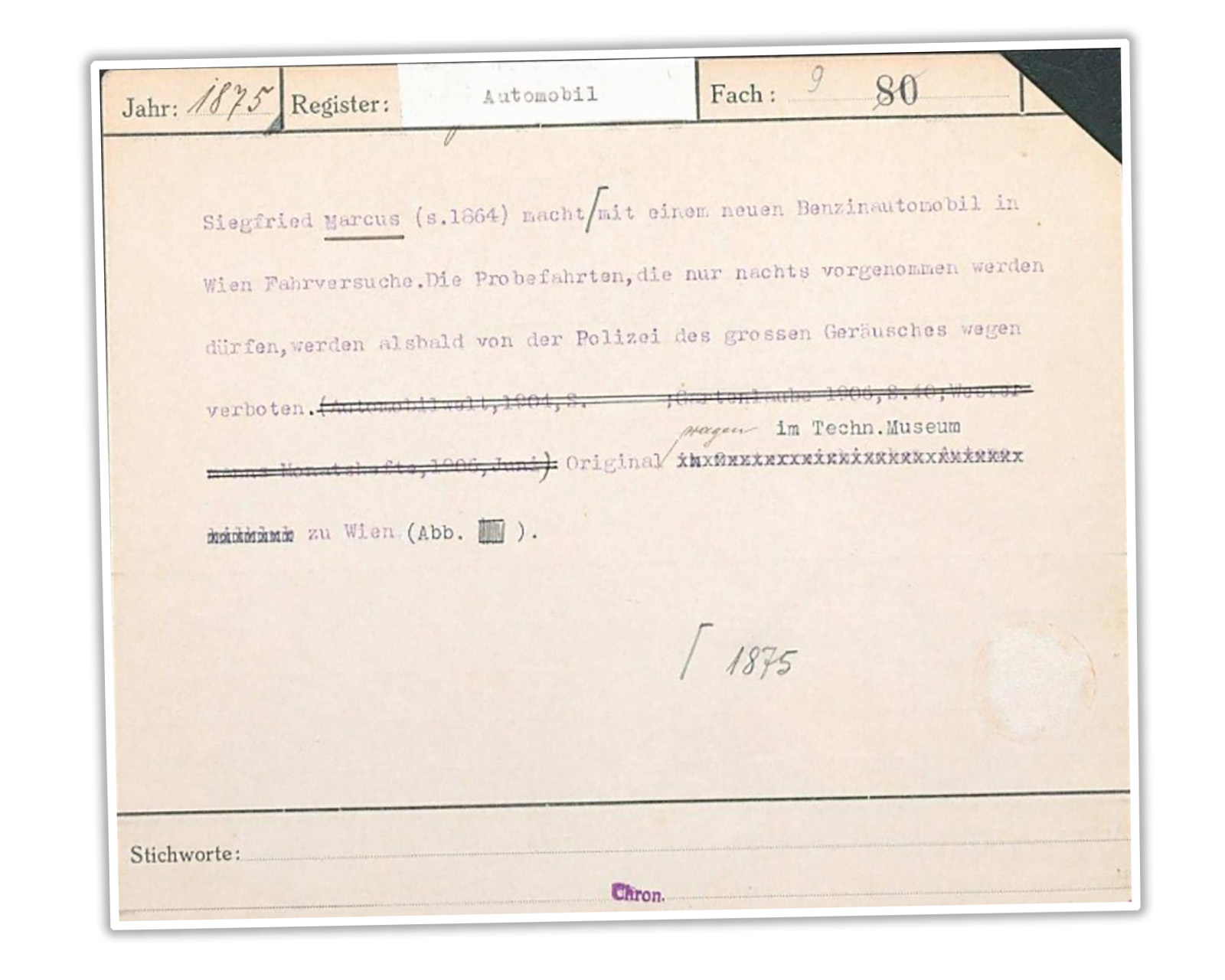
Mercedes-Benz likes to downplay the 1875 car, claiming it was actually made in 1888; I hardly think it matters, because Marcus did have a running internal-combustion car in 1875, and I know this because there are records of a noise complaint from Vienna Police being issued to Marcus and his Benzinautomobil (gasoline-powered car) from that year:
 The Marcus/Benz first-car controversy has a more sinister element, because Marcus had been taught as the inventor of the automobile (I’d disagree with that, too, but still) to schoolkids in Vienna, but when the Nazis came to power in the late 1930s, they put a quick stop to that, because Marcus was a Jew. There is correspondence from the Reich’s propaganda ministry ordering that all references to Marcus inventing the automobile be expunged and replaced with Benz and his Patent-Motorwagen. I’ll have a larger investigation of this in the future, because it’s all deeply infuriating.
Maybe Mercedes-Benz will try to say the Patent-Motorwagen was the first production automobile, but even then, they’d have trouble, I think. About 25 Patent-Motorwagens were built between 1887 and 1894, but back in 1878, Amédée Bollée’s La Mancelle automobile went into series production in France, with 50 examples built; most by Bollée, but 22 of which were built by a licensee or perhaps bootlegger in Berlin.

Mercedes-Benz did have a car that could be considered the first really mass-produced car, the Velo, which had 1,200 units produced. Mercedes-Benz’ website states it like this:
“The world’s first production car with some 1200 units built was the Benz Velo of 1894, a lightweight, durable and inexpensive compact car.”
…which I think is a little misleading, since it seems to imply that 1,200 Velos were built in 1894. There weren’t. Yes, 1,200 Velos were built, but that was between 1894 to 1901, and that is impressive, but in 1894 only 67 were made. Other companies were building cars in series at this time too, though, like Panhard et Levassor with about 90 cars made in 1894. So maybe the Velo could be considered the first mass-produced car, but considering Panhard et Levassor had made over 1,000 cars by 1901 as well, along with Peugeot, who, incidentally, also likes to claim the first mass-produced car, their Type 3 of 1891 which sold 64 copies. So who knows for this one?
This all drives me nuts for so many reasons, not the least of which is the fact that Mercedes-Benz is still the beneficiary of a Nazi-era propaganda campaign, and they don’t seem to be the least bit concerned with changing this, or the actual truth. I’m tired of seeing sites like Jalopnik just accept Mercedes-Benz’s flawed claims without question, especially because I spent so much time on that site trying to get the truth out there. Hell, I wrote a story in 2020 listing 10 cars made before 1869! In an easy-to-read listicle! Did no one search their own site to check if Mercedes’ claim was accurate?
The 1886 Benz Patent-Motorwagen is an incredibly important car for so many reasons: perhaps the first true Otto-cycle car to be built, for example, and it definitely marked the start of a new era of automobiles as they emerged from their more experimental stages into something more common. But the notion that the Patent-Motorwagen was somehow “the first automobile” is simply absurd. The development of the car was long and slow, and the Benz machine absolutely has its place. Mercedes-Benz’s insistence on calling it “the first automobile” debases the whole history of the car, and debases Mercedes-Benz itself.
Sites like Jalopnik should know better than to perpetuate this myth that only serves one company and diminishes the work and accomplishments of so many more.
Stop it, Mercedes-Benz. Enough already.


I guess it shouldn’t surprise me, but it’s still disgusting and disturbing that Mercedes-Benz is still benefitting from this. Your investigation should prove to be very interesting.
I think saying that the 1886 Benz Patent-Motorwagen is the first automobile is like saying that the Wright Flyer I was the first airplane and not Alberto Santos Dumont’s 14Bis or Clément Ader’s airplane.
I feel like the credits for Speed Racer are relevant here.
https://www.theautopian.com/the-end-credits-for-the-old-speed-racer-show-featured-some-shockingly-good-early-automotive-history/
But what is that velocipede? It’s got to be something…
Yikes. The US Congress wasn’t even a year old when they roasted Read’s automobile so hard that he gave it up completely. Imagine an infant making fun of you that hard.
I think all Mercedes has been claiming is they had the first car with an internal combustion engine, not a coal fired steam engine or electric battery driven.
Please read the caption on the top photo of this page from Mercedes-Benz. https://group.mercedes-benz.com/company/tradition/company-history/1885-1886.html
Oh lordy. They are pulling a fast one. MB was definitely not the first automobile
Cugnot invented the truck or you could call it a tractor. A bunch of people more-or-less simultaneously invented the passenger car.
though I think unequivocally, Panhard et Levassor invented the “modern” blueprint of the passenger car – front inline engine, rwd, steering wheel instead of a tiller, etc., starting in 1891.
Wait… are you telling me the marketing department of a car company can’t be trusted to tell the truth?!
Mercedes-Benz historians seem to be a pretty petty bunch in general. Go through the museum and they name designers and drivers of their cars, except the ones built and raced by Ferdinand Porsche. Heck they won’t even typically acknowledge Porsche as a company except as “that other car company across town.”
Having been to the Mercedes-Benz Museum a couple times, I find it HIGHLY amusing that the whole Daimler-Chrysler era is all but completely ignored.
On my guided tour of that museum, the guide spent an egregious amount of time on the company’s doings up to about 1930ish and then speed walked through an entire floor and gallery of aircraft engines muttering about “how some things happened” and then stopped abruptly to get back into some detail about the 1950s.
LOL – not surprised.
Yeah, just kind skips from 1935 until 1946. The Porsche museum doesn’t real acknowledge that time period either. BMW Welt on the other hand does cover it.
“Did no one search their own site to check if Mercedes claim was accurate?”
Well, yes, but it’s all written by bots now, and they’re trained on a much larger dataset wherein the Mercedes story is far more prevalent.
At the Technology Museum in Berlin, guess who invented radio, TV and computers?
The Germans, Natürlich!
Everyone in the UK knows that all of those things were invented by Brits.
(Ok, Marconi was an Italian immigrant, but he did his work in the UK)
We’d still be using spark gap transmitters without Lee De Forest inventing the Audion vacuum tube in California. But I’ll give you Brits the magnetron that won the war with radar.
Konrad Zuse? He has a pretty good claim, really.