

Think about the Toyota Corolla. What pops into your mind? It’s just as likely to be a beige, automatic sedan engineered for trouble-free commuting as it is the black and white AE86 fastback from a well-known Japanese anime series, or a dusty one driving past in the background of a news report from a faraway country. That’s the legacy of the Corolla’s 60 years in production.
Even if the model series has grown from one segment to another during all this time, it’s been built with the same name for six decades, providing dependable and durable motoring around the globe for anyone who needs a Corolla, with the occasional oddball version for flavor. As well as the most basic ones, let’s take a look at some of the more interesting Corollas over the years.


Toyota still makes Corollas in the Takaoka plant that was specifically built to build the 1966 Corolla. Over the years, manufacturing has expanded around the world to locations such as the New United Motor Manufacturing (NUMMI) plant in Fremont, where a Tesla plant is located today, and Burnaston, UK, where the GR Corolla is also built. American Corolla production takes place in Mississippi, at the TMMMS plant.
Starting Small
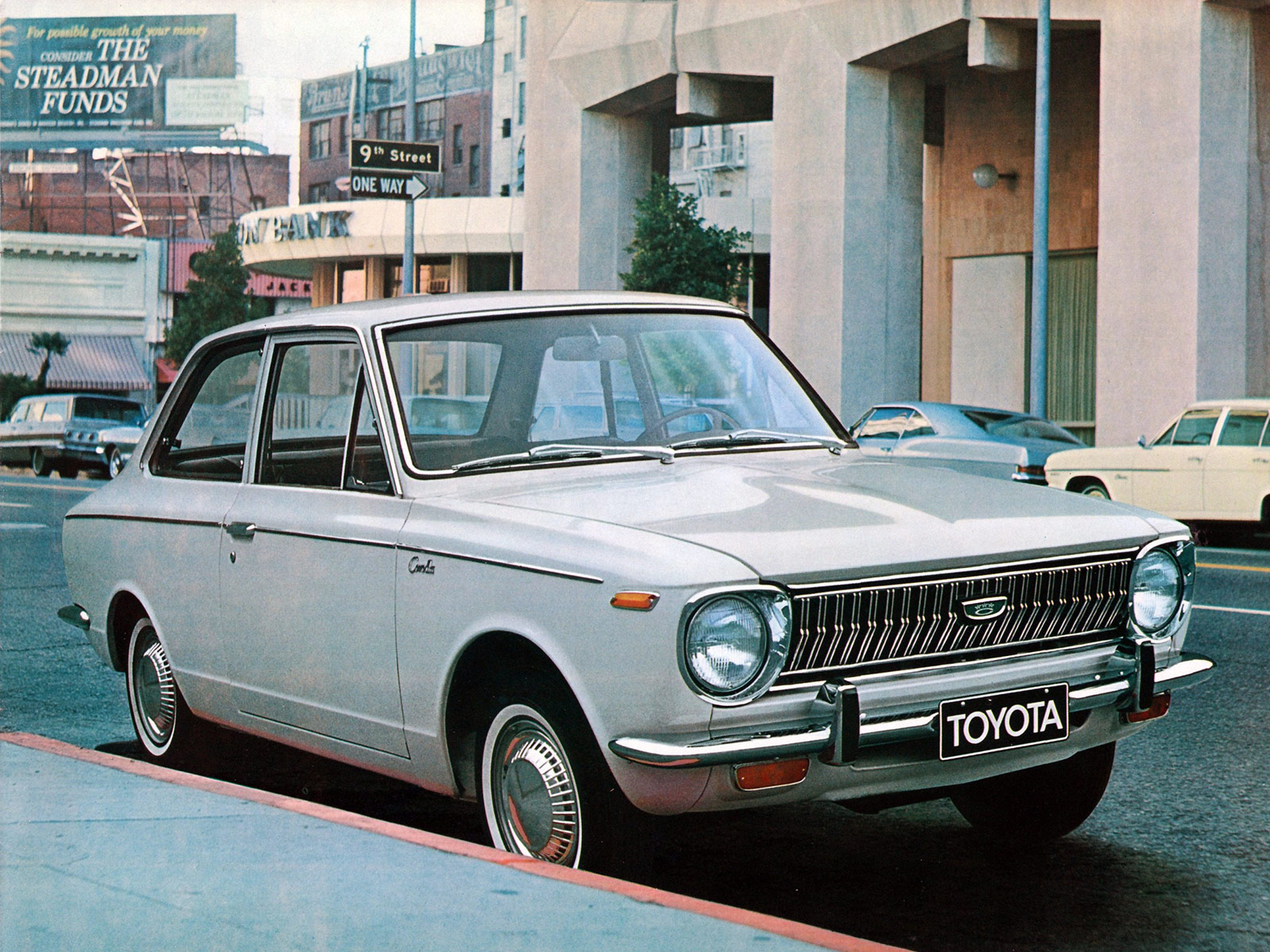
The first Corolla was a tiny sedan with an engine barely over one liter in displacement. After two years of Corolla production, the first cars were shipped to North America in coupe, sedan, and wagon styles.
It took until the mid-1970s for the Corolla to grow significantly, as the third-generation car was noticeably longer and wider than the E10 and E20 generations. Logically, it was marketed as the Big Corolla in Finland, as in this ad from 1976:
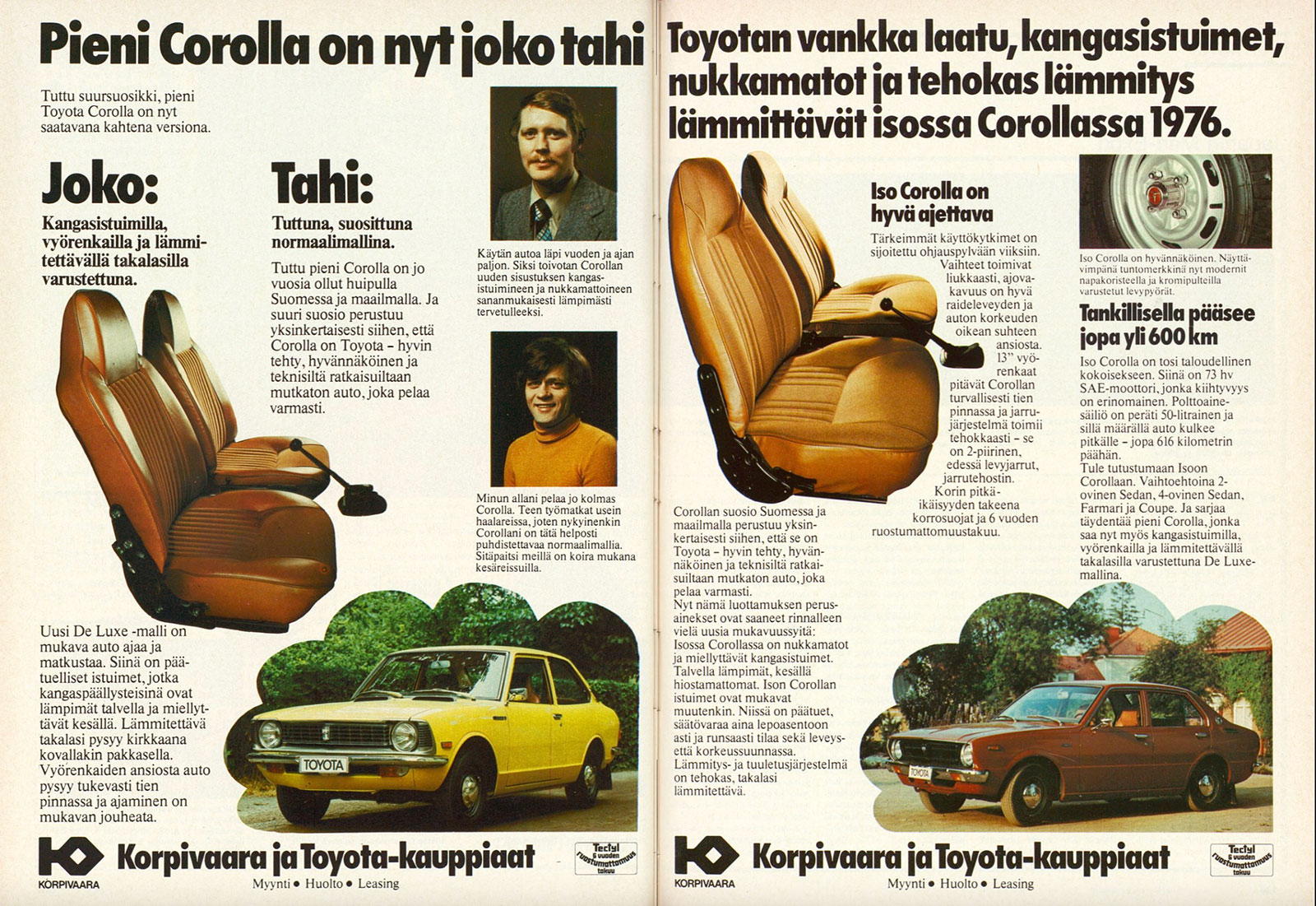
The Finnish importer had stockpiled enough old-style E20 Corollas after production ended in 1974, so they were sold alongside the new E30 generation Corolla for a while.
As it often happens, Toyota also kept making the old E20 generation wagon and van past the sedans’ discontinuation, as they were built until 1978. The square fourth-generation car (E70) was already introduced in early 1979.
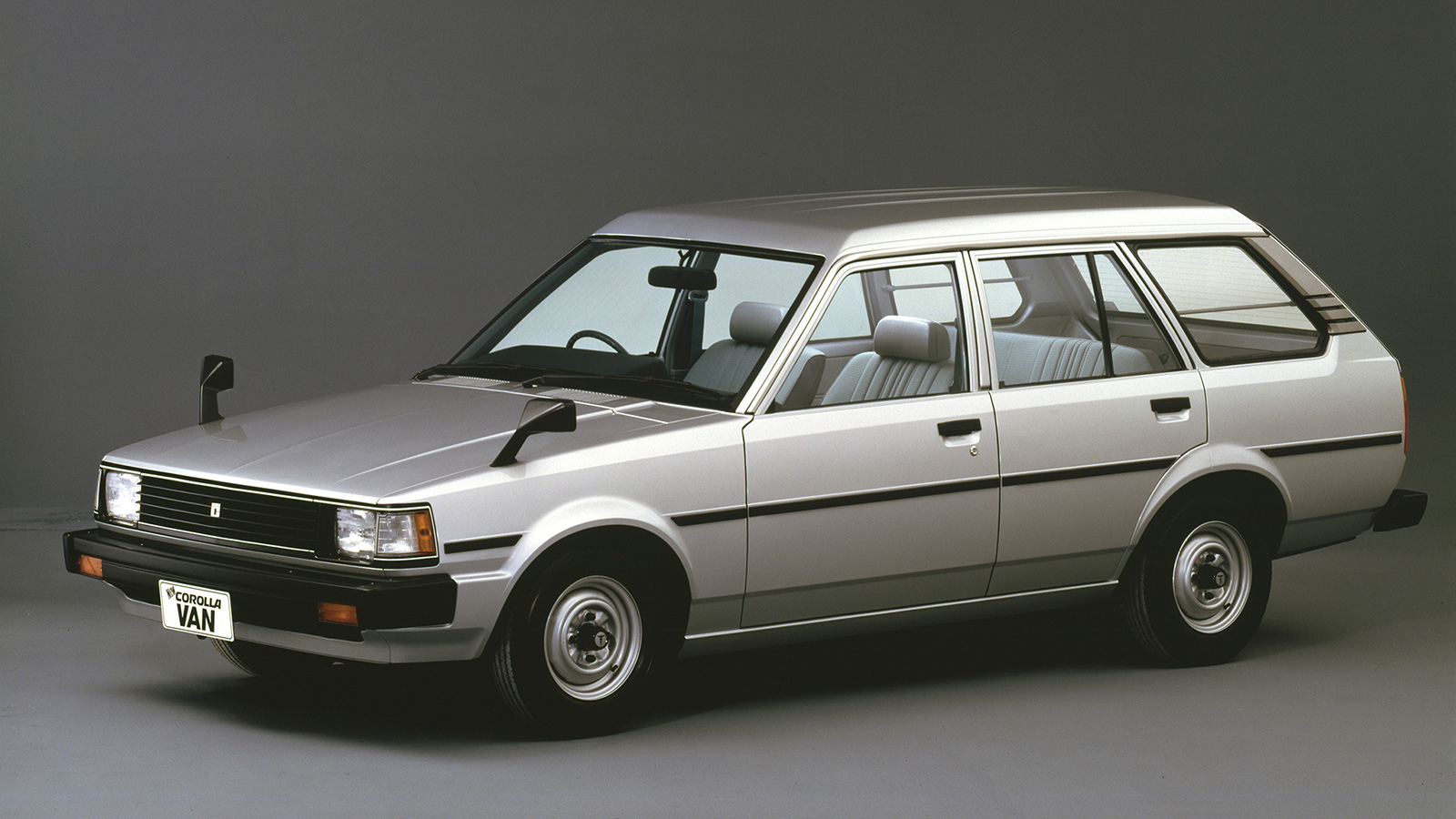
The E70 generation basis was also partially used for future Corollas, as the model line sort of split by the introduction of the E80 gen in 1983: sedans and hatchbacks went FWD, as Toyota accepted the transverse FWD layout that was becoming the standard in the segment, and the wagon and the coupes remained RWD – the wagon was still a lightly restyled E70 gen car when it ended production in 1987. The silver high-roof van above is just the kind of delivery wagon I’d love to drive. Look how simple it is!
Drift King

These cars here represent the duality of the Corolla heritage: basic transportation on steel wheels and a cool-looking coupe version with pop-up headlights.
Thanks to touge drift culture and the Initial D manga and anime series, the Corolla Levin AE86 and its Sprinter Trueno pop-up headlight sibling have become iconic ‘80s cars that are also immensely expensive in any good condition. In Europe, they have been used in rallying all this time, which has kept their values high, as rally garages have often needed straight shells for builds. Stock, they had as little as 70 hp in North American DX specification, and even the 4A-GEC engine in the North American pop-up-headlight Corolla GTS made just 112 horsepower. Most enthusiast AE86s are likely to have more poke these days. As well as building your own new Corolla AE86 out of a Chinese reproduction shell, you can also have a Japanese tuner build you a perfect restomod version for a lot of money.

The E70 generation Corolla’s platform and engines were also again used in the Daihatsu Charmant, a rebranding exercise whose modern-day equivalent was the Suzuki Swace, a Corolla wagon sold in Europe between 2020 and 2025.
Another rebranding was the Geo/Chevrolet Prizm, a Californian Corolla/Sprinter by way of General Motors joint venture, that was built for three generations at the NUMMI plant. The earlier E80 generation car was also sold as the Chevrolet Nova, built at the same factory.
Cool 4WD Wagons, Hot Engines

For the E90 generation, not only were RWD Corollas dropped from the model range, but four-wheel drive was introduced. Toyota’s Sprinter Carib, a model line that had spawned from the smaller Tercel, jumped up a model line and became the Corolla Sportswagon or the Corolla All-Trac Wagon. Toyota would offer these Sprinter Caribs and 4WD Corolla Wagons up until the 2000s, when the E110 generation was discontinued.
I have a late AE115L myself, and it’s certainly handy in the winter with its Full Time 4WD that transfers up to 50% of power to the rear without needing to select it with a lever, unlike in earlier cars. I can get it sideways at a moment’s notice in wintertime by just booting the throttle, but that is partly due to the good, but certainly not great, winter tires on it.
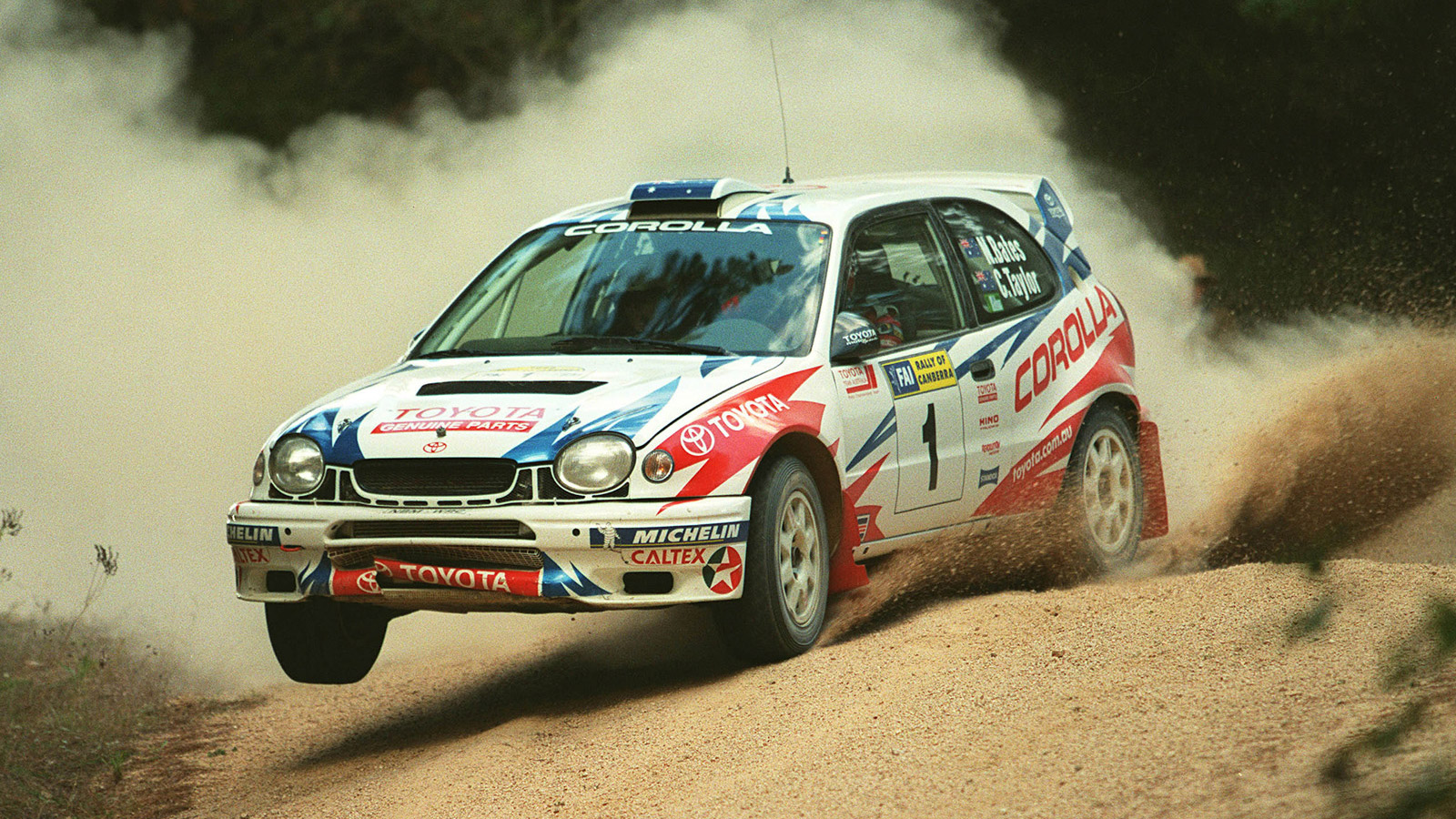
The E110 generation car also provided the base for Toyota’s WRC Corolla, and the G6 and G6R warm hatches were marketed with some of that rally-era magic, even if 110 horsepower was the best they could get. The G6 and G6R did get sports seats and a six- speed gearbox, and the G6R had an aluminum hood and a lower, stiffer suspension as well as a body kit.

As a concept, 2000s Corollas may sound boring from an enthusiast standpoint, but that’s not the whole story. Depending on the market, there have been some interesting powerplants available: the 2ZZ-GE, noteworthy for extracting as much as 192 horsepower from 1.8 liters without forced induction, was fit in the Corolla T-Sport and the Corolla XRS (above) as well as its Matrix/Pontiac Vibe cousins (170-180hp) and Lotus Elises and Exiges, plus Celicas. The tenth-generation E140 car got the 2.4-liter 2AZ-FE Camry engine, which is huge for a Corolla.
The eleventh-generation cars brought the sort of hybrid tech to Corollas that had been synonymous with Priuses; Toyota’s Hybrid Synergy Drive combined the everyday usability of a regular automatic car with very complicated hybrid technology that Toyota had managed to make as reliable as a Corolla would need to be.
At the time, sporty Corolla hatchbacks for the North American market were sold as the Scion iM, but those would not get as much power as the earlier hot Corollas. The current Corolla generation is the twelfth, and it’s been in production for quite a while already: it was introduced way back in 2018. With current fuel prices, the fuel economy of a hybrid Corolla is much appreciated: older Corollas could sip fuel, but that’s because they weighed nothing compared to the ones sold today.
Back To Basics

My granddad, a carpenter born in 1926, used to drive a white 1.3-liter, manual, four-speed E90 generation Corolla from around the time he retired but couldn’t put down his tools. The Corolla somehow embodied his ethos, as he simply needed a reliable car that would get him and his carpentry tools around when he needed to fix up something at the summer cottage.
The car was absolutely bare-bones, a black-bumper sedan with no rev counter, and it was indistinguishable from most of the other 1988-1992 Corollas that were sold here.
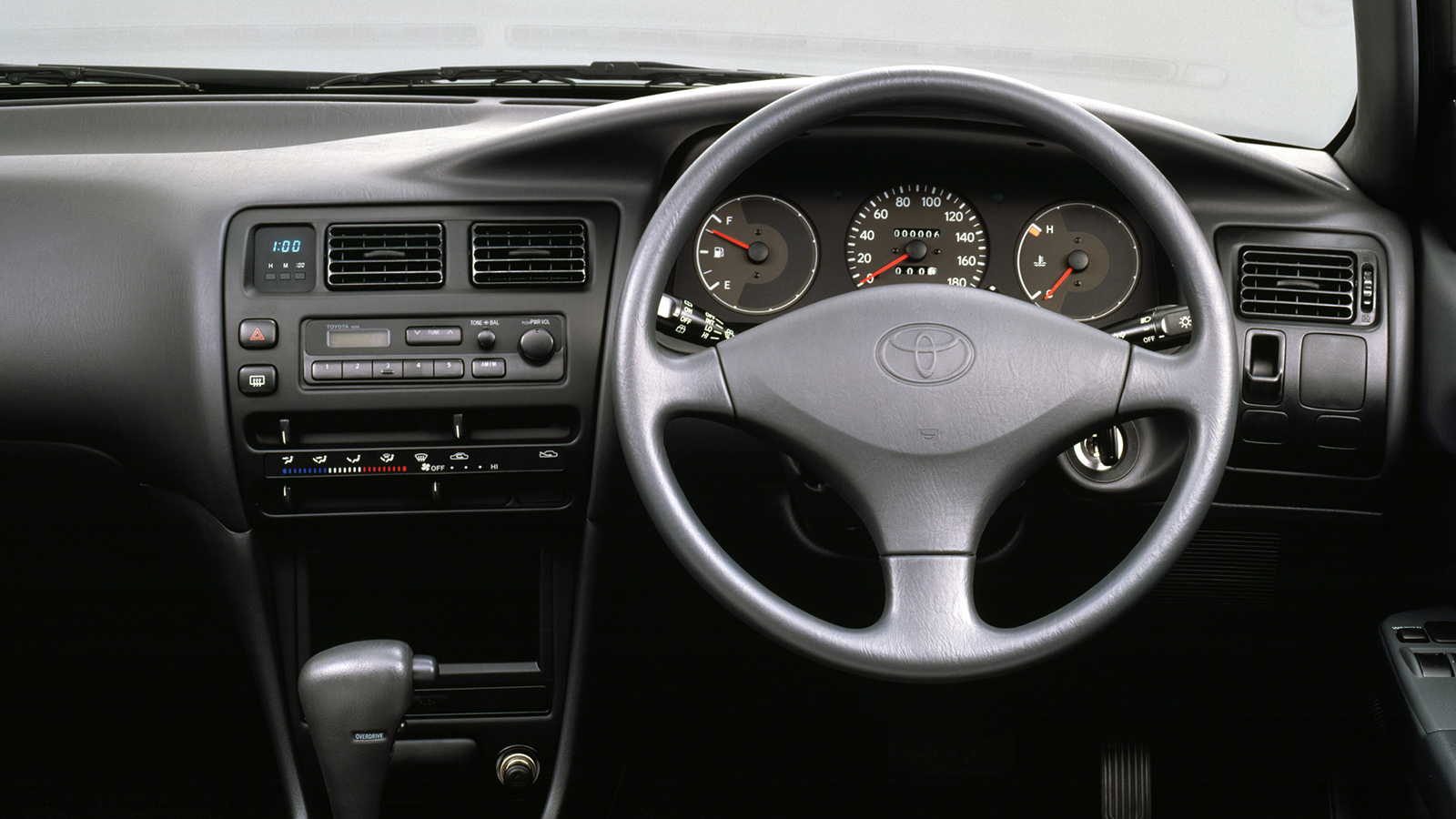
The following generation, the E100, has also proved very durable. They’re still a common sight here in Finland, and while you could spec them up, my idea of a ’90s Corolla is of one like this – especially since RHD ones were used as mail delivery cars. As well as having the steering wheel on the right, you could tell them apart from the orange Posti colour.
Few Corollas that Toyota makes today are as basic, as customers want automatic transmissions, hybrid assist, CarPlay, and a lot more power.
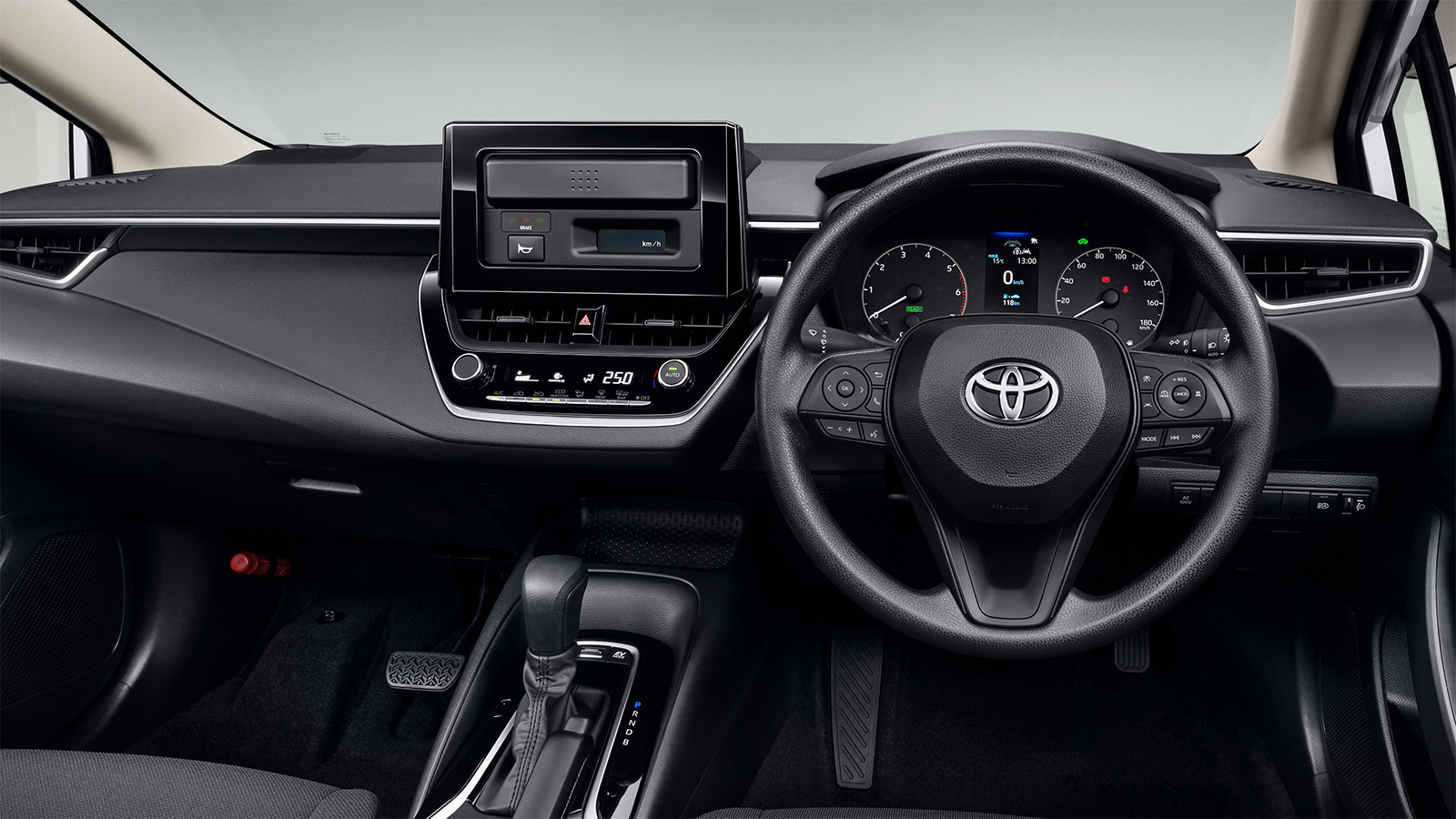
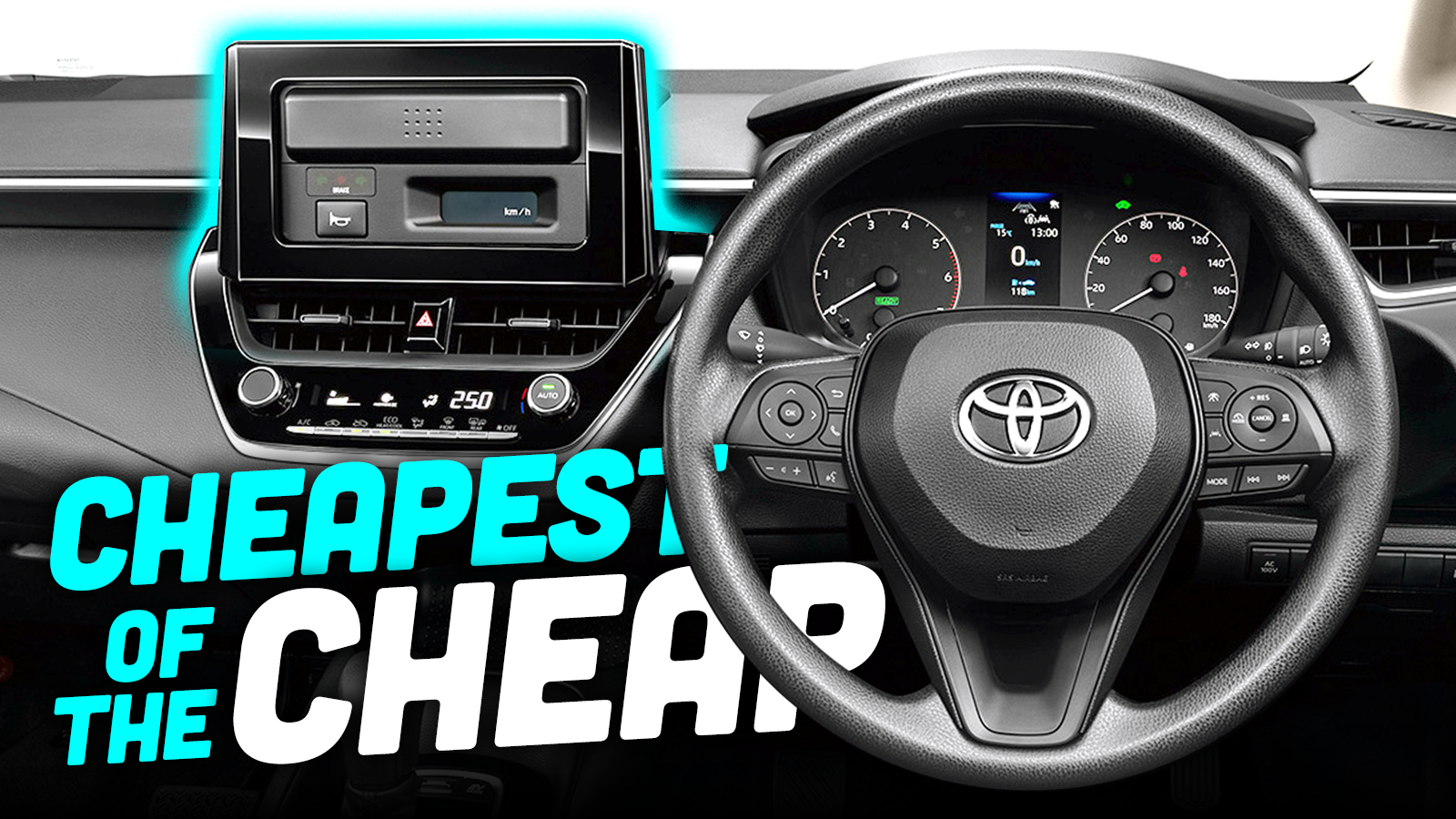
This brand-new, 2026 model year, Japanese-market driving school special, then, is the complete opposite – not only because the cabin layout is mirrored for right-hand-drive. Tailored for driving instructors, it’s available with the minimum necessary equipment, as it doesn’t even have a radio.
Compare it with the E100 generation dashboard above, and you can see it’s today’s equivalent of the Truly Basic Corolla.
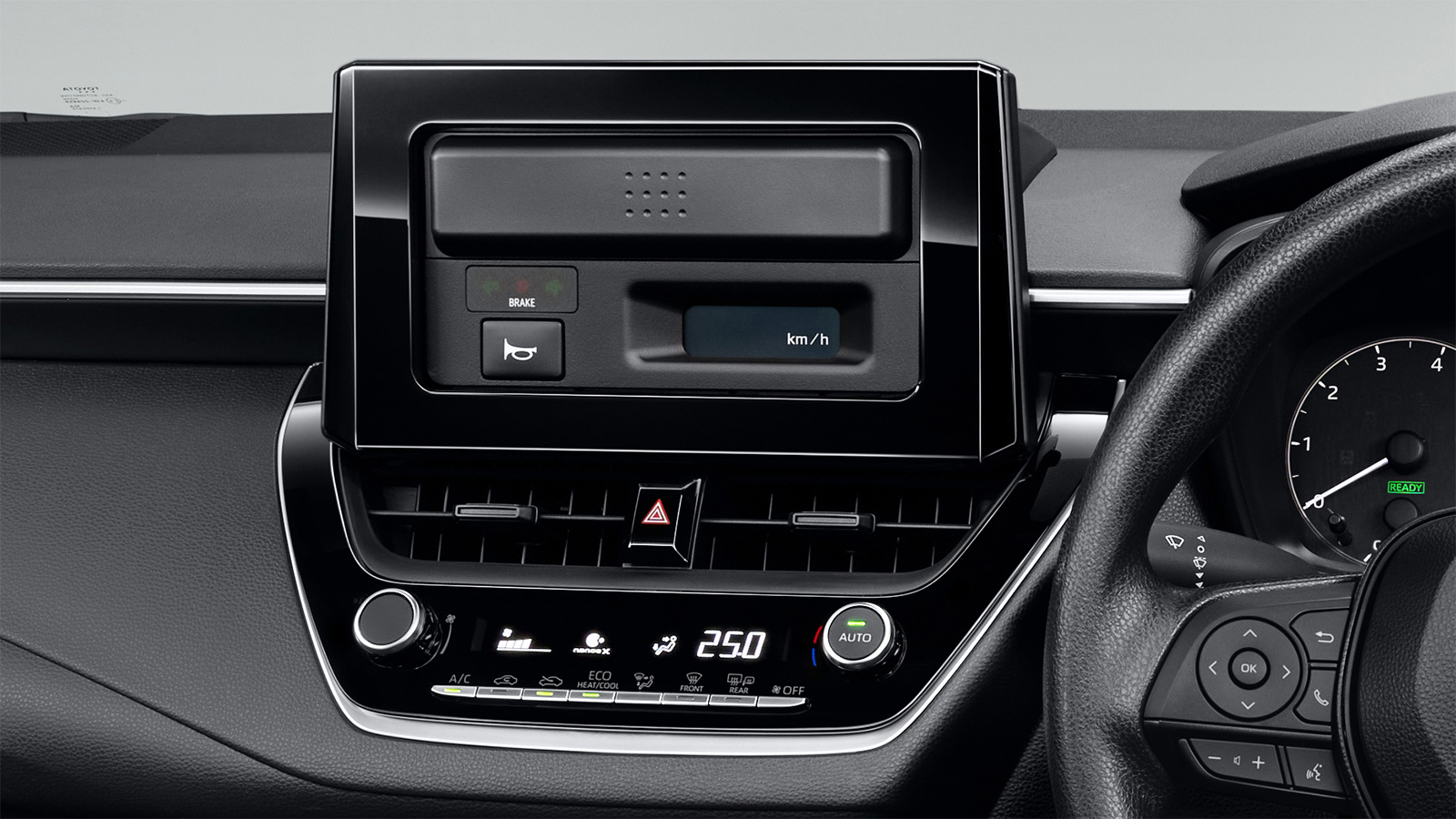
The usual dashboard touchscreen has been replaced with a single-DIN-sized placeholder, and what looks like the familiar Toyota digital clock is now a speedometer for the instructor. Next to that is an indicator for the blinkers and brake pedal use, and there’s a separate horn button as well.
As is usual for driving school vehicles, these Corollas come with a brake pedal for the instructor, and twice the number of mirrors compared to a regular sedan. Air conditioning is thankfully retained in case the atmosphere heats up during a lesson.
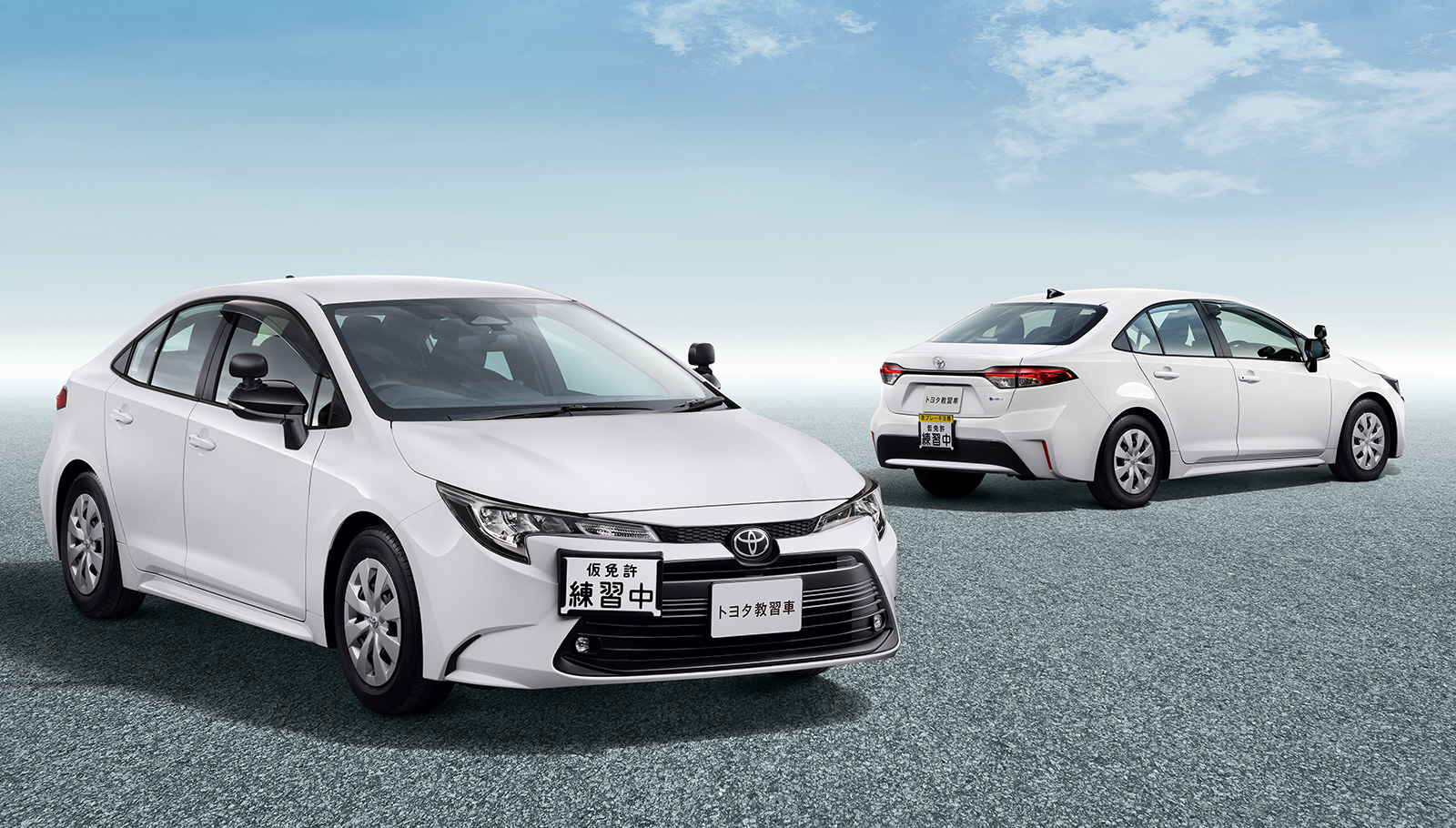
In the pictured Driving School Corolla with a CVT, the engine is the usual 1.8-litre with hybrid assist, but Toyota also offers a 1.5-liter paired with a six-speed manual. This is the only manual-gearshift Corolla sold in Japan except for the GR Corolla, which is a slightly different beast. Then again, the Morizo edition GR Corolla doesn’t have a rear seat, which is bare-bones in a different way.
In 2025, Toyota sold nearly 250,000 Corollas in the US and around 155,000 in Europe. It was the 11th best-selling car in the United States last year, and globally, after 60 years of continuous production, it’s the biggest-selling car there has ever been with 50 million built. The next best seller is the Ford F-150 (43 million) if you count trucks, and the Volkswagen Golf if you don’t (37 million). Rust is likely to be the Corolla’s only enemy, as they will continue to chug along, day after day, and even the rustiest ones in Northern Europe are eventually shipped to Africa, where they will continue to do the one thing they were built for: to get people where they want to go. Sometimes sideways.
All images: Toyota




I like that the steering wheel still has volume buttons.
They probably make the horn louder.
Japan gets all the cool stuff…
I like this, base car models today have too many features, i would love a car without most of them, but keep the radio!
Make the radio a dealer installed option, so some people can still choose not to pay for it
Dealers would LOVE that.
Reminds me of the car I learned to drive on. A 1968 4 door Chevy Nova in almost the most stripped down version possible. Straight 6, 3 speed manual, manual windows, no extra chrome bits anywhere. My parents bought it used from an uncle and the story was that the only reason the car had an AM radio was because it was installed by mistake and he demanded a discount since the car didn’t match what he ordered.
That is not the optimal placement of the horn button, nor is it large enough. Maybe it is for the instructor to reach so they don’t accidentally brush a learner’s breast or something?
This all reminds me of “The Naked Gun” scene:
“Roll down the window… extend your hand,… extend your middle finger…”
Voiced by John Houseman.
I get why radios aren’t needed. Most radio stations “air” on the internet. Plug for KTYD in Santa Barbara.
And, honestly, I do not want any more than nice speakers, nice wiring, nice antenna, and a nice spot in the dash for an aftermarket audio system. Nope, don’t need the backup camera or monitor. Don’t need a map.
It is solely for the instructor.
That Finnish ad. Sooooooo maaaany vowels.
Now let’s find the Polish ad.
From the lead image and headline I was really hoping that touchscreen replacement was going to be a pop-out phone holder
I must have some eyestrain/delirium from work, because I have hit semantic satiety on the word Corolla and now see “Gorilla” in its place.
Not the worst problem I’ve had, to be honest.
I was about 15 before I realized they were not Crayolas.
I bet hardly any Autopian readers know what a Corolla is. It’s a pretty odd thing to name a car after.
GRCorolla doesn’t help, doesn’t it?
I’m finally excited to buy a corolla later this year, if you would have asked me 5 years ago, I would have said you’re out of your mind if you thought I would buy a Toyota let alone a boring Corolla.
Granted the corolla I am buying is nothing like any other Toyota except for the rally homologation special Yaris but still.
I own a 23 CE, it’s an awesome machine. Only downside is if you drive it like how you’re supposed to, you’ll be getting kicked in the nuts every time you go to the pump.
That is how my FK8 Type R is, joys of a heavily boosted small powerplant. I got 6.7mpg at my last track day with it, 11mpg during my trip to Tail of the Dragon. Luckily, I commute only 100ish miles a week, so fuel costs are mostly negligible. Before settling on the GRC I was heavily considering a gen 1 SVT Raptor which would get in the low teens.
An ex of mine had a late ’70’s Corolla wagon in super-dull tan. Just thinking about that car brings gets the PTSD going.
Here… to fix your PTSD, I recommend you get this 2005 Audi Allroad Quatro:
https://www.edmunds.com/audi/allroad-quattro/2005/vin/WA1YD64B85N025657/?national=true&radius=6000
Y’know, if that “rebuilt vehicle report” involves a recent engine rebuild, that might do the trick.
Yes. And that Audi totally won’t give you a new form of PTSD to replace your existing one.
No Sir…
I can’t convince my brain that the image of the center stack isn’t a photoshop.
Also, if you install a DIN head unit, does it stick out the back of the “screen”?
Oh, actually, on closer inspection it looks like the back of the “screen” extends out and down to the dash to house the DIN head unit.
Am I the only one that is surprised that there is a large enough driving school demand for cars that Toyota actually makes them special?
These are common in Europe, manufacturer build those versions.
They take driving education a lot more seriously in Europe than we do in the U.S.
In Japan, yes. Driving schools are enclosed private road circuits including small “hills” for handbrake starts, manoeuvring areas etc. Learners start there before venturing out onto public roads. The schools use their own cars, and most people opt to train for a manual licence, even though a big percentage never drive a manual car again after passing the driving test.
Corollas may be popular in large metropolitan areas, but where I live, I never even saw a Corolla growing up. (I got my license in 1987) There were never any in my high-school parking lot, nor at the college campus I attended. So I looked up when people actually started buying them in my neck of the woods. Here’s what Google tells me:
Rural Wisconsin largely adopted the Toyota Corolla in two distinct waves: 1992-1998 (when the Corolla officially evolved into a larger, more comfortable vehicle) and 2009-2012 (when the Great Recession forced many rural drivers away from large trucks and toward high-MPG, hyper-reliable commuter cars).
The timeline of Corolla adoption in rural Wisconsin breaks down in three key phases:
1. The Skeptical Era (1970s – 1980s)
The barrier: “Foreign” cars were seen as impractical for heavy winter snows, hauling equipment, or unpaved backroads.
2. The Shift to “Maybe a Little White Wonder Car” (1992 – 1998)
3. The Modern Commuter (2008 – Present)
Of course, nobody around here buys cars anymore. Here’s what sells in rural northern Wisconsin:
1.) Ford F-150 / Super Duty
2.) Chevrolet Silverado 1500 / 2500HD
3.) RAM 1500 / 2500
4.) GMC Sierra 1500 / 2500
5.) Chevrolet Equinox
6.) Jeep Grand Cherokee
7.) Subaru Crosstrek
8.) Toyota RAV4
9.) Ford Explorer
10.) Toyota Tacoma
It sure would be nice to be able to get even one of the above vehicles as a stripped-down base version with a manual transmission, hand-crank windows, and no infotainment screen.
The Subaru Crosstrek is like driving a video game.
So many miserable features.
Other that that, it’s more or less car like. It’s no 2000 Impreza, which was a fine stay out of your way get stuff done car.
The hybrid models in particular make me shake my head, since all along you’ve been able to get comparable economy and save ten grand by giving up the lift and cladding instead of adding a motor and battery.
Well it depends the use case. If I is a backwoods driveway and mostly staying within 15 miles of home they make sense. Two-way (bidirectional) PHEV charging, and rooftop solar look like a good combination for the mud driveway lifestyle.
If you are just filling it with gas and driving a lot, then it’s stupid.
Being tuned to 90% of needs and building at least barely adequate for the other 10% is fine.
Turns out rural Wisconsin and rural Michigan have similar vehicle tastes, add Buick CUVs and the Toyota Tundra and that’s the list of what 95% of new vehicles I see around are
Those mirrors should be a dealer installed option.
The trend of smaller and schijtier mirrors sucks for visibility.
None of your lowland dyke dwelling fecal vulgarity here! This is the Autopian! Oh wait, the Autopian gemstone is coprolite, never mind.
It’s a shame we don’t have a thumbs down button on Autopian. At times it could be useful.
Well, the opportunity to respond to Dutch scatological references was too rare to pass up,
The Netherlands is literally translated as the low lands, and is protected by dykes, so I don’t think that’s particularly unreasonable.
An Autopian coprolite ring seemed like it would clue the reader into the hyperbolic nature but if you read that as something offensive, you have my sincere apologies. I shall try to be more over the top in the future.
An Autopian coprolite ring seems like a great piece of premium merch, perhaps something more ridiculous would have landed better.
Why I recognized schijtier is a mystery otherwise my Dutch vocabulary is limited to jenever and maatjesharing.
Anyway sorry to have caused distress , my favorite color is orange , and the DAF TurboTwins of Jan de Rooy are awesome.
In 15 to 25 years (depending on your import laws), these are gonna be “Iraqi Taxi” level collectibles.
That clapping sound you hear is the sound of countless Autopians throwing their wallets at their screens.
They bringing these new manual Corollas to the states?
No. We had a chance to buy manual Corollas a few years ago and didn’t.
FWIW You can still get a new manual Corolla hatch. It is just an AWD Turbo 3 cylinder with big fender flares.
Dealers didn’t buy them. Can’t get you in a car today unless its the lowest common denominator. Get effed if you want to order what you want
Eh, I’m inclined to believe they’d stock them if the demand were there. You seem to think the demand doesn’t exist because dealers made it inconvenient to get one. I’d bet dealers made it inconvenient to get one because for years the demand for manual transmissions have been in the single digits.
Happy to be wrong here if you can prove it.
People here have had plenty of stories of dealers not stocking or not wanting to order
In a market that sells 16 million vehicles a year I guess that proves it then.
I was looking at the manual Mazda3 – but the manual transmission is only available with a high trim level, a bunch of unwanted options, but not all wheel drive. And mostly ugly colors. 6 shades of gray and a sort of scab red. I mean the interior is kind of nice and uncluttered by tecnokibble in the version without manual but whoever came up with the different option packages is a total moron.
About as much chance as scoring a HiLux Champ.
My first car was a ’78 Crayola. It was a gorgeous design.
What colour was it? What did it taste like? Did it have driver assist that beeped when you drifted over a line? Tell us more. So many questions…
Blue? It fit really well up my nostril, but it never did come back.
My cousin did that.
His ear wax was blue for the next 20 years…
I didn’t realize that driving school specific cars were a thing until a few years ago when I saw a Toyota Crown Comfort Hong Kong taxi replica in L.A. and learned from the owner that it was originally a driving school spec car.
Driving school specific cars are also a thing in Europe.
RIP to my TE72. Dumb neighbor ran into it while parked on a perfectly straight street and I had to sue her to get her to pay because she’s too cheap to buy anything but minimum liability insurance. That wasn’t enough for even an old car because she also hit a Prius and a house in the same move.
Boooo. There’s a guy in my area (outside Portland OR) selling off a bunch of 70s Celica parts if that helps.
That’s awesome. Now I want one that options in manual windows!
Slate truck is your best option now
My mom drove a 82? manual with the all glass hatchback well into her 50s and only replaced it after she rolled it and totaled it. I may get my kid one when her Kia Soul finally grenades from oil starvation.
There’s one of those in our village, a slightly faded red one. My dad had one new in 1986 and I still think I should get one.
Dang, stop teasing us with headlines for cars we can’t have!
Yesterday I saw Swace and wondered why all I had seen were estates. Now I know…
That’s hardcore . . . Kudos, Toyota!
Too bad it’s not rear-wheel drive. But damn, they should have never gotten rid of the manual.