

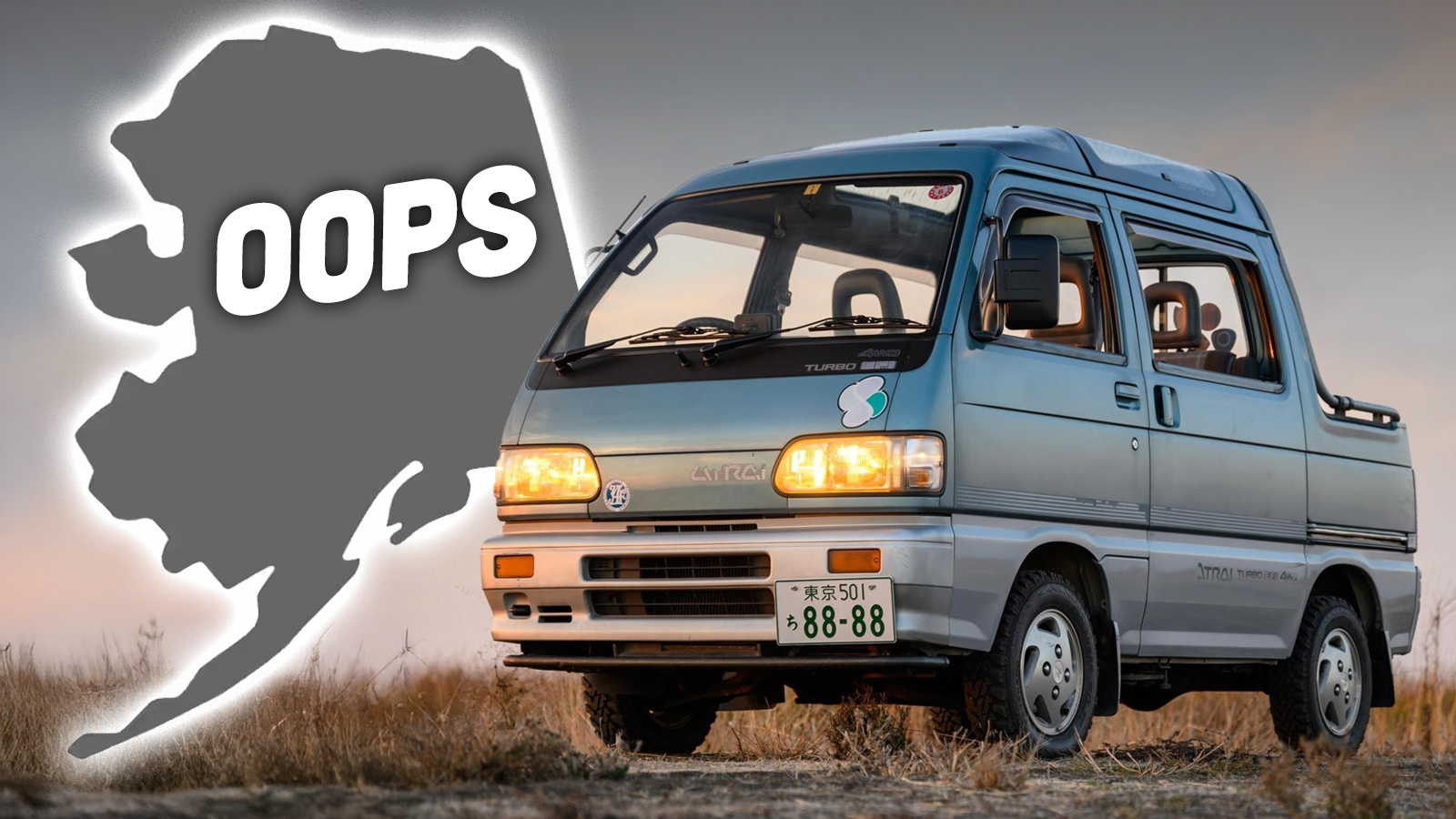
Enthusiasts of imported cars across America have been fighting a years-long battle against their state governments. Several states have banned or otherwise restricted the registration of legally imported cars. Enthusiasts have been fighting back, scoring historic wins. Now, it’s Alaska’s turn. While Alaska did not ban imports after 2021, it has had a longstanding law that accidentally banned any vehicle from 1981 and newer that wasn’t built to American standards. Thanks to enthusiasts, this law is likely to get overturned soon.
Several American states have decided that certain imported vehicles are unfit for use on their roads. Many of these states implemented their bans in 2021 following a recommendation from the American Association of Motor Vehicle Administrators (AAMVA) to ban every vehicle not manufactured to Federal Motor Vehicle Safety Standards (FMVSS). The states that either restricted or otherwise banned imported vehicles in 2021 or after include Maine, Rhode Island, Michigan, Georgia, New York, Pennsylvania, Massachusetts, Colorado, Illinois, Virginia, and Wisconsin.


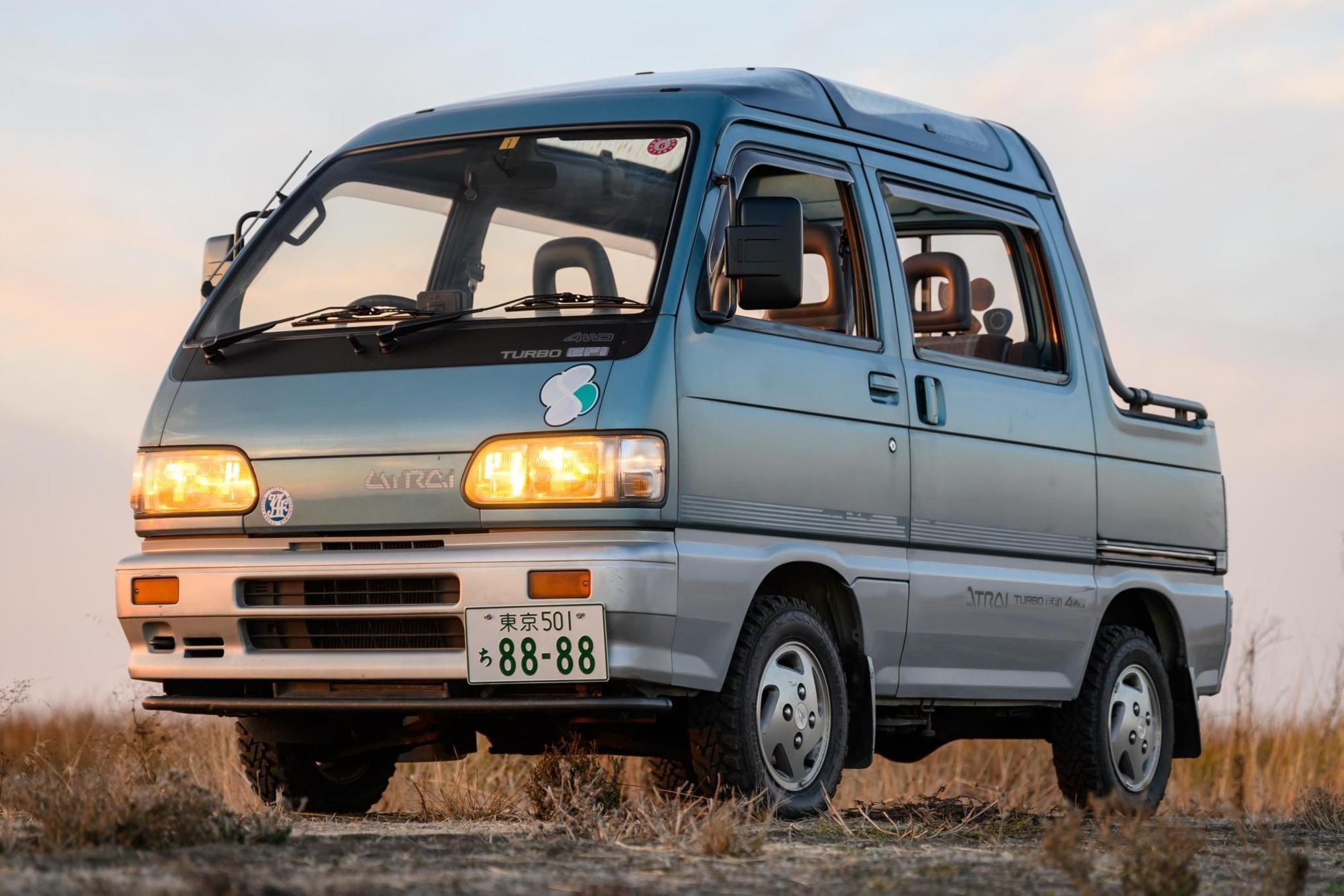
Many of these states specifically targeted the Keijidōsha, Japan’s smallest class of road-legal vehicles. Kei cars are legal to import into America without restriction once they surpass 25 years of age. However, while these vehicles may be legal to import on the federal level, the states retain the right to determine what vehicles are allowed to be registered for road use. Keis and mini-trucks have been a target of the AAMVA for longer than a decade, and it has successfully convinced states to pass laws or policies against the vehicles.

Some states, like Maine, took their bans to the extreme and banned the importation of all classic cars, regardless of their size or country of origin. Colorado attempted to ban imported cars and vintage military Jeeps. Thankfully, Maine is pretty lousy at enforcing its anti-import law, but it’s still there if the state suddenly decides to use it again.
Some of these states, like Pennsylvania, do allow Kei owners to operate their vehicles, but only under restrictive antique vehicle schemes that legally don’t allow enthusiasts to use their cars how they please. There are many other states that banned mini-trucks — Kei-sized trucks that are off-road only and limited to 25 mph — before 2021 and have since tied street-legal Keis into their bans.
This is all to say that, depending on where you live, you can import a car that the federal government has no problem with, but your state will refuse to register. It’s a mess, to say the least.
There Have Been Many Victories
When I last checked in on the car import laws of American states, I wrote about how Wisconsin has technically banned Japanese Kei cars since 2013, but didn’t really enforce it until now. Since then, the battle in Wisconsin remains ongoing, while enthusiasts in my state of Illinois have largely stopped fighting despite ramped-up import ban enforcement from our state. Georgians have been fighting their import ban unsuccessfully for years, and even a lawsuit couldn’t beat the state’s disdain for imports.
Conditions are not all bad. Enthusiasts in Oregon have been standing up and fighting their longstanding ban, and now have bipartisan support for the legalization of imported vehicles. I’ve also heard news that enthusiasts in states across the eastern seaboard are also fighting their states’ restrictions.
All of this came from some high-profile wins in 2025, as I’ve written about recently:
Back in March, I wrote about how Lone Star Kei, the organization that was the first to legalize Kei vehicles after new bans were instituted beginning in 2021, sought to secure the privileges of Keis in Texas law. That bill became law, and Texas now has one of the best Kei laws in America.
I also wrote about how Colorado was secretly running one of the worst Kei bans, one where the state said you couldn’t do anything with your Kei but drive it on private property. Colorado’s enthusiasts fought for pro-Kei legislation and got a law enacted that protects Keis.
These laws haven’t been the only wins in the past few years. Enthusiasts in Michigan and Massachusetts also overturned their bans. All of these successes are proof that grassroots organizing and education work. These enthusiasts — with the exception of Michigan, as those enthusiasts sued the state — didn’t make the state their enemy, but pointed out what Keis actually are and why having them legal is beneficial for everyone.
Now, we land in Alaska. America’s Last Frontier did not ban Keis in 2021 like the aforementioned states. Instead, it has a law that has been on the books for a while that somehow makes less sense than most bans. Alaska bans any car that’s from 1981 or newer that is not built to FMVSS.
Alaska Won’t Register Any Import That’s Newer Than 1980

As it currently stands with regulations in Alaska, it doesn’t matter where your imported car comes from or how big it is. If you cannot prove it was built to American standards or that it is older than 1981, you cannot drive it. This rule encompasses all imports, regardless of whether it’s a BMW 3 Series wagon from Germany or an Isuzu Elf motorhome from Japan.
When denying a vehicle registration, Alaska cites 2 AAC 92.020(a)(2)(A–B). Let’s look at that. 2 AAC 92.020 is “Title and registration: grounds for refusing title or registration or transfer of title or registration.” The regulation lays it out pretty clearly, emphasis mine:
(a) The department may refuse to issue title or registration or transfer title or registration if the
(1) applicant does not comply with the procedures established in AS 28.10 (vehicle registration, liens, and title) and the provisions of this chapter; or
(2) the vehicle model year is 1981 or newer, and
(A) the vehicle lacks the permanently fixed label or tag that is required under 49 C.F.R. Part 567 and that states that the vehicle conforms to all applicable United States Department of Transportation federal motor vehicle safety standards in effect on the date of manufacture; and
(B) the applicant fails to provide a letter from the vehicle manufacturer that states that the vehicle conforms to all applicable United States Department of Transportation federal motor vehicle safety standards in effect on the date of manufacture and that the vehicle was manufactured for highway use.
But 1981 is so arbitrary. Why does Alaska care about that year so much? According to Representative Mike Prax (R – District 3), this was a mistake. On 7/1/2006, he claims, 2 AAC 92.020 was published with the aforementioned 1981 provision. At the time, Alaska had intended to create a classic car category that matched the federal government’s “25-Year Rule.” 1981 was 25 years before 2006, so it made sense at the time. However, Rep. Prax says, the legislature made a mistake in passing the law with the fixed year of 1981 rather than basing its law on a rolling number like the federal government and many states do.

Some enthusiasts report that the law wasn’t really a problem until about 2025. Enthusiasts were able to import cars and drive them in Alaska. Then, seemingly overnight, Alaska stopped issuing license plates to the owners of imported vehicles. The Alaska DMV currently identifies an imported vehicle through its model year and VIN. The state specifically looks for a 17-digit VIN and, if not found, assumes your import is not built to FMVSS and therefore not legal under the law.
Apparently, the ban isn’t being enforced fully, and some imported car owners are still able to register their vehicles. But many more are being left with paperweights. Since the enforcement action is more recent, some people continue to bring imported cars into Alaska, only to find out that the state is refusing to register them.
Enthusiasts in Alaska wasted no time in fighting back by organizing, getting the word out about the ban, and contacting their representatives. As a result, in less than a year of time, they managed to get a strong effort from a bipartisan coalition of lawmakers to overturn the old law.
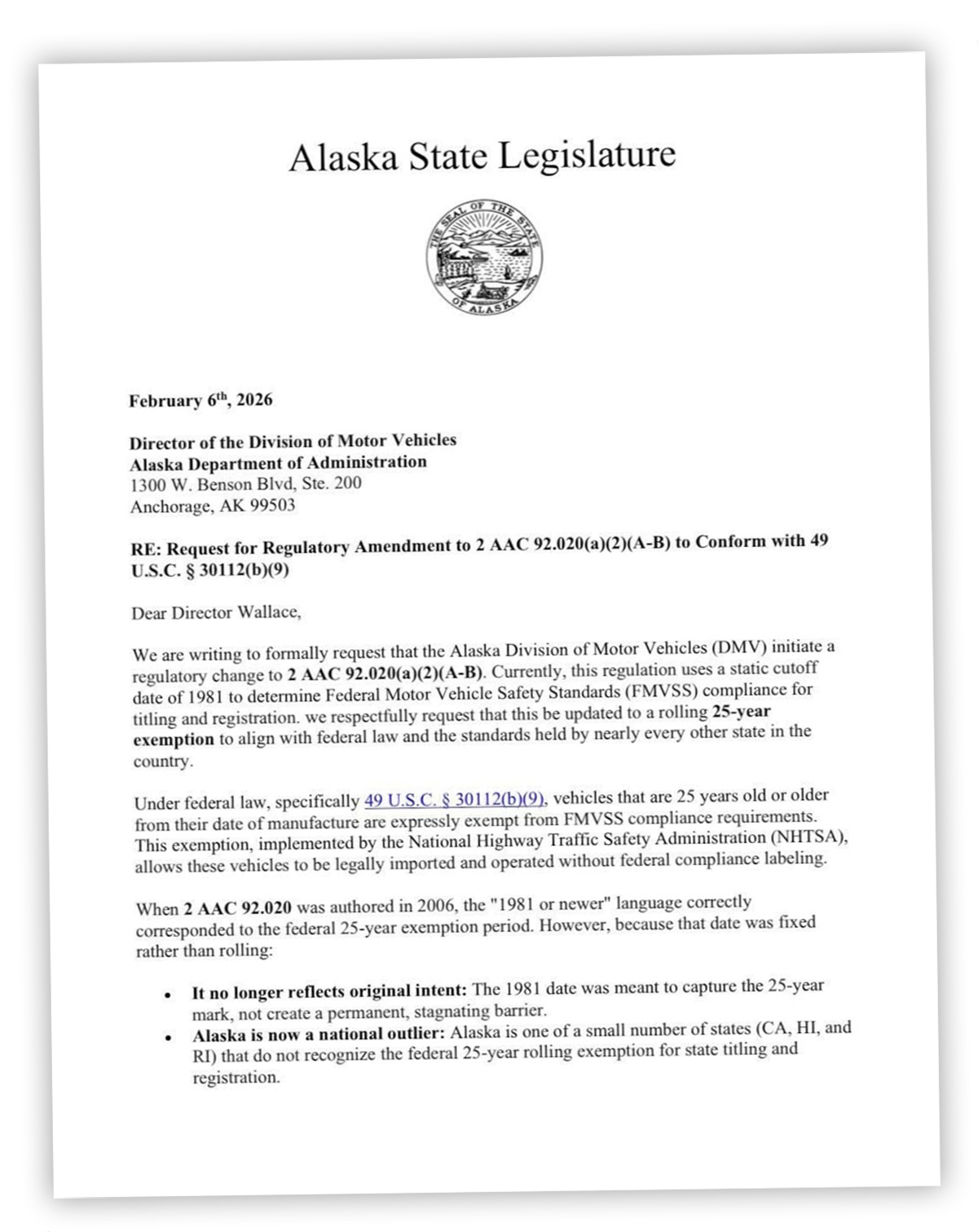
On February 11, 2026, Senator Cathy Tilton (R – Wasilla) filed Senate Bill No. 239, which stated:
A BILL
FOR AN ACT ENTITLED
“An Act relating to the registration and titling of legally imported motor vehicles; and providing for an effective date.”
BE IT ENACTED BY THE LEGISLATURE OF THE STATE OF ALASKA:
* Section 1. AS 28.10 is amended by adding a new section to read:
Sec. 28.10.068. Registration of legally imported vehicles. If a vehicle is at least 25 years old and was legally imported into the United States, the department may not require that the vehicle comply with current federal motor vehicle safety standards before registering the vehicle under this chapter.
* Sec. 2. AS 28.10.221 is amended by adding a new subsection to read:
(e) If a vehicle is registered under AS 28.10.068, the department may not refuse, suspend, or revoke a certificate of title based on the vehicle’s failure to comply with current federal motor vehicle safety standards.
* Sec. 3. This Act takes effect immediately under AS 01.10.070(c).
That’s it. SB.239 is a short bill, and if enacted into law, it would eliminate the 1981 hard line for a rolling 25-year rule. The awesome part is that the bill also doesn’t single out any kind of imported vehicle, either.
The bill is incredibly popular, too. A total of 12 Republicans, five Democrats, one Independent, and one Not Affiliated lawmaker all back the bill. As a result, the bill passed both the state House and Senate. Now, as of May 20, the bill is on its way to Governor Mike Dunleavy’s desk, who is expected to sign the bill into law. If the bill succeeds, Alaska will have one of the most pro-import laws in America.
The AAMVA

The one weird bit about Alaska’s law is that it actually predates the meddling by the American Association of Motor Vehicle Administrators (AAMVA). If you’ve been reading my import car law coverage for a while, skip to the end. Otherwise, if this is your first time here, I’ll give you a speed run about what the AAMVA does and why it has been such a thorn in the backsides of enthusiasts:
Officially, AAMVA is a non-governmental non-profit lobbying organization composed of motor vehicle administrators, law enforcement administrators, and executives from all 50 states, Canada, Mexico, the Virgin Islands, and Washington D.C. AAMVA does not have legislative power but its goal is to convince all members to adopt its ‘Best Practices’ to streamline driving laws across North America. Back in the late 2000s, AAMVA was made aware that Americans were importing tons of mini-trucks. These trucks were the 25 mph speed-limited off-road-only rigs, and their owners wanted to drive them on the road. Some mini-truck owners even modified their trucks to go faster speeds. The states, which, again, are all AAMVA members, didn’t know what to do about this.
The answer came courtesy of an Insurance Institute for Highway Safety opinion published in 2010. The Insurance Institute for Highway Safety crash-tested a mini-truck against a third-generation Ford Ranger and concluded that low-speed vehicles and mini-trucks are unsafe and should be removed from the road. AAMVA agreed, issuing the recommendation in 2011 that led to states banning mini-trucks.
AAMVA would ramp up its efforts in 2021, targeting all imported vehicles (and any other vehicle not originally built to FMVSS) regardless of country of origin or size, but AAMVA specifically has a bone to pick with Keis.
Click here to read my previous coverage.
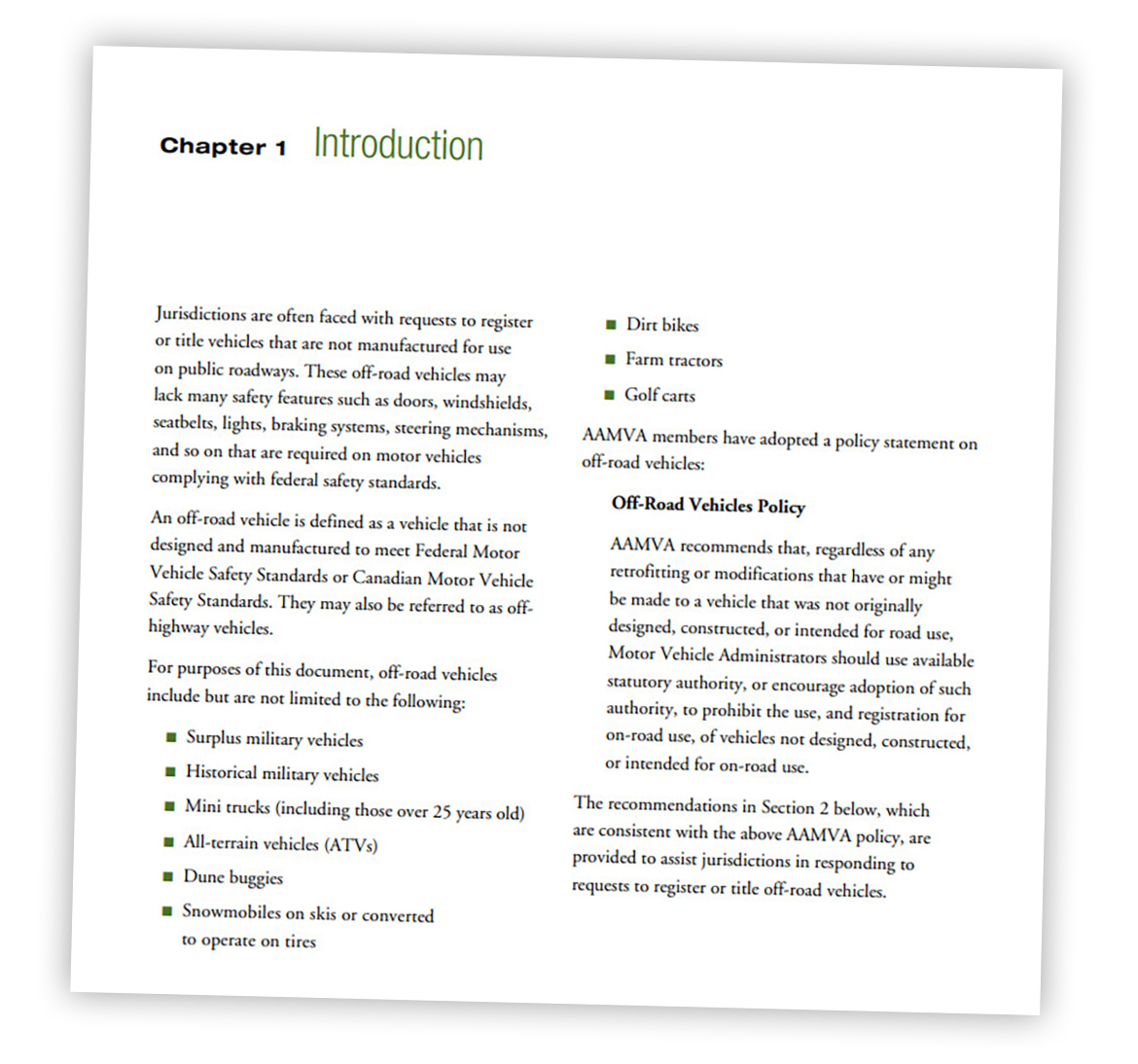
In 2021, AAMVA published ‘Regulation of Off-Road Vehicles: Best Practices‘, which specifically calls out Kei vehicles, as well as any vehicle not built to FMVSS, as needing to be banned. In at least one case, Colorado, it was found that the state’s auto dealer lobby and the state police were large supporters of a ban on imported vehicles.
In this case, it’s unclear why Alaska waited until 2025 to enforce its 2006 law, but it does follow the playbook of the AAMVA.
Strength In Numbers
What’s happening in Alaska is yet another example that organizing works.

Enthusiasts didn’t give up, nor did they attack their state. Instead, they reached out to their lawmakers, explained what was going on, and got those lawmakers on their side. Senator Tilton says that she was educated on this issue after one of her constituents imported a car, couldn’t register it, and then reached out to her. Now, her name is on the bill that could finally change the law.
The import fans in a lot of the states that reversed bans are merely following the playbook established by enthusiasts elsewhere. As car fans in North Carolina proved in 2019 and David McChristian and his Lone Star Kei proved in 2024 in Texas, organizing a group, establishing a unified message, and calling representatives works. Now, so many imported car owners across America aren’t just allowed to drive their cars, but have legal protections for their cars.
So, if you’re in a state that bans your favorite imported car, all is not lost. Get a group together, create a plan, and start calling lawmakers. Maybe you, just like the enthusiasts of Alaska, Colorado, Texas, Massachusetts, and beyond, might find success in befriending politicians.
Top graphic image: Cars & Bids


In a world where my 65′ Mustang is legal to drive on the road and motorcycles are allowed on the road its insane to prohibit vehicles for safety reasons. Let people drive whatever they want. If safety is important to you there are many options. If safety isn’t important you should be given the same freedoms to choose what you want.
Especially things like Kei cars. Sure, they are unsafe for their users, but by simple virtue of massing less than virtually anything else on the road with 4 wheels, they are considerably safer for all other road users.
This may be… Imprudent… Does the AAMVA actually do anything good? I apologize, but other than lobbying to get laws passed… Have they actually accomplished anything for the greater good? Or can we create our own coalition to go against them… Oh I don’t know the Autopian Association Society or AAS for enthusiasts?
Autopian Speedster Society 🙂
If the police AND auto dealers are for a law or piece of legislation, you can 100% rest assured that it is no good for anybody. Well, except the police and auto dealers.
FUCK THE AAMVA!!!
To the douchbags at the AAMVA:
Go fuck yourself. You’re all stupid fucking worthless pieces of shit. You dumbass jerkoffs fuck around and play games w/ people’s lives for no fucking reason. You have no value and are a scourge to society. If your bullshit scammy “organization” didn’t exist, things would only get better. You are a bunch of fuckface bullies. I don’t know how you live w/ yourself. Get bent, kick rocks, and again: GO FUCK YOURSELF!
“Tell me how you really feel”
Just did…to save time! Ha ha
These fuckers really make my blood boil…
Good for Alaskans, that was fast. What happened to Illinois? Are the state lawmakers hostile?
There are maybe two of us working with lawmakers in the state, and it hasn’t been successful. Everyone else is doing nothing.
I’m sorry.
Autopians in Illinois! Get with it, this is (still) a democracy.
A few dozen registered voters who make their voices heard can make a difference, and you will then be official Autopian Heroes, recognized across the country and worldwide.
Alaska is a low-population state, and it’s lawmakers are as often as not just regular Janes and Joes you can actually just walk up to in the street. So when they hear from their constituents, they are very often hearing from friends-of-friends, neighbors, business contacts, or what have you. Combined with the fairly compact legislative agenda, they have both the incentive and ability to make sensible laws like this in short order.
Illinois, on the other hand, is a corrupt bureaucratic mess. Just trying to get on a state rep’s calendar to discuss some fairly major investments we were trying to bring in to the local town took like five friggin months, and the dude could not fucking have cared less- jobs, schmobs. Doesn’t surprise me that Kei cars are getting no traction there, it’s not the kind of thing Illinois politicos care about.
I really appreciate the behind the scenes insight into why Illinois is a mess.
I believe that 1981 was the year that standardized VIN in the US to a 17-digit alphanumeric ID. Before 1980 they wouldn’t know if it had a US VIN or not.
Oh, but it’s fine to ride a motorcycle without a helmet if you’re an adult. SAFETY!
Or Alaska airplanes.
I have interacted with many a DMV EMPLOYEE, while they aren’t bad people they aren’t the brightest either. I’m willing to bet a illegal vehicle could be passed easily with all the badges removed and a VIN plate of a legal vehicle that looked similar or was rare enough.
Not that I am suggesting anybody does this. But if you do let us know if it works. Arizona is friendly I got my JH past their inspection program with a 6 digit vin that they said was already registered. I asked them what car and they said a Buick I pointed out Buick never had a 6 digit vin and I was legal.
It took me three attempts to get a vehicle through the DMV inspection lane, because the inspector wouldn’t approve the engine block serial number as a valid VIN equivalent on the title, even though that’s how the car’s always been registered since it was new in the 1950s, so I went to a different DMV office the third time, the employee there just glanced at the number on the block, checked the paperwork, and signed off, no issues.
The same thing happened when I went to register a small camper I bought out of state, the state it was from didnt title trailers under a certain curb weight, so it just had a transferable registration. DMV employee refused to register it and told me I needed to talk to the state police vehicle theft task force. Went to a different DMV office, the guy behind the counter, who was maybe barely 20, pulled out the guidebook for other states’ regulations, looked it up, and issued me a title, plate and registration immediately.
It’s not that they’re bad people or that they’re not smart. They are just allergic to hard work and any kind of out-of-the-box thinking. Their satisfaction scores are also tied to how long it takes to serve each customer, so they’d rather tell you to kick sand than take the time to solve the problem in front of them.
They shouldn’t put the 25 years in the state law in case the Feds ever change it.
They should just phrase it:
If a vehicle
is at least 25 years old andwas legally imported into the United States….I wonder if the Alaskan classic import scene has a Lada Russian cars?
Bravo *slow clap*
Gaz, Dude – Don’t be so Volga!
You can see the Lada factory from Wasilla.
Beat me to it. Thanks for the grin, again.
🙂
You’d think so, but nope! There was one guy who was mysteriously gifted a brand new Ural by Putin, though. Not sure if it ever made it as an Autopian post.