

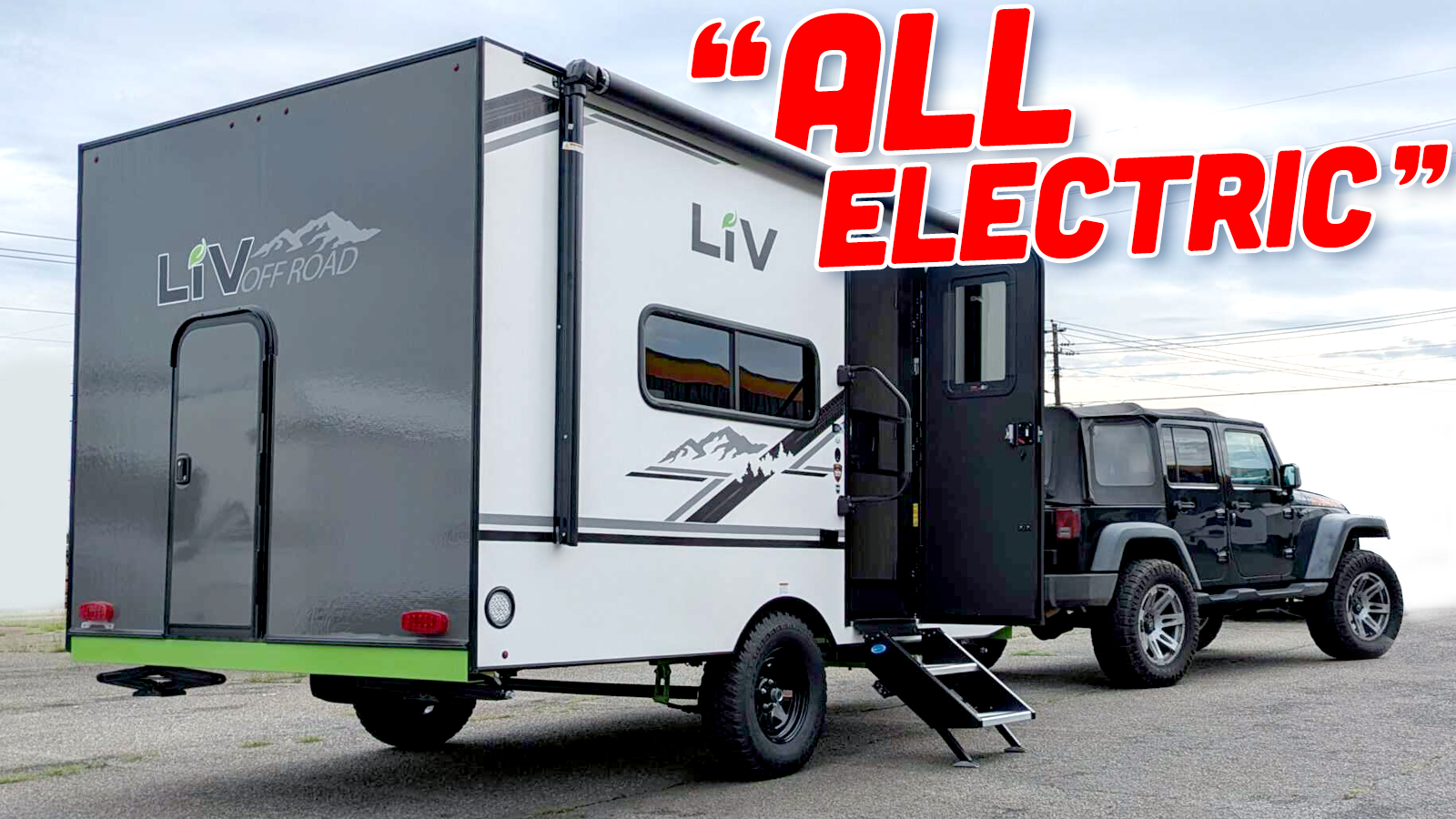
Since 2021, Lightweight Innovative Vehicle, or LIV, has offered RV buyers something a bit different. Instead of building its campers out of aluminum, wood, or even fiberglass, LIV came out of left field with campers made out of plastic. Since then, LIV has taken up a niche of the RV market for people who want to save some money on a new camper and don’t mind getting a little experimental. Now, LIV is taking itself a step further by introducing its first supposedly “all-electric,” off-road capable-ish camper. This is the LIV E-Leaf OffRoad, and it’s a plastic camper that can go off-pavement and still costs a reasonable price.
One of my least favorite trends in the RV space is how some companies handle off-road builds. It seems that, for some companies, tossing “off-road” or “overland” into a camper’s name is justification for a sharp increase in pricing. You can easily spend 30-large on what amounts to a pimped-out utility trailer with a roof tent strapped on top of it. If you think that’s bad, I implore you to visit Google and fire “overland camper vans” into a search. Be sure you’re sitting down. I’ve said it before, but there’s one RV company out there demanding over $500,000 for a Mercedes-Benz Sprinter van.


Some of these off-road builds aren’t exactly hardcore, either. Companies will slap a lift kit, knobby tires, and a mean graphics package on a camper and ask much more money for it. A lot of these rigs look great on Instagram, but make less sense when you actually start thinking about them. So, to me, it’s a bit refreshing when I see something like the LIV E-Leaf OffRoad (the official name doesn’t have a hyphen). It’s an “off-road” camper that’s devoid of most of the gimmicks from recent RV trends. It even costs less than the last camper I wrote about.

Why Plastic?
I have covered International RV’s LIV quite a bit over the past few years, but it’s still a startup company that most RVers don’t know about. The company itself hasn’t really figured out how to get its name out there. It teased the E-Leaf a month ago, and nobody noticed until now. So, if you’ve read my previous entries on LIV, continue on! If you’re new here, I’ll keep it short. From previous reporting:
When I first saw International RV’s LIV in 2023, the company’s display was tiny, and they couldn’t even get into the big RV show in 2024. International RV has come so far. It had a huge display at the 2026 Florida RV SuperShow with lots of models and a bunch of salespeople. LIV is the RV brand of International RV, which was founded in 2021 in Americus, Georgia. The company’s mission is to solve one of the biggest problems that RV owners face today: Poor longevity due to poor build quality and water leaks. The people behind International RV came from Factory Direct Marine & RV, a retailer specializing in boats, RVs, and their associated parts. This experience in boats trickled down into the RV operation. You’ll see what I mean later.
When LIV debuted in 2023, it made a splash with how it builds its campers. Every LIV trailer is built from top to bottom from a thick thermoplastic honeycomb that is ultrasonic-welded together, making for a “single-piece” shell. The floors and the interior furniture are also plastic and welded to the main structure, too. International RV proudly notes that there’s no wood to rot, no particleboard, no rubberized roofs, and no destroyed rainforests.
International RV says that its honeycomb structure, which is over an inch thick, is so strong that the roof of a LIV trailer can hold 3,000 pounds. The structure also forms a unibody, which negates the need for a large supporting frame. When you look under a LIV, you see a basic and rather small frame, and it holds the trailer’s tongue, tanks, and axle.

International RV does listen to customer complaints. I’ve been a member of the official LIV owners group since 2023 and have seen many complaints. Some members have complained about sticky roof sealant that collects grime, sticking doors, poor quality caulking jobs, lousy propane gas flow, frequent circuit breaker trips, and even missing parts. The missing parts were sort of unacceptable, too, like stabilizers that had missing bolts or cabinets that didn’t have their doors installed. Early LIV adopters also complained about how boring their interiors looked.
To the company’s credit, International RV admitted that it had quality control issues and was working on retraining its production staff alongside doing better quality checks. Since then, I have noticed fewer complaints about newer trailers, and the newer trailers also have a lot more welcoming interiors, too.
That being said, International RV still has room for improvement. Checking the LIV owners group today reveals complaints about poor customer service, poor fit and finish of certain parts, and even some reports of minor water leaks. Personally, I also noticed some poor fitment of some interior bits on the campers that LIV brought to the Florida RV SuperShow this year.
I must also shake my head at International RV for using AI slop in its official materials. Come on, guys, this doesn’t even look real. AI slop makes your company look less legitimate. Gemini couldn’t even spell “off-road” correctly; it’s just bad:

All other images in this piece are not AI-generated. Hey, International RV, let me borrow one of these, and I’ll get you real pictures.
Thankfully, none of the reported issues I’ve seen concern structural problems, so it seems like International RV got that part right. Most customers seem to adore their campers and report that, even with the lingering quality control issues, a LIV is still built better than a typical camper. Yes, the bar is just that low. Personally, if I were to buy a new camper right now, a LIV would be near the top of my list.
So then, what have the people at International RV cooked up now?
The Mostly All-Electric LIV
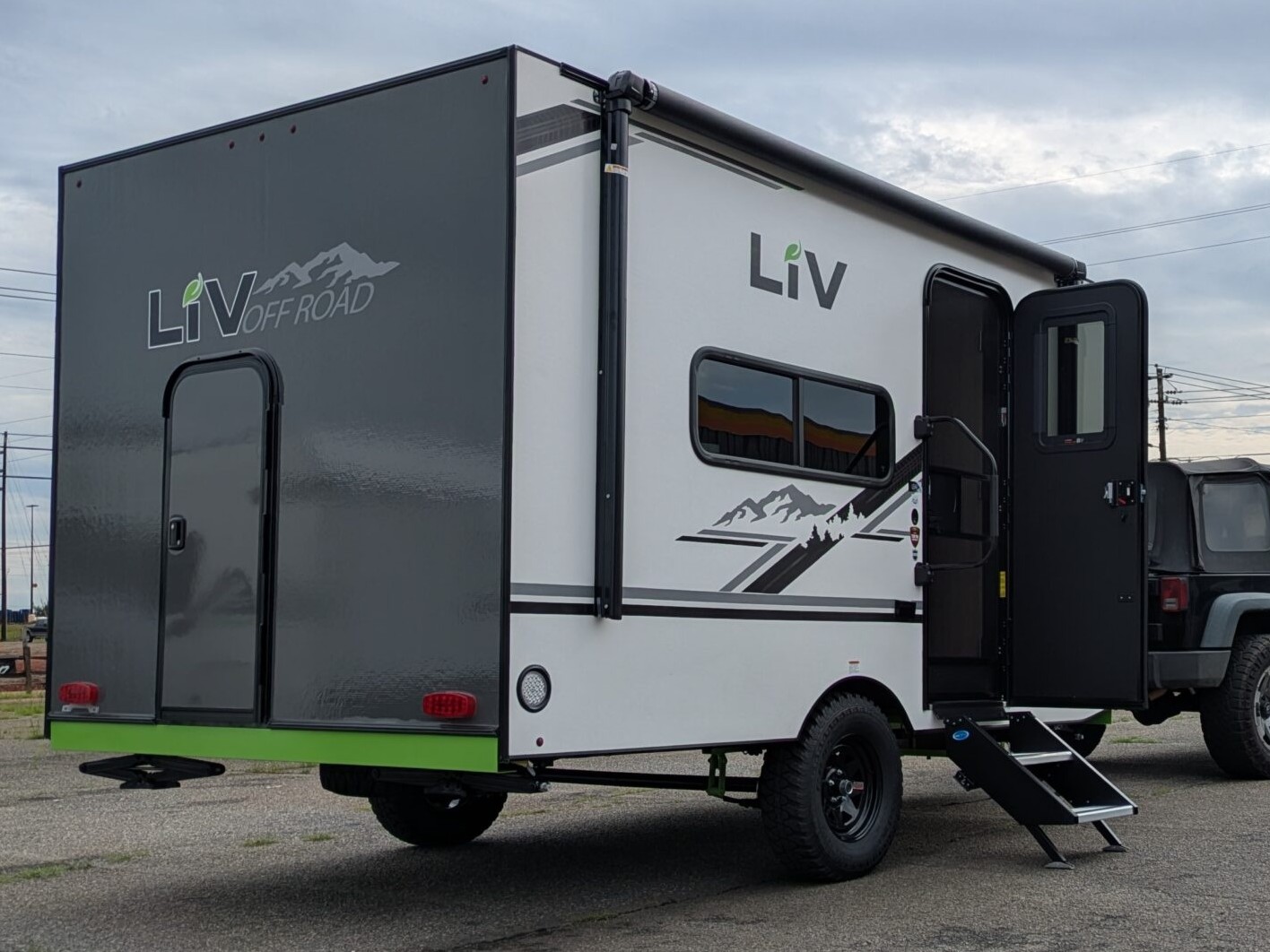
The LIV E-Leaf OffRoad starts off as a typical LIV trailer. It has the same heat-fused “one-piece” unibody as other LIVs.
What’s different is what’s underneath. A typical LIV has a minimal steel trailer chassis underneath, and its job is to carry the trailer’s axle, tanks, and tongue. This one sports a bright green frame, and International RV says this one is different because it features underbody diamond plate to shrug off hits from rocks and trail debris.

Another slab of diamond plate can be found up front, though that’s a feature that other LIV trailers have had since the company’s start.
Other changes to the outside include two 200-watt solar panels, off-road tires, and a graphics package that slaps a small mountain onto the side of the trailer. The E-Leaf is based on the 13 Leaf design, and, like that trailer, I would also expect the E-Leaf to be available with a lift kit.

The biggest change that International RV is advertising is inside. Normally, the smallest LIV trailers have a propane system for the stove, furnace, and outdoor grill. The E-Leaf does away with all of that, and replaces all propane appliances with electric equivalents.
Now, when you walk up to the stove, there’s a single-burner electric cooktop (but still no backsplash). The eight-gallon water heater is also electric.
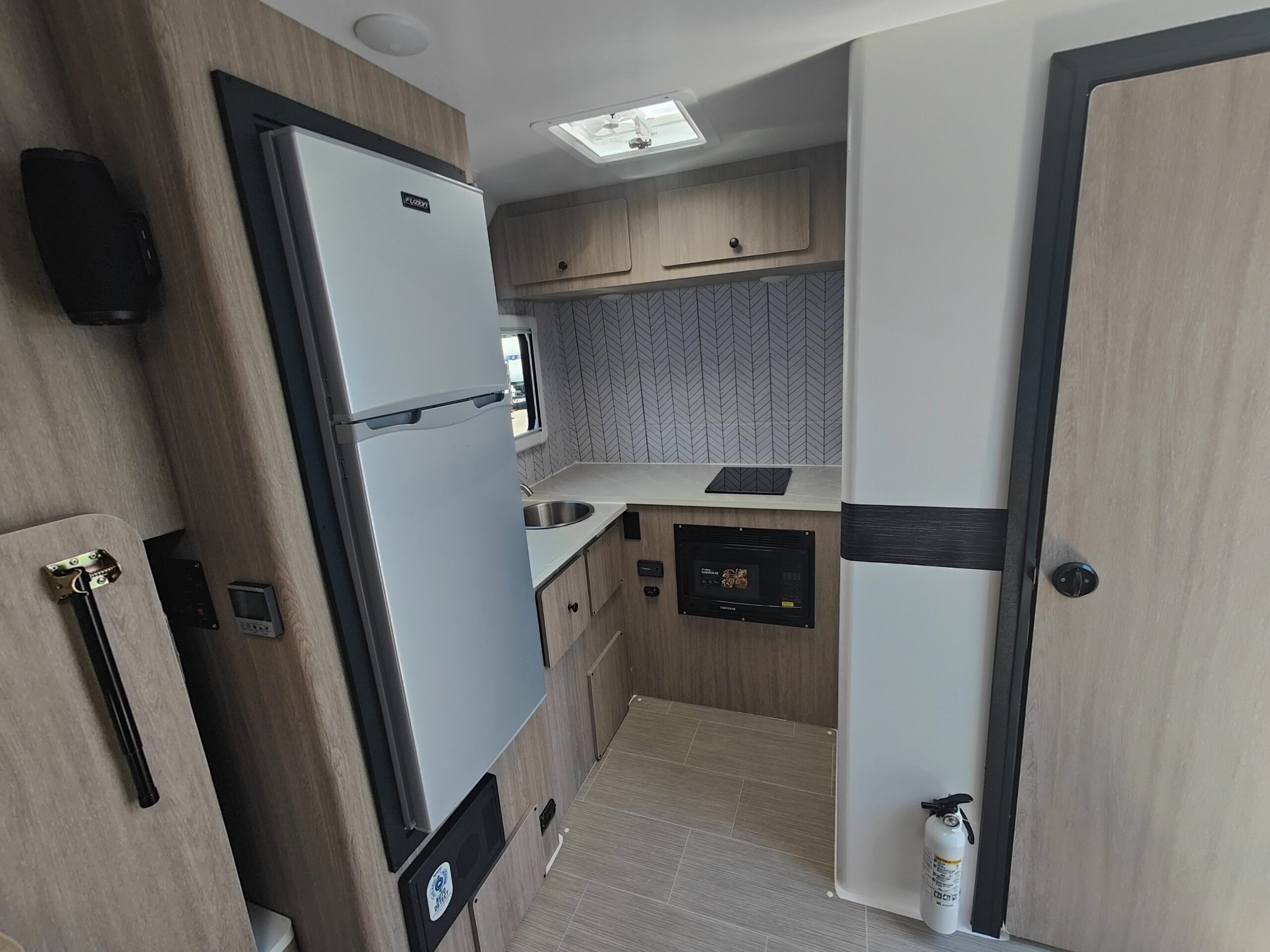
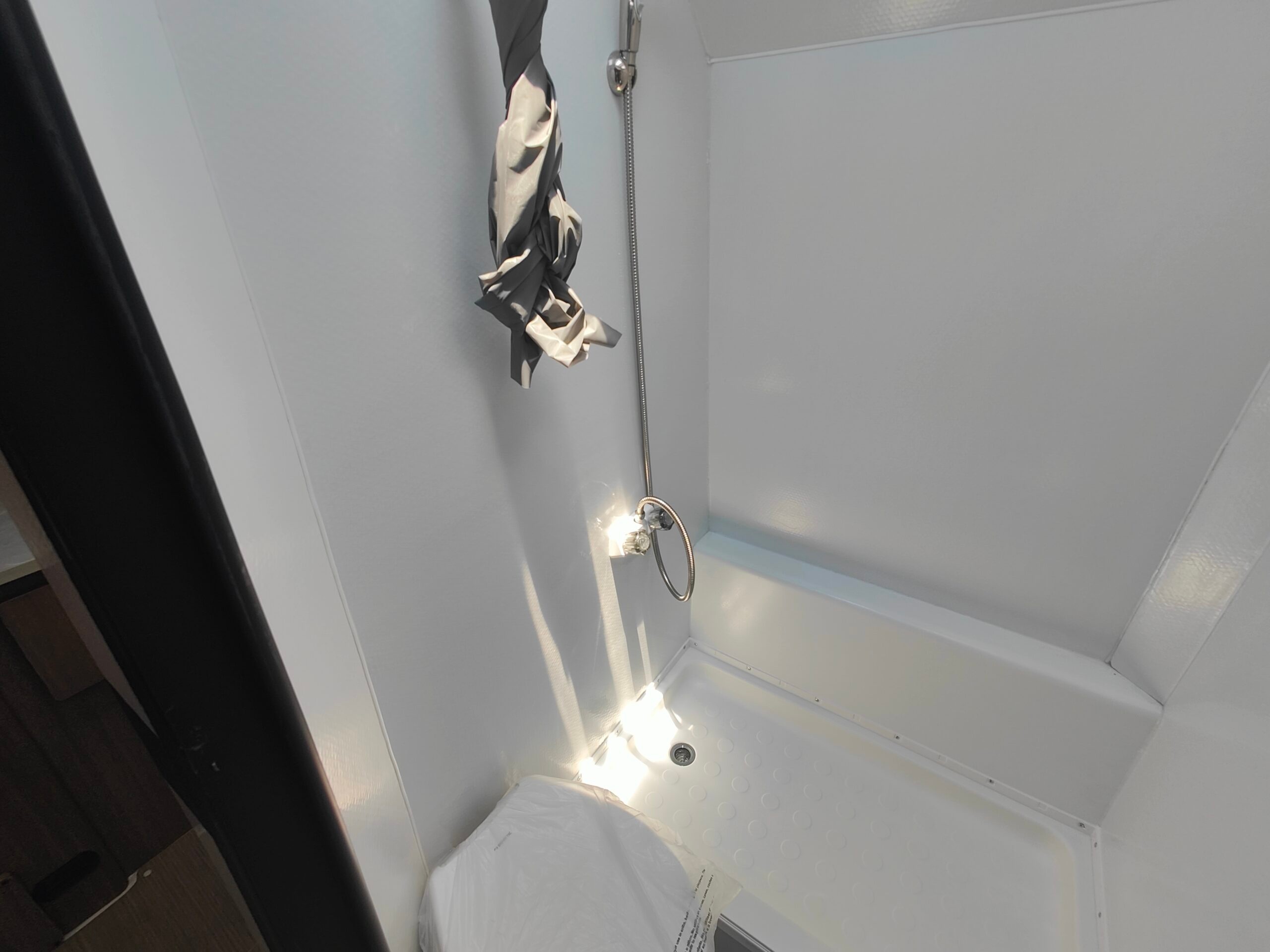
The layout of the E-Leaf is similar to the 13 Leaf. That means a galley kitchen up front and a dry bath right next door. Behind there is a convertible living, dining, and workspace that turns into bedding for up to four people at nighttime. A small TV takes up the back wall for those campsite movies.
The new interior also sports a couple of neat upgrades. Gone is the residential-style wall air-conditioner and gone is the wall-mounted electric heater. In their place sits an under-bunk air-conditioner and heat pump. The new setup eliminates one hole from the trailer’s body and gives the trailer a better overall appearance.
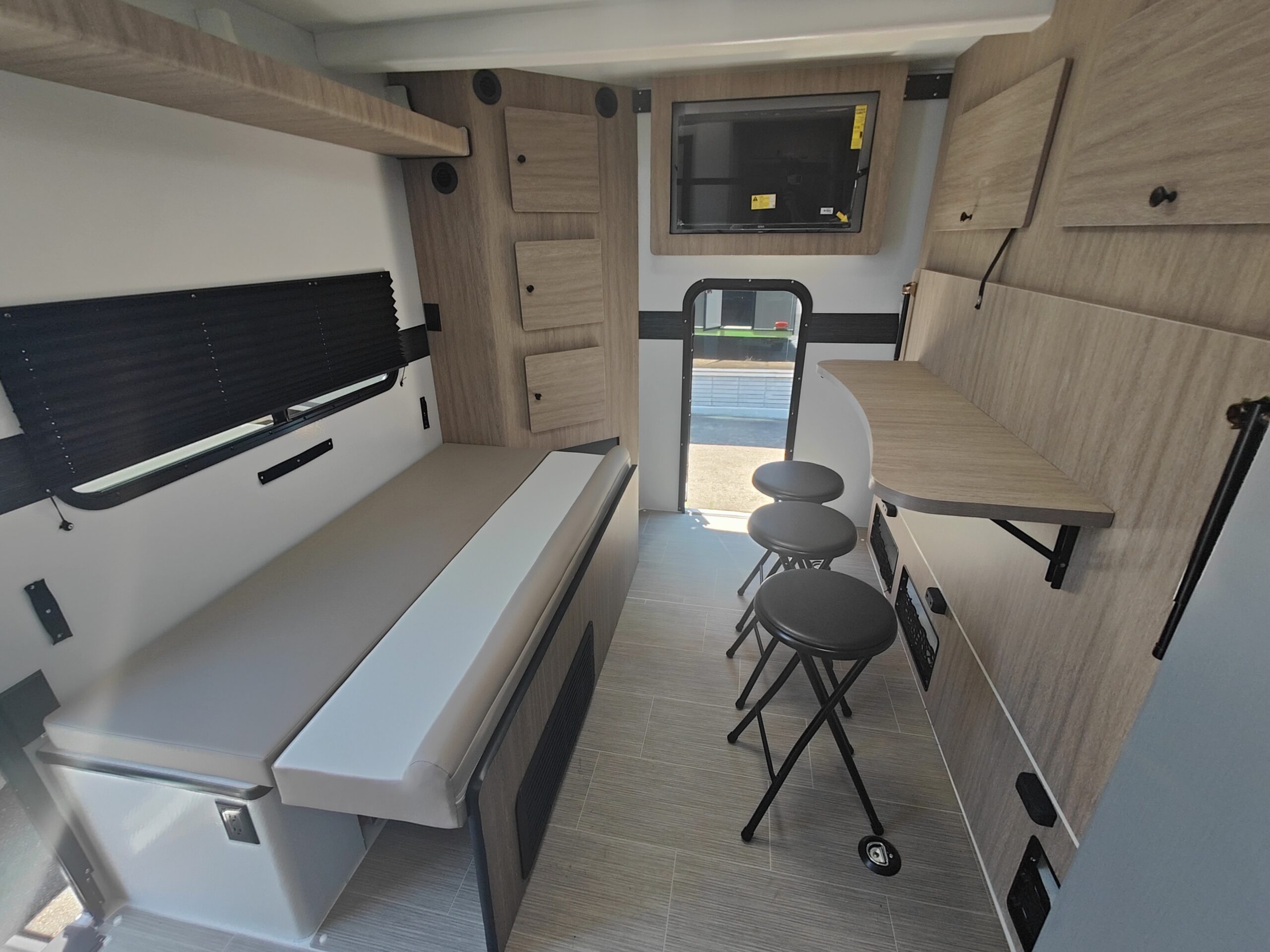
As far as equipment, like all of the cheaper LIV trailers, there’s nothing that’ll blow your socks off. It has a refrigerator, a stainless steel sink, and a microwave to go with that electric burner.
The electrical system includes the aforementioned solar panels, a 60A MPPT charge controller, a 3,000W inverter, and a 300Ah lithium battery. A 20A DC-to-DC charger tops everything up while you’re towing the trailer. If you happen to run the stores down, the trailer comes with a Westinghouse iGen2550 Inverter Generator for backup power.
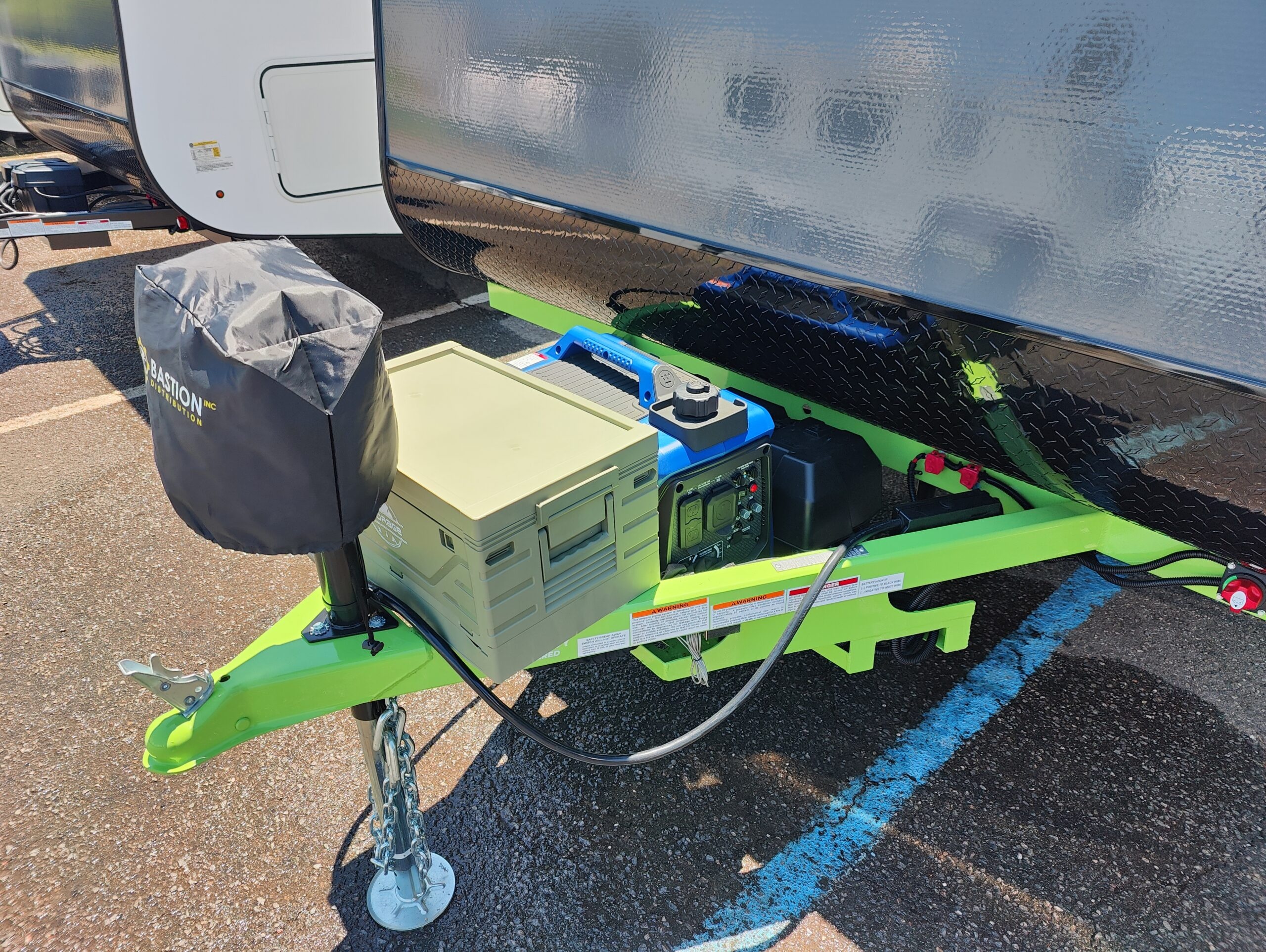
Of course, that does place a caveat on the whole “all-electric” thing. Technically, the trailer itself is all-electric and can be used as an all-electric camper. But burning gas is an option.
I’m okay with that caveat. International RV knows that there can be times when you run out of juice, and you can shut the generator off the moment the battery is topped back up. I know that I would probably fire up the generator on some unbearably hot and sticky nights here in the Midwest to get some air conditioning.
International RV has not set a production date just yet, so if you want one, hang tight. The E-Leaf’s spec sheet also has not been finalized, but since the E-Leaf is based on the 13 Leaf, I can at least speculate what you’ll be getting. A 13 Leaf is 17’2″ overall with a 13’7″ living space that has 6’7″ of standing room. It carries a 25-gallon fresh tank, a 30-gallon gray tank, and a 30-gallon waste tank. When equipped with the off-road package, the 13 Leaf gets 15-inch wheels and tires.
A dry 13 Leaf weighs 1,890 pounds, has a 340-pound tongue weight, and a 660-pound cargo carrying capacity. I would expect the E-Leaf to have similar dimensions, but a weight closer to 2,000 pounds. Obviously, that does not leave much room for heavy gear, so keep that in mind.
Seems Reasonable

International RV says that you’ll be able to score an E-Leaf for “under $25,000.” As of publishing, the standard LIV 13 Leaf, which rides on street tires, is $19,000 before options. LIV doesn’t advertise how much the off-road package costs, but either way, it suggests that LIV thinks the addition of a heat pump, off-road tires, solar panels, the charging hardware, and an inverter generator is worth less than $6,000. How much less is unclear until International RV finishes the spec sheet. Maybe my eyes have been clouded by crazy expensive builds, but that doesn’t seem bad.
I like that the E-Leaf is not promising to take you to the ends of the Earth. It’s not covered in miles of bedliner. It doesn’t have random MOLLE panels, gun racks, or traction boards, either. It’s just a camper that should be able to take a little bit more abuse. You can even see that it has a fairly standard trailer axle. You aren’t really taking this down the toughest trails. But a mild to moderate fire road to your favorite camping spot? Sure! I toured a 13 Leaf earlier this year and thought it was a pretty neat, cheap-ish camper. It’s sad that the camper’s price has gone up, but it’s still in that affordable range.
At “under $25,000,” the E-Leaf is even a few grand cheaper than the Clasica fiberglass camper I recently wrote about while having tons of more features and more room to relax in. So, while the E-Leaf isn’t the perfect camper and it comes from a new brand that still needs to improve itself, I think it’s still a pretty reasonable choice. It’s not crazy expensive, should be pretty simple to use, and doesn’t weigh a whole lot. So long as you don’t mind the whole plastic experiment, it could be a fun little rig, I think!
Top graphic image: LIV





Wow, I’ve been thinking that LIV sounded sort of interesting due to the plastic instead of stick builds; but now think less of them due to the quality problems and especially the fucking AI shit- I boycott all companies using Artificial Idiocy as much as I can. Another side note I just thought of is I’m sick of so many plastic products so me buying this would just add to the plastic problem. Would rather have fiberglass which is way better and it’s great even the classic ones have lasted this long so they contribute less to a throwaway society. Also, oh I just can’t wait for these to leak and then short out the batteries, etc. ha ha… that’s if I got one and I’m definitely not their target customer anyway.
“under-bunk air-conditioner and heat pump”
What in the fresh hell stupidity is this? The LAST place for anything mechanical like that should be is right under where you’re trying to… SLEEP!”
That doesn’t strike me as a terribly robust axle setup.
I volunteer at a antique radio museum and we have to travel around a lot with our stuff to various shows. And to power the radios we take along Li-ion battery systems to power our stuff. What I see stuck to the front of the camper looks like a single li-ion car battery. That’s not a huge amount of capacity for what the stove and fridge is probably going to require. I would have at least doubles what they have there.
Buddybears, more interested in your comment about antique radio museum involvement & the shows you mention than camper details. My sister & i had our grandparents McMurdo Silver Masterpiece V electrically restored a few years ago. I stumbled onto an incredible online source of info about restoration specific to that model. i eventually supplied Gerry O’Hara’s PDFs to my repair facility to assist them with the project, that came from western canada & where he is radio enthusiast /volunteer for SPARCradio museum. I have never seen a radio museum or any antique radio shows. curious to hear more about your involvement & whether these shows happen in Northeast US. Lars
Ah lovely. McMurdo radios cost more than a car when they were new. I like to call those the equivalent of the horsepower wars during the muscle car era. In the 30’s some of the upper end and even consumer brands would have models with large quantities of tubes since…. more tubes must be better! We have a few McMurdos as well as Scott radios in our museum and one has the better part of 30 tubes. All built like a fine watch.
I volunteer at the California Historical Radio Society and we have a few 1000 pieces along with audio and video equipment. We are having a big event this weekend and will auction a lot of sets we worked on.
The good news is these radios can be kept working forever. You can alway replace things on them, the tubes were and are still very plentiful and often have multi-thousand life expectancies. If yours has an audio input for a record player, you can run a bluetooth module through it. The do sound remarkably good. I use mine all the time as my actual sound systems
my MasterPiece V does have an input for phono. that is a physically weird connection i dont recognize, to say the least. Also an aux RCA type input port likely an after purchase addition. audio levels through that RCA connection are quite low & seems a bit of a waste to not use the tuner section after having all that electrical refurbish work done. the unit does have the original massively large 40+lb speaker in excellent condition. I have since purchased a little AM transmitter. it runs fine on 9v battery, but still plan to make a wall powered clean& solid 9v supply to run it continuously.
The RCA input was probably for an earlier record player. Earlier units would use a salt crystal pickup that would put out a pretty large amount of voltage ( for a record player ) of 1-2 volts versus a modern unit that’s a fraction of that. So if you run something in now the signal is quite low. You can cheat in getting a cheap equalizer with a separate volume control. Then you can run a hotter signal in and get better performance out of the giant speaker.
I love a bit off-rording.
Mercedes, next time you mention an RV is reasonably priced, please include the price in the first paragraph. I’m tired of going to the end of the article to find out its a plastic box with poor quality control for $25k.
$25,000 sure buys a lot of nights in a comfy hotel.
The irony of building an “off-road” camper that requires an electrical connection is…delicious?
I realize it has a fair-sized battery and some solar, but that giant electric fridge is going to suck down the battery in a hurry, and 200W of solar isn’t going to be enough to come close to replenishing it. Which I’m sure is why the generator is included, but who wants to sit and listen to a generator at their remote campsite?
“Other changes to the outside include two 200-watt solar panels”
400 watts but that still isn’t enough. Solar panels are cheap and I’m sure there is room for more on the roof. If you are going to go all electric don’t cheap out.
The other part of it is that these almost-residential sized electric fridges take too much power for off-grid. I have family who use electric coolers when they camp, and they can run indefinitely off a 100W solar panel and a basic lead acid battery, but they’re substantially smaller than this. If they halved the size of the fridge it could probably work with 400W and 300Ah.
No doubt – those dorm fridges are horrible. I like 12v DC chest fridge / freezers My Dometic 35L would run for days on 200 Ah of lead acid batteries and 200 watts. For my current build I switched to ICECO. A little louder but still very efficient.
400W is getting there. That’s probably enough for the basics like lights, pump, and fridge assuming it’s a 12V marine/RV fridge and not a regular residential one. At least, as long as it’s in the sun. It’d need a lot of battery to bridge cloudy days, though. Or some generator time.
As I mentioned above – my Astro conversion would go days running lights and 12V 35L chest fridge / freezer with 200 watts of solar and 200 ah of 12V lead acid batteries. The fridge draws about 350 Wh a day so that is 3 1/2 days on the battery to drop down to 50% SOC. Never had a problem with power until the batteries got old.
400 watts would be better but still pushing it when combined with an induction cooktop. Batteries don’t last long drawing 1,000 watts.
Maybe this is a basic question, but why do ‘off-road’ campers need knobby tires? Traction for breaking or something else?
You don’t want the trailer to move laterally when towing on a side-grade.
The guys that had off-road rigs around here back during the Great Recession ran the same wheels and tires as on their wranglers or tacomas. Basically carrying two spares. You could drop the trailer and still get home.
Now right it’s got to be mostly a badging thing though. Maybe a little bit of floatation too with the wider contact patch? Maybe a little reduced rolling resistance with the increased diameter?
I like the idea of the LiV plastic camper, and the price is good. I wish they weren’t so darn ugly and had some more windows.
Having owned two vintage Airstreams, a vintage Winnebago trailer, and a modern 14’ KZ Sportsmen Classic… I’ll never buy another leaky, heavy wooden box. Our beat up 40-50 year old Airstreams were soooo much easier to pull and well-constructed.
Our next camper will be a streamlined aluminum or fiberglass egg, or just maybe a LiV if they fix quality and come up with a design I like.
Windows are key (though tough with smaller campers like this where wall real estate is important). I don’t want to feel like I’m living in a plastic box. This particular example could use another window or two.
The KZ Sportsmen did that well for such a small trailer. Three big windows around the dinette / bed in front, a small window over the sink, a big window over the side couch, and a window in the door. Great layout, too bad it was coming apart at 10 years.
The reasoning may be that windows = unwanted heat transfer. Especially lightweight, thin windows. More, larger windows cut into the amount of insulated wall area, so the heat or cooling will have to work harder.
If you’re not worrying about thermal losses, then designers can knock themselves out with lots of big, panoramic windows, and they often do in conventional RV designs. But those rigs really need some shade in the summer for their A/C to keep up, and they’re far from ideal for winter camping in snow country.
High-end motorhomes tend to emphasize self-sufficiency to one extent or another, and they’ve been built with more insulation than most trailers and fifth-wheels for several decades. They also use double-pane windows for better thermal efficiency. Even so, they tend to have noticeably smaller windows to help cut unwanted heat transfer. It looks like this trailer is following a lot of the established conventions that the motorhome end of things has been doing for a while.
I wonder if the small windows are a consequence of the all-plastic body. With no metal frame reinforcing around the openings it might get too flimsy with big windows.
Indeed! Windows are heavy!
The problem with any of these cheap trailers is the beds look awful. Like shit hotel level. Like sure the other stuff is great but when you wake up with your back locked up, it is kind of pointless.
I imagine people have a tendency to leave the dinette cushions turned makeshift bed alone, but like, the main beds in these sorts of things… people have to be replacing the padding with real mattresses right? I’d have to agree, if the point of a camper is to have a real bed to sleep in, ideally you’d wake up without feeling like you slept in a tent.
Yeah, though I do not think you could replace this with a real mattress due to the space and how it looks to split.
Yeah I’m actually having trouble figuring out the bed situation from the pictures. Looks like there’s that sad bench thing, but then also a fold down bed from the cabinet that makes up the “bar” area? Oof, is there a chance the fold down and sad bench chunk merge into one bed? That would not be very appealing.
It’s… not the best interior design, lol. I will admit that.
A lot of people put a memory foam topper on their crappy RV mattress to make them liveable.
It looks very Chinese. I suppose the Chinese have been building trailers out of plastic like that for a while. But they are about $3k. Even the trailer frame looks Chinese sort of looks like one of those harbor freight bolt together trailers. I think you might be better offer with the hobo freight trailers with a shed on it you could even get a plastic one I suppose and the finest of Amazon, Walmart, and eBay components. Can probably be done in a weekend or two for significantly less. I don’t hate the idea but I don’t understand the price. Maybe when it magically gets half off at the rv dealers like they always do for slightly under $10k or maybe slightly under $12k for the solar all electric version I could sort of see it.
It does seem to have a few Chinese parts (like the entry door), but the body is built in Georgia.
What camper doesn’t have lots of Chinese components?
Lightship? And the possibly the random guys building “tiny house on wheels” . It would be interesting to see what is the most north American content trailer.
I’m curious if they got the idea from the Chinese went we can build this here then just sort of modified a design to more American specs. Even the way they are building the body looks similar to how the Chinese do it.
I feel like for the price of the genset, they should’ve just dropped a larger lithium battery in the rig.
Other than that, not a bad little unit.
I agree with you, why bother with a genset – you could have put another 300ah or 600ah battery in its place.
Looks like there’s also probably roof space for more solar, too. Something like 600W of solar and 800Ah of battery would make all-electric way more feasible.
Which I’m all for.
I can’t wait to see more electrification in this field, where people can enjoy their tech without gensets humming away in nature.
I like these. I get that campers in general are expensive (these are luxury items guys) and not exactly screaming values. As for the construction, I’d rather take a chance on the plastic versus the shitty plywood construction that ALWAYS fails. Especially for a price that’s competitive with the plywood. If the interior is a little chintzy to keep the price down, so be it.
Who knows how it’ll go long term but I’m rooting for it.
I still just doubt their reasoning behind plastic. I get it, plastic serves a purpose. But we have decades of experience using wood, metal, (whatever) and ending up with waterproof enclosures. Having to resort to a plastic welded box doesn’t seem like the right answer. How are those weld joints going to handle stress and strain. What happens if any of those sealed joints crack? Doesn’t seem easily repairable.
If camper/RV companies just stopped using the absolutely cheapest materials with the absolutely cheapest assembly processes, this wouldn’t be an issue at all.
How many campers have ipe on them? I’ve got to wager most are made out of cheap (and renewable) trees more common in the US and Canada.
But yeah, let’s use a bunch of petroleum products to save rainforest destruction.
Pretty sure most of the plywood you find in campers comes from Indonesia.
Fair enough. But Indonesia certainly isn’t the only plywood source. They could (like I said the first time) just not source the absolute lowest quality/cheapest plywood. Heck, use something like Advantech, which is made domestically, and it eliminates like 3/4 of the problems they site with wood.
I’m just not convinced that building so much of a camper out of plastic is the right answer here.
And maybe it’s not, but after decades of people like Mercedes begging camper manufacturers to use better materials, those companies have continued to refuse. As long as people are willing to finance 60k houses on wheels made from luan, they’re gonna keep on keeping on. To draw in those “never again” people who have sworn off plywood campers, it makes sense to go with a completely different material from a marketing perspective. Might it be more risky? Yes! But it’s an easier sell than “we swear that this time we used less shitty plywood!”.
I would imagine there’s some other issues with using higher quality woods, most notably weight and flexibility. But I’m certainly not an expert on this sort of thing.
They use laminated lauan plywood for the paneling, which as far as I can tell is mostly from critically-endangered tropical trees of various sorts. Floors are probably more regular plywood or OSB.
I’d be interested to know how they protect the plastic body from UV and weathering. Is it just the paint, or is it formulated to resist these things?
half the exterior on cars is plastic and in general they hold up for years.
But campers are expected to last much longer than cars. /s
I’m also curious about flammability. I’d hate to wake up in a burning Rubbermaid bin. If I would even wake up with that toxic smoke.
It generally takes quite a bit to light plastic on fire, certainly more than it takes to light wood, but yeah, the fumes would be bad.
Unlikely to be any worse than normal wood-and-fiberglass laminate RV construction. They all go up pretty fast. There’s a reason they all have smoke detectors, CO detectors, and LP detectors plus egress windows.
If quality is obviously lacking on the small stuff, it makes me wonder about big stuff (like structural integrity). Concept sounds good on paper (CAD).
I’m looking at this thing and marveling at the idea of spending $19,000 and getting so little. Or the “off-road” version for six G’s more, and it looks about the same.
The clapped-together nature of RVs has always been disappointing to me. I used to be way more interested than I am now, but it’s been a recurring theme to me that the damn things only look good. Beauty, as they say, is skin deep. I’d see the shoddy construction details inside even the higher-buck models from Foretravel and Beaver and, yes, Wanderlodge and just be so disappointed.
I think I’d be happier shopping for a trailer and refitting it myself. I just found a 12′ trailer for sale for under $4k, that leaves a lot of room in the budget to, I dunno…do better. Or if not better, then at least have no one to blame for the cheap construction but myself – or to congratulate for the attention to detail, materials or reliability, for the same.