

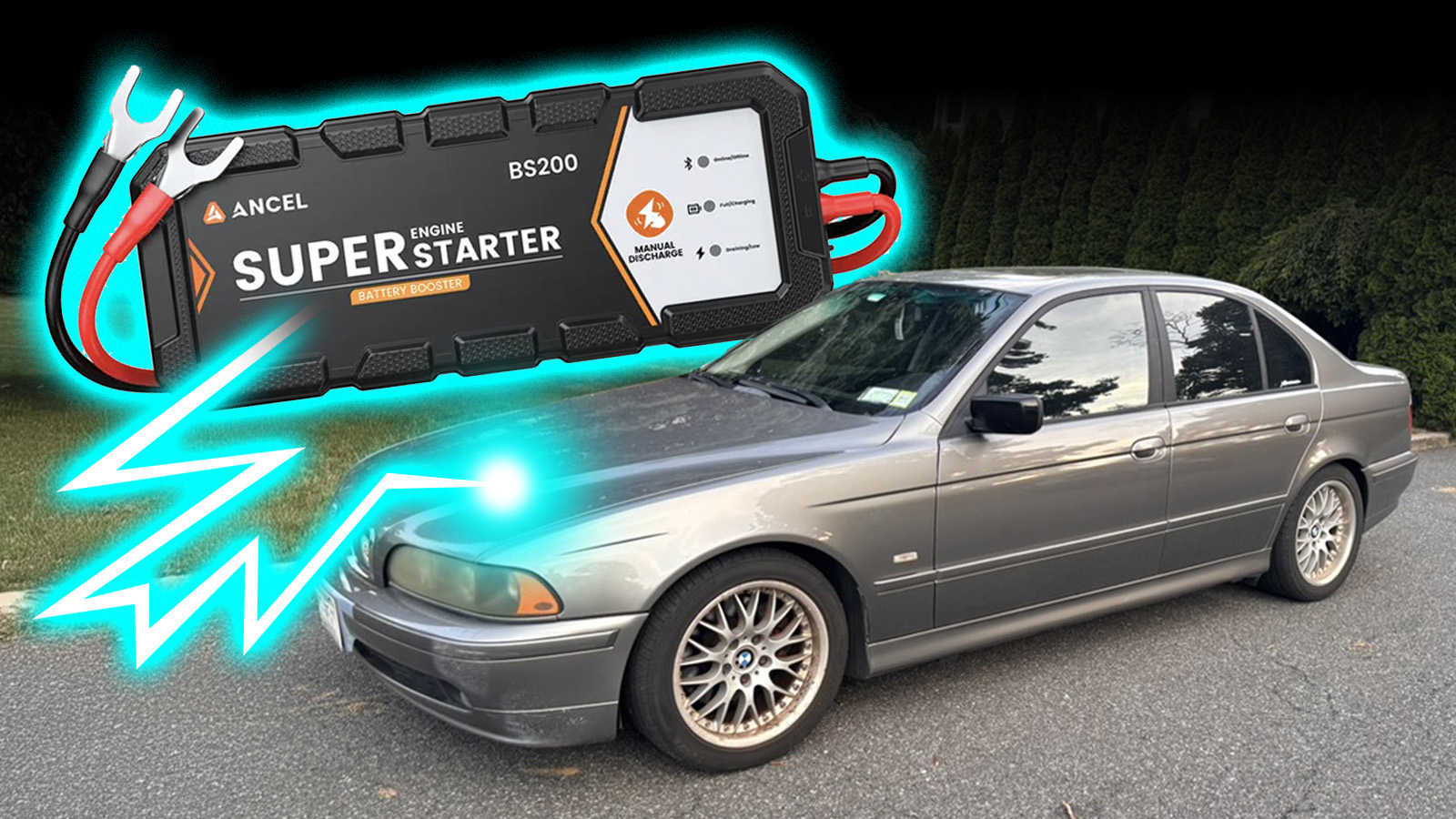
I am a car enthusiast without a garage. I park my beloved high-mileage manual E39 “Clive” in a city parking lot, with no ability to trickle charge the battery when it’s sidelined for long periods of time. There’s also a slow parasitic draw that I think is linked to the aftermarket system that I use to play music from my iPhone. My lazy solution has been to disconnect the battery when I know I’m going to put the BMW on ice for a while. If I forget to do it, I often have to jump my car’s battery, which is annoying when I’m in a hurry (the only time this seems to happen).
While I typically recommend a portable jump pack to anyone with an old car, I often find that when I need that particular bit of technology most, the portable jump pack is also dead. Some of this is my own fault, because I could either be more thoughtful about how I take care of the car or the battery, and just be better about disconnecting the battery. I know another E39 owner who has a little solar cell that trickle charges the battery, which probably isn’t going to work in a public lot, even if it’s a clever idea.


It’s gotten bad enough that I’ve had to lug the very heavy 12V battery out of the awkward trunk position in the BMW in order to take it to AutoZone for a quick refresh more than once. I hate doing this, which is why when aftermarket tools builder Ancel reached out to see if I’d test out its BS 200 Super Starter, I decided to be at least a little proactive and try to address the problem.
My expectations were low, as I’d never even heard of a super capacitor-based starter assistant before and was only vaguely aware of the company. The promise of using algorithms to “intelligently detect” the stress on a battery during startup and therefore surge energy to protect the battery sounded like silly marketing-speak to me.
It’s now been six weeks of putting this system through its paces and, other than a slightly tricky installation due to the E39’s rear-mounted battery, it’s honestly been the best upgrade to the car since I purchased it. The stress of not knowing what’ll happen when I turn the key is gone, leaving me room to get stressed about entirely new things.
What Is A ‘Super Starter’ Anyway?

The concept of a jump pack is fairly straightforward. Every version I’ve had is basically a large lithium-ion battery with an attachment for jumper cables. You attach the cables to a dead battery, turn the car on, and hope you charged your battery pack full enough to get the car to crank.
A ‘Super Starter’ battery booster is a little different. For one, the rectangular box doesn’t live in your glove compartment; it’s permanently attached to your battery and charges itself off the very thing it’s supposed to charge. Rather than being used temporarily in an emergency, it is there to always assist with the battery under load.
Because chucking another lithium-ion battery on top of your (probably) lead-acid battery isn’t a great idea, the BS200 Super Starter uses super capacitors instead of traditional cells. The benefits are the BS200 stores very little energy (just 2.3 watt-hours, compared to 60-80 for most jump packs), can recharge quickly, and can discharge a lot of power quickly. It’s also less susceptible to degradation due to large temperature changes. The downside is that you’re not going to be able to use this to charge your phone.
Installing It Is (Theoretically) Easy
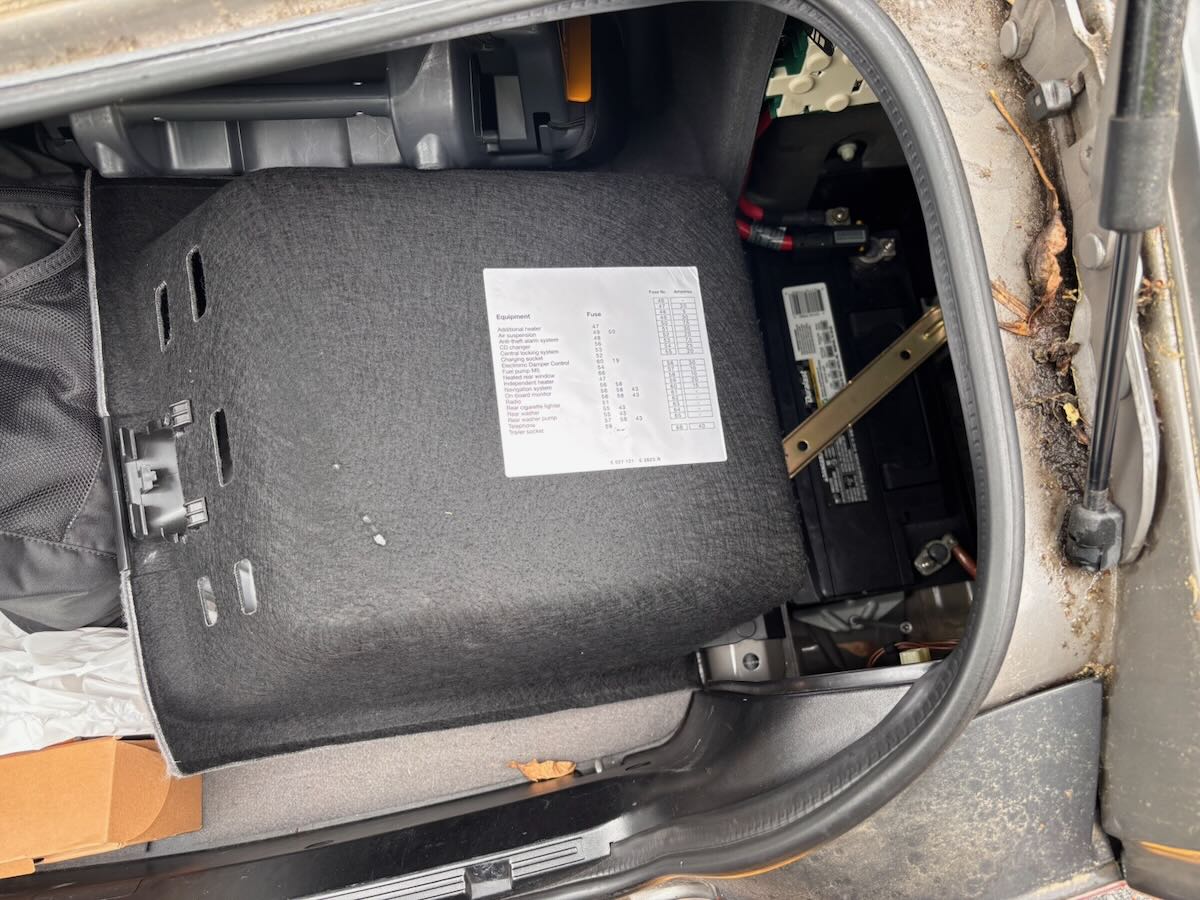
The BS200 is clearly designed for use in a vehicle with a battery in the engine bay, which covers probably 90% of applications. My E39 is not most vehicles, and so the battery is in the trunk behind a panel. It’s also bolted into that little trunk well with a crossmember. Nerds!
When I went to install the BS200, I realized that not only would it not sit easily on that battery (which is the recommended placement), but I could not have it on the battery and close the access panel at the same time. My initial thought was just to run the negative and positive cables around that panel. That wouldn’t work because the cables, while appropriately long for an under-hood installation, are too short for my around-the-panel solution.
Out came the drill.
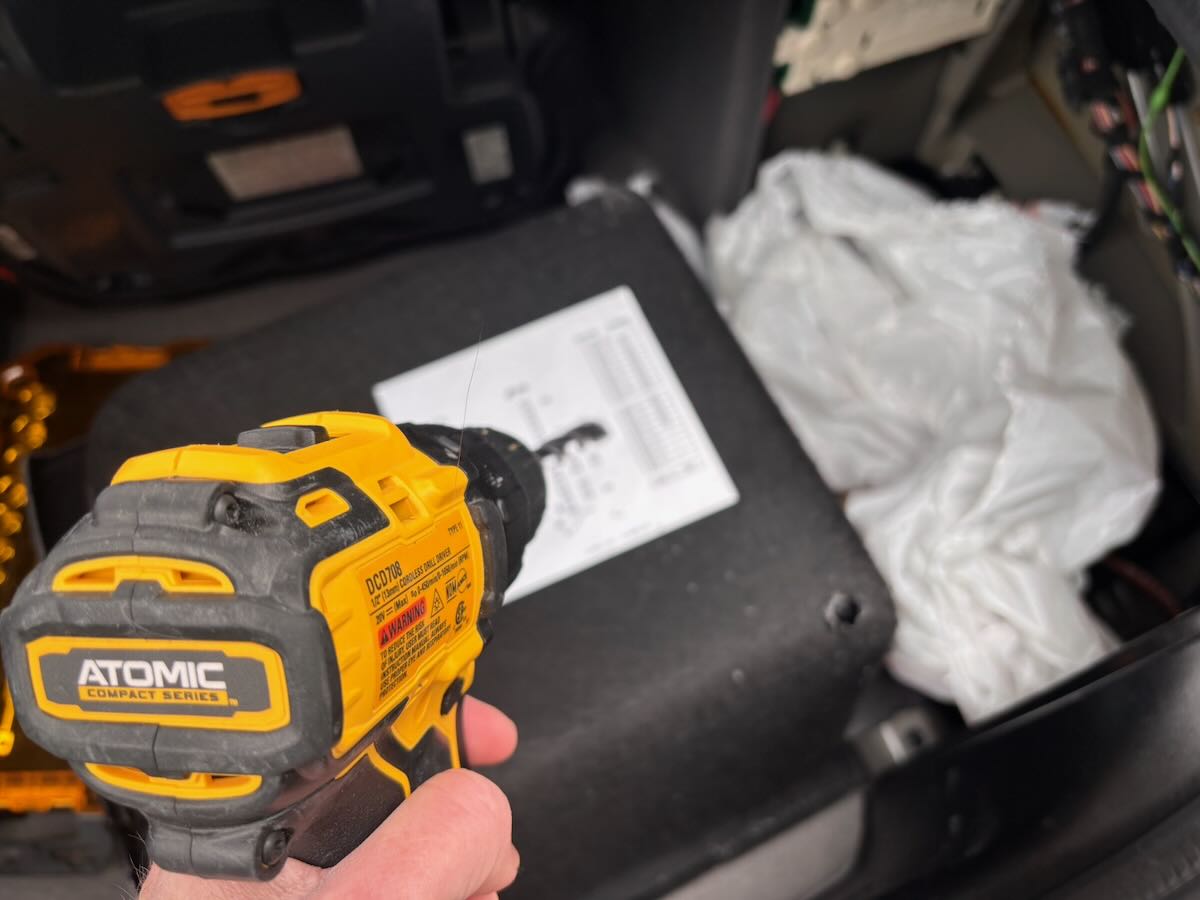
I ended up putting two holes in the panel and then running the cables through them. This also didn’t quite work as I couldn’t get the angle just right to keep the panel open enough to actually tighten the clamps around the battery terminals. Double nerds!
Eventually, I realized that I could line up the super starter dead in the middle and, with a socket wrench extension, I could juuuust tighten everything up and make it fit. While it takes up a small amount of trunk space (that I wasn’t using), it ended up being an elegant solution, and I’m happy with the way it looks.
The Big Test
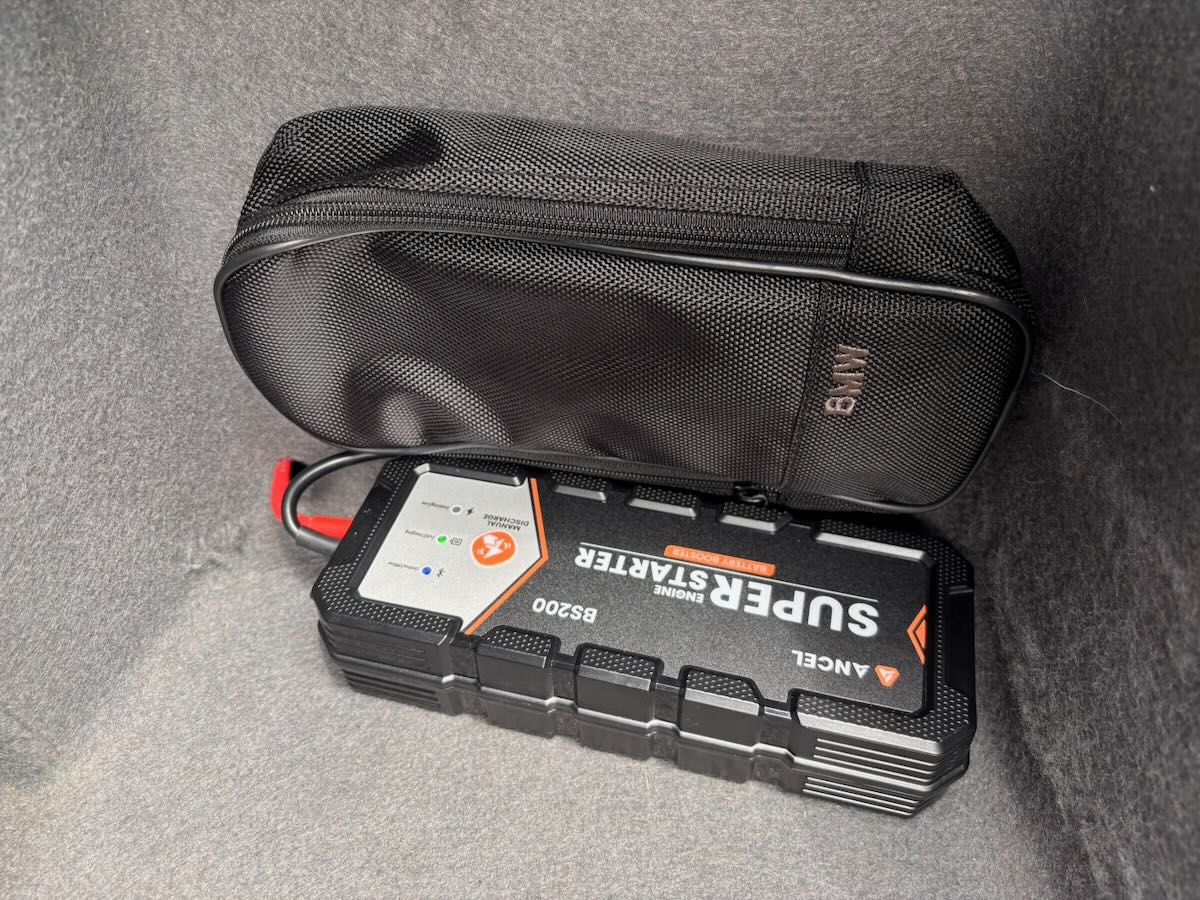
Before installing the Super Starter, Ancel recommends charging it up fully using the USB-C port on the side. Because the supercapacitors need so little energy, this happened in less than an hour. The BMW had been sitting for a while, and I was worried it wouldn’t start at all. With a quick turn of the wrist, the glorious inline-six fired right up, although the app showed the battery was dead. Hmpf.
Just to be safe, I quickly updated the firmware in the BS200 (it connects to your phone via Bluetooth), and it showed the battery was at 20%, which was probably right:
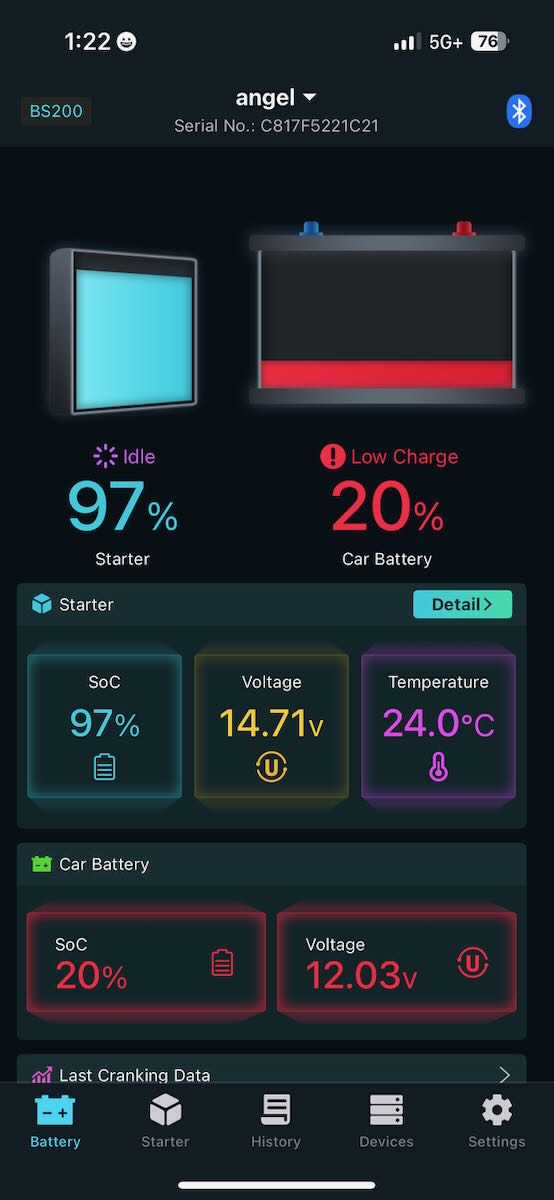
The app is pretty good, gives you a history of battery performance, and has a button you can press to dump all the energy into the battery if it’s really, truly boned. Once the battery is in decent shape, the starter recharges itself. This wasn’t the big test, though. I knew I had a lot of trips coming up and was picking up a NISMO Armada, which meant the BMW would be sitting for a while.
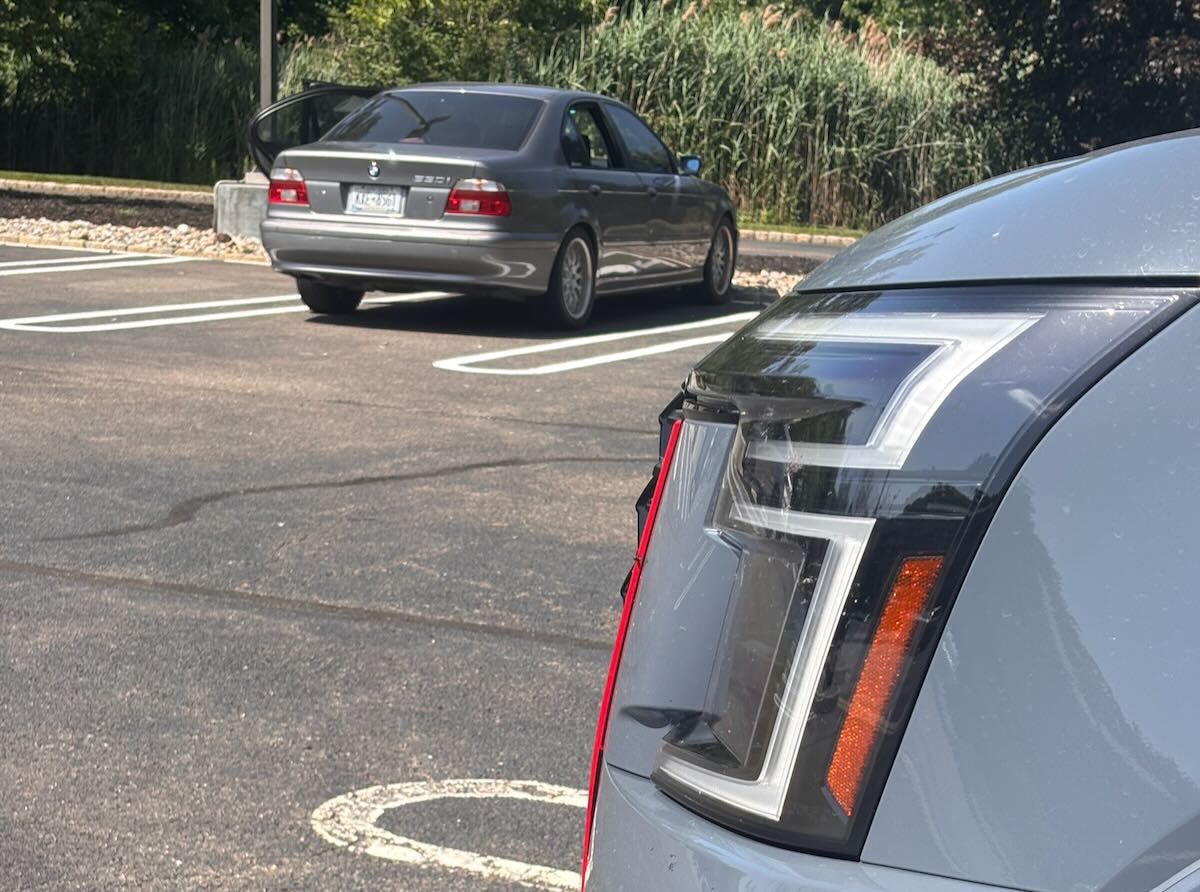
I didn’t disconnect anything and, it turns out, I left my A/C on, my radio on, and did all the things I usually try not to do when I leave the BMW parked for a while. By the time I returned from my trip, it was over 100 degrees, and it was going to be a huge pain if the battery was dead.
As you can see in this Instagram video, the car started up just fine.
View this post on Instagram
I was greeted with my A/C pumping and Soundgarden coming out of the radio. I welcomed both as it was over 100 degrees in that parking lot. This was repeated a couple of weeks later when I went on another trip and left Clive parked for 10 days. I hopped in, turned the key, and drove off like nothing ever happened. In cold weather testing, Car and Driver found the Super Starter also performed well.
Should You Buy A Super Starter?
If you have a trickle charger or drive your car frequently enough, this probably isn’t a big issue for you. While Ancel claims that reducing the energy required by the battery to start/run your car could extend the life of your battery by years, I haven’t had it long enough to independently verify this. If you almost never deal with dead batteries, just get a lithium-ion jump kit and try to remember to keep it charged.
However, if you do end up in this situation frequently, it’s kind of a no-brainer. In the time I’ve had it to review it, the price of the BS 200 on Amazon has dropped $50 to $149. If you have a turbocharged 3.0-liter engine or a naturally-aspirated engine that displaces more than 3.5 liters, there’s the BS300 at $237.99, and for large trucks or big V8-powered cars the BS400 is $279.98.
In addition to reducing stress on the battery (and on the driver), I do like seeing in real time how long it takes to drive around and recharge the battery. When passengers are in the car, I’ll leave it up on the screen and feel like Paul Walker in The Fast and the Furious minus the manifold danger.
[Ed note: Ancel sent a pack to review. This review also includes affiliate links, which means we may get a commission if you buy one. – MH]




It’s an interesting idea, but only if it can hold a charge longer than the battery it’s attached to. That’s the test we need to see.
“Bro, we put a battery on your battery, to help your battery!”
This seems like a good idea, a battery booster that stays charged by the battery. Of course capacitors, like batteries, won’t last forever. And capacitors will gradually lose their charge if you don’t drive the vehicle for a very long time.
So reading the manual, I think this may be the basic operation of the unit.
Basically a set of super capacitors but also voltage monitoring.
Normal operation.
Unit is trickle-charged from the main battery when the car is running also seems like it will charge itself if it self-discharges ( no spec given on how long this takes but some other cap start devices list times anywhere from 12 days to months), even if the car isn’t running. It basically tries to keep itself alive in a long-term storage situation. Now the amount of power it needs to not self-discharge is likely tiny.
Normal starting it likely senses the voltage drop and connects the caps in parallel to the battery, which will provide most of the starting power which prevents lowering the voltage on the start battery during cranking. My guess is this was the starting Matt saw his battery was a little low but not too bad. This will help keep a struggling battery alive for a long time.
If your main battery gets really low you hit the button or the app and it parallels the cap to the main battery regardless of voltage so this is basically acting like a jump start box. This mode seems limited to 10 seconds so if your car takes a long time to crank this part might not work for you.
Then it also monitors the voltage of the main battery to keep you aware of issues.
Overall It seems like its pretty helpful if you find your self with a low battery alot when you crank over your car. Also likely extend a cheap starting battery for quite a while. But it’s not really a trickle charger or a jump pack. It’s closer to a jump pack but helps the start battery everytime.
I guess it might also come in handy if you have some kind of parasitic draw that drains your main battery, if you leave it for a couple of weeks.
My car hardly ever stays in the garage for more than a week, but I’d love something like this for my motorcycle.Unfortunately, I’m not sure if I could find the space for a box this size under the Buell’s seat.
Model shown is of course for a car.
Looking at Ancel’s website looks like they have a ‘super start’ options based on engine size, with currently 3 different models all targeted at cars/trucks
I agree this could be a great idea for some motorcycles and if Ancel or someone else develops a ‘super start’ for motorcycles I fully expect from a practical perspective physically it should And would need to be much smaller
What’s done is done, but the appropriate way to install this on the E39 is under the hood. BMWs with trunk mounted batteries typically have a jump post under the hood. That’s your positive connector and chassis ground is your negative.
90% of my extended family switched to hybrids (EREV for me, another EREV with my dad, aunt with an EV, MIL got a Toyota HEV), so our jump packs don’t see much use these days. But a few years back I got a Gen Ace starter (OEM behind Lokithor) after using their RC lipos for ages, great little tool for rescuing strangers and friends with Chinesium 12V batteries in their cars.
Summers here in Central Asia are pretty brutal too, temps get up to 50c, glad to hear that super capacitor jump starters aren’t just scams anymore.
The Toyota hybrids do have a relatively small 12V battery for starting up etc. These are easy to drain and you can’t pushstart a hybrid.
I had to resort to jumper cables or an external 12V battery charger a few times in my old prius. I would have liked a jump pack at todays prices back then.
Don’t chuck your jump packs just yet. And learn how to use them on your car before you are stranded in a dark and shady parking lot.
Good point, somehow I thought the Toyotas could recharge the 12V battery with the HV pack.
Worst jump I had to perform was on an Audi Q5, the jump points under the hood were heavily oxidized and the battery was trapped under the floor of the electronic-release hatch. Had to climb over the rear seats, remove trim panels to find the manual hatch release, then remove more panels to get to the battery. Thankfully the car started right before sundown
is there a self charging trickle charger version of this?
Wouldn’t that just be a second battery in parallel? Because those exist.
I think the allure of this super starter thing is that it is small, relatively easy to install and light. And that it supposedly keeps its charge for when it detects you trying to start it.
A second battery trickle charging the first would just extend the time before a complete flat battery.
Yes, that’s basically what I want. My mom is in her early 70s and drives in a 3 mile radius 99% of the time. Her 2015 mazda6 doesn’t like this frequent stop and go and tends to eat through her batteries and go dead all the time because it uses more electricity starting than it gets a chance to charge. I gave her a trickle charger to use every week or two, but her apartment landlord noticed it and physically locked the outlet next to her parking spot. I ended up getting her a beefy portable battery to charge at home and then use with the trickle charger, but it’s kind of a hassle. That’s why I was thinking if there was a second battery to trickle and extend the starter battery, it would increase the time between when she needs to charge her starter.
God North American apartment complexes are so insufferable.
Just cheap ass landlords
Seems like this product could be a good addition for any car that is not run frequently and when run, only run on short trips.
If I had such a scenario where I couldn’t run a trickle charger I’d give this product a try
Capacitors don’t store a charge for very long. I question whether this will become an extra drain on the battery over long term storage
‘Prolly not. They’d need to have internal solid-state relays to switch between charge and discharge, so shutting itself off to avoid draining the battery would be easy.
And it’s a tiny amount of charge, anyway
Still I’d like that to be tested before I rely on it to start my car out of long term parking.
I’d certainly agree with you there, just like pretty much ANY third-party electrical automotive accessory.
This is supposed to be bolted directly onto the battery though. Other third party accessories are usually switched through the auxiliary.
That’s why I waited over a year to review my solar panels. Wanted to make sure they actually kept batteries charged and didn’t just make a dying battery last a little longer.
I wish there were more specs on this,
My automotive electrical engineering is limited to “don’t use 12 volt wiring in a 6 volt car” and keep young mechanics away from old British cars because they will install the battery backwards, depolarize the generator, and set off a week of crazy.
Same here but I mean, all you have to do is add your own Lucas “replacement smoke” ha ha
Yeah , Lucas smoke is cheap, but the tools to get it back in are hard to find, and the old positive ground smoke is getting low.
Still not as bad as sourcing old Magneti Marelli smoke. Or distributor caps. Probably someone has started 3D printing those by now but they were the essence of unobtainium reinforced with unicorn hair last time I bought one.
I had always wondered about the necessity of the “3+3” callout on GM crew cabs. Huh. Today I learned, I guess.
Its an interesting idea. I had something like that on a truck for bit but didn’t work out so well if you left it for more then maybe 3 or 4 weeks. I’ve been getting these lfp batteries that have what most sellers call a built in jump start. Basically the bms cuts power at around 25% to 30% soc. Some can be configured. Then you either have a remote, button, or app via Bluetooth to have the bms turn the power back on to start the vehicle. Right now they cost maybe 2x to 3x what a regular lead acid battery costs. They also appear to last and in theory can last a decade. But they are coming down in price. The small ups or emergency light 10ah lfp batteries are now cheaper then the agm equivalents everything is heading that way.
FYI, the prices on Ancel’s website, at least for the BS300, are cheaper than the pricing on Amazon.
So if this thing is 12 volts, that’s 125 farads?!?
Yeow.
If it’s 13.5 that’s still 97 farads.
Still yeow.
What’s that, 9,000 joules?
How did they make it so small?
Supercapaicitors are super freaky. This sounds like it could vaporize a stray wrench.
Looking over at the 5000 joule photo flash setup and remembering some neat death experiences as a studio assistant. Of course that was at a 800 volts, so the amperage was lower, but it could throw a mean spark and make things go bang.
Does this thing have current limiting?
Yeah I remember in engineering school a “small” half Farad cap would give quite a jolt. We used to charge them up and toss them to each other because your first instinct is to catch it, and then you’d get shocked.
I work with embedded electronics. You can get 1000 farad super capacitors that are around the size of a AA battery. I have four of them on my desk at work right now. If you’re okay going slightly larger, the type we’re using go up to 1400 farads.
Anything using an energy store capable of high current, like super capacitors or lithium batteries, will have a regulated output of some kind. Although in an application like this, the maximum allowed current will be quite high.
At what voltages?
Super capacitors still seem crazy to this oldtimer. I know that some people get excited by high voltages, but a thousand amps, that’s just hard for me to fathom.
Once built a cap out of a couple rolls of aluminum foil and wax paper in a class in high school. I can’t remember the what it tested at but it was scary. The same teacher had a class in how to design an atom bomb ( in 1972 ) and how to grind a telescope.
The funny thing about the atom bomb, was that by the end we all knew classified information, but we had all figured it out for ourselves.
Of course designing one is easy. Getting the materials is somewhat less easy, but a breeder reactor would definitely be a shortcut.
I’m pretty sure you can just look it all up now, but the point was that once you know something is possible, figuring out how to make it practical isn’t so hard.
Anyway, supercaps seem impossible, then you hear about them existing and it’s “Oh, a sponge maybe?”
The particular ones I have are rated to 3.8V, between 3-4V is pretty typical.
Supercaps are useful when you want large charge and discharge currents. To store more energy you’ll want a lithium cell, but they can’t take large currents unless you put a lot of them in parallel. A single 3400 farad Eaton XL60 supercap is rated for 143A at 3V continuous, or up to 2700A pulsed.
I suppose a supercaps in series with a lithium cells would be optimal for allowing brief surges of current in both directions without the weight of a battery pack rated for that current.
If you have an EV rated at 1000 horsepower and 2000 nm of torque, you probably aren’t going to be able to use that for more that 5 seconds without having more pressing problems than a depleted battery, and getting rid of a chunk of battery weight would be good too.
Your high school teacher was a unicorn. I wonder how many students they inspired to become engineers?
Absolutely
She was a physicist at a national laboratory and taught a couple classes in exchange for tuition for her children. I think she or her husband worked on the manhattan project.
It was an interesting school that emphasized improvisation and problem solving, and was founded by some of the same people that started outward bound. Mountaineering was a required subject for example.
Mentors are invaluable. Mine didn’t explain atom bombs, but he was still pivotal.
I was raised by an uneducated, chain-smoking single mom in a vacuum of worthwhile male figures. It wasn’t until I began dating a girl in high school that I met a mentor: her freshly-paroled big brother. In one weekend he walked me through how to do all the desperately needed maintenance on my Spitfire: oil change, new plugs, wires, points, fixing a manifold vacuum leak, putting oil in the SU dashpots etc and so forth.
And now I realize that I should reach out to her and ask how the brother’s doing and pass my gratitude along.
Apparently my Fiat (1980 124 Spider) has a parasitic draw. I bought quick release battery clamps so I don’t need tools to disconnect the battery. Eventually I hope to track it down and fix it, but the rat’s nest of wiring in there is a bit daunting. It’s got wires that just terminate in cut ends and wires with connectors that don’t connect to anything, but all the lights, and electric doodads seem to work, so it’ll wait until I get other issues sorted.
Oooooo, I’m intrigued.I imported a 1987 FIAT 126 from Italy back in January. It’s going to sit in storage during the winter months, so I’m interested in quick release clamps so I could bring the battery in over the winter so I wouldn’t need tools.
Do you have a link to the ones you bought?
They were just some cheap ones from Amazon. https://www.amazon.com/dp/B0DL25W9CM?ref=ppx_yo2ov_dt_b_fed_asin_title
Not sure how to post it as a link, but if you paste it in your browser, it should work.
LOL, it posted as a link.
Or you could, you know, fix the parasitic draw. You even seem to know where it’s coming from.
Its a BMW. Once you fix one parasitic draw, you just invite another one from elsewhere.
I had the world’s worst BMW e34, and the electrical system was the one thing that actually worked.
I had the worlds worst E36, and absolutely nothing worked, but nearly all the faults were intermittent, even, somehow, the mechanical ones. Hugely frustrating, and cost more in running costs every year than it did to buy it.
I had to give it away for free in the end.
The only real solution is to sell it.
You could’ve just extended the wires instead of bringing out the drill…
What makes this thing plus your OEM battery any different than having a car battery with 2.3 Wh higher capacity?
I suspect that the capacitor can’t be drained by a parasitic load as it is separate from the main battery.
Is it though? And a typical car battery is somewhere north of 500Wh. I’m struggling to see what benefit an extra .5% gets you.
That it can’t be drained – the design of this thing walls it off.
Yeah, basically the Super Starter only needs a tiny amount of energy and it pulls it usually from the battery while you’re driving and doesn’t discharge easily. If somehow the battery is drawn down, thre will still be enough in the SCs to fire the battery.
The gimmick with the supercapacitors is not their total capacity but rather that they can give you a whole lot of cold cranking amps in a hurry. They can charge up from a mostly-depleted battery slowly and then kick in when they notice you’re trying to start the car.
Sort of like a turbo giving you a boost once the engine spools up, although in this case they’re entirely electronically gated.
It can discharge 1500 amps RIGHT NOW, as opposed to over a few minutes.
Ooooh! Battery Shark!
Gar-un-teed to improve your 12v battery mpg by 50%!!!
Could have used this on my old toy, which had some sort of parasitic draw similar to yours. I no longer have and my new car doesn’t have the problem, but I do have a teen about to start driving a family hand-me-down next year. Honestly, $200 might be worth the peace of mind.
Cool product, thanks for sharing.
Does Ancel state how long the capacitors stay charged? Matt’s experience is 10 days, and I wonder if that’s the outside limit before they self-discharge. I wonder if the self-discharge is faster or slower at freezing temperatures.
If parasitic loss is the root cause of Matt’s battery woes, then a better long-term solution is a kill switch, much like what are found in racing vehicles.
From my understanding of supercapacitors, they can’t really hold a charge much longer than 2 weeks. Heat also severely increases self discharge rate.
Modern cars don’t like having the ECU disconnected on a regular basis.
I understand your point. But if Matt’s battery keeps dying, that’s almost the same as disconnecting the battery when when Matt’s off gallivanting.
Even a ‘dead’ battery probably keeps the ECU alive like a Terminator. Had an ’05 MDX with a parasitic loss. I’m trying a solar charger on its replacement with luck so far.
I read the “manual” not a lot of details there, but it does say it will keep charging with the car battery as low as 5 volts, so My guess would be you have a week or two after the regular battery drops to 5v.
Neat little product!
We used a Big Boy version of this technology on our articulated buses for about 8 years until we switched to AGM batteries. Super Capacitors are excellent for this purpose.
Of note for those that live in hotter climates:
There have been reports of lithium packs igniting in very hot (>120 degree) car interiors.
So if you’re the type to carry a jump pack for the car it’s transported in, this thing Matt is talking about is probably safer. Capacitors are very resilient to temperature compared to lithium.
Goes out to his shitbox to remove the jumpack from the trunk.
Don’t worry… it’ll be fiiiiiine.
And if it isn’t, well you’ll have something to entertain the rest of us with!
Win-Win!!!
We already suffered through our near 100 heatwave earlier this week, so it’s fine now; but already brought it inside just in case. Sometimes I’m dumb.
Oh really?
I was about th get one of those and if the solar roof on my Prius gets turned of” what does this button do?” it gets to about 140 degrees on a warm day. Gott for killing moth eggs in wool carpets, just stick them in the car for a couple of days. Probably bad for Lion batteries.
Added one to my cart for my next Amazon order, as the little solar charger isn’t cutting it on my Lx.
This and a solar charger would be a good combo.
Yeah, that’ll be the plan.
I have trickle chargers hooked up to my portable propane generator and to a sump pump battery backup. I wonder if this is a solution for those too. Maybe not, since the battery only gets turned on in an emergency, so likely wouldn’t keep the gadget charged?
Why not both? Solar should be able to keep those capacitors tippy top.
Which author is using little solar panels as a trickle charger for this purpose?
And how do they compare?
While I can’t speak directly to your question, I use solar panel maintainers on multiple vehicles and have been quite satisfied with the performance. Even keeping the solar panel inside the car sitting on the dash seems to provide enough energy to keep a mediocre at best condition battery working well for me.
Sadly I did not have the same experience with my 03 Civic Lx, so I’m gonna give this a try. It’s likely that battery is completely shot, and the smartphone app should work on the Android Head Unit I installed in the thing, so I’m hoping to get better visibility into the current state of affairs.
the battery condition monitor in the app is pretty cool. I can’t argue with that at all. Honestly, I see nothing wrong with a belt and suspenders approach to this, unless the super start thing doesn’t allow for it. Do both!
Yeah I’ll plug the solar back in once I have better visibility in the battery charge state, last I jumped started it I had to FORCE jump it, so I know that battery is stuggling.
Moral of the story is I need to drive it more.
Yeah, my solar panel maintainer things won’t really help a shot battery. They’re more for keeping already decent batteries still alive.
Which solar maintainer worked for you? I tried one and it did nothing, even connected straight to the battery terminals.
I do’nt know what brand they are. They were about $40 each on Amazon, wire in directly to the battery terminal, and come with a small controller and a solar panel. There are a couple of different two wire quick disconnect points, so its easy to leave wired to the battery and just disconnect the charging system when I use the car.
I’m about 98.6% sure Mercedes is using one or two of them.
That was Mercedes, I bought one for my seldom driven Highlander and it has been good so far.
Another guy who parks in the same lot, but he says it works well for him.
That’s me! My solar panels have never let me down. I could park a car for a year or two with the battery still connected, come back, and the battery will fire the thing right up.
TY!
They seem like more elegant solutions imho. Have you advice for which model/style work (or don’t?)