

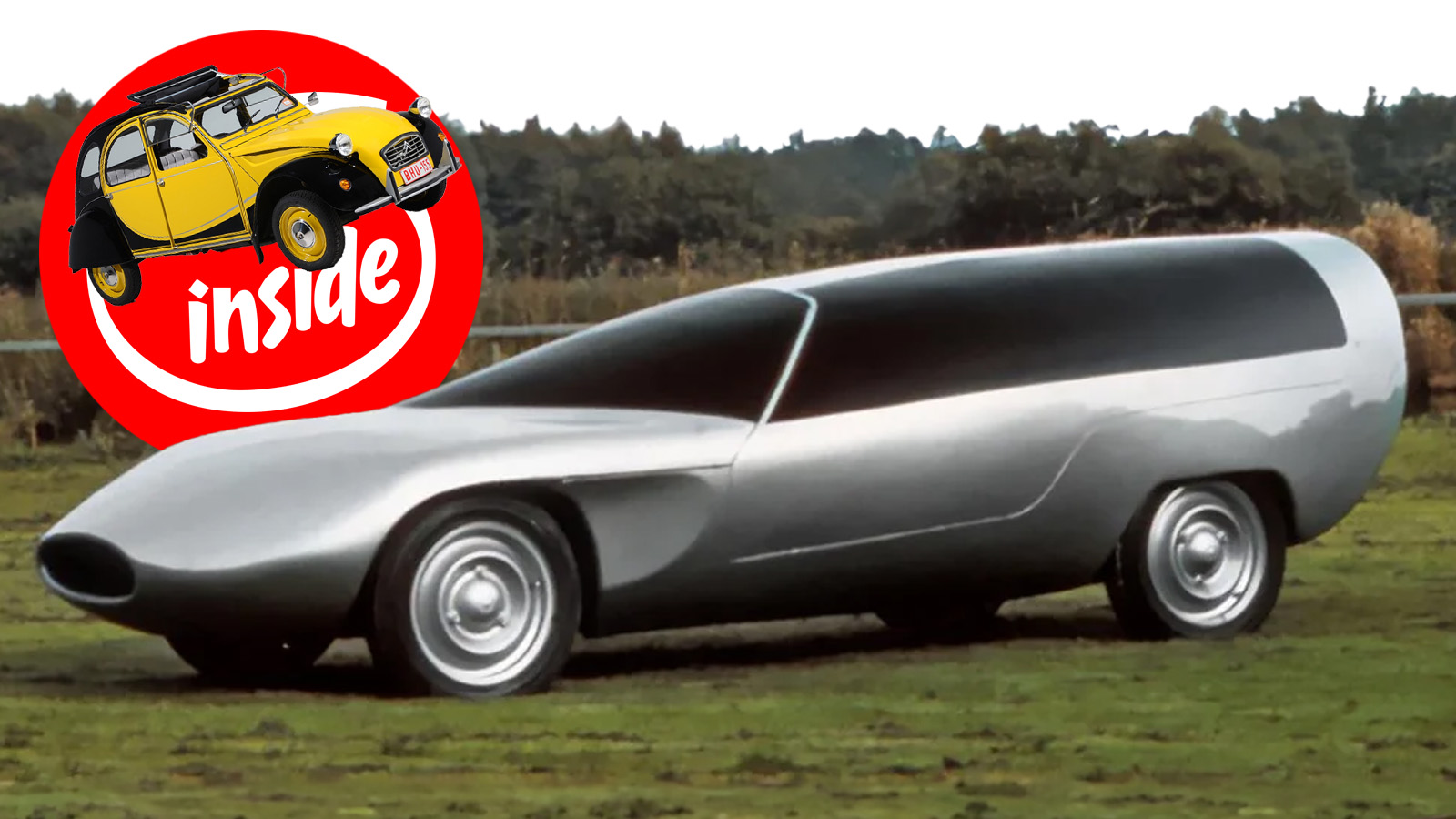
In my still-short time with my Citroën 2CV, I’ve come to respect the remarkable efficiency that seems to be the guiding light shining down upon every decision that was made in the engineering of the car. If there’s a part that could be eliminated, it’s not there. Things that don’t exist, generally, can’t break. The result is a wildly light, clever, and, yes, efficient machine. A stock 2CV is supposed to get about 43 MPG or so, which is fantastic. But it seems that wasn’t good enough for the famously eccentric designer Luigi Colani, who managed to build a very customized 2CV that got a shocking 133 miles per gallon.
Think about that! 138 mpg, way back in 1981! The 2CV has a gas tank about 6.5 gallons, so that would take the effective range of the car from about 280 miles to a staggering 864 miles! That would be enough to drive from New York to Atlanta without stopping, if you had such an urge and a truly colossal bladder.


Of course, Colani’s 2CV looked almost nothing like the archaic tin snail we all know and love. Really, did anything Colani design look like what you expect? Remember, this was a man whose take on a semi truck cab looked like this:

…and his take on a Volkswagen Polo looked like this:

Colani designed everything from forks to pianos to cars to hydrofoil boats, and all were designed with his signature biodynamic design language, and one doesn’t necessarily get the impression that his main goal was efficiency per se; Colani seemed to operate by his own set of rules and goals that originated either in his head, or, barring that, maybe the Codex Seraphinianus.
That’s sort of what puzzles me about his experimental take on the 2CV: the whole goal of the complete re-body was to, it seems, set a fuel economy record, and he seemed to have done just that, in 1981. Colani had always been interested in aerodynamics, but it usually seemed to come from a stylistic urge as opposed to an efficiency one. But not this time.
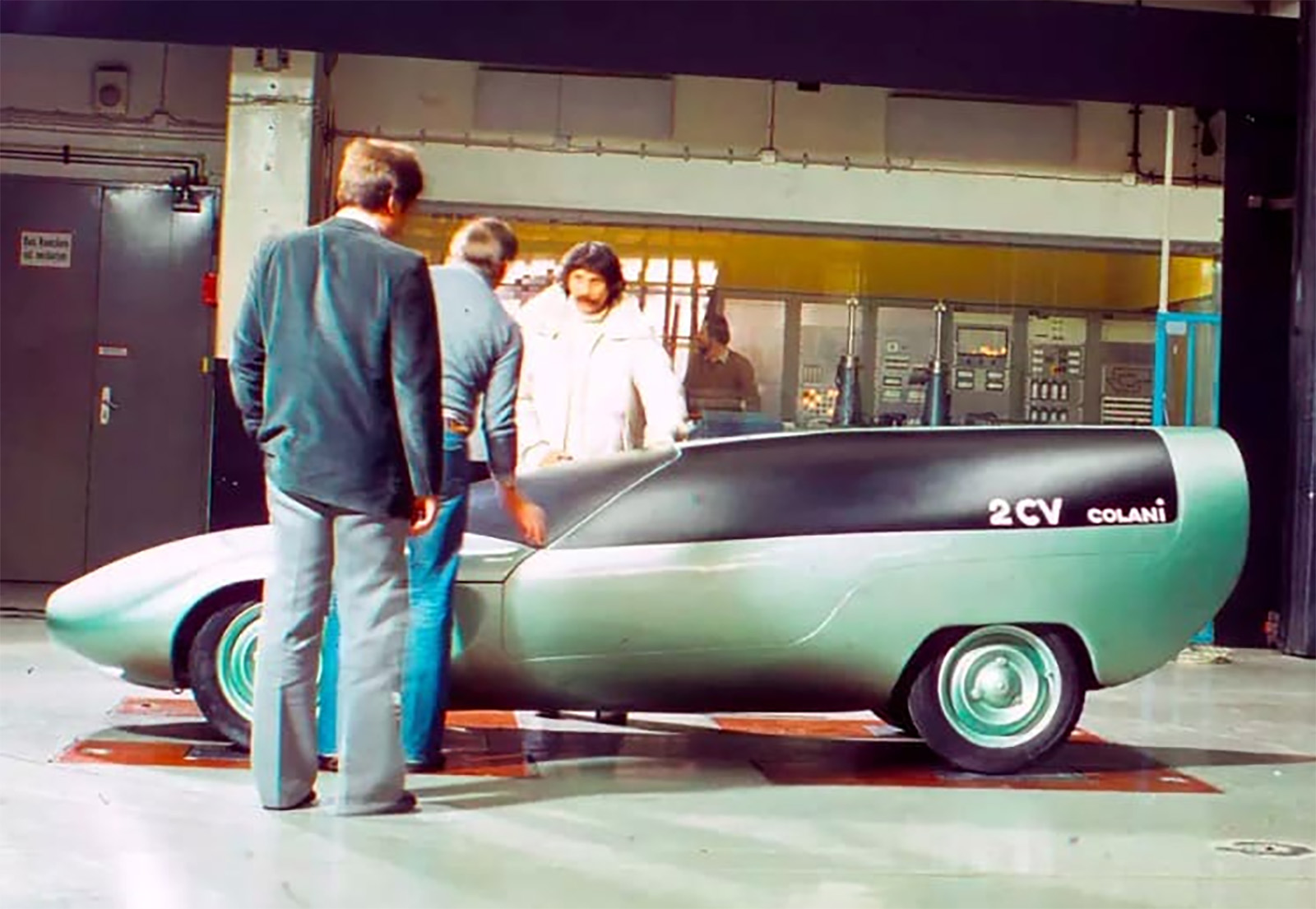
This time Colani seemed to mean business; the plastic body he wrapped the otherwise stock 2CV chassis in was slick and light. The frontal area was tiny, it had minimal protrusions of any sort, and an interesting Kamm-effect rear.
Only the distinctive three-stud wheels suggest the car’s true origins, and I’m surprised those weren’t covered with some manner of full wheel cover.

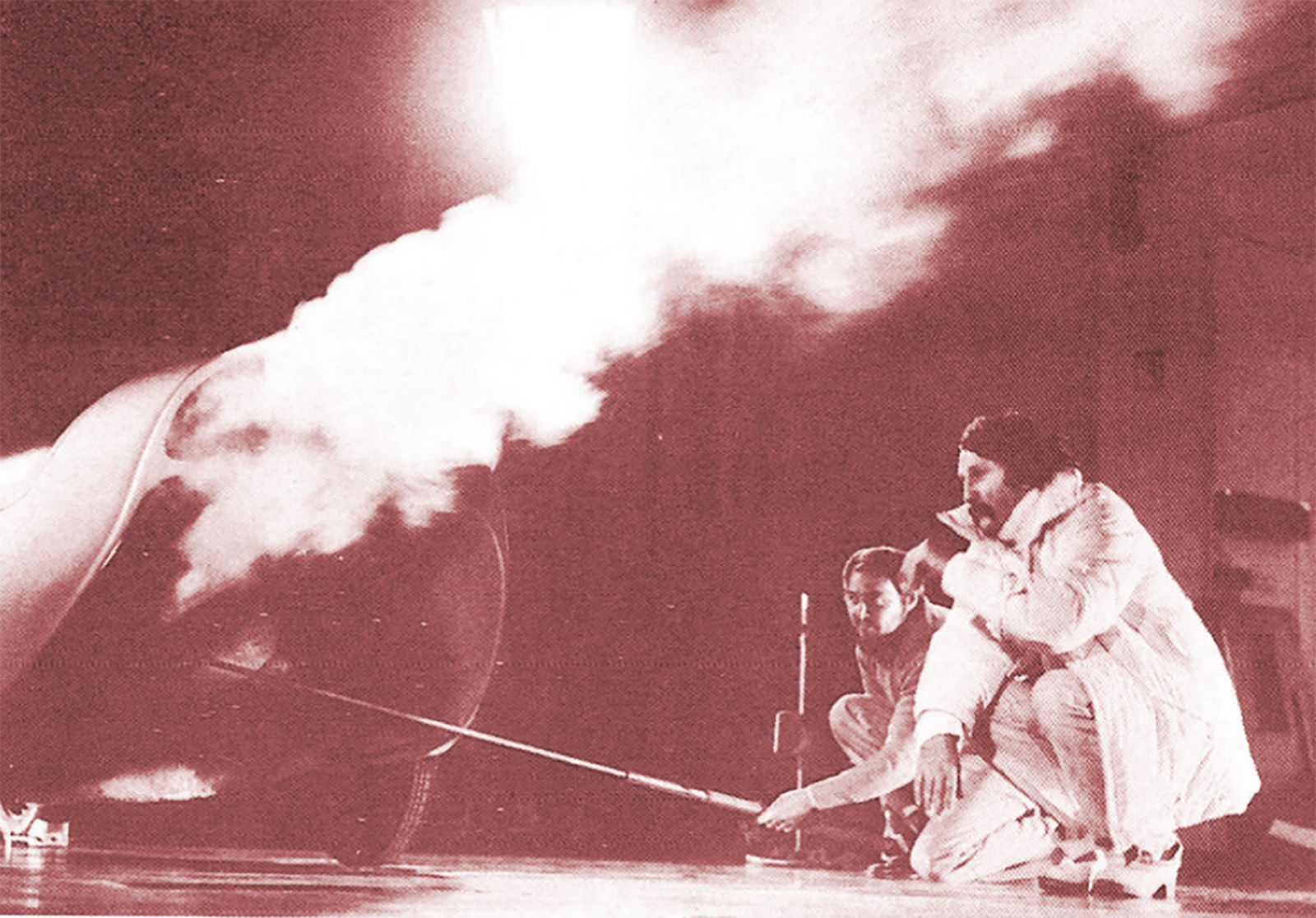
I can’t actually find any real numbers on what the drag coefficient of the final body was, but there are pictures of Colani himself seemingly playing with smoky streams in a wind tunnel, so some manner of wind-tunnel testing, even if it may have been more of vibe-aerodynamics variety, did take place.
It’s especially interesting to see underneath the body because it’s quite clear that it’s just stock 2CV mechanicals inside:
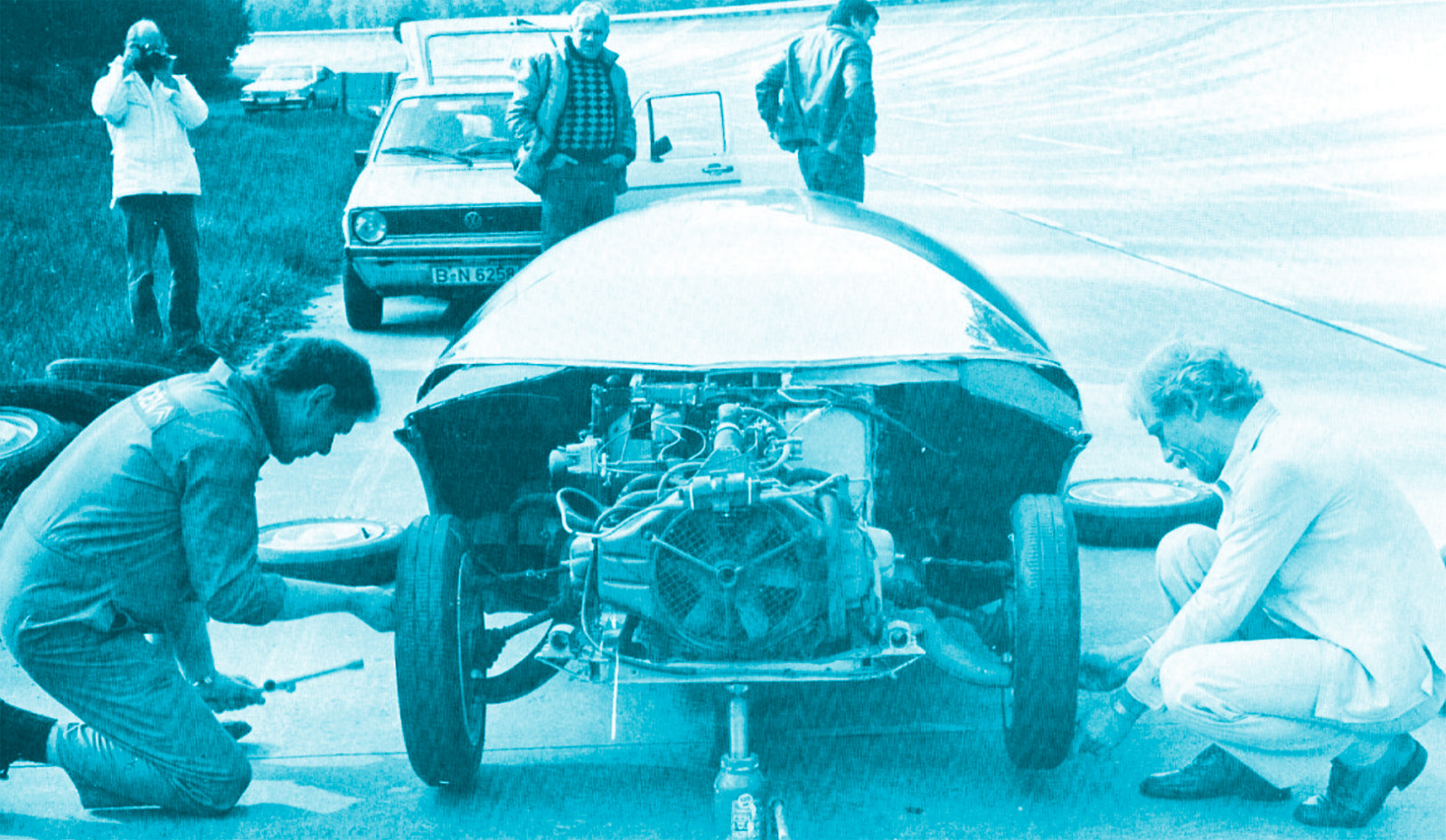
There’s the air-cooled flat-twin, there’s those distinctive curved suspension arms. All of this is pretty amazing when you think about the fact that the car they picked as the basis for their efficiency record was, in 1981, already a relic of a design at 33 years old. Aside from special low-rolling resistance tires from Goodyear, the re-designed body was the only significant change.
But what a change it was! After testing at Continental’s Contidrome track, they managed to use only 1.7727 liters of fuel per 100 kilometers, at a speed of 66 km/hr. I’m getting these numbers off of what was written right on the car, just before it was doused in champagne, as you can see here:
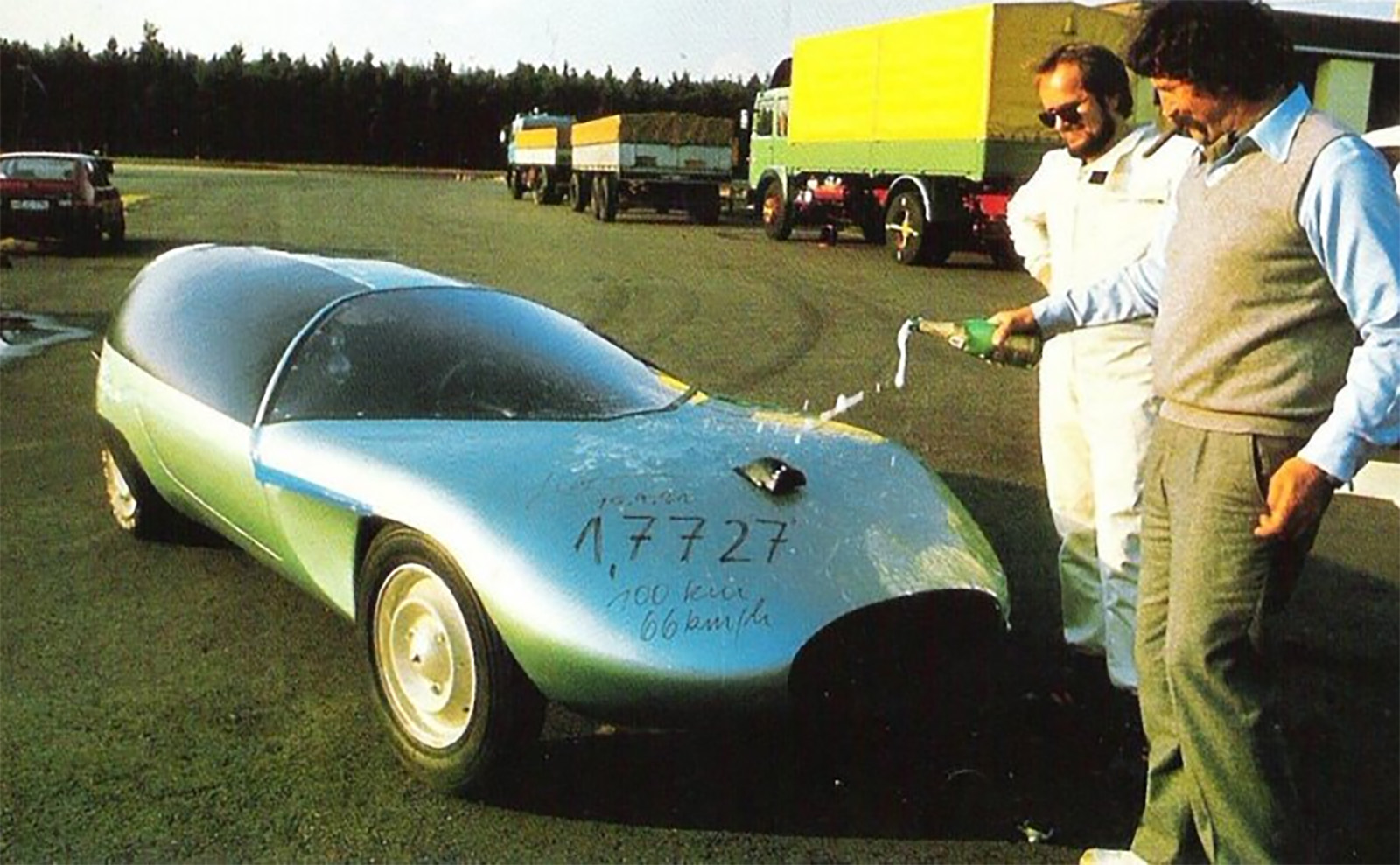
So, in Freedom Units, that comes to 132.7 miles per gallon at a steady 41 mph. That’s pretty amazing for a 1981 experiment based on a deliberately crude and basic 1948 mechanical design.
I know we usually think of Colani as something of a stunt designer, a flamboyant showman, but it’s great to see that he was capable of some genuinely practical feats, too.
(top image: Colani Design, Motorcar Classics, Intel)


More Colani content plz.
I don’t know if Luigi Colani comes close to being the most outrageous car designer, I can think of a few others, not even considering Ed Roth, Gene Winfield, and that other guy, but cars designed for production.
Nice link to Codex Seraphinianus, that’s been on my buy list for a while.
You know, it’s been too long since I’ve read an article about Gabriel Voisin. Could you guys do something about that?
Okay but how fuel efficient could it have been if Colani used a Fuel Shark?
I thought this was going to be more riffing on the Citroen C10 concept:
https://en.wikipedia.org/wiki/Citro%C3%ABn_Prototype_C#/media/File:Paris_-_Retromobile_2014_-_Citro%C3%ABn_prototype_C10_-_1956_-_004.jpg
That’s about as aerodynamic a shape as I can think of.
Rebodies can do a lot to improve certain aspects of a car. Aero drag is a fun one to attack if other aspects aren’t going to be addressed. Friend Wood – the builder’s actual name – rebodied a 2CV back in the day in a multiple layers cold molding process with laminated wood. The result weighed less than the original car and was also much, much more aerodynamic:
https://www.reddit.com/media?url=https%3A%2F%2Fpreview.redd.it%2Ffriend-woods-tryane-ii-v0-fi77jzk7jzc71.jpg%3Fwidth%3D1019%26format%3Dpjpg%26auto%3Dwebp%26s%3Dc417f76edd6a8a5f1408f11b4ef143fd12f5bed9
The Tryane II could also exceed 100 mph top speed and get 70-90 mpg in normal driving, upwards of 140 mpg in controlled conditions with careful throttle application, on a stock 2CV engine. Supposedly, a 0.24 drag coefficient, and it weighed 900 lbs.
I first came across this car during online searches back in 2005. Amazing work on part of Friend Wood.
I always wondered where he got the money to do some of these designs? Who paid for them?
Good god, that Codex Seraphinianus is some Meow Wolf shit. Yikes!
Who is this “we” you speak of? Because I object to those characterizations, which feel like they’re suggesting a lack of substance or importance, or possibly an element of flimflammery.
I personally have always thought of him as a genius engineer and brilliant artist who uses his ability to be completely unconstrained by what has existed before, totally free of the shackles of logic and reason, to strike out into uncharted territory in search of wholly new solutions to longstanding problems rather than be satisfied with incrementing the status quo, while delivering those solutions in beautiful and exciting packages. That, or he’s just plain crazy and inordinately lucky. ToeMAYtoe, toeMAHtoe. But I have NEVER though of him as anything so inconsequential as a showman.
He had the combination of wealth, time, and talent to make his visions a reality. Well for the cars and trucks at least, get them to the functioning proof-of-concept stage.
The way we’ve been wasting energy since the advent of the automobile, all to allow corporations to extract as much money from the buyer as they can, under the guise of aesthetics, is something Colani was right to be enraged at. As a species, we’re literally destroying our planet and causing needless suffering, when the extent of these issues that we see today is totally unnecessary and could be significantly lessened without giving much of anything up regarding our living standard.
But then the Epstein class wouldn’t get as much of our money, and would have a harder time keeping us grinding our lives away, so can’t have that…
I own a few Canon cameras designed by him. The design language he developed for Canon in 1989 has been used ever since. The only problem is that you can only hold them as they were designed to be held, which I really don’t like.
His steam locomotive is pretty wild
https://www.google.com/search?sca_esv=7f321bca7b936533&rlz=1CDGOYI_enUS770US770&hl=en-US&sxsrf=ANbL-n57ERmT1jkaIR609emyiMPYdDTDnA:1778010362796&udm=2&fbs=ADc_l-anYpvSch6nZB23wgI5nE2rmiB5eWMOuULHKiSpvEnkgZ3GhONjHxmxXFEcQawHGpW0s3NS2GQVkNYSg2LJQEm29Y9Xz6TpI7c76FTMgVafIrx4Cn593hgcGq2NGfWSdAEwqQ-RpAudr5axPWTZGXFcIgGXHaMHgN7Q78mgr6yBcd56n8YSCxJlTOmgVkQpyVJUlFmNo1sD3n4HiDoDUVliS_IwAuQ2ng4NliUQWAG7NEbPSBU&q=luigi+colani+steam+train&sa=X&ved=2ahUKEwjRhNPg9KKUAxUGGDQIHWGvIAcQtKgLegQIDxAB&biw=375&bih=628&dpr=3
The proportions are messing with my brain. It doesn’t seem possible for that to be the same wheelbase.
I first ran across Colani’s designs in the G. N. Georgano Encyclopedia of Motorcars.
It was striking and different and I wanted to know more. I always liked his maverick spirit and conviction. Of course he was also part showman.
I didn’t realize the design world snubbed him as much as they did – since so may of us enthusiasts if a certain age were fascinated and entertained by his work and personality. Knowing about Colani was one of those IYKYK things if you were a teenage car fan in the early ’90s.
https://youtu.be/SVo7H3EheMY
I’ve heard of him referred to as an “intellectual terrorist”. The auto industry especially didn’t like some of his ideas, because they’d have eliminated planned obsolescence from vehicle styling and design in favor of maximizing fuel economy and maximizing value to the customer by leapfrogging efficiency over contemporary designs, instead of maximizing shareholder value by draining the car operator’s wallet.
Thing about designing a car is it goes a bit deeper than plonking on a vaguely phallic fiberglass shape onto it. Colani’s styling exercises certainly were striking but they were mostly just that. The whole victimization of his persona is hilarious. He built some funky looking sculptures with wheels, that’s about it. Sure you can make something very slippery by sacrificing literally everything else, that doesn’t make him a genius who the industry missed out on.
Schools literally banned students from studying his work or mentioning his name.
A car is supposed to get you from Point A to Point B, with a given amount of safety and comfort, and for most people reliant upon the used car market, preferably as inexpensively as possible. Everything else is extraneous, and modern vehicle designs, by trying to do so many extraneous things, make getting from Point A to Point B a needlessly and greatly more expensive and stressful exercise than need be, all in the name of extracting that almighty dollar from peoples’ wallets. Product enshittification not only costs money, but also lots of the operator’s time, adds stress, and in general, reduces living standard.
What I liked about Colani’s designs is that he got straight to the point of what a car is for: going from Point A to Point B, and he wanted to do it as efficiently and with as minimal resource consumption as he could. If I had the money to start a car company, that is exactly where I’d start. There’d be no company “parts” or “software” ecosystem to trap buyers into, no infotainment, no proprietary tools/lockouts to DIY repairs, no touchscreens, and I’d seek to minimize the per mile cost to the operator for a given vehicle type, even if the vehicle was a supercar, by making it as light and slippery as possible for its application, damned be whatever the reigning styling zeitgeist and fads of the time were. Also, if it doesn’t last for at least 2 decades without any problems then something needs correction and if it’s not fully repairable with a basic set of Harbor Freight tools by a drunken shadetree mechanic with an 8th grade education, then start over.
We should and could have had 70+ mpg sedans and wagons capable of comfortably seating a family back during the first fuel crisis of the 1970s, and they could have been designed to be confidently used as a daily to this day. The technology was already there. The will wasn’t, because there’s money to be made by forcing people to consume resources.
Tired of literally EVERY option on the market being loaded with sizzle, but no steak.
It puzzles me that a 2CV is called crude…
maybe “simple” is better. Because it’s definitely clever.
Simple definitely. But it is one of the cleverest and most innovative (for the time) cars ever engineered.
Maybe an idea for a future article or series are the clever and innovative unsung heroes. Cars that are magnificent but sometimes don’t get the credit they deserve.
Cars like the 2CV, the A2, the iQ, the Multipla or the rope-drive Tempest just to name a few.
Interesting!
But I call BS on the 133 mpg in anything resembling the real world.
The 2CV (goat they are called here, duck in the Netherlands) already is quite fuel efficient. One could improve by streamlining, but never triple. Certainly not with an engine that was designed around simplicity and not around fuel efficiency.
At a steady speed, impressive fuel economy is possible
Taller gearing and aero can do impressive things. The stock 2CV has a .500 drag figure, more 1970s pickup than modern car.
So this is the mythical 100mpg venture l carburetor I’ve always heard about
No way that’s a fully stock chassis, right? That wheelbase looks… Longer. Is it just an optical illusion from the lowered height? Hmm, but is it complex elongating one owing to the coupled suspension?
Look at the pictures of people standing next to it, the roof height is 1-2 feet lower than on a 2CV, which dramatically changes its proportions.
Thank you for including non-moronic measurements for the civilised world.
Much appreciated.
Colani made some… interesting stuff.
Hardly, I didn’t see him use bushels of gas per picoparsec which are the only acceptable way to measure fuel efficiency in Jasonia.
What’s a “bushel of gas” in buttloads please?
https://en.wikipedia.org/wiki/Butt_(unit)
This is the right answer, here, as it’s based on the Hogshead.
Bushels are obviously porous and best used for apples, it’d never work for fuel.
It has to be porous otherwise the gas won’t be able to filter into the carburetor.
Well now I wanna know that the drivetrain’s top speed is in this form. With THAT low of drag coefficient, I’m sure the top speed would be whatever the engine can rev out in top gear.
You know they’re serious when they are measuring the consumption to the nearest millilitre.
I’ve mentioned this car in the comments before. I’ve read from multiple sources it has a Cd value of 0.19. Couple this with the frontal area of a 2CV, or even smaller, and it’s obvious where its fuel economy comes from.
Now imagine it was made into an EV with 1980s technology. 800 lbs of NiFe batteries for a roughly 12 kWh pack, a series DC motor, and a 72V golf cart controller would have made this a 90+ mph car that did 0-60 mph ~16 seconds, and it would have easily got 120+ miles range @ 55 mph. And maybe been affordable in volume production, with a battery pack that could last decades with proper maintenance(periodic KOH replacement), NO BMS AND ALL ANALOGUE.
Edison batteries, the batteries you buy today that your grandchildren will still be using.
Now imagine that with modern lithium batteries at 10x the volumetric energy density. 1000 miles of range would be possible.
Or you can go for a much smaller pack, settle for 300 miles range, and have a light and sporty EV whose curb weight in lbs has a 2 or perhaps even a 1 in front of it.
Wow, he sure gave that little 2CV the full Colanic.
That’s one of his more normal designs
https://share.google/2zb9Kl9zWZ9visKGm
Some of those are quite pretty. Others… oof.
I really like the 1963 BMW 700. 125 mph on only 32 horsepower. That’s efficiency comparable to the legendary Stanguellini Colibri.
If I had the resources to build a 4-wheeled sports car from scratch, the 1989 Utah 9 would be a good starting point. It would be great for a small but practical 2+2 EV design with fold-down/removable rear seats, while also doubling as a micro delivery van.
This man had a lot of good, practical, and useful ideas, that mostly went ignored. He wasn’t ahead of his time, so much as the establishment running things is depriving everyone of a future where said establishment doesn’t get to extract every last cent. The products we can buy, for the most part, are designed with monetary extraction from the customer in mind, and Colani was against this with every fiber of his being.
One of the trucks is in the Technik Museum Sinsheim – the whole place is such a madhouse that this isn’t even the strangest thing in the room.
This thing looks like something I’d accidentally find in my wife’s bottom closet drawer and make me question myself as a man.
And she said… “I’m pickin’ up good vibrations”
It’s your teammate, not your competition. Have fun and stay safe out there!
Though the pic is about as clear as swamp water, it looks like the air is transitioned up from underneath the car at the rear. This would explain things a bit better because, as the bodywork doesn’t taper in profile, it’s not a Kammback, but might be one from the underside? Whatever it is, it appears to be reducing wake drag.
Also adding downforce by using ground effect. Luigi’s designs almost always assured the car would be stable at triple-digit speeds, in spite of a focus on drag reduction, without needing all the drag-adding vents/scoops/spoilers/curtains that many modern “sports” and “race” cars have to obtain downforce.
I don’t think downforce was a major consideration at 66 kph.
Probably not a consideration at that low speed, but it is almost always a consideration in Colani’s aero designs. He was great at maximizing downforce with minimal drag penalty, and his designs all followed that template. Especially his weirder ones, like his takes on the Mercedes C112, the Lamborghini Miura, and the Carisma Spyder.
“I can get 7̶0̶ 133 miles to the gallon on this hog!”
The most fuel-efficient way to drive a basket of eggs across a freshly plowed field without breaking one.
Jason I beg of you please post the cannonball run record and figure out if this fuel efficiency would win out over speed and constantly refills of the tank. It’s the one thing TG Never asked in their races. It was always Jeremy driving a 180 mph car at the speed limit.