

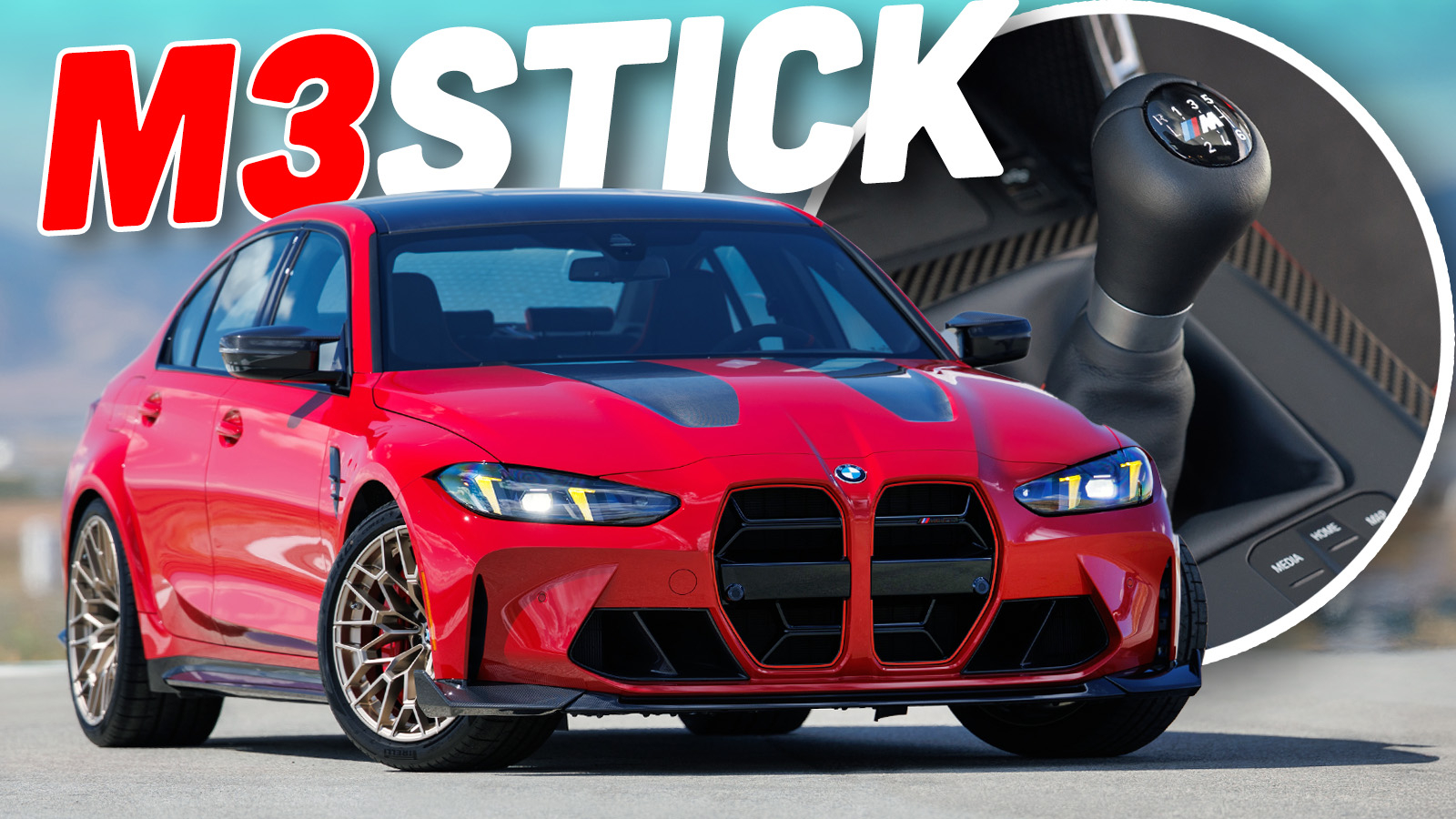
Manual transmissions on new cars have been dropping like flies. Once a month, I feel like the news breaks of yet another car that loses its stick shift option. BMW is one of the few remaining manufacturers that champion the manual, offering no fewer than three cars with shift-it-yourself gearboxes (it used to be four cars, but the Z4 just ended production).
While the company has warned that the manual transmission does have an end date, it’s making sure to squeeze the most out of the stick shift before it goes away. BMW on Monday revealed the M3 CS “Handschalter,” a manual-equipped, rear-wheel drive version of its most extreme M3 sedan. For a moment, all feels right with the world.


Handschalter, roughly German for “hand switch,” has become the moniker for BMW’s special-edition manual cars. When the company debuted the manual transmission option for the Z4 back in 2024, it also carried the Handshcalter name.
In the case of this manual M3 CS, this is far more than just a transmission option. The drivetrain has been given some serious changes to accommodate the three-pedal gearbox. For one, the AWD powertrain has been switched out for a rear-drive setup, and the turbocharged S58 inline-six has been detuned from 543 hp and 479 pound-feet of torque to 473 hp and 406 lb-ft, matching the output of the base M3.
Less Power? Who Cares
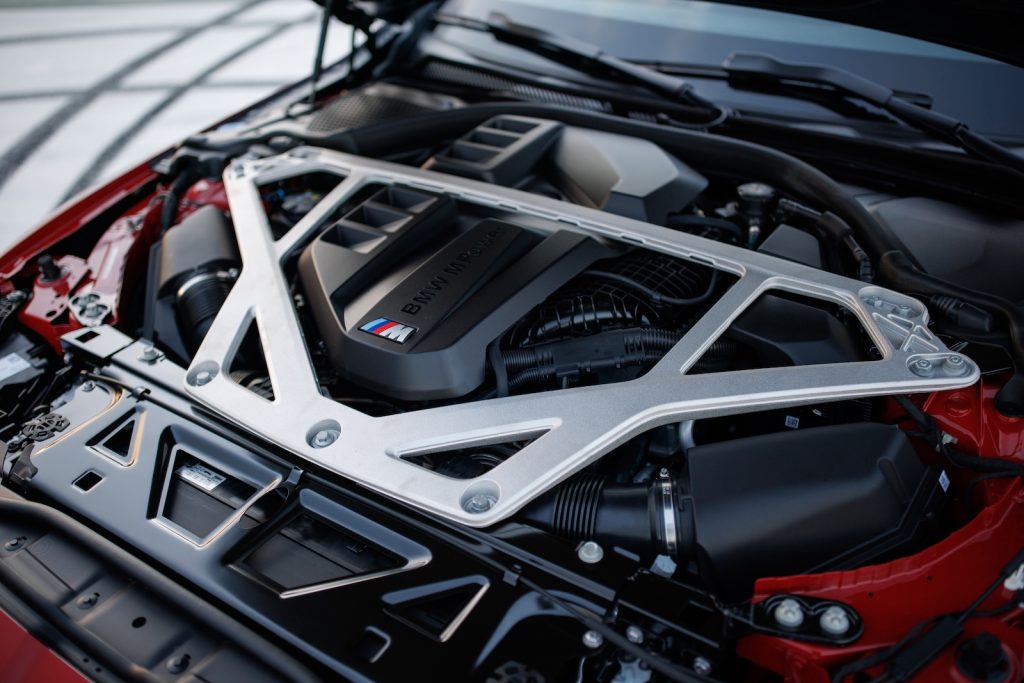
Why the absence in power? Well, BMW M CEO Frank Van Meel told Australian outlet Carsales that its current six-speed gearbox is limited to around 440 pound-feet of torque, making it difficult to fit in higher-output models.
To remove these limitations would require a new gearbox at which point the business case gets very difficult.
“From an engineering standpoint, the manual doesn’t really make sense because it limits you in torque and also in fuel consumption,” said Van Meel.
“But from an emotional standpoint and customer standpoint, a lot of people still love manuals, so that’s why we kept them, and we intend to keep them as long as possible.”
So basically, BMW has decided it would be worth the trouble to detune the M3 CS to accept its existing manual gearbox, and that buyers won’t mind the difference in power and grip from the lower power rating and lack of all-wheel drive. If I had the money for a CS, I’d certainly get the one with three pedals, even if it were slower.
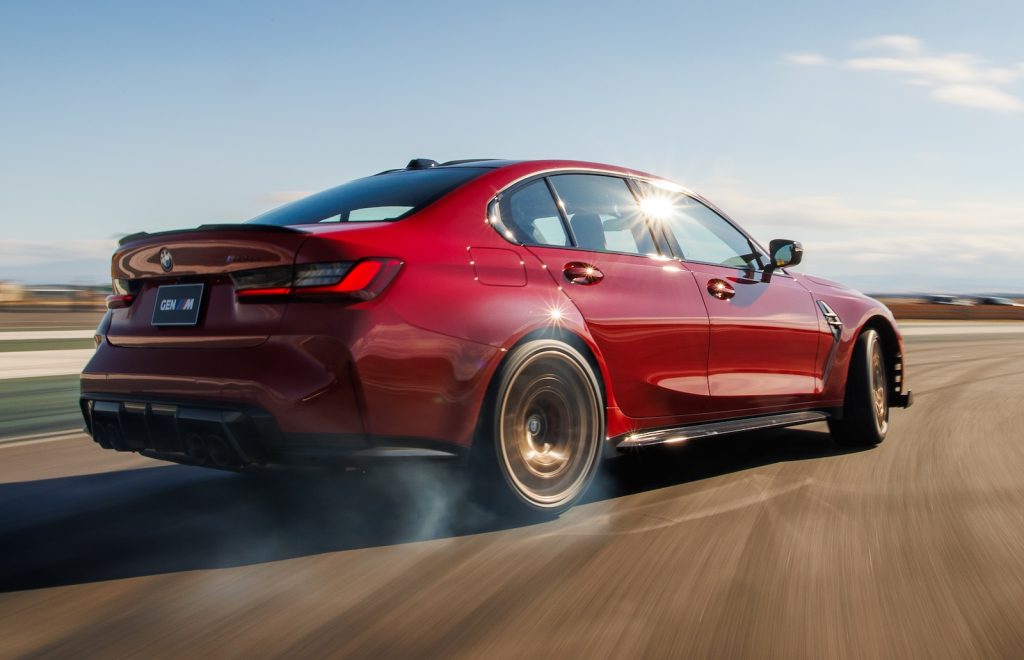
And to be clear, it is, in fact, slower. BMW estimates the CS Handschalter can do the 0-60 sprint in 4.1 seconds, nearly a second slower than its estimate for the normal CS. Top speed has also decreased, from 188 mph to 180.
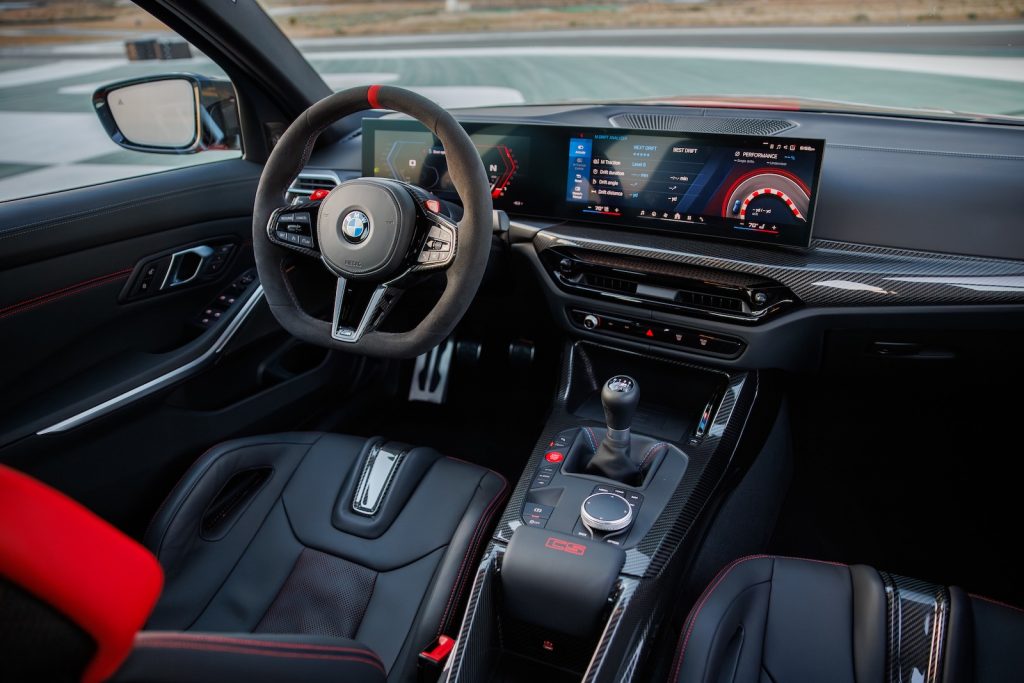
Not that straight-line numbers matter. The CS’s focus has always been on cornering ability and driver involvement, and that focus remains so with the manual version. Thanks to carbon fiber-reinforced plastic, forged alloy wheels, a titanium muffler, and carbon bucket seats, the CS Handschalter is 42 pounds lighter than the standard M3. Option the available carbon-ceramic brakes, and you cut another 31.5 pounds from the final curb weight.
As far as chassis tuning goes, BMW says it’s reengineered the car for this new drivetrain and the new weight distribution. Here’s what’s been changed under the skin, per the company’s press release:
The tuning of the M Servotronic steering and the electronic control settings for chassis, engine, and gearbox are all specific to the Handschalter.
The specially tuned axle kinematics and unique wheel camber settings are engineered to optimize steering precision, transmission of lateral control forces when cornering, spring and damping response, and wheel location. New springs and a new rear axle link lower the M3 CS Handschalter by 6mm compared to the standard M3. Shock absorbers previously found on the ultra-high performance M4 CSL and special auxiliary springs round out the M3 CS Handschalter’s chassis dynamics package.
Just As Flashy As Before
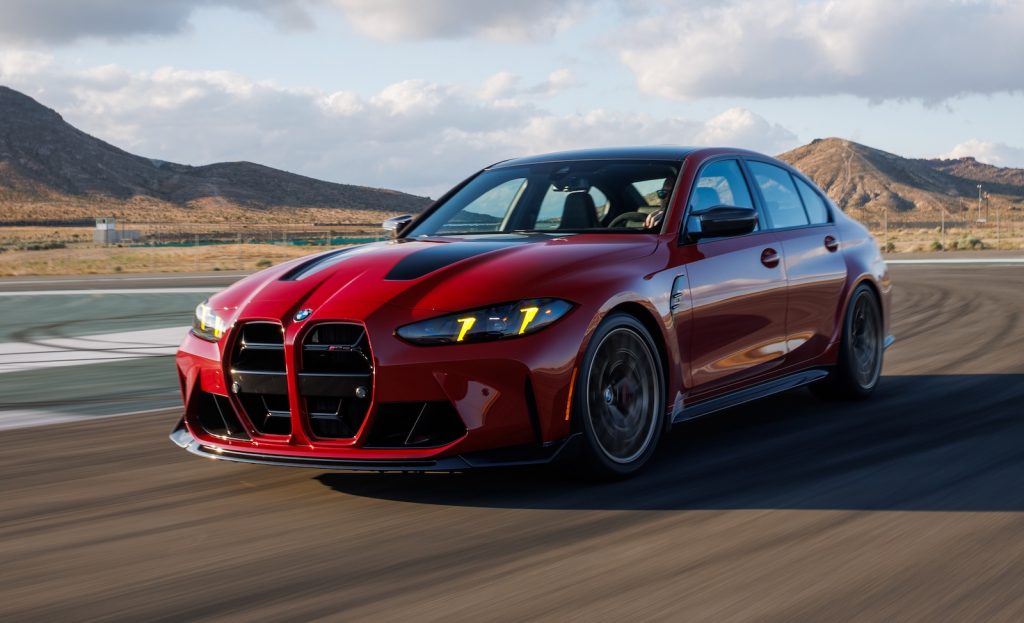
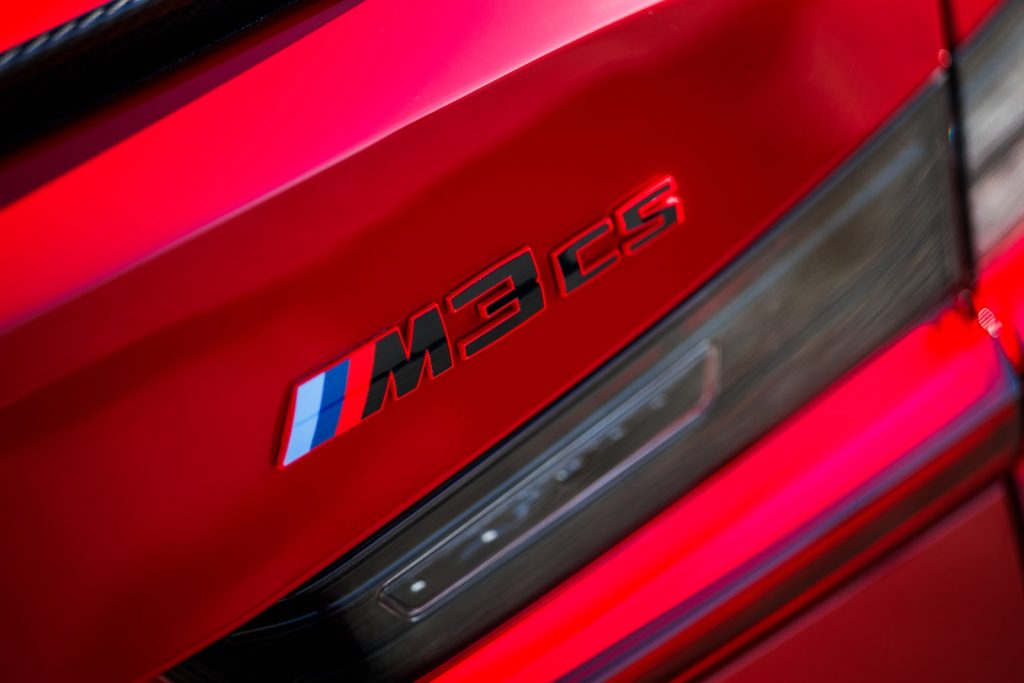
On the outside, you’d be hard-pressed to notice a difference between the normal M3 CS and the Handschalter. The roof, hood, splitter, air intakes, mirror caps, diffuser, and rear spoiler are all made of carbon, with the hood featuring two channel-shaped cutouts to showcase the material. There is also a set of sweet gold-painted wheels measuring 19 inches up front and 20 inches in the back, which can also be optioned in black, if gold is too over-the-top for you. Oh, and don’t forget the fancy “M3 CS” badges front and back, outlined in red.
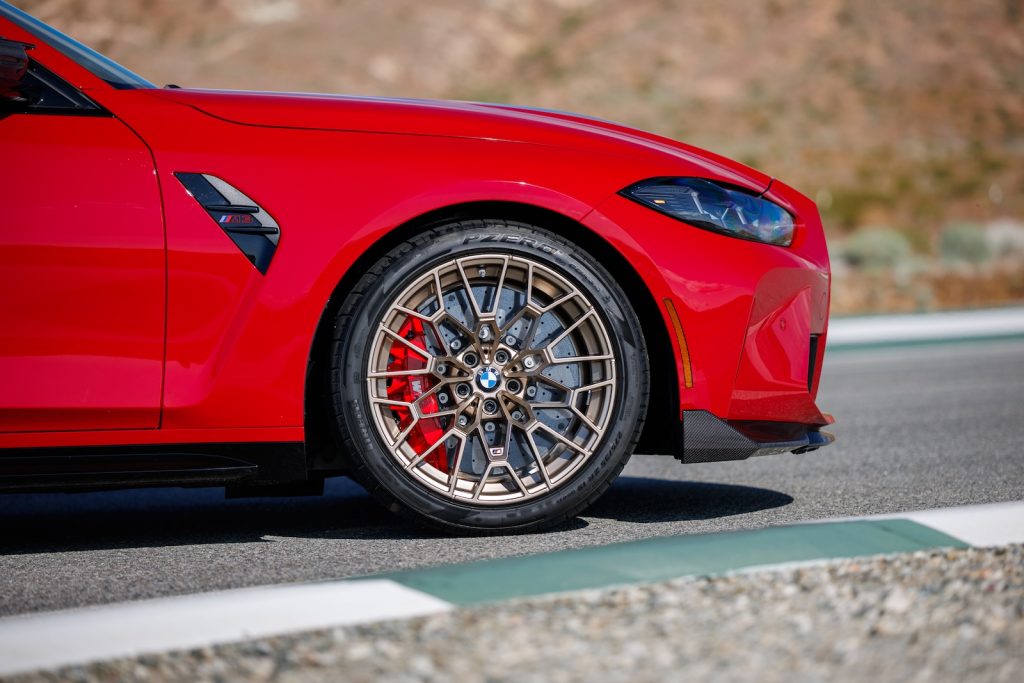
BMW says the CS Handschalter will be available in four colors. Isle of Man Green metallic and Black Sapphire metallic are no-cost shades, while two historic colors from the company’s Individual program, Imola Red and Techno Violet metallic, are available for an extra $4,500.

Though exact production plans are under wraps, BMW says the manual M3 CS will be produced in “very limited numbers” starting in July, with first deliveries expected in the fall. As for pricing, the Handschalter starts at $108,450, including destination. That’s around $23,000 more than a base M3, but over $11,000 less than the AWD, automatic CS.
BMW is marketing this car as a North America-only send-off for the sixth-generation M3, which makes sense considering the current car has been around for nearly seven years now. Going by Van Meel’s previous statements and all of the effort BMW is putting into making the last sixth-gen M3 a manual, it’s very likely this will be the last new production M3 with three pedals, ever. From here, it feels like a worthy goodbye.
Top graphic image: BMW


I have always liked the German word for bra/brassiere. Bustenhalter. With an umlaut over the u. German is a fun language with its compound words. I wish I had more reasons to learn more of it.
I made more use of French and Spanish, what I knew of them. Trying to reason with an airline agent in French while in Russia is one of my favorite moments and one that a colleague repeatedly told about when we got back to the states. That and ordering pizza for my eight-year-old kid near Paris and he looked at me and said “what just came out of your mouth?”
My order is in! Each dealer got one, except Motorsport dealers that got two.
Isle of Man Green G80. Second choice is purple. Gold wheels, csl brace, red calipers, daily driver package to get the hud.
I was always planning on a MY27 6mt as these are the last manual M3s ever, but this CS edition just sweetens the deal.
Although this won’t be a long distance cruiser, it will also not be a garage queen. It’ll even get winter wheels!
The autosolutions ssk is already at home and will go on immediately. It transformed the E46 M3 back in the day and is great in the E92 M3 stroker.
“Though exact production plans are under wraps, BMW says the manual M3 CS will be produced in “very limited numbers” starting in July, with first deliveries expected in the fall.”
The Canadian press release says there will be 40 for the market, but weird that the US presser makes no mention of a number.
Feels like an exercise for upper management to say “See, no one buys manuals!”, intentionally ignoring they seriously handicapped its capability because “business case”.
Can I get the shifter without the pig nose?
Disappointing that BMW is sticking to the torque limit for these manuals. Given the size of the market for these, I understand there’s no way they will develop a whole new unit.
Please, BMW, please give the M2 CS this treatment.
I vehemently disagree with the yellow DRLs, they look like shit compared to the crisp white of the standard car.
Everyone wants purple. I want purple. Purple purple purple.
Buy a purple one. Moth ball it for 20 years. Then sell it on Cars and Bids for $400,000.
I bought $56K of NVDA in early 2022, and it is now worth $444K. Very few cars are a smart investment.
Very true, but you can’t show off at Cars and Coffee with stock lol. Really car investments don’t pay off now. They pay off if you buy it 5 years before it becomes popular, like NVDA.
I see purple car, I want purple car.