

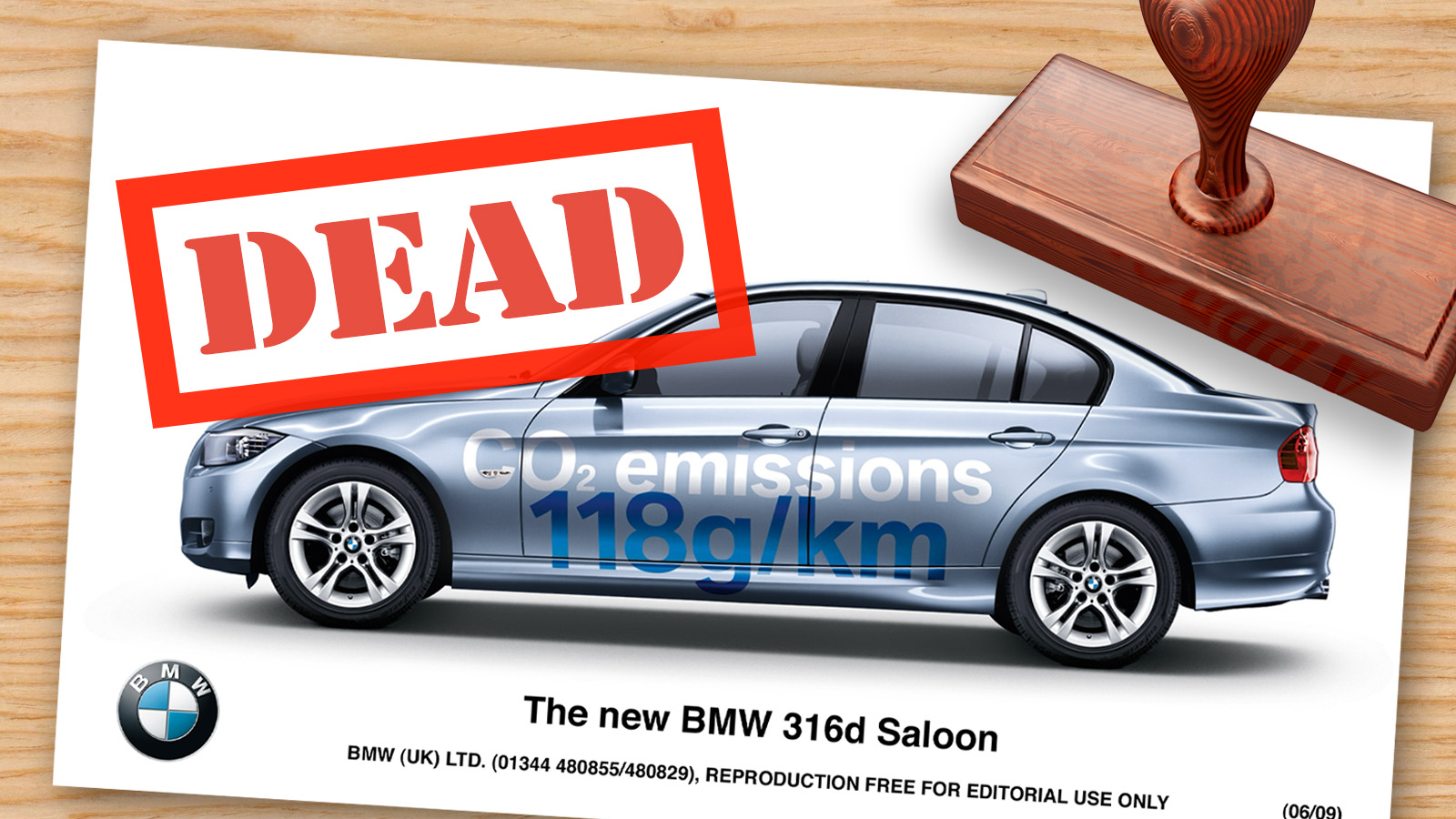
In all the excitement over the new G50 BMW 3-series, there was one detail that quietly slipped by me. The whole point of the new 3er and sibling i3 is that BMW will give you just about any powertrain you want, whether its a full-EV, a plug-in hybrid, or something with as few electric motors as possible.
Except, that powertrain flexibility doesn’t include diesels. For the first time in more than 40 years, you’re not going to be able to order a brand new BMW with some form of oil-burner.


It may be easy to blame this on outrageous diesel prices–and it certainly doesn’t help. I don’t think that’s what’s happening here, both because the timing of it doesn’t line up and because of general market trends.
The Diesel 3er Was Once King
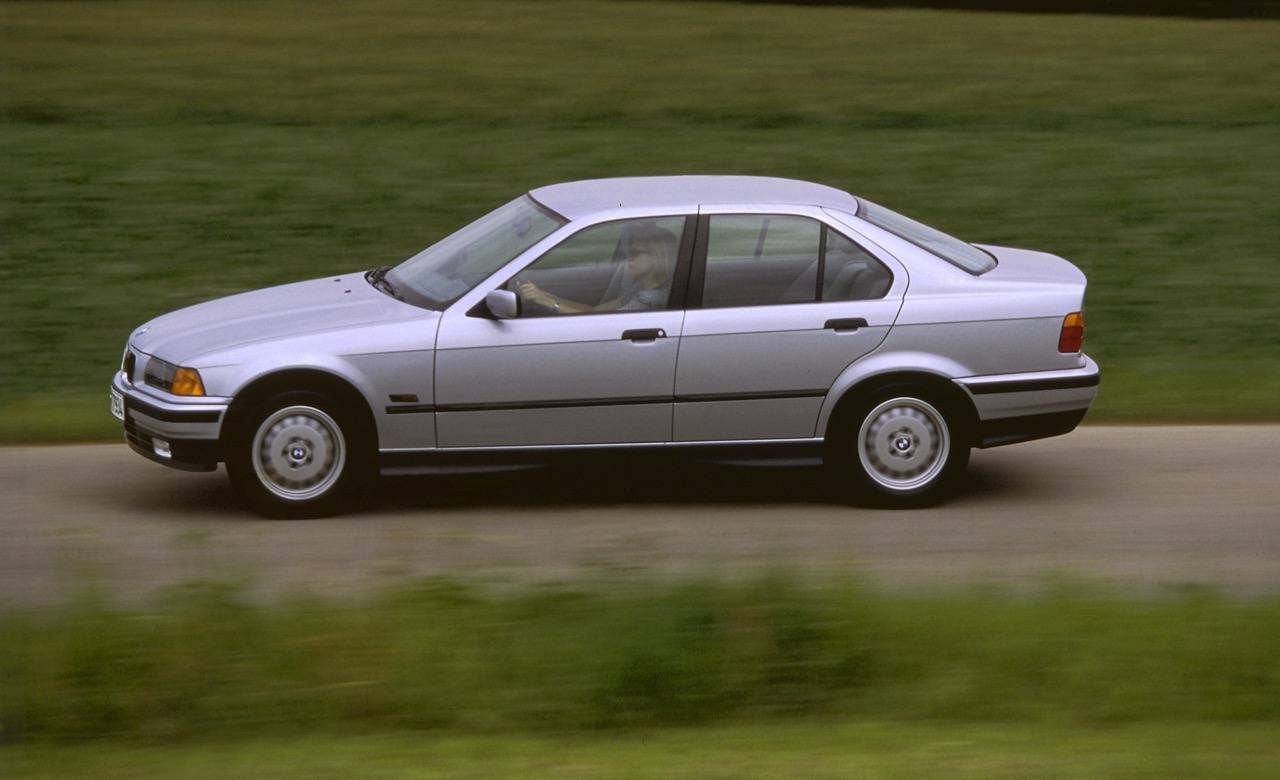
It’s hard to overstate just how important diesel sales have been to BMW and, in particular, the 3-series (or 3er as they call it in Germany). BMW entered the diesel game in the ’80s, and its first effort was the M21D24, a straight-six diesel based on the company’s M20 gasoline engine with a 2.4-liter displacement (thus the D24 in the name).
This was introduced in the E28 5-series in 1983, though the first appearances in the United States of the engine were in the form of a delightfully strange RV and a Lincoln.
In 1985, the motor would transfer over to the E30 BMW in the form of the 324d and 324td. With 210 lb-ft of torque, the turbodiesel variant is somewhat surprisingly one of more powerful non-M models of the era. The E36 BMW would add a four-cylinder diesel engine to go alone with the new six-cylinder, which would be the trend.
At one point, according to Automotive News, diesels accounted for as much as 80% of total 3-series demand in Germany and Europe, all the way to the F30 generation made between 2011 and 2019.
So what happened?
There’s A Lot Of Blame To Go Around
The death of diesel is always going to start with Dieselgate. In 2015, it was revealed that Volkswagen had conspired with a supplier to put a cheat mode into its vehicles in order to pass more stringent environmental tests while maintaining an edge in performance. While Volkswagen and its brands get tagged the most for this, BMW did eventually pay fines for diesel cheating.
Unsurprisingly the peak of diesel sales in Europe followed soon after in 2017, as did changes around emissions regulations. As the then head of R&D at BMW said before the Frankfurt Motor Show in 2017: “The actions of some have severely compromised the credibility and trustworthiness of our industry. As a result, we now face tighter – and sometimes irrational – approaches to legislation. Around the world, regulations on fuel consumption, emissions and safety are changing faster than ever before.”
The world would switch to quickly caring about electric cars, and diesel became the odd man out. The mileage advantages of diesel motors were being erased by hybrids, which offered similar or better performance using a fuel that’s usually less expensive.
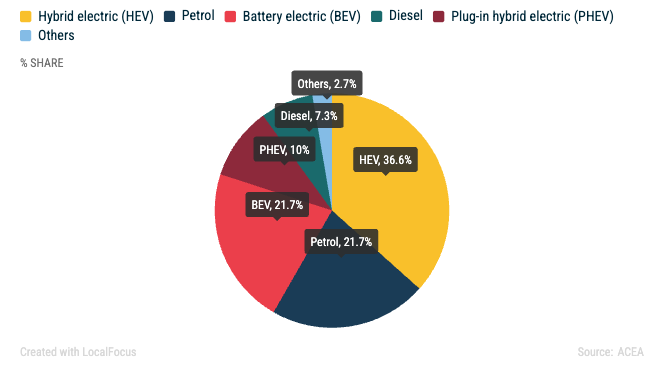
As you can see in the chart above from the ACEA, plug-in hybrids now regularly outsell diesels. While the VW emissions scandal definitely hastened this, it was probably inevitable as hybrids and EVs became more popular.
Tightening regulations have also put the screws to BMW’s plans, as BMW Blog reports:
A BMW spokesperson confirmed in an email to BMWBLOG that the new 3 Series Sedan will be offered exclusively with gas engines, either on their own or as part of a plug-in hybrid setup. The lineup kicks off with the four-cylinder 318 and 320, followed by the six-cylinder M350 xDrive. A plug-in hybrid based around a gas engine is coming later next year. These powertrains will likely carry over to the unconfirmed 3 Series Touring (G51).
BMW hasn’t given a specific reason for dropping diesel power, but it’s not hard to fill in the blanks. Euro 7 regulations are making combustion engines increasingly expensive to develop, while diesel demand in Europe has been massively declining for years. Bean counters will argue that engineering and certifying another generation of diesel engines for a shrinking market is becoming increasingly difficult to justify.
If you want your mileage and you want your performance, your best bet is probably the plug-in hybrid.

This isn’t to say that all BMW Diesels are dead, as you can still get the engine in either cars that haven’t been updated yet or in the larger passenger sedans and SUVs. Whether or not those stick around or are eventually phased out is another question.
Top photo: BMW; DepositPhotos.com


Good riddance.
I had a 2025 318d long roof as a company car for a year and it sucked so bad.
Sound, hvac, trottle responce, they all belonged on a cheap ass shitbox. Not on a car with a pricetag in the ‘luxury class’.
And don’t get me started on the sub par touchscreen. This thing went black and unresponsive in the cold. And it held things like defrost and seat heater.
A shame. I know a 3 series diesel isn’t most folks’ idea of sporty transportation, and it’s got to have been on the low-end pricewise for all 3 series cars, but I kind of like it. The least garnished 3 series is actually the least off-putting IMO. And I’ve owned a diesel car (for a long time: 23 years) and though it gave me agita (not the engine but other stuff, because it was a VW) I still am a big fan of oil burners.
End of an era. Still driving a 2015 328d here in the US. Before the latest madness, the fuel economy was great. Now, on a $/mile basis, it’s almost the same cost as an M5. Thanks Mango Mussolini.
I blame GM for the death of diesel cars … on this side of the pond. Also, for the stigma that only light trucks and up could have one. A stigma that persists today, even through the dieselgate drama. I can say unironically there are still people asking if they can swap in a Cummins 4bt or 6bt into their light truck to avoid emissions checks and tow a 50,000 lb trailer.
Three of those were down to me – an E46 2.0 Touring, and E91 2.0 and an F31 3.0. The engines were superb – the 2.0s far better than BMW’s petrol four cylinders at the time for responsiveness and torque, with 45+ mpg even if you were caning the car. When I got the E46 the CO2 emissions (basis for company car tax) and residuals (basis for lease costs) were so much better than any competitor that it was stupid to get anything else. Luckily the car was fantastic too.
Good. Diesel passenger cars shouldn’t be a thing.
Pushing diesel through misguided regulations was a generational mistake in Europe. Credit to them, they’ve made amends for it and are quickly moving away, but it did a ton of damage in its day.
I’ve had the chance to visit at least one South American city still crawling with diesel engines with barely any emissions equipment. The air on the streets was acrid. Anyone who wants that back is insane.
I went to Nicaragua and the amount of traffic while walking so close to the street and a lot of cars running diesel = awful, I could feel it in my lungs.
Yeah, diesel is dead. Countries are increasingly outlawing diesel-powered passenger cars.
The one place I think they still make sense though is in Germany on the Autobahn where the high speeds affect your mileage less in a diesel than in hybrids. I averaged 44 MPG in a Q3 diesel I rented there a few years ago while averaging nearly 95 MPH and doing a few sprints up to ~135 MPH because autobahn.
Ironically, diesel makes more sense for the big pickup trucks Americans love.
I’ll just hold on to my mk4 tdi as long as I can.
I had one (’01 Jetta 5M). I loved it. Sold it in 2016, because I needed a bigger cabin and Texas meant it really needed a sixth gear.
The fuel economy has now been overtaken by the cost of diesel. And being honest, the maintenance costs of the TDI were a lot higher than the V6 Accord that replaced it and achieves lower fuel costs on long trips. 40 MPG on regular vs 50 MPG on diesel. That math stopped working out and I sold it and bought the Honda.
But I do miss that car.
I saw someone rocking a MK6 TDI sedan yesterday. I did a double take when I saw the badge. It was like seeing a brown unicorn.
I just don’t see the need for that fuel in cars anymore either. Towing, sure. Ocean freighters, sure. A 3 series BMW, nah, I’ll pass.
Something not mentioned is that EU fleet fuel economy regulations are in g/km CO2. Every gallon of diesel burned releases more CO2 so by measuring in g/km CO2 the EU is erasing the energy density advantage that diesel has over gasoline.
The current fleet average is 93 g/km. At 118 g/km CO2 that 3 series is 25 g/km over the limit. Each g/km has a fine of 95 Euro so BMW would pay a $2,375 euro fine for each vehicle sold.
It’s a little more nuanced than that.
https://theicct.org/wp-content/uploads/2022/01/Gas-_v-_Diesel_-CO2_emissions_-EN_-Fact-_Sheet-2019_05_07_0.pdf
Diesel does create more CO2 per gallon but that’s because it creates more power per gallon. But the technology of diesel (mainly the much higher compression) made them more efficient in KgCO2/km than petrols at the time – and probably still would be if diesel hybrids had become a big thing.
Diesel was seen as the best way to reduce CO2 emissions in the EU before Dieselgate. The reason diesel got killed had a lot to do with all the NOx and particulates that spews out of them.
I bought an old diesel specifically for a road trip last year – it would quite happily do 60 euroMPGs at freeway speeds, but it was a filthy dirty thing and it was quite obvious that it was doing very bad things to the environment.
Diesel produces more CO2 per gallon because it has more carbon. Burning a gallon of gasoline produces 19.6 lbs of CO2. Burning a gallon of diesel produces 22.4 lbs of CO2. That is also where the extra energy comes from.
Diesel’s used to produce more power per gallon of fuel burned than gasoline engines back in the days when the typical gasoline engine was naturally aspirated, port injected, with low compression and diesels were direct injected turbos. Those days are gone. Much of that diesel technology has come to gasoline engines.
The other thing that has changed on both sides of the Atlantic is that diesels no longer get their own special emission standards. Today they have to meet the same standards as gasoline engines and that is harder to do with a diesel and requires expensive after treatments. (However, gas engines are immune and now those DI turbo gas engines also require particulate filters)
End of the day it is easy to make power, meet fuel economy standards, and meet emission standards with hybrids (and EVs of course). This is why diesels and non-hybrid gasoline vehicles have dropped to less than 1/3 of sales in Europe. Tighter fuel economy standards + tighter emission standards = more electrification.
It is also basically impossible to meet the current 93 g/km CO2 standard without a hybrid. Even a tiny car like the VW Polo with a 1.0 TSI is rated at 121 g/km
Diesel’s advantages over spark ignited engines are far less significant in a hybrid application. Yes they have higher compression ratios which helps efficiency, but the bigger gain is maintaining that efficiency at a much wider range of engine speed and load points. SI engines lose a lot of efficiency when they have to be throttled at lower loads (increased pumping losses) and when they run retarded spark timings at low speed/high load to avoid knock. Diesels normally don’t need throttles and can usually inject at the most favorable time for best efficiency, plus a turbo further reduces pumping losses.
In an SI hybrid you can usually go to an Atkinson cycle valve timing setup for better efficiency, keep the speed/load range more limited to the most efficient operating points, and those steps often allow some cost to be taken out of the engine. On a diesel hybrid you still have the big diesel cost adders in place (>2000 bar fuel system, turbo, stronger internals for higher pressures, complex aftertreatment, etc.) and a lot more weight, with little to no efficiency benefit over an Atkinson cycle engine. NVH probably becomes more of a challenge as well, and that high compression engine takes more energy to start and stop smoothly. Even if you can eek a small fuel economy improvement, it’s going to be at a very high cost.
Still hard to beat a diesel for highway cruising.
The allure of passenger car Diesel engines came down to 3 things:
a] cheap fuel
b] simplicity due to fewer emissions controls
c] more torque
[a] and [b] are distant memories, and torque addicts can get their fix from EV.
That pretty much sums it up.
Yep, and now the drawbacks are even more obvious by contrast. They sound like shit and are dirty as hell.
Good summary…
Better fuel economy was a big one too and these paid off for those that put big miles on their cars. Today that advantage is more than offset by the fuel cost and in smaller passenger cars hybrids are usually more efficient overall anyway.
The modern turbo SI engine covers the desire for “c” pretty well these days.
Actually I think this could bring back the ability to have DIY guy do the create your own diesel again.
“…(or 3er as they call it in Germany)…”
Which is pronounced “Drei-er”
or
“Dryer”
Apparently the Germans considered the 3 Series an appliance too.
You mean like a Camry or Carolla the best selling cars ever? Not sure your argument has enough sense to make 2 cents.
Once again, ^^ missed the point completely.
I remember when BMW was supposedly working on a 9 series (codenamed “Arnold” for secrecy), finished with fine Austrian oak in the dashboard and it was going to come in an exclusive black paint.
They were going to call it the Schwarzeneuner, but it was terminated.
*giggle*