


I’m sorry, did you think that the Decade of the Hybrid was 2020-2030? No, my friends. The Decade of the Hybrid is from 2025 to 2035, which means we’re really just at the beginning of a huge surge in both hybrid sales and production. Need more proof? Even the most ‘who needs hybrids?’ of all the old-school OEMs has come around.
That’s right, GM will spend $750 million tooling up to build hybrids, and in the category that I think is the most promising for the technology. It’s not a win for The Morning Dump, it’s a win for America. Stellantis is at the start of its own resurgence, but it’ll have to endure another quarter of losses before it gets there. Did the Trump White House strong-arm Audi into making a plant announcement last week? That’s an open question.


It sounds like France and Germany will successfully walk back the EU’s 2035 emissions goals, and not everyone is happy about it.
Hybrids! Hybrids! Hybrids!

That beautiful site is the Lansing Delta Township Assembly, which currently builds the three-row Buick Enclave, Chevrolet Traverse, and GMC Acadia. Those are all fine vehicles, and when I drove the Traverse recently I did think it would be better if there was a hybrid option (though, the current drivetrain is also not bad).
It sure sounds like that’s what they’re getting in this GM press release:
As part of its long-term plans for Lansing Delta Township, GM intends to prepare the site for future hybrid-electric vehicle production. Details about nameplates and timing will be shared closer to launch.
“Lansing’s strength starts with its people. Their skill and experience are why we continue to invest here,” said Mike Trevorrow, senior vice president, Global Manufacturing. “We’re building on what this team does well today while preparing for what customers will need in the years ahead. That means investing in our people, our facilities, and the ability to build a broad range of vehicles.”
The success of the Toyota Grand Highlander, Kia Telluride, Hyundai Santa Fe, and other three-row hybrids should be the only data point that GM needed to realize that hybrids were at least part of the future. Yes, it’s not great that GM was so resistant to hybrids, and they’ll probably pay the price for that call, but it’s nice to see the company is course-correcting.
It seems obvious that the three vehicles will be the Acadia, Enclave, and Traverse, though GM doesn’t explicitly say it. A reporter for Automotive News did ask, and was told it would be those three family crossovers.
What kind of hybrids will they be? Will they be mild hybrids, PHEVs, or traditional hybrids? Because the company only has one Corvette hybrid, it’s hard to say what flavor or layout to expect. It would be awesome if these were EREVs, though they probably would have just come out and said that were it to be the case.
Either way, more hybrids is good.
Stellantis Only Lost $503 Million In The Third Quarter
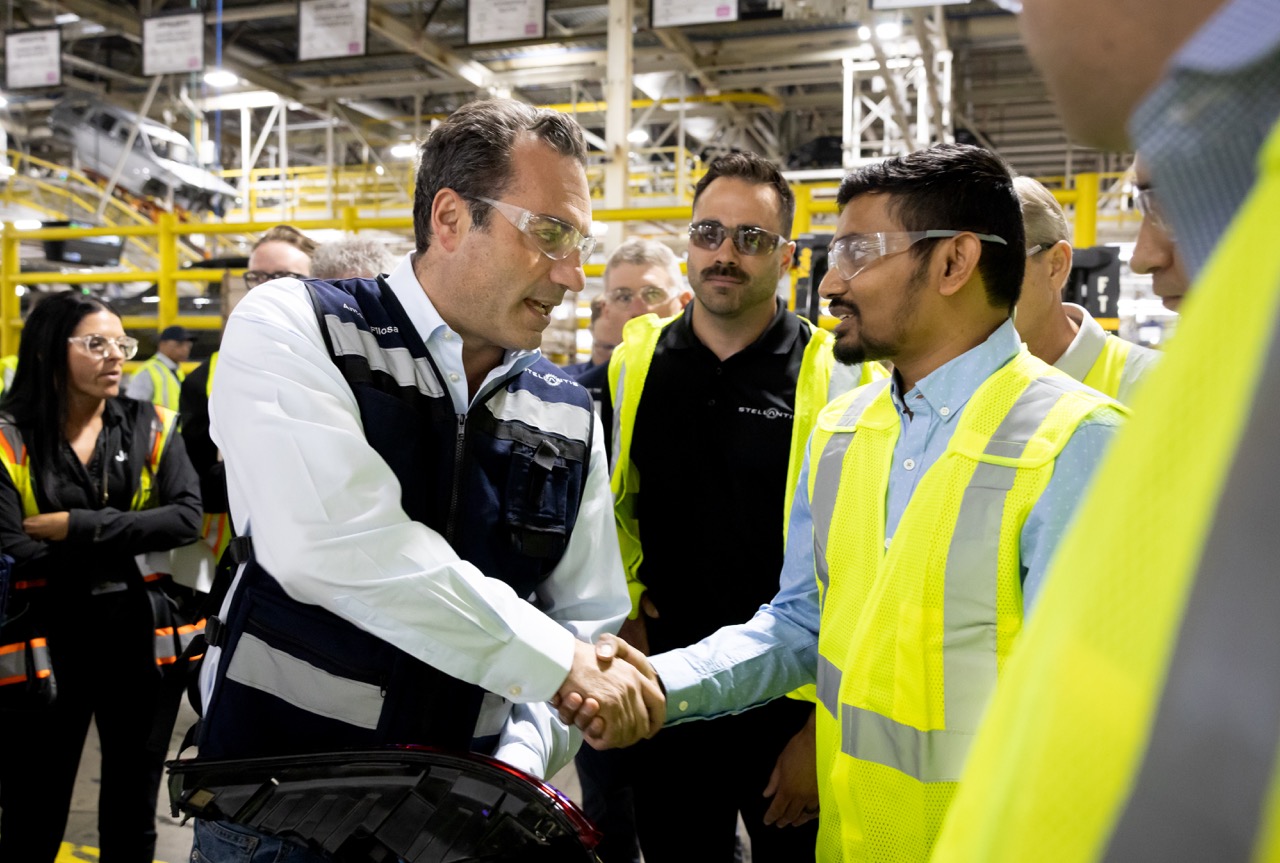
This might sound like damning with faint praise, but it’s not the worst that Franco-Italo-Dutch-American automaker Stellantis only lost $503 million. If you’ll remember, the automaker posted a loss of $5 billion. So, this is better.
Here’s CEO Antonio Filosa explaining why it’s maybe not that bad:
During the quarter, we continued to make progress in the early execution of our FaSTLAne 2030 plan, launching new products, accelerating partnerships as planned, and delivering meaningful improvements in manufacturing and quality. At the same time, our Value Creation Program has ramped up rapidly, with positive contributions being recognized in the quarter, and we remain on track to implement at least 40% of the total €6 billion in run-rate efficiencies by the end of this year. As a result, we reaffirm our 2026 guidance, and our expectation of positive Industrial Free Cash Flow in 2027.”
The company also expects to spend about $1.1 billion on tariffs this year, which isn’t helping.
Did Trump Strong-Arm Audi Into Appearing At Event?

Audi handed the Trump Administration a win on the campaign trail when it announced it would be building a new plant in Georgia, just in time for a campaign rally in that state. It didn’t go over well in Germany, and many wondered if Audi CEO Gernot Döllner wasn’t maybe in violation of company rules by speaking at the rally.
According to German newspaper Handelsblatt, not only was the VW Board of Directors aware, VW CEO Olive Blume was involved in the announcement. Why make the announcement now? Here’s what the report says (translated):
Audi currently plays a negligible role in the US market. This investment is intended to change that. Furthermore, the tariffs imposed by Trump are a factor in the decision: The Ingolstadt-based company currently imports all its vehicles for the US market from Europe or Mexico. These tariffs cost the automaker €1.2 billion last year. Audi’s sales in the US have declined by 16 percent this year.
That sentiment was echoed in this editorial from Automotive News:
The timing and Döllner’s rally appearance may be linked to an arrangement that an anonymous U.S. official described to Reuters.
In exchange for the factory commitment, the Trump administration and VW will continue talks on a tariff reprieve, the official said. The discussions focus on a proportional tariff credit for manufacturers that commit to new U.S. production, the official said, and any changes would apply to all manufacturers that expand U.S. production.
If Audi was strong-armed into showing up, that’s not great, but it’s less on them and more on the administration.
EU Climate Chief Is ‘Not Impressed By The Intellectual Logic’ Of Franco-German Climate Plan

Germany and France are the biggest countries in the EU and therefore have a larger proportional sway than others, and they’re also countries that are home to automakers. With the threat of China looming, high tariffs, et cetera, it sounds like the two countries are going to be successful at pushing back the European Union’s big climate goals.
Not everyone loves this, and those who don’t have kinda funny/bitchy things to say about it.
A deal between France and Germany to effectively abolish a climate neutrality goal for carmakers by 2035 threatens to undermine Europe’s efforts to stave off competition from Chinese electric vehicles, according to the European Union’s climate chief.
Wopke Hoekstra, in charge of the CO2 rules for cars, welcomed stronger “Made in Europe” criteria for the sector, but said that higher fuel prices and an uptick in EV sales showed that staying the course was the best way to safeguard the industry.
“I’m not impressed by the intellectual logic,” Hoekstra said in an interview. “European carmakers are not hindered by too steep electrification targets; they are hindered by the fact that a larger share of these electric vehicles are being produced by the Chinese.”
Of course, Chinese automakers have a huge (probably unfair) advantage when it comes to cost.
What I’m Listening To While Writing TMD
Here’s a fun Halloween song from Devon Cole. It’s called “W.I.T.C.H.” and it’s an acronym.
The Big Question
What would you hybridize that’s not currently hybridized?
Top photo: Buick


Well well well Stellantis! With a loss like that, by Anthropic S-1 standards, Stellantis stock should have a market cap of like $300 Trillion! That’s how this works, right guys?
TBQ: Hybridize the Bronco so I don’t look like,or more like, a mall crawling douche. At least if it was a hybrid I could say it gets decent mileage.
TBQ: To echo what others have said, pickup trucks. My Ram is pretty good on the highway for what it is, but one trip around town drops my tank average at least .5mpg, and that’s over 400 miles.
A hybrid pickup that got 25/25 (or so) would be amazing. I think the F150 Powerboost was close to that, and a great concept, but from what I read the execution may have been a little lacking. I really wanted to get a Powerboost, but I read about too many issues with them. Ford seemed to have enough recalls on the purely gas trucks as it is, so the added complexity scared me.
I think the half ton is a good place to start with this, as most of the trucks on the road are half tons bought as daily drivers. I do agree that it should also extend to 2500 and 3500’s well. Image a 1200ft lbs Duramax with another few hundred ft lbs from a hybrid. Or a hybrid Babymax that got 30mpg+ avg.
I’d hybridize the Mustang GT so that I can enjoy the V8 on highways and back roads, while leaning on the electric motor for efficiency in traffic jams and suburbs.
I’d hybridize the WRX with similar logic. I’d replace the CVT with a DCT, while adding a P3 electric motor (at the DCT output rather than between the engine and gearbox). That would give me lightning-quick shifts at higher speeds while avoiding DCT jitters at low speeds.
TBQ:
3/4-and-1-ton trucks seem like low hanging fruit for hybridization (I would make them EREVs). They are already expensive and heavy, so weight and price tag are less of a concern. Plus, an electric motor would produce the requisite torque for heavy towing without needing a ginormous engine, a massive cooling system, or a complex, failure-prone emissions system. If nothing else, these trucks use enough fuel that there is probably an economic case to be made even if they come with a $15,000 upcharge over a typical truck.
Also, yesterday’s article about Porsche’s stupid fake shifting system gives me an idea. Why not add simulated coal rolling? You could build a system that shoots out a stream of real-looking but non-toxic, non-polluting black “smoke” from behind the right rear tire. For added realism, you could add hidden speakers for diesel sound effects (including a prominent turbo whistle) and some kind of shake weight-like thing to simulate engine vibrations. Honestly, I’m surprised some dumb Youtuber hasn’t done this already.
Agree on heavy trucks as EREVs. The cost pencils out there.
The problem with fake coal-rolling is that sadly the harm to others & the environment is considered to be a ‘feature’ not a flaw…
I’d be hybridizing all the largest and least efficient vehicles. The benefits of improved fuel efficiency on those would be much more noticeable than on vehicles that are already efficient.
I’d also like to see a lot more PHEV/EREV vehicles, especially in performance vehicles, where the immediate acceleration will be a selling point.
GM hybrids will be interesting. I’m pretty confident they won’t be EREVs outside of any trucks that happen to go hybrid. EREV is an excellent marketing strategy (and I’m not opposed to them as they equate to a lot more electric miles being driven), but as powertrain they are kind of crap efficiency wise due to all of the conversion losses. GM is usually pretty conservative when it comes to powertrain design, so I’m guessing they won’t step too far ahead of what they are already doing. My prediction is standard hybrids all around, with maybe one or two PHEV models as sort of tech demos.
What it actually means is if they agree on something it happens and no other countries matter. The only time smaller EU members have any power is when they can drive a wedge between them. Google tells me Mr. Hoekstra is Dutch, so the complaints are pretty much on brand for a country that really doesn’t have any skin in the game regarding auto emissions rules, but since it appears both Paris and Berlin have calculated that intentionally knee-capping their own automakers will just let China eat the whole market and are taking sensible steps to avoid that, he’s just screaming into the hurricane at this point.
TBQ: All of them. The thermodynamic and mechanical operating characteristics of an Otto or Diesel cycle internal combustion engine simply do not line up with the duty cycle demands of daily driving. As a result, billions (trillions?) of gallons of fuel have been uselessly burned, tons of unnecessary CO2 have been emitted, and dollars wasted. Hybrids are a proven, relatively simple way to massively correct the characteristic curve to something much closer to the duty cycle demand, and any manufacturer not offering them universally should not be taken seriously in this day and age.
Full size Vans, Mid Size Trucks, Full Size Trucks, and HD Trucks, preferably REVs but at least with enough battery capacity to use regenerative braking with a trailer down our longest/steepest grades, e-CVTs are the only way to go for conventional hybrids though, and sadly the tech hasn’t been scaled up for the aforementioned groups of vehicles.
Also the Maverick should have a PHEV version
tbq: Not just new cars! I’d love a kit to hybridize my ZJ.
It’d be kinda silly for anyone to produce one, of course, but that wasn’t the question…
TBQ:
Finally, a question to which Miata is not the answer.
Naw man, you could make a sweet Miata hybrid. But here’s the kicker- you’re not hybridizing the motor, you’re introducing an electric turbo driven by regenerative braking powered by a teeny battery. The idea is you would add very minimal weight, but be able to eliminate the turbo lag that has killed any idea of a stock turbo Miata.
Every gas vehicle should be a hybrid, as an ECVT / electric motor + helical gearbox + battery is simply the most elegant & efficient way to turn hydrocarbons into forward motion.
That said, I am staunchly against EREVs in compact & midsized mainstream vehicles. The need for two fully capable power sources- A fully functioning ICE engine + substantial battery, puts the concept into a price bracket that is simply not feasible.
As great as they are, even conventional hybrids with their tiny 1kWh batteries are only starting to make economic sense. You’re still looking at a half-decade to pay off a CRV hybrid in fuel savings. PHEVs make this problem worse. This is why GM has held off until now.
EREVs are even worse, and only make sense if the vehicle fits into an expensive luxury niche. Or, if the drivetrain is replacing something expensive and costly to operate like a diesel in a HD pickup truck.
DT can stump for EREVs all day long, but there is a reason his beloved i3 was hardly a success, and he would probably never buy one new. The concept is not economical for everyday vehicles.
Agreed but with a slight disagreement.
I believe EREVs will be the future, just not now. More likely than not they’ll be geofenced in the future so you can’t run the engine inside of city limits, reducing urban pollution but giving you the convenience of gas outside of city limits.
EREVs have a problem in that they will never match a pure hybrid on efficiency because conversion losses are a killer. They are a good solution if you can commit to like 95% short range EV miles, 5% road trip miles, but that’s not everyone.
Agreed. You gotta have enough range to make going to town feasible on electric only. Right now I burn through 60% of my range on my 2025 Leaf S driving to town and back. If the same car had a gas generator I’d drive the damn thing everywhere.
The reason I didn’t get an ICE vehicle (including a hybrid) when I got the Leaf was that most of my drives were less than 10 miles round trip, which with the frigid temps in the winter here would definitely not be enough time for engine to get up to temp. An engine block heater could solve that, but you’re not supposed to leave them plugged in all the time, so you gotta plug in the block heater 3-ish hours before you want to drive the car.
It’s never going to happen. The economics just don’t make sense with batteries getting better & cheaper. If you need gas, just save the money and buy a conventional hybrid, or spend the EREV generator money on more battery capacity.
Conventional hybrids + an ever-increasing number of EVs will make up the bulk of light vehicle sales for the foreseeable future.
EREVs are an expensive solution for niche use cases, luxury vehicles and heavy trucks.
For my sake I hope you’re wrong.
A Full Size or HD REV would be the perfect vehicle for my family. Enough range to get to town and back on EV only (currently burn through 60% of my range in a 2025 Leaf S on the same trip), the ability to pull a trailer and use your standard drive thru style gas pump instead of non-trailer friendly EV charging infrastructure, and oodles of regenerative braking while towing a trailer.
I see a ton of Traverses/Acadias/Enclaves on the road these days and I must confess-they’re all very attractive cars now. I think GM deciding to make them look as truckish as possible was a great move. Normies might see them and confuse them for Tahoes/Yukons/etc. and GM has money on the hoods of them these days.
They also have the most interior space of anything in that class. The issue is the powertrain. It’s now a raspy 4 popper that struggles to get low 20s fuel economy combined. If it was still an NA V6 like the Pilot there’s a case to be made for putting up with the poor gas mileage for better reliability…but it isn’t. It’s similarly inefficient and ALSO less reliable! Brilliant, GM!
I have no idea why it took them this long to determine they need a hybrid. There is 0 reason for any family hauler not to be hybridized in 2026…and based on my incredibly scientific method of keeping an eye on what I’m seeing on the roads, the Korean hybrid big crossovers are selling like hotcakes.
Like those things took over school pickup lines almost overnight. They are EVERYWHERE now because getting a hybrid Toyota hauler is a $60,000 proposition unless you can wait a year plus or are willing to fly somewhere and drive one back. You can go to a Hyundai/Kia dealership and drive off in a hybrid Palluride for $50,000-ish….or a nearly loaded Santa Fe hybrid for even less.
GM has those cars thoroughly beat on style and space, though. Korean design is the fast fashion of the automotive industry…not to mention no one knows how reliable that brand new turbo/hybrid powertrain will be. We’re gonna find out soon enough, but there’s um…a lot going on on paper.
We were already going to look at the Traverse/Acadia (the wife thinks the Buick brand image is cooked, I don’t agree but happy wife happy life etc) but if they can get a hybrid to market in the next couple of years they’ll look a whole lot more appealing.
The school pickup/dropoff line is the absolute best way to see what families are buying in your (the royal your) area. The HK cars are absolutely dominating vs the midsize German and American kid movers out here in the urban Seattle area.
Hybrid all the things except the lightweight sports cars! And maybe not worth it for some long-haul trucks. Any vehicle which uses brakes regularly.
ALL fullsize trucks should be hybrids. Every single one.
Really, probably all internal combustion passenger vehicles and light trucks
The issue is currently that the efficiency gains for a hybrid that doesn’t have an e-CVT or is not an EREV are very small relative to the cost and complication of the system.
They need to fix that before a Hybrid Mandate.
TFL’s testing of the F-150 Hybrid towing at max capacity vs the Maverick Hybrid with 4K tow package towing at max capacity does a pretty good job of showing how much worse the F-150 was, and you only got a slight MPG gain over the Pure ICE version
Hybridize everything obviously. With all the different flavors of hybrids currently available, I would argue there is a beneficial hybrid setup for every vehicle type. Execution is the hard part, not deciding what to hybridize.
Maybe a more interesting question to me is what vehicle types should still be offered with ICE or EV powertrain options. As time goes on EV will be viable in more types of vehicles and use cases and ICE will be justifiable in less cases, but will not go to zero.
I’d hybridize the Wrangler again. But do it better this time
You mean you don’t want to have your vehicle spontaniously combust? What’s the fun in that.
Yes! When I first heard of the Wrangler hybrid I thought it would be the perfect vehicle…all of the capabilities of a Wrangler, but with good gas mileage! There’s no way they could screw this up… 😐
TBQ: Everything? Almost everything, at least. Certainly my CX30, even in a mild-hybrid form would be an upgrade.
It’s not a question of what I would hybridize that’s not already a hybrid but what I would PHEV-ize that’s currently a hybrid, and the easy answer is the Toyota Sienna
Yes, though it would make an expensive product even more expensive, which is a bummer for most families.
Bigass Diesel HD trucks, so then you could honestly claim that it pulls like a freight train.
Still baffling to me that despite being used in locomotives for a literal century, diesel-electric power is only just now being considered for pickup trucks
I just want a reasonably affordable EREV to be released. Scout, the Ramcharger and all the rest might as well be fantasy vehicles until proven otherwise with actual sales.
TBQ: A hybrid Wrangler that doesn’t set itself on fire would be nice
They won’t be affordable, I guarantee it. Go look at the cost of a full size truck with even the base 3.0 or 2.7 engine, and then add 10-15k for the battery & electric running gear.
TBQ: All pickup trucks. Having the electric motor to help get off the line while towing and hauling would be nice, and even a 1-2 MPG increase in efficiency would result in a lot of cumulative fuel savings.
On the flip side, I think most EVs should be hybridized with small range extender motors in exchange for a smaller battery.
ID Buzz deserves the EREV treatment, they could even put the range extender in the back like where the old school VW busses had their engines
Definitely! Also, looking under my 500e, I feel like there’s definitely space under the trunk where they could stuff a little bitty generator.
It really does. End the pack a little sooner and stick a 1L 3cyl engine back there.
I would sell a hybrid version of GM’s large SUVs, with the Turbomax plus a hybrid system, whether plug in or traditional.
Mid to high 20s combined shouldn’t be too big a stretch if that’s done right.
The old 2-Mode’s were rated at 20 mpg hwy with the 6.0’s, so mid-high 20’s combined should be an easy goal
Assuming the V8 version was still sold as an option for those who need it, it might even be possible to do better mpg wise by sacrificing towing capacity on the hybrid, since many buyers don’t use it.
A Grand Highlander hybrid gets 34 combined with AWD and is almost as big as a Tahoe. You’ll have a weight penalty for the truck frame and real 4×4 system, but maybe 30 mpg is possible with the right tune.
I’d hybridize a performance/”sporty” version of a regular car, like a Hyundai Elantra N-line. Get good handling and fun-to-drive, with efficiency. The full-rip N can still be ICE-only.
I’d hybridise a cheapish RWD two door coupe.
So that maybe Toyota could sell GR86s in Europe again and I’ll be able to replace my GT86 when it finally succumbs to some Subaru-related catastrophic incident.
Or, you know, hybrid Miata.
ooh I would totally be down for a hybrid GR86 too
Yeah, that would be awesome, something like a Mustang or BRZ that also gets like 45mpg? Sure, sign me up