

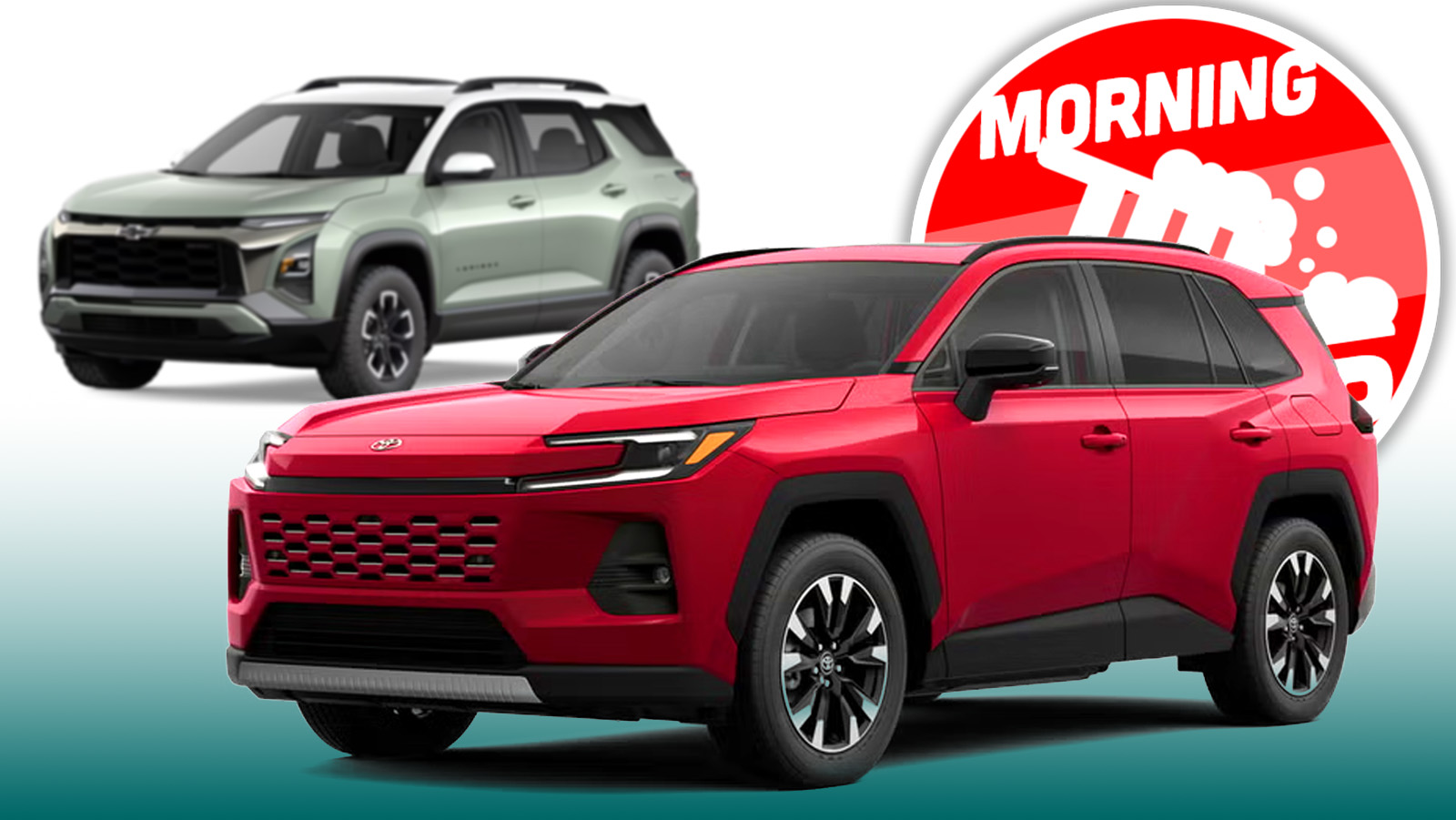
One little piece of data in the quarterly sales numbers released this month that’s raising eyebrows is Toyota’s extreme narrowing of GM’s historical dominance in the United States. While El Generalissimo might take the crown in 2026, if this trend continues it might be a different look in 2027. The reason? Hybrids, of course.
The Morning Dump will continue to beat the hybrid drum, and Honda is a good example of an automaker that would be in a much worse place without them. Given how successful its hybrids were, why did Honda invest so much in EVs? Lack of oversight. Honda also lacks a real midsize pickup, so here comes Mitsubishi to the rescue.


EU regulators also sort of missed the importance of hybrids, which is how Chinese automakers have managed to sell so many of them in Europe. Will that stand?
GM Is ‘Not Tone Deaf’ Even If It’s Maybe Going To Land In Second Place

It continues to be an amusing reality that GM’s only hybrid in North America is the Corvette E-Ray. This isn’t to say that the E-Ray is bad (I haven’t driven it, but I assume it’s good). It’s just that if you could hybridize one vehicle in GM’s lineup it would definitely be the Equinox and equivalents. GM, though, got super into EVs and has had a hard time getting past that decision. [Ed Note: Back in 2019, GM — presumably caught up in the hype and regulatory momentum of the time — decided that, because EVs are the future, it would focus on building those instead of cars for the present (hybrids). The result is now years of missed opportunity. Even if the U.S. transitions rapidly BEV tomorrow, this was clearly a misstep. That said, I respect that GM is ready to do a 180, and I respect its EV game. -DT].
Speaking to CNBC, GM’s VP of Propulsion Engineering said something interesting:
“It’s fair to say that [hybrids are] part of the plan,” Anderson, a 35-year GM veteran, told CNBC during an interview. “We’re not tone deaf to our customers. We know what they want and we want to give that to them as quickly as we can.”
This feels very: You’re asking a lot of questions my ‘we are not tone deaf to the extreme popularity of hybrids’ t-shirt has already answered.
GM needs to get on it, as Toyota’s huge outlay of hybrids has allowed it to close within approximately 130,000 cars of the automaker in the United States this year. That’s still enough of a lead that GM will probably be ok this year, but as Automotive News points out, that might not hold in 2027:
“GM’s position at the top of the U.S. market suddenly doesn’t feel quite as automatic as it once did,” Waatti said.
[…]
While many factors are at work for GM in 2026, having only one hybrid — the low-volume Chevrolet Corvette E-Ray — has put the company at a disadvantage, Waatti said.
“We can debate exactly how many sales that’s costing GM,” he said, ”but it’s increasingly difficult to argue that it isn’t costing them some.”
As the article points out, Toyota briefly gained the sales lead in 2021 because of pandemic-related semiconductor shortages, which is a supply problem and not a demand problem. This is a demand problem.
Of course, GM still makes a lot of profitable pickup trucks, and the company has become a lot more disciplined when it comes to margins. While no one wants to lose a sales lead that’s mostly stood since 1931, the fact that the company has managed to invest heavily in EVs and continue to make money is impressive. If Toyota is at the the top next year, but GM makes a lot of money, I’m sure they’ll all be able to live with it.
Honda’s New Board Chair Says The Company Lacked True Oversight

Honda posted its first annual loss ever as a public company, and there’s a lot of blame to go around. While tariffs and crashing sales in China didn’t help, the main culprit is the company’s disastrous EV shift, which overlooked hybrids.
How did a company so well-poised to snag hybrid demand get it so wrong? Fumiya Kokubu, an outside director who became chairperson of the company’s board of directors this year says in this Nikkei Asia report that the governance structure of Honda is to blame:
“It is difficult for the Board to properly assess what kind of discussions led to the investment,” Kokubu, who also serves as executive corporate advisor of trading house Marubeni, said in the company’s annual report published on Friday.
The way the board operates was changed in 2021, in theory to create more oversight, though with the effect of giving more decision-making authority to executive officers in the company.
Kokubu said the structure meant major investment decisions were often presented to the board only after they had been made, leaving directors with limited opportunities to scrutinize the reasoning behind them.
The company “began to rely too heavily on a monitoring-type Board of Directors,” he said.
Sounds like my local school board.
Honda Will Reportedly Sell A Rebadged Mitsubishi In Asia

Just for fun, there’s an old TMD top from a story I wrote last July, talking about how it’s possible that Nissan’s new shift towards building more body-on-frame trucks in the United States might result in Honda getting a real midsize truck to replace the Ridgeline. It’s also possible that Nissan will build a version of some truck for Mitsubishi in the United States.
And in Asia? It sounds like Mitsubishi might build a version of its truck for Honda, as The Japan News reports:
Honda Motor Co. has finalized its plan to sell Mitsubishi Motors Corp.’s flagship Triton pickup truck under its brand, according to sources.
This marks the first collaboration resulting from partnership negotiations between the two companies. Honda plans to begin selling the rebadged vehicles in Southeast Asia as early as 2028 and is considering expanding to other regions. The two companies intend to broaden their collaboration and strengthen ties of the three-company alliance that includes Nissan Motor Co.
Right now, Honda makes a unibody-based Ridgeline in the United States. Nissan makes the Frontier for North America, which is different from the Navara, which is the global truck. Mitsubishi makes the Triton, which was co-developed with the Navara. You can see how, in the future, it might make sense to just make one truck that everyone sells a version of depending on the market.
How China Slipped Hybrids By EU Regulators

European Union regulators and lawmakers were so concerned about Chinese EVs, they ended up being a little blind to the “threat” of Chinese hybrids. The challenge is that consumers want cheaper cars, but also want jobs. The EU wants to lessen its trade deficit with China, but Chinese automakers need exports.
It’s all a mess, as Bloomberg reports:
France and Germany increased pressure on Beijing even further this week, calling for the EU to significantly expand its retaliatory economic powers — suggesting it should consider severing trade ties with bad actors that launch trade wars. Europe’s two largest economies also want the EU to investigate whether subsidized imports are harming sectors like chemicals and plastics — probes that could produce more tariffs.
Beijing has preemptively warned the EU against adopting what it called protectionist measures.
Europe’s toughening stance reflects its growing awareness that the trade deficit with China, which reached €360 billion last year, is crippling local industry. At the same time, though, China is increasingly relying on those exports to support its own growth.
The good thing is that both sides need one another, to some degree, so maybe they can figure out a way to make everyone happy. Or, at least, everyone sustainably miserable.
What I’m Listening To While Writing TMD
I guess I should have played this earlier, but it’s the Galpin Car Show this weekend, which meant I’m ‘Going Back To Cali’ from LL Cool J. Also, peep the young-ish Rick Rubin. Also, the Ric Menello-directed video is great.
The Big Question
If you could bring any car to the Galpin Car Show this Sunday, what would it be?
Top photo: Toyota/GM


So many global automakers have or had the German disease. Obsessed with one thing and ignorant of others. Geely had it when it came to the us. Refusal to go lower then premium. GM has it with hybrids.
Byd now launching small series hybrids in Europe with 600 miles of range. Seems very much like the idea behind yesteryears tdis. The Chinese have midsizes erev with 1250 mile range.
GM could have done something similar many volt fans were begging them to do it. Have the generator as an option on an bev. Just like the Chinese are doing. They had the experience. Just lacked the will.
I don’t think GM was wrong to go so hard on EVs. I still think it’s generally the right move and will pay off for GM in the long run.
What I do question though was developing small displacement boosted ICE engines that weren’t hybridized. They downsized engines on a significant number of models (Equinox/Terrain, Traverse/Acadia, even the Colorado/Canyon, etc) netted no real world gain in fuel economy. It means a big number of models are left in the dust compared to Toyota and Hyundai when it comes to fuel economy. Sure, some of the downsized engines came with a decent amount more performance than their prior powertrain (Colorado or Silverado buyers not opting for the V8), but I’d argue GM didn’t need to improve performance there, they needed better fuel economy.
TBQ: I’m going with the Batmobile.
I always love the “what I’m listening to” segment. Have fun in Cali!
“Look, hybrids are a dead technology. We tried selling a whole bunch of mild hybrids that offered very little improvement in mileage and, for some reason, no one bought them. Then, we created a really great hybrid drivetrain and put it in a mediocre vehicle in a dying segment and for reasons beyond human comprehension, no one bought them. Clearly the problem is with hybrid technology as a whole and not because of our product planning. Nope. Not that. Now, stop asking stupid questions. We have a lot of replacement V8 engines to build.”
GM didn’t just have mild hybrids. They had 21 mpg Silverado and Tahoe full hybrids from 2009 to 2013 and a 46 mpg Malibu full hybrid from 2016 to 2019.
Remember when 48v “mild” hybrids were all the rage? Did any US manufacturer actually go through with that?
Yes, Ram had (has?) them in their trucks called “E Torque”
Also Audi had (has?) some mild hybrids at least on the Q5 and Allroad. I’m sure other models as well since VAG loves reusing the same powertrain everywhere.
pretty sure RAM still sells eTorque
Depend on if you think Stellantis is a US manufacturer.
48V hybrids are quite popular in Europe and BMW, Mercedes, VW, and Volvo sell them here.
I called it years ago that going whole hog into EV would backfire and the companies that went heavy hybrid would thrive. The market just wasn’t ready to make the EV switch like that. The benefit of hybrid is that you are still investing in electrification so you are building up your manufacturing and knowledge base on how to build an EV so you could rapidly pivot, but also hedge your bets against market resistance or regulatory environments.
Just as a reminder, GM no longer sells a Corvette called “E-Ray”, it’s the Grand Sport X now.
If it weren’t a thousand miles away, I’d love to roll up to Galpin in a 1983 Rosso Corsa…eh, you know the rest. I hope all the Indigenous People have a great time!
PS Everything about the What I’m Listening To is wonderful. Well done, thanks for that.
And so completes GM’s ultimate goal of making themselves small enough to fail, should that come up again