

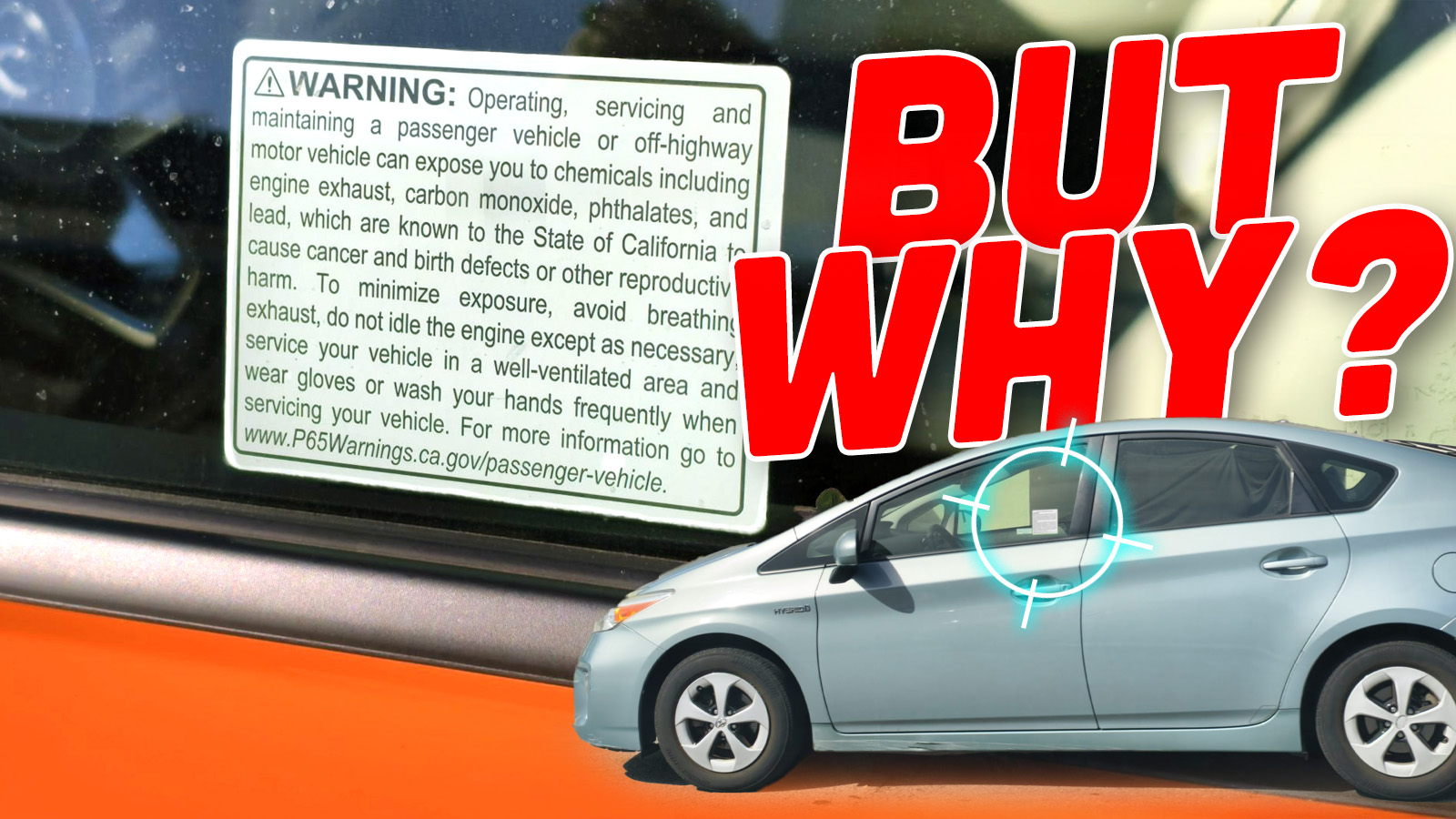
Every time I go to California, I fall in love. I love the state’s trains, car culture, weather, people, cuisine, and even roads. If it weren’t for housing prices out there, I would have teleported to California eons ago. But there’s one thing about California that always throws my head for a spin: how many cars, even old ones, have a nearly pointless sticker stuck to their driver’s window. As much as I try, I cannot figure out why people are willingly giving up some outward visibility just to advertise Proposition 65.
I had the privilege of staying in California for nearly a week last month. It was a grand time, one that saw me drive the Nissan Rogue Hybrid, ride the Amtrak Pacific Surfliner, and drive The Autopian‘s Autozam AZ-1 787bb at RADwood NorCal. I even got to review U-Haul’s sweet Toy Hauler! But between all the action, I also found myself passing the time by playing a game that I invented.


Whenever I’m a passenger in a car or just walking down a street, I like to look at the driver’s windows of passing cars and parked cars. In my experience, there’s a shocking number of cars rolling around California with a black-on-white label slapped on their driver’s windows. The label warns of the car’s potential ability to cause cancer, and is a warning seen on pretty much everything in the state. A solid chunk of car owners never remove this label after purchasing their cars, and will drive with that sticker on their window for decades. My game? It’s to find the oldest car still rocking a Proposition 65 sticker on its driver’s window.

For the past ten years, I’ve been trying to figure out why these stickers are never removed. Now I want to talk about it, because I cannot be the only person who notices this, and I feel like I’m going crazy here.
What Proposition 65 Is
First, for everyone who doesn’t live or visit California, let me explain the wonder that is Proposition 65. The State of California has a handy explainer that says:
Proposition 65 requires businesses to provide warnings to Californians about significant exposures to chemicals that cause cancer, birth defects or other reproductive harm. These chemicals can be in the products that Californians purchase, in their homes or workplaces, or that are released into the environment. By requiring that this information be provided, Proposition 65 enables Californians to make informed decisions about their exposures to these chemicals. Proposition 65 also prohibits California businesses from knowingly discharging significant amounts of listed chemicals into sources of drinking water. Proposition 65 requires California to publish a list of chemicals known to cause cancer, birth defects or other reproductive harm. This list, which must be updated at least once a year, has grown to include approximately 900 chemicals since it was first published in 1987.
Proposition 65 became law in November 1986, when California voters approved it by a 63-37 percent margin. The official name of Proposition 65 is the Safe Drinking Water and Toxic Enforcement Act of 1986.
What types of chemicals are on the Proposition 65 list?
The list contains a wide range of naturally occurring and synthetic chemicals that include additives or ingredients in pesticides, common household products, food, drugs, dyes, or solvents. Listed chemicals may also be used in manufacturing and construction, or they may be byproducts of chemical processes, such as motor vehicle exhaust.What does a warning mean?
If a warning is placed on a product label or posted or distributed at a workplace, a business, or in rental housing, the business issuing the warning is aware or believes that it is exposing individuals to one or more listed chemicals. By law, a warning must be given for listed chemicals unless the exposure is low enough to pose no significant risk of cancer or is significantly below levels observed to cause birth defects or other reproductive harm. Learn about how businesses can comply with Proposition 65. Learn about how consumers can use Proposition 65 warnings to protect their health.

“Prop 65” warnings are everywhere in California, from hotels and televisions to household goods and makeup. It’s a right-to-know law. The chemicals and products aren’t banned, but consumers are required to be notified of their potential presence.
A company can have its product tested to confirm whether it has cancer-causing chemicals or not. If their product tests safe, then they don’t need a Prop 65 warning. However, as Wired notes, some companies opt to skip testing and just slap the labels on. That means there is a mix of products that do contain potentially harmful chemicals and some products that are safer. But all of them have warnings.

Californians have seemingly been desensitized to the warnings. There has been more than one time when, talking with a native Californian, they joked to me that California would totally post a Prop 65 warning that “California contains chemicals known to the State of California to cause cancer.” People just seem to go about their days, ignoring the labels.
People Leave Prop 65 Labels On Their Cars
But the labels are a bit of a shocker to someone who doesn’t live in California, like me. I still chuckle when I go to a hotel and see a big Prop 65 warning plastered on a wall next to the front desk. Then there are the cars. I will happily sit in the backseat of an Uber and try to see how many cars I can find that still have Prop 65 warnings in their windows, and I’m blown away that the number is too high for me to count.
But even weirder to me is the variety of cars with Prop 65 labels still on them. Yes, a lot of “appliance” cars have the labels, like Toyota Corollas, Honda Accords, Nissan Rogues, and so on. But I’ve also seen them on high-dollar luxury cars, stereotypical enthusiast cars, and trucks.

I’m most impressed when I see an aged Prop 65 sticker still hanging on, stuck to a car that’s 20 years old. It makes me wonder how many cars are sitting in junkyards with vintage Prop 65 stickers still on them. Even our long-term loaner, a Mazda CX-90, proudly displays a Prop 65 warning:

Sometimes, I can even tell when a car from California has been transplanted to the Midwest. Sure, the car might wear Illinois license plates, but that Prop 65 warning will still be on the driver’s window. It’s so fascinating to me.
What makes it even more befuddling is the fact that the sticker isn’t required to stay on the car. You can peel it off the second you get the keys to a new car. That’s what I did when I bought a new Smart Fortwo from Smart Center West Covina in 2016. I peeled the sticker off the window and threw it into the glovebox as a keepsake before I even adjusted my seat.

Yet, here we are with cars still rocking the sticker sometimes two decades after they were purchased new.
I’ve been trying to figure out why. I asked some folks who live in California, and their best guess is that everyone is so desensitized to Prop 65 warnings that they ignore the one on their car. Those people, presumably, also aren’t bothered by losing a few inches of visibility out of their window. That’s not too crazy a theory. Many people never remove tags from their mattresses.
I also asked our Discord, because we have lots of readers who live in California. The consensus there is that not every Prop 65 sticker comes off easily, and it can be a battle involving razor blades, Goo Gone, elbow grease, and lots of time. So maybe some people don’t even try.

I’ve been asking this question to lots of people for about a decade now, and nobody seems to know for sure. Thankfully, I’m not going crazy. Jason Torchinsky has noticed this with cars all over California, and he’s wondered the same thing I do.
If you are one of those Californians with that sticker in your window, don’t be afraid to remove that little thing. It might take a little bit of work, but your car will look better, and you’ll get a little more outward visibility, too. Or maybe do leave that sticker there. You’re giving me something fun to do while I’m bored in traffic!
Top graphic image: author


We recently brought home a CPO BMW i4. Giant Prop 65 sticker on the window warning us about the exhaust chemicals produced by the engine…of our electric car.
Yeah, it’s gone. There was a bit of Goo-Gone involved, but it wasn’t too bad. It was also a clear sticker, not one of the older white ones, so even when it was on it wasn’t super obvious, just silly.
My ’65 Corvair was brought into California in 1987 or ’88, early days of Prop 65, and for some reason it got a label slapped onto the driver door window. That one is still there, because it would be much, much harder to remove and removal might possibly damage the glass, so maybe I win a prize for oldest car in CA rocking a Prop 65 sticker, and probably one of the oldest stickers, too!
They could save a lot of hassle by just putting up big signs on the border warning that the State of California contains chemicals known to the State of California to cause cancer, that would cover everything