

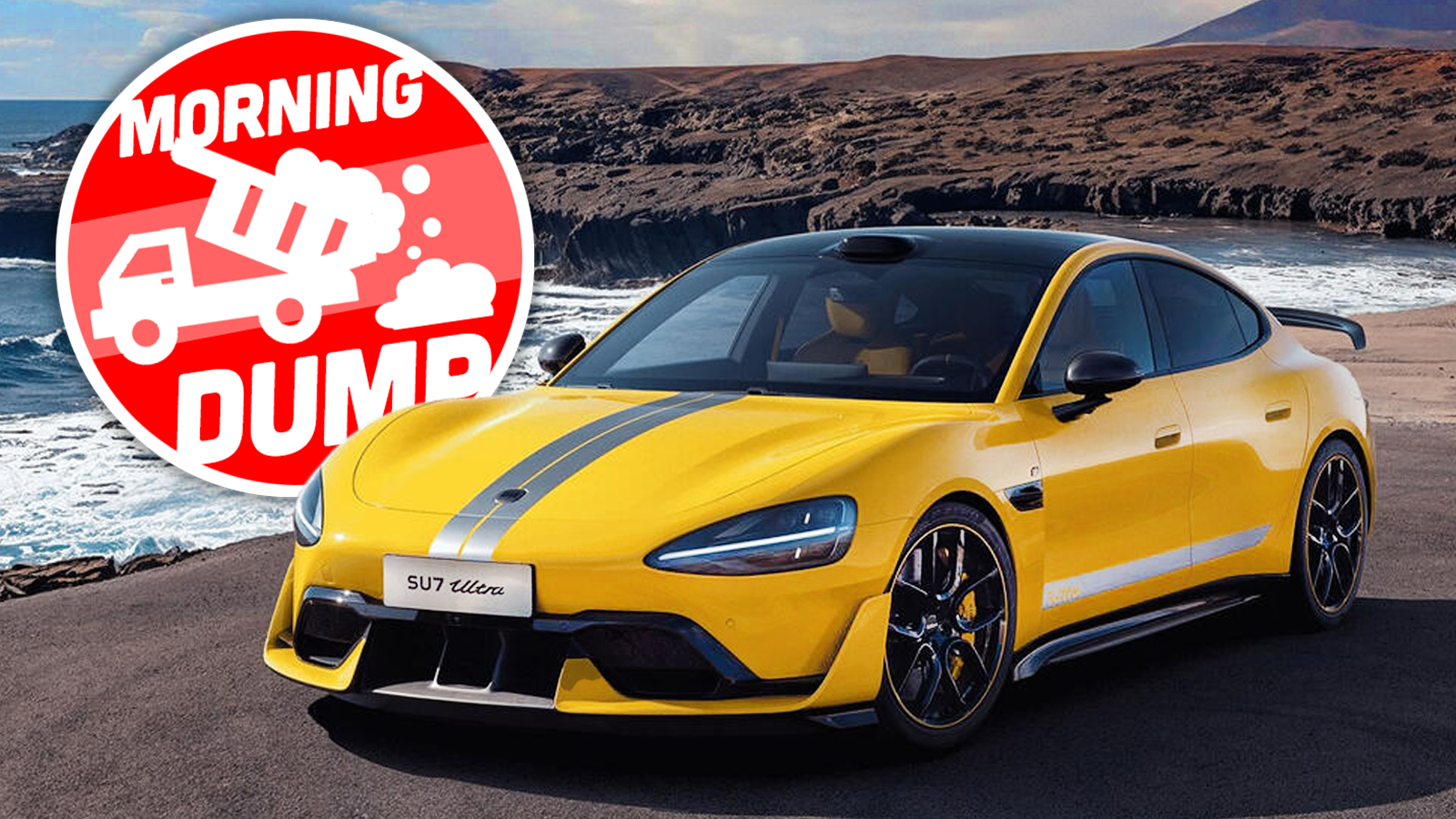
It seems like every other week, there’s a headline about how Western automakers’ plans for China haven’t worked out as expected. If it makes you feel any better, many global brands have experienced trouble in the Chinese market. The whole entire thing is down year-over-year by a massive amount, and this should result in two things: domain expansion and survival of the fittest.
At the same time, the Audi A8 is sticking around in America, Russia’s in the midst of an alternative fuel craze, and Ford just recalled the Mustang for an annoying but mildly amusing reason. Welcome back to The Morning Dump, where we do the baby-bird thing of chewing the fat on this morning’s big car news stories so they’re easier for you to digest. Look, I only had three days of taking over this from Matt, so less ridiculous metaphors will return soon.


Big Trouble In High-Tech China

It’s all too easy to look at China’s automobile industry as a monolith. After all, with hundreds of brands on sale, distinction becomes a bit of a challenge. Over the past decade or so, favorable policy (like what we previously saw in the U.S., but even more so) has fueled a new car boom, but now it seems that the chickens are coming home to roost. Overall sales in China are not doing so great, as Bloomberg reports:
Retail sales of passenger vehicles fell 23.2% from the year before to 1.6 million units, China’s Passenger Car Association said on Wednesday. New-energy vehicle sales, including plug-in hybrids and pure-electric vehicles, slipped 9% year-over-year, though the segment still accounted for over 60% of the market for a third straight month.
This marks a continued decline over the last monthly report’s year-over-year drop of 21 percent, and sales of electrified vehicles slipping to near-2024 levels indicates that this isn’t just a matter of only gasoline-powered cars becoming undesirable. When we’re looking at this scale of domestic sales slump on top of massive excess capacity, the next step for many automakers from China is clear: Export or die.
Manufacturers leaned heavily on exports to offset the slowdown. Exports of new-energy vehicles surged over 150% to 499,000 units, signaling that foreign markets are absorbing excess production. Despite a one-fifth drop in domestic sales, BYD Co.’s total shipments rose 5.5%, driven by exports that almost doubled from a year ago.
Indeed, we’re on the cusp of seeing Chinese OEMs venture into markets unimaginable even three years ago. BYD is already listed on Transport Canada’s Appendix G list of recognized foreign vehicle manufacturers, and Chery is testing multiple vehicles in the Greater Toronto Area. At the same time, Europe’s still receiving new-to-them Chinese brands like Aion and Lepas, seeing deeper market penetration. Market conditions in China mean we’re about to see an export push like we’ve never seen before, and it could break either way.
It won’t go well for every brand. Skywell’s U.K. importer has recently waved the white flag, leaving that brand’s British sales future in purgatory. Likewise, HiPhi did try exporting its futuristic EVs but ultimately ended up filing for bankruptcy in China. In some ways, the market’s a lot like the Western car market of 100 years ago. Loads and loads of brands, not all of which will make it. A rationalization is likely coming, but not before a whole bunch of models make it abroad. How confident are you in parts support?
Not Dead Yet

Earlier this year, it seemed certain that the Audi A8 was about to waltz off into the sunset. In the marque’s home market of Germany, it stopped taking orders for its flagship sedan, and there’s no official immediate replacement on the horizon. It felt like everyone was waiting for the bell to toll, yet it hasn’t quite sounded yet. Audi just announced changes to its 2027 U.S. lineup, and guess what’s still here?
Yep, it’s the A8 and its twin-turbocharged V8-powered S8 variant too. The A8 L gains two new wheel options, the S8 gains a new wheel option and standard heated rear seats, but these executive machines are otherwise unchanged from last year. Pricing for 2027 starts at 96,395 for the A8 L and 131,295 for the S8 in case you’re feeling particularly bold.
This continuation is particularly unusual because when was the last time America got a flagship German luxury sedan that the Germans didn’t get? For the past five decades or so, we’ve either seen global models or the really good stuff stay in Europe. Think Mercedes-Benz 500SEL in the days when America only got a 380SEL. While the A8 and S8 probably aren’t long for this world in their current forms, they’ll continue to roll into American showrooms for the foreseeable future, and that’s noteworthy.
From Russia, With Propane And Propane Accessories

It goes without saying that Russia’s car market has been weirder than usual lately. Economic sanctions and other factors have produced fake BMW X5s made from real parts, new cars without catalytic converters, and now the return of a fuel that seemed generally obsolete in North America. It’s LPG, Liquified Petroleum Gas, and Russian drivers allegedly can’t get enough of it. As Reuters reports:
Egor Popov, whose Garant-Gas company fits equipment to convert cars to run on LPG in Moscow, said demand had multiplied.
“We have a waiting list until September,” he said.
That’s astounding because by-and-large, LPG as fuel for cars is generally considered old hat in the west. There was a craze for it decades ago due to its lower running costs and cleaner emissions compared to gasoline, but over the past decade, it’s really fallen by the wayside. Pumps have been closing down, taxi operators seem to be satiated with hybrids, you know the drill. However, the people of Russia face different conditions. Their supply of propane and butane is plentiful, but their supply of oil isn’t the steadiest it’s ever been for obvious reasons. Another installer whom Reuters interviewed stated that at-the-pump propane prices are less than half those of gasoline, and given the circumstances, that makes sense.
Granted, LPG isn’t as energy-dense as gasoline. You’re looking at an energy deficit of around 27 percent per gallon, but when the fuel costs half as much as gasoline or less, actual real-world savings-per-mile are there.
Wipe It Down

The Ford Mustang GTD is a $327,960 exercise in just how far you can take a pony car. It may one of the fastest production cars the Nürburgring has ever seen, but it’s still a Mustang, so it’s caught up in an incredibly weird new recall shared with its non-supercar sibling. When it gets really cold outside, the windscreen wipers might only operate at their absolute maximum speed. As the recall report states:
In cold temperatures of 0 degrees Celsius or less, the vehicle’s wiper motor may lose Local Interconnect Network (LIN) communication with the vehicle’s steering column control module. As a result of this communication loss, customers may experience front windshield wipers that only operate at their high-speed setting and an inoperable windshield washing system in these cold temperatures.
Man, not being able to clean your windscreen on the go would suck during winter in salt country [Ed Note: I doubt anyone is driving a GTD in the winter. -DT], to say nothing of the annoyance of blades that wipe either too quickly or not at all. Normally, a LIN communication fault can be traced back to shorts, corrosion, bad grounding, bad voltage, module failure, or just a programming issue. Unsurprisingly, the Mustang’s wiper problem falls under the last category.
The supplier of a semiconductor chip on the wiper motor’s printed circuit board assembly erroneously used a 32-kilobyte programming equipment setting for the 16-kilobyte chip to be programmed with a mismatched 32-kiloybte algorithm. This erroneous equipment setting may result in the LIN communication issue at cold temperatures.
Ah yes, that is quite the oversight. Thankfully, the fix for the 67,842 potentially affected 2024-to-2026 Mustang and 2025-to-2026 Mustang GTD models is just a new wiper motor that’s already in Ford’s parts catalog, so it should be an easy swap with relatively little downtime. Automotive software. Isn’t it lovely sometimes?
What I’m Listening To While Writing TMD
Guys, look, listen. It’s summer, the sky’s clear, I have the keys to a drop-top in my pocket, the vibes are surprisingly good. You know what can make it even better? “U Sure Do” by Strike. What a tune.
The Big Question:
Who will survive in China’s car market?
Top graphic image: Xiaomi


A world without the Audi A8 is like a world without Nickelback.
I have a prediction for the future of car sales in China, and globally.
Picture a time when a new transportation device with four wheels that can seat a family of 5 is available from a Chinese manufacturer for $8000.
It automatically comes with standard AC, power windows and all of the usual electronic gizmos, etc.
It also comes with insurance for the first 3 years that will also include no fault, any reason full coverage with a swap out option. Example: you are in a parking lot and you crash it into a bollard by mistake. Option 1-replace the body panel damage OR you have the option of choosing a $1000 deductible replacement fee and get A COMPLETELY NEW VEHICLE, fresh off the “showroom” floor. Period.
Right now, China has the capability to supply the entire planet with $10,000 vehicles… they could crank out 30,000,000 million units a year if they really wanted too… buy one in any color you want… and if you crash it, you just pay your small deductible and get a new one and the damaged car is recycled and the process begins all over again.
New World Motors, Incorporated.
Thoughts?
The Ford thing is reason 32498 of why new cars suck. Fuck Ford and the rest of them for their bullshit digital doodadery. A simple on/off switch worked fine, but doesn’t break and doesn’t take a dealer to fix it, so Ford isn’t interested.
I’ll just Popov to buy some LPG