

If you’re like most of us, you’re probably sick of having your day derailed by crack agents from the National Institute of Standards and Technology (NIST) parachuting onto your roof, using some manner of backpack laser system to cut through your roof, land in your living room, pin you to the floor, knee in the small of your back, and show you pictures of Volkswagen air-cooled engines, demanding that you tell them which ones are industrial engines and which are for automotive use. It’s annoying, and I’m sure you’re as sick of it as I am. Last time the dude stepped on the hoagie I was eating and didn’t even apologize!
While I can’t stop NIST agents from invading your home and restraining you, what I can do is help you familiarize yourself with the differences in VW industrial and automotive air-cooled engines so that when this does happen, you can get those NIST goons off your back (often literally) and you can then resume going about your day.


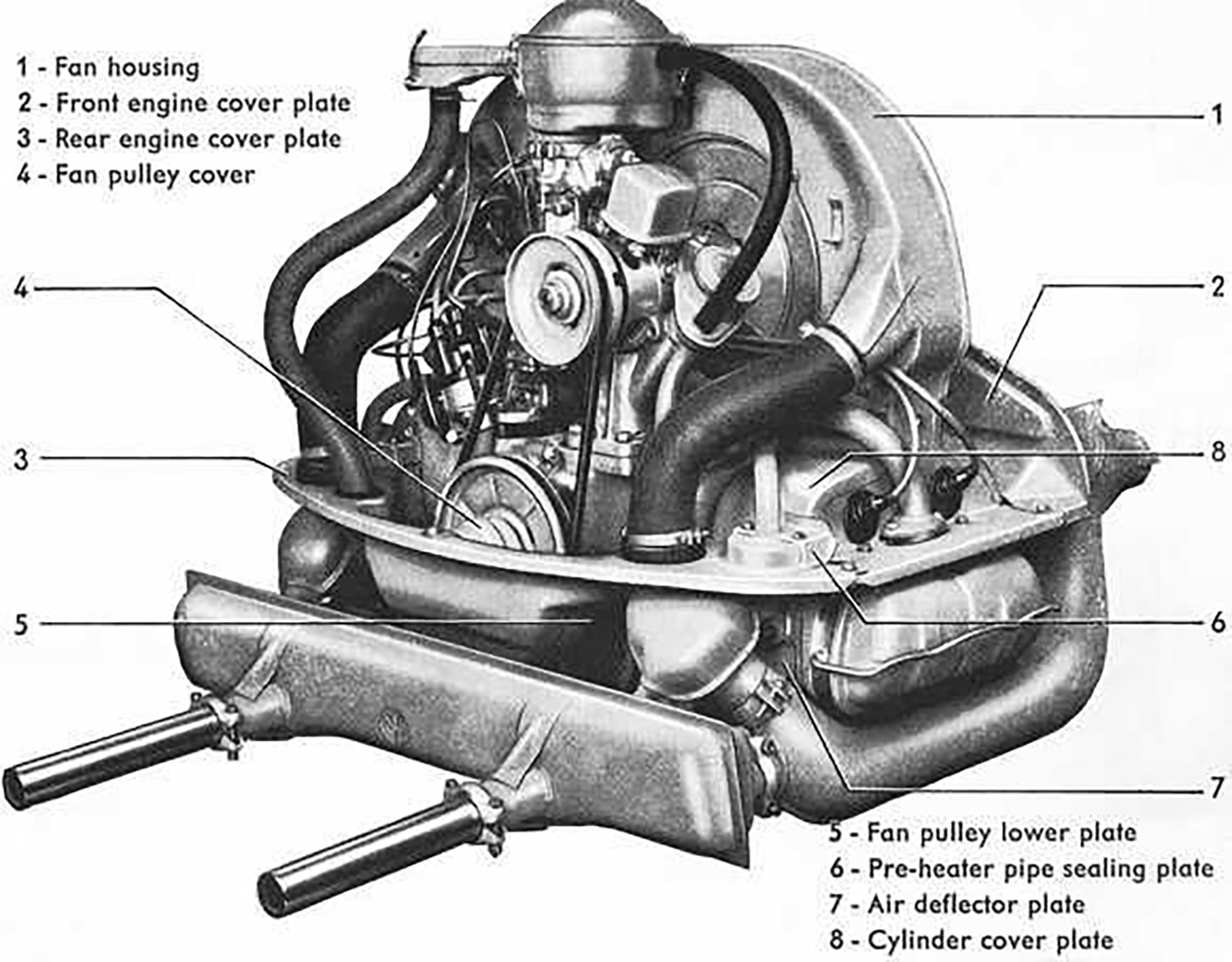
So, with that in mind, let’s take a look at a typical example of a VW air-cooled engine; we’ll use the most common type, the upright-fan Type I engine, as used in Beetles, Ghias, earlier Buses, Things, and so on; this one is a 1963 “clean air” engine, notable for the fat heater air hoses on each side of the fan shroud:
Okay, now, let’s look at a VW Industrial engine of about the same vintage, 1962:
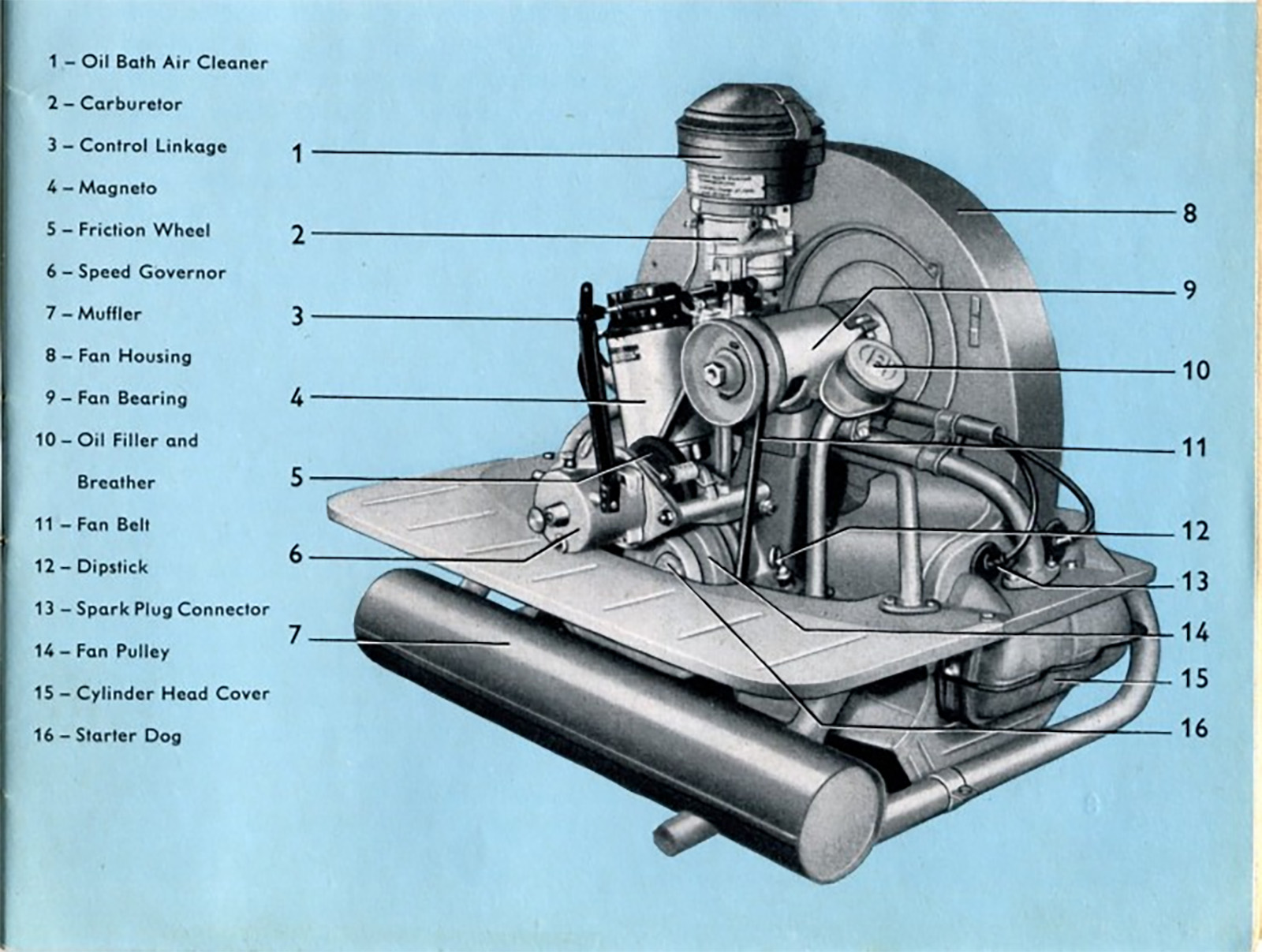
Already we can see some pretty notable differences here: a different, more squared-off and ribbed lower tin shroud, separating the cooler upper parts from the hotter lower parts. The muffler is different, with only one exhaust outlet; there are no heat exchangers, just a J-shaped pipe below the cylinder head; no heater hoses from the fan shroud; and a magneto/distributor instead of the usual kind, along with an engine speed governor bolted to the front.
The VW Industrial engines changed along with their automotive counterparts, and came in 1200cc and 1600cc sizes, but always maintained a pretty similar look. Here’s a 1969 industrial engine:
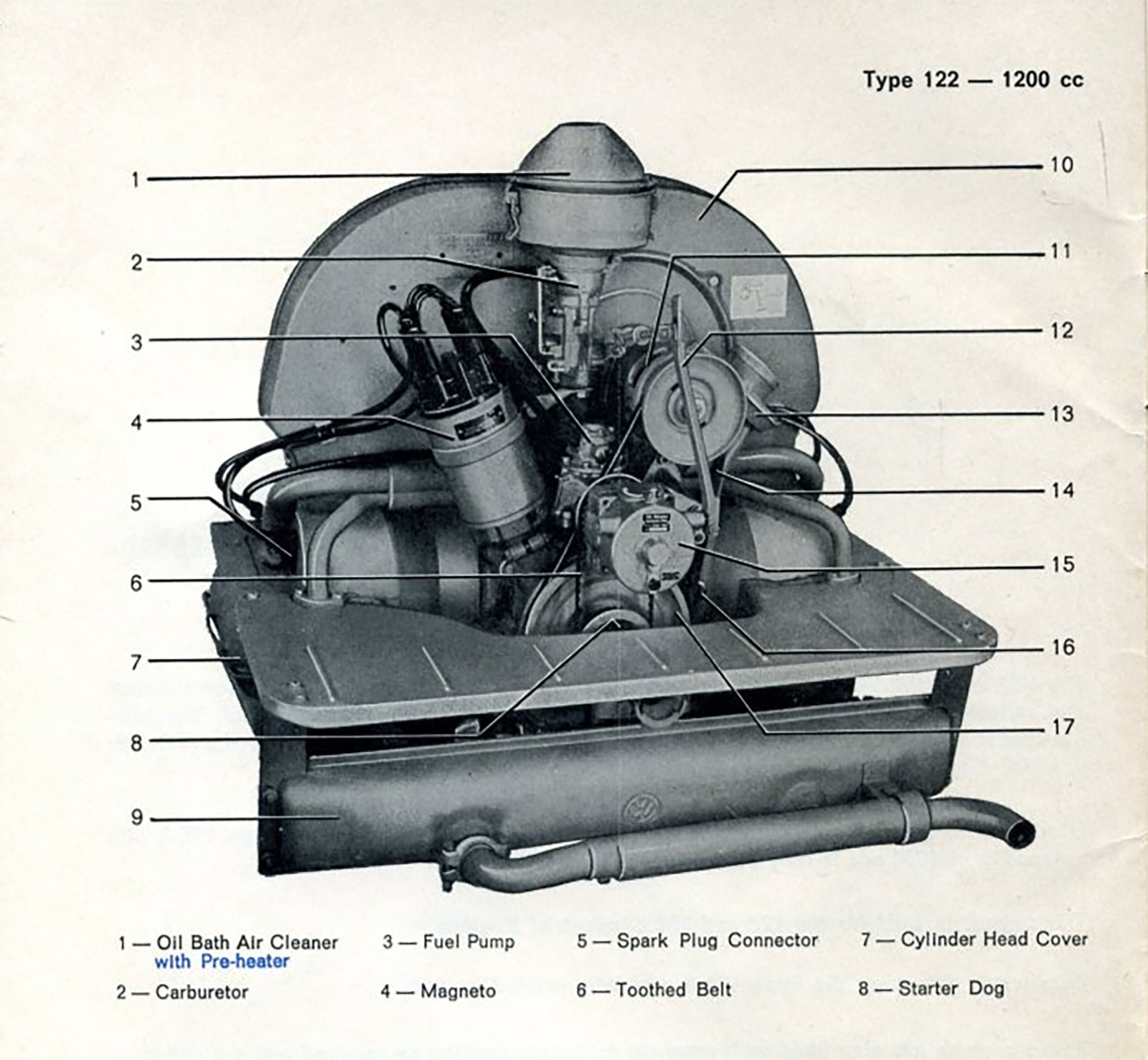
Same major differences from the automotive engine as noted above. Here’s a 1985 one:
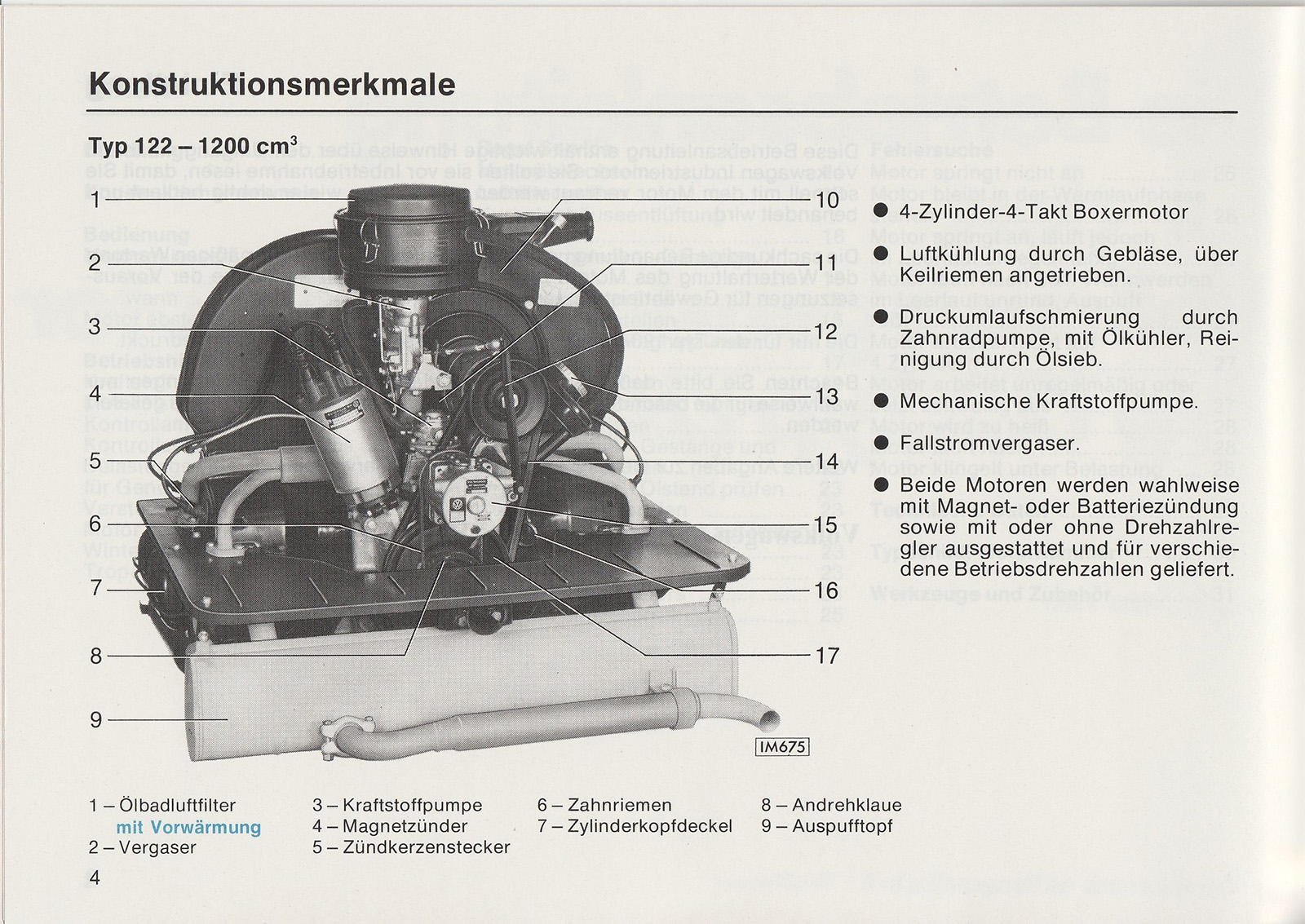
It’s clearly updated, but also not that different, really. The industrial engine hallmarks are the one-exit muffler, different lower shroud, no fresh air/heat hoses, magneto ignition, and speed governor.

The governor looks interesting; there seem to be precision RPM settings, as well as a larger lever for idling/running, as you can see in these instructions for how to start the industrial engine:
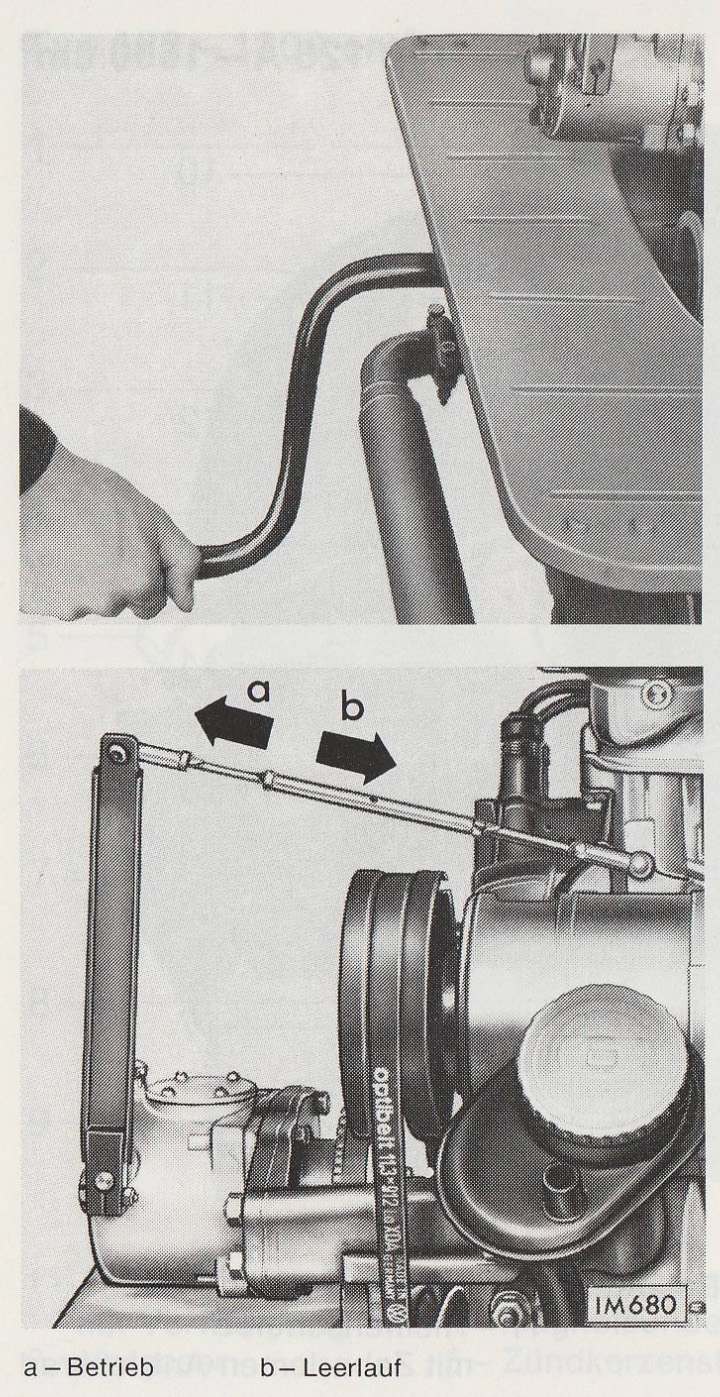
You can start the engine with a crank, like you could with really, really early Beetles, or there was a starter motor that could be activated with a button. Also, you can see the big governor arm that goes between idling (leerlauf) and operating (betrieb). Cool!
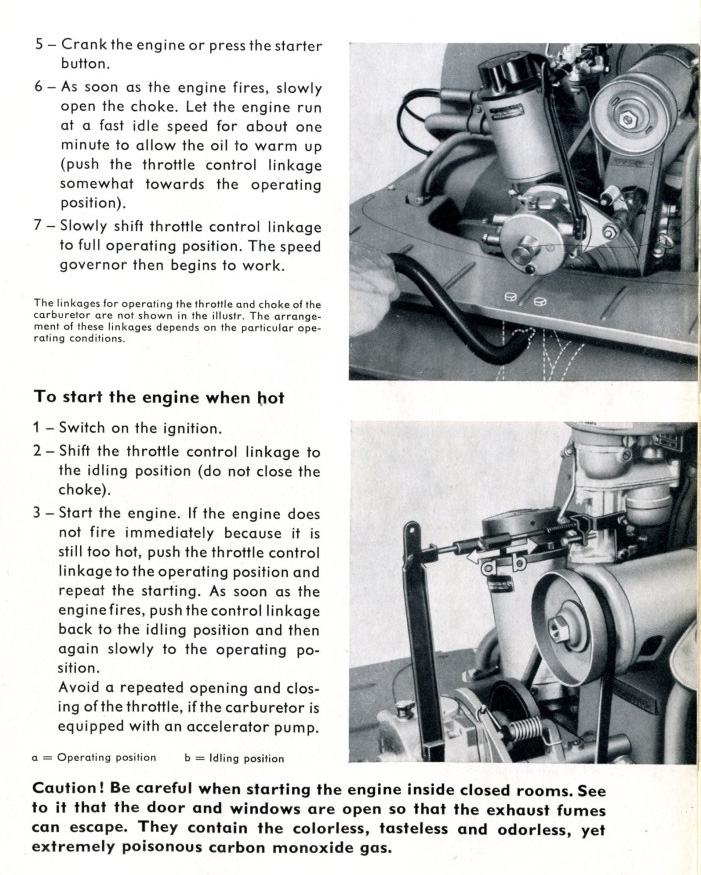
I’m not really clear where the starter button is, though? Is it at the center of that governor unit? Is the starter integrated into that?
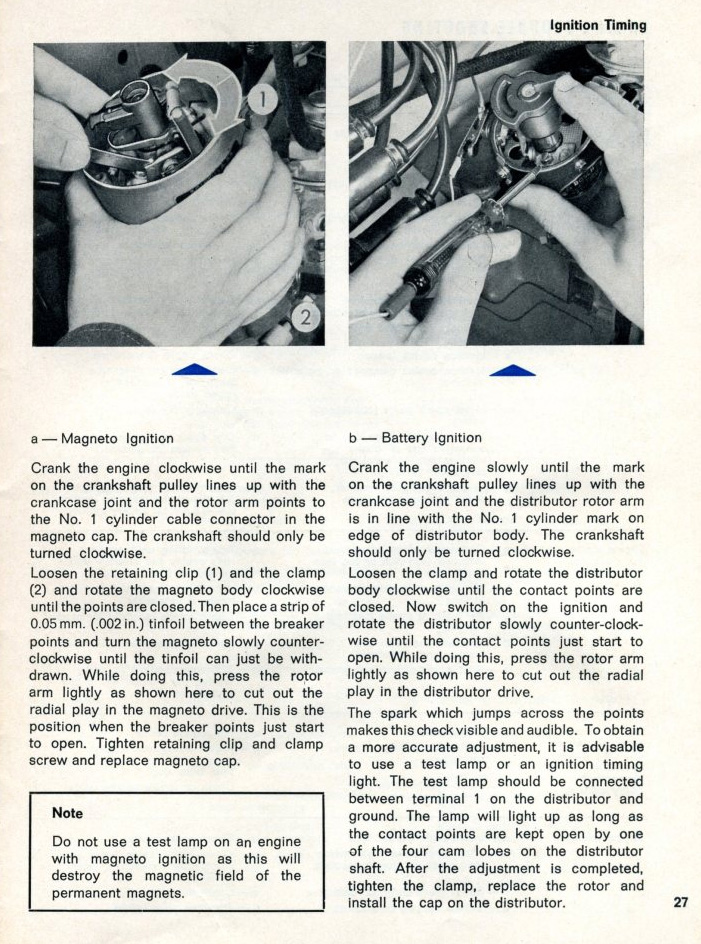
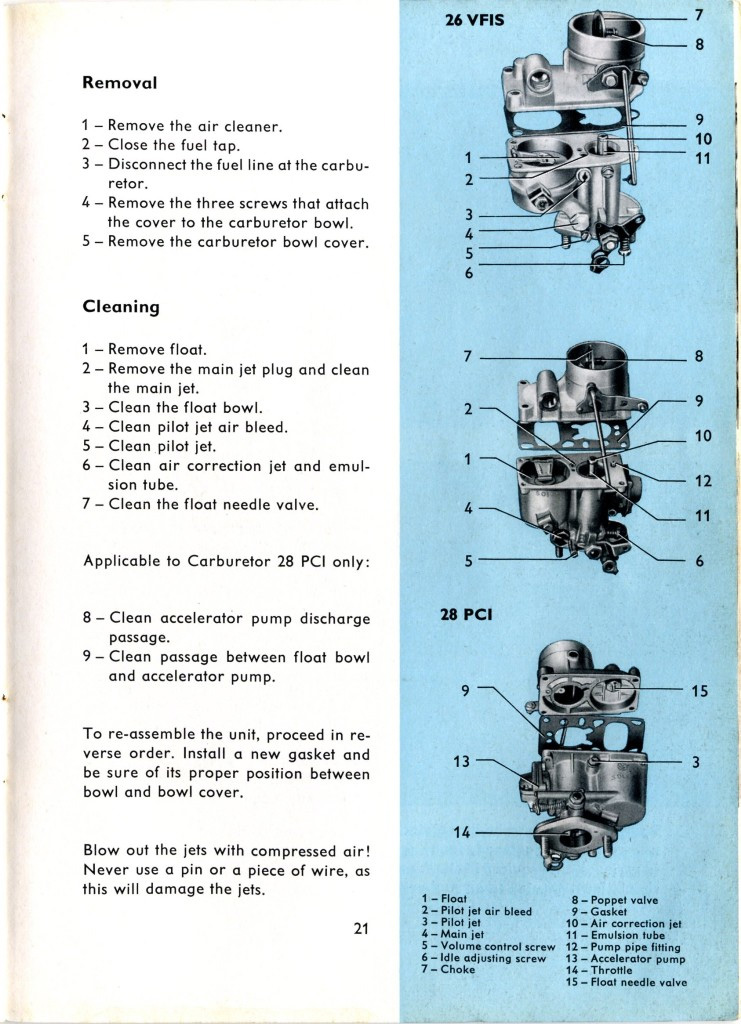
The magneto ignition is quite cool, I think. Unlike a regular distributor, a magneto needs no outside power source, as it makes its own power with an internal setup similar to a generator, but using permanent magnets. It’s not as good at generating electricity as a generator, but it eliminates the need for a battery, which is useful. I had no idea a test lamp could destroy the magnetic field of the permanent magnets in the magneto, as that warning suggests. How does that happen?
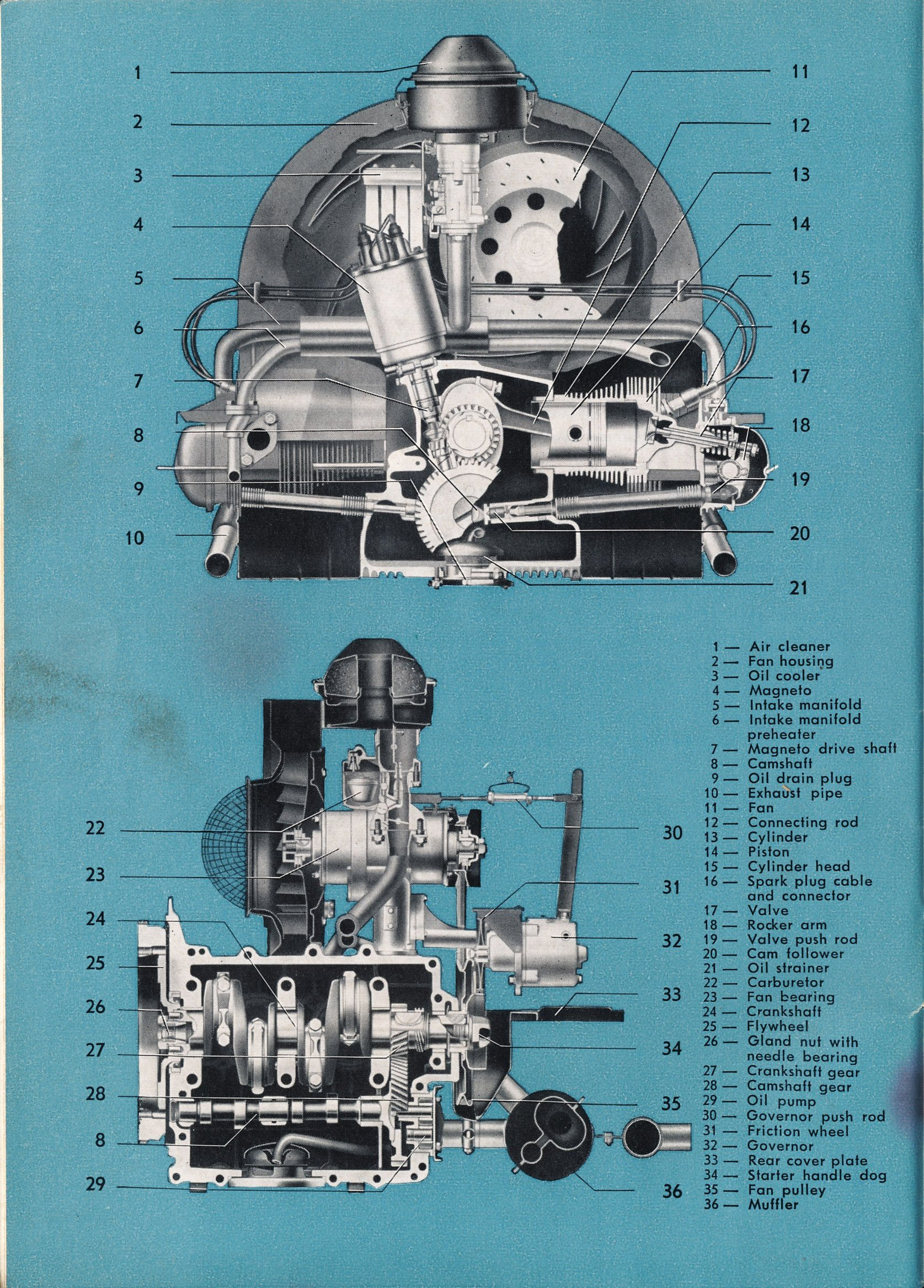
The cutaway reveals that the VW Industrial air-cooled engines were pretty much like stripped-down automotive engines. They got a nice little domed mesh over the fan’s air intake, to save fingers from being julienned, too. The carbs seem simpler on the industrial engines, too, which makes sense, as they’re optimized for constant-RPM usage instead of the variable madness of a driving engine.
Maintenance looks pretty much like what you’d expect from any air-cooled VW engine:
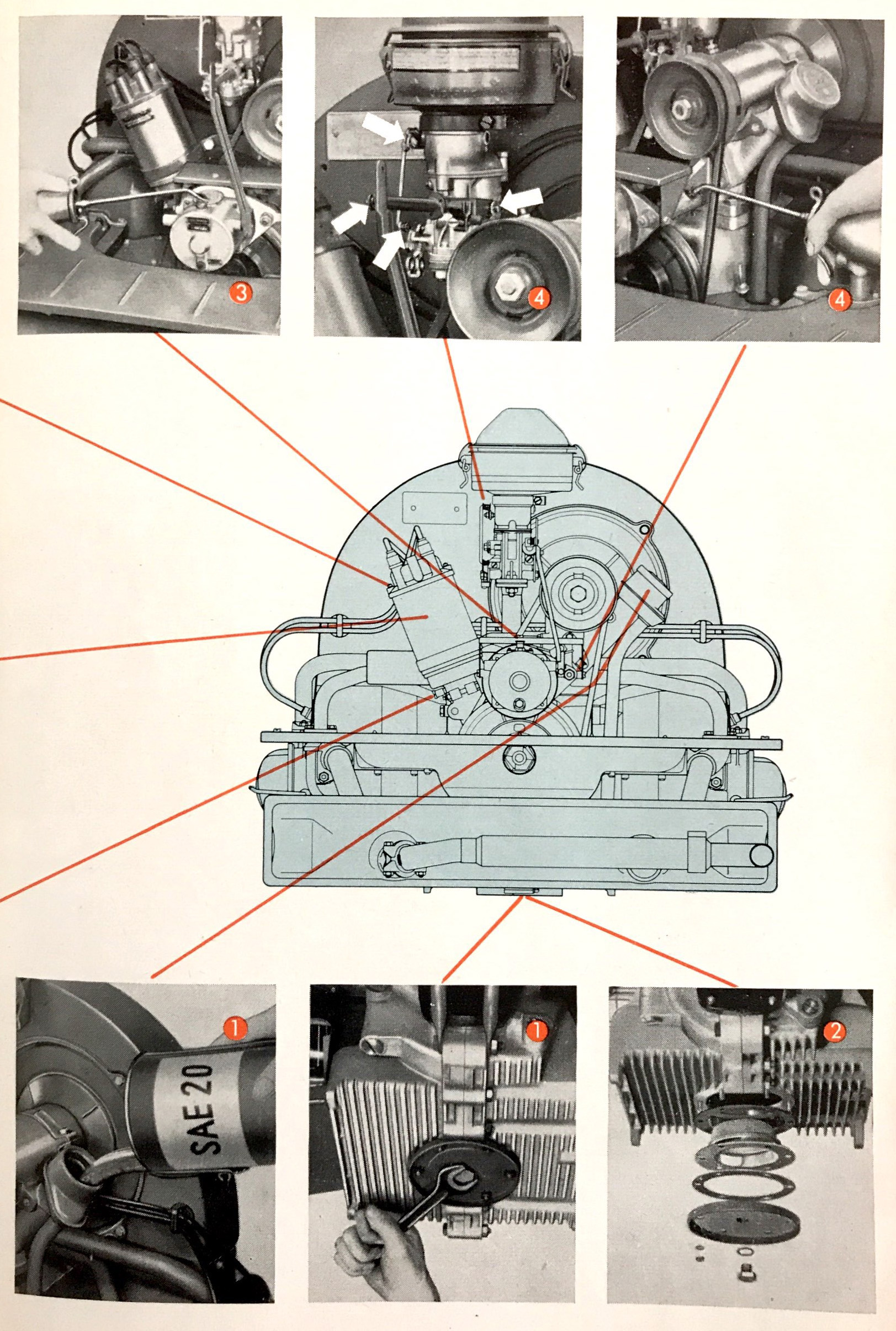
The use of SAE 20 single-weight oil is interesting but makes sense, since most of these engines would be working in environments with less climate variability, or even indoors? Because, you know, they tended to stay in one place.
There’s not much in these manuals about the power takeoff options, but I suppose that was very dependent on the use of these engines. I’ve heard of these VW engines being used for ski lifts and sawmills and fire engine pumps and rotating signs and all sorts of things. I’ve occasionally heard of people adapting them for automotive use, though that sort of seems harder than just finding an old Beetle engine or whatever.
I’ve seen these in person a few times, and they always fascinate me; I suspect there’s at least some of these old workhorses still in service, doing some sort of mundane but crucial activities, and I’d love to actually see one in action. If anyone has a lead on a place still using their old air-cooled VW industrial engine, please let me know!
Top graphic images: Volkswagen


I had a shop teacher that had one in the back of his truck connected to a generator and he had 2 of the cylinders that had the exhaust valves held shut (pulled lifters I think? Maybe everything except the valves and springs? Not sure), a port in place of spark plugs feeding an ait tank and air intake separate from the carb. Had an all in 1 maintenance unit for air and power.
Porsche made an industrial version of the engine in the 356, along the same lines. I think they and the VWs were supposed to be a little stronger in the expectation that they would be running at full power for days at a time. When my uncle died, he left one of them in the barn along with a Porsche 597 Jagdwagen, and we installed the industrial 356 engine in the Jagdwagen.
Porsche also made a aviation version of the 911 engine but after years of development it was not very successful.
Wow I love Porsche and while I of course knew about their tractor, never heard of the Porsche 597 aka Jagdwagen. Very Interesting, thank you for sharing!
Looking it up, seems it was produced in very limited numbers having lost out the military contract to DKW
“Development costs for the truck came out to 1.8 million Deutsch mark. Converting that to USD and adjusting for inflation, that’s somewhere around $5 million in 2025. Unwilling to simply dump the investment of money and elbow grease, Porsche set about producing the vehicle in very limited numbers. From 1955 to 1958, the company manufactured 49 units for the civilian market, with a reported 20 extra also produced.”
W/in quotes from: https://www.military.com/off-duty/autos/porsche-597-jagdwagen-truck-never-was.html
Yes, fortunately there are same mechanical parts that can interchange with a VW bus, the portal axles in particular.
It was a great way to have lots of phone calls with Myron Vernis who’s name and phone number was written on a piece of masking tape stuck to the car.
My uncle and Bob Garretson had to literally smuggle it out of east Germany and the EU since they get weird about military vehicles at controlled borders, and there was something about the serial number having been loaned from Porsche to the army, then sent back to Porsche then disappearing for 40 years and turning up in a barn with some old race cars. My uncle had a reputation for buying weird Porsches, he also had a tractor with an original mower attachment, so word got to him pretty quickly.
A Unimog was also on his bucket list, but he wanted just the right , read weird, history and never got one.
Now I want a hand cranked VW industrial engine powering a backup generator for my house.
Can these be made to run on propane?
Yes, yes they can – they can also be made to run on wood gas
At least he didn’t eat your lemon pound cake. 😉
Now I kind of want to hike down to the ski lift in the Beartooths and see if it’s running off one of these. I gotta think it’s something like this given how remote that area is.
I was thinking just the other day of another Ferdinand (The Elder) Porsche air-cooled engine design, the Steyr 1500A 3.5 litre V8. That would be a hell of thing for a WWII Jeep, period correct, engine swap doncha think? What’s David doing?
I wonder too how many of these ended up in aviation use.
So, we got NIST agents parachuting into people’s houses to demand answers about air cooled VW gasoline powered engines…
Wouldn’t that make them ICE agents?
(Too soon?)
I’ve been getting tailed by the American Egg Board lately, and I don’t think I’m the only one
I don’t know if they still do, but I read that VW also made TDI industrial engines. Reportedly, well maintained, they would easily go 10,000 hours between overhauls.
This is mildly informed speculation, but I think the concern with using a test light with a magneto is that a magneto produces very little current. A test light would draw too much current in the coil; that current would create a magnetic field that would work against the field of the permanent magnets, and perhaps permanently demagnetize them. I do see references to using neon lamps instead, which supports the notion that low current is required.
Generators often need to be polarized to run correctly. I think when a test lamp (and connected to “earth” or ground) is used it could de-polarize the magneto and cause the brushes / commutator to burn if run de-polarized or with the polarity reversed.
The opposite of the Geordi La Forge approach
I really enjoy regional terms. Up here in Canada we often call them banh mi, but there has been a lot of talk of subs this week too.
I wonder if an air cooled engine/generator would make sense in a sub. It seems there would be a lot of water available nearby to dissipate heat.
Only if you got the meal deal that included chips and a fountain Coke with free refills.
But definitely no soda. That’s for cleaning.
Nice article, but could use a little more detail.
I watch a YouTube channel called “Out of the Woods” which features a fellow running a small-scale lumber mill in TN. He recently added a brand new circular sawmill that it powered by a VW air-cooled flat 4 industrial engine. In 2026! I don’t think Volkswagen is still making them, though; it’s probably one of the purveyors of replacement engines for cars that’s also making brand new industrial engines.
I was recently at an airplane museum and they had a small personal garage built plane from the 60s on display that looked like something from WW1. Open cockpit, fabric over wood single wing and so forth. It had a VW engine! I almost didn’t recognize it without the dog house and it had bolts holding the valve covers on. I had no idea they were in planes as well.
The Aerovee is a very popular conversion kit for experimental craft, though standard VW engines have also been used a lot for that same purpose. Aerovee kits boil down to fuel injection and a custom crank with a prop hub at the nose and magnetos where the flywheel used to be.
Most piston-powered craft use air-cooled flat-4’s for their balance and lightness, the VW units mainly differ from them in that they’re smaller, rev higher and have a flywheel.
Some aircraft manufacturers are now adapting small Mercedes-Benz turbodiesels (the inline 4 from their European entry-level cars) because it makes good power in a lightweight package, gets superior fuel economy and can run on jet fuel, far cheaper and healthier than leaded aviation gas.
I have heard of a few experimental aircraft using Subaru water cooled flat fours.
Back in 2013, someone was developing a Subaru 2.0L turbodiesel for usage in aircraft, and they validated its high-altitude performance by filling it with Jet-A and racing up Pikes Peak! I don’t remember what came of it, but it was a really neat idea and I love the creative way of testing it.
Another semi-popular aircraft engine is the 13B, it’s super light, compact and loves to run at a constant RPM, where it actually achieves good thermal efficiency. With a reduction box it makes for a great power unit, and it’s easier to rebuild than a piston engine, so it’s great for aircraft that require a rebuild every so often anyway.
There have also been a good few ultralights running BMW boxer twins, which are a solid choice as motorcycle engines have great power/weight ratio, and since the boxer Bimmers are touring bikes with shaft drives, they’re designed for long hours at speed and have a divorced gearbox (most chain-drive bikes have the crankcase cast directly into the gearbox and are hard to adapt for alternate applications due to the 5-6 forward gears and no reverse: cars require an external reverse box, and boats/aircraft are stuck carrying around all these superfluous gear ratios, clutch baskets and shift forks that they don’t need). The BMW engines can bolt up to a lightweight fixed-gear reduction box with the stock crankshaft and are already designed to work as a structural member, so they can mount right to the airframe and take the full thrust of the prop through the block without issue. Bikes use silicone boots to mount the carbs, so it’s dead easy to install an aeronautical fuel system if desired for higher altitudes (so the pilot can adjust mixture from the cockpit depending on air density), and they run magneto ignition from the factory.
The neat thing about boxer and rotary engines in aircraft is that their great primary and secondary balance allows for weight saving all over the airframe, as the structures and hardware aren’t subjected to as much stress from vibration, especially at the engine mounts. So even if a boxer 4 is heavier than its inline 4 equivalent, the airframe it can be mounted to is ultimately lighter.
You’re not supposed to remember encountering a NIST agent! Oh shit oh shit oh shit!!
Riding a cable car in SF as a kid, I remember the conductor telling us they had a VW engine in the powerhouse as a backup when the power went out. Probably one of these!
Industrial VW boxer engine was used in most Rosenbauer water pumps for ages. We had two in our voluntary fire brigade in Ljubljana, Slovenija.
The one with an electric starter had at the time (cca 1990) cca 180 hours, the one without had around 100. You can guess only once which one was sold: the electric start one, of [censored] course. The guys having this extremely bright idea were the old firemen for whom the electric start was a totaly unnecessary luxury 😀
Hand start was a bitch. Magneto’s were a disaster. Even rebuilt ones went caput very fast and in last 30 years there was some (well, a lot) heavy handwork involved in starting the heavy red bastard of a “portable” water pump. The main problem with magnetos were a total nonstart when hot, so there was no turning off a water pump in the middle of the action even if … don’t know what would need to happen, we even added oil and refueled it while running 😀
We have recorded one (with number: one) broken wrist from handstarting so there you go 😀
We’ve found a mechanic that swapped over a normal (non-magneto) ignition, apparently the one from AlfaRomeo 33 boxer is an exact fit – had to add a 12V accu there too. There was some kind of problem with vacuum advance so it wasn’t fitted.
As we’ve used the red heavy bastard less and less we sold it this year to a local fishing club/society. They are taking care of a few lakes and ponds and will use the pump mostly to aerate the water in the hot (read: now) months 🙂
How we all hated that pump… there was a celebration when it was gone. Well, a few beers were had, nothing we wouldn’t do every thursday evening, but let’s call it a celebration 😀
This is a trademark Torchinsky schematical photo from the neighbouring Austrian fire brigade web page, hope the link works: https://www.ff-rennweg.at/files/bilder/technische_ausruestung/oldies/TS%20VW%2075/IMG_2125.JPG
Working in some factory with one of these things sitting indoors, running for hours on end really sounds like a gas!
I think it really sounds like uncatalyzed gas exhaust!
Smells….
Be really careful talking to a German about gas-filled “factories.” Be especially concerned if they enjoy the subject.
Hang on, I once read or was told the famous/infamous Bosch 009 distributor was what was used on VW Industrial engines, (and that that’s why Solex 34s don’t like them) but now I’m being told that, actually, Industrial engines ran magnetoes? Who’s right here? And do I put the 009 or SVDA style spinner on my 34-clone-equipped 1776?
For those who may not be familiar, the 009 is a mechanical (i.e. centripetal/centrifugal) advance distributor; the stock distributor uses a vacuum advance.
The 009 is not “infamous”. It is one of the most popular and effective mods on Type 1 engines.
My ’72 Super Beetle had a 009 with a Bosch blue ignition coil and a Solex 34 when I bought it and everyone was happy – not sure why you think “Solex 34s don’t like them”.
As Jason indicated, the industrial engines used magnetos because they could run without a battery, which made things easier maintenance-wise.
I’d go with the 009 for the 1776. Actually I’d recommend the 009 in most/all applications because it works really well and removes the need for a vacuum line.
There’s tales of a flat-spot during part throttle acceleration when used with a 34, particularly with stock jetting on them. But I have new examples of both dizzies, so I can try both.
Excellent! Since you’re a member, you can stop by the #rusty-spanners channel on the Autopian Discord and let us know how it goes 🙂
Just to be annoying, can one of these be bolted to generator to make a EREV, like in the back of a Scout?
Or a slate?
oooh it would just sit in the bed, cool!
A new, modern, generator would probably be more efficient, but the VW engine would have more character.
Although, from what I’ve heard, most modern EVs don’t allow you to charge them while they’re moving. (Probably to stop people driving around with a generator in the back of their Tesla, and then passing out from exhaust fumes)
Well, yes, technically. They’ve been used to run stationary generators, so you could rig one up like that if you have the wherewithal and live in a place that doesn’t do emissions testing. Or use a pre-emissions base vehicle
This is interesting. In German, leer (pronounced like lair) means ’empty’ and lauf is the root of the verb laufen, meaning ‘to run’.
Empty running = idling. Makes sense. 🙂
that IS interesting!
Thanks! We’re all about learning 🙂
Does the low gas warning light come on and say leerlauf? Asking for a friend…