

For the last 95 years, General Motors has sold more cars than anyone with one notable exception. For 94 out of 95 years, ever since passing Ford, GM has been the biggest manufacturer in the United States. That one year was 2021, and a shortage of semiconductors hit pretty much every automaker hard, but it hit Toyota slightly less hard because it had learned a hard lesson about stockpiling parts after the 2011 earthquake and tsunami.
What’s going on this year? Don’t make The Morning Dump tap the sign again. It’s Toyota again being forward-thinking while GM is either way off its game or, if you prefer, GM being even forwarder thinking. Does that make sense? All of this comes from the Cox Automotive forecast for the second half of the year which shows the market in a weak but durable holding pattern.


Honda, Nissan, and Mitsubishi aren’t one company yet, but they’re taking this whole “working together” thing seriously as the Japanese brands that aren’t aligned with Toyota try to figure out how to move forward in a very complex world. The same can be said for the UAW, which has to weigh recent success over potential future headaches.
The Decade Of The Hybrid Comes For Us All

I keep seeing the new Toyota RAV4 Hybrid and I’m not 100% sure I like the aesthetics. Is this an upgrade over the previous, somewhat more handsome generation? It’s a matter of preference, although the RAV4 is selling so fast that it’s clear most people prefer the RAV4 almost to life itself.
Though Toyota has a surprisingly robust portfolio of new EVs coming out this year, it’s the hybrids that pay the bills. No one makes more hybrids than Toyota, with basically every vehicle they offer at least coming in a hybrid variant if not only available as a hybrid. With the EV hype now cooled to Vanilla Ice levels, it’s hybrids that are the clear winner in the market. This might change, and there is a slow inevitability to electrification, but it ain’t changing tomorrow.
Cox Automotive had its big half-year report, and there’s something interesting in the forecast:
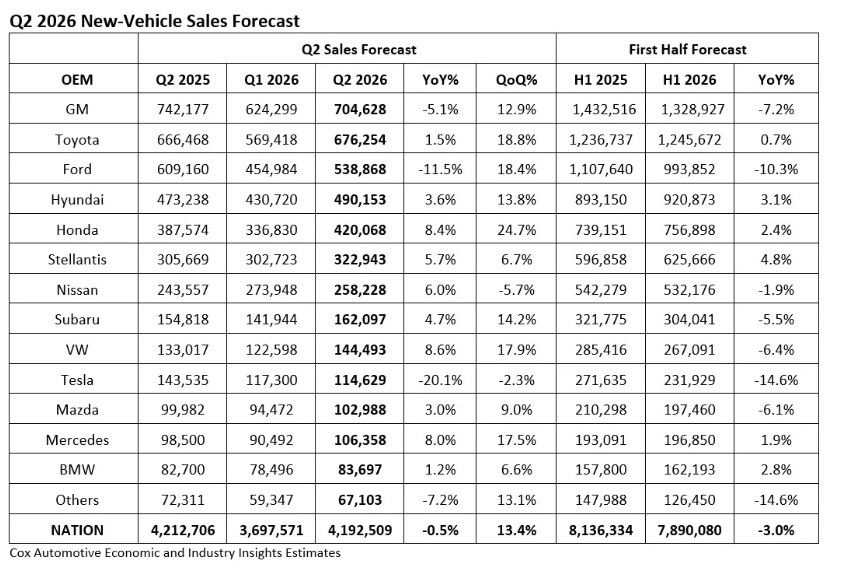
There are winners and there are losers, though there are a few standouts. Tesla is on the way down, but Tesla also doesn’t really have a new, compelling vehicle. Ford is down, which is both a reflection of the loss of the Escape and the fact that it’s missing a key ingredient (aluminum) to build the F-150. Right at the top you can see that GM remains at the top, but it’s losing market share to Toyota.
This is, as Bloomberg points out, all about hybrids:
“Toyota has a chance,” said Charlie Chesbrough, senior economist for Cox. “We’re not predicting it yet, but it’s possible. Consumers are interested in hybrids and GM can’t compete.”
Chesbrough expects GM to put up a fight. “They would use incentives to try to keep it,” he said.
[…]
GM spokesman Jim Cain disputed that the automaker would increase incentives to maintain its sales lead over Toyota. The company has worked to avoid rebates as part of a push to maximize profit and cash flow, holding incentives below the industry average for the last three years.
“Our track record speaks for itself about discipline on production, pricing and incentives,” Cain said.
Hmm…
Automotive News conveniently has an article out about why GM bet on EVs over hybrids:
Despite taking nearly $9 billion in special charges over the past year to adjust its manufacturing plans, EV development remains GM’s “North Star,” Barra said.
“We’re mainly investing and continuing to work on EVs because we think that’s the endgame,” she said.
The company’s strong balance sheet and improved cash flow allow it to continue pursuing electrification long-term even if the technology isn’t yet profitable, CFO Paul Jacobson said at a Feb. 4 Federal Reserve Bank symposium in Detroit.
“That’s our safety blanket,” he said.
It’s very GM to be too early on a technology, and it’s also very GM to maybe be too early twice. Curiously, GM only offers one hybrid right now in the United States. Do you know what it is?
Cox Forecasts A Lot Of Red, Which Isn’t Terrible
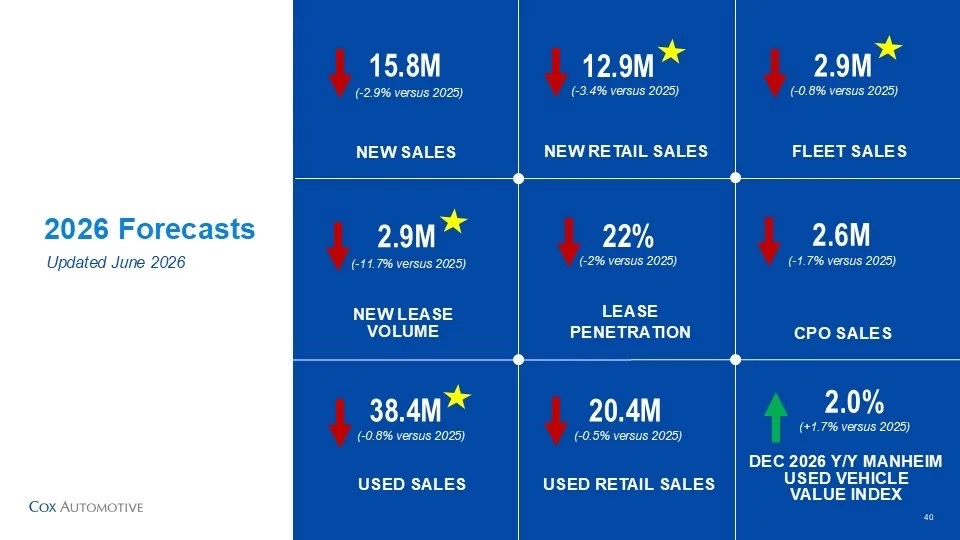
Here’s another forecast from Cox, and it shows what’s expected for the full year. Car sales will be down about 2.9% compared to 2025, which really ain’t that bad when you consider the affordability crisis, the drop in EV sales, the tariffs, the War in Iran, and the 900 ways politics has tried to derail the market. It just can’t be stopped.
“Although there is a tremendous amount of economic and policy uncertainty these days, the new-vehicle market seems to be relatively unfazed. Thus far, vehicle buyers have shrugged off the latest shock – the Iran War and higher gas prices – as new-vehicle sales have been fairly stable the last few months,” said Cox Automotive Senior Economist Charlie Chesbrough.
People just really, really, really want CR-V Hybrids, Grand Highlanders, and Kia Carnivals. You can take the Kia Carnivals out of their cold, dead hands.
‘I Heard About It From The [Expletive] Newspaper’

There’s a real fight for the management of the United Auto Workers, and the crux of it seems to be that the current guy, President Shawn Fain, can’t turn it off. The aggressive tactics Fain used to win historic contracts have, reportedly, been turned inwards on the union itself. It’s not pretty and has driven Rich Boyer, a Vice President in the Union, to challenge Fain.
Of the many complaints against Fain, one of the most pressing is that Fain allegedly doesn’t keep the rest of the leadership in the loop, resulting in kinda amazing quotes like this one from the Detroit Free Press:
As an example, Boyer said he did not know the UAW had endorsed then-Detroit mayoral candidate Solomon Kinloch until his wife interrupted him while he was mowing his lawn.
“I found out about [the Kinloch endorsement] while I was cutting my grass in my front yard,” Boyer said. “We never went through the process of sitting every candidate down, vetting the person, you know?
“I was out in front of my house, cutting my grass and my wife comes out on the phone, she says, ‘You guys endorsed Kinloch?’ And I said, ‘We did? I don’t know,'” Boyer recalled. “We didn’t know about that. … I heard about it from the [expletive] newspaper.”
He didn’t clariy if the [expletive] newspaper was the Freep or The Detroit News.
Honda, Nissan, and Mitsubishi Are Likely To Make A Standardized ECU

If I could have a headline back, it might be: “How Nissan, Honda, And Mitsubishi Will Become One Of The Largest Car Companies In The World.” In retrospect, I should have substituted could for will. Pobody’s nerfect, I guess. Also, the Three Amigos topshot really doesn’t work now that the CEO of Nissan is a Mexican businessman. To cut myself a little slack, I’m fairly sure even Ivan Espinosa didn’t see that coming.
While these three couldn’t make it work as a merger, it doesn’t mean that Honda, Nissan, and Mitsubishi won’t make it work in another way as Nikkei Asia reports:
Honda Motor, Nissan Motor and Mitsubishi Motors have entered final talks about standardizing electronic control units (ECUs) for their next-generation vehicles, Nikkei has learned.
The Japanese automakers aim to develop cost-competitive cars by jointly procuring the key component that boosts vehicle functionality.
Software-defined vehicles (SDVs) are characterized by functions such as autonomous driving and onboard information systems. The control units being discussed by the three automakers contain the software for these features.
This makes a lot of sense to me.
What I’m Listening To While Writing TMD
Check it out, it’s Cannons with a cover of Bruce Springstreen’s “Dacning In The Dark.”
The Big Question
Does GM or Toyota end up on top?
Top graphic images: GM; Toyota


Hot Chip did the best cover of Dancing in the Dark.
Convince me otherwise.
New Toyota is not good, it is a 100% downgrade from the historic Toyota that people remember and buy the cars based off. That said, they are significantly easier to deal with in my experience,when something goes wrong. GM continues to do dumb things, and has a machine gun pointed at their feet with the trigger locked on fire.
This is the type of stuff that let Toyota get a share in the first place, and US based OEM’s seem unable to learn. I think probably because we bail them out. Im not for importing from other countries to fix this, I think we should just let them fail, not protect them more than a regular person etc.. and it would solve most the issues.
HONDA, what in the fuck are you doing. Get away from those other two as fast as fucking possible. I am guessing their recent slumming with those other two is the reason we are starting to see major reliability issues from them. I don’t give a single fuck if it saves cost to co-develop, you do not hitch to absolute losers, when you are a winner.
+1
“Im not for importing from other countries to fix this, I think we should just let them fail, not protect them more than a regular person etc.. and it would solve most the issues.”
GM has burned a lot of people in one way or another that refuse to buy another. Toyota’s biggest problem are it’s dealers. They don’t want to make deals because they don’t have to. I’m not sure enough people trust GM period let alone with BEV. The Silverado and Bolt are the two that seem the most trusted and have some value especially when they dealers actually deal. I suspect most of the time if a person or fleet can’t get a Ford truck and need one they will check out Ram and might end up with one. The only way I can see GM holding selling more this year. Is deep discounts ok trucks and suv. Maybe offer an insane warranty and big discounts on bev.
Spot on.
Toyota can’t meet demand for their popular vehicles. They could make a lot of Rav 4s when they were both hybrid and ICE. Now that it is all hybrid, they can’t seem to get the numbers up. Sienna has been in short supply for _years_.
How much of that is “can’t” and how much is “willfully doesn’t”?
agree..toyota rarely (if ever) uses the “pack em deep and sell em cheap” style. They definitely seem to be happy to leave volume on the table if it means their margin per unit stays up. As pointed out, the Sienna has been hard to get maybe even pre-COVID. That’s an eternity for them to have solved this if they wanted to.
FWIW Toyota just got one of the RAV4 production lines up and running this week after the retool for the new model. Toyota KY starts RAV-4 hybrid production, breaks ground on new paint facility
AFAIK, the Rav4 plans are running full shifts x 7 days in both Canada and Japan.
Not sure if TMMK is fully up to speed yet.
Interestingly if sales number can be trusted: both Canada and Australia buy proportionately more RAV4s than in the US.
Covid taught people to not oversupply. Its much better to have a wait list than a Stellantis level inventory.
Toyota learnt with the VRA.
Our household is finally kid free and the wife wants a comfortable SUV to drive from our house in California to see our relatives in Montana. She really wanted a Tahoe. When we looked at one she could not believe the 16/20 MPG. We drove over to look at a Grand Highlander and the 35 MPG won her over. I know they are not really the same vehicle, but for what most people do they are close enough. GM just doesn’t sell anything compelling when it comes to being efficient.
Where is my EREV Colorado/Silverado/Tahoe.
BTW, I think the only GM hybrid is the Corvette E-RAY.
They really blew it with that new Traverse redesign. Put a good hybrid in that and they’d have a nice competitor with the Grand Highlander. Right now mid-20s mpg, if you are supremely lucky, isn’t going to cut it.
Honda doesn’t seem to have issues moving Pilots and they get atrocious rea world MPG for the segment.
Developing common electronics is a great idea, IMHO. This makes a lot of sense. There is absolutely no reason to keep that type of thing in-house. Same could be said of door lock actuators, window motors, ball joints, etc… Stuff you don’t see that is blatantly ubiquitous is perfect. Kudos.
EV development remains GM’s “North Star,” Barra said.
Why would you remind anyone of one of your most horrible engines?
Next up, Project Vega
TMD early this morning 😛
Yeah, I’m surprised standardized/generic ECU’s aren’t a thing yet, also generic/universal ABS and other safety shit.
Oooh, Cannons is a solid choice.
Also, congrats on the early Morning Dump!
I always find an early Morning Dump makes the whole day smoother.
“What’s going on this year? Don’t make The Morning Dump tap the sign again”
Oh, that explains why everything is terrible. January 1st was a Thursday. We all accidentally got on 2026-A.
If GM opens orders for the new full size trucks within the next couple months, they’ll probably hold the lead because as we all know, TRUCKTOBER is happening soon
Truck month only happens 12 times a year.
Hell Yeah!
To be fully competitive GM needs to bring back Carplay and Android Auto right away and have hybrid versions of at least the Trax/Envista and Equinox/whatever the GMC and Buick are as soon as development allows.
Their biggest mistake was going for a “leapfrog” strategy of electrification which meant gaining and then briefly holding the lead on hybrids (Volt>Prius still today) and then hot-potatoing them as soon as the full EVs came out. An “and-also” strategy would’ve served them much better.
The lack of Android Auto has removed GM from my purchase list.
I am one of the people that would not consider an appliance-type vehicle without CarPlay. If it was a fun, weekend vehicle you could theoretically get me to consider one without it. The reasoning behind the decision is just so shady too.
But, my other main issue is the reasoning behind why GM wants to sell vehicles without it. They want to have all the data on what I am doing and how, likely to sell it or use it to transform the vehicles into an advertising platform of some sort. It’s so damned intrusive. I know CarPlay protects some of that data but not all. It’s a good start.
I recognize that I am far from the majority on this but I am god-damned tired of every corporation out there acting so f-ing entitled to data about me and acting like I am renting the products from them when I own them. Enough. I will drive cars without factory-installed spyware until I die if I have to. I am in my 50s so I guess it’s possible I won’t need a new car for that long. Maybe Slate will still be kicking with new options in a few years.
Just get over yourself and try and make good cars. GM, Rivian; stop trying to make it on selling my life out like a pimp.
It depends on how many Americans can afford expensive full size or expensive mid size trucks.
Irrelevant around here. Truck comes first. All other things come last.
Sounds like you live on the equivalent of a pacific atoll, where everyone will be underwater (on their loans) soon…
Relatively rural Northeast.
It’s variable. There are a lot of people around here who basically live for, and live in, their trucks. When you’ve designed a life around living in the boonies, far from your employment and modern conveniences, you spend a whole lot of time in your truck. There’s a large contingent of people here whose trucks are far, far nicer than their housing, or their lifestyle.
Do these people “afford” their truck? Depends on what you value. To me it all seems silly and it’s not a lifestyle that I’m interested in. To others forgoing other things to be able to tool around in a truck all day is their optimum way of life. Obviously this varies, some people afford it just fine without sacrifice, some live the truck > else life, and others are 30 days from repossession lol.
In the rural upper midwest, WI, MN, ND, etc. The people you describe have everything 3/4+ hr to get everywhere. They need their trucks for their ICE powered lifestyle, ATVs, SXS, Campers, towing Icehouses, snowmobiles, etc. The same guys that see EVs as a direct cultural threat.
yeah, I have a cousin who spent years driving new BMWs while living in a trailer park. But because she made those decisions, it was perfectly affordable. she cares most about her car, so that is where she spent her money. She could have had a nicer place and a crappier car, but chose not to. That doesn’t work for me, but she didn’t put herself in financial danger to do it.
I am pretty sure if you breakdown those sales, the majority of GM are leases. Also, the Toyota financial side of things handle the majority of those sales, dealers do not like outsiders from a financial perspective. Even if their numbers are a little less than GM, their profit is way bigger.
In Mexico, Toyota does not allow cash sales, everything has to go with Toyota financial with ridiculous interest rates.
In Quebec (and possibly all of Canada), car loans (not leases) for new vehicles must be open loans by law with no penalties.
Finance, pick up the car and clear the loan the next day.
So they’re going to spend loads of money developing it, only to release it half baked leaving a bunch of disgruntled buyers with broken cars, then proceed to can the project and replace it with some variant of the LS motor?
“Someday we WILL build a full EV with headgasket problems!”
Subaru?
Well, they can in fact build good EVs. We had first a Chevy Volt, now leasing a Equinox EV. The Volt has almost 260,000 miles before we sold it. The Equinox? 50,000 so far, nothing to do except add washer fluid.
I say the Iron Duke…
TBQ: Toyota ends up on top. GM can’t seem to stop pantsing itself, and it also doesn’t make anything other than big trucks that people actually want. They make things people will settle for, but they don’t make them particularly well, and they seem allergic to actually considering what buyers WANT. Like Carplay/Android Auto, and interiors that feel nice, and good fuel economy.
You could argue that they’ve done a better job than than many of keeping some affordable options in the lineup (like the Trax, Trailblazer, and their differently badged siblings) which gives them an advantage over, say, Ford, who has no compacts and no mainstream hybrids. Which might even make you think that they are stealing Ford/Stellantis sales from the “only buy domestic” crowd that don’t have other options under $30k (unless you want a Hornet with $20k off on the hood).
But yeah, going hard on EVs isn’t an excuse for failing to keep their gas vehicle compentitive.
I see a more of those little Buick crossovers on the road lately.
It’s a great price if you want a compact crossover with AWD and a little nicer interior that the Chevy stablemates.
Sure, their strategy appears to play out well against Stellantis & Ford.
Cerealbox marketing of 14 variants of the same vehicle only gets you so far.
The morning dump is so early, it’s going to to throw off my whole day.
One day Toyota will unseat GM. It’s only a matter of time.
It is just like taking a dump after showering just gotta start everything all over again.
might as well go back to bed
I think I like it more, partly because it seems a little less driven by aesthetics. The more squared off rear and taller (looking, at least, I don’t feel like looking up the numbers) profile seems more practical. The last gen was a little too faux-aggressive for my liking. I know some people hate the perforated “grille” look, but I actually don’t mind it.
It’s the Corvette GS-X, nee E-Ray
Did they drop the ZR1X label?
No, they just made X = hybrid.
Grand Sport
Grand Sport X
ZR1
ZR1X
Ah makes sense also yeah surprising the only hybrid from GM is the Corvette. They actually are stopping building the battery plant they planned for Indiana which is crazy to me because I am surprised they couldn’t just use it to make hybrid batteries but makes sense since they have no hybrids.
So is that one hybrid or 3? E-Ray, GS X, and ZR1X?
The GSX replaces the E Ray, so it’s actually 2.
Genuinely forgot about this, what a fun fact.
And here is the post I expected would be somewhere here when I made my post much later.
GM hasn’t exactly been coming to the table with new models to directly compete against Toyota. While Toyota’s not directly eating the full-size pickups, but Ford & Stellantis have the capability to eat into GM’s segment there and hand Toyota the crown.
It’s a matter of time. If not this year, then next.
To make matters worse, America’s protectionism (CAFE/Chicken Tax/import taxes/general-handwaving-gesturing-at-everything) has allowed GM to have their walled garden with large trucks. Toyota being able to leverage a RAV4 or Corolla hybrid worldwide creates a scale of investment that GM just doesn’t have anymore.
TBQ: Toyota
What I’m listening to: I’m so glad the synthesizer has returned. I remember the last time they were all the rage and this wave is even better. Cannons cement that for me. To be fair, I don’t care for the Boss that much. He super talented and is legacy is huge, but I don’t like listening to his music. So this cover turns a good song into a great song for me.
I think GM will manage to stay on top. Most of their products are actually pretty good, readily available in any town, and come with stacks of cash on the hood. The Toyota Tax is real and insurmountable for a lot of people. For example, my aging mother in law just got a new Equinox to replace her old one, I was pleasantly surprised how nice it actually was. She initially wanted to go with a new Rav4, but she found out that was a lot more than a Equinox and she was going to have to step down to a Corolla Cross to stay within her budget. Sitting in an Equinox is way nicer than a Corolla Cross and she walked right back to Chevy.
GM just really needs to work on some kind of hybrid offering for their commodity stuff. MIL was nervous about it, but she realized her worry was misplaced when she actually did the math that her last Equinox only averaged about 4k miles a year and her actual gas expensive was tiny…. If GM had similar fuel economy numbers as Toyota’s increasingly common hybrid-only offerings, it would have honestly been the only vehicle she even considered. I can imagine the same goes for Traverse, Trailblazer, Blazer, etc etc and all their crossbadged counterparts.
The Equinox fuel economy is pretty disappointing (from my experience) but overall not a terrible car and for a few grand less than a Rav you can buy a lot of gas.
But I think people are still feeling the uncertainty of fuel prices, so that’s going to be hard on equinox sales. As is the lack of Carplay and AA in the new ones…
The Toyota tax is understandable for some cars, but the fact it basically exists across their entire lineup is mind boggling.
I’m not going to say the Tundra and Tacoma are bad, but it’s just amazing how much cheaper you can get a competitor from GM (and Ford) in those categories.
The Tundra I think can be placed in the bad category right now. The quality of that vehicle just isn’t great.
so true, but it seems like thousands of prospect buyers haven’t got that memo yet. They sure keep buying the thing and it’s on track for their best selling year to date. I should be not that surprised as GM has had engine woes as well, yet they have held onto the top selling full sized truck spot for several years.
Personally I think the Tundra is a very strong contender for the worst new vehicle available in the US, it boggles my mind how much blind brand loyalty influences large purchases.
I do recall the incubator site for this site, whose name should not be said, was all in on EV’s to the point of predicting Toyota’s demise for wasting their resources and time on hybrids. Beware of true believers, whatever it is they believe.
There are articles in the archive of *this* site (written by someone no longer here) predicting the same thing.
Ridiculous at the time (as many of us said in the comments) and laughable now.
Is it that ridiculous? I mean, the largest market in the world is still actively headed down that path. It’s gonna happen elsewhere too, it’s just a matter of when.
I think it’s ridiculous to say that Toyota’s focus on hybrids over EVs in the near term, while still researching eg solid state batteries for the long term is imperiling the company, yes.
Perhaps a certain German lighting site? LOL.
Remember how we’re all supposed to be car sharing now? Then Covid happened?
Just give it more time. Toyota may be gloating now, and I think from a US-centric perspective, their strategy is very sound.
But they’re ceding market share everywhere else. Toyotas are everywhere in emerging markets and those markets are electrifying fast. Toyota is bleeding share to China.
For someone non-American, the sales chart with the automotive group is fairly surprising. And circles back to the comment on the earlier COTD article:
– Chrysler (Stellantis) is outsold by three foreign manufacturers (!)
– Subaru outsells VW (!!)
Subaru over VW is not surprising if I go by what I see in my town. Subarus are everywhere, and I do mean everywhere. VW is not even an afterthought, it’s pretty much disappeared. VW did it to itself, prior to the big D-gate you could see VW’s around. Now I see an odd New Beetle or maybe a Tiguan or Atlas. Subarus are everywhere.
Surely. But from Europe this feels odd. VW is still the best seller by far (even if the Golf doesn’t have the stronghold it used to have).
And Subaru must sell about three cars a year (incidentally one of them to a friend of mine…).
My first car was a 70 Beetle. I had a New Beetle. I would love to drive a VW but they keep doing things that seem to purposely make me rule them out.
One could ask, in Europe, why would one buy a VW over a Skoda?
Is VW genuinely worth any premium if all the touchpoints feel identical, comes with the same engine options, and drives similarly?
Or is it really down purely to “das auto ist deutsch”?
I don’t have direct experience with recent Volkswagens but I do with Skoda (Ocatvia Combi diesel manual). They are great cars, worth every penny and I would undoubtedly recommend them.
But I guess the VW brand still carries some cachet. There are also cars like the T-Roc (incidentally one of VWs biggest, if not the best, sellers in Europe) which have no Skoda equivalent. And last but not least, senior Skodas are priced level with VW, sometimes even higher.
VW has made so many mistakes with the American market that people have for the most part forgotten they exist. I get that crossovers are what sells, but unfortunately for VW their strategy of competing directly with Toyota and Honda with a damaging reliability reputation hasn’t resulted in sales.
Why is it odd that the market for cars in Europe is different from the market in the US? Subaru barely has a presence there, but they are all-in on North America. Conversely, VW is not actively expanding, maybe even retreating in NA as they face internal struggles.
VW’s portfolio is arguably tailored far more for European market tastes than it is American, whereas Subaru marketing is basically precision guided at the exact “sporty-outdoorsy aspirational middle class American” that buys it’s vehicles.
Of course, I am the first to acknowledge it. It still surprising when you see it with cold figures, though.
For every car Honda sells in Europe, BMW sells 10. In the US Honda outsells BMW 4 to 1.
As I was saying, one thing is knowing the differences exist, the other it putting some figures behind those thoughts.
It’s not just Dieselgate, it’s that VW can’t decide how they want to position themselves in the US Market.
They offer, effectively, four vehicles: Jetta, Tiguan, Atlas, Taos (I mean, there’s also the Golf GTI & R, and the EVs but let’s be serious on volume)
The Jetta is a me-too that gets thoroughly trounced by the Civic & Corolla. VW isn’t consistent enough to keep the Jetta as a proper “premium” and doesn’t offer a hybrid (yet?)
The Tiguan is sold at a premium to others in the segment, but has suffered in fuel economy and doesn’t really feel that much more premium than, say, the Toyota.
The Atlas which is, genuinely, an SUV designed to undercut the US market for a big-feeling midsize SUV
And the Taos which is a bare bones basic stripper of an SUV.
VW also has a terrible reputation for quality/complexity/service costs, and it’s dealer network has not helped their reputation any.
So what is VW meant to be to the market except confused?
In New England, bought a Subaru a year a half ago, and now notice I’m in lines of Subaru’s at stop lights, in traffic, even parking lots. If all pickup truck brands are lumped together, then it looks like pickup trucks vs.Subaru’s around here.
My wife has an Outback and my daughter is buying a Forester hybrid (with a story of a really bad dealer experience at one place, exceptional at the place she’s buying it) and my mother in law has had 2 Outbacks. They’re everywhere here in my little SW Virginia town.
Yesterday driving around doing normal stuff I tried to spot VW versus Subaru. Easily 20 to 1, advantage Subaru. In my little town there are more Volvos, Range Rovers, Porsches and even Mustang Mach-Es than VWs. Non scientific, just out driving around seeing cars, but still. How far VW has fallen.
VW hasn’t connected with the US market since the day of the Beetle. Every 5 years it seems like they roll out another turn around plan that completely misses the reasons they don’t sell cars in the USA.
(I’ve had 4 Jettas – 2 sedans and 2 wagons. They have nothing for me now and after the warranty (or lack of warranty) experience with latest Sportwagen I won’t even look at another VW)
I used to be a big VW fan. But I haven’t been interested in much they offer over here (except for the Golf R and GTI). Personally, I think they have a few major problems in the US:
Their product line is very generic and pretty boring. They pursued the masses and abandoned their uniqueness. They used to do something different in the US market (be it cheapness with the airheads, sportiness with the early watercooled stuff, premium engineering and driving experience with the 90s to early 2000s, etc) and now they are just plain, generic vehicles for the most part.Lack of competitiveness. Most of their generic stuff isn’t as good as other generic stuff. Why would you buy an Atlas over Telluride, Pilot, Grand Highlander, etc? Same for a Taos, Jetta, etc. The new Tiguan does seem like a bright spot.Lack of fuel efficient offerings. They don’t offer hybrids on volume segments like 3 row SUV or 2 row CUVs to compete with Toyota, Honda, Hyundai/Kia. They used to dominate this market and completely abandoned it after dieselgate.They kept their premium service/parts pricing. Maintenance and parts costs can be pretty painful compared to other economy brands and much closer to luxury brands.All this is to say, VW really lacks a compelling reason to buy one in the US market.
Subaru has sidestepped a lot of this by continuing to market themselves as “different” and having a different enough product line from the mainstream brands to back it up.
Atlas buyers: “At least it’s not an Ascent.”
Ascent buyers: “At least it’s not at Atlas.”
I think others have answered the question pretty well, but I find it just as fascinating to look at what sells in Europe: https://www.best-selling-cars.com/europe/2025-full-year-europe-best-selling-car-manufacturers-and-brands/. It’s very odd to see VW at #1 and especially Stellantis at #2, even though I doubt what you’d call a Stellantis product is what we’d call a Stellantis product.
Why are Japanese brands so poorly represented over there? I’m surprised by how far down everyone but Toyota is. I can understand not importing cars from the US as they’re either not sized for your roads or a cheap econobox you can find a better version of locally.
Two curious things. BMW (the brand) outsells Peugeot (Stellantis most successful brand in Europe). And BMW (the group) outsells the entire Toyota Group in Europe.
Man, we are weird the Europeans…
Is it still the case that BMW and Mercedes will sell lower-end cars to compete in EU markets? In the US we have this weird part of our culture where if a brand sells lower end products, we will not think of their premium products as being… well, premium.
It’s why Toyota started the Lexus brand. We would not consider paying so much for a really nice Toyota but this new Lexus line of cars is obviously worth so much more!
I think that Acura products were sold as Honda is most other global markets but I’m not sure if this is still true.
Mercedes has the A180 (136bhp 1.3 litre) for €33,300. And BMW the 116 (122bhp 1.5 litre) for €34,250. Right at the heart of the C-segment. Probably there are cheaper alternatives, but they are not that expensive. And with residuals being stronger, monthly payments are probably lower.
Honda has never brought Acura here. Cars like the Legend or the NSX were Hondas here. Nissan tried introducing Infiniti but failed and left after a few years.
BMW sells 10 times more than Lexus (which incidentally also sells more cars than Honda, even if just barely). Mercedes-Benz and Audi also outsell Lexus (and Honda) about 9 to 1.
It makes sense. GM is far from the best option and largely is the highest-volume seller here in the US. Over there MB and BMW have home-field advantage too.
Obviously things are changing with true global markets but that will take time.
I wish we got the lower spec options here. They didn’t do all that well when they were here because people didn’t understand the difference between the BMW 318i and a Honda Accord and thought the BMW was more costly just because it was a BMW and BMW fans thought it was too cheap.
On my recent trips to “the continent” I keep seeing Corolla wagons everywhere. A few glances in them and they’ve been mostly manuals too. While not as nicely styled as VAG’s offerings in this space like the Sportwagon, they look pretty compelling. I know they are not exactly the same as the NA (and NA manufactured) Corollas, they must be close enough to be certified for our markets. At least here in Canada, I’m sure they would be a hit, especially since VW abandoned the category. That Corolla Cross thing they sell here is pretty much a pointless step up in size, I bet it’s significantly bigger that the first few generations of RAV4.
Would it sell in the US? Nah, not trucky enough, but here in Canada, it could put their numbers well ahead of GM. And they could probably build it here too!
I believe Toyota doesn’t sell any manual cars in Europe anymore except the Yaris GR and perhaps the base non-hybrid Yaris in selected markets. And if you can find any leftovers GR86 or Supras in dealers.
I recall when Ford was top 5 sales in Europe, they had a strong presence and sold 1M+ vehicles frequently. They were a common sight on the streets or that’s what I recalled the first time I crossed the pond.
But they really dropped the ball when they decided consumers did not want small, affordable cars plus the whole powershift and wet belt engines fiasco. Too bad, they used to have a nice lineup and were even considered quite reliable.
We didn’t have any issues with PowerShift gearboxes (not that they were chosen often anyway) or Ecoboost engines. At least a publicly as the wet belt Puretech which got Stellantis sued and actually recently god replaced by timing chain versions. And Peugeot still sells very well.
Their biggest mistake was discontinuing the Fiesta and Focus and expect everyone to buy their crossovers instead. Which of course we didn’t…
The Fiesta was a great little car. I owned 2 of them, 1 powershift I crossed the dice on and I will not deny the transmission acted up from time to time but it never left me stranded. I traded it in for another one with a 5spd manual, same 1.6 Sigma engine and itwas a night and day difference. We only sold it because we needed something bigger for our household needs.
Which has more recalls and issues? Toyota or GM? (I don’t follow the news so my guess is GM but I am definitely biased.)
Ford.
Fix Or Recall Daily
Fix Or Recall Drunk
Ford issues recalls like it’s an angsty teenager starved for attention.
It often feels like they make these mistakes because they want to get caught, lol.
Jeep.
Quick search on the NHTSA website of active recalls Fjord has the most by a long shot at 51 followed by Chrysler at 19 then GM at 17 and then Toyota at 15. I can do more digging for actual vehicle amounts though.