

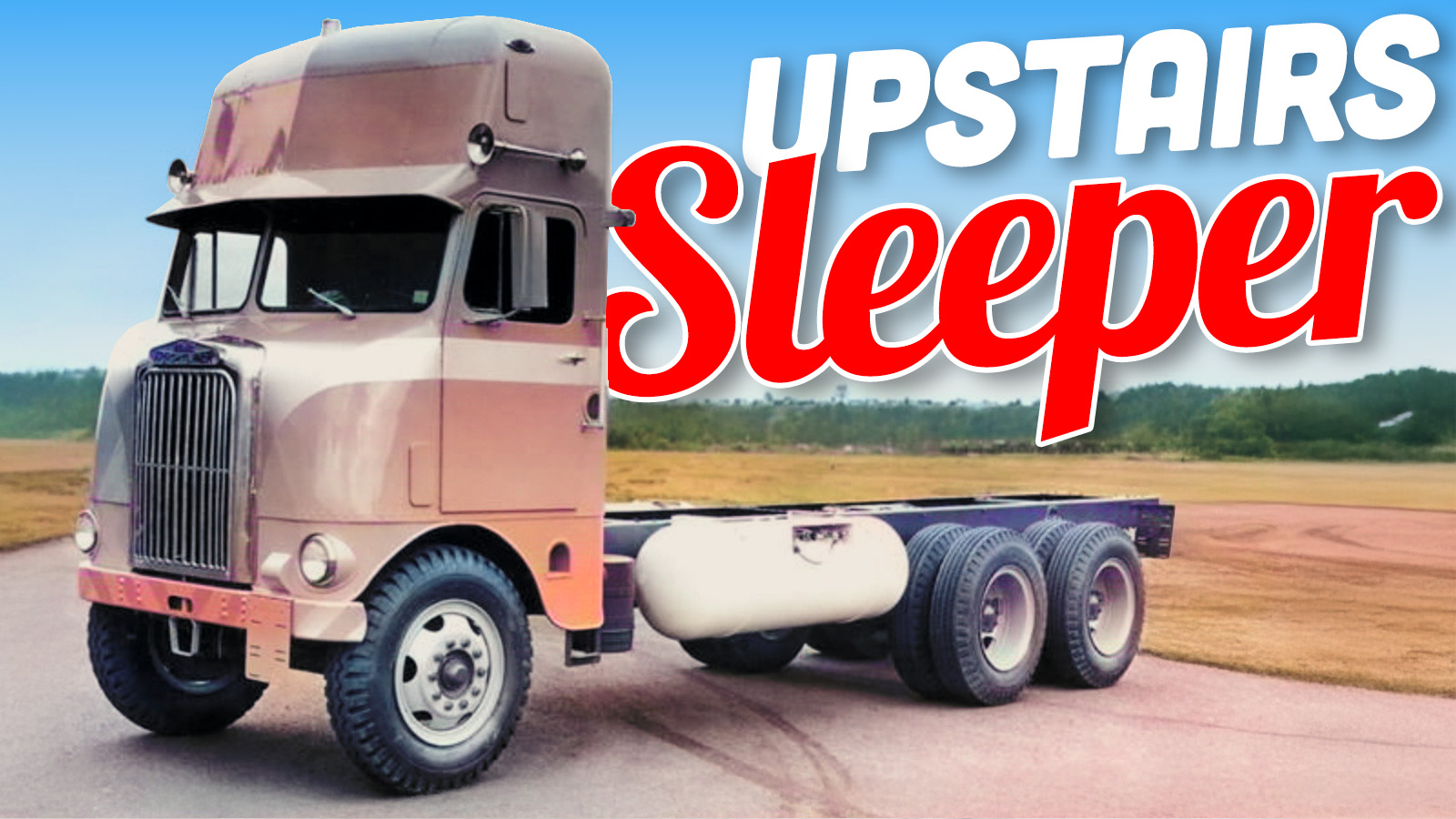
Back in the 1930s, the sleeper revolutionized long-haul trucking. By adding accommodations to the truck itself, drivers didn’t have to find lodging after a long day on the road. Instead, they were able to set up an RV of sorts right next to the cab. But the sleeper also introduced a new problem. Every inch taken by a sleeping space for the driver was an inch taken away from a trailer, and thus valuable load space. Freightliner came up with a wild solution that made long-haul trucks no longer than day cab trucks by making the trucker sleep on top of the truck.
Sleepers have been around for nearly as long as the truck itself has. Back in the late 1920s, America’s trucking industry experienced a period of expansion. The nation’s road network now permitted longer journeys than before. Some drivers operated on long enough routes to require rest periods. Early sleepers were experimental, slipshod, and tacked on, literally. Some of these sleepers were built by the drivers themselves and were stuffed anywhere they could fit, be it the back of the rig itself or even under the trailer. These tiny boxes were also built out of whatever materials were available with minimal engineering skill. This resulted in sleepers that didn’t have proper ventilation, safety measures, or even windows. You might as well have been stuffing yourself into one of the crates riding in your truck’s trailer.


While clunky and dangerous, these sleepers opened up a world of possibilities. Now, trucks can have two drivers in the cab. While one driver sleeps, the other drives, ensuring the load is always on the move. It didn’t take long for truck manufacturers to pounce on this innovation. Australia’s Owner Driver magazine claims that the first American truck manufacturer to offer a sleeper was Mack with the 1929 Mack BJ. Meanwhile, Kenworth says that it was actually the first truck manufacturer to build a sleeper in-house in 1933.

It wasn’t long before sleepers created a problem of their own. For much of trucking history, there were no federal standards on truck size and weight. Instead, regulating truck dimensions was left to the states, and it resulted in vastly differing laws. A truck that was legal in one state might not have been legal in any surrounding state. Or if a truck built for one state’s regulations was legal in another state, it might not have been competitive with that state’s regulations.
These limits meant that space optimization was critical. The longer your tractor was, the shorter your trailer had to be. The shorter your trailer was, the less cargo it could carry. This meant that each load would bring less money. The regulations on total truck length and weight sparked a truck manufacturer arms race. Fairly regularly, manufacturers would advertise a new rig that shed weight in one area, or saved a few inches in another area. All of it was done under the guise of padding the profits of operators.
In particularly restrictive regions, engineers got wacky to make the most of the regulations. In Illinois, for example, trucks weren’t allowed to be any longer than 35 feet. Car haulers got the most creative. To carry a maximum number of cars, manufacturers built car haulers where cars slipped in between the truck’s cab and the truck’s engine.

These regulations are why the cabover ruled the roads until after national standards took hold in 1982. Cabovers, which placed their cabs atop their engines and front axles, were shorter and lighter than conventional trucks, allowing for longer loads. But some companies found that the cabover design alone wasn’t enough, and that there was still room to shed weight and length.
Some engineers took aim at the sleeper. This part of the truck couldn’t be eliminated, but its addition also meant less payload and less space for cargo. If only something could be done about that. In 1953, White-Freightliner found a weird way to make sleepers a non-issue.

A Trucking Empire
Freightliner is one of the first names in trucking nowadays. Go to a highway, any highway in America, and you will probably see as many Freightliner Cascadias as you see Toyota Camrys. If you’re a parent, there’s a good chance that your kid rides on a school bus with a Freightliner badge up front. But Freightliner wasn’t always the default answer to long-haul trucking. In fact, it didn’t even start as a company that any mere fleet operator could buy from.
The history of Freightliner links back to the once-iconic Consolidated Freightways (CF) trucking empire. FreightWaves tells the story of what was once a household name in trucking:
CF Freight, affectionately referred to by truckers as “Corn Flakes,” was founded in 1929 under the name Consolidated Freightways by Leland James. The company got its start in Portland, Oregon. The company was founded when James combined four short-haul companies located in Portland into one trucking firm. Once these companies were combined, James focused on expanding their reach. At the time, trucking in the West was a fledgling industry. The lack of industrial expansion to the West at this point made any sort of progress difficult to achieve. Because of this, James focused primarily on establishing CF Freight as a force in Portland and the surrounding areas. Only after he achieved considerable success did he consider broadening the company’s horizons.
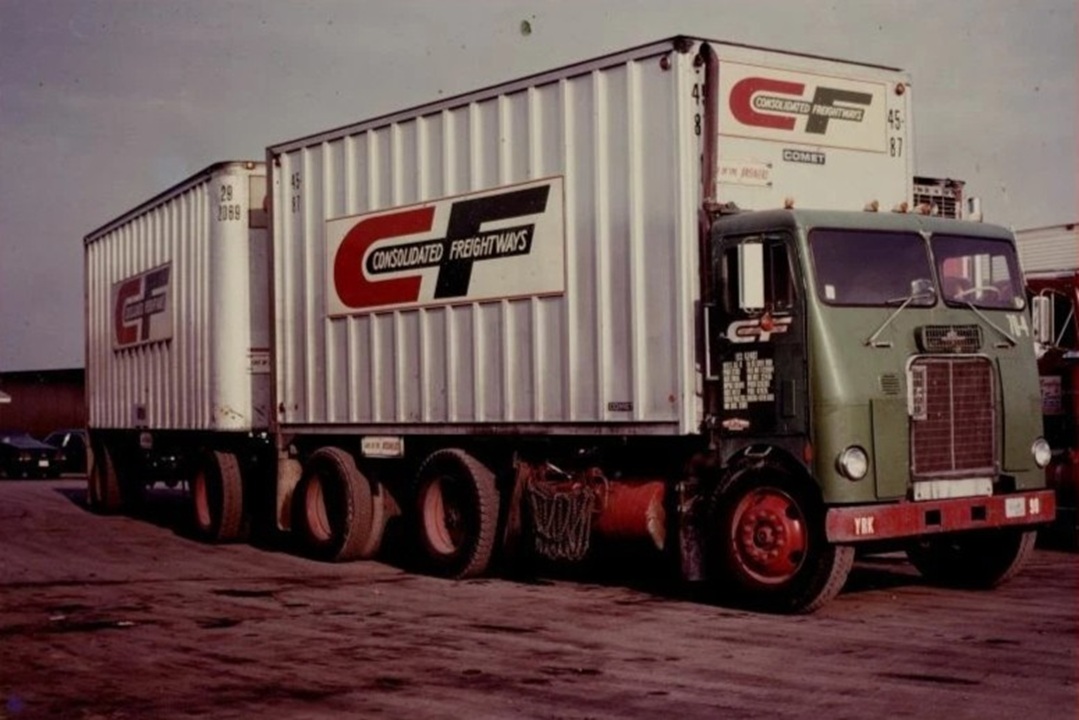
Almost immediately after the company was founded, the Great Depression devastated the citizens and industries of the United States. Competition was fierce, and rates were low as a result. While many companies went under, unable to stay afloat in such desperate conditions, companies like CF were large enough to wait out the lean times. Occasionally, CF even benefited by picking up customers that had been dropped by other carriers that could not withstand the Depression. CF’s biggest competitor at the time was the railroad, which was reliable, but often slow and unpredictable. In 1935, the Interstate Commerce Commission (ICC), which had for decades regulated the railroads, began to regulate the growing trucking industry as well.
Following regulation, Consolidated proved itself a force to be reckoned with. Its routes encompassed Washington, Oregon and California, no small feat considering the initial challenges presented by the lack of infrastructure in the West. More opportunity for growth arrived during World War II. The railroads that had previously been responsible for much of the interstate transportation of freight now were moving war supplies. Trucking companies were able to step up and fill the gaps left behind by the railroads, and CF seized the opportunity. By the war’s end, Consolidated Freightways had added dozens of new terminals throughout the western United States and had extended its service as far east as Chicago. By 1950, revenues stood at $24 million, and the company was operating 1,600 pieces of freight equipment. Because the ICC regulated rates and routes, the best way for companies to grow was through acquisition. Consolidated Freightways began an aggressive acquisition strategy, and by the end of the 1950s it had acquired an incredible 53 of its former competitors.
Staying ahead of the competition was a large part of CF’s strategy. This meant adopting the latest technologies and finding new ways to innovate logistics. One potential area of improvement is the semi-tractor. Usually, a trucking company has to buy whatever’s available on the market. Truck manufacturers do take driver input on their designs, but the truck manufacturer gets the final call on a design.
Freightliner Is Born

Consolidated Freightways decided to cut out the middleman, and in 1942, Leland James launched Freightways Manufacturing (FM). At first, Freightways Manufacturing was the truck-building arm of Consolidated Freightways. The trucks it built were just for CF and were not sold to anyone else. Likewise, its trucks were built to satisfy Leland’s dreams of the future. Namely, he thought that if trucks could be built using a cab made of aluminum rather than steel, the tractor could be lighter and thus have a greater legal payload. He also wanted trucks that were smaller than any of the ones on the market in the early 1940s. Reportedly, he didn’t like any of the trucks on the market, and nobody was willing to build his dream, so he decided to do it himself.
According to Freightliner of today, the trucking industry of the early 1940s doubted Leland’s dream could be done. Determined, Leland made it happen, and Freightways Manufacturing debuted in 1942 with a ‘Bubblenose’ cabover. The truck actually started life as a 1937 Fageol before Freightways rebuilt and re-engineered the rig. During the rebuild, the original Fageol cab was tossed out and replaced with a new aluminum Freightways cab that was placed over the engine and front axle. So much of the truck was changed that it was retitled as a Freightways rather than a Fageol.

The truck was a smashing success. The Freightways Manufacturing rig, which didn’t have a real name, was shorter than the original Fageol, allowing Consolidated to haul a longer trailer. According to Heavy Duty Trucking magazine, it was also lighter than the next competitor by at least a ton, which meant that it could carry heavier cargo, too. This rig would help change trucking history, as it proved that lighter trucks that didn’t use traditional building methods weren’t just possible, but massively profitable.
FM would spend much of the 1940s rebuilding old trucks into new, lightweight rigs, and changing its name to Freightliner along the way. In 1949, Freightliner sold its first truck to a company outside of the Consolidated ecosystem, Hyster forklifts.

In 1950, Freightliner announced its next innovation, the Model B-42, also known as the Eastern Freightliner. By using aluminum and magnesium for the truck’s structure, Freightliner got the B-42’s base weight down to just 11,200 pounds. Add in the short 112-inch wheelbase, and the truck was able to pull a single 45-foot trailer in North Dakota and Minnesota or pull 24-foot doubles in eastern states that permitted 60-foot truck lengths.
That same year, Freightliner began slapping a sleeper onto the back of its trucks, creating long-haul rigs that were capable of towing 35-foot trailers within legal limits. Then, in 1951, Freightliner was approached by a large number of potential customers who wanted what was previously locked to just CF. But there was a problem as the company didn’t have an official sales channel. Freightliner would ink a deal with the White Motor Company that would see the latter marketing Freightliner trucks to other trucking companies under the White-Freightliner brand name. This agreement lasted until 1977.
The Truck To Beat Regulations

Freightliner’s next swing was a big one. Back in the 1950s, diesel power had already proven itself in trucking, but it hadn’t fully taken over the industry just yet. Some trucking companies operated in areas where diesel was scarce. Many of these companies opted for gasoline-powered trucks and just lived with the fuel economy penalty. However, there was an emerging technology that was snagging headlines back then: liquefied petroleum gas (LPG).
Butane-propane had some amazing proposed benefits back then. The Chicago Transit Authority reported to the Commercial Car Journal that buses that ran on LPG tested well with drivers and passengers due to its lack of diesel smoke and odors. It was also found that engines that consumed LPG burned less oil than diesels, and with rock-bottom LPG prices, a bus that ran LPG was $10 cheaper per 1,000 miles. Chicago loved LPG so much that it had 551 LPG buses in operation in the early 1950s and planned to add 400 more.

The Wichita Transportation Corporation concurred, saying that an LPG-fueled bus could drive 400,000 miles before needing an engine overhaul and that butane-propane burned so cleanly that oil changes every 15,000 miles were permissible. The San Antonio Transit Company took it even further, saying that its LPG buses could go 450,000 miles between overhauls and 24,000 miles between oil changes.
It was hard to ignore the promises of butane-propane. Back then, it was cheaper than both gasoline and diesel, and a truck could be converted to run on LPG for less than the cost of buying a factory-built diesel. LPG also didn’t wash oil off cylinder walls or dilute the crankcase oil, leading to the long oil change intervals noted above. Another benefit of LPG was low carbon emissions.
As Successful Farming reported, LPG even found its way into tractors. Sure, LP had 27 percent less energy than the gasoline of the day, but it had a higher octane rating, and you could fill up multiple tanks of LPG for the same price as a single tank of gasoline. It just seemed like the sort of perfect solution for an operator who wanted something better than gasoline, but not as expensive as the upfront cost of a diesel engine.
None of this was new, as there had been known LPG conversions going back to the 1920s. However, the 1940s and the 1950s saw a greater push to see if LP could replace gasoline. In 1954, the Commercial Car Journal even published a guide on how to convert your truck to LPG. The magazine advised finding an engine with 15,000 miles or lower so that you couldn’t have to worry about carbon buildup from running gasoline. CCJ also noted that you’d need a special carburetor, a special fuel tank, an increased compression ratio, altered timing, and a few other odds and ends. The report concluded that converting a gas engine to LPG would cost you $300, and you’d easily make the money back in maintenance costs that are sliced in half and fuel costs that are 5 percent to 20 percent cheaper.
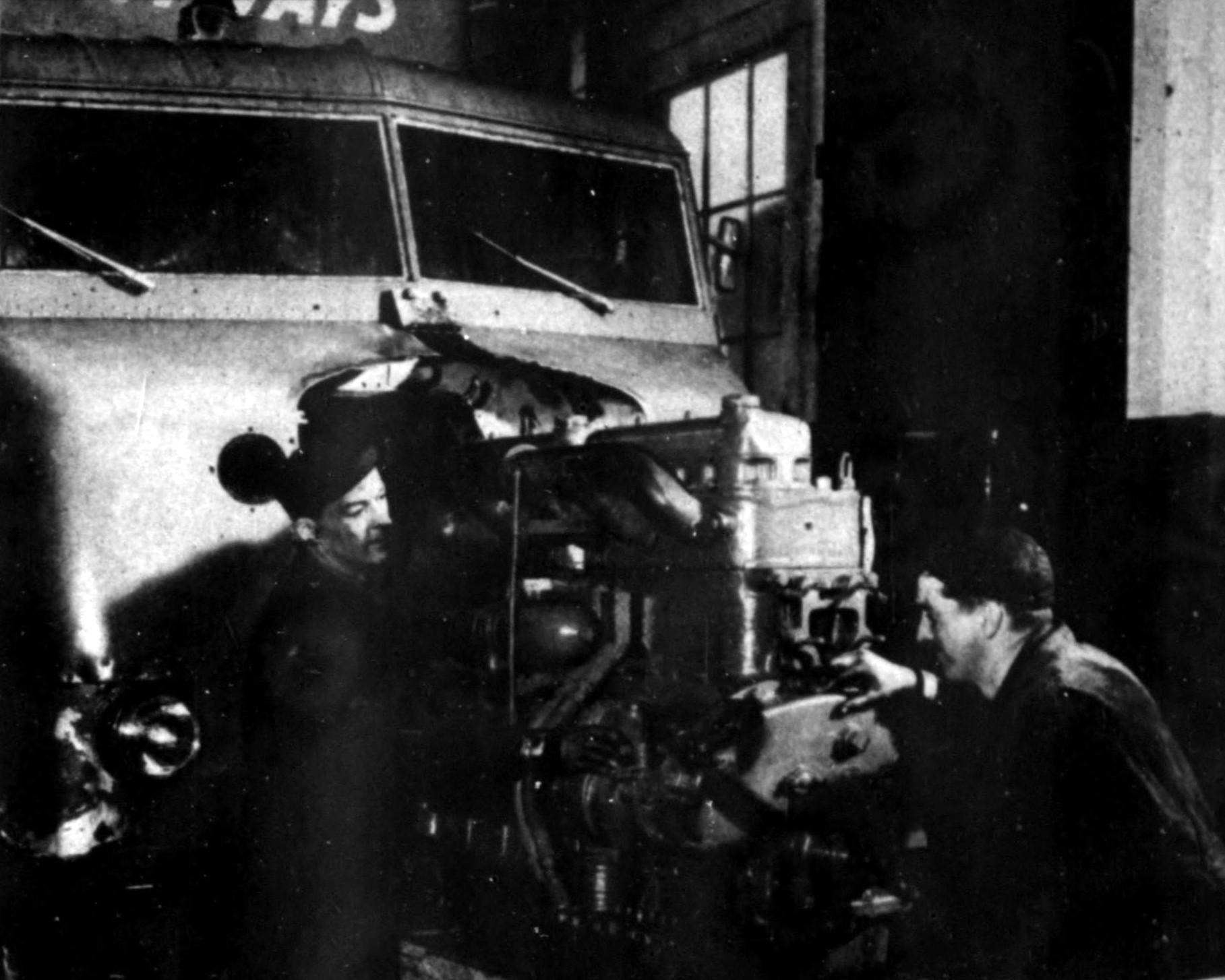
Freightliner decided that it would just offer an LPG engine right from the jump. In 1952 or 1953 (sources differ), it launched the WF-64. The name actually had a meaning. “WF” stood for White-Freightliner, while “64” identified it as a 6×4 Dual Drive truck. Basically, both of the rear axles were powered.
The WF-64 had a couple of party tricks. The build of the truck was standard Freightliner. It featured a magnesium alloy steel frame with a stubby aluminum cab perched on top. This wasn’t the only weight-shedding done in the WF-64, as it also featured chrome vanadium steel springs and the standard engine, a Cummins NHB straight-six, featured lightweight parts to cut down girth even more. The result was that, empty, the truck weighed only 13,350 pounds.
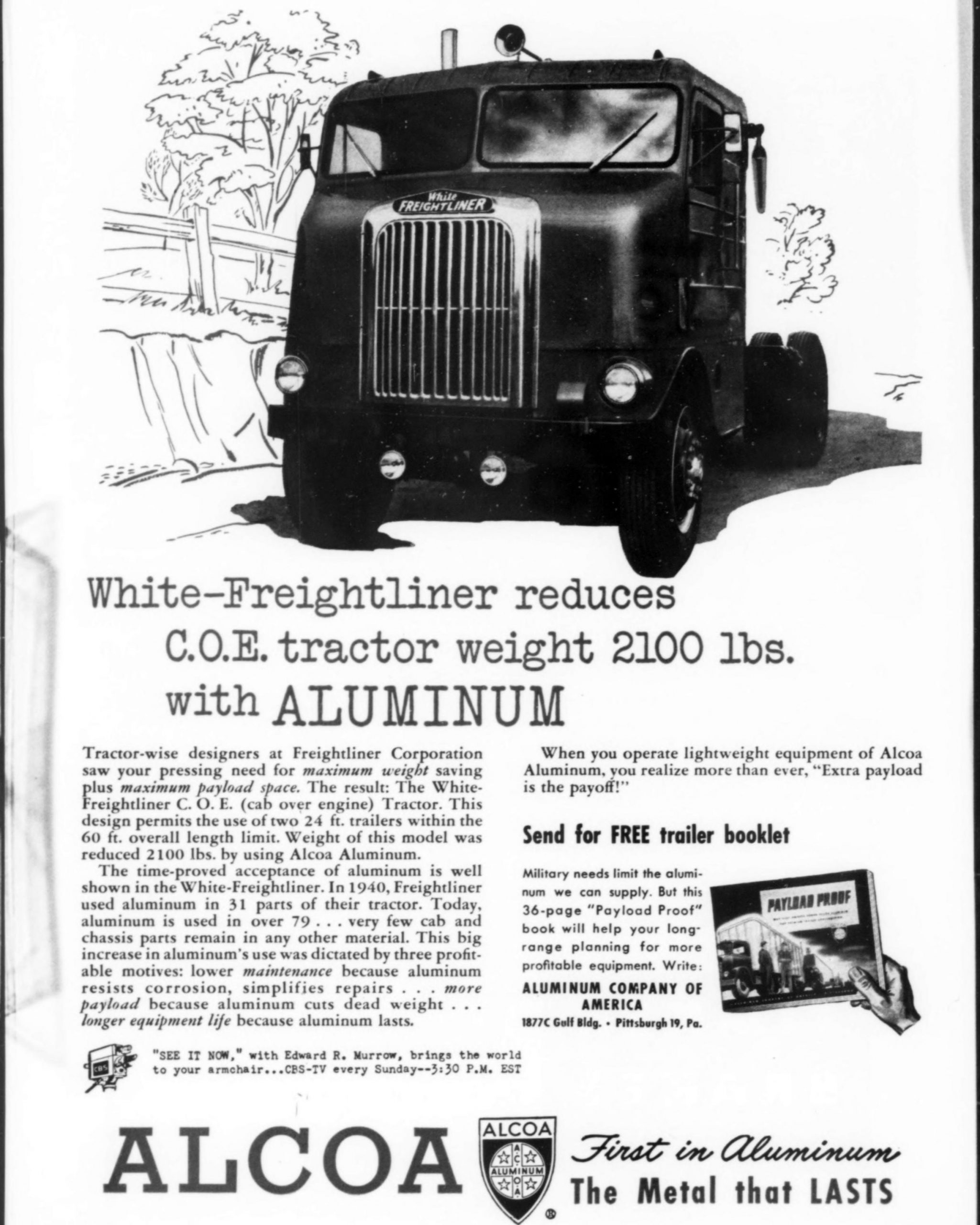
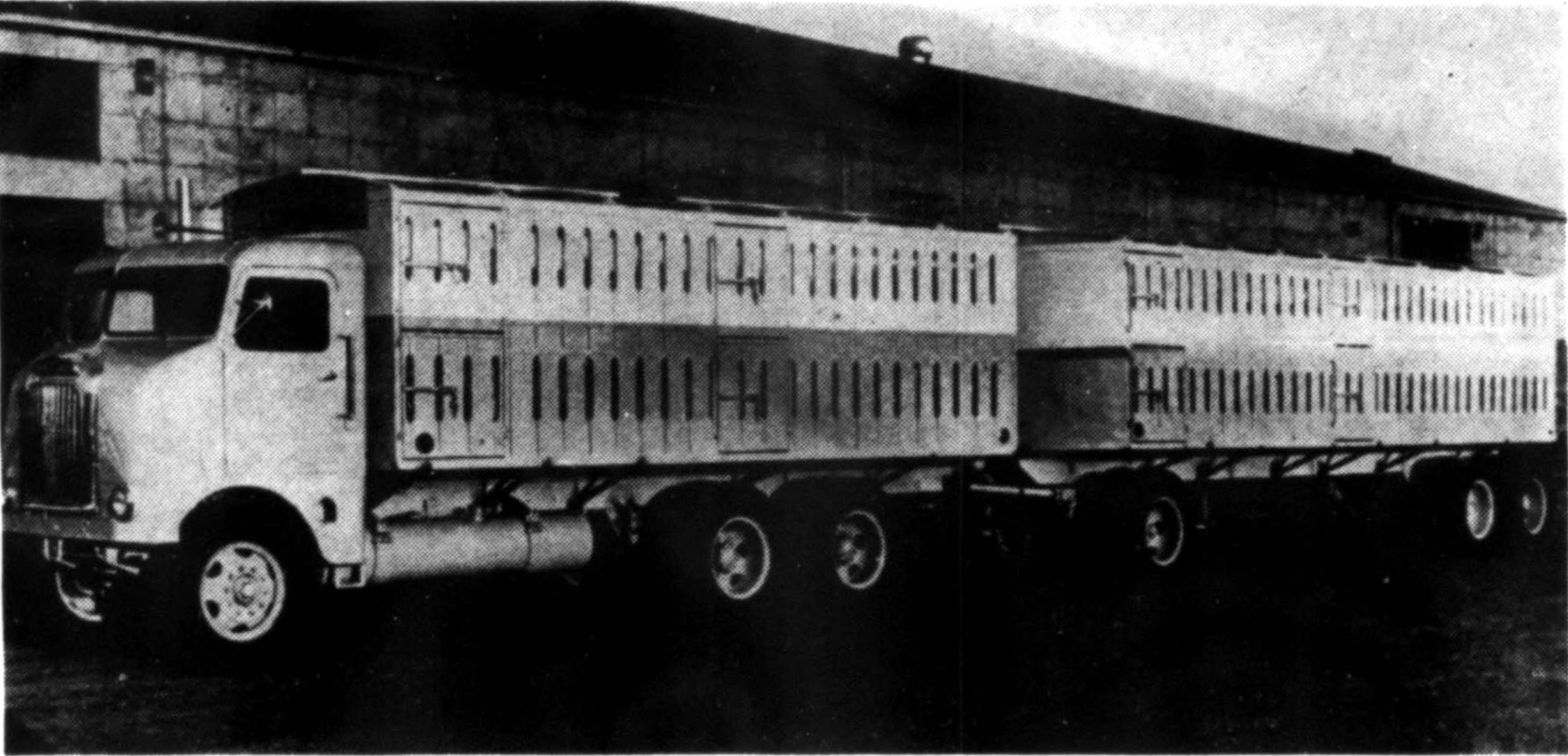
The WF-64 was marketed with a 196-inch wheelbase and an overall length of 28 feet. You were expected to use 22 of those feet for a cargo box. You would then hitch a 28-foot trailer to the truck, allowing for a total of 50 feet of loading space in a truck measuring 60 feet long in total. Some states didn’t just limit total truck length, but trailer length, too. By making half the truck essentially a straight truck, the WF-64 technically complied with the laws of those states.
The options list was vast. Buyers had a choice of 11 transmissions from Fuller or eight different transmissions from Spicer. The standard transmission was a Spicer 8041 four-speed. Three different Spicer auxiliary transmissions were offered, in addition to two Fuller auxiliary transmissions. The standard auxiliary transmission was a Spicer 8031-G three-speed transmission. Sadly, I found no interior images of the WF-64, but here’s a video of a Freightliner cabover of the same vintage:
The front axle was a Timken-Detroit FE-900 with White-Freightliner hubs, while the dual rear axles were Timken-Detroit 5QW dual drive axles with a spring suspension. Options for axles included four other Timken-Detroit options or lightweight White-Freightliner axles with aluminum components. Westinghouse air brakes handled stopping, Gemmer made the steering box, Budd made the standard steel wheels, and Alcoa made the optional aluminum wheels.
The most exciting part of the hardware came down to what was under the cab. In addition to the aforementioned Cummins diesel, White-Freightliner also offered Buda Diesel DA, DAS, and DAT engines in addition to Cummins JT, HRB, HRFB, NHBS, NHRBS, NT, NTO, and NRT engines. If diesel was unavailable to you or just too expensive of an upfront cost, a selection of gasoline engines were offered from the White 390A to the Hall-Scott 590, 855, 935, and 1091. Notable was that Hall-Scott was a pioneer in butane-propane engines, and White-Freightliner sold the Hall-Scott engines as gas or LP. Outputs of all available engines ranged from 150 HP to 300 HP.
A Sleeper That Doesn’t Add Length
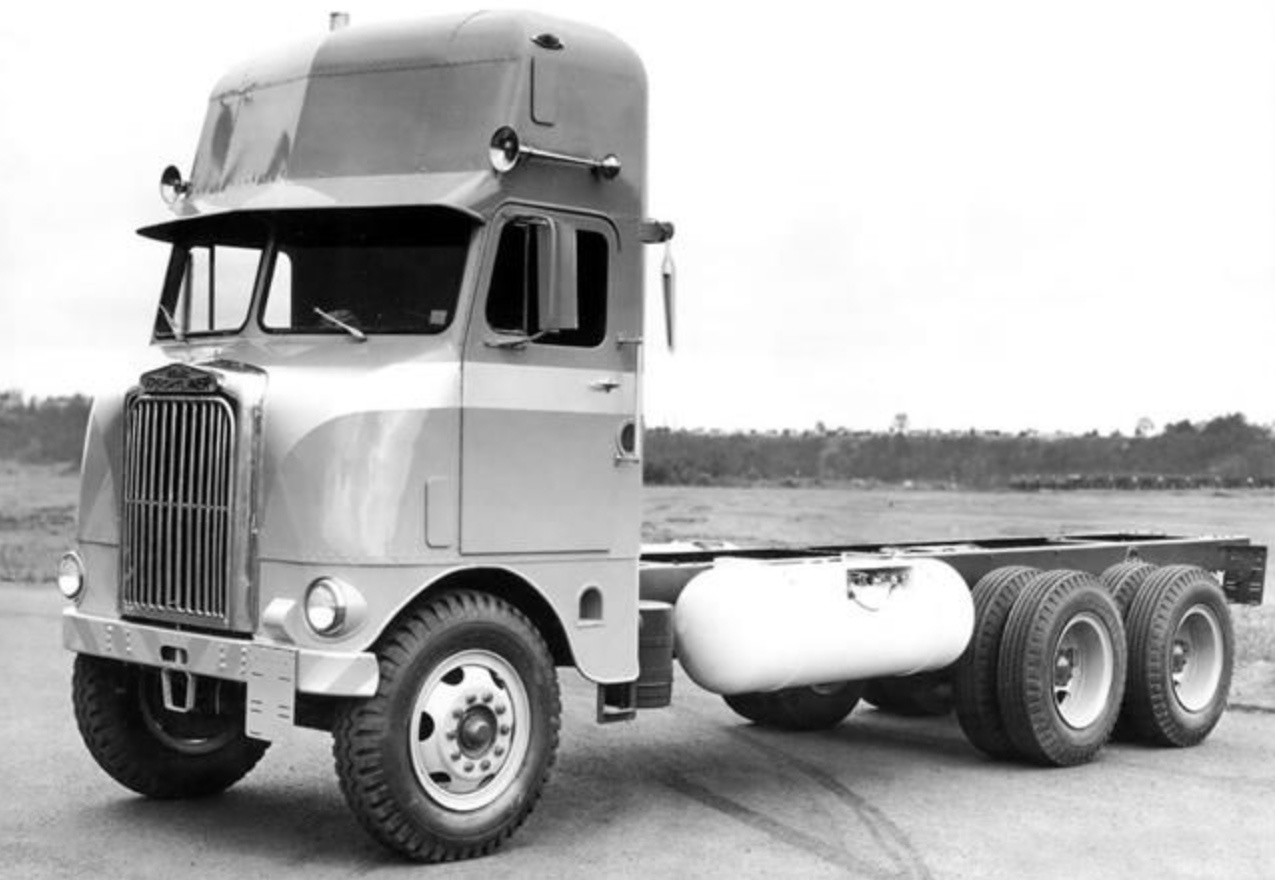
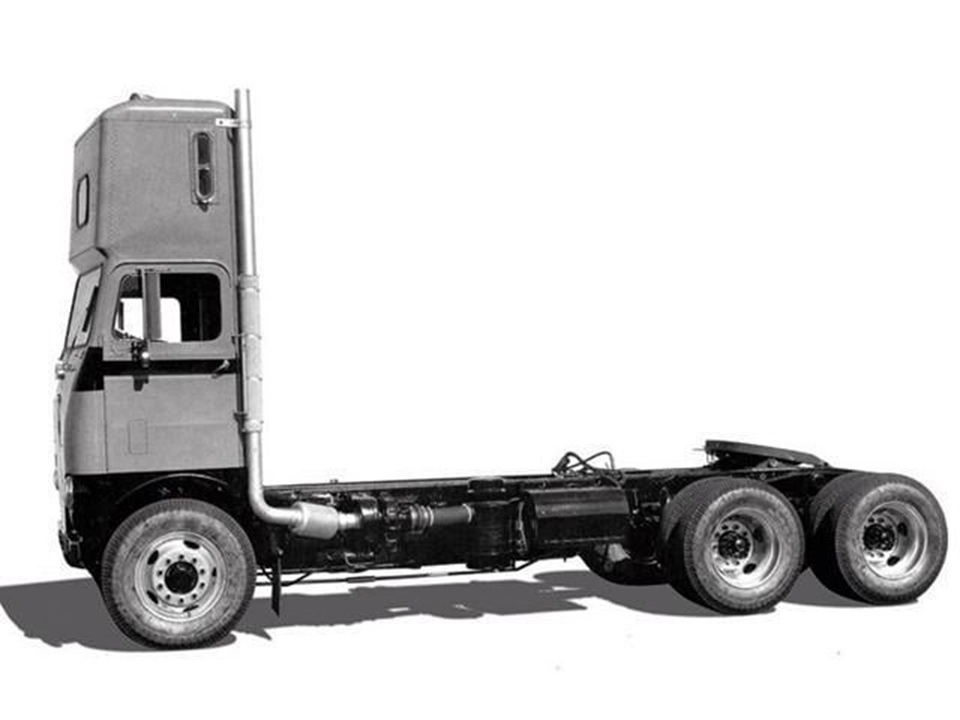
Then there was one more trick. White-Freightliner wanted this truck to be a long-haul rig, which meant adding a sleeper. But slapping one to the back of the cab would have stolen valuable space. The truck wouldn’t be able to hold 50 feet of cargo if a couple of feet was used up for a bed.
To get the best of both worlds, White-Freightliner simply installed the sleeper on top of the cab. In doing so, Freightliner essentially built a long-haul truck that was the size of a day cab. The sleeper was somewhat roomy, too, with 82 inches of length and 28 inches of width for the trucker to work with.
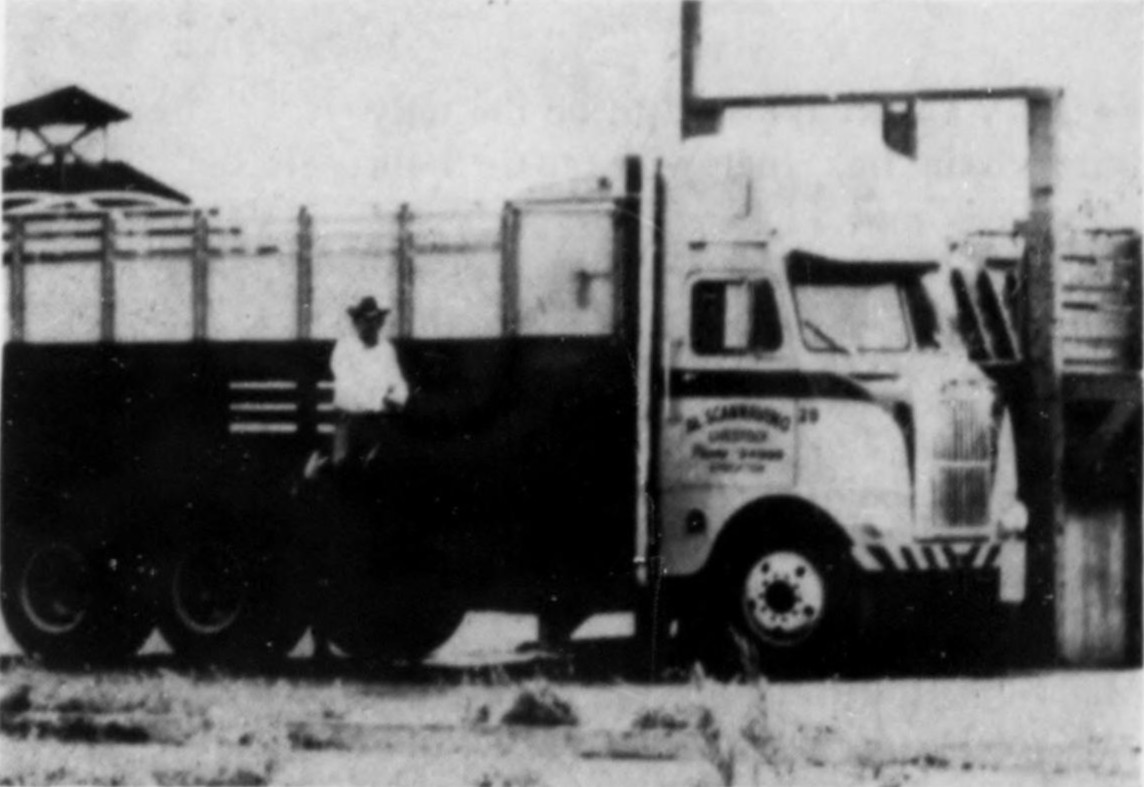
White-Freightliner believed that, by covering all ends of the trucking market, it would be able to serve its customers no matter what they needed. According to period reports, the WF-64 and its stubby cab and high-rise sleeper were built on the demands from the Stockton Livestock Co. of Stockton, California, which wanted to carry as much cattle as it could fit within legal limits.

White-Freightliner saw the truck as a huge win for operators. The weight reduction techniques meant that the average WF-64 could carry 2,880 more pounds of cargo than other trucks. That doesn’t sound like much, but Freightliner said the gains were impressive. The company claimed that every pound shaved from the truck was worth $1.85 in additional revenue-earning capacity per year.
The LP engines were also seen as a good idea, at first. Reportedly, Diesel WF-64s averaged 5.5 mpg to 6.5 mpg while gassers put down 3.5 mpg to 4.5 mpg. The butane-propane engines scored 3 mpg to 4 mpg, which was worse than every other engine, but the twist was that gasoline was 29 cents per gallon, diesel was 24 cents per gallon, and LPG was only 14 cents. Depending on the region you operated in, diesel and LPG had roughly similar operating costs of four cents per mile.
Add on the towering sleeper, and you had the recipe for a great hauler that followed the letter of length and weight laws, but maybe not the spirit of it. Freightliner said that a WF-64 plus a trailer weighed 32,060 pounds and had more than 43,000 pounds of payload with 240 gallons of fuel. Adding the WF-64 to the White-Freightliner also increased sales. So then, what happened? Why isn’t every truck an LP-fueled wonder with a bed above the cockpit? A handful of drawbacks appeared rather quickly.
Ahead Of Its Time
When it came to LP power, the lower energy content of the fuel meant that LP WF-64s had a shorter range than gasoline models. Other complications came from the low availability of LPG at the time, the bulk from the pressurized tanks that the LPG lived in, lower power output from the engines, and the fact that LPG vaporizes poorly in cold temperatures.
This meant that adopters of the LPG trucks were largely on the West Coast, where the fuel was more abundant and colder temperatures weren’t that high of a concern. Ultimately, LPG would take about two more decades before it would enter something closer to the mainstream. By the 1970s, there were even police cars and pickup trucks rolling around on LPG conversions. Today, buses, trucks, and other vehicles can be had in LPG flavor.
As for the weird sleeper, this wasn’t some anomaly. In the 1960s, White-Freightliner also built the FT and WFT, which had an incredibly small bumper to back of cab (BBC) of only 48 inches, which included the sleeper! That BBC matches the equally pencil-thin GMC “Crackerbox,” which did not have a sleeper.
In 1952, the federal government set standards for sleepers, which included minimum size requirements, proper ventilation, exhaust leak protection, a proper emergency exit, and a way to communicate with the driver if the sleeping berth is not open to the cab of the truck. Most rigs would go with the standard layout of placing the sleeper behind the cab, and after the publication of the 1952 rules, the “coffin” sleepers became a thing of the past.
Freightliner kept producing these weird sort of “sleepover” trucks for many years. Most of them stayed in the West Coast or the Pacific Northwest as hacks to maximize loads in states with harsher length limits like California and Oregon. Freightliner wasn’t the only company slinging weird sleepers, as the Corbitt 600 of the early 1950s sported a sleeper that was in front of the driver’s feet. The Eisenhauer truck I recently wrote about had a sleeper that ran longitudinally through the bottom of the cab next to the driver’s seat. Peterbilt even got in on the action with its 451:
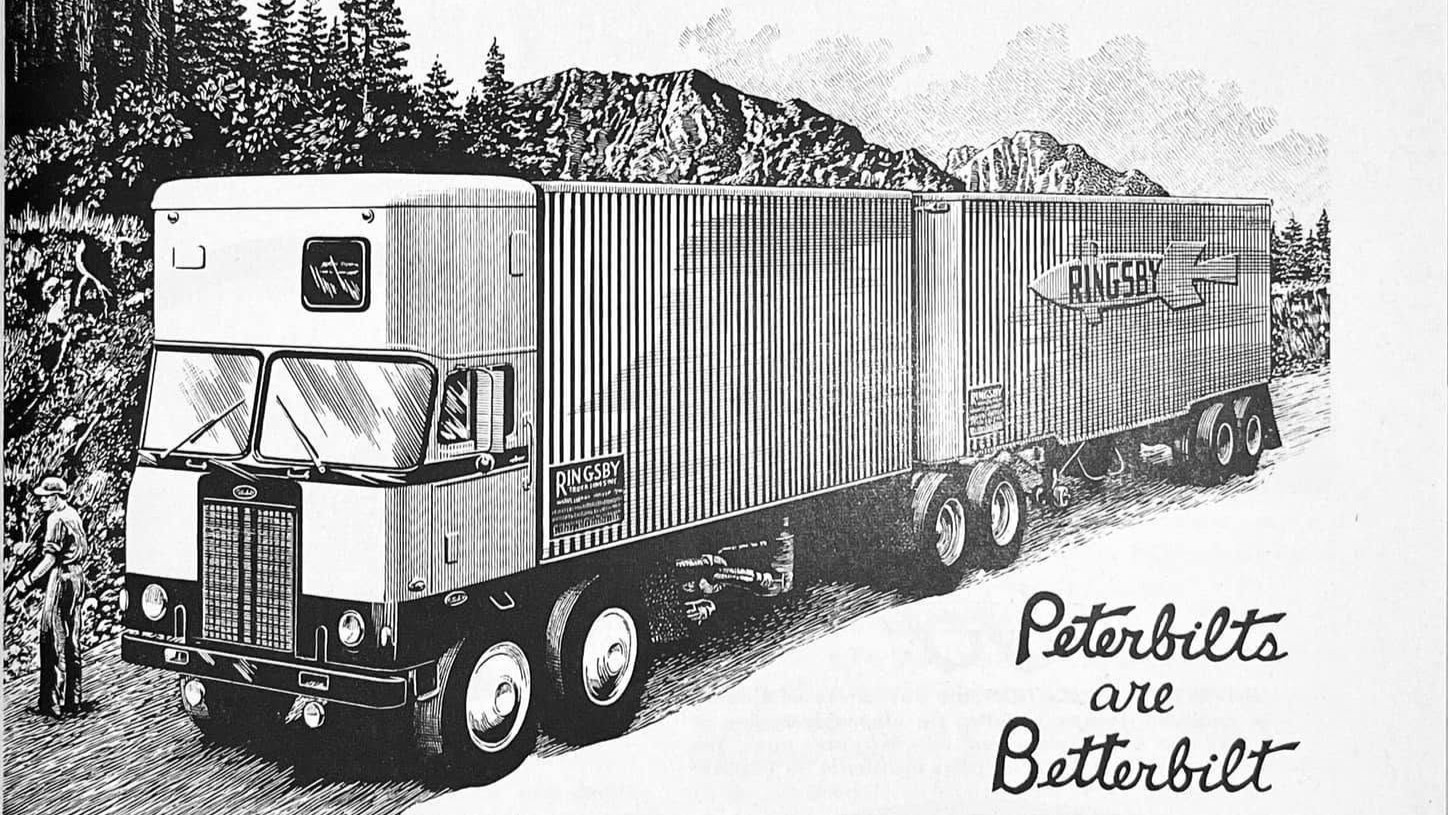
When the federal government finally did away with the patchwork of state-based truck length regulations in 1982, the need for wacky sleepers disappeared. Now, trucks can have roomy sleepers while still hauling 53-foot trailers and while still loaded to a gross weight of 80,000 pounds.
A Great Piece Of History

If you’re interested in seeing one of these thin Freightliners, the Iowa 80 Trucking Museum in Walcott, Iowa has a Freightliner WFT on display. The museum is also a part of the Iowa 80 “World’s Largest Truckstop,” where you can probably burn most of a day if you really love truck stuff.
So, like many inventions of old-school trucking, Freightliner’s idea to perch a sleeper on top of the truck was an innovation that was forced by regulations. When Freightliner couldn’t build back, it built up, instead. The result was forcing truckers to sleep on top of their rigs so they could bring in more money from their loads.
While the need for a goofy truck like this became a dead end the moment regulations gave truckers more breathing room, it was still a great piece of engineering for the day. It was weird ideas like this that made most of the semi-tractors that I have written about. As time has shown over and over again, when faced with seemingly impossible situations, engineers will invent a way out. Sometimes it works out, sometimes it doesn’t. Hey, at least this one wasn’t another ill-fated turbine!
Top graphic image: Freightliner


Always learning something on The Autopian! I had never heard of these “coffin” sleepers and never even would have thought of it- so clever and interesting.
“bumper to back of cab (BBC) of only 48 inches”
The semi in that photo is so goofy looking but awesome at the same time.
Wonderful research and amazing article!
In Europe the top sleeper is quite common, especially for little trucks like this: https://thomann-nutzfahrzeuge.de/wp-content/uploads/2024/10/Pritsche-Plane-Top-Sleeper-1-1024×768.png
I’ve seen a few current gen Promaster cab-chassis box trucks with an upstairs sleeper. Must be really tight in there!
Truck stop hookers must have been thinner in those days 😉
Truckers too
A truck wearing a trucker hat. So meta.
“When it came to LP power, the lower energy content of the fuel meaYnt that LP WF-64s had a shorter range than gasoline models. Other complications came from the low availability of LPG at the time, the bulk from the pressurized tanks that the LPG lived in, lower power output from the engines”
Funny how despite all these drawbacks that killed clean burning LPG and that bastard gas butane there has been so much put into hydrogen as the great new hope for the trucking industry. Hydrogen offers an even shorter range, even bulkier, even heavier, even more expensive tanks and raises the ante with boil off (if LHG), no infrastructure, few proven recoverable natural reserves (although that may be changing), etc, etc.
Meanwhile natural gas when used in a pilot ignition setup offers the same power and driveability as running on pure diesel but with the low emissions and lower maintainence and low fuel costs of running (mostly) NG. True the range per gallon is lower than diesel and the tanks have the same drawbacks as hydrogen tanks but NG is widely available, very cheap, and domestically produced which ain’t nothing.
“and the fact that LPG vaporizes poorly in cold temperatures.”
Which it seems could have been an easy fix by just using an electric heater and waste heat from the engine to preheat the gas.
“Freightliner Tried To Make Trucking More Efficient By Making The Driver Sleep On Top Of The Truck”
Seems like a good idea except for the aerodynamics. It does make me wonder though if it might not be possible to make a drop down tent under the trailer.
Oh yeah, like they did back then.
“Some of these sleepers were built by the drivers themselves and were stuffed anywhere they could fit, be it the back of the rig itself or even under the trailer.”
I missed that. Glad though the drivers didn’t. I wonder how well those worked.
Yeah, me too…don’t think I could sleep very well. Not the safest spot but I still wouldn’t be averse to it, ha ha. Would obviously still prefer a fancy, cozy rv-like cab
I dunno, I think a drop down camper could be made of something a lot more bear resistant than a cab.
Oh yeah, good point!
LPG is not the same as butane. LPG is about 95% propane and 5% butane. It has many advantages for small stationary engines that are used infrequently, such as a backup generator or a homeowner log splitter; there is essentially no carburetor, and as the article states, oil change intervals are longer and the fuel burns cleaner than gasoline, so the engine lasts longer and pollutes less in some ways.
Propane is also really popular for forklifts and other warehouse machines. Propane burns cleanly enough to use in a well ventilated space. I saw a crew using a propane powered floor grinder in a 7-11 one night. The propane forklift’s oil would look new at 150 hours where a diesel Bobcat’s oil would be black after 20 hours.
Rooftop sleepers were still around in Europe in the 80s and 90s for specialist trucks that needed maximum volume. I remember a late 80s article about a,rig used to deliver empty beer cans. The sleeper was like a capsule hotel with some small windows and an aluminum ladder.
*Insert joke about falling awake here*
I am probably missing something, but why is displacement of the Hall Scot engine measured in square inches not cubic inches?
Maybe back then was back when it was hip to be square?
Imagine being the driver on rest and you look out that little portal window and your co-driver is heading towards the 11’8″ bridge
The first thing that came to mind was that, although probably not at the 11’8″ bridge, I can imagine at least one poor driver was swept out of bed while asleep. And the early ones didn’t even seem to have windows.
If we only get one post today, I’m glad we got one from Mercedes. Always interesting and well researched.
I wonder how friggin hot it got up in those sleepers if the thing didn’t have A/C?
I was expecting a picture of the inside of the cabin, left disappointed.
Coming in a future post?
Somebody spends a week sleeping in there as a punishment/dare.
Me too. Was thinking it might look like a Japanese capsule hotel.
https://sleepeducation.org/sleepless-japan-capsule-hotel-experience/
Imagine a drainage pipe with nude pictures stuck to the inside.
Go on…
Low bridges sound like they’d be more frightful.
Especially if you drive with a partner and the partner goes upstairs to take a nap while you drive.
So when you hit that low bridge, it turns into a gruesome situation fast.
“And that, Kids, are how Manwiches are made.”
That truck looks like it’s wearing a trucker hat! It is surprisingly adorable.
So stupid question: do modern sleepers have toilet facilities, or are they basically just beds? Seems like team driving could work even better if it has a toilet.
Sorry, I just brought us back to poop.
We never really left poop…
Answer:
Most don’t have any kind of toilet facilities. They’re set up most commonly with bunk beds, fridges, TVs, microwaves, and these days air fryers.
Think of an old school 13ft Boler trailer. Nearly everything you need minus the bathroom.
Now, some people who run cargo where they can run a longer truck, will have basically a mini RV “toterhome”. This is common for married team drivers, and they often will do hella long distances.
Thanks! I appreciate the answer.
home depot bucket
“home depot bucket”
Or a diaper…
Sounds like camping. Throw some cat litter in when you’re done to keep the smell down.
Depends …
It’s very rare, because even a 60″ sleeper is space and weight limited. The notable exception is if you are not using your truck as a commercial vehicle, in which case having a cassette toilet, fridge and hotplate allows you to register it as an RV in many states
Volvo has stayed at the front of the pack for sleeper comfort features in North American semi tractors — they’re basically an RV straight out of the factory except for the lack of a toilet. I’m wondering how much longer it will be before they decide to offer an OE cassette toilet option
We had a husband and wife team assigned to a dedicated load for the non-profit I work with. Their company truck had a 16′ sleeper, yes 16′ and it was a full RV in side including a shower and washer/dryer combo. The typical sleeper however is just a bed and maybe a TV or microwave.
Super interesting! The LPG part jumped out for me because I remember Winnipeg taxi cabs in the 80’s, most of which were propane. Your cab would get to your house to take you and your family with all their giant suitcases to the airport. It would be a chevrolet caprice, with a trunk as long as Beetle, no problem for those bags, right? Then you open it – and the entire freaking thing is full of giant propane cylinders. Ridiculous. I remember riding with giant suitcases across everyone’s laps, or odering multiple cabs. Interesting tech, not suitable for taxicabs haha.
I’m genuinely surprised, given that truckers’ unions were quite strong during the ‘30s up through the ‘70s, that the concept of a tiny coffin-sleeper without adequate ventilation or safety was around for as long as it apparently was! You would think that truckers would object to being stuffed in a box for the night, but I suppose it was better than having nothing at all…
I have been in a couple of more recent big-rig sleeper-cab tractors, from around 2006-2008 model years, though as a tourist and not as a driver. I was actually impressed with how cozy the sleeper area was, considering the limitations of the space. One of these was a big Freightliner, and it had a good sized bed, a few little cabinets for your things, and nice little integrated lighting. Honestly, in terms of quality and materials, it was probably nicer than my first apartment. Clearly, things have come a long way.
Long-haul trucking has, at times, been romanticized in the ‘States, the image of the gritty, self-reliant owner-operator outwitting authorities and delivering goods to them what needs ‘em, but I’ll tell you, sit your ass in the driver’s seat of one of these things and your mind will drift, if only for a moment, to an imagined future where you’re happily chatting on the CB under a darkened moon, possibly on the 6th of June, in a Kenworth pullin’ logs.
When I was a kid, a friend’s family’s dairy farm had one of these. I don’t recall what brand it was, but I remember we weren’t allowed to climb up inside the sleeper, so naturally we did. It was creepy inside, and earned the nickname “the tomb” from us kids.