


While running around SEMA a few weeks ago, I happened upon the Jeep Recon, an off-road vehicle that has been absolutely panned by the media. “Flawed but fun,” wrote Road & Track. The Drive wrote, “Disappointment is a Jeep Thing Now.” Yikes! “It’s a Great Electric Wrangler, But a Not-So-Great EV,” was Edmunds‘ headline. “Great Jeep Character, Disappointing Execution,” wrote Motor Trend. It’s a shame, because the Jeep Recon could easily have been a better vehicle if it weren’t for one baffling engineering decision.
Last year I saw the Jeep Recon at the LA Auto Show and I felt inspired to write: “An Off-Road Analysis Of The Electric 2026 Jeep Recon: It’s Going To Be Good.” In the body, I clarified “good not great,” with the main points in favor of the Recon having to do with its solid geometry.


Check it out:

Thirty-three degrees is an excellent departure angle and a very good approach angle, and 23.3 degrees is a decent breakover angle (ground clearance is a decent 9.1 inches). I went on to mention that the fully independent suspension likely was going to lead to rather modest articulation, but that the locking rear diff would help solve the traction issues associated with tires lifting. That seems to be the case based on reviews I’ve read.
Speaking of, let’s talk about why the Recon is getting smoked by critics; it really boils down to range.
The Recon Is Getting Smashed By The Media, And The Reason Is Range

Car and Driver wrote, “With a high price and a low range, the Recon is going to have a hard time outrunning more traditional off-road options among hardcore outdoors enthusiasts.”
The Drive‘s review mentioned that the Recon failed to qualify for a “lane” that it defined thusly: “In one [lane], you have the genuinely good EVs—think Chevy Equinox EV, Hyundai Ioniq 5, or the Rivians. They offer plenty of range, charge relatively quickly and cheaply, and focus on efficiency.”
Motor Trend did a “Road Trip Range” test, and… well:
We were less shocked by the Recon’s poor showing in our Road-Trip Range test—a paltry 166 miles. As an off-road-focused SUV, that’s on some level excusable. What wasn’t was that range figure coupled with the Recon’s poor charging performance: 71 miles of range in 15 minutes on a charger and 119 miles in 30. Shouldn’t performance vehicles have performance charging systems, especially ones theoretically designed to go way off the beaten track, where chargers are less accessible?
166 miles! That’s quite bad. (Though it’s worth noting that your mileage will literally vary depending upon driving conditions).
My friends at TFL said essentially the same thing as everyone else:
You’re meant to take this vehicle well off the beaten track to places like Moab — it’s in the name, after all — and how far can you go? Go for this all-terrain trim with 33-inch tires, and you’re looking at … 222 miles. That number may be pleasantly symmetrical, but there’s no way to sugarcoat this: It’s not enough. You can’t fix a dead battery with a jerry can, and even when you can charge up, you’re topping out at about 200 kW on a DC fast-charger thanks to this car’s 400-volt architecture.
After a day’s driving, both Tommy and I can confirm range anxiety is still alive and well in this Jeep Recon. Over 116.6 miles, we used 57% of the available charge, or about 2.5 miles per kilowatt-hour. That’s not Hummer EV levels of inefficiency, but we are talking about a 6,100-or-so-pound brick of an EV, and you’ll feel it if you try any long-distance excursions.
The critiques can all be summarized by the beginning of Car and Driver‘s headline: “The Obstacles of Low Range and High Price: 2026 Jeep Recon EV Tested.”
The Recon’s Inefficiency Is, In Part, The Result Of A Bizarre Engineering/Design Choice
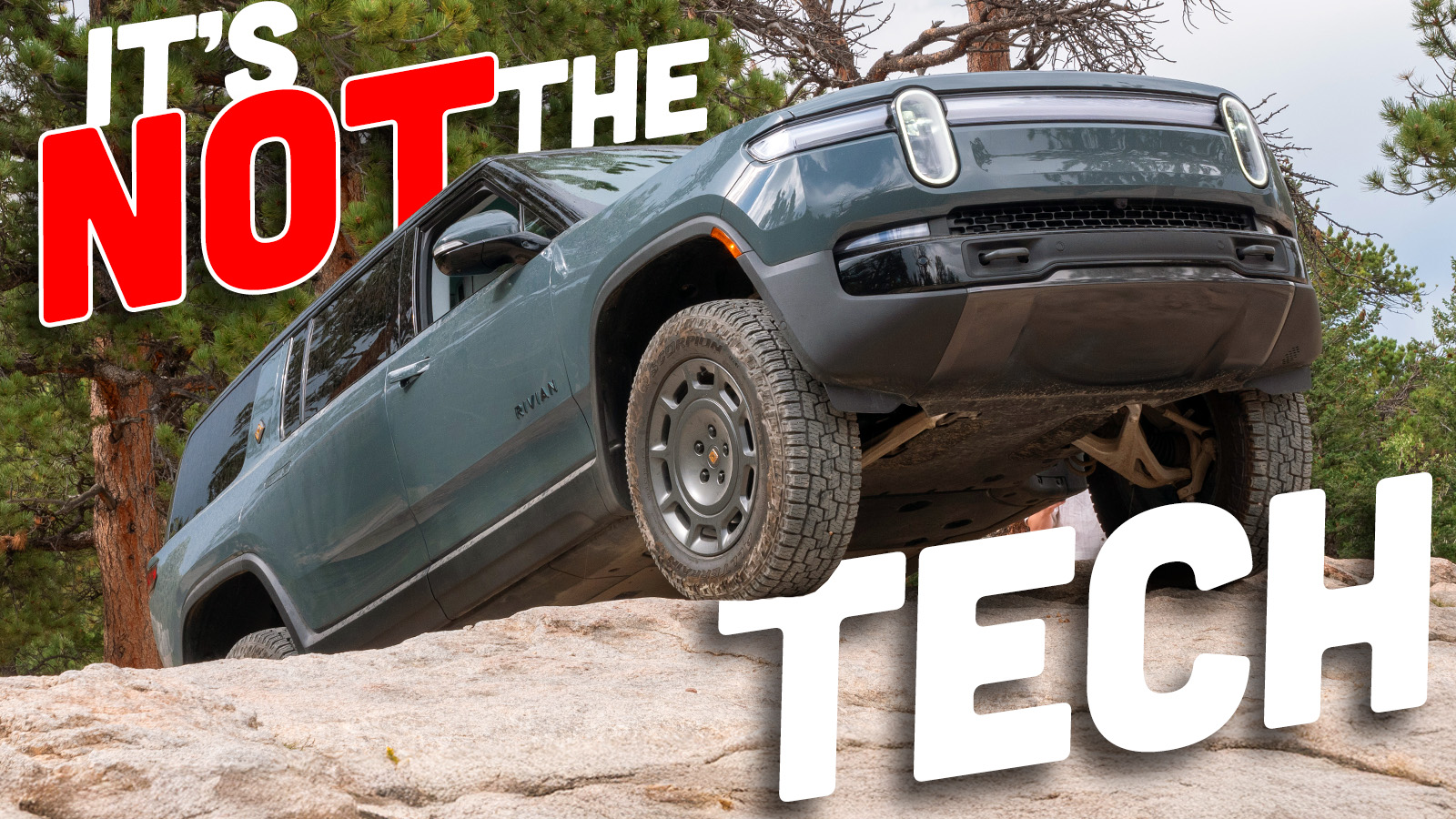
The most capable electric off-road vehicle in the U.S. right now is a large three-row — the Rivian R1S. As I wrote in my article “The 1025 Horsepower Rivian R1S Quad Motor Is A Phenomenal Rock-Crawler, But Not For The Reason You Think,” it’s actually not the fancy 1,000+ horsepower quad-motor drivetrain that contributes most to the big SUV’s great capability, it’s the geometry.
Geometry is typically an area where a large three-row might struggle, but the R1S’s air suspension resolves all that, jacking the vehicle way up in the air, yielding phenomenal approach, departure, and breakover angles thanks to short overhangs, a reasonable wheelbase, and a whopping 15 inches of ground clearance.
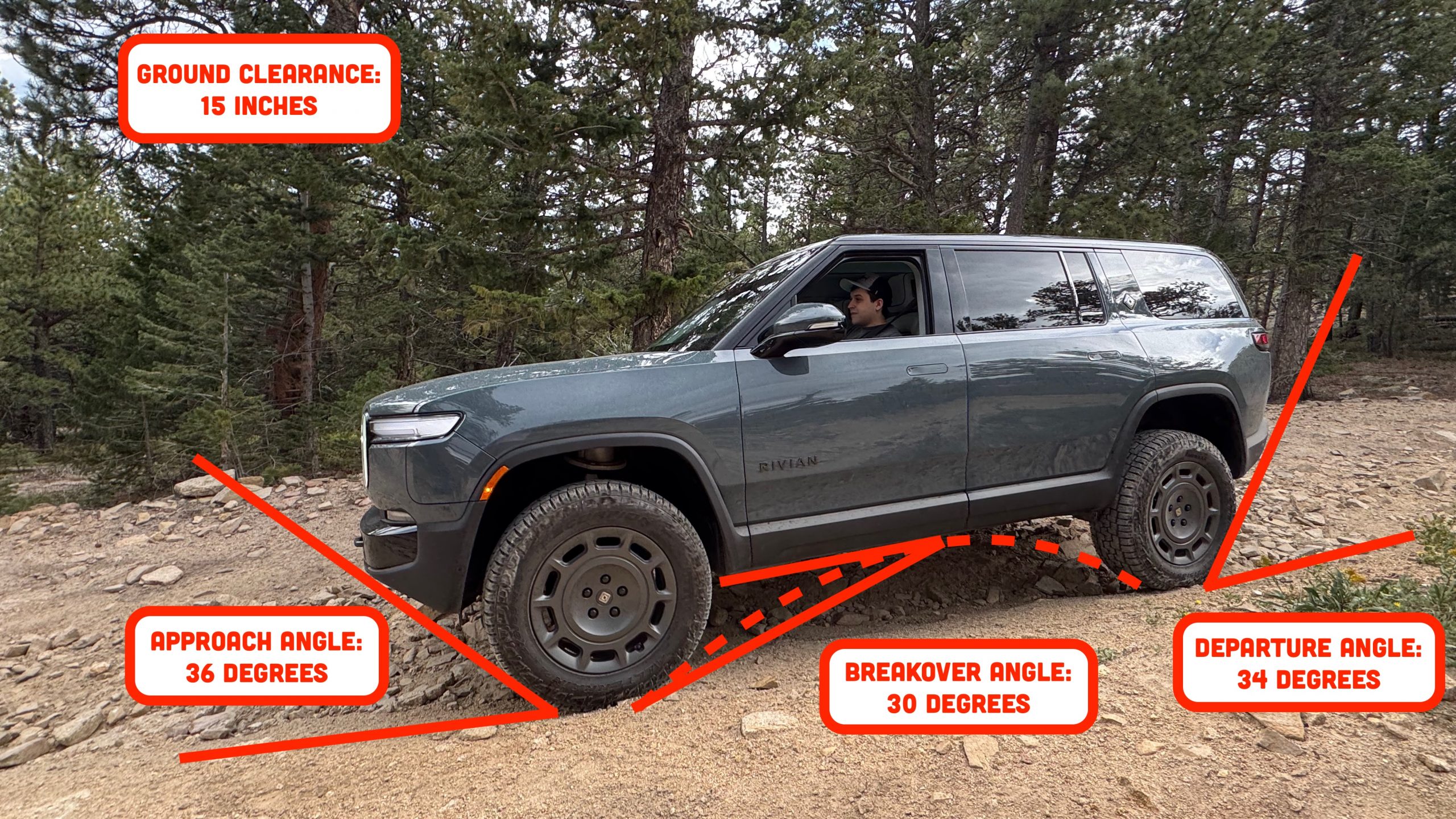
These figures are better than those of the much smaller Jeep Recon. And what’s more, the Rivian — in its 2-motor, all-terrain tire configuration (the Recon has two motors as well) — is actually more efficient than the Jeep:

The R1S All-Terrain Performance Dual Large requires 44 kWh to go 100 miles, while the Jeep requires 48 to go the same distance. This is surprising because the Jeep is so much smaller; here’s a comparison of the two vehicles’ dimensions:

Though I haven’t driven the Jeep Recon off-road, I have watched some videos, and though it has a locker that the dual-motor Rivian does not, it seems they both have issues with traction over certain obstacles. Watch the Recon struggle to apportion power to its front axle:
The Rivian, too, has some traction limitations, though it seems that it features some kind of brake-based traction control that helps it climb uneven grades:
This is all to say: We have two vehicles with similar off-road capability, but one is much larger and heavier, and yet more efficient.
I Don’t See How You Can Justify Not Having Air Suspension On An Off-Road EV
This figure is the one that blew my mind: The Jeep Recon’s drag coefficient is 0.4. This is the same as that of the Lexus GX, a much larger, three-row gasoline vehicle (gas vehicles are typically less aerodynamic due in part to higher cooling demands than EVs; airflow traveling through the front grille and into the engine bay creates significant drag):

Given how shockingly uncompetitive the Jeep Recon’s drag coefficient is, it’s clear that Jeep didn’t put tons of effort into maximizing the vehicle’s efficiency — and that, in the EV world, is death.
In the ICE SUV world, you can get away with it, and Jeep has done so for years. The Wrangler is a brick, aerodynamically speaking, and the result is less-than-excellent fuel economy. And while that alone can deter buyers, at the very least it doesn’t yield sticker shock. A 15 MPG SUV generally costs the same as a 40 MPG SUV. But in the EV world, an inefficient design means you’ve got to pump 94 kWh worth of batteries into the vehicle just to get the uncompetitive 222-mile EPA range figure, and the result is a base price of about $65,000. (To be sure, this is cheaper than a Rivian R1S).
This leads me to my point: It seems to me that, in the EV space, a hard-core off-road vehicle has to come standard with air suspension. I see no way around it (you can offer less capable base models with steel coils, sure). I won’t pretend that the Recon’s inefficiency is entirely a result of its lack of air suspension (look at that boxy profile), but the Rivian R1S is also boxy. The Rivian’s attention to drag reduction and its air suspension yield class-leading off-road geometry without that geometry significantly compromising aerodynamic efficiency. Meanwhile, in order to achieve off-road geometry that’s worse than the Rivian’s, the Recon gives up drag, which means it needs a bigger battery to get a range above 200 miles, which means it costs more.

There’s pretty much no exception to this rule. The Electric Mercedes-Benz G-Wagen doesn’t have air suspension, but that means that, thanks to a 54 kWh/100 mile rating, its 117 kWh battery will only take it 239 miles on a charge, and its 32-degree approach angle, 31-degree departure angle, and 20-degree breakover angles are only good, not great. (Ditto with 9.8 inches of ground clearance).
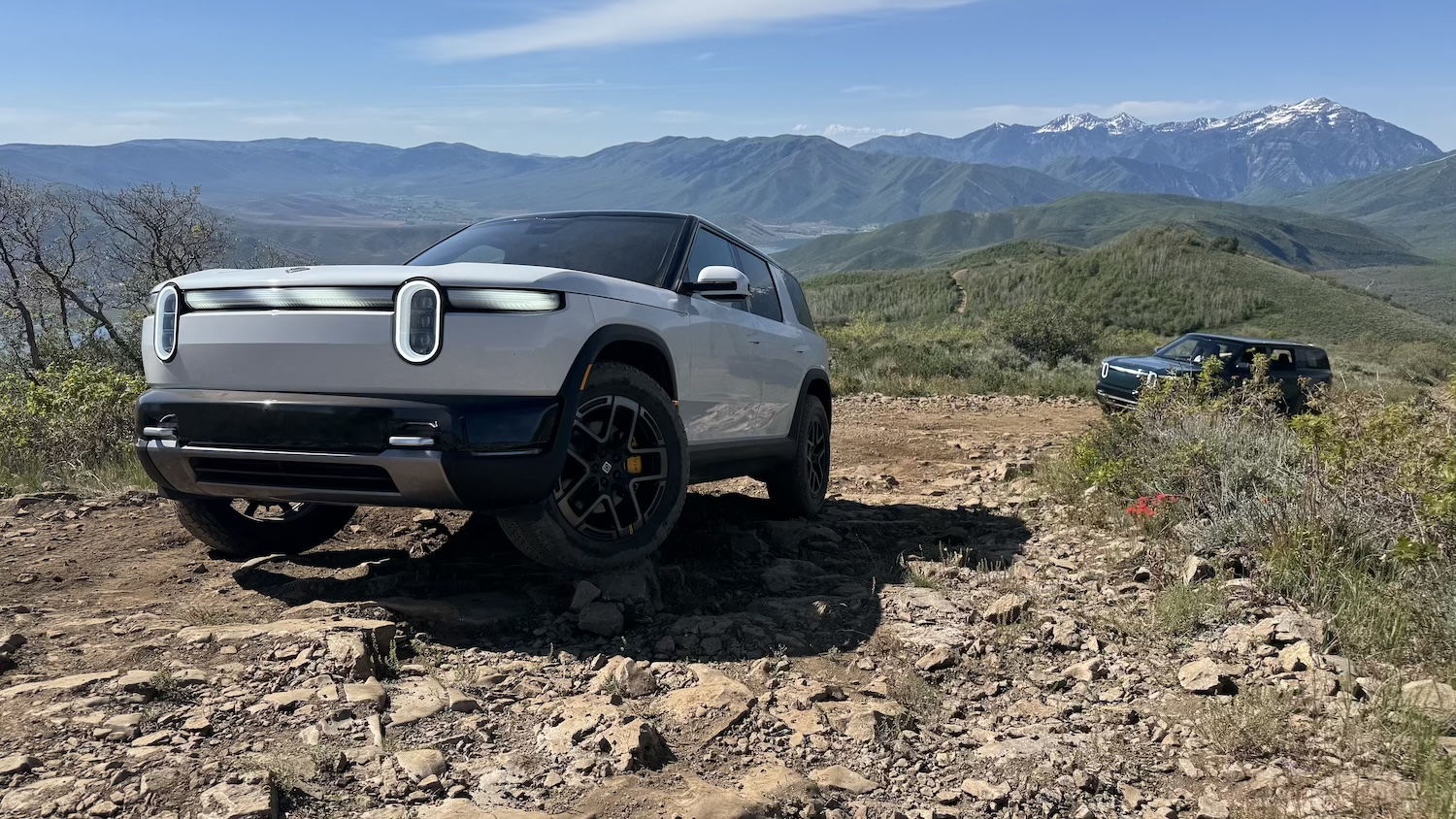
The Rivian R2 also doesn’t offer air suspension, but not only is its off-road capability rather limited (its approach angle of 25 degrees is acceptable, as is a 26-degree departure angle and the 20.6-degree breakover angle caused by a rather large 115.6-inch wheelbase), many are finding its real-world range to be lower than its EPA label indicates — likely a result of that boxy shape and the ride-height compromise associated with trying to make it decent off-road.
The Tesla Cybertruck is equipped with air suspension, which is why it not only has excellent off-road geometry largely better than that of the Jeep Recon — 40 degrees approach angle, 27-degree departure angle, 26-degree breakover angle, 16 inches of ground clearance — but it’s more efficient than the Jeep, needing just 43 kWh to travel 100 miles versus the Jeep’s 48.

Then, of course, there’s the Hummer EV, which also has air suspension but is the size of a barn.
Air suspension is no panacea. Overall aerodynamic design/size are key. Still, the reality is: To be truly excellent off-road, you must have high ground clearance, short overhangs, and fairly large tires. Those deteriorate aerodynamic efficiency and thus — on an EV — range. The only way around that is either increasing the battery size ($) or offer air suspension.

As I stood there at SEMA looking at the Recon, I couldn’t help but wonder what might have happened if they’d paid a bit more attention to aerodynamic efficiency, and if they’d offered air suspension. Maybe instead of 9.1 inches of ground clearance, it would offer 14. Maybe instead of 33-degree approach and departure angles, it would offer 40. Maybe instead of a 23-degree breakover angle, it would be 30. It’s not trivial, and it would cost a bit more than a standard suspension, but an air suspension system like what Jeep has offered in its Grand Cherokee for years could make the Recon a much more capable vehicle, and what’s more, it might have paid for itself in the form of reduced battery size (or, alternatively, increased sales resulting from higher range with the existing battery).
From where I stand, if you’re going to make a hard-core off-roader, air suspension is no longer a choice in the EV world.
Top graphic image: Jeep


