

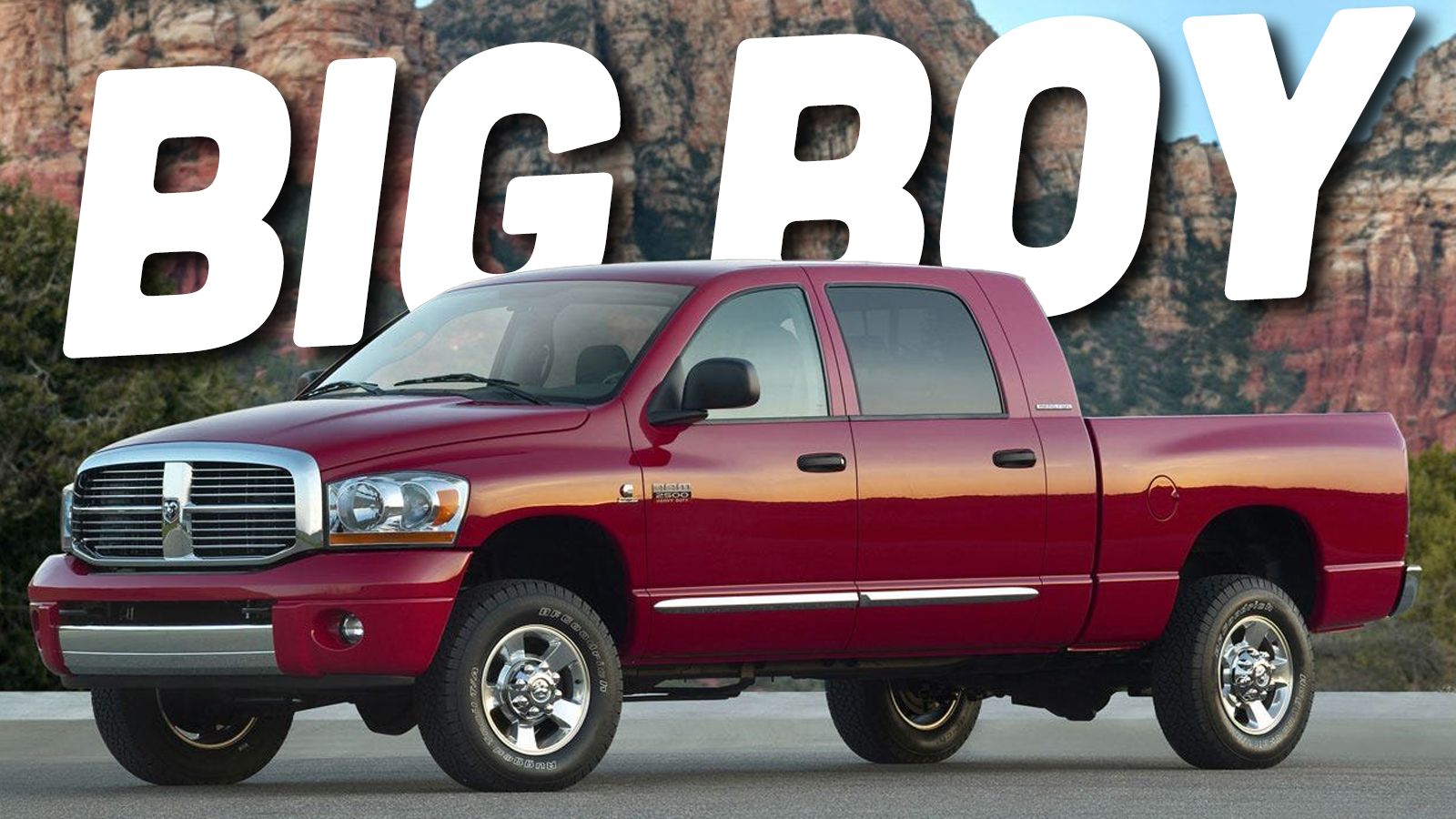
The crew cab pickup truck is a staple of American car culture today. These trucks are workhorses, family sedans, and luxury cars all in one practical package. But there was once a time when crew cabs were more novel, and Detroit automakers raced each other to make the biggest, most luxurious truck interior. Two decades ago, Dodge made the definitive answer to the largest half-ton truck interior with the Ram 1500 Mega Cab. This mammoth machine was so huge that its cab was technically larger than those found on new half-tons today. Oh yeah, the Mega Cab was also so big it had the industry’s first reclining rear seats and even an optional dinner table.
The crew cab pickup truck has been around since at least 1957, the year when International Harvester introduced the Travelette. Back then, the crew cab served the purpose that they said on the tin. These trucks weren’t family sedans, but offered enough seats for a whole railroad crew or construction team.


It wasn’t long before America’s pickup truck builders entered into a cab arms race. Dodge, Ford, General Motors, and International Harvester traded salvos as each brand introduced a cab with more comfort, more space, and more seating capacity. Dodge hit the market with its first crew cab in 1963, while Ford punched one out in 1965. General Motors joined the grid in 1973 with its four-door C/K.
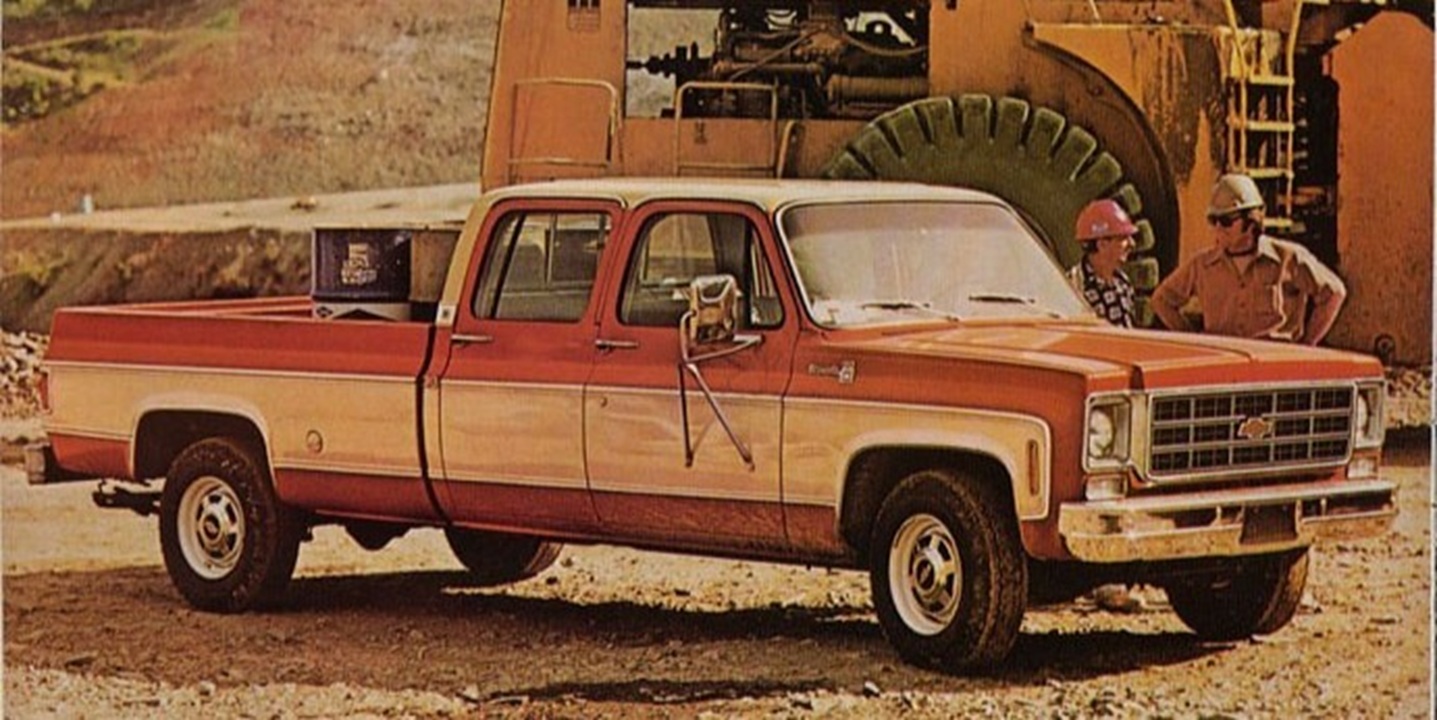
Little by little, these trucks went from being the tools of workers and farmers to being the daily drivers of families who wanted their trucks to be multiple vehicles in one. Even import brands got in on the action, offering their own flavors of extended cab rigs. The truck cab arms race wasn’t limited to full-size trucks, either, as you could even get something like a Ford Ranger, Chevrolet S-10, or Dodge Dakota with side-mounted jump seats.
The 1990s and the 2000s were a transitional period for the American pickup truck. Automakers realized that so many Americans were using their trucks for fun, and some people even saw them as status symbols. Some truck owners didn’t need their trucks for work at all and just wanted to own one. Automakers began to cater to these recreational buyers more than they did in the past.

The 1994 Dodge Ram was a revolution in pickup truck styling with its mini big rig looks. In 1998, Ford split its heavy-duty F-Series into its own Super Duty line so the F-150 could continue down a path of being a more approachable daily driver while the Super Duty continued to represent hard work. General Motors transformed its trucks into vehicles that were more family-friendly than ever. The concept of the luxury truck even returned with the likes of the Lincoln Blackwood and the Cadillac Escalade EXT.
The cab size arms race was alive and well during this time, too. General Motors says that its 1999 Chevrolet Silverado and GMC Sierra offered the largest crew cabs in their segments. Ford would then say that its Super Duty SuperCab and Crew Cab truck configurations had best-in-class interior volume. In 2006, Dodge had enough of the bickering and launched the Mega Cab, a half-ton (but also heavy-duty) truck with a cab so large that it had more space than the cabs of even big heavy-duty pickup trucks.
Dodge’s Breadwinner
The Mega Cab was based on the third-generation Dodge Ram, the truck that was supposed to close the gap between the Ram and the market leader at the time, the F-Series.
The distinctive 1994 Dodge Ram was lightning in a bottle for Chrysler. When that truck launched, Dodge had a measly seven percent of the full-size pickup truck. However, as the Los Angeles Times wrote, Dodge’s mini big rig got so many people into showrooms that Rams made up a full 21 percent of the truck market in 1998. But truck buyers eventually started getting bored with the Ram, and by 2001, enough buyers were scooping up first-generation Silverados and tenth-generation F-150s that the Ram lost ground to 17 percent market share.

Making matters worse was the fact that Chrysler fumbled a major product launch. When it came time to launch a new iteration of Chrysler’s iconic minivans, orders came down from DaimlerChrysler to improve the minivan’s content without changing its looks. As a result, the third-generation Dodge Caravan, Chrysler Town & Country, and Chrysler Voyager took no real risks. Visually, they looked like a mild facelift of the third-generation vans that Chrysler had been slinging since 1995, even though they were fresher than that. Both journalists and the public responded with a resounding yawn as the competition stole sales from the company that hailed itself as the progenitor of the minivan.
Learning its lesson from that stumble, DaimlerChrysler didn’t pump the brakes on Dodge’s plan to go all-out on a new Ram, which had been in development since two years after the launch of the second-generation Ram.

My previous retrospective continues:
When it came to the next generation of the Ram, Dodge gave its designers and engineers the mission to create an entirely new truck, but one that didn’t lose the macho big rig style of its predecessor. Here’s how this new truck’s design was described, from the Los Angeles Times:
His team’s task, said Dodge truck design studio chief Dennis Myles, “was to keep what we own–the Ram image–and yet be different, to exceed our own design.”
To do that, the team basically put the old Ram on steroids. They beefed it up with a more aggressive front end–what Myles calls a “get out of my way” grille capped by a hood that slopes sharply up to a windshield that is canted a full 5 degrees more than that of the current Ram. It gives the pickup a racier, speedier profile. The front and rear fenders are more pronounced; the taillights are integrated into the fenders and mimic the “Frenched” taillights of custom hot rods of the 1940s and ‘50s.
The Ram truck team then took a long look at how their customers use their trucks and then set out to create a new rig that could withstand the abuse.

The new truck gained impressive platform updates to go with its aggressive look. Dodge said that its new hydroformed steel frame had five times the torsional strength and two and a half times the lateral bending strength of the old Ram’s frame. Reportedly, a third-generation light-duty Ram is designed to work hard for at least 150,000 miles, or a 50 percent better durability cycle than the old truck. My retrospective continues:
At launch, the new Ram carried developments such as a hydroformed steel frame. This boasted five times the torsional strength and two and a half times the bending strength of the previous truck’s frame. At the truck’s launch in 2001 for the 2002 model year, the Ram had a base 3.7-liter V6 rated at 215 HP and climbed all of the way up to a 5.9-liter 245 HP V8. The heavier duty 2500 models got an 8.0-liter V10 making 310 HP or the fabled 5.9-liter Cummins diesel straight six and its 235 HP and 460 lb-ft torque.
These trucks were available in rear-wheel-drive and four-wheel-drive configurations with electronically shifted transfer case as well as an independent front suspension. However, the 2500 and 3500 models retained live axles up front. Those wouldn’t be the only engines, as there would be a 6.7-liter Cummins diesel straight six making 350 HP and the gnarly SRT-10 with its 8.3-liter V10 making a killer 510 HP. Dodge even made a hybrid version of the third-gen Ram.
When Just Having Four Doors Isn’t Enough

Dodge also did something a bit unexpected with the new Ram. Designers wanted to give passenger comfort a higher priority without making the truck physically larger. So they made the decision to cut three inches from bed length so that the cab could be three inches longer. Further changes added just under another inch, giving the new Ram’s cab a total 3.7-inch stretch over the old one. Cutting the bed meant that the new Ram was still able to fit into a regular garage without too much trouble.
Something else new was an update to the Quad Cab, which, for the first time, gained rear doors hinged on the B-pillar like a typical crew cab truck would have. The mild stretch to the cab also allowed the Quad Cab to further bridge the gap between a regular cab and a true crew cab, with the LA Times describing the back seats as “almost full-size.” However, this meant that the competition still had bigger cabs, as they were selling full crew cab trucks.
That didn’t matter much, because the Ram team had some crazy ideas that they actually put into production. The Ram 1500 SRT-10 was the fastest truck, while the Power Wagon was one of the most off-road capable. They even had a preposterous idea for those who were disappointed in the size of a Quad Cab.
The Truck Cab To Rule Them All

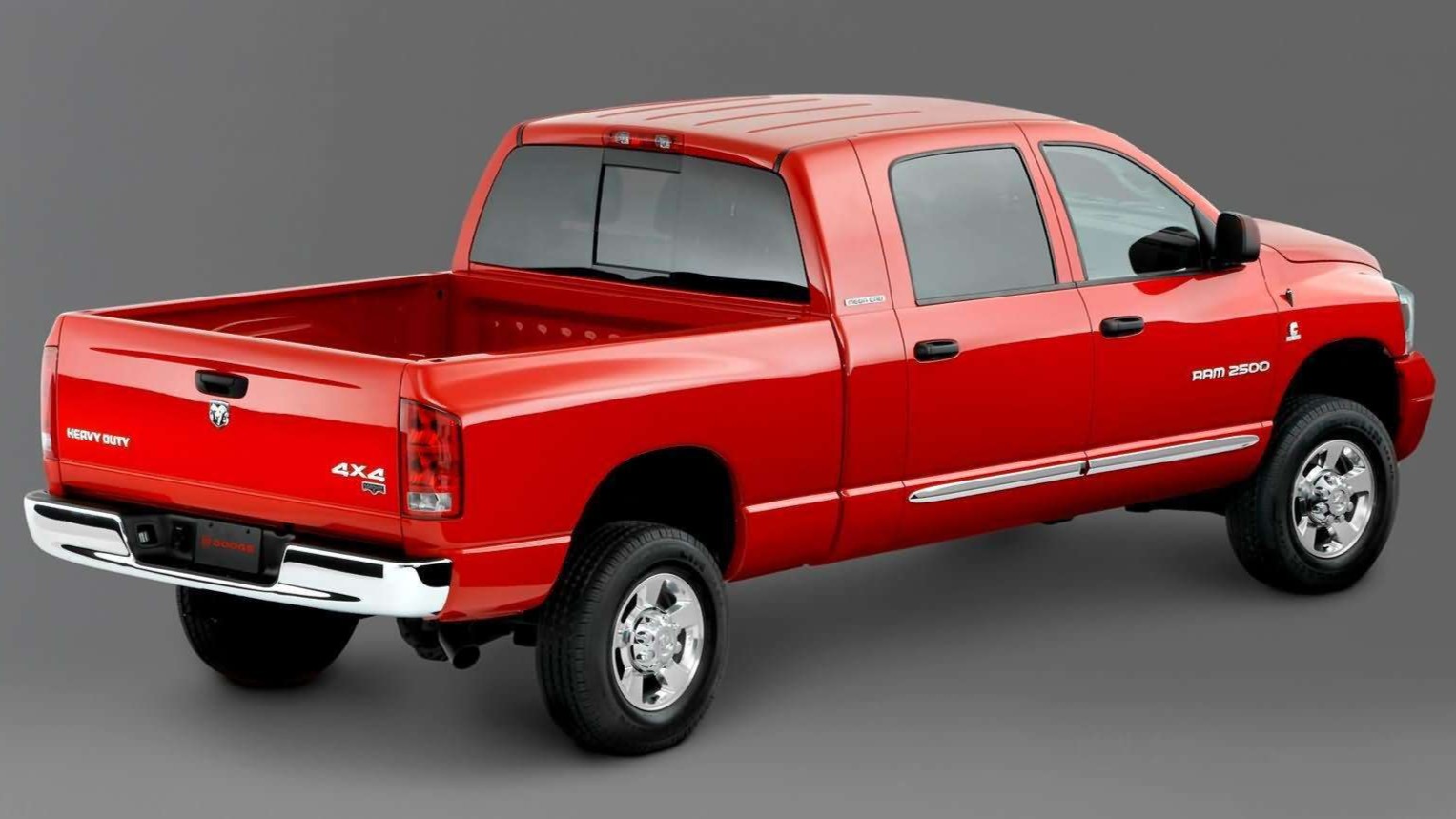
In August 2005, Dodge launched the final word in full-size truck cabs. No longer would anyone be able to complain that Dodge wasn’t selling a true crew cab, because with the new Mega Cab, it had the biggest cab of any full-size pickup, from light-duty to heavy-duty.
Dodge’s engineers used an old trick to create the Mega Cab. In the past, automakers used to take the heavier frames, suspension, or axles of their heavy-duty trucks and slap them under their lighter trucks, creating what is known as the “heavy half.” On the other end, buyers got to buy a pickup truck with greater capacities than a regular half-ton without committing to a three-quarter-ton or greater. One of the last heavy-half trucks was the Nissan Titan XD.

Anyway, to create the Mega Cab, Dodge engineers started with the 160.5-inch wheelbase frame of the Ram 2500 Heavy Duty Quad Cab long-box. Then, they tossed the eight-foot bed for a six-foot, four-inch bed. This left a whopping 20 inches of space from the back of the cab to the bed, and Dodge made sure to take up every inch. Engineers left the front of the Ram largely untouched, but extended the rear nearly two feet to a lengthy 111.1 inches. Overall length is unchanged from a Ram 2500 at 247.7 inches.
The spec sheet for the cab was hilarious, with Dodge claiming lots of “largest.” From the press release:
Largest, longest cab – 145.2 cubic feet, 111.1 inches long.
Largest interior cargo volume – 71 cubic feet.
Largest cargo volume behind rear seat – 7.6 cubic feet.
Largest flat floor load area – 24.9 square feet.
Largest second-row leg room – 44.2 inches.
Largest rear door opening – 34.5 inches wide, 35.5 inches high.
Largest rear door open angle – 85 degrees.

That legroom stretch is an impressive 7.5 inches over a Quad Cab model. Rear seat space was up 12 cubic feet to 69 cubic feet overall. Dodge bragged that this cab was so huge that it was a full foot longer than the cab of America’s previous biggest truck, the 2005 Ford F-250 Crew Cab. It’s almost as if Dodge designers happened upon a Union Pacific Big Boy and decided to make one, but in truck form.
The wildness doesn’t slow down from there. Dodge advertised the first-ever reclining rear seats in the Mega Cab, which were able to tilt from a 22-degree to a 37-degree seatback angle. If you so desired, you could also fold the seats down flat and use the combined rear cargo area and seats to create a massive bed or place to set tools and gear inside the truck.

Bolstering the new cab was a facelift that was applied to the whole Ram lineup, which gave the trucks a more attractive front end, some technology upgrades, and later, a new steering wheel. But why did Dodge build this monolith of testosterone? As MotorTrend reported in 2005, crew cab truck sales had tripled between 2000 and 2005, yet Dodge was getting left behind as buyers were choosing true crew cabs over its Quad Cabs. Explaining itself for its creation, Dodge said:
“Packaged with full-size Ram capability, the all-new 2006 Dodge Ram Mega Cab offers the most interior passenger space, cargo capacity and functionality of any pickup truck on the market,” said Darryl Jackson, Vice President, Dodge Marketing, Chrysler Group. “Dodge Ram Mega Cab is the first and only pickup truck to comfortably seat six adults and provide enough interior storage space to bring along plenty of gear. “Since the year 2000, demand for full-size crew cab pickup trucks has grown approximately 19 percent – and Dodge is responding with the spacious, capable and powerful 2006 Dodge Ram Mega Cab,” added Jackson.
[…]
“Pickup truck buyers use their truck in a variety of different situations,” said Jackson. “They use it for their daily driver, family road trips, and various recreational activities. The all-new 2006 Dodge Ram Mega Cab delivers ultimate versatility, offering the most functionally diverse cab ever created for pickup truck buyers who want more room, comfort and convenience.”
[…]
When it comes to pickup trucks, size matters, and Dodge delivers,” said Mike Donoughe, Vice President, Body-on-Frame Product Team, Chrysler Group. “The all-new 2006 Dodge Ram Mega Cab features a cab of immense proportions, perfect for hauling the entire family, while also hauling heavy loads.”

Size wasn’t the only thing that was immense about the Mega Cab, as it pounded the ground with a curb weight that never went any lower than 6,100 pounds in the 1500, and reached around 7,550 pounds in the heavy-duty versions.
A Limo With A Bed
Dodge also intended the Mega Cab to be a flagship luxury truck of sorts, and as such, it came with an options list as titanic as the truck itself. Options included Bluetooth connectivity, a DVD player, leather seats, a dinner table, a sunroof, stereo upgrades, side airbags, towing mirrors, tinted windows, a navigation system, a power sunroof, adjustable pedals, fake woodgrain trim, limited-slip differentials, trailering packages, and so much more.
Update: Period reports made a mention of a dinner/multipurpose table, but brochures do not. I examined center consoles and do not see one that works like a table. Perhaps this was a feature that press vehicles and prototypes had that did not reach customers.

Dodge didn’t even sell the Mega Cab in a lower trim level. The base 1500 model was the SLT at $32,960, including a $900 destination charge, and the only other trim was the Laramie at $38,055. With options like four-wheel-drive and interior accoutrements, it was easy to get the price above $47,000 for a 1500. The Mega Cab was also available in 2500 and 2500 Heavy Duty flavors, and those easily surpassed $50,000.
Something interesting about the Mega Cab was that, even though the 1500 model was using a heavy-duty frame, axles, and eight-lug wheels, Dodge didn’t really make a huge deal out of advertising it like a heavy-half. Instead, Dodge focused on how huge the truck was while not sacrificing any capability. A 1500 Mega Cab could tow up to 8,800 pounds, while the 2500 could haul up to 12,900 pounds and the 3500 got up to 15,800 pounds. Payload remained healthy, with up to 2,440 pounds for haulage. For comparison, a regular 2006 Dodge Ram 1500 Quad Cab was rated to tow up to 8,750 pounds and a payload up to 1,570 pounds.

The only available engine for the 1500 and the standard engine for the 2500 was the 5.7-liter Hemi V8 with 345 horsepower and 375 lb-ft of twist at the ready, backed by a five-speed automatic transmission. Optional on the 2500 and standard on the 3500 was the 5.9-liter High Output Cummins straight-six diesel with 325 horsepower and 610 lb-ft of torque, which had either a four-speed automatic or a six-speed manual.
The Mega Cab blew reviewers away. Here’s what MotorTrend said:
Up front, the Mega Cab has all the same strong points as other Ram models, including clean styling, a functional layout, and decent leg- and headroom, even for big-and-tall types. While the front seat is good, the second row is where this new model really shines. The extra inches grafted onto the cabin make the Mega Cab’s rear seat downright limo-like. There’s plenty of room for three adults across and legroom so abundant it puts the GM and Ford crew cabs to shame.
While all this room to stretch out is nice, it’s only the beginning. Topping the back seat’s list of gee-whiz features are the first-ever reclining rear seats in a full-size pickup. Add huge, wide-opening rear doors and a 60/40 split-folding rear seat that offers more than seven cubic feet of storage with the seat up and more than 70 cubic feet with both sides folded down, and you have an interior that’s as practical as it is comfortable. The cabin’s other desirable qualities include reduced noise levels, power-adjustable pedals, optional side curtain airbags, and an available rear-seat DVD entertainment system. Comparing the Mega Cab’s interior with those of other crew-cab pickups is like comparing an airplane’s first-class cabin with the cheap seats in coach.
Slide behind the Mega Cab’s steering wheel and you’ll find the Hemi and Cummins engines provide impressive acceleration and remarkably quiet operation. While the Hemi may be the popular way to go (nearly half of all Ram buyers choose it), the Cummins’s superior fuel economy, great gobs of torque, and excellent overall driveability make it our hands-down engine of choice. On the road, both the two- and four-wheel-drive Mega Cabs handle surprisingly well. The ride quality also was quite good on 2500 models, but the 3500’s heavy-duty underpinnings cause a slightly rougher ride. Steering was nicely weighted and offered a precise feel that made the truck feel smaller than the 20-foot-long beast it is. When it comes time to get on the brakes, massive 13.9-inch antilock discs at all four corners produce sure stops with minimal fuss.
Some journalists complained that the 1500 Mega Cab rode a little hard compared to other half-ton trucks, but that wasn’t surprising considering its more heavy-duty bones. Yet, most had good things to say about the truck. You can even hear some excitement in John Davis as he talks about the Mega Cab for MotorWeek‘s review:
A reviewer for Autoweb had a different take:
Thom Blackett’s Advice about the 2006 Dodge Ram Mega Cab: Despite all of the fun I had driving this truck, I can’t see ever buying or recommending it. For all that money, buyers get a 1500-series truck with average build quality and materials, a capable but taxed powertrain, a six-foot bed, only 7.7 inches of ground clearance, and dimensions that make four-wheeling only prudent in a wide-open, snow-covered parking lot. Oh, and that extra room for rear passengers. Here’s my advice: Tell the kids and friends riding in back to suck it up and wear knee pads if need be. Put your Napoleon complex or whatever insecurities in check and consider a truck that provides a sensible balance between need, capability, size, and image. Do that and you’ll probably be skipping the 2006 Dodge Ram Mega Cab.

The Dodge Ram 1500 Mega Cab would enjoy a full two years on the market as America’s biggest and baddest truck. However, the Mega Cab would be made redundant after 2008 as the fourth-generation Ram would arrive in 2009, bringing a true crew cab option with it without forcing buyers to drive a 2500 with the marketing of a 1500. Thankfully, the Mega Cab itself didn’t die off then, and instead continued as a popular option for heavy-duty Ram pickups. You can still get a Mega Cab in the Ram HD today!
If you want one of the 2006 to 2008 Ram 1500 Mega Cabs, finding one for under $10,000 shouldn’t be too hard; just expect that truck to have over 100,000 miles, if not over 200,000 miles.
2000s Dodge Was So Fun

But for a brief time, you were able to buy a truck that was a 1500 in name and was larger than everything else. The Ram 1500 Mega Cab would be big even by today’s standards. A Silverado 1500 has 139 cubic feet of interior volume, while the Ram 1500 has 132 cubic feet, and the F-150 sports 131.9 cubic feet of room. A notable truck is the Ram 1500 because while its overall cab space is technically smaller than the old Mega Cab, its rear seat legroom of 44.8 inches is better. But that just goes to show why the light-duty segment doesn’t really need a Mega Cab today.
Still, I love what Dodge was up to back in the 2000s. Dodge really took a look at the market of crew cabs and decided to counter them all by making a cab of elephantine proportions. A titan of a truck that was so big inside that it was like having a pickup-shaped motorhome. Does anyone need a truck like this? Maybe not, but I can’t help but laugh and wish I was a writer when this big boy came out.
Dodge’s answers to all questions were extreme back then, but in a silly, fun way. This was the same era that gave us the Magnum, updated Vipers, the Ram SRT-10, the reborn Challenger, and this Mega Cab. I even appreciate the forgotten Nitro and the weird Caliber SRT4. The designers over at Dodge, who must have had shots of 93 octane on their work breaks or something, even tried to Dodge-ify a Smart Roadster! Maybe I’m crazy, but I’d love to see Dodge do it all over again.
Top graphic image: Dodge




Man a fully loaded one of these things is almost cheaper than the average transaction price of all cars in total nowadays. What a time to be on this spinning ball
I still see mega cabs around and marvel at a truck with a cab longer than its bed. It’s the most disproportionate thing since the 70s Ranchero where the hood and the bed were the same length. I can understand why they were doing it but I grew up with mostly single cab or extended cab trucks with long beds so expect the bed to be the longest part of the truck.
Some guys buy the mega cabs stretch the frame and convert them to long bed. It’s a huge truck.
I sold Dodge when the 2001 Caravan came out. It was quite a bit more expensive than a similarly equipped 2000 Caravan. The Odyssey was less expensive than the 2001 Grand Caravan, but it had a waiting list, the Caravan didn’t. Halfway through 2001 Dodge came up with ‘the Odyssey killer’ Grand Caravan eX for $27,500, the eX was mostly equipped like a Grand Caravan ES that started around $33,000 up to $37,500 with every option. The eX sold much better than other Grand Caravans even though they had less markup than other Grand Caravan’s and didn’t get the same incentives.
The 2002 Ram looked and drove great but it didn’t sell that great until the Hemi became available midway through the 2003 model year – then it was easy to sell.
In the early 2000’s we sold a ton of quad-cab Dakotas, Durango’s, Rams and Intrepid’s.
Stratus sedan’s sold okay. Neon’s and Stratus coupes usually had birthdays on the lot – they took more than a year to sell. We were a big Dodge dealer in a big Midwest city.
I wonder what sank this for customers. I remember reading about them at the time and seeing them on the road. I thought it was a pretty good idea.
Is that wheelbase/length just too unruly?
Was it too close to admitting you didn’t really need a truck as a 1500?
Was it just too expensive for a Dodge?
Nothing succeeds like excess.
I imagine those massive rear doors inflicted a lot of door dings in their day. Particularly in the hands of little kids. One gust of wind and WHAM!
I loved these when they came out and I still want one. I think the 2nd gen Megas are better looking, but I really want to find a manual transmission with the 5.9 cummins in it. That would pretty much be my ultimate tow rig.
If you have kids and a dog these are one of the few ways to haul a 5th wheel and have everyone comfortable without going full on custom. I have seen a number of race car teams with them as well over the years.
I always thought Toyota basically copied Dodge with the 2nd gen Tundra. The Double Cab was just like the Dodge Quad Cab and the CrewMax was basically a 7/8 mega cab.
my favorite of this generation of megacab was the long hauler concept https://www.motortrend.com/features/ram-long-hauler-concept-first-test damn thats a lot of truck.
Would the Mighty Boy fit inside the Big Boy???
https://en.wikipedia.org/wiki/Suzuki_Mighty_Boy
It always seemed weird to me that for that generation, they just skipped the normal crew cab, and went straight to the mega! They had the larger doors already made for the mega, so why not just do a normal crew cab? It seems that’s where most of the market would have been