


Driving a Kei car or carved-panel Toyota Crown hearse attracts a lot of attention in America, but they likely don’t even get a second glance on the streets of Tokyo. No, to stand out there you’ll need something from the other side of the globe, like a car made in the United States. You can’t get much more all-American than the now-dead General Motors brand called Pontiac, but would there really have been that much of a market for cars designed for the people of Omaha rather than Osaka?
I wouldn’t think so, but that’s exactly what GM tried to do several times over nearly a century. Here’s the strange tale of Japanese-market Pontiacs.


Some Assembly Required
While Japan is now known as an auto-making powerhouse, in the years before and after World War II, they actually built a number of cars from so-called “knock down kits” of Western car brands. That means unassembled or partially sub-assembled autos were sent to the Land of the Rising Sun to have final assembly done there. The British did this a fair amount, and ironically the Japanese reportedly made some of their own parts for the UK cars domestically that were far better than the items imported from Old Blighty.
Oddly enough, Pontiacs were some of these “knocked down” imported cars. Starting in 1927, General Motors’ Osaka Assembly plant in Osaka, Japan built Pontiac sedans like this 1937 example:

Here’s a brochure from eBay showing the sales literature for this particular car as proof:

It’s unknown how many Japanese-assembled Pontiacs were shipped and sold, but this whole project ended in 1941 for reasons that might be rather obvious.
Really, Really Eastbound And Down
With Japanese cars of the eighties, you saw a lot of flashy tech and even flashier styling on things such as an AMG-bodied Mitsubishi Debonair.

General Motors must have looked at this scene, glanced at Pontiac, and then said, “hold my beer”. You want to stand out? The 6000STE should do the job:
How about a Grand Prix? Or better yet a Firebird with strange orange turn signals where the fog lights should be?

You’d think the Japanese buyers would swoon over those steering wheel buttons. Naturally, there was no effort made to convert the cars to Japan’s right-hand drive, but at the time, some saw owning a left-hand drive imported Western car as a sort of status symbol (in the way JDM people here today kind of consider a wrong-side steering wheel a badge of honor).
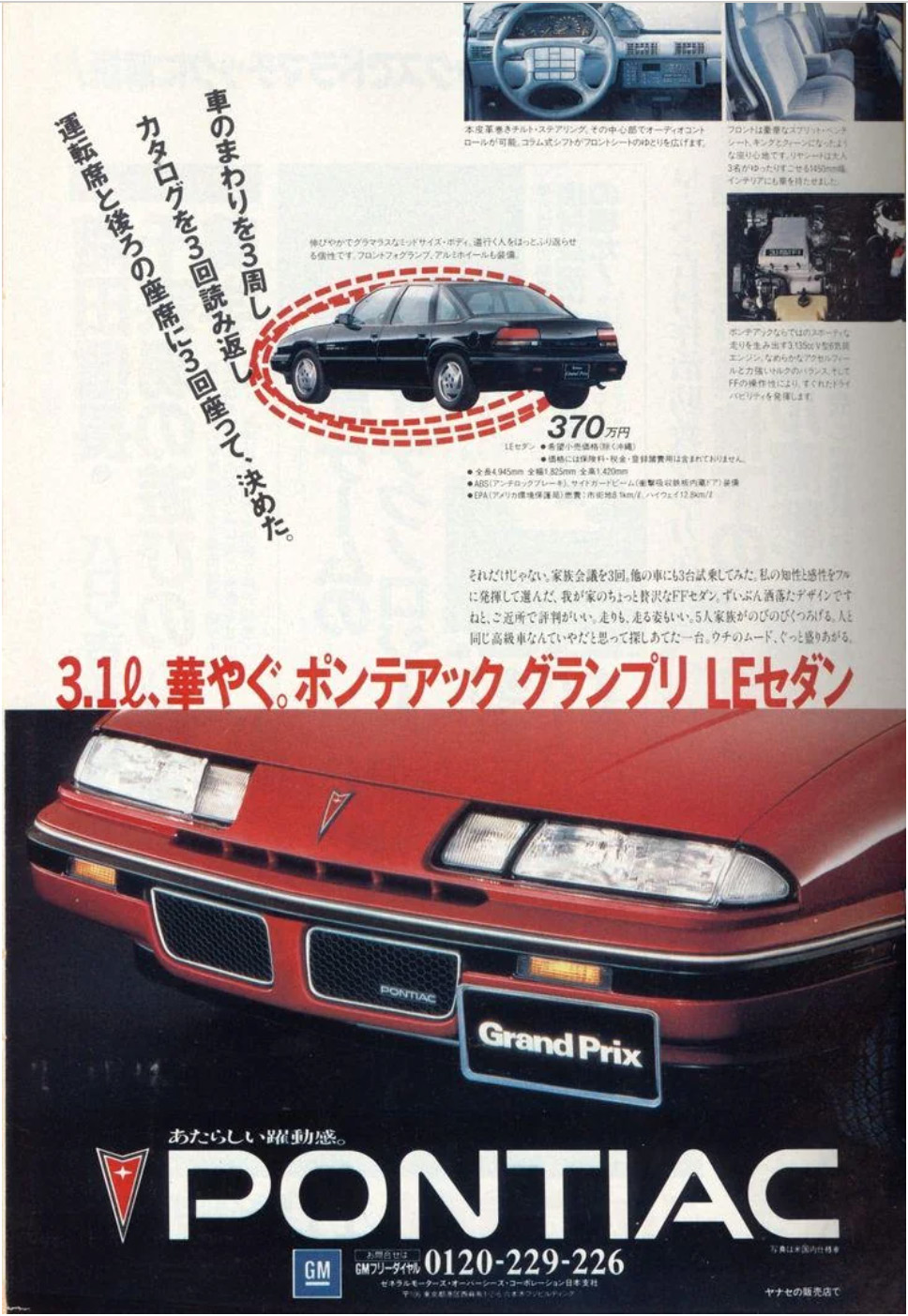
How about a Japanese-market Grand Am? Sure!
Even facelifted late third-generation Firebirds made their way across the ocean. Notice the big convex side marker/turn signals like pimples on the front fenders and incongruous flip-away mirrors (as required by Japanese law) to replace the standard Trans Am fare.

Sedans, however, seemed to be the mainstays of the Japanese Pontiac offerings:

Probably the car seemingly best suited to bubble-economy Japan was the one with the most buttons and wiz-bang tech inside which I’ve written about before: the Bonneville SSEi. With the fake AMG treatment, this first-generation car would be the ultimate ride for budding Yakuza to parade about it, complete with weird retrofitted rectangular headlights, fender-mounted side blinker repeaters, and flag-like flipper mirrors.

Despite the likely small number of takers, they doubled down and brought in the next-generation Bonneville, here with massive turn signals where the American car had low-beam headlights.

Sinister-looking in black, it does seem like it would fit into the movie Black Rain where they made Tokyo look like the set of Blade Runner.

The ad above supposedly says the Bonneville’s list price was 5.4m yen. A new R32 GT-R’s list price in 1989 was 4.45m; this was a little later, but still, it’s a pretty good indication that “being different” had to be pretty important for you to shell out serious cash for a Bonne.
So many different images of these Japanese Bonnevilles; my guess is that there were probably a lot more brochures printed than actual cars sold. Honestly, I can’t confirm figures anywhere, but most accounts claim that Pontiac sold fewer than 200 cars of any model during their push of the brand from the late eighties up until near the bitter end in 2010.

However, even if these didn’t sell, what about a Pontiac that was really a Toyota but came over to Japan essentially as a Pontiac but badged as a Toyota?
Matrix Reloaded
One of the hidden gems of the Pontiac line of the final years was, in most ways, not really a Pontiac at all. The subcompact Vibe hatchback was essentially a twin of the Toyota Matrix that was built in California’s NUMMI factory as part of a collaboration between GM and Toyota that began with the Corolla-based Chevy Nova in 1984.

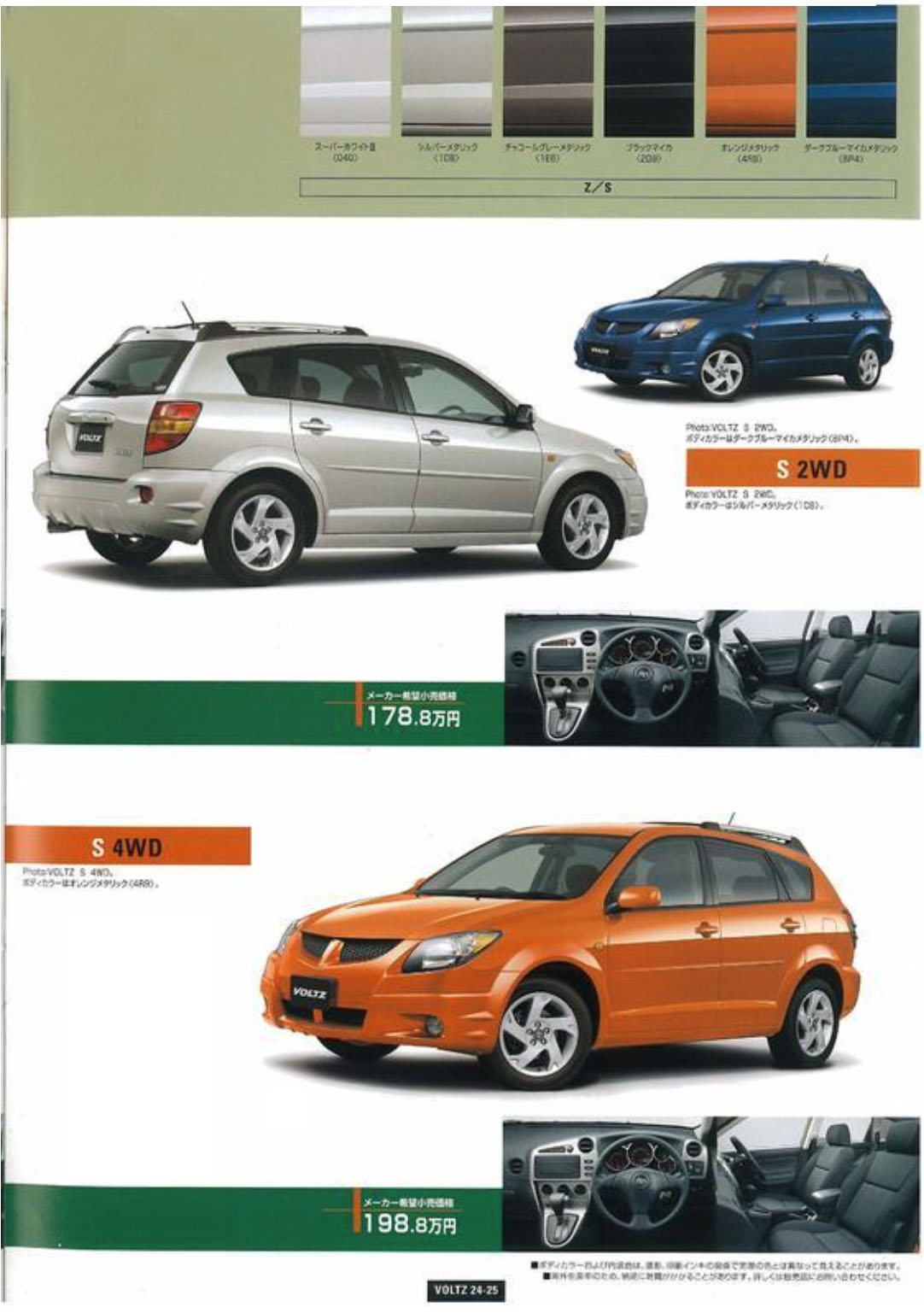
Under the watchful eye of the Japanese, the products of the venture were deemed good enough for Toyota to sell it on their own soil. However, there was a bit of a twist. You would think that Toyota would choose to sell the more Toyota-like version of the Vibe/Matrix twins in their domestic market: they did not. Their Japanese-market version, named the Toyota Voltz, was in fact simply the Pontiac Vibe version with different badging and mirrors. Maybe that makes sense; with all of the JDM Toyota options to bring in something that looked like the Matrix might be a bit like taking a cheese sandwich to a banquet; at least the Voltz gave Japanese buyers a little taste of Michigan.
Even the interior was the same, albeit reversed for the Japanese right-hand drive market Voltz. That name makes it sound like it was an EV, which it most certainly was not.
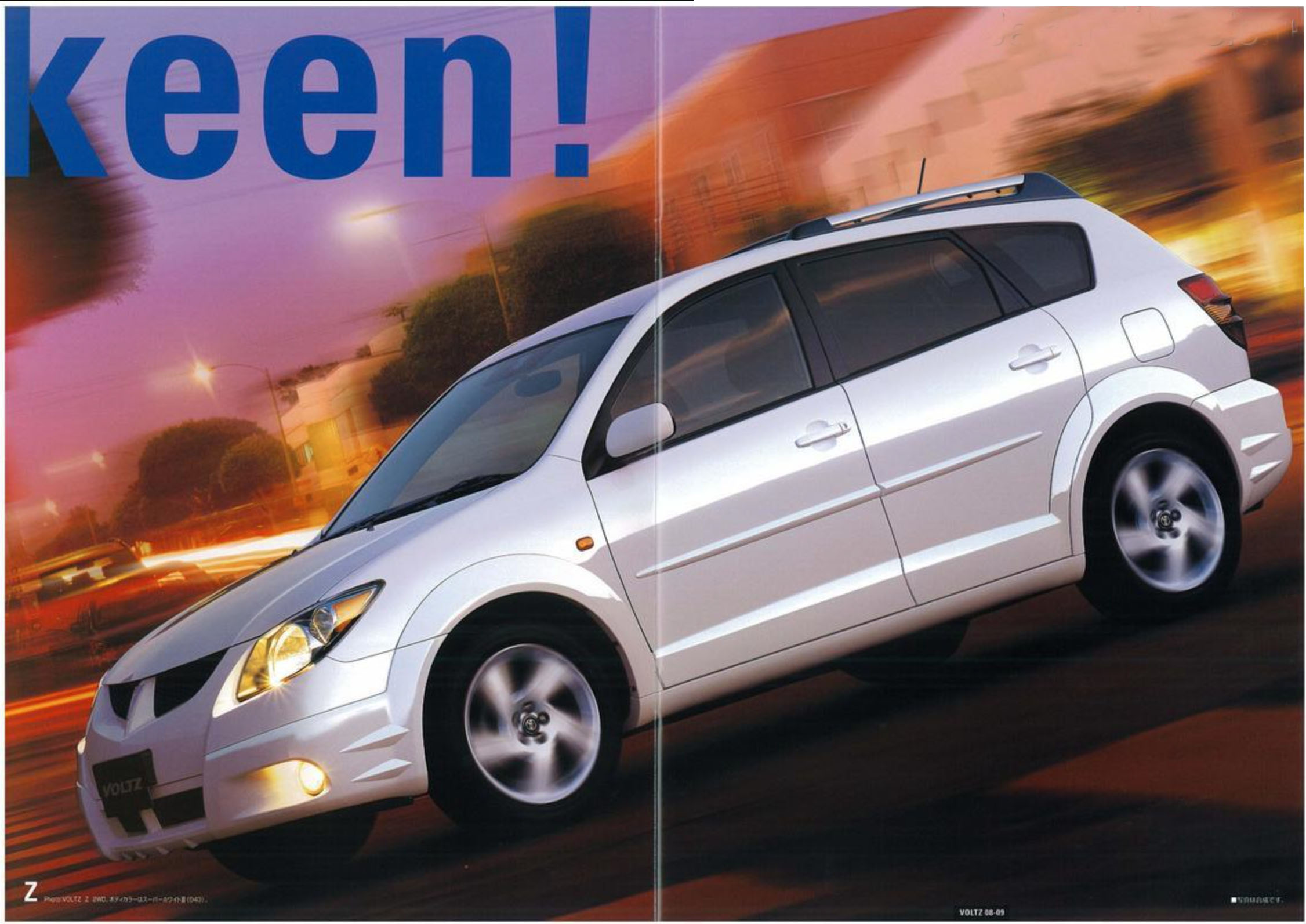
It was keen! You got a little taste of America with this Pontiac/Toyota hybrid, as the adjective that hadn’t been used in the U.S. since the fifties implied.
Somehow the Voltz name implied an electric car, which it was not. But it was everywhere!
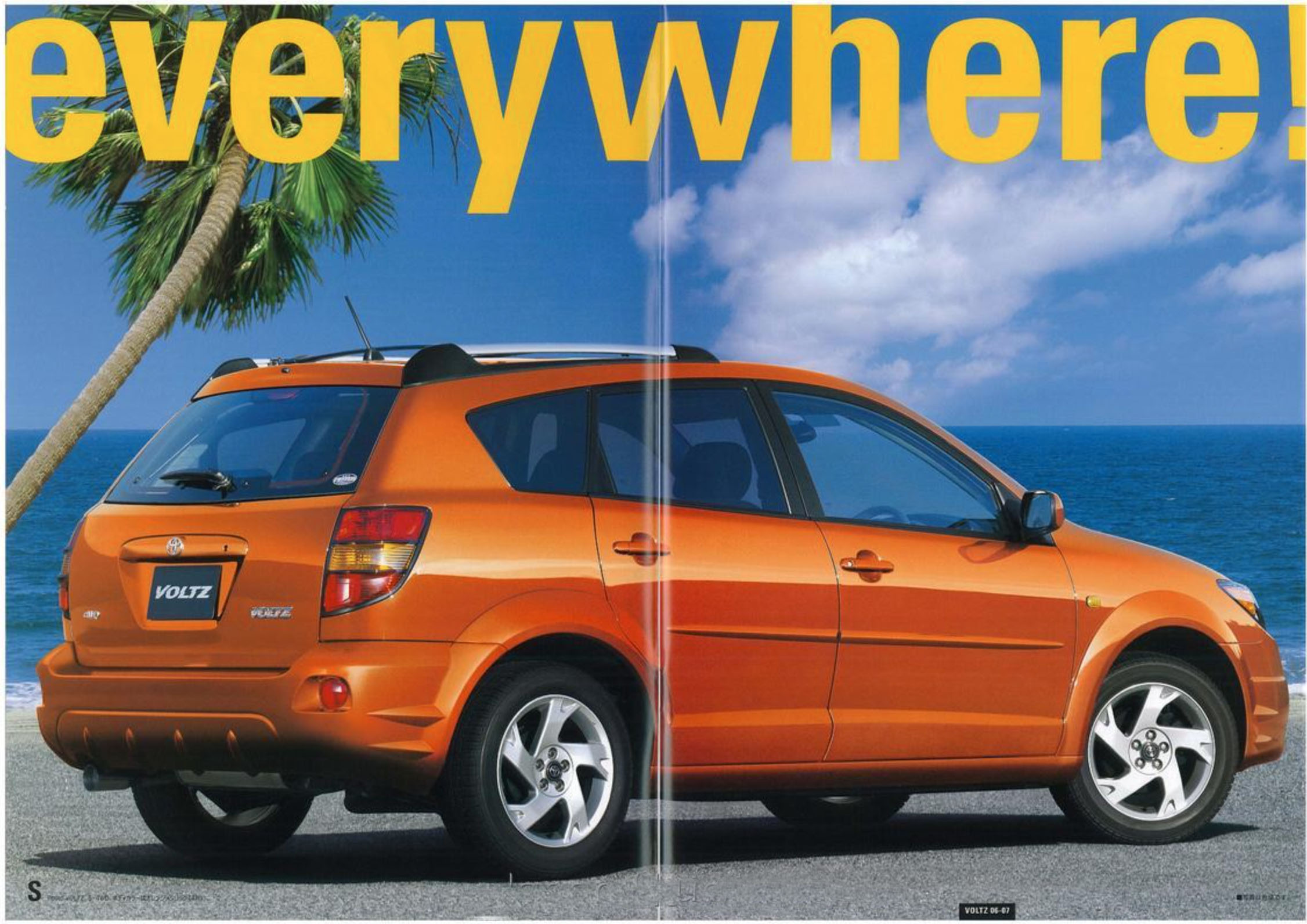
Actually, it wasn’t. Sadly, the Voltz was withdrawn from the Japanese market after only two years due to poor sales of only around 10,000 cars. Maybe it was the fact that the Japanese were spoiled for choice, or possibly it was the bad reputation of American-made cars from the malaise era. Regardless, it’s rather ironic and a shame that Japanese buyers rejected what many would argue was, at least in terms of quality and reliability, the best Pontiac-branded product built in the final era of the brand.
Hey, A Win Over Buick Is A Win
I’ve already mentioned that sales of Pontiacs in Japan were never that strong, but it’s worth noting that in 2022 the brand outsold GM’s rival Buick. This is a surprising figure, most notably because it meant a brand that ceased making cars in 2010 was even in the running.
According to GM Inside News, in March of 2022 Pontiac sold 3 cars in Japan against one Buick; the month before they moved 5 cars against a mere 4 from Buick. How did this happen? What kinds of Pontiacs were they? Some G8 in mothballs just sitting around for a dozen years waiting to hit the Wangan Expressway at midnight? I guess we’ll never know, but whoever you three or five Japanese buyers are out there we salute you.
It doesn’t matter what side of the globe you’re living on when you speak the universal language of Wide Track. Wherever you are, get on those Pontiacs and Ride, Pontiac, Ride!
Top graphic image: General Motors



I was hoping this was going to be about Pontiac’s big sales effort in the Vatican City. Imagine what a 6000STE popemobile might’ve looked like!
It is well known that the pope drives a Luce.
https://ewtnvatican.com/articles/pope-leo-xiv-ferrari-luce-steering-wheel
When I was stationed in Japan in the early 90s, I saw American cars (outside of the base motor pool) very seldom – Perhaps twice.
They were Yakuza cars.
My fourth gen Camaro Z28 is ex Japan and has a few differences. Found a couple of ‘Viceroy’ cigarettes and some Yen under the drivers seat too. Love to know how many were sold in Japan.
So the Japanese preferred the American version and the Americans prefer the Japanese version. Interesting.
By the way isn’t it the Yakuza not Yazuka?
I once confused Yakuza and Jacuzzi, now I’m in hot water with the Japanese mafia.
That was awesome!
Fine, please take my like.
Better than confusing Yazuka and Bazooka and shooting your moth off
And yet, weirdly, the PT Cruiser did really well in Japan. I still see loads of them stashed behind houses. They may have gone past “shaken” inspection but the owners never seem to part with them.
GM Tried to compete with cars that were “just cars”. In Japan, to sell a foreign car it has to be special, weird or cool. Jeep does pretty well..so does Alfa.
Also, you need a lot more dealerships than US makers are willing to build.
The Japanese appear have a highly refined sense of the absurd. Evidentiary points include Pokémon. Mitsuoka Motor, weird cafes, remote control toilets are a few.
British cars have tended to do well there, Japanese buyers loved the classic Mini and the MGF, the MG RV8 sold in paltry numbers but an outsized percent of those went there, and most of Mitsuoka’s business model had revolved around making new Japanese cars look like old Jaguars, Rileys, and Wolseleys
I see original Mini’s daily when the weather is reasonable. In Matsumoto there are several dealers who specialize in them.
Both times I’ve been there I saw various Lotus products; Elan, Esprit and Europa, several Ginettas (a g12 wow!) and innumerable jags Porsche, Mercs and a load of Italian exotica. Check out Daikoku if you are ever there!
I was in Japan for thirteen days and saw three Caterham Super Sevens in traffic, not at car shows. I did see a surprising number of Chrysler products (300s and various Jeeps); the only US GM products I saw were two Chevrolet Astros – a design whose greatness was always celebrated in Japan.
I saw a couple of caterhams as well. Mercan stuff was a mixed bag, a couple of caddy’s, a Blazer, A couple of Explorers, quite a few gmc vans, a Chrysler 300 a 60’s Plymouth station wagon a newer Lincoln and one huge ass 7th gen Impala SS and a handful of smart cars. There were more but … memory.
That’s why I take photos of all cars I see on trips. My wife and kids are mostly patient.
I’m often too slow to get the phone out, sign in, launch the camera, and snap anything resembling a decent picture. The probability of a finger close up is greater than 90%. I’m hopeless at photography.
I literally have nightmares in which I spot something amazing (like a Hino Briska or a Moretti 750 Giardiniera) and am too slow to get my camera up, and then I get a second chance and realize my autofocus is off, and then the lens cap is on, and so on.
It has happened IRL, too, still cursing myself for having had my camera set up for macro and missing a shot of a (rare in NYC) Caterpillar CT660.
So true about the toilets… you’d have to pry my heated seat Toto washlet from my cold, dead… something
This may have just answered a question I’ve had since the mid-aughts: the game Tokyo Xtreme Racer 3, developed by Japanese developers Genki, which is about MidNight Club style highway racing featured…a 1983 Firebird. A base model 1983 Firebird. Y’know, with the Iron Duke.
90-something horsepower at a part of the game where the rivals were capable of well over 200 mph.
Disappointment didn’t even begin to describe it.
Now, at least, I know The General was selling the things there at the time. The Voltz was in Gran Turismo 4, by the way, and was more competitive in that game.
Hmm. Importing a LHD Bonneville SSEi would be wild.
LHD JDM!
The oncoming drivers would blink the high beam at you because the JDM headlamps are aimed upward to the left.
In the UK you can buy cheap stick-on lenses, so we can take our LHD cars over to Europe.
I remember the first couple of times we went over to France, my dad also had to dye the headlights yellow.
…actually, it was always legal to drive foreign-registered cars with white headlights – however, if a light went out you would have to change both lamps to yellow ones. No mixies!
It’s very fitting that three of the best cars Pontiac sold after MY2000 weren’t Pontiacs at all. The Vibe was (mostly) a Toyota and the GTO and G8 were Holdens.
I have to admire the hubris (or sheer stupidity) of GM thinking they can just take a bog-standard US-model car, make minimal changes (not even swapping the steering wheel), and try to sell to a country that drives on the opposite side of the road.
Especially knowing that Vauxhall is right there with the steering wheel on the right side.
Slaps a random mid-grade Pontiac with yellow turn signals: yep, good enough.
As mentioned in the article, left hand drive is (or at least was) somewhat of a status symbol in Japan. I’ve seen multiple LHD Japanese market BMWs and Mercedes despite the fact that they sold RHD ones there too.
I have the strong feeling that it may have been true on desirable models, or imported “forbidden fruit” from a luxury marque than going out and buying something like that.
Someone at GM got sold a bridge.
*shrug* some LHD American cars like the ’90s Buick Century wagon (sold as Regal over there) were actually somewhat popular.
American cars are popular in LHD configuration, at least among car nerds. They have whole car shows dedicated to USDM, here’s a recent one from Alexi (Noriyaro)
Yep, I’ve been reading about USDM Jams for many years.
Driving on the left side of the road and having the driver on the left side allows you to fit a bodygard on the right side, in the front passenger seat.
If you can afford a body guard, you can afford to pay somebody else to drive. And if you’re driving a LHD car on the left side of the road, you’re a much easier target for someone on the sidewalk.
I’m not buying the bodyguard story.
I was hinting at who was seen in LHD limos in the first place when it all started. People who were definitely chauffeured around.
As for who would most likely target them – people on the sidewalk or people in cars passing them on the right – the jury is out.
JDM cars are popular in the US for exactly the same reason.
Except RHD cars were not sold new in the U.S. with a handful of exceptions. Whereas LHD cars are sold new in Japan.
Even Jaguar – they would ask you your preference, and I have been told that the majority were LHD. Part status, but also because many were chauffeur driven.
Driving an imported LHD car was considered “status symbol” during the 1980s. Even Rolls-Royce offered the choice of LHD or RHD.
I mean, I’d personally rank Pyeongyang and McMurdo Station as less likely than Japan (post WWII, at least)
Yeah, North Korea prefers Lincolns over anything GM
Huh, I didn’t know that Pontiac officially sold in Japan. I knew Buick did, as they had to sell the Century wagon in Japan as a Regal since Toyota had the rights for that name. I’m guessing they were sold at the Yanase dealer network where most American brands were sold.
I’m a nerd for overseas market cars and am fascinated with the different lights they have to meet local regulations. I was fortunate to visit Japan back in March and friend of Autopian and legendary journalist Murilee Martin connected me with one of his friends in Tokyo who is fascinated with American culture and daily drives a Japanese spec Mercury Grand Marquis. I totally geeked out looking at how the headlights and taillights were modified. Bombing around Tokyo in a Grand Marquis with a Japanese driver wearing a Bass Pro Shops t-shirt while listening to Hank Williams Jr. was not on my bingo card, but was an experience I won’t soon forget.
I am fascinated by the USDM cars, that hastily adapted (and not that different from those Japanese Pontiacs) were sold in Europe. 90s Buicks, for example.
There was a guy in the local Sport Compact scene building a JDM Cavalier back in the early aughts from a Z24 his mother had given him. I thought I was drunk the first time I saw his build thread.
That’s even more confusing because I’d only heard of the Vauxhall Cavalier, which was an entirely different car.
And of course, GM was too stupid to sell RHD Vibes domestically. They’d be great for postal use.
Eh, you’d need to have a van-like sliding door for it to work well for postal use
no, not really.
You can buy a brand new 2026 Wrangler with RHD at a US Jeep dealer right now.
In the 90s, Subaru sold a RHD Legacy/Outback wagon in the US for postal use. The Saturn SW1 was alsio available with RHD, though the S-series was killed off just before the Vibe came out.
None of the above had a sliding door.
And GM sold RHD Saturn S-Serieses in the US during the 1990s. They didn’t sell many, but I’d assume most that they did went to rural mail carriers
The Daihatsu Charade was also available RHD for rural mailmen. One popped up on eBay in about 2002 and I will never forgive myself for not having bought it.
I was imagining this for a rural postal carrier rather than replacing the Grumman LLV.
True, but you have to admit that a sliding door is better than a swing-open one for delivery applications, no matter if it’s a rural road or an urban one.
Why? You’re mainly driving down a road at 20MPH stopping at every mailbox, and feeding it with junk mail out the window. In the 1/50 scenario where you need to deliver a package you drive up their driveway, get out normally, and grab the package from the back. While a sliding door gives you better access, they’re slower and take more force to operate than a swinging door.
Unless the weather is terrible, mail carriers just drive with the sliding door open and rarely operate it.
Our rural postal carrier was a big guy, and used a normal LHD Ford Festiva for his route. He’d just reach across the car out the right window to the mailbox.
The retrofitted quad headlights was probably to save money having to redesign the beam pattern of the lens designed for US laws and side of the road (I forget how Japanese regulations differ besides the opposite side driving, but EU had a different beam concentration at the time, one that’s arguably better, of course).
General Motors didn’t consider spending extra fund on developing the T84/T85 export headlamps for smaller sale volume in Europe. That is until Cadillac started exporting Allanté to Europe in 1991, which was first GM North American-sourced car to have “proper” export headlamps from the beginning.
1987–1990 Cadillac Eldorado and Seville, exported to Europe, were fitted with a wide ECE headlamps taken from another European vehicle (I have tried to determine the donor vehicle to no avail) and turn signal indicators shoehorned in the headlamp bezel. When Allanté started selling in Europe, the late 1990 to 1991 Eldorado and Seville were fitted with Allanté export headlamps, improving the appearance.
Pontiac followed with 1992 Trans Sport, Buick with 1992 Park Avenue, and Chevrolet with 1992 Caprice.
The T84/T85 export headlamps have glass lens and better light distribution than US headlamps. They have been out of production for a long time, and the second-hand units command premium price. I’ve seen somebody buying a 1994 Caprice in Sweden that was rusted out badly then selling the T84 export headlamps for more than the car’s value.
Ok, what do T84/T85 mean? They’re GM RPO numbers for export headlamps: T84 is for the right-hand rule-of-road, T85 for left-hand (UK, Ireland, Malta).
Good detail! It was the same with some other cars in the US, too, where the left-drive glass European units were sought after for not getting cloudy like US plastic ones and for the better beam pattern.
That’s hilarious. And it also reminds me of an old issue of Teknikens Värld, in which they were challenged to buy and run winter cars for pennies, and one of them got a 280SE (W108), fitted with US-spec headlamps. He, too, sold the headlights for more than the car was worth, which made a mockery of the challenge.
REALLY liked that “cheese sandwich to a banquet” line, eh? Enough to use it twice! Where’s the editor? 🙂
I kid, but I do expect quality from this place!
You expect quality? From us??
BTW with the name Fordlover your post isn’t until tomorrow.
What? I’m only allowed to read the Ford Friday posts? And yes, I do expect it, because y’all deliver it! Unlike Ford, keep it Job1 here, OK?