


The humble diesel engine has not had an easy time in recent history. The Dieselgate scandal cratered diesel’s popularity, and today’s record-high diesel prices might have some buyers rethinking buying a diesel for their next vehicle. But none of that has deterred General Motors. Even as its competition runs to electrification and smaller engines, General Motors thinks the future of the pickup trucks is not exactly a hybrid, but burly diesels and hugely powerful V8s.
General Motors is gearing up to launch its next-generation pickup trucks, the 2027 Chevrolet Silverado and the 2027 GMC Sierra. There has been a drip-feed of information regarding the new trucks. Recently, we learned that the truck will get two new V8s, but they won’t have oil dipsticks. We also know that the new trucks will be filled to the brim with technology, including three dashboard screens.


Both of those are surprising on their own, but then there’s what Automotive News pointed out today. While Ford and Toyota have hybrid pickup trucks on the market and Ram is actively developing one, General Motors is going in an entirely different direction. General Motors has decided to double down on diesel, serving a niche of buyers that its competitors have abandoned. Yet, amazingly, this plan isn’t anything new for the General.
We Finally Know More About GM’s New V8s

Today, General Motors has finally revealed the specs of the powerplants that will propel its new generation of half-ton trucks. As I reported yesterday, buyers of the 2027 Chevrolet Silverado and the 2027 GMC Sierra will have the option of four diverse engine choices.
Starting from the base engine, the 2.7-liter TurboMax inline-four will be making a return for the 2027 model year. The TurboMax will now output 350 horsepower and 455 pound-feet of torque, which is a 40-horse upgrade over the 2026 model. As Automotive News writes, this engine is being pitched as the affordable option for folks who might not need the hauling prowess of either V8 or the incredible range of the diesel.

As I mentioned yesterday, the engines that won’t be returning for 2027 are the 5.3-liter L84 V8 and the infamous 6.2-liter L87 V8. GM is replacing them with 5.7-liter L76 V8 and 6.6-liter L78 V8 powerplants designed around GM’s new Gen-Six small-block V8 architecture. Here’s what GM said it did to create these new engines:
To generate more horsepower and torque from the new light-duty truck V8s, GM engineers applied several key enablers:
– Increased displacement from 5.3L and 6.2L to 5.7L (350 cubic inches) and 6.6L (400 cubic inches), respectively, by increasing piston stroke 6 mm.
– Higher compression ratio for more efficient combustion.
– More airflow via larger throttle diameters.
– New intake manifolds with tuned runners to manage the additional airflow.

The new engines feature 4.4-inch bore spacing, a cam-in-block design, two valves per cylinder, and rocker arms. The 5.7-liter L76 sounds like a screamer with 402 horsepower and 428 pound-feet of torque on deck, a considerable upgrade over the 355 horsepower and 383 pound-feet of twist from the outgoing 5.3 L84 V8.
Then there’s the 6.6-liter L78, which fires out an impressive 481 horsepower and 501 pound-feet of torque, making it the hottest naturally aspirated V7 in the light-duty class. It’s a decent bit healthier than the 420 horsepower and 460 pound-feet of torque in the outgoing 6.2-liter L87 V8, and will hopefully not be as controversial.
America’s Only Purveyor Of Half-Ton Diesels Doubles Down

The real twist is GM’s continued adoration of diesel power. The LZ0 3.0-liter Duramax straight-six diesel that allows GM’s twins to be the only half-ton diesels in America is back for an encore. Output in the 2027 version is unchanged at 305 horsepower and 495 pound-feet of torque. The other good news is that the 2027 Silverado’s tow rating is up to 13,700 pounds, an upgrade of 400 pounds compared to the outgoing model. The 2027 Sierra also gets a 400-pound tow capacity upgrade to 13,500 pounds.
Curiously, the 13,700-pound capacity is achieved with the 5.7-liter V8. The Duramax, at least at launch, will be rated for up to 12,100 pounds of towing. This is the inverse of how the current Silverado and Sierra work, where the maximum tow rating is achieved through the diesel or the 6.2-liter V8. To be fair to the diesel, this is exactly what happened early on in the 3.0-liter Duramax’s run, when towing was limited to 9,300 pounds. So, GM could always make changes to pump up the diesel’s numbers later.
The more surprising thing is that GM is even bothering with a diesel half-ton at all. Ford, Ram, and Jeep abandoned their diesel half-tons a long time ago. Likewise, we now live in a world where the national average price of diesel is $6.39 per gallon. Unless you’re a total diesel nut as I am, I wouldn’t blame you for not seeing the point in getting a diesel. Add in the emissions equipment that’s costly to repair outside of warranty, and it makes you wonder why GM is continuing to bother with the idea.
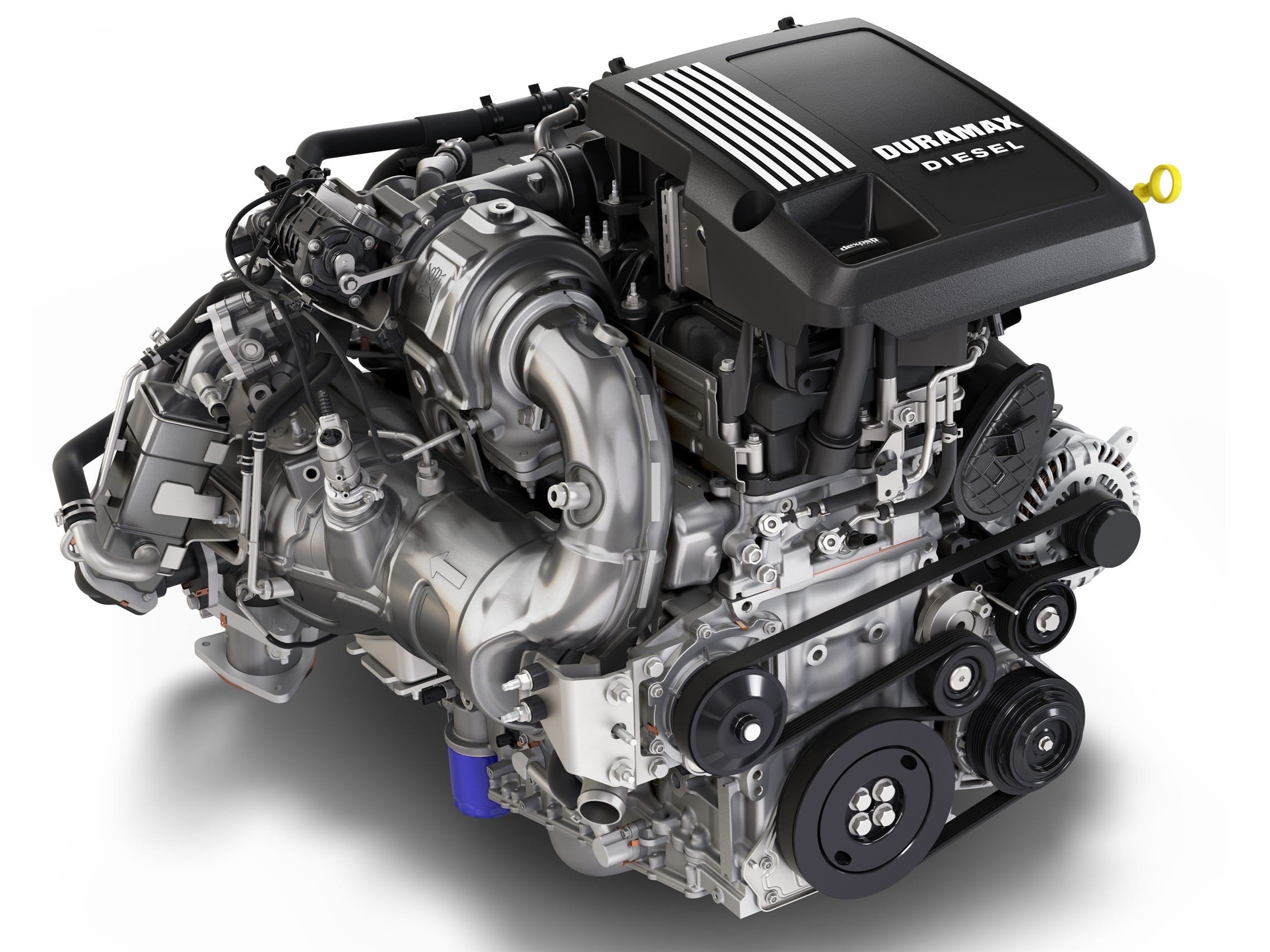
However, as I’ve explained in the past, General Motors got back into the diesel passenger car market in 2014 to battle Volkswagen’s TDIs. It was a momentous occasion, considering that it had been nearly three decades since GM last sold a diesel car in America.
Then GM used the Dieselgate scandal as an opportunity. Volkswagen might have eroded the public’s trust in passenger car diesels, but to General Motors, the cheating was the problem, not the diesel engine. With Volkswagen making a hard pivot to electric vehicles, General Motors identified a void in the market for light-duty diesel vehicles. General Motors would churn out diesels in the Chevrolet Equinox, GMC Terrain, Chevrolet Cruze, Chevrolet Colorado, GMC Canyon, Chevrolet Tahoe/Suburban, GMC Yukon/Yukon XL, Cadillac Escalade, and yep, the Chevrolet Silverado 1500 and GMC Sierra 1500.

Today, GM’s list of light-duty diesels has been reduced to the Tahoe and Suburban, the Yukon, the Silverado, and the Sierra. But even that is just staggering. Ford isn’t going to sell you an Expedition with a Power Stroke, and Dodge apparently doesn’t have the bravery to put a Cummins in the Durango. What gives? Automotive News gives some insight into what GM is thinking:
“It’s not one engine for everybody,” GM President Mark Reuss said during a media event at the company’s engine plant here. “It’s the freedom to choose the engine that fits your work, lifestyle and priorities.”
For Silverado and Sierra buyers, GM sees its diesel powertrain as having some advantages over a hybrid option, including driving range. The redesigned pickups’ Duramax engine allows more than 900 miles of highway driving on a 34-gallon tank. “If you look at the performance and efficiency but also raw performance and range, hybrids really don’t do it,” Reuss said. “It’s a bit different adding a hybrid system to an existing powertrain and trying to get the efficiency out of it like that.”
“Different customers need different combinations of capability, range, affordability, towing confidence and convenience,” Reuss said. “Our aim is to meet them where they are.”

At first, I was taken aback by what Reuss said, but I thought about it for a minute. I get it. I tested the Toyota Tundra TRD Pro in 2023 and came out thoroughly unimpressed with its hybrid twin-turbo V6’s efficiency. When towing, the TRD Pro returned worse fuel economy than I got pulling the same trailer with a regular naturally aspirated V8 gasoline engine. The 2026 Chevrolet Silverado 1500 diesel I tested earlier this year bested the TRD Pro’s towing fuel economy by a whopping 42 percent. Even when driving around empty, the Tundra couldn’t beat the diesel.
To be fair to the Tundra, Toyota did say it didn’t make a hybrid half-ton for efficiency, but to prove that hybrids could do real truck stuff. It’s also not just the Tundra. Some Ford F-150 PowerBoost owners claim that going hybrid doesn’t help their towing fuel economy, either. That’s not to say that hybrids are bad. I adored the Tundra for its instant power and towing prowess. But it also makes me understand why GM is doubling down on diesel. Likewise, GM also gets to claim that it’s the only manufacturer with a half-ton lineup featuring a four, two V8s, and a diesel!

GM’s commitment to diesel goes beyond the call of light-duty. The automaker’s heavy-duty Silverado and Sierra trucks are also reportedly getting updated diesel power. According to GM Authority, succeeding the 6.6-liter L5P Duramax V8 diesel will be the L6P. As of publication, General Motors is still quiet about the spec sheet of that one. It will reportedly be joined by the 6.6-liter L8S gasoline V8, which is expected to be an updated version of the current 6.6-liter L8T V8. Exact numbers have not yet been confirmed for this engine.
Then there’s potentially one more engine out there. For the past couple of years, GM-focused publications and enthusiasts have been talking about a rumored 8.3-liter Duramax diesel, which would be a sort of pickup truck diesel to rule them all. GM hasn’t said anything about this engine, so it may not even exist. But the idea of it is fun to think about. Currently, Ford’s 6.7-liter Power Stroke V8 is the most powerful pickup diesel on the market. Could a big lump of General Motors muscle surpass the Power Stroke’s 1,200 pound-feet of torque? I don’t know why, but I’m getting excited just thinking about it.
GM’s Been Working On These Engines For Years

Anyway, back to the engines we do know about. According to Automotive News, GM’s investment in V8s is not a reaction to the changing political climate. From Automotive News:
The new engines and pickup redesigns come at a critical moment for GM. It needs the profits from its high-margin pickups to compensate for the import tariffs it’s paying and the $11 billion in write-downs it took over the past year on investments in electric vehicle manufacturing. While CEO Mary Barra says EVs remain the company’s “North Star,” the new V-8s and GM’s high hopes for its gasoline-powered pickups suggest that an all-electric future remains distant.
“We spent effort and time on EVs, and we will continue to do that. But we never let our foot up off the throttle on our naturally aspirated V-8s or any of our powertrain lineups,” said Mark Dickens, GM’s executive chief engineer for full-size trucks and SUVs. “Fundamentally, these engines didn’t happen overnight. This is years of development that’s gone into these engines.”
The engines were in development before the Trump administration moved to slash fuel economy standards, GM executives said.
The big question is, will focusing on V8s and diesels pay off in the end? My crystal ball is currently showing me a blue screen, so I’m unable to tell you.
What I can say is that GM’s trucks are seemingly getting even more exciting than they already are. Just the fact that the lowest engine in the lineup still makes 350 horsepower is awesome. I also stand by what I said earlier this year when I said that the Silverado 1500 diesel is one of my all-time favorite pickup trucks. Maybe it’s just me, but it’s so cool that GM isn’t just keeping diesel around, but is actively rooting for it. Me too, GM, me too.
Top graphic images: GM


This is clearly an effort to grab the last seat in a game of Ring Around the Rosie, which ironically is originated from the Black Death.
Imagine the GM dealers will have “Get your last truck hear today” and “This is your last chance to buy a Diesel Truck!” On rolling ads .
I believe the government should require proof of 10k towing before allowing the sale of one of these. And get rid of the Section 179 which will lessen every supervisor driving one of these without ever towing something.
Rant complete
Those are incredible numbers for the 2.7! I have faith that GM can actually build a half decent engine after all their years with ecotecs. The LNF in my Saturn is 20 years old with DI and turbo pushing 300hp reliably.
Dang, lucky. The LNF in my 08 Cobalt SS blew at 60k. That car was fun but man it had so many problems.
The SS got the porous castings I think? In the Kappas they are pretty stout aside from the water pump.
Still sad they dropped the 2.8l baby Duramax for the 3rd gen Colorado / Canyon. Just crossed 90k on mine.
I still can’t figure out why they haven’t taken their new I6 baby duramax and made a 4 or 5 cylinder version for the mid-size trucks. They would get crazy fuel numbers
I’ve got a ZR2 with 33’s and a front level, stock engine tune and full emissions, etc. Everyday driving I’ll get 23-24mpg. If I’m on a road trip and taking the 55mph backroads, 28+mpg is pretty easy. I’ll actually get worse mileage on the freeway and going over 70mph, as this thing as all the aerodynamic properties of a brick. But if I stay around 65-70mph I can usually manage at least 25mpg.
The more normal street trim ones will easily get upper 20’s, low 30’s in stock form.
Car and Driver got over 30 mpg in their diesel Silverado test. It was just a standard LT trim with road tires but those are crazy numbers
Yeah, that’s the issue with mid-size trucks. Almost all the frontal area and weight of a full size, but generally saddled with a less powerful engine so you spend more time in the powerband and more fuel. Lopping 2 cylinders off the 3.0l i6 gives you a 2.0l i4, and I don’t think there’s much room to increase the bore size. So you’d be down significantly on power and probably end up with worse fuel economy.
The closest comparison is the current turbomax trucks. The Colorado / Canyon get the same or maybe +1 or 2 mpg over the Silverado / Sierra.
I was thinking more I5 than I4, the I6 is roughly 300hp-500lb/ft so an I5 should be around 250hp-415lb/ft and use 16-20% less fuel so mid to upper 30’s should be possible.
The big issue is volume, they sell so fewer mid-size than full size a second engine is a tough sell to put in them
It was surprising they even offered one in the 2nd gens, it’ll absolutely not happen in the future. This is all just a thought experiment.
For comparison, my 2.8l makes ~180hp and 370 lb/ft. They’d need to add balance shafts for an I4 / I5 so who knows what they’d end up at. And although it looks pretty tiny in the engine bay, there’s not much room to add another cylinder. I haven’t looked at a 3rd gen engine bay but I don’t think the dimensions changed much. Removing the fan shroud is pretty much mandatory for any work on the front of the engine, although that’s mainly due to the stupid air deflector thingys meant for noise reduction. I just trimmed some of the off when I had to swap my alternator pulley out.. And the 4th injector is already underneath the windshield cowl, no room to move it back.
I know a few of the 2nd gen owners who tuned / deleted their trucks are showing easy 30mpg to almost 40mpg on the street trims.
What I *really* want them to do, is throw this new 5.7l V8 into the Colorado ZR2. I would 100% pick one up and deal with the short bed / crew cab.
A 5.7 in the Colorado or Canyon ZR2 would be amazing.
Man, I read about their dynamic fuel management a few days ago and was super impressed, but a V7?! Now, they really doing something strange.
“Then there’s the 6.6-liter L78, which fires out an impressive 481 horsepower and 501 pound-feet of torque, making it the hottest naturally aspirated V7 in the light-duty class. ”
Are they fucking stupid or what? Its $10 a gallon for diesel here in California. And the economy is on the verge of collapsing. And a shit ton of people are already losing their jobs. Why not focus more on fuel efficiency when its clear our “government” in its current form is going to do whatever it can to fuck up the economy as much as humanly possible. And unless the other side wins back both the House and Senate? The bullshit will continue. So yeah. Way to go GM. Way to show everyone how well-prepared you are for what anyone with a brain can see as a pretty shitty next couple of years.
I would just like to ask the people making comments like this – In what year do you think major design and engineering decisions for these trucks were made?
Yes, planning ahead for various circumstances is prudent, but no, multi-billion dollar vehicle development programs can’t turn on a dime for every geopolitical incident, trade dispute, or on the ravings of a madman.
Not to mention that it still takes a certain amount of energy to move these vehicles around and have them hit their hauling and towing numbers. Yeah, there’s a lot of “cowboy cadillacs” but work still needs to be done and these trucks do a lot of it.
GM has EV pick up trucks that do a lot of work already. If a buyer is upset about gas prices, they can buy the electric version in the same showroom instead
yesterday, obviously.
Somehow… China got the message. And that is why they are about to buy a shit ton of factories in Canada, already have a shit ton in South America, are making major inroads into the EU, are putting all of the German automakers on notice, and are developing battery tech and chemistry at an accelerated rate. But what is GM doing? Building more full sized trucks that are now massively expensive to buy, massively expensive to keep filled with fuel. This is why GM is becoming a regional versus an international brand. They should have gotten the message a long time ago and its not like we haven’t had repeated, dramatic recessions and economic calamities over and over again. Once again GM is putting themselves in a fantastic position to go bankrupt. Again.
GM also sells class-leading EVs in several varieties, is making record profits, and sells nearly a million full-sized trucks a year using the formula they are iterating on here, so I’m again confused what you’re trying to say.
Full sized trucks have never sold in those other markets (except Canada), so designing for them doesn’t make sense.
We own an Equinox EV, which has been great. But don’t kid yourself. Those sales are a blip compared to what they make most of their money on. Silverado, GMC Sierra, Chevy Tahoe and GMC Yukon. All of those giant full sized trucks and SUVs. Now granted they are smart to sell what people want. And given that most Americans are dumb as dogshit, they’ll bankrupt themselves with those things- which many are, as we speak.
In other words- same story. They are reliant on the absolute most extreme level of product that is exposed to the fury of the current fuel price disaster. And that means they are ill-prepared for when and if that demand collapses, which given how close we are to a economic collapse- seems likely.,
I guess we simply disagree on the likelihood of anything like that scenario happening.
Well…. its happened before. So why would it be any different this time? And do you think the public has an appetite to bale em’ out again? Because it sure seems like right wingers didn’t like that last time and seeing as how most of em’ drive those big ass trucks… Not sure they would get saved this time.
“And do you think the public has an appetite to bale em’ out again?“
Hayyyyyy
If it helps GM is in a much healthier position now than in 2006 financially.
Eh, missed the part about dual fuel injection to avoid the carbon buildup on valves from DI, also still no mention of DFM and whether it will still be there to cause problems. The 6.6 HD trucks lack this and I think that is why I would want one of those over anything else, except that 6 speed Cadillac with the system removed because of the manual trans as well.
The issue with the current 6.6 is that it drinks oil like the old 3.6 V6. The Electric oil dipstick helps check on this I imagine, especially with the oil change intervals, but it should not be a thing that continues.
DFM is still there. It’ll never go away unfortunately.
The 5.7 V8 in the C5 Z06 made 405 hp and 400 lb/ft of torque in 2004.
Now, I’m not going to complain that the new 5.7L makes 402 hp and 428 lb/ft of torque in truck spec because that would be silly. However, I will complain that GM isn’t taking the C7 chassis and putting this 5.7 in it and making a cheaper sports car that slots underneath the current Corvette.
you mean like a 4 door Camaro?
I hope it shows up in that too but the C7 was a great car and there’s no reason to throw out a great FMR chassis. Put the smaller 5.7 in it and make it more of a GT and call it a Solstice or something and sell it for Camaro money
God dang these things are tall. I care less about their powertrain and more about banning them from school zones and limiting them to 65 MPH.
I can get behind that. I hate how trucks have become so tall that I have to get creative to close their hoods.
While I like driving more recent trucks for their interior spaciousness and great ride over everything but the worst pavement, the fullsizers have gotten ridiculous in pure size. I shouldn’t have to set up a stepladder or a scaffold tower to open and close a hood or get in the vehicle. Very nice to drive when I’ve had them as rental vehicles though
I do hate the step ladder to reach the oil cap. they could at least put a wheel well door in there if the rest of the truck crowd really needs the extra height to want to buy them.
For that matter I don’t understand how anybody under 6′ can comfortably load stuff into the bed.
As much as I like to give American manufacturers shit for quintupling down on V8s and their steadfast refusal to adapt to a dramatically changing market, I don’t think GM is wrong here. Outside of the folks who buy sports cars I don’t think there’s a demographic that cares less about fuel economy than truck owners, and it’s not like the hybrid systems in the F150 and Tundra are that much more efficient anyway.
There’s only so much you can do to improve the efficiency of what’s effectively 3 ton brick…although I’m not sure how appealing diesel is going to be because of how prohibitively expensive it’s become. It’s going to be a long time until it comes down again, if it ever does at all.
Not only that, but GM’s V8s are actually modern, really competitive, and manage to get reasonably good fuel economy. It’s not like Stellantis’ 5.7L Hemi where it’s comparatively way down on power and gets way worse fuel economy than not only the competitor’s V8s, but also their own internal I6. GM gets similar fuel economy with their V8s as everyone else’s downsized stuff. Why change?
this new 5.7 GM motor is 402 HP and 428 lb/ft of torque, the hemi you mention is 395 HP and 410 lb-ft of torque, Might be fuzzy math, but how far down is “way down” on power? Also the E-Torque Hemi’s get better fuel economy than the old 5.3’s at least on paper.
Because in practice, the Hemi got the same fuel economy as GM’s 6.2L. Every 5.3L GM I’ve driven got way better fuel economy than any Dodge, Jeep, or Ram with a 5.7L. Both the Hemi and 6.2L were also usually the the top spec engine (at least until the Hurricane HO arrived) in their 1500 series trucks and many SUVs. That is really the engine I’m comparing it to, because they lined up in segment both price-wise but also efficiency wise. Based on that, I would consider a 25hp and 50lb-ft a solid deficit.
Looking forward, I’m willing to bet GM’s new 6.6L will get fuel economy on par with the Hemi; so yeah, being down 86hp and 91lb-ft is what I would consider way down. I’d also bet GM’s new 5.7L, while only putting out a bit more power, does it while using less gas.
[reads about the L87 recalls reaching a million vehicles affected and rising diesel prices]
… yeah, best of luck with that General.
The old 8.1 L big block made basically the same power and torque in pickups as the 2.7 does now.
And yet, we also get an all new 400 ci V8 as well.
Great day no matter where you come down in the displacement debate.
Wait, is today April first and I missed it? Or is GM actually listening to customers for a change and giving them what they want?
I know these engines have been in development for a bit, but I’m assuming the massive self inflicted dick puych that was the electric Dodge twins must have felt like a “God is shining down on me” moment for the development team.
Sort of not surprised that GM, consistently the most ass-backwards financially-engineered shell of an auto manufacturer is deciding to pin its future on gas engines. Ford at least still has engineers somewhere in the company, or at least a large enough European division that someone still builds things over there; Chrysler/Dodge is a budget line in Stellantis’s global strategic portfolio, but GM? That’s all American business, baby, 100% pure-grade Sloan-school badge-engineered what’s-this-“the-quarter-after-next-quarter”-talk finance wizardry (that you and I owned back in ‘08!) with a badge and a motor that will stay attached for exactly as long as the spreadsheets suggest it ought.
This comment makes very little sense as GM is also arguably the EV leader among mainstream brands, and that every other pickup maker also uses gas engines.
Agreed. They don’t have a perfect brand strategy but they do have competitive EVs.
Don’t they sell the most EVs second only to Tesla?
I believe that is (or was) true, and the only reason I qualified the statement with “arguably” is that I know Hyundai/Kia is coming on strong as well.
The V8s had better be pretty much flawless on launch, because GM has nearly the whole company riding on them.
BTW, GM management using “North Star” as a V8 guiding principle might want to work on their phrasing.
Pick a powerplant and put one in the vehicle, and make it a good one. Gas, diesel, electric, any work. I irrationally say NUTS to hybrids.
Also, Berkeley CA laughs at your $6.39 per gallon and ups you $2.40 to $8.79 a gallon. Yeah, nearly $9 a gallon.
That’s wild. That’s $0.50/L more than I pay here in Canada, BEFORE the exchange rate. That’s $2.33/L USD, and the gas station by my house this morning is $1.75/L CAD.
Im going to come out and say that, all things considered, The General is the king of the V8 engine. Yes, yes, many other brands have had some amazing V8s. But when you consider how ubiquitous the Chevy V8s have been, how many amazing Corvette V8s, there have been, how iconic a 350, or an LS is, and their ling history with the layout, GM is the boss. And good for them for refining proven “low tech” pushrod setups. I have a 2018 2500HD with a 6.0V8 in it. Sure it gets shitty gas mileage, but it has over 100kmi on it, it has never let me down, has never asked for more than oil and gas, and has spent its life constantly pulling heavy trailers. No turbos, no DEF fluid, no premium gas or hybrid battery doohickies. Just old school displacement and it works.
My previous work had a 6.0 that we used to test trailer hitches with. We consistently put that truck through conditions very few trucks would ever see once. We only towed about 20k miles a year with it, but we often towed at or over it’s weight rating while flying through the desert at high enough speeds to get airborne (I only had the truck or trailer airborne, never both at the same time, but my boss claims he had them both airborne once). The terrain was anything but smooth, sometimes a bit muddy, always rocky. We’d take 3 spare tires (truck and trailer had the same 8 lug pattern) and I did end up using them all once. The exhaust fell off, the motor mounts wore out and the engine rotated enough for the fan to hit the shroud, we went through 3 receiver hitches that wore out from our testing, and a variety of other small things happened but that truck never left anyone stranded. We kept up on maintenance religiously for the powertrain/drivetrain and never had an issue.
Somehow my inlaws 6.0 that only saw dirt twice in its life blew an engine (rod knock) at 130k miles.
That sounds like an awesome job! Where do I apply?
We had to get with the times and upgraded to an L5P Duramax. It was great for the power, but I felt bad beating it up and had plenty of emissions issues with it making us stay closer to home and mostly on pavement.
I was in R&D for the company that makes the Equal-i-zer hitch. I can’t imagine a company with better leadership, but the owner retired and sold the business to a publicly traded company. That’s when I moved on.
another +1 for the simple 6.0 in my old 2005 2500. Over 460,000 tough miles and it was still running when I sold it. That engine had never been opened. I still miss those seats.
Really? My work one was an 04 and my in-laws had an 05, I always had a very sore back after driving all day in those seats. Some of the worst seats I’ve sat in, not as bad as the Topkick I guess, but that have been from the high load capacity suspension that we never needed when towing.
“making it the hottest naturally aspirated V7 in the light-duty class.”
I really hope that is not a typo and they are actually developing a V7.
Regular gas at Chevron in Sacramento was 6.2999 today. Bloody insanity.
And more insanity is the bad timing of building new V8s when our fuel now costs more than the famously expensive petrol in Europe, where small cars are the norm.
You would expect semis and pickups to slow down just a little on the freeway to gain an extra MPG or two, but no, they’re all still at ten (or more) over the limit.
Diesel and gasoline will have to hit ten bucks a gallon before any one really cares.
It’s like beer – whatever it costs, eff it, give me twelve of them, and a couple of lottery tickets.
Hey neighbor, the Arco at my corner was $.5.79 for the cheap stuff. It’s wild up here. Diesel is 10 bucks in many areas already. Add that the main pump for the Saudi pipeline has been destroyed and Costco is rationing engine oil it seems like a bad time to bet on ICE only. Doing these new engines with an EREV would make it an interesting truck.
Yet somehow Sam’s and Costco manage to sell gas at a buck a gallon less then Chevron.
And there is an Indian casino gas station that sells premium at 20 cents higher than regular. It sure does seem like the big name brands just mark up their prices because enough fools are willing to pay that much.
They absolutely put a markup on gasoline.
The redesigned pickups’ Duramax engine allows more than 900 miles of highway driving on a 34-gallon tank.
I mean, with a big enough tank anything can go over 900 miles.
Weird it doesn’t mention those 900 miles are gonna cost you $284 here in CA.
That’s because they don’t care about anywhere west of the Sierras.
But but, they have a truck NAMED Sierra!
They do indeed. And a Denali. But only Hyundai cared enough about California to have a Santa Cruz.
Now I wanna know stats: do the good folks of Santa Cruz buy more Santa Cruzes than other places?
Me too.
350HP and 455 pounds of torque is quite an upgrade for the 2.7l. I wonder if they beefed it up more for the power increase?
I learned today that the L4B 2.7L turbo-four in the new Silverado and Sierra will now have 350 hp. and 455 ft./lbs. of torque.
Imagine a 2WD regular-cab, short-box pickup with the 10-speed transmission and those hp./torque numbers.
Compared to the early 1990s 454SS, those numbers are enough to make me want to at least take one for a test drive.
When I worked for GM, they had us do all sorts of fun truck things at a corporate event with that 2.7T. It’s a hoot, it just doesn’t sound like a big V8.
The sound doesn’t matter though because you’re blasting Van Halen so loud as you giggle
I want to see that 2.7T in a Porsche 944
Best I can do is a small Cadillac sedan
Sad noises.
It’s a bold move Cotton, let’s see if it pays off.
(But as someone who would rather see fewer giant pickup trucks on the road I hope it does not).
Yeah, same. I have a hard time getting excited for more huge trucks with immediately deleted emissions equipment stomping around.
GM getting it right, right up to discontinuing it. Keep inventing new engines instead of going back to their best ones and improve them.
A question what is more economical an ICE engine at todays price and mpg or a diesel engine with the greater range but higher cost of fuel?
Is this a trick question? A diesel engine is based on internal combustion you know.
Also saying “ICE engine” is redundant, like “ATM machine”.
There’s an ATM machine at TCBY yogurt, do you remember your PIN number?
I think it’s near the hot water heater…..
Well GM got this part right. Now put the damn dip stick back!