

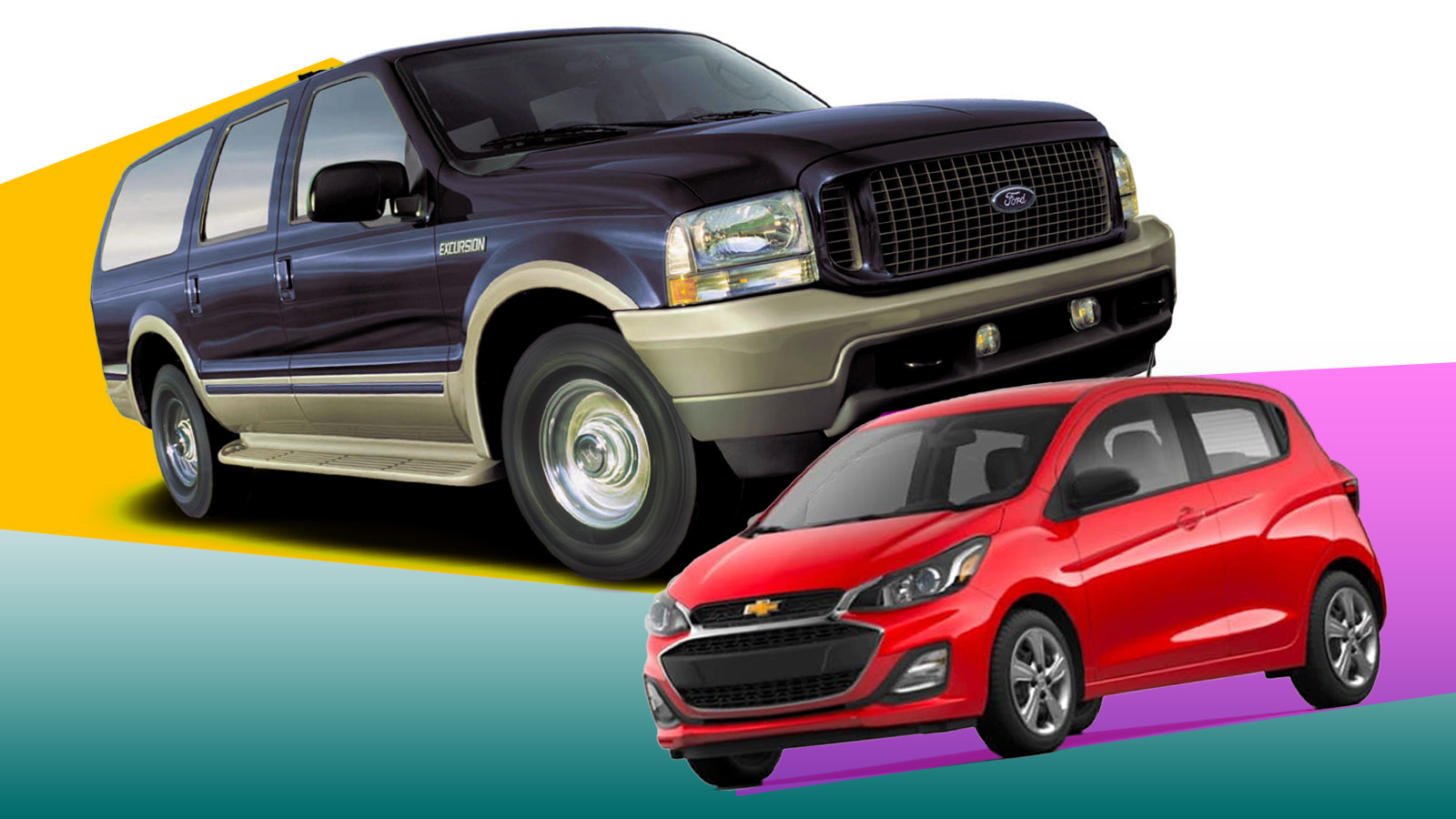
Learning to drive has been a rite of passage for teenagers for just about forever. A car offers a teenager the kind of freedom they’ve never had before, but being a new driver also comes with risks. Parents naturally want to keep their kids safe by surrounding them in as huge a bank vault as possible. However, buying your kid the biggest pickup truck or SUV you can find could come with some consequences in a crash, and here’s why you might want to pass on that idea.
This subject has skidded across my desk after an offhand comment that I made on social media. If you follow my work, you know that I prefer to log off the moment I get done with work for the day. Unlike my wife, I don’t really care about social media. I couldn’t care less about Reels, Shorts, Snaps, TikToks, or whatever app people use. But there are times when I emerge from the shadows, post something, and then go back to living my life.


One of those times happened earlier this week. I opened up Threads to see what my wife has been posting, and I suppose that since the algorithm knows I like cars, one of the posts I saw was a parent talking about what cars they were going to buy their kids. To save you from visiting Threads, I’ll just post it as a quote:
Do not put your kid in a subcompact car when they get their license.
Corolla. Civic.
I wouldn’t even put them in a sedan.
Do you want them to survive their first accident or not?
My son will drive an F-150 and my daughter will drive an Expedition.
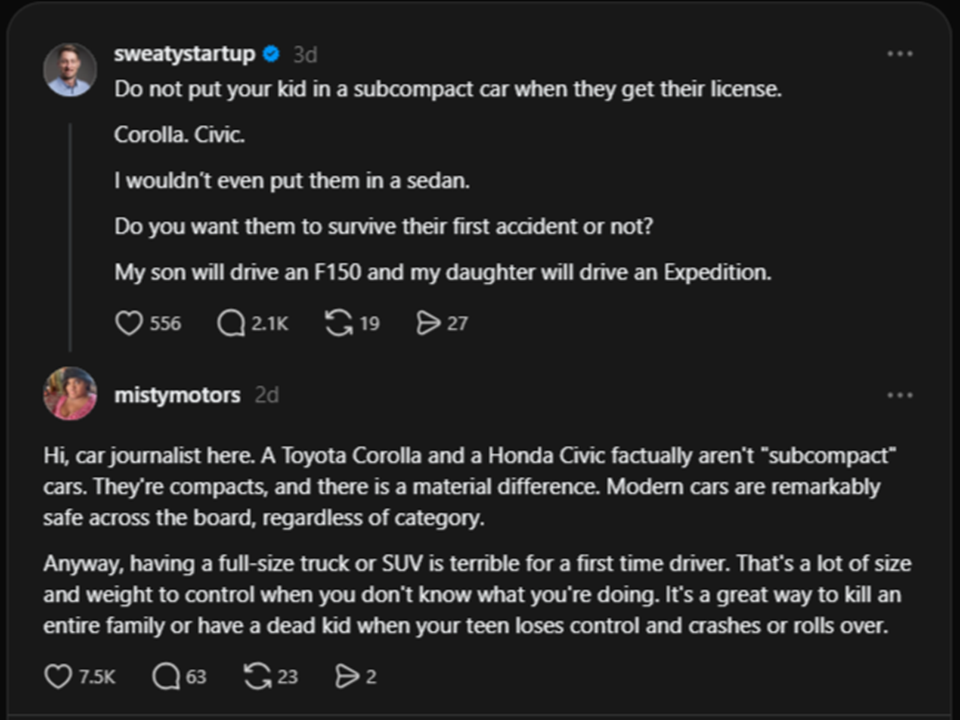
If you want to read the whole thing, click here.
The first thing that bugged me was the notion that a Toyota Corolla and a Honda Civic are “subcompact” cars. Maybe many decades ago, but not today. These cars are in a larger class called compacts, even though that is almost a misnomer, given how big today’s cars are. I suppose there’s a non-zero chance he was just naming two models he wouldn’t put his kid in, not saying they’re subcompacts, but it’s hard to tell.

Then there was that second part, where this person said that they were going to put brand-new drivers in a Ford F-150 and a Ford Expedition based on the idea that such vehicles were what they needed to survive a crash. Now, look, I should have scrolled on and read my wife’s posts as I intended, but this post got me hook, line, and sinker. I made a reply that explained that Corollas and Civics aren’t subcompacts, modern cars across all classes are remarkably safe, and that there are hidden dangers in putting first-time drivers in vehicles with high centers of gravity, high weights, and great size.
I then proceeded with my day, not thinking about my comment. As it turned out, this comment went viral. I’m such a lurker on social media that this, to my knowledge, was the first time I’ve ever made a viral comment on social media. Clearly, thousands of people care about this. But why?
Bigger Is Usually Safer

Buying a safe car isn’t as simple as buying the largest vehicle your money can buy. Likewise, a car that’s safe for one person can actually be dangerous for another person.
On July 31, the Insurance Institute for Highway Safety (IIHS) published the results of a study into which modern cars are the safest and which ones were the least safe, based on fatality figures. The study tracked deaths from 2021 to 2024 in Model Year 2023 and older vehicles.
Some of what IIHS found out wasn’t particularly surprising. From IIHS:
More than half of the model 2023 vehicles with the highest driver death rates are small cars, sports cars or muscle cars, a new report from the Insurance Institute for Highway Safety shows.
“Even the safest small cars don’t fare well in crashes with large pickups and heavy SUVs,” IIHS President David Harkey said.
“Powerful engines and marketing that attracts aggressive drivers is the issue for sports cars and muscle cars. They’re dangerous mainly because of how they’re driven.”IIHS has been calculating driver death rates approximately every three years since 1989. This year marks the second time IIHS also calculated the “other-driver death rate” — the number of drivers in other vehicles killed in crashes with each model. Size and power define the worst models on that list too, but it’s the biggest vehicles that are most dangerous to others. Ten of the top 20 are large or very large pickups, including several heavy-duty variants with more powerful engines. Across all makes and models, the average driver death rate was 37 drivers per million registration years. The average other-driver death rate was 53. The other-driver death rate was most likely higher than the driver death rate because many of the crash partner vehicles were of older vintage and offered occupants less protection.

Some of this is just physics at work. If you crash a small and light vehicle like a Kia Rio into something big and heavy like a Ford F-150 crew cab, the big truck is likely to fare better. As someone who owns five Smart Fortwos, which was once the smallest modern car sold in America, this is something I’ve always been cognizant of.
It’s not that these cars are unsafe. In fact, it’s quite the opposite. Today’s cars are built with the benefit of decades of safety research, innovations, and engineering. IIHS has a great way of showing this, too. Every once in a while, IIHS likes to smash a modern car into its vintage equivalent. The vintage car always loses, and it’s not even close. Those old beasts might have been heavy metal, but they crumple like beer cans and compromise their passenger compartments. Watch a 2026 Chevy Blazer obliterate a 1996 Chevy Blazer:
However, as the IIHS has said over the years, there are several factors that make larger vehicles the winners in crashes against small vehicles. Something to keep in mind is that, when IIHS, NHTSA, or other organizations perform crash testing, they are tossing cars into walls or having sleds ram the car. The kinetic energy is provided by the vehicle’s own weight. The tests do not show what happens when the vehicle crashes into something that is heavier than it is. IIHS notes:
Both size and weight affect the forces people inside a vehicle experience during a crash. The magnitude of those forces is directly related to the risk of injury. Larger vehicles have a longer distance from the front of the vehicle to the occupant compartment. The longer that distance, the more the frame of the vehicle can be crushed before it crushes the people inside. Long front ends only provide more protection in frontal crashes, but these crashes account for more than half of passenger vehicle occupant deaths.
Weight is important when two vehicles collide. The heavier vehicle will push the lighter one backward during the impact. That puts less force on the people inside the heavier vehicle and more on the people in the lighter vehicle.
IIHS demonstrated the role of size and weight in a series of crash tests in 2019, pairing a midsize SUV and small car made by Kia and a large car and minicar made by Toyota in collisions with each other. Both smaller vehicles, the 2018 Kia Forte and 2018 Toyota Yaris iA, had good ratings in the five IIHS tests relevant to driver protection, but they performed poorly in collisions with the larger vehicles.Improvements in crash protection have made vehicles of all sizes safer, but bigger vehicles are still safer than smaller ones even with those improvements. As the chart below illustrates, crash deaths decline as vehicle size increases. A similar chart using weight instead of size would look almost the same.
But Bigger Isn’t Always Better
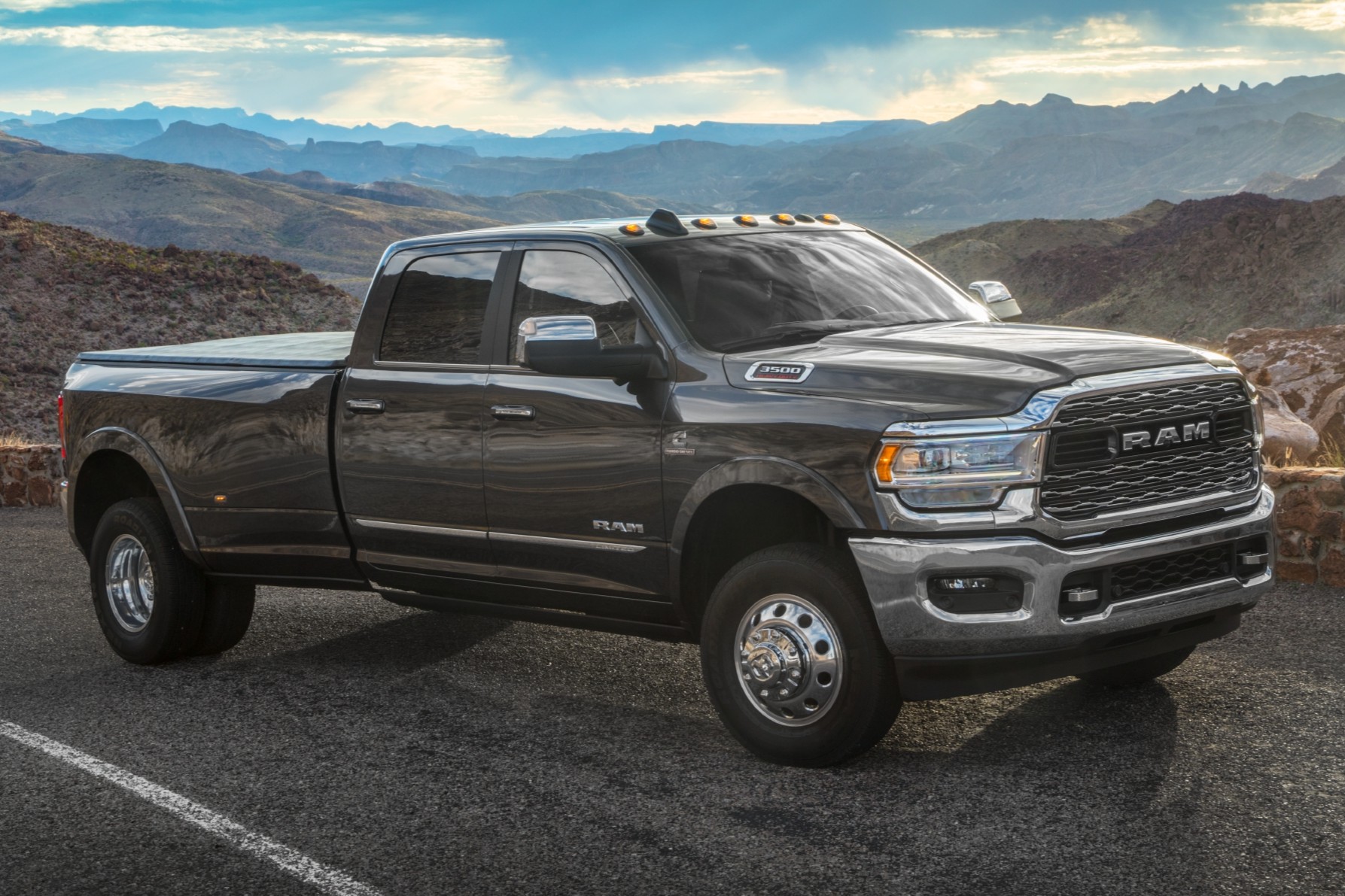
Everything I have given you thus far supports the guy’s point. Even IIHS generally agrees that bigger is safer. So why shouldn’t you just go out and buy your kid a Ram 3500 right now? The unfortunate fact is that while a pickup truck might protect its occupants, it is disastrous for everyone else. From IIHS:
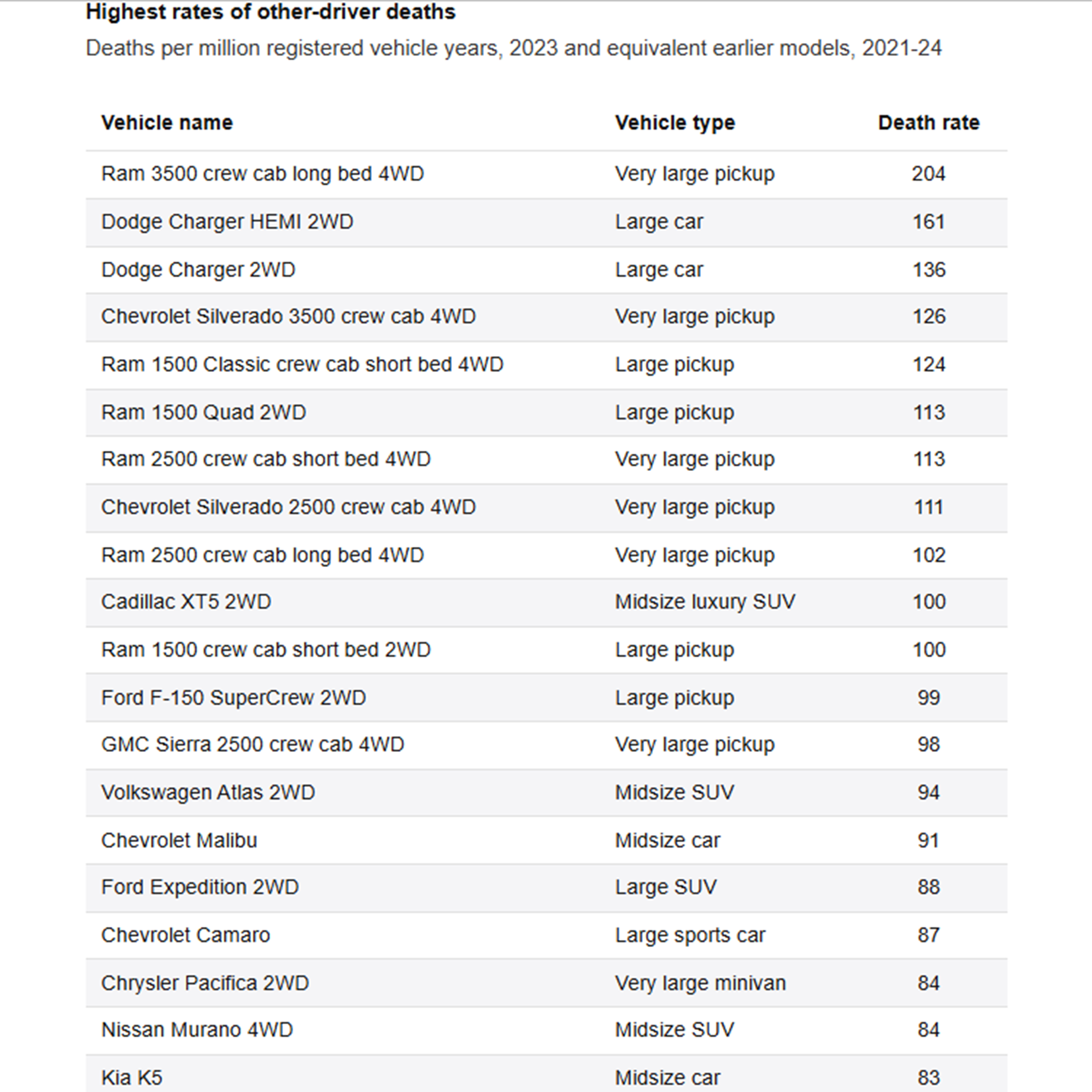
The model with the highest driver death rate was the Kia Rio, with 170 deaths per million registration years. The Ram 3500 crew cab long bed four-wheel-drive had the highest other-driver death rate, at 204 deaths per million registration years. Eighteen out of the 20 models with the lowest driver death rates are SUVs, including four small, nine midsize, four large and one very large model. Six models had death rates of 0.
The Chevrolet Camaro, Chevrolet Malibu and the two-wheel-drive versions of the Dodge Charger and Dodge Charger HEMI feature among both the models with the highest driver death rates and those with the highest other-driver death rates. All but one of the six models that feature among the vehicles with both the lowest driver and other-driver death rates are luxury SUVs.
The models on both these lists are the BMW X5 four-wheel-drive, BMW X7 four-wheel-drive, Porsche Cayenne four-wheel-drive, Volkswagen Atlas four-wheel-drive, Volvo XC60 four-wheel-drive and Volvo XC90 four-wheel-drive. The rates include only driver deaths because all vehicles on the road have drivers, but not all of them have passengers or the same number of passengers. The number of deaths is derived from the federal Fatality Analysis Reporting System. Registration data come from Mobility Global.
To put that first paragraph in other words, Ram 3500 pickup trucks kill other drivers in crashes more often than the drivers of Kia Rios die in crashes. In fact, the list of vehicles that kill other drivers the most is almost entirely populated by pickup trucks, SUVs, and muscle cars. From IIHS:
According to the IIHS report, trucks don’t even have the lowest death rate for their own drivers. According to IIHS, the vehicle class that has the lowest deaths per million registered vehicle years is “very large luxury cars,” with 7 deaths per million registered vehicle years. Second to that is “large luxury SUVs” with 10 deaths per million registered vehicle years. Small pickup trucks come in at 31, large pickup trucks are at 29, and very large pickup trucks land at 24.
For comparison, the worst is the class that IIHS calls minicars, which have 158 deaths per million registered vehicle years. IIHS notes elsewhere that large SUVs and trucks are also known to kill more pedestrians and cyclists than smaller vehicles. Basically, a truck will probably protect you or your teenager fairly well, but will also leave you more likely to kill someone else in a crash. That doesn’t even mention the psychological toll of being in a crash where the other person dies.
Teenagers Are Terrible Drivers

Even after all of this, there’s another thing you need to consider. Teenagers are bad drivers and have crash rates over four times greater than adults. They have poor car control, don’t really know what they’re doing, and are piloting a multi-thousand-pound missile with all of the distractions of the world going on around them. They don’t have the experience to know to slow down for rain, snow, or ice. They don’t know the proper speeds to take a corner. Also, I was a teenager once, and I remember how I thought I was invincible. I did dumb things with cars back then that I’d never do today.
If you take a peek at the IIHS list of picks for teen drivers, there isn’t a single pickup truck on the list, and the largest SUV class is mid-size. IIHS is pretty clear on why:
As in past years, the list doesn’t include anything with excessive horsepower relative to weight or anything marketed for performance. However, many seemingly benign vehicles come in high-horsepower versions, so even when shopping from the IIHS-CR list, families should make sure to stick to the base engine. Powerful vehicles can entice young drivers to take risks or lead them to speed inadvertently.
Minicars, as well as anything under 2,750 pounds, are also excluded. Although smaller models tend to be popular with young drivers, they can’t protect their occupants adequately in crashes with bigger vehicles.
On the flip side, large SUVs and large pickups aren’t a good choice for inexperienced drivers because they can be hard to handle and take longer to stop. They also pose more risk to others on the road, including pedestrians, bicyclists, and people in smaller vehicles.
It’s also notable that large trucks and SUVs may roll more easily than smaller vehicles, especially if your teen outfits them with lift kits and larger tires.
Thus, the sweet spot is somewhere in the middle. You don’t want to give your teen the largest possible vehicle at a time when they have no idea what they’re doing behind the wheel. As evidenced by IIHS findings, that could be a recipe for a life-altering disaster. However, it’s also true that maybe you don’t want to buy your kid that used Chevy Spark. Instead, IIHS recommends something like a Mazda 3, Toyota Camry, Subaru Forester, or a Volvo XC90. Check out the full list here.
The Choice Is Yours

Of course, none of this is really written in stone. Even the safest cars in the world have had fatalities. Likewise, many folks have grown up driving terrible, unsafe cars and gotten through unscathed. My first car was a 2001 Kia Rio that had a body of rust and an only halfway functional cooling system. I drove that car like a maniac.
Ultimately, as a parent, the decision is up to you. Buy your kid whatever you want. I suppose your teen should also have some input, too. However, I think that whatever decision you do make, it should be an informed one. Don’t just blindly buy a model on the assumption that it’s safe. Be sure to do some research and know what you and your teen are getting into. If you and your teen decide the risk of a certain vehicle is worth it, at least you decided from an informed place.
Above all else, I also recommend defensive driving classes and then, later, advanced driving classes. High school Driver’s Ed classes sometimes just teach you the basics, which is fine. But actually knowing how to handle a car rather than just drive it could potentially save your life one day. It’s also really fun, too. But no matter what you do, be safe out there!
Top photo: Ford/Chevy


I’m sure the guy has perfectly rational and not at all sexist reasoning for F-150 for his son and Expedition for his daughter.
We’re currently a one-car family,so the chances of me buying my son a car of his own are next to nil, but I can happily cover his bus pass (an Orion VII is *way* bigger than an F-150 to boot).
Yeah that part stood out to me too. I don’t know the ages of his kids or his family’s current vehicles, so maybe those just happen to be the most likely hand-me-downs available when his son and daughter hit driving age. But it sure does come across like “real men drive full size trucks” and “SUVs are for moms and future moms” subtext.
Got a thought on this too: When I sold cars, it was very rare that a young lady came in wanting a full size truck: they want an SUV.
And vice versa for boys. Not to go Jordan Peterson on this lmao but I really do think USUALLY it’s a matter of boys feeling more connected to the outwardly utilitarian nature of a pickup and girls seeing the practical utility of an SUV.
It doesn’t have to be F150/Expedition.
I sold a lot of single cab Tacomas and rangers to young men, and I sold a lot of HR-Vs and RAV4s to young women. Just my observations there.
I mean, it’s quite clear that these people do not care a jot that other people die, as long as they themselves are safe.
And thus where we are today as a country…
My kids will get whatever we can afford at the time, so probably a 2006 ford explorer with a broken AC for the firstborn.
Thanks for this wise advice! I wish we’d stop saying that bigger vehicles “win” in an accident, because there are no winners. I wouldn’t want my child to live with the guilt of taking out a family because of a dumb move.
Plus-size vehicles have psychological effects on their drivers. You feel isolated and above it all. This might make them feel indestructible, but large, heavy vehicles create more hazard in one car accidents. They’re hard to see out of, especially when parking at the kind of urban venues where concerts take place. They can provide too much room for distracting passengers, too. The best thing I can say about them is that low MPGs might make them drive less.
Growing up back in Tennessee in the 1960s, the short cut to a drivers’ license was to use a motorbike. If it was 50cc or under, you could get your license at 15 1/2, six months early. Mine was an Italian two-stroke sold at Sears and branded “Harley Davidson.” It might have been faster if it had pedals, but I enjoyed until my birthday, when I leapt into my mom’s new Mustang. That as a small car for its day, but it seems just right to me.
My littles all have littles.
All the kiddies learn/learned to drive in an old Pathfinder. 2003. Had the airbag recall so it’s as safe as can be…I hope?
Oldest had a succession of Subes that all self-distructed with head gaskets. When she was old enough, bought a CX-30 new.
Next had a Fit that held up well with some small issues until a neighbor’s friend backed into it. When she was old enough, bought a Civic Hybrid new.
Next one went from the Pathy to a Scion iA until Bambi chose to snuggle at speed. Drives a Mazda 2 now.
Last one has an Element I just picked up that she might start with right away. Can’t get the Pathy to stay running at this point. Element is the biggest by far any of the girls had.
Lots of kids at school drive large, lifted trucks and destroy them, quickly or slowly, sure as God made little green men.
Love your username. 🙂
And not that it matters, but I also strongly approve of your automotive parenting… your kids made smart choices when it came to buying cars.
Part of this argument hinges on the “truck guy” caring about other-driver deaths. In my experience, that is absolutely not something they care about.
Jacked up F250s are a scourge in my part of the world, and the trailer trash behind the wheel give not one shit about anyone other than themselves.
“Jacked up F250s are a scourge in my part of the world, and the trailer trash behind the wheel give not one shit about anyone other than themselves.”
Bingo. They’re not trailer trash here, though. They graduated to suburb trash.
Great points and a very important and somber subject here.
I don’t intend to argue or refute anything I’ve seen here, but 20 years as a first responder (with most of my closest friends also first responders themselves) I have some opinions I’d like to share.
This is all strictly anecdotal, and I don’t want to come across as a know it all. Please keep that in mind.
I live in a rural area, where A LOT of the population drives big trucks, and a lot of that population gives their 16 year old new drivers a big truck as a first vehicle.
I have been on a LOT of crash scenes, and unfortunately have had to cut a lot of people out of thier vehicles.
In 20 years I have never seen a bad 2 car MVA where a teen was driving a large truck and hit another car. Could be pure luck, but I have never seen it.
I have, however, seen A LOT of single vehicle crashes where multiple young people were not wearing a seat belt, and the cause is usually distraction, reckless operating, or alcohol, in order of frequency.
So yes, there is clearly a problem with parents giving inexperienced drivers a large, powerful vehicle, especially one that can seat 4 or even 5 passengers in comfort. I grew up this way. Teens ride places together. Who drives? The kid with truck that can haul the most ass, the most asses, or both. And riding in a bed and getting ejected is definitely also a thing.
It’s not good.
But on the other hand: Inexperienced drivers crash cars. Period. Into other vehicles, sure, but more often, it’s Into a ditch, or a tree, or a rock, or a rollover, or a parked vehicle than anything else. And I don’t care how advanced we make small cars: when it’s a compact or smaller, it is never pretty. Never. You just can’t fight physics. I don’t want to make this too awful long, and please don’t mistake me: I LOVE small, fun little cars.
But if you have a teen driver, don’t put them into a tuned up Cummins, or a 5.0 F-150. Don’t put them in a little prius or civic, either.
Midsize SUV. Grand Cherokee, CRV, RAV4, Forester. Those things kids flip over or slam a tree (or get hit by a kid in an F-150) and walk away from.
Defense of small cars is understandable.
But as a firefighter and a parent, please get your kid the boring ass SUV that’s slow, easy to drive, and hard to fold up.
The German lease machines are great for this. I’ve seen several q5 and Tiguan go in ditches and are absolutely fine. Even when they roll people walk out. Raptor goes in a ditch at speed a wheel is coming off frame might be bent probably using a porta power to get them out if they can’t climb out the window. If it’s rolls it’s not going to be pretty.
I used to hate this time a year working in a suburban station. There was always a MVA in front of this one high school on what had become a very busy road that was very twisty for seeming no reason other them the developers in the 60s wanted it that way. Most of the time it was vehicle vs tree or ditch. The little cheap compacts at the didn’t do well. Even when the parents splurged for a brand new escort, aspire, or similar to get airbags. Sometimes you would work on them while the rescue guys did their thing but more often then not it ended with a tarp and the ME coming out the scene.
My brother’s friend ended up working a the same station years after I left and it was the same thing. Just with versas and rios. He only lasted a few years seeing that before the PTSD got to him and ended up living in van playing music.
Fellow first responder here, with 20+ years on duty. I can only agree with this statement. Kids will do stupid shit when given a bit of freedom, and as a parent all you can do is teach them about consequences and how to look for possible dangers in the world. I’m taking my son to get his temps this afternoon, so this topic has been front of mind for a while.
Great comment.
I also spent quite a number of years as a rural firefighter / medic with more than a hundred MVCs. My experience was different.
Had a DUI kid in a gen 1 VW Rabbit hit a large heavy steel strainer designed to keep logs from plugging a culvert. He took the windscreen with his head and then ran away. Very big ticket. No injuries
Had an F350 full of trash towing a trailer full of trash head on in a 55 speed zone into a Mercedes 300 Wagon. Got to race Sawzall VS Jaws (Sawzall won). No injuries.
Possibly stolen M3 that rolled big time and left carbon fiber trash all over the highway. No patient: driver long gone.
Several Subaru incidents. One was a rear ender into a school bus. The bus drove off. Hard to cut open. No injuries. Corolla and Camry? No major injuries. NUMI Chevy Nova? No injuries.
Worst? Trans Am vs Douglas Fir and 80’s Olds Cutlalss vs Douglas FIr. Fir 2, GM 0.
From what I have seen, the dymanics of the incident make more difference than the car. That and don’t hit a Douglas Fir that is three feet or more in diameter.
Overall impression? With the exceptions of Mercedes and Volvo, there doesn’t seem to be all that much difference. Modern cars are amazingly good. Oh, and beware of those older GM seat belts that can pop open in a crash.
By the way, I always remionded my kids that if they crashed they would likely be stripped to their underwear and taped to a backboard right out on the highway. Seemed to work.
A mid-to-fullsize sedan would make more sense, as they are less likely to flip in the first place
Absolutely agree, but remember where the hood line of a Camry sits when looking at any post 2011-3/4 ton pickup.
Heavy-duty pickup trucks have their frontal structures designed to sit lower to prevent them from driving over other cars in a head-on collision.
If you’re talking about the Camry rear-ending a full-size truck, its worth considering that a sedan will have a better chance at stopping in time than an SUV or another truck. If a sedan can’t stop in time and rear-ends an F350 while still travelling at 20mph, a heavier SUV in the same situation might still be doing 30 when it hits the F350.
sweatystartup: You don’t want your kid to die in a car crash as a teen. Good.
You also don’t want them drinking themselves to death by age 30 after killing someone in a car crash because their mistakes were amplified by the Ferd Ffifteenthousand they were driving. People just don’t think of that, do they?
“The unfortunate fact is that while a pickup truck might protect its occupants, it is disastrous for everyone else”
And this here is why sensible regulation is so important. When the incentive for individual choices is in direct conflict with societal outcomes, you have a big problem.
As a parent, why wouldn’t you put your kid in the safest bank vault possible? You’re contributing to the problem, but do you care as long as your kid is protected?
My first car was an NB Miata. There’s something to be said for that because I can count several accidents I was able to avoid due to the car’s agility. But in the event of an unavoidable crash, I’d have been worse off for sure.
My first car was a hand-me-down Lincoln Mark V that my folks gave me mostly because it was taking up (all the) space in the garage. They were definitely believers in the “bigger is safer” idea and swore the car saved my life when I fell asleep at the wheel years later and clipped a two-foot thick utility pole clean off at bumper height going around 45 mph. I grudgingly acquiesced, but I probably would have been just as safe in one of the many Saab 9000s that followed, primarily because:
-those were very crash-safe cars (I flipped one and both myself and my elderly cockatiel in a soft carrier came out unharmed), and…
-the Saabs were manuals. I probably wouldn’t have dozed off if I had to shift for myself.
I feel compelled to save face a little by adding that those were my only serious wrecks. A few years after the Lincoln incident a friend rolled his Saab 900 into a barbed-wire fence that got wrapped around the car like string on a bobbin. He too walked away safely… through the hatch, I think. We were a bit past our teens and still were terrible drivers.
Great that a voice of reason spoke up on Threads, kudos to you!!
Yeah, oftentimes when I see a Ford Expedition, especially a first-generation one, on the road I’m reminded of a high-profile case that happened locally about 25 years ago where a high school student, from a very wealthy family, was driving a new Expedition (1st gen) upon leaving school and hit a semi-homeless person on a mobility scooter crossing the street while she was making a turn at an intersection near the school. She dragged the person *and* the scooter some 50 feet (!!) before she realized something was wrong (and also because people were screaming at her to stop.) Witnesses said that such an incident most likely would not have happened with a regular-sized car and that it was very much a case of a new teenaged driver in such a massive vehicle.
Unfortunately, given the socio-economic factors here, socio-politically-aware cynics would be absolutely correct in making some assumptions about the outcome of the case. Alas.
One feels for the victim and his family and also for the teenager for having to live with the psychological consequences of what she had done even though she was ostensibly exonerated.
That case, due to being so high-profile locally, was actually among the factors in my kids’ choices of their first cars (& current cars), none of which are SUVs, thankfully, when they started driving more than a decade ago as the case was still relatively fresh in memory.
Unfortunately not everyone has learned the same lesson; I’ll drive by that high school and see the student parking lot crammed full of big SUVs, with rationally sized cars being a notable rarity, and I’ll remind myself not to be around when school lets out.
Prius were known to do very similar in a few cities as well even with non teen drivers. Certain kinds of people don’t pay attention or even seem to care. I mainly blame their parents one way or another. It’s normally the same people that would kill a family of 4 to save 3 seconds wherever they are going.
Since we are talking about vehicle classes… The Civic is classified as a midsize car and has been since 2016. The current Civic is larger than a 1996 Accord.
As to vehicles for teen drivers. My recommendation is always a midsize or larger car or compact or midsize Crossover. For Crossovers one made after 2010 when “light trucks” had to meet the same safety standards as cars.
Looking at the IIHS list I’m happy to the the Chevy Malibu there. The Malibu could be the holy grail of cheap yet safe boring cars.
EDIT: Today I discovered that from 2016 to 2019 Chevy sold the Malibu with a “Voltec” 2-motor hybrid powertrain. 46 mpg. WHY, Chevy, WHY did you give up on hybrids?
Per NHTSA classification, compact cars have curb weights between 2,500 pounds and 2,999 pounds. The only versions of the Civic that exceed 2,999 pounds are both trims of the Civic Hybrid. Many trim levels of the Corolla are also under 2,999 pounds.
Conversely, the EPA bases its classes on interior and cargo volume rather than vehicle weight. Indeed, the Civic has fallen into the EPA’s midsize class for a while due to its interior volume.
But the EPA’s classifications are flawed because some larger cars have small interiors and some smaller cars have large interiors. This leads to some vehicles ending up in some bizarre classes. In 2020, for example, the EPA considered the BMW M4, the Mercedes-AMG E53, and the Nissan GT-R to be “subcompact.” Meanwhile, cars like the Bentley Continental convertible and Porsche 911 were “minicompact” by the EPA’s weird standards. In 2020, the EPA even considered a version of the Civic to be “large.”
Personally, I would be a fan of overall size being used for classifications because both the NHTSA and EPA have imperfect classification methods. Anyway, most car publications don’t really go with the EPA’s definitions because they’re rather chaotic. Go to Car and Driver, and the Civic and Corolla show up as Compacts.
Don’t you love it when different government regulatory bodies have different definitions? The difference between NHTSA’s CAFE and EPA GHG rules are even more fun. 🙂
Getting back to car classes, I’d say the NHTSA classification is more problematic than the EPA one. The purpose of a vehicle at the core is to move people and cargo. The larger the car, the more people and cargo it can move. Most people when they look at a car they classify them by size not weight.
The problem with NHTSA weight classifications is pretty clear in your example. We can have the same car jump classes based on trim. A gas Civic and hybrid Civic are physically the same size inside and out but according to the NHTSA the gas car is a compact and the hybrid a midsize. Then we throw in EVs.
The Niro EV weighs 3,803 pounds so according to the NHTSA it is a full size car, the same as a Mercedes S-Class and any car that weighs 3500 lbs or more.
Sometimes both the weight and the volume say one thing but media another. The 2026 Nissan Sentra weighs 3,097 – 3,177 lbs and has an interior volume of 110.4 cu ft. By both weight and volume it is midsize. Car and Driver calls it compact, Road & Track says it is in the small sedan category, and even theAutopian calls it a compact.
BTW, I’d love a link to the NHTSA regulation. I’ve seen reference to it but never found the actual document.
Oh yeah, NHTSA’s idea on how to classify cars isn’t any better.
I have tried to find that regulation once but ran out of time and had to move to something else. NHTSA’s main site lists out how it categorizes cars, but I haven’t found the specific regulation just yet. That’s something else that I wish the feds would change one day!
I’ve talked to people from IIHS and DOT about the classifications before. Their belief is it’s not actually a regulation in its self but further classifications for ncap based on IIHS-HLDI classifications.
https://www.iihs.org/media/b19c7e8c-54ea-4a35-a3bb-3a05fa2a5c16/O27mDA/Ratings/Protocols/current/hdi-auto-size-class.pdf
DOT is confused enough to have funded a study linking FHWA to NHTSA.
https://rosap.ntl.bts.gov/view/dot/63222
I can see the logic of teaching a kid in a large vehicle but not giving them one as their first. My dad always said teach in the largest vehicle you have give them the safest you can. I think that’s sage advice. If a farm kid has a lot of experience driving trucks and tractors having a truck at 16 probably not a big deal. Chad the broccoli head from the suburbs who’s dad is a “truck guy” that never uses the bed let’s not do that. Cuv or compact for you.
I taught my daughter in a variety of cars and trucks. Then she got a cuv. She only had a little bit of farm life very minimal tractor driving. If she had grown up on the farm was used to tractors and trucks and wanted one I probably would have gotten her a smaller truck. Nothing modern full size or crew cab. Probably not even 1/2 ton unless there was a specific reason like towing a trailer regularly. And still that seems like ok here is truck you use for that and here is your small car for everyday use.
I knew some cops that had a company doing defensive driving classes. They were also some of the worst drivers I’ve ever seen. Their vehicles both issued and personal always had mass amounts of carnage.
Sometimes you can find firefighter ran defensive driving class that do a good job. You want defensive driving those are your guys. Try driving a 13k lbs box truck at 90 mph though traffic and red lights while trying to keep it smooth for the guy in the back working on someone. Or a 25k lbs engine at 60mph though lights and traffic while everyone is confused and trying to hit you.
My sister put her daughter though one or the cops ones and apparently the key take aways were what to do when getting pulled over from their perspective. Wonderful.
Also that post seems like a linkedin influencer post just the new meta nonsense of threads.
Sounds like a good idea. I would suggest not using the largest vehicle you have for the driving test though, especially if you’ve been running it on “FARM USE” exemption plates for years despite living on 1/8-acre and farming digital content for a living. Just as a “to whom it may concern.”
Is 1/2 acre ok then?
That’s the kind of thing you can only get away with in Virginia and the Carolinas. Probably need to invest in some more land to make more legit though.
Funnily enough the guy I’m thinking of with a car like that and a teenager with a learners’ permit right now, lives in exactly that part of the country. Weird coincidence, no?
Here’s what disturbs me about this discussion:
(emphasis mine)
“If you crash a small and light vehicle… into something big and heavy … the big truck is going to win the fight.”
“…there are several factors that make larger vehicles the winners in crashes against small vehicles”
Automobile crashes are not a “Win or Lose” scenario.
This is not a game.
This is people’s lives.
And lets say you survive a crash you caused in your BigStupidTruck or your SuperHemiAngryAlphaMobile – when that other person in the other car dies, you are at risk of being arrested and tried for Vehicular Manslaughter. You risk being hauled into civil court by their surviving family and being subject to financial losses which will cripple you and your family financially for years if not decades.
Even if they live – if you have destroyed their health and ability to earn a living – you are liable for that.
And you will have their death or maiming hanging over you for the rest of your miserable life.
So positioning survival after killing or maiming someone else as “winning”?
Not correct and not appropriate.
Meanwhile – the statistics may point to larger vehicles being safer for their occupants in a crash – smaller, more maneuverable vehicles are better able to avoid those crashes in the first place (plus they’re smaller targets).
But that only works when the driver is paying attention and driving defensively.\
Dad – You want to keep your kids “safe”?
Teach them to never text, call or scroll when they drive, and keep the volume of the stereo down to reasonable levels.
Teach them to pay attention at all times when behind the wheel and drive defensively.
Teach them how to look ahead of the car ahead – safe driving distances from the car ahead – how to use safely navigation tools so they know where they’re going and get live traffic alerts – and evasive maneuvers so they can actively avoid crashes.
I apologize for that original wording. It wasn’t meant to imply that crashes are a game. It was an admittedly poor way to say what I was thinking.
I have changed the wording to:
Crashes are life and death and many if not most people will prioritize protecting “me and mine” over a stranger. This is the reality of life in the USA which is one of the most individualistic countries in the world.
No doubt.
However the positioning of it as “I survived therefore I won. They died therefore they lost” is pathological.
Put all the teens in the largest, most powerful vehicles available.
Then they can kill each other in the high school parking lots.
They’re driving to school while I’m trying to get to work, but the wake traffic will be later and won’t bother me.
Another reason why not to give your kid a truck or large SUV: a 16 year old kid should not be carting around 7 of their friends in a big SUV. Give them a pickup and guess what? Now they’re carting around 10 of their friends, 5 in the bed.
Source: my parents let me drive around the spare house vehicle in high school, it was a crew cab F-250.
No question Mercedes is dispensing some valuable and correct information here. But some people just don’t get it. So if you are bound and determined to put them in the tank make sure they pay half the payment, their insurance, and for the gas. I am sure they will be a lot safer driving that 10 miles a week they can afford.
lol took about 20 seconds of looking at that dude’s post to see that he’s a total kook.
I saw a V8 Armada with a Student Driver sticker yesterday that was driving TERRIBLY while I was on my motorcycle so I sped away from that situation as quickly as possible.
Nothing more than LinkedIn lunatic engagement bait. You’ve gotta have thick skin to even browse the Internet these days, nevermind engage with it.
Yep. Unfortunately, the safety arms race has led people into vehicles that ensure death for thee, not for me. It’s insanely selfish (and stupid) to hand a kid the keys to an Expedition with the expectation that driving a battering ram will keep their spawn safe.
Also stupid, the number of other teens and crap you can fit into a full-size vehicle. Not exactly a smart move, dude.
Odds are, your kid is going to have a hell of a time piloting something as long as an F-150 without hitting shit, or being a general menace to society. Honestly, if an insurance company finds out a freaking 17 year old is using a modern Expedition as a daily driver, they probably should boost the premiums to the freaking absolute max on them.
Get your kid (or recommend your kid buy) something reasonable. Not everyone needs a Geo Prism rusted to the last mile of death that stalls on left turns like I started with. But your kid doesn’t need to drive something they can’t control, can’t see out of, and don’t respect the limits of. All of the rest of us trying to survive appreciate it.
Arms race is the word I always use. People buy big, heavy car to feel safe. So then everyone else on the road buys bigger and heavier cars to be safe until no one is! The popularity of the SUV is a curse on our roads.
Also: Teens don’t need cars at all. In fact, I’d go as far as to say that parents who give their kids cars just don’t care about them. Or their kids.
Allowing your teens to drive shows you trust them to begin learning how to be a responsible part of society.
Plus it’s less places I need to drive them around to.
My mom apparently had a genius plan for when I came of driving age.
She hated driving, so the very day I got my permit, she put me behind the wheel of her GMC Envoy XL and told me to drive her to a Golden Corral some 30 miles away. From that day forward to about the day I moved out, I was basically her chauffeur. I couldn’t even borrow her car unless I drove her somewhere first. Clever lady. 🙂
My mom loves driving (she grew up on a farm, learned to drive when she was 8) but once I, the eldest child, got my driver’s license, ferrying around my younger siblings to piano lessons, etc. mostly became my job.
I drove whichever car my parents weren’t using, 1966 Pontiac Lemans (alas, gone before I went to college), 1969 VW bus, what have you.
I had to get up and drive my nurse mom to the hospital at 6:30 if I wanted to use the car that day. Then I had to pick her up right after school got out. However, she really didn’t want me to drive her anywhere, she wanted me to do the errands by myself so she could stay at home and relax.
Certainly pretty important for teens to learn how to drive if you live in a place with no useful public transit. Which is most of the country.
Oh, they can drive. Yes, that is necessary.
What I meant was that kids don’t need parents to buy them a car of their own.
That’s a mixed bag for me. I want to encourage responsibility, but I also want to be practical and understanding, and not encourage working and saving for a car to outweigh other priorities like school, sports and activities, and family time.
The way my family did it, there was an extra car that started off for my use, but as my brothers learned to drive, became theirs next. I couldn’t take it to college or anything with me. That’s what I plan to do with my kids – not buy them each a car that belongs to them, but to provide a car they can use that’s safer and better equipped than what they’d be able to afford on their own.
They need to do it eventually, and not driving the kids around is a glorious step towards the empty nest.
I’d buy an f550 for my 11 year old if it got him out of the house sooner.
Uhhhhh, what?
Just put your kid on a bus. Sheesh.
They’re big and heavy and presumably driven by people who know what they are doing.
and make it a manual!
I say do it Gen X style: give them a gutless wonder, 80hp or less, no safety bots so they learn on their own, and buy a S-ton of life insurance on them
Win-win.
Bonus points for sending them out with bottles of hosewater.
Hell yeah!
I’m liking this idea.
Is it still legal to take out life insurance on random people not related to me (Walmart style)? I’ve seen some little shits locally that I’d gladly gift a third gen turbocharged Camaro.
Would it be weird to also bet against them on prediction markets?
Weird? Maybe. Unprecedented? Nope:
https://www.npr.org/sections/planet-money/2026/08/25/g-s1-139946/how-the-aids-crisis-helped-create-a-multibillion-dollar-death-speculation-market
It better still be legal.
It’s how I plan to fund my retirement.
“Do not put your kid in a subcompact car when they get their license.
Corolla. Civic.
I wouldn’t even put them in a sedan.
Do you want them to survive their first accident or not?
My son will drive an F-150 and my daughter will drive an Expedition.”
TL:DR Some of you may die but that is a price I’m willing to pay.
Thanks a lot Farquaad! Let’s see your F-150 and Expedition do this!:
https://www.motorbiscuit.com/nissan-altima-driver-miraculously-survives-worst-crash-weve-ever-seen/
I say we split the difference.
Jeep CJ5 lifted on 35s. Someone’s gonna die. It’s 50/50 on who.
Kids need Altimas.
I like it.
On 35s
Only if they’re spinners
Or a Rogue. It’s just a Talltima.
But guaranteed fuel economy will be one of the deaths.
More reason for them to get a McJob.