

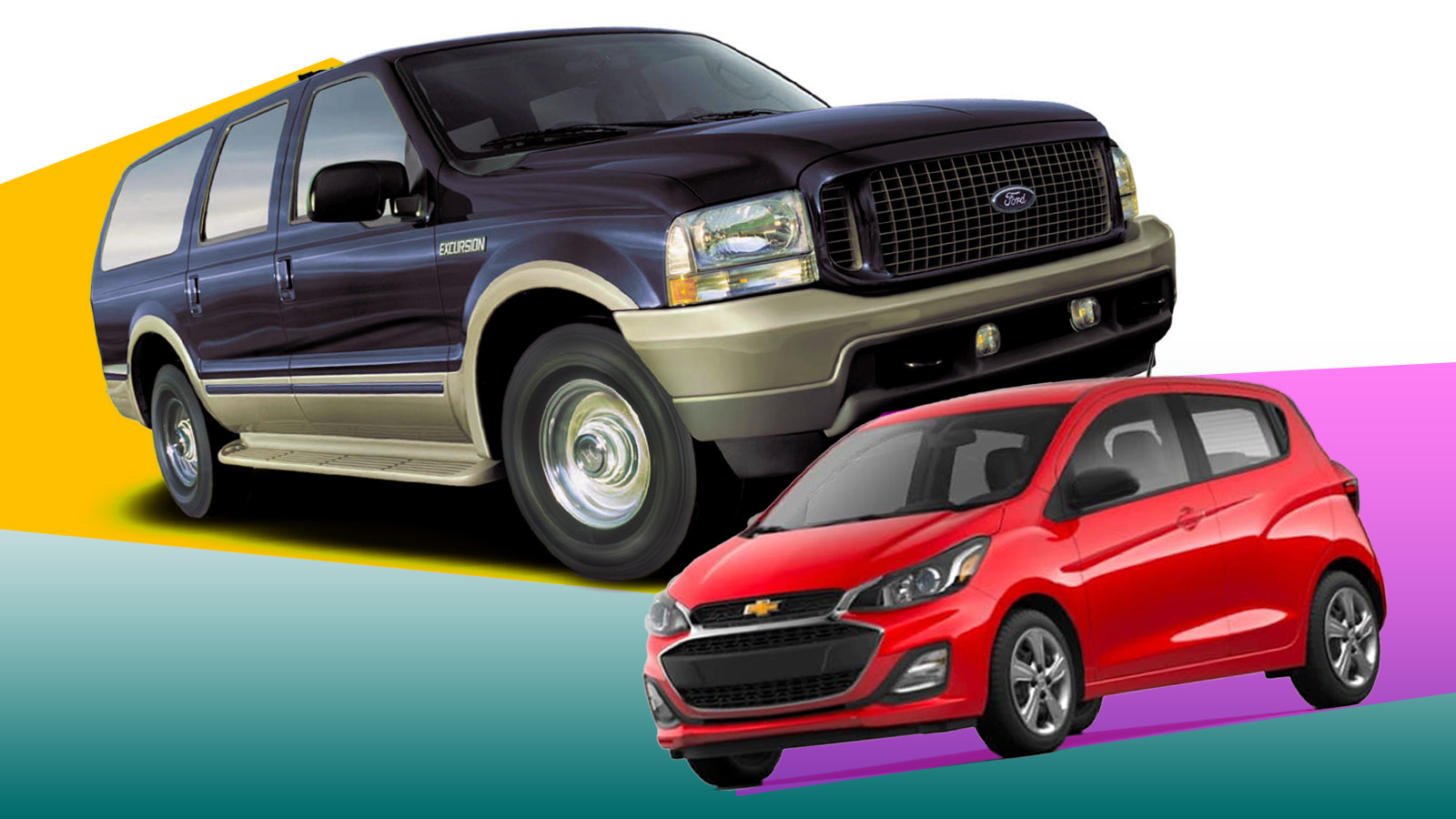
Learning to drive has been a rite of passage for teenagers for just about forever. A car offers a teenager the kind of freedom they’ve never had before, but being a new driver also comes with risks. Parents naturally want to keep their kids safe by surrounding them in as huge a bank vault as possible. However, buying your kid the biggest pickup truck or SUV you can find could come with some consequences in a crash, and here’s why you might want to pass on that idea.
This subject has skidded across my desk after an offhand comment that I made on social media. If you follow my work, you know that I prefer to log off the moment I get done with work for the day. Unlike my wife, I don’t really care about social media. I couldn’t care less about Reels, Shorts, Snaps, TikToks, or whatever app people use. But there are times when I emerge from the shadows, post something, and then go back to living my life.


One of those times happened earlier this week. I opened up Threads to see what my wife has been posting, and I suppose that since the algorithm knows I like cars, one of the posts I saw was a parent talking about what cars they were going to buy their kids. To save you from visiting Threads, I’ll just post it as a quote:
Do not put your kid in a subcompact car when they get their license.
Corolla. Civic.
I wouldn’t even put them in a sedan.
Do you want them to survive their first accident or not?
My son will drive an F-150 and my daughter will drive an Expedition.
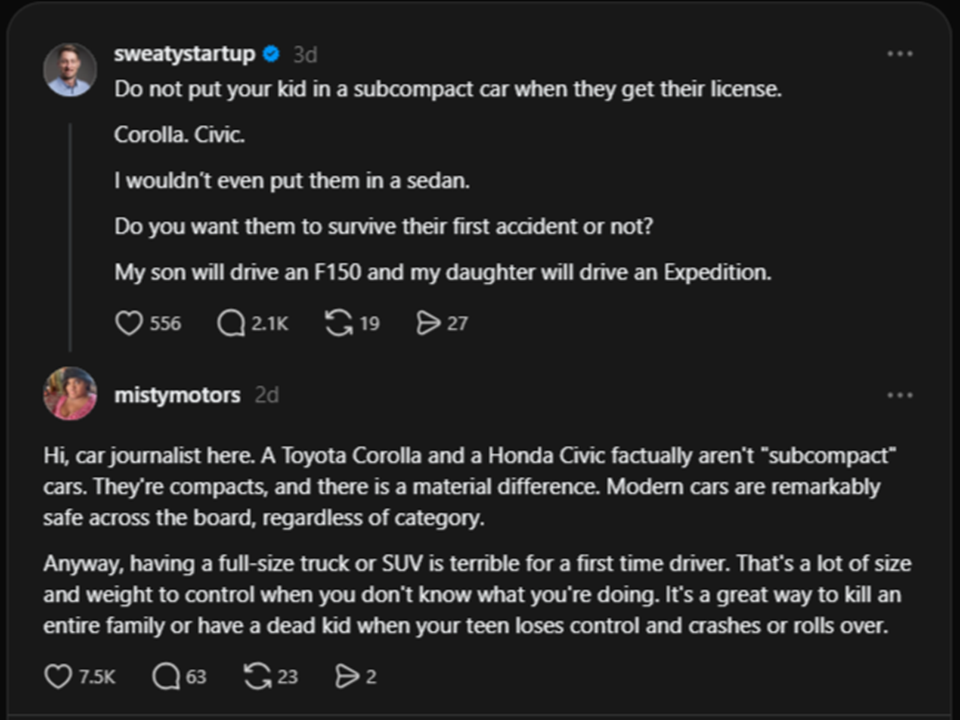
If you want to read the whole thing, click here.
The first thing that bugged me was the notion that a Toyota Corolla and a Honda Civic are “subcompact” cars. Maybe many decades ago, but not today. These cars are in a larger class called compacts, even though that is almost a misnomer, given how big today’s cars are. I suppose there’s a non-zero chance he was just naming two models he wouldn’t put his kid in, not saying they’re subcompacts, but it’s hard to tell.

Then there was that second part, where this person said that they were going to put brand-new drivers in a Ford F-150 and a Ford Expedition based on the idea that such vehicles were what they needed to survive a crash. Now, look, I should have scrolled on and read my wife’s posts as I intended, but this post got me hook, line, and sinker. I made a reply that explained that Corollas and Civics aren’t subcompacts, modern cars across all classes are remarkably safe, and that there are hidden dangers in putting first-time drivers in vehicles with high centers of gravity, high weights, and great size.
I then proceeded with my day, not thinking about my comment. As it turned out, this comment went viral. I’m such a lurker on social media that this, to my knowledge, was the first time I’ve ever made a viral comment on social media. Clearly, thousands of people care about this. But why?
Bigger Is Usually Safer

Buying a safe car isn’t as simple as buying the largest vehicle your money can buy. Likewise, a car that’s safe for one person can actually be dangerous for another person.
On July 31, the Insurance Institute for Highway Safety (IIHS) published the results of a study into which modern cars are the safest and which ones were the least safe, based on fatality figures. The study tracked deaths from 2021 to 2024 in Model Year 2023 and older vehicles.
Some of what IIHS found out wasn’t particularly surprising. From IIHS:
More than half of the model 2023 vehicles with the highest driver death rates are small cars, sports cars or muscle cars, a new report from the Insurance Institute for Highway Safety shows.
“Even the safest small cars don’t fare well in crashes with large pickups and heavy SUVs,” IIHS President David Harkey said.
“Powerful engines and marketing that attracts aggressive drivers is the issue for sports cars and muscle cars. They’re dangerous mainly because of how they’re driven.”IIHS has been calculating driver death rates approximately every three years since 1989. This year marks the second time IIHS also calculated the “other-driver death rate” — the number of drivers in other vehicles killed in crashes with each model. Size and power define the worst models on that list too, but it’s the biggest vehicles that are most dangerous to others. Ten of the top 20 are large or very large pickups, including several heavy-duty variants with more powerful engines. Across all makes and models, the average driver death rate was 37 drivers per million registration years. The average other-driver death rate was 53. The other-driver death rate was most likely higher than the driver death rate because many of the crash partner vehicles were of older vintage and offered occupants less protection.

Some of this is just physics at work. If you crash a small and light vehicle like a Kia Rio into something big and heavy like a Ford F-150 crew cab, the big truck is likely to fare better. As someone who owns five Smart Fortwos, which was once the smallest modern car sold in America, this is something I’ve always been cognizant of.
It’s not that these cars are unsafe. In fact, it’s quite the opposite. Today’s cars are built with the benefit of decades of safety research, innovations, and engineering. IIHS has a great way of showing this, too. Every once in a while, IIHS likes to smash a modern car into its vintage equivalent. The vintage car always loses, and it’s not even close. Those old beasts might have been heavy metal, but they crumple like beer cans and compromise their passenger compartments. Watch a 2026 Chevy Blazer obliterate a 1996 Chevy Blazer:
However, as the IIHS has said over the years, there are several factors that make larger vehicles the winners in crashes against small vehicles. Something to keep in mind is that, when IIHS, NHTSA, or other organizations perform crash testing, they are tossing cars into walls or having sleds ram the car. The kinetic energy is provided by the vehicle’s own weight. The tests do not show what happens when the vehicle crashes into something that is heavier than it is. IIHS notes:
Both size and weight affect the forces people inside a vehicle experience during a crash. The magnitude of those forces is directly related to the risk of injury. Larger vehicles have a longer distance from the front of the vehicle to the occupant compartment. The longer that distance, the more the frame of the vehicle can be crushed before it crushes the people inside. Long front ends only provide more protection in frontal crashes, but these crashes account for more than half of passenger vehicle occupant deaths.
Weight is important when two vehicles collide. The heavier vehicle will push the lighter one backward during the impact. That puts less force on the people inside the heavier vehicle and more on the people in the lighter vehicle.
IIHS demonstrated the role of size and weight in a series of crash tests in 2019, pairing a midsize SUV and small car made by Kia and a large car and minicar made by Toyota in collisions with each other. Both smaller vehicles, the 2018 Kia Forte and 2018 Toyota Yaris iA, had good ratings in the five IIHS tests relevant to driver protection, but they performed poorly in collisions with the larger vehicles.Improvements in crash protection have made vehicles of all sizes safer, but bigger vehicles are still safer than smaller ones even with those improvements. As the chart below illustrates, crash deaths decline as vehicle size increases. A similar chart using weight instead of size would look almost the same.
But Bigger Isn’t Always Better
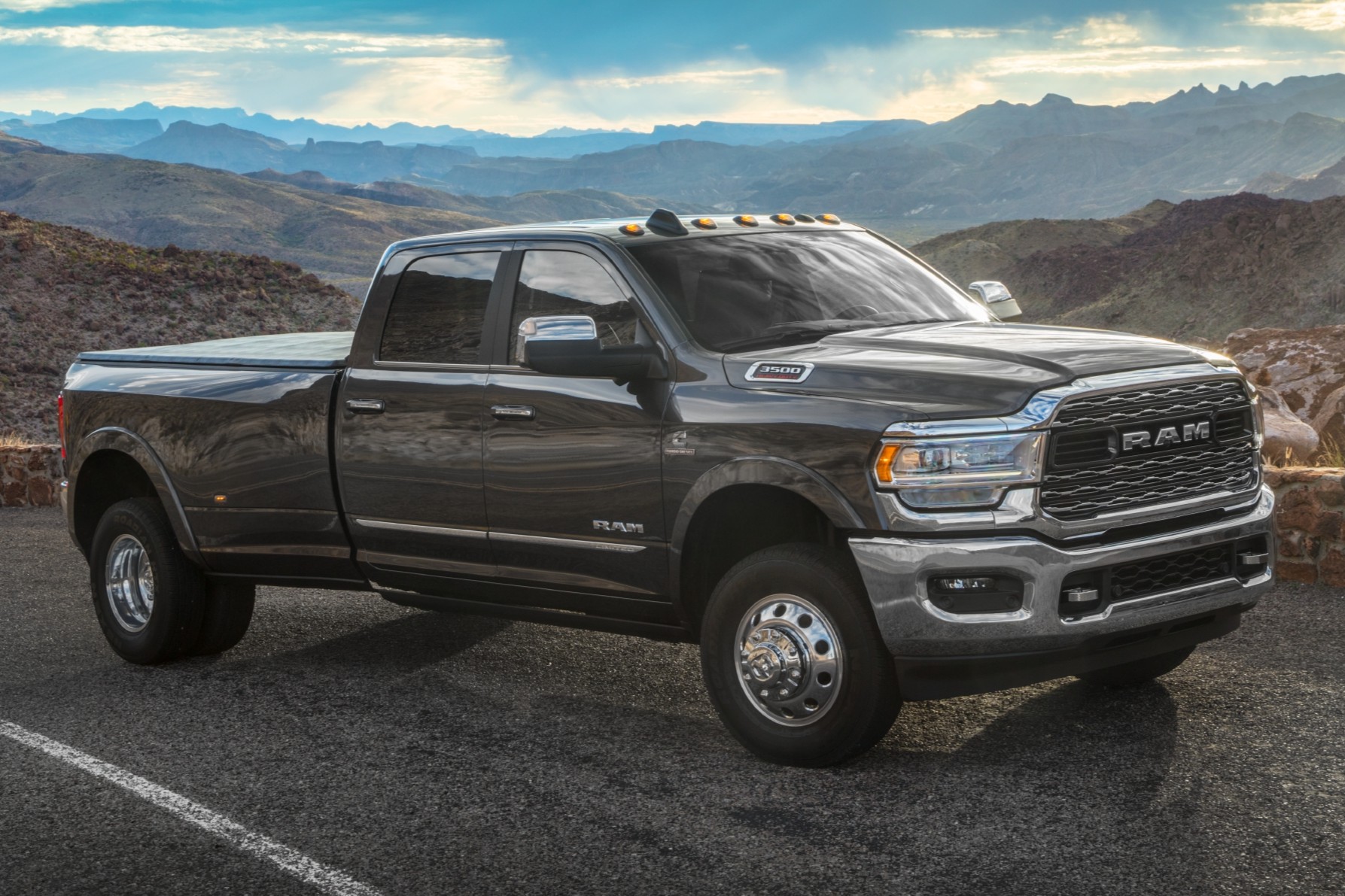
Everything I have given you thus far supports the guy’s point. Even IIHS generally agrees that bigger is safer. So why shouldn’t you just go out and buy your kid a Ram 3500 right now? The unfortunate fact is that while a pickup truck might protect its occupants, it is disastrous for everyone else. From IIHS:
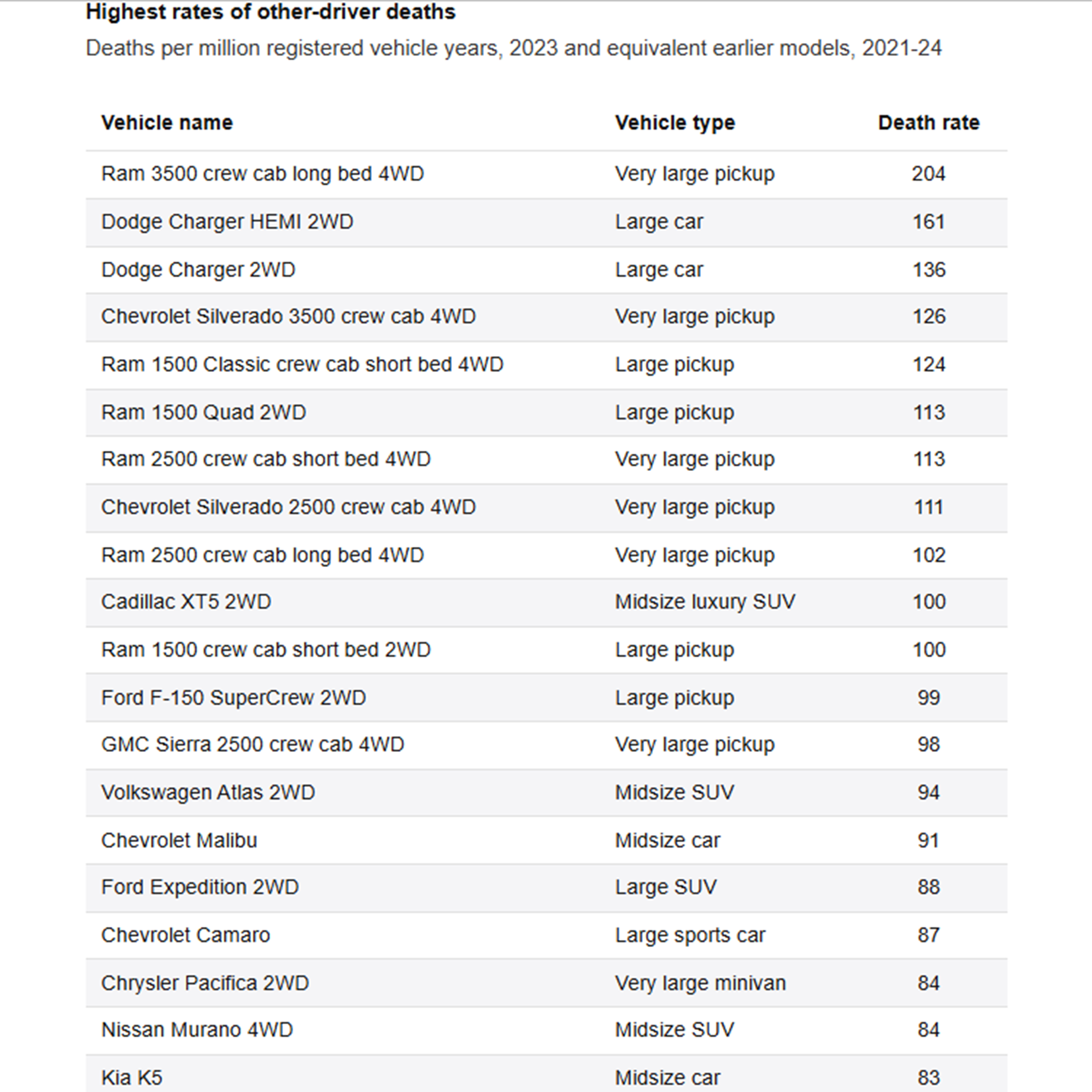
The model with the highest driver death rate was the Kia Rio, with 170 deaths per million registration years. The Ram 3500 crew cab long bed four-wheel-drive had the highest other-driver death rate, at 204 deaths per million registration years. Eighteen out of the 20 models with the lowest driver death rates are SUVs, including four small, nine midsize, four large and one very large model. Six models had death rates of 0.
The Chevrolet Camaro, Chevrolet Malibu and the two-wheel-drive versions of the Dodge Charger and Dodge Charger HEMI feature among both the models with the highest driver death rates and those with the highest other-driver death rates. All but one of the six models that feature among the vehicles with both the lowest driver and other-driver death rates are luxury SUVs.
The models on both these lists are the BMW X5 four-wheel-drive, BMW X7 four-wheel-drive, Porsche Cayenne four-wheel-drive, Volkswagen Atlas four-wheel-drive, Volvo XC60 four-wheel-drive and Volvo XC90 four-wheel-drive. The rates include only driver deaths because all vehicles on the road have drivers, but not all of them have passengers or the same number of passengers. The number of deaths is derived from the federal Fatality Analysis Reporting System. Registration data come from Mobility Global.
To put that first paragraph in other words, Ram 3500 pickup trucks kill other drivers in crashes more often than the drivers of Kia Rios die in crashes. In fact, the list of vehicles that kill other drivers the most is almost entirely populated by pickup trucks, SUVs, and muscle cars. From IIHS:
According to the IIHS report, trucks don’t even have the lowest death rate for their own drivers. According to IIHS, the vehicle class that has the lowest deaths per million registered vehicle years is “very large luxury cars,” with 7 deaths per million registered vehicle years. Second to that is “large luxury SUVs” with 10 deaths per million registered vehicle years. Small pickup trucks come in at 31, large pickup trucks are at 29, and very large pickup trucks land at 24.
For comparison, the worst is the class that IIHS calls minicars, which have 158 deaths per million registered vehicle years. IIHS notes elsewhere that large SUVs and trucks are also known to kill more pedestrians and cyclists than smaller vehicles. Basically, a truck will probably protect you or your teenager fairly well, but will also leave you more likely to kill someone else in a crash. That doesn’t even mention the psychological toll of being in a crash where the other person dies.
Teenagers Are Terrible Drivers

Even after all of this, there’s another thing you need to consider. Teenagers are bad drivers and have crash rates over four times greater than adults. They have poor car control, don’t really know what they’re doing, and are piloting a multi-thousand-pound missile with all of the distractions of the world going on around them. They don’t have the experience to know to slow down for rain, snow, or ice. They don’t know the proper speeds to take a corner. Also, I was a teenager once, and I remember how I thought I was invincible. I did dumb things with cars back then that I’d never do today.
If you take a peek at the IIHS list of picks for teen drivers, there isn’t a single pickup truck on the list, and the largest SUV class is mid-size. IIHS is pretty clear on why:
As in past years, the list doesn’t include anything with excessive horsepower relative to weight or anything marketed for performance. However, many seemingly benign vehicles come in high-horsepower versions, so even when shopping from the IIHS-CR list, families should make sure to stick to the base engine. Powerful vehicles can entice young drivers to take risks or lead them to speed inadvertently.
Minicars, as well as anything under 2,750 pounds, are also excluded. Although smaller models tend to be popular with young drivers, they can’t protect their occupants adequately in crashes with bigger vehicles.
On the flip side, large SUVs and large pickups aren’t a good choice for inexperienced drivers because they can be hard to handle and take longer to stop. They also pose more risk to others on the road, including pedestrians, bicyclists, and people in smaller vehicles.
It’s also notable that large trucks and SUVs may roll more easily than smaller vehicles, especially if your teen outfits them with lift kits and larger tires.
Thus, the sweet spot is somewhere in the middle. You don’t want to give your teen the largest possible vehicle at a time when they have no idea what they’re doing behind the wheel. As evidenced by IIHS findings, that could be a recipe for a life-altering disaster. However, it’s also true that maybe you don’t want to buy your kid that used Chevy Spark. Instead, IIHS recommends something like a Mazda 3, Toyota Camry, Subaru Forester, or a Volvo XC90. Check out the full list here.
The Choice Is Yours

Of course, none of this is really written in stone. Even the safest cars in the world have had fatalities. Likewise, many folks have grown up driving terrible, unsafe cars and gotten through unscathed. My first car was a 2001 Kia Rio that had a body of rust and an only halfway functional cooling system. I drove that car like a maniac.
Ultimately, as a parent, the decision is up to you. Buy your kid whatever you want. I suppose your teen should also have some input, too. However, I think that whatever decision you do make, it should be an informed one. Don’t just blindly buy a model on the assumption that it’s safe. Be sure to do some research and know what you and your teen are getting into. If you and your teen decide the risk of a certain vehicle is worth it, at least you decided from an informed place.
Above all else, I also recommend defensive driving classes and then, later, advanced driving classes. High school Driver’s Ed classes sometimes just teach you the basics, which is fine. But actually knowing how to handle a car rather than just drive it could potentially save your life one day. It’s also really fun, too. But no matter what you do, be safe out there!
Top photo: Ford/Chevy


When I was a kid the busy intersection visible from our kitchen window was notorious for accidents.
I distinctly remember a head-on collision between a Hilux and a Corolla of a similar age. The Corolla was pancaked back to the windscreen, and there was barely a mark on the Hilux at all. But it was the Hilux driver that left in an ambulance with neck injuries, and while waiting for the ambulance was comforted by the Corolla driver, who was completely unharmed.
Something like a manual Accord would probably be the optimal first car for a new driver. Substantial enough to not get crumpled like a beer can in a collision with an F150, but dynamic enough to not be a liability in an evasive maneuver like an SUV.
I learned to drive in a beat-up automatic Volvo V50 2.4 non-turbo with 168 hp, as did my younger brother. It was the perfect blend of ‘safe enough’ with ‘small enough’, ‘slow enough’, and ‘cheap enough’ to be the perfect learner beater.
I still find it funny though that my grandmother came by one day and said, ‘what a big car!’ But I think she just sees any station wagon and thinks it’s a ‘big car’.
It strikes me that it can be difficult to separate the effect of the vehicle from the effect of the driver when looking at fatality rates for vehicles, but you can infer large trends. It seems very likely, for instance, that luxury SUVs and large luxury sedans have the rates they do because they’re mostly driven by middle-aged drivers, who can afford them, rather than teenagers, who cannot.
Teens are AWFUL drivers, my first car was a retired 93 police interceptor (detective version!) that I bought from the poice auction for $300 bucks and I promptly wrapped a V8 RWD panther around a tree because I was trying to do a burnout for my gf.
My pops gave me his second gen 3.2TL which was so much fancier and while I never totaled it, I bumped and scraped it al the time. But also I learned how to work on a car in that vehicle and now I’m a responsible track rat.
I’m just going to put two things out there:
3. and Non BMW owners turn signals classes
if you have a highly irresponsible kid or one with really bad driving skills, please just don’t put them on the road until they are ready or stick them in a second gen prius with 90 hp.
I was getting my hair cut this past weekend and a kid came in right before me and was talking to another barber. He looked young and I saw that he had been dropped off by an adult (no idea if it was his mom or not but needless to say he didn’t drive himself). He was talking at length to his barber about how he is saving up for a Mustang and his first car has to be a muscle car from the early-mid 2000’s because “that’s what it has to be”
He went on talking about looking at one but the salesman sold it right before he came in (classic) and he tried to sell him an Accord that had no AC (also classic). The kid said that he “aint driving no damn Accord. What am I? Halfway into my grave with 3 kids that hate me?” Now the barber, who seems like a slightly functioning adult, goes “dude I don’t blame you. I wish I could have gotten a muscle car to do stupid shit when I was your age.”
No matter what car you have at that age, you’re gonna do stupid shit. I had a B4000, my buddy had a 96 Grand Cherokee and my other friend had a Focus that was halfway to its grave when he bought it. But to advocate for a muscle car and encourage that behavior seems just flat out irresponsible.
Long winded comment, I am sorry, but let’s try to teach the kids to be better than we were, especially with all the distracted driving happening now.
Huh, kinda confirms my bias, so I’m liking this post. I’ve got a 2014 Ford Focus on it’s third new driver, and both the drivers and the car have so far survived the experience well. Basically it’s a choice of not too much car to learn in, plus respectably decent safety ratings for the worst case.
The middle kid graduated to buying his own Focus ST3 he liked them so much.
I learned to drive in a full size (pre minivan era) Dodge van. I worked at a record store on the main street, so I got good at parallel parking. That van was Stellantis quality long before Stellantis.
Spent most of my teen years in a 2 door Neon dodging deer, semis, and farm vehicles. That glorified go-kart was good for getting my teen brain to comprehend my own mortality driving to work on the interstate. The real MVP was the defensive driving course we had in our county – it was top-notch and I wish it was required for all teens.
I wonder how hard it would be to program a modern car to operate in a “teen” mode with a special key, much like valet mode but worse:
Top speed limited to 85 mph
Acceleration to 10+s 0-60
Traction control always on
Seatbelts on or car won’t work
Virtual ankle bracelet tracking mode
Stereo only plays christian rock, abstinence and DARE propaganda with shrill backseat driver criticism of any minor traffic violations.
Dashcam and driver recording always on with automatic logging of major traffic violations
SatNav only displays approved destinations, e.g. school, library, church, grocery store but not vape shops, liquor stores or gun stores.
Electric shock mats in the seats triggered when inappropriate behavior is detected.
Stuff like that.
Top speed limit at 85 makes sense, neutering acceleration is a rough one though. Acceleration can be a safety feature. I can hear all of the arguments of why it shouldn’t be but here in the real world with heavy, tight traffic, I want agility and quickness to get out of a mess, vs only caring about preventing a mess.
Nah.
My car does 0-60 in a bit over 9s even when empty and I never have to come even close to flooring it for *safety reasons*.
My Tesla has a parental control mode where you can set the maximum speed, reduce acceleration to “chill” mode, forces all safety features to be enabled, and sends notification when the car is used between 11pm-4am. It can also restrict certain apps on the car’s UI. It’s not perfect but it’s a good start. Not related to parental mode, but all Teslas you can view the location, speed, and what’s playing on media from the mobile app. Makes it very easy to spy on your teen.
I think it depends on the Tesla.
An older S with physical controls I think is better for a teen than a newer, everything on the touchscreen Tesla.
Well, at least it would be for me.
My 2020 F150 has something that says key profiles or the like. I think I can program it certain parameters in this vain. But never explored it because I don’t have a kid of driving age yet
Oh?
*keyboard clicks furiously*
Folks we have a (partial) winner!
“You can configure certain vehicle feature settings when you first create a MyKey. You can also change the settings afterward with an admin key.
Note: Not every feature applies to every vehicle in every market. When they are available for your vehicle, they will appear in your information display, providing choices to switch them on or off, or to select a more specific setting.
https://www.ford.com/support/how-tos/keys-and-locks/mykey/how-do-i-use-mykey/
Speed limiter, full check
Audio system control and back seat driver, partial check
Traction control always on, full check
It’s a good start.
The best part? All of it is included in the purchase of used vehicle. Along with the Ford app which lets you remote start and lock/unlock your vehicle. Again at least with my truck as that’s the only experience I have with it. Plus key fob remote start. Beats the Mazda’s I have with their connected app which you have to pay $10/month for after the first year and then the remote start only starts it about 65% of the time.
My friend had a weird interest in getting his daughter a “cute” Fiat 500. ended up doing it actually, and I liken them to SMART Cars and Scion iQ’s. Though I do kind of recall the little tikes Smart Cars having some sort of HSS perimeter frame, making them less likely to crush, though perhaps more like to become a pinball down the road in a crash, so is that more safe or not? at any rate. I have multiple vehicles I am fine with giving up to my daughter in a year or so, though I still require that she learn to drive one of the stick ones first.
That said, I am actually leaning towards a bigger Sedan with AWD, mostly for the winter months in the middle of the US. She might even have a free Subaru Legacy with just under 100K miles available from Grandma if that is what she wants, but I am kind of leaning towards some detectives cars I have seen popping up lately. AWD 5.7 liter chargers with a cop motor, cop tires, cop suspensions, cop shocks, and under 100K might be the right thing. one even left the bull bar up front.
seem silly, I know, but hear me out. I purchased a 91 Caprice at one time for a temp filler car when some guy slid through and intersection and took out my 76 Heavy Half. it was just a 305 TBI thing but the spotlight and white paint made it so all the other SCHMO’s on the road sat up straight, drove the speed limit and otherwise tried very hard to follow the rules of the road when around that thing. I kind of think that alone would go a long way towards keeping my daughter safe on the road.
So get your teenage a used Lexus LS
had a friend in highschool driving his parent’s one year old hand me down LS400. the dumb shit he did in that is pretty crazy. that car has way more power than any new driver should handle.
I have 4 boys. Two of them drive now, the third starts in march. Kid one drives an 06 Buick lacrosse, kid two drives 09 Pontiac vibe, kid three will drive a second 06 Buick lacrosse. All three have modern safety systems (more than what I had). Each of these cars cost between $2200 and $2500. I spend around $300 on a new apple car play radio and a back up camera. We put it in ourselves. Good father and son time.
So far, they have hit a mailbox, had two small wrecks caused by others, and a front bumper ripped off of it’s clips but we still don’t know how that happened (yea right!). I love these cars, the are cheap to buy, cheap to insure, safe, parts are abundant, and they get decent gas mileage. I am partial to the Buicks. If any of them caught fire today, I would replace it with a Buick lacrosse or lucerne. The Pontiac has the Toyota motor that is burning about a quart of oil every 3000 miles.
This is what I’ve said for years.. nice to see I wasn’t out in left field. My daughter learned to drive with and continues to drive a 17 Accord. It happened to have the V6 since it was mine, but I’m ok with that. She’s a responsibile kid and I think the extra power is more likely to be used speeding up because she misjudged how quickly a car was coming over doing something irresponsible like I would have done at her age if my car had any power.
I learned to drive on a 94 Accord, which was handed down to me once I got my license. I think a mid size sedan is a great start- a bit more size and potential protection, but not too much. Of course that 94 Accord and a current Civic are the same size, so I guess a newer Civic is fine too.
Makes sense to me. My logic was more along the lines of a large car just too large for the new driver to be able to judge the dimensions of the car and then more likely to hit something and the small car is so small that they would be afraid to drive something bigger because it’d feel too big. Not exactly why the article recommends mid-size, but close enough I guess.