


Fifty years ago, absolutely no one could have imagined that the traditional Jeep and Ford Bronco would one day be bought by anyone other than park rangers, a few sportsmen or survivalists, and niche fans. Oh, there was also Daisy Duke back then, but that’s about it. How can we forget Daisy? [Ed note: Don’t sleep on David Soul hunting the vampires of Salem’s Lot in his CJ-5 – Pete]
Well, today many stylish ladies of any age group seem to choose a loud, lifted Wrangler over a luxury sedan or sports car, and families by the thousands are buying heavy-duty Broncos as their daily driver. Conspicuously absent from the choices is an offering from General Motors. Not since the old K5 Blazer of the seventies with a lift-off roof has The General even tried to play in this sandbox, so there’s not a lot of precedent for them to do so. However, I recently saw some concepts of theirs that might make cool alternatives to the entries from Ford and Stellantis. Like the current Willys-style Wrangler, the inspiration comes from the last place you’d expect for a suburban street vehicle.


Humvee, You Are One Ugly Mother…
I’m not a big follower of military vehicles, but I get why companies clamor for the opportunity to build one. A contract from the government means millions if not billions in sales that have nothing to do with the hassle of selling through dealerships and competing with umpteen other brands; just make a few thousand of some army green thing and it’s sold before it even leaves the factory. It’s no surprise then that car companies will pitch battle-ready vehicle concepts to defense departments the world over. Few of them actually get produced, and some of the rejected ones are way cooler than the Jeeps and Humvees that actually did get built in large numbers.

One famous example was called the “Cheetah,” developed by an American company called Mobility Technology International (MTI) and supercar-builder Lamborghini in 1977. With a steel chassis and fiberglass body, the Cheetah featured a Chrysler 360 V8 in the back, which supposedly resulted in poor handling. The Cheetah was demonstrated to the U.S. military, but they never tested it, much less purchased any of them.

Lamborghini instead attempted to market the idea as a product for oil exploration companies. The struggling firm’s financial problems put paid to the project, but they later revived it with the engine in the front to create the vaunted Countach V-12-powered LM002. A total of 301 civilian examples were built of this “Rambo Lambo”, the only sport utility ever made by the Sant’Agata firm if you don’t count the gussied-up Volkswagen Touareg they sell now.
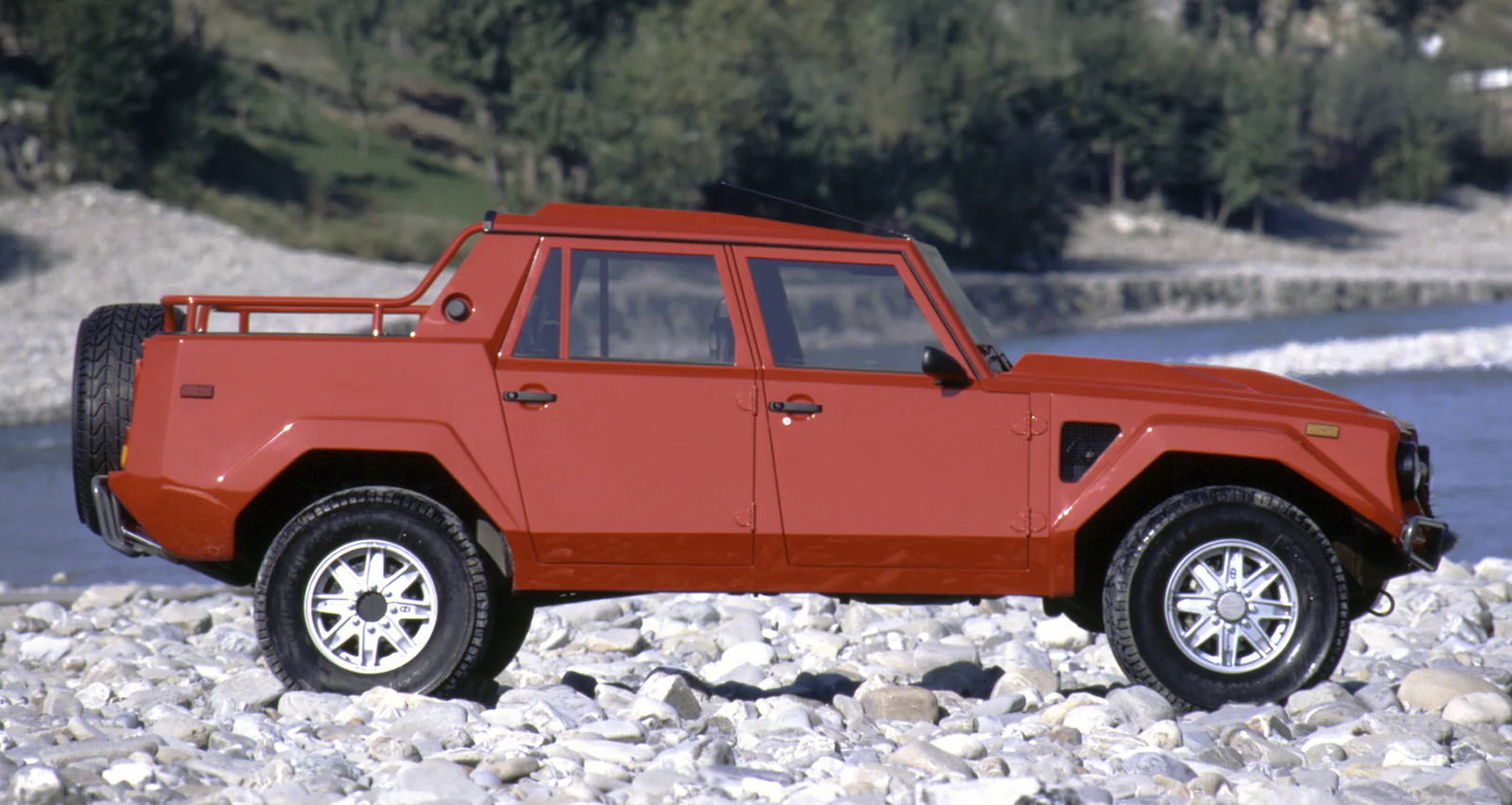
The contract that Lamborghini didn’t get for this new style of military Jeep ended up going to a division of the company that made the original Jeep. AM General actually began as the commercial/military products division of the ill-fated American Motors Corporation in 1971, and this always-innovative company started work on what was called the High Mobility Multipurpose Wheeled Vehicle (HMMWV or Humvee) in 1979. However, by the time the multi-billion dollar production contract was issued in 1983, AM General was no longer part of AMC. The purchase of a majority stake in the company by a French firm (Renault) meant that American Motors had to dump AM General from their portfolio. I feel the need to mention that any time AMC had a great and potentially profitable product, they got rewarded with a swift kick in the ass. Every. Single. Time.
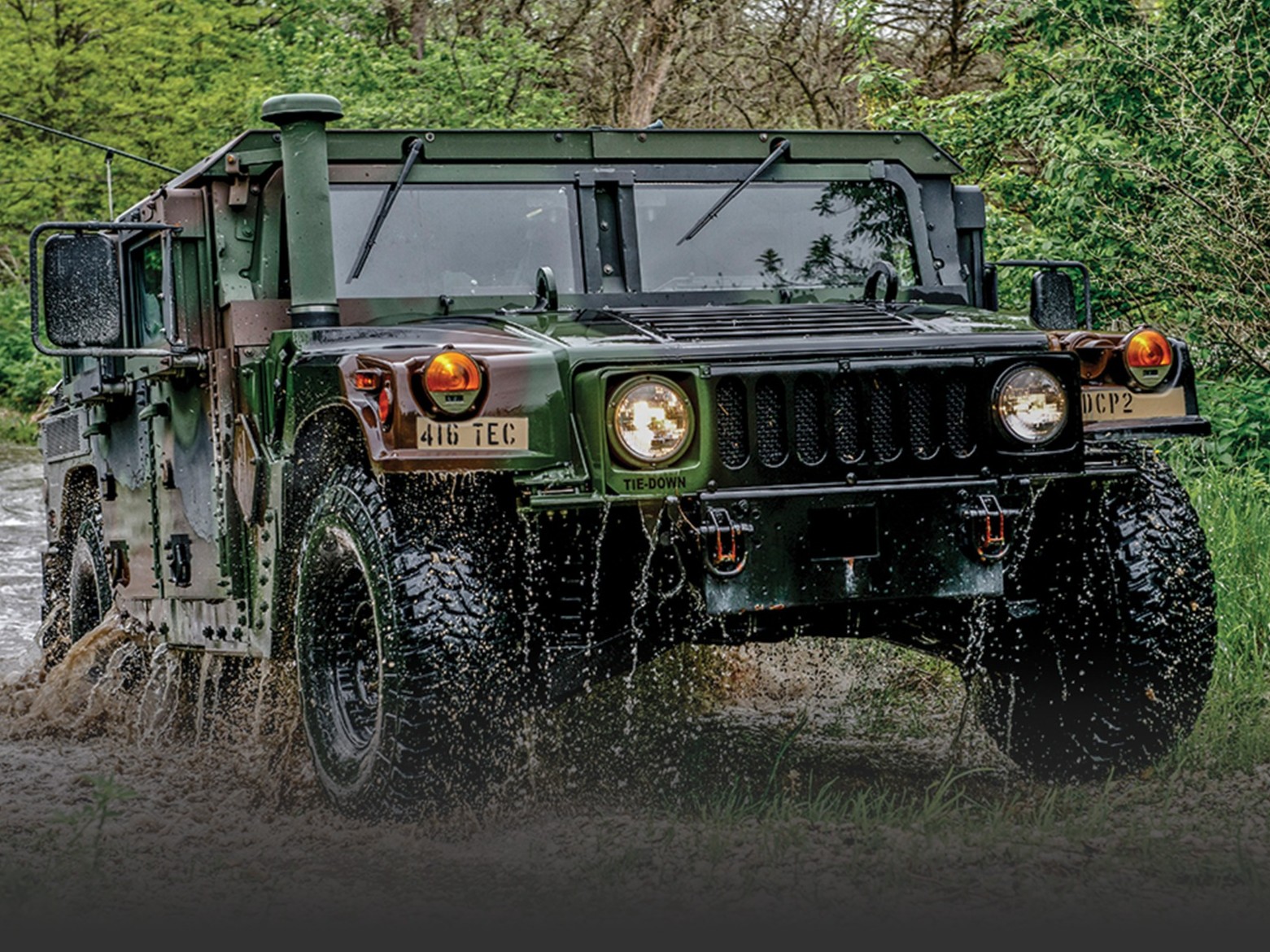
Now an LLC and goaded on by the man who said “eef eet bleeds, vee can keel eet”, AM General began making civilian versions of the Humvee under the “Hummer” brand name in 1992. By now, SUVs were a fire-hot commodity, so General Motors purchased the rights to the Hummer name in 1999 (but never had anything to do with the military versions). GM sold the original Hummer as the H1; later they expanded the lineup to include the GMC pickup-based H2 in 2002 (built at the AM General factory).

The smaller H3 debuted for 2005, built at the factory that made the Chevy Colorado on which its chassis was based.

Sales of such conspicuously consuming products suffered in the late-2000s Financiapocolypse; with GM’s bankruptcy, Hummer was one of the victims of the great Purge Of Brands and ceased to exist after 2010. A decade on, the Hummer name returned under the GMC brand with the tough look of the earlier H-series, but now as an environmentally friendly luxury EV.

Yeah, I know; it’s not the same thing as the battle-ready examples of the vehicle that it shares its name with. It’s more like an adult-sized Power Wheel interpretation of the original models than anything resembling a “real” Hummer. Still, a bigger regret to me is that no Hummer or Humvee of any kind over the life of the brand came close to matching something like the Jeep Wrangler or new Bronco in terms of being an open-topped, manageable-sized off-road fun machine that made sense for road use. I think I see a way to make that happen.
General Motors For General Infantry
Just because they didn’t build Army Humvees doesn’t mean that General Motors didn’t want government contract business. In fact, GM has an entire division called “GM Defense” that has the sole purpose of creating military products. In recent years, they displayed a number of rather cool-looking products like the “Next Gen” Tactical vehicle.

Here’s what the GM Defense website says about it:
Based on the Chevrolet Silverado 3500HD ZR2 truck, the rugged and durable Next Gen combines GM’s 2.8L Duramax® turbo-diesel engine with a 12-module battery pack, in addition to drive motors for the front and rear axles that enable Silent Drive and Silent Watch, technologies that make the vehicles harder to detect.
It’s very industrial-looking, but the detailing makes it look very much like a designer had a hand in the development.

GM Defense also came up with an electric military vehicle concept, or the EMCV:
The EMCV is presented with the same chassis and powertrain as the Hummer EV, which is powered by the giant 200 kWh battery pack. Planned to have a slightly lower range than the current 329 miles of the Hummer EV at 300 miles, the vehicle is also coming equipped with a diesel range extender if needed. The EMCV has the capability of 800-volt DC fast-charging up to 350kW, enabling up to nearly 100 miles of driving range in about 12 minutes. The military vehicle offers 329 miles of combined driving range, according to GM Defense, with a 0-60 mph acceleration time of 3 seconds.;
It’s essentially a tactical interpretation of the current GMC Hummer EV; the chassis and powertrain are the same.

Range is supposedly less than the street version, so figure around 300 miles, but GM admits that the diesel range extender could be added. The design language works quite well, and it almost comes across as a giant side-by-side more than a luxury truck that spawned it. I don’t know how far either of these proposals got with the Army, though I can say with virtual certainty that a battery-powered war machine sounds like a non-starter in anyone’s book. They claim that “fast charging” could give it 100 miles of range in ten minutes, but exactly how this is going to happen in, say, an Iraqi desert is not known. This idea is likely never going to see the light of day.
Regardless of the feasibility, I love the appearance of these things; any design that starts out as a combat vehicle has some cred as a heavy-duty vehicle. It’d be a shame for either one to end up as a never-was, so let’s use them to make that GM Jeep/Bronco competitor they’ve kept from us.
Declaring War On Stellantis And Ford
First, we need to figure out what mechanicals General Motors even has to make a Bronco/Wrangler competitor. Since Ford’s Jeep fighter Bronco uses a chassis heavily based on the mid-sized Ranger pickup, I have to believe that Chevy Colorado underpinnings would be perfect if chopped down to the wheelbase of a Wrangler. This body-on-frame with a live rear axle and four-wheel drive should at least be the equal of the Bronco; a fact that’s important for credibility if not for real-life use. Let’s face it: about 95 percent of Bronco and/or Jeep owners are as likely to go rock crawling as they are to drive on the surface of Mars itself.

I’ll put a new body onto this chopped-wheelbase pickup chassis for what I’ll call the Kodiak, reviving the name of GM’s long-dead series of heavy-duty trucks. The styling ends up being a mishmash of the two military proposals I’ve shown above, with the EV unit’s center body capped off in front with the Silverado version’s nose. The one shown below in matte green would be the hard-core example, but I would imagine a more mall-parking-lot-friendly version as well. Naturally, to compete with Jeep and Bronco, the doors could be taken off and stashed in back. A drop-down windshield would have to be part of the package as well.
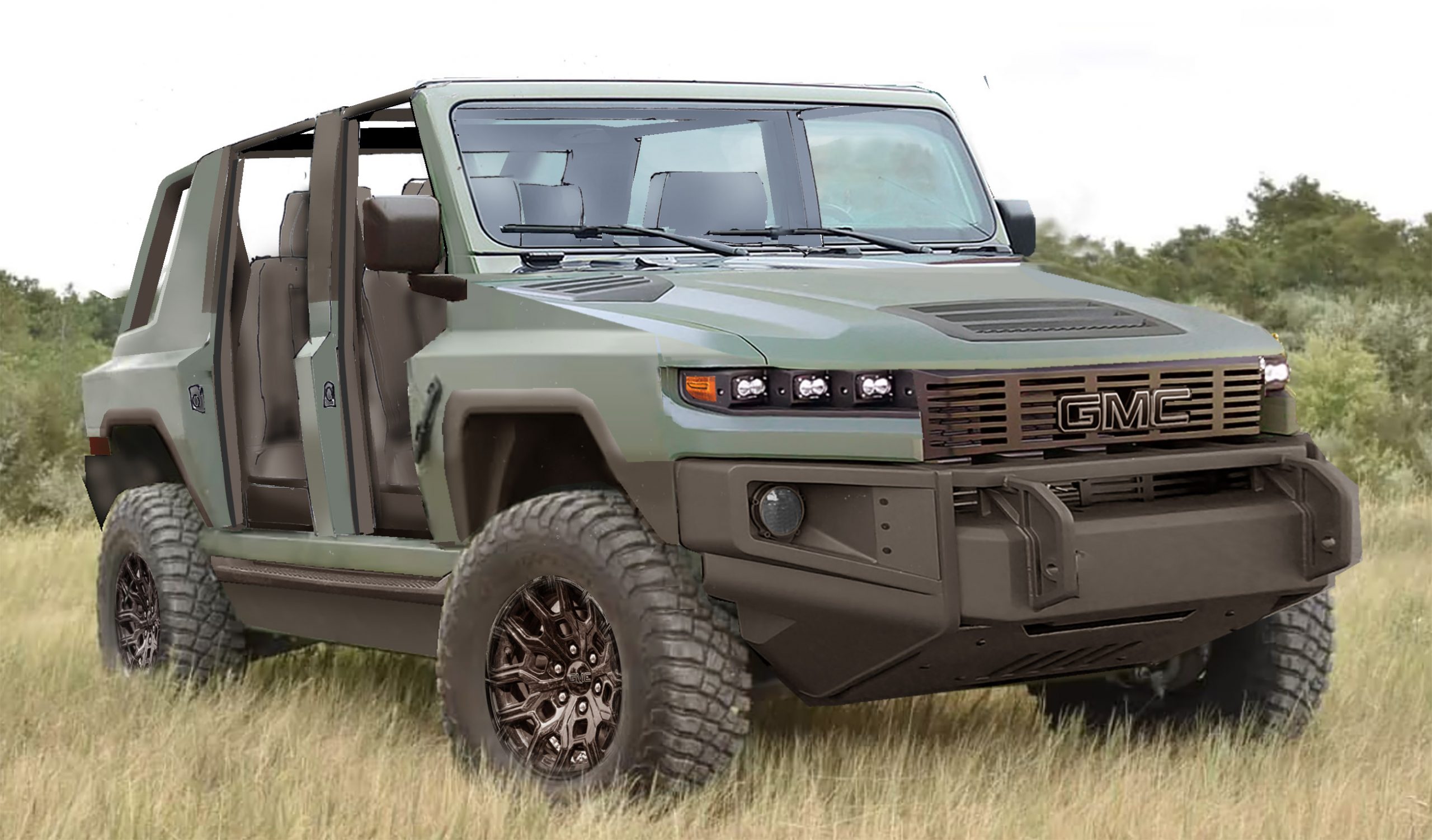
A thick body-colored C pillar that wraps over the top is not unlike the current GMC Hummer EV, but the whole thing is much more industrial and aggressive than that luxury behemoth (it looks more like an old Isuzu Rodeo, which I love). Doors feature roll-down frameless glass windows, and the roll cage body can be covered in fabric or rigid roof panels. Rear quarter windows can also be removed.

What I like about it is that it looks modern, or even retro-futuristic, without trying to recall the appearance of some sixty- or eighty-year-old vehicle as with the Ford and Jeep entries. Here’s an animation to show how the military vehicle concept translates into the consumer version:
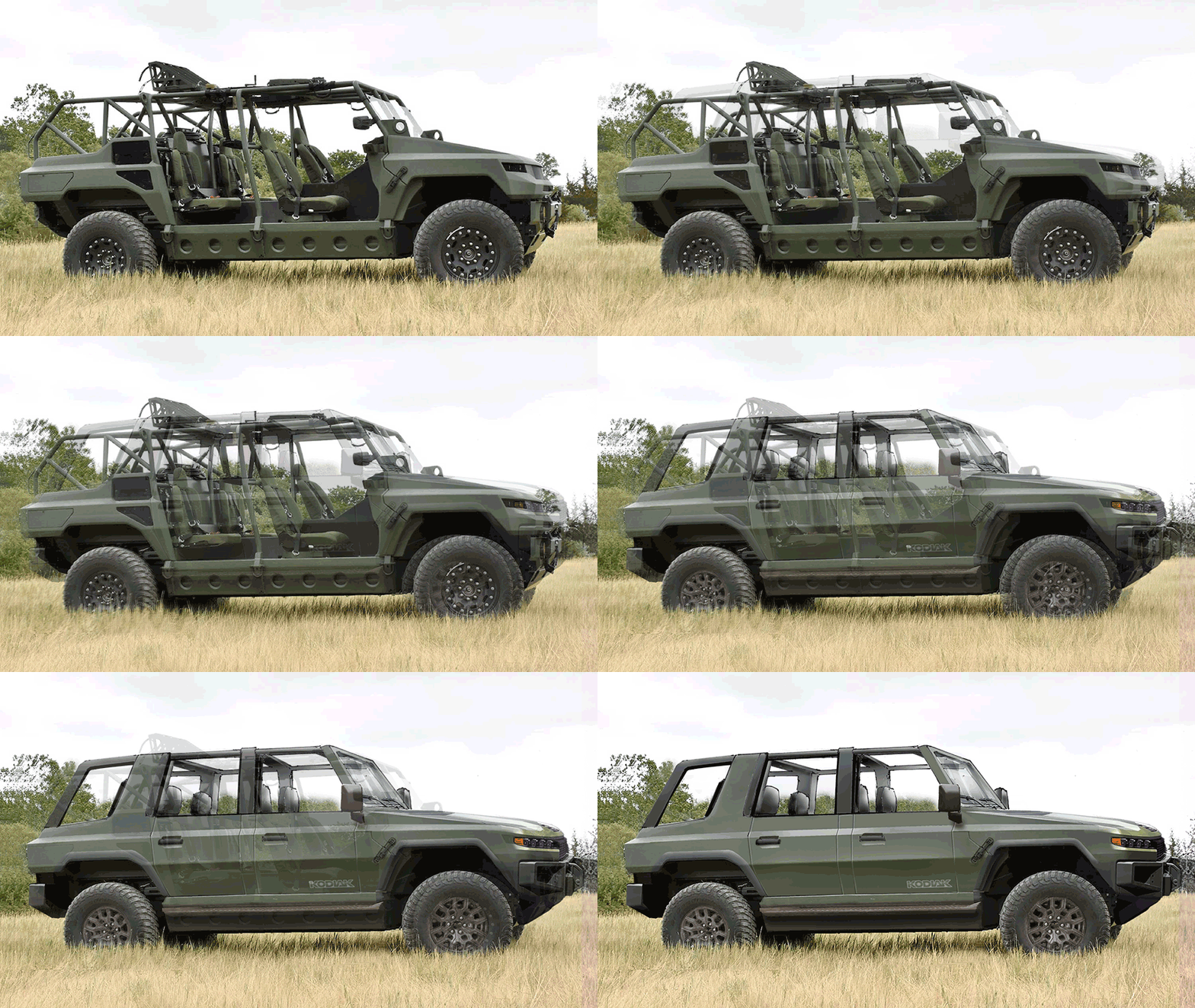
In back, the tailgate has simulated “box taillights” as on the original Hummers (and on earlier Jeeps before they went and got all stylistic with them); wraparound smoked-out light units below the tailgate have turn signals, rear fog lamps and repeater lights for when the gate is down.

Inside, the interior of the original Hummer was almost as iconic as the outside, with a massive, almost pyramid-shaped monolith of plastic dominating the design.

I’d like to pick up on that shape with the new GMC Kodiak’s dash. Exposed fasteners abound, with round military-radio-style knobs and buttons including a set of controls for the differentials and drive modes. A row of switches for things like seat heaters is done in tactical style to add some purposeful-looking fun. I’ve even copied the old Hummer’s odd power window switch placement on the sides of the center console, for better or worse (it keeps them off of the removable doors, at least).

Whether you like the idea of Army Jeep-style vehicles is beside the point; a lot of people seem to want them, even though they’re a bit like using a samurai sword to cut celery. A GM entry based on a competent mid-sized truck with the attitude of some real military proposals could assist the Bronco in making things even more difficult for Stellantis.
Top graphic base image: GM Defense


“I can say with virtual certainty that a battery-powered war machine sounds like a non-starter in anyone’s book. They claim that “fast charging” could give it 100 miles of range in ten minutes, but exactly how this is going to happen in, say, an Iraqi desert is not known. This idea is likely never going to see the light of day.”
I wouldn’t be so sure about that. Military logistics are always looking for ways to simplify supplying units, and I think there is a case for charging from gensets. And abundant sunshine for solar top-ups.
I also wonder whether the right modular battery technology could serve dual use as energy storage and armoring. Obviously not lithium-ion, but maybe iron-air?
Why are you using concepts? The “Infantry Squad Vehicle” is in service, and is basically a colorado underneath.
Now do the two door version
This needs a Panhard touch… At least the Stellantis version
But Sadly PSA sold it to Volvo Trucks (well RVI at that time) more than a decade or so ago…
Flashy “oPeRaToR” vehicles get the most spotlight but what we very much need are non-tactical vehicles that use less liquid fuel. Stuff that stays on the flightline and does fewer than 10 miles per day (e.g. servicing vehicles) would be an excellent use case as EREVs.
I’m also curious how much mass the electrified versions of these tactical vehicles will have vs. their combustion counterparts. It doesn’t seem like it’ll become a bottleneck for airlift (C-130s in particular tend to run out of cubes before they run out of pounds) but it will show in fuel burn rates when some commander decides those vehicles need to be there yesterday, which happens pretty frequently for anything with even a whiff of special forces to it.
The problem here is how do you power it? I completely agree that EVs are ideal for very low mile work, but being the military time is the most critical of all facets. Whichever uses less fuel is better all else equal, but whatever takes less time wins every time. The US Mil is the king of logistics, so getting fuel somewhere isn’t a problem. Waiting for a pack to recharge isn’t deemed acceptable.
BTW, this is why most anything tactical runs on cr123a’s, AAs, or external batteries.
Also, military vehicles are exempt from environmental regs.
Needing to get fuel someplace is a huge weakness. See the constant attacks on supply convoys in Vietnam, Iraq and Afghanistan. In each one of these conflicts the US had a massive military superiority but our enemy used guerilla tactics to attack weak points in the logistics chain and inflict casualties until the US public turned against the war and we pulled out. The fewer tankers rolling though hostile territory the better.
The US military is also slowly learning from the war in Ukraine and realizing anything with a heat signature within a drone flight radius of the front line is dead. That is why pretty much every new ground vehicle the US military is requesting is a hybrid. Both to act as a gen set in the field but also to be able to move through that buffer zone without an ICE engine throwing out a heat signature say “Here I am, here I am, send a $5,000 drone to destroy this $500K vehicle. Ukraine has shown that armored vehicles are old tech that doesn’t fit into the current reality. Armored vehicles have been taken out like lines of calvary charging machine guns in WWI.
My FIL worked for defense contractors long ago and they were developing hybrid vehicles for the Marines way back then. Like you said, in electric mode they are silent and virtually invisible.
There are some very fun papers published by the Naval Postgraduate School (their masters and PhD granting institution) detailing adoption rates of more ecofriendly technology by troops! (This was published in 2018 so the “technology adoption” conversation is not the AI hellscape it is now): https://dair.nps.edu/bitstream/123456789/2307/1/NPS-AM-18-215.pdf
*raises hand* Logistics/fuels officer here. 🙂
We are the king of logistics but that’s not a position you achieve once and then you’re done. In fact, we’ve become so accustomed to having uninterrupted logistics and supply chains that we’ve begun to take it for granted.
Time is certainly the most critical factor but in the modern era war is a clash of supply chains and economies (which gets very complicated when said economies and supply chains are interlinked to a high degree). That’s the reason we don’t simply airlift everything everywhere – you have to conserve your fastest mode of transport for the most critical items
which usually turn out to be whatever the operators with the biggest beards want. All those chonky vehicles have to get where they’re needed first and the stuff that brings them there is itself consuming fuel, spare parts, and your tax dollars to do so!Most anything tactical is ultimately running on Jet A-1/JP-8 which is our single tactical fuel. It’s good because you can grab Jet A-1 damn near anywhere that runs turbine aircraft, and JP-8 is Jet A-1 that has been modified with additives like icing inhibitor, static dissipation, lubricity etc. These fuels are what run the vast majority of generators, ground vehicles, aircraft etc.
As *Jason* points out below, though, getting fuel where you want it to be is a massive annoyance. It’s one of those “20% of your problems will take 80% of your time” sorts of things. I wasn’t saying that hybrid tactical vehicles are a non-starter, just expressing some musings from the POG (person other than grunt) perspective.
My major interest as a researcher is energy savings. I appreciate that these tactical vehicles may consume less fuel, but the overwhelming majority of our fuel expenditure (tax dollars, contribution to anthropogenic climate change, etc) is thanks to the USAF and our cargo airlift. The capability is the best in the world, but we need that world to be habitable.
Aircraft fueling is, IMO, the toughest thing to decarbonize. Batteries work in drones where the payload is small, hydrogen takes up too much space.
I think direct air capture to fuel or biofuels will be powering aircraft that need a useful load, or they may just be some of the last fossil fuel vehicles.
Spot on re: aircraft fuels. It’s a matter of energy density. At the moment, there is no matching the combination of power density* and refueling turn time of hydrocarbons. I also agree that heavier-than-air aircraft (aka the vast majority of current aviation) will probably be the last of the fossil-fuel-powered vehicles.
*power density from the perspective of the entire system not just the fuel, before anyone comes at me with “but what about nuclear” 😉
“Next Gen combines GM’s 2.8L Duramax® turbo-diesel engine with a 12-module battery pack, in addition to drive motors for the front and rear axles that enable Silent Drive and Silent Watch, technologies that make the vehicles harder to detect.”
I would absolutely buy a Chevy truck with that powertrain.
Especially in Colorado size
I wish they’d do a Colorado street truck with the 2.7L turbo four connected to a a Tremec six-speed.
Reminds me of the old Tonka bronco-ish truck from the 70’s with wheels you could remove, and then lose one of, and royally piss off your dad. Or so I’ve heard.
I got a chance to drive the Infantry Squad Vehicle (a military version of the Colorado ZR2) in the backwoods of Michigan and it rips. I have a Wrangler that I beat up in the Sierras, and that drive in Michigan made me almost sell it for a Colorado ZR2. But a new car payment, crap fuel economy and an up charge for 35s kept me in the Wrangler. For now
Does GM still own enough of Isuzu to call this the Trooper?
GM only owns enough of GM through the generosity of US taxpayers.
Sure they lost their homes, but eventually Chevy sold a few Volts (late and over-budget, of course, since it was government work by that time).
Ya know, I was very glad that we stepped in and didn’t allow GM to fail, because at the time, GM had somewhere around 240,000 employees relying on that company for a paycheck.
Fast forward to now though, they’ve shed a total of 100,000 workers, and somehow are making the least reliable fleet of vehicles in thier entire history, and continue to ignore segments that are begging for a vehicle.
They truly could be the world’s foremost car corporation, I believe the engineering is there. They don’t have a build quality problem like Stellantis, they don’t have an engineering problem like Ford.
They just literally do not give a shit about anything other than quarterly earnings calls, and it shows.
Yeah, it made sense to me at that time too. Now though, I’d struggle to ever want to buy a GM vehicle. They really pissed me off a few years ago when they cried poverty when it was time to give their workers raises and bonuses but then turned around and gave an even larger number to shareholders without a peep.
The fact that they took the trouble to bring back the Bolt makes me think they’ve got some savvy. And a lot of those job cuts have to do with the seesawing EV regulations.
The US seems to be going through a military cosplay phase. Is everyone a doomsday prepper these days? It appears the dystopian future is winning in the minds of Americans.
“They are eating the cats and dogs!”
Welcome to the reality of 2026.
“It’s not a phase!”
Seriously, the “phase” has been going since September 12th, 2001.
Longer than that. I remember Ruby Ridge.
It seems it’s just been the last 20 to 30 years that everyone and their brother decided they needed military grade weapons to survive.
FWIW it’s been about as long since the assault weapons ban wasn’t renewed and you could get AR-15s again. The demand was there (though how much of it came from people not caring so much about something until they couldn’t get one is impossible to say.
I’ve been going since 1960, so to me this is a phase.