

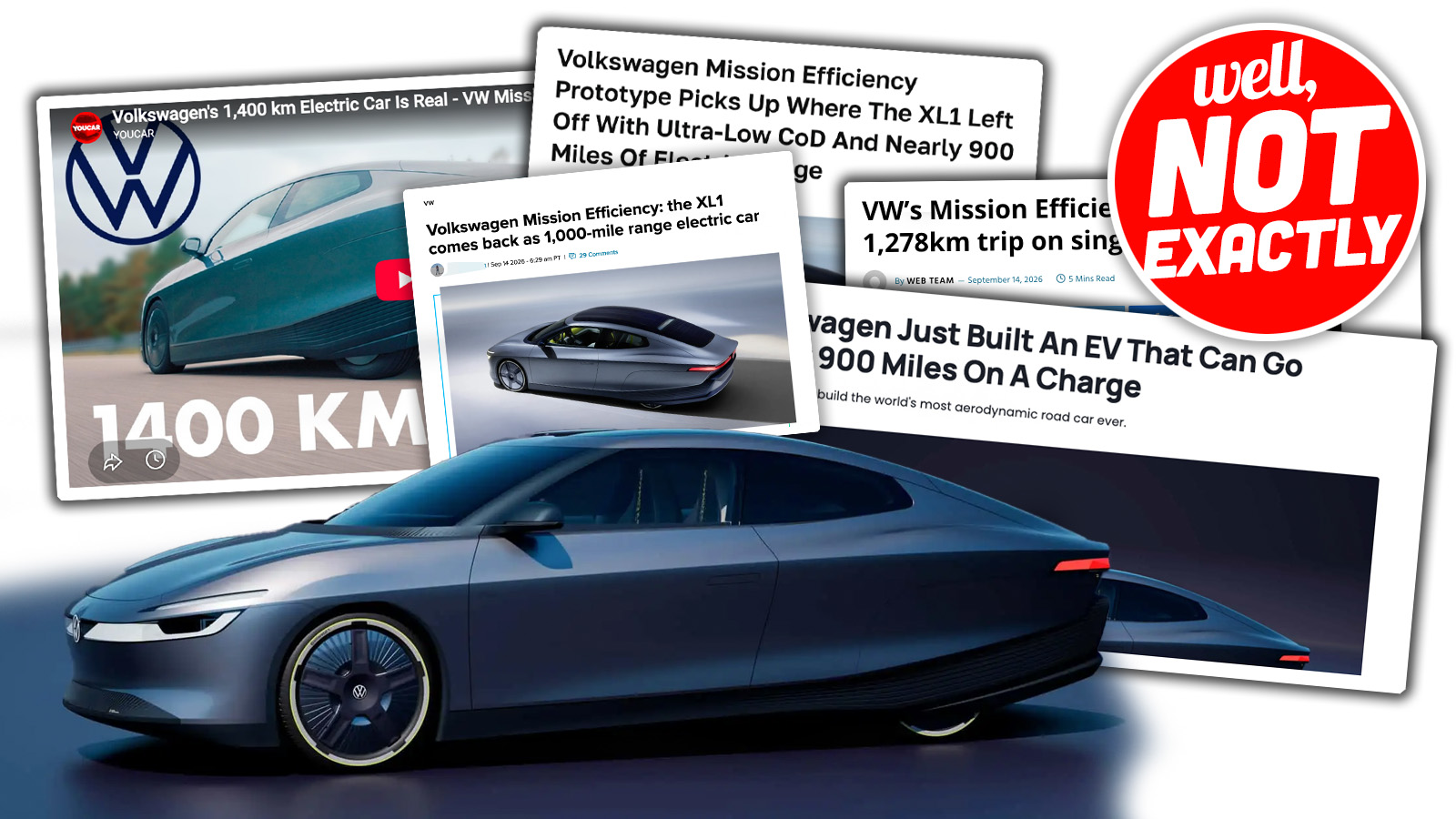
You may have seen a lot of stories floating around about how VW’s new Mission Efficiency concept has a range of about 900 miles; that isn’t true. It’s about half that, which is still quite good, but let’s talk about how we knew it was wrong.
Remember the Volkswagen XL1? Back in 2013, in the heady days before Dieselgate made everything so unsavory, VW showed off an incredible little car that looked like a sleek spaceship, a diesel plug-in hybrid with a drag coefficient of 0.189 (for comparison, the Lucid Air has the lowest Cd of 0.197, and a Tesla Model S has 0.208) and got somewhere in the neighborhood of 250 mpg. I got to drive one around Manhattan once, long ago! It felt pretty futuristic. Well, now that we are actually in the future, complete with everyone freaking out about a robot uprising, VW has provided a suitably updated new spaceship-like car, and this time it’s all-electric and even more of, well, everything, if “everything” is efficiency.


VW is calling this new car “Mission Efficiency” and describing it as “the world’s most efficient near-production electric car,” which is sort of a strange set of qualifiers. “Near-production” means, what, that they’re actually going to build these, and it’s not just a concept? They may mean “production” in the sense of how the XL1s were “production” where they only built 250 of them, though to VW’s credit, 200 of those were sold to retail customers. Oh, and they cost the equivalent of about $180,000 in today’s money.
Oh, and the Cd of Mission Efficiency is a shocking 0.158, which is a new record for a car approved to drive on normal roads. (The frontal area is 2.08 m², so if you want to calculate the drag at a given velocity at a given air density, you can for fun).
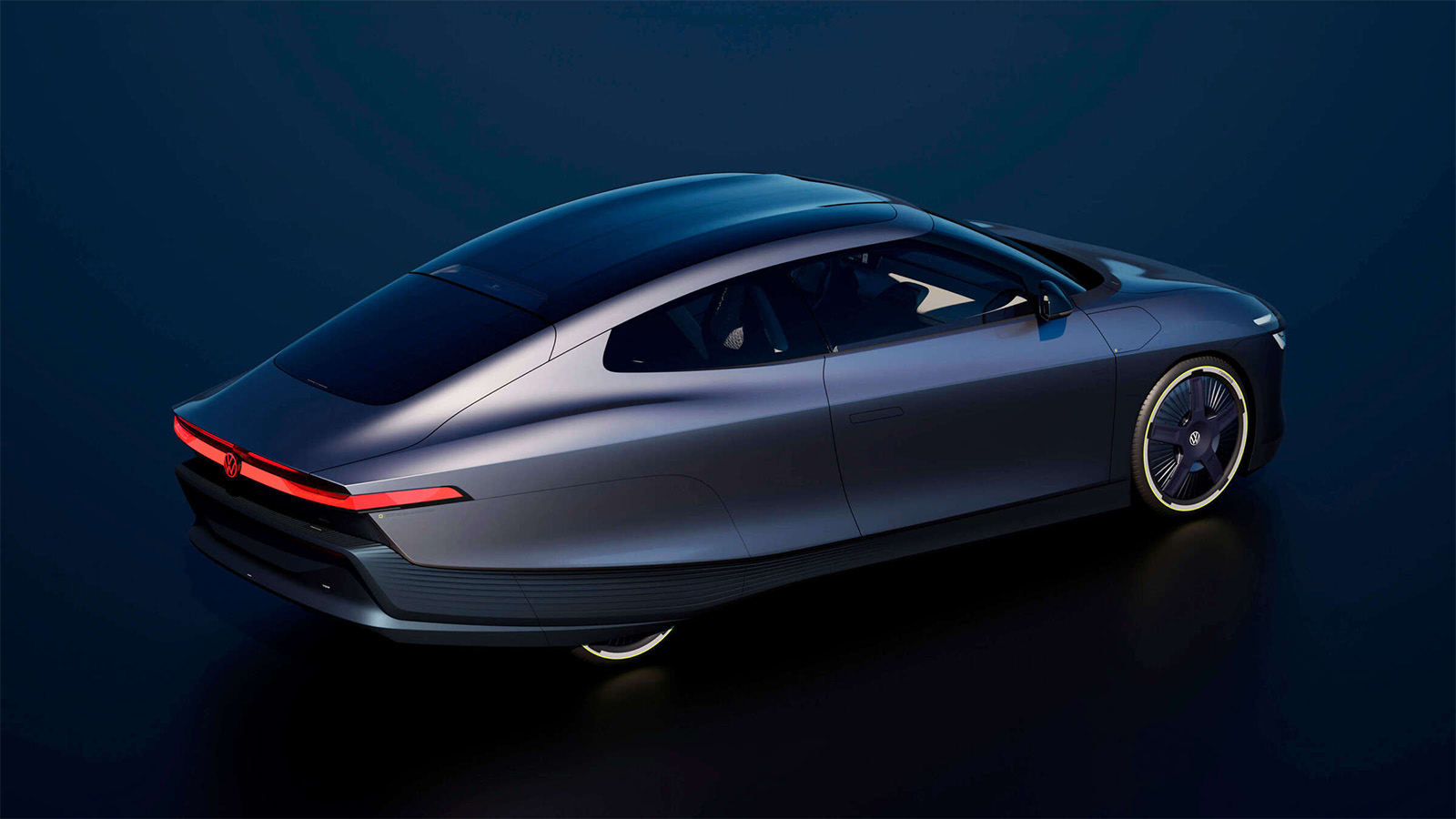
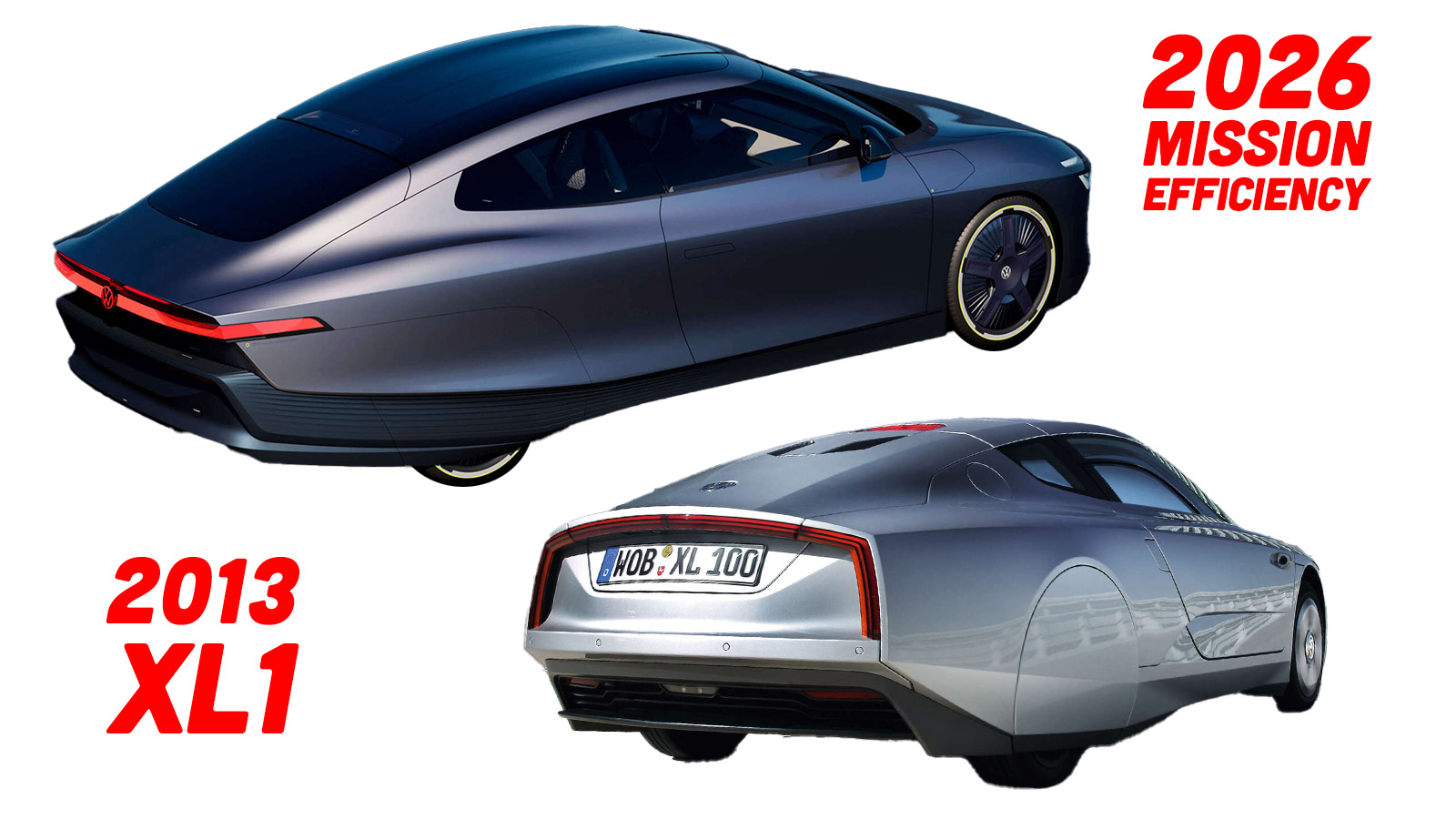
If this thing looks remarkably like the old XL1, there’s a reason for that, and that’s because the laws of aerodynamics haven’t changed in the past decade or so, which means the same basic shapes still are the most efficient.
One of the more interesting differences between the Mission Efficiency and the XL1 has to do with the side mirrors; specifically, that the new car has them:
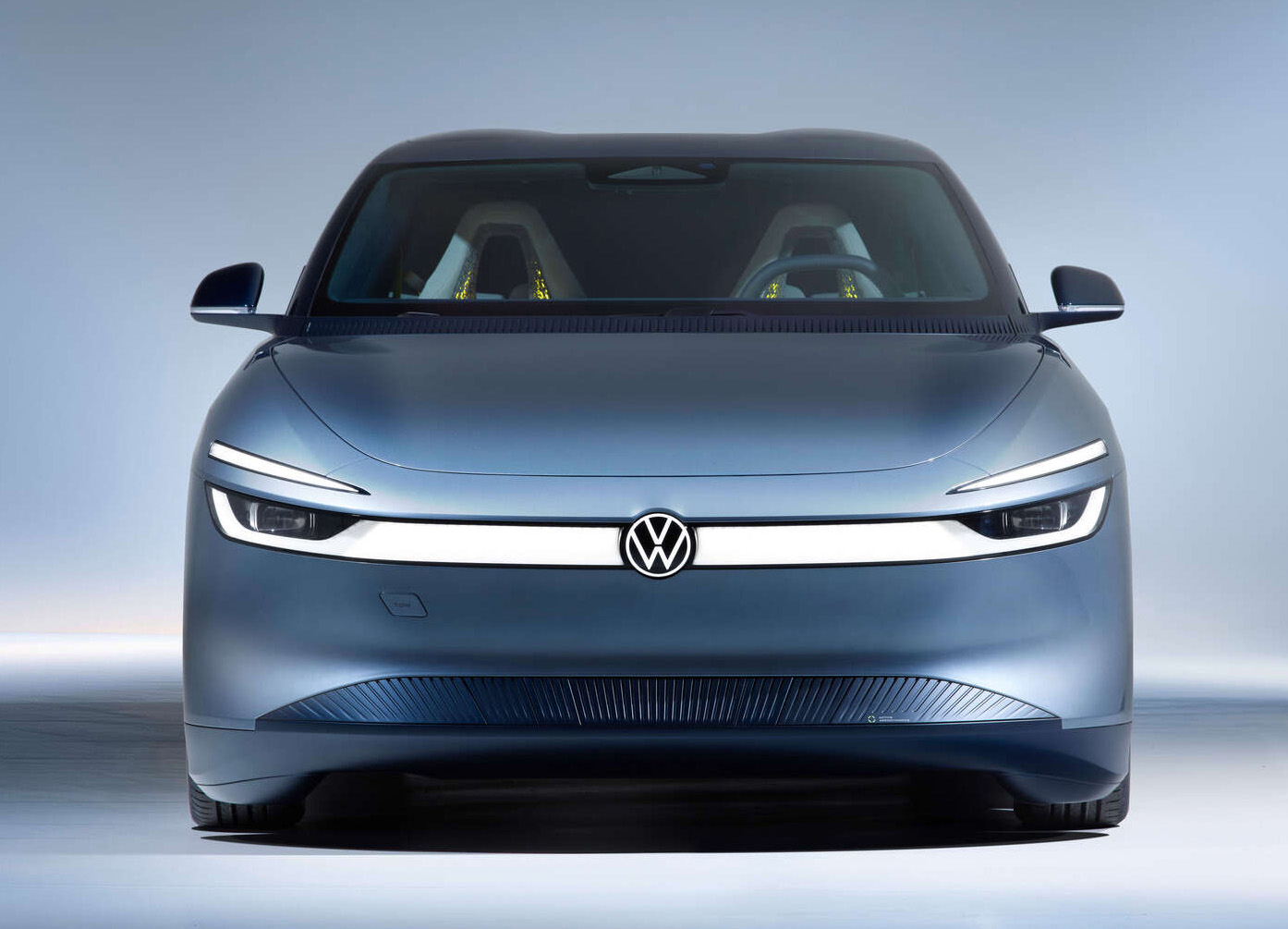
The older XL1 concept forwent (that’s a weird word) side mirrors in favor of cameras and screens, but it now seems that the hit taken by the external mirrors isn’t worth the cost, complexity, and energy draw of camera-based systems. Plus, camera side mirrors still aren’t legal in America.
Okay, let’s talk about the part VW is most excited about, the efficiency. VW took the existing front-wheel drive drivetrain from their ID.Polo, with its 133 hp electric motor and 54.9 kWh battery, so there’s no new exotic hardware under the hood, just stuff that is already in production, which is good. It’s even built on the same MEB+ platform.
VW took the Mission Efficiency on a test run of 1,278 km (794.11 miles) from Wolfsburg, Germany, to Vienna, Austria. When they arrived in Vienna, they had 164 km/102 miles of range left, which is where many media outlets are getting that roughly 900 mile range figure. But that’s not really what happened, and I almost made the same mistake myself, until our EIC David caught that something didn’t smell right about that sort of number from a 55 kWh battery.
[Ed Note: I don’t want to seem mean because I love many of these outlets, but unless there was a change in VW’s press release that I’m not aware of, saying it was confusing and that’s why so many got this wrong is being a bit generous. Any huge claim should always be approached with some amount of skepticism, and this should have been extremely obvious. 900 miles out of a 55 kWh battery means an efficiency of 16 mi/kWh. That’s three to four times the efficiency of even some of the slipperiest, lightest, smoothest-rolling cars on the road. This was obviously not right, especially since in VW’s own press release, it mentions an efficiency of 6.89 kWh/100 km, which is about 9 mi/kWH. It literally tells you how far it goes on a certain amount of battery capacity, and then it tells you the battery capacity. This thing goes about 9 mi/kWh*55kWh = 495 miles on a charge. Not 900. What’s more, it says clearly in the press release that the car charged once during that trip.
I’m fallible myself, but it’s the scale of this mistake that confuses me. The fact that somehow seemingly nobody read the press release and nobody thought “900 miles out of a 55 kWh battery. That doesn’t pass the laugh test” kinda worries me. But again, it’s possible I’m missing something, . -DT]

VW’s press release is worded in a somewhat confusing manner, but it notes that there was a stop to charge the car en route. Based on that, and using VW’s own numbers, which they proudly note in the press release:
On an officially documented consumption test drive over a distance of 1,278.36 km from Volkswagen’s German Development Centre in Wolfsburg via Poznań (Poland) and Olmütz (Czech Republic) to the Austrian capital Vienna, the Mission Efficiency achieved real consumption of 7.51 kWh/100 km including charging losses (6.89 kWh/100 km without charging losses). The route was completed with an average speed of 67.72 km/h; the top speed was 138 km/h. The 54.9 kWh battery (net) was only charged once during the journey. On arrival in Vienna, it had a remaining range of 164.0 km.
I did reach out to VW to confirm the range, and was told this:
On our test track in Wolfsburg under specific conditions (constant 68km/h), we reached out a range of 821km (7km remaining range) with one charge.
So, that’s a range of about 514.5 miles per charge at a constant speed of just over 42 mph, a way no one ever really drives. So, the 450 mile real-world number feels right to me.
Despite not being something absurdly high like 900 miles of range, the car is quite efficient, with VW noting that the Mission Efficiency is as efficient at 87 mph as the regular ID.Polo is at 62 mph. Still, to get there, VW also had to have some special tires; from the press release:
“The optimal tyre is another point of leverage for reducing fuel consumption and increasing the vehicle’s range. Working closely with Continental, Volkswagen developed a concept tyre based on the EcoContact 7 series tyre, which with a rolling resistance of 4.9 kilogrammes per tonne is about 25 per cent below the threshold for the EU’s best tyre label class A. Essentially, the sidewall and the tread compound have been optimised to minimise energy losses during rolling.”
VW did at least try to make the car somewhat practical, being a 2+2 instead of a strict two-seater like the XL1 was.
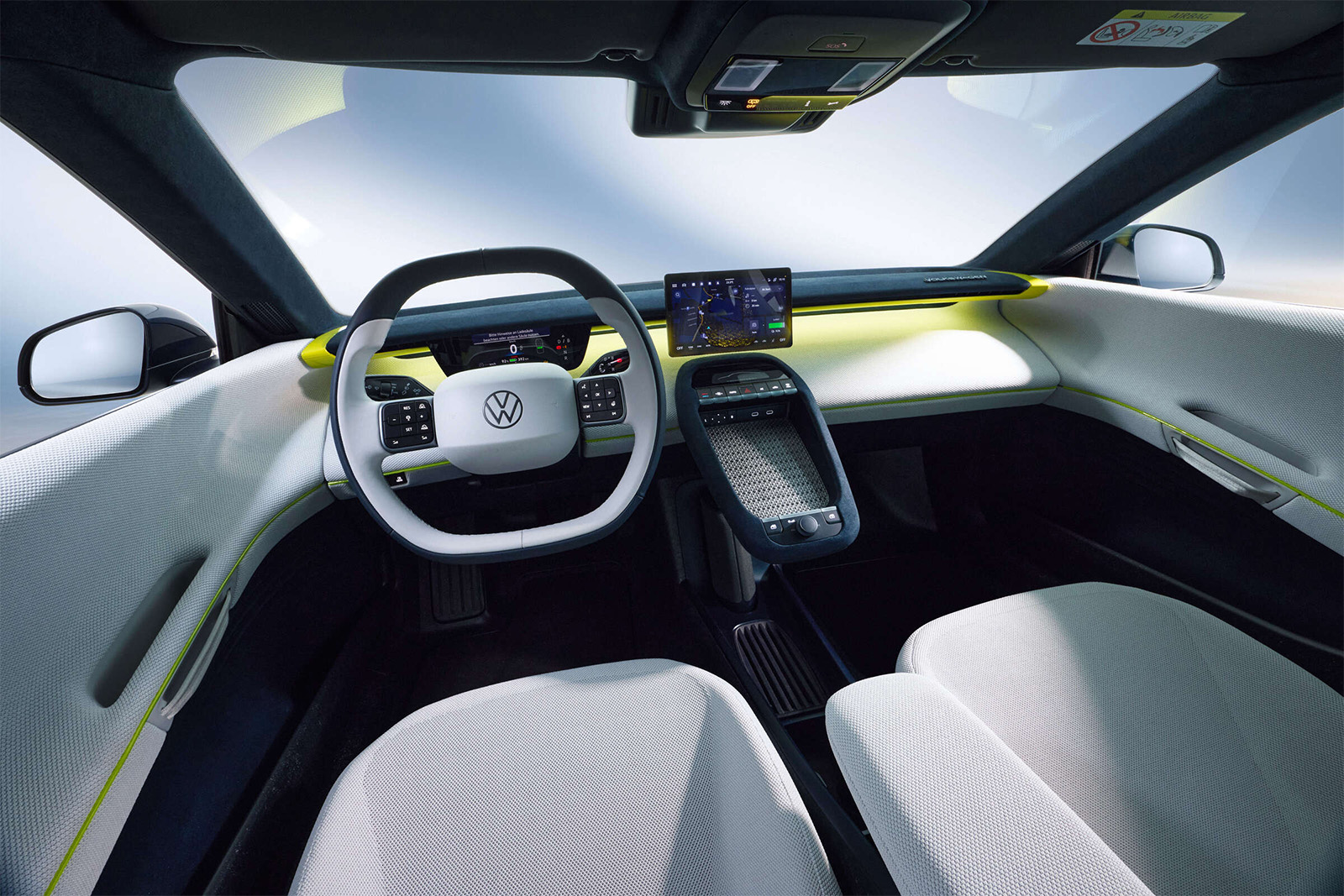
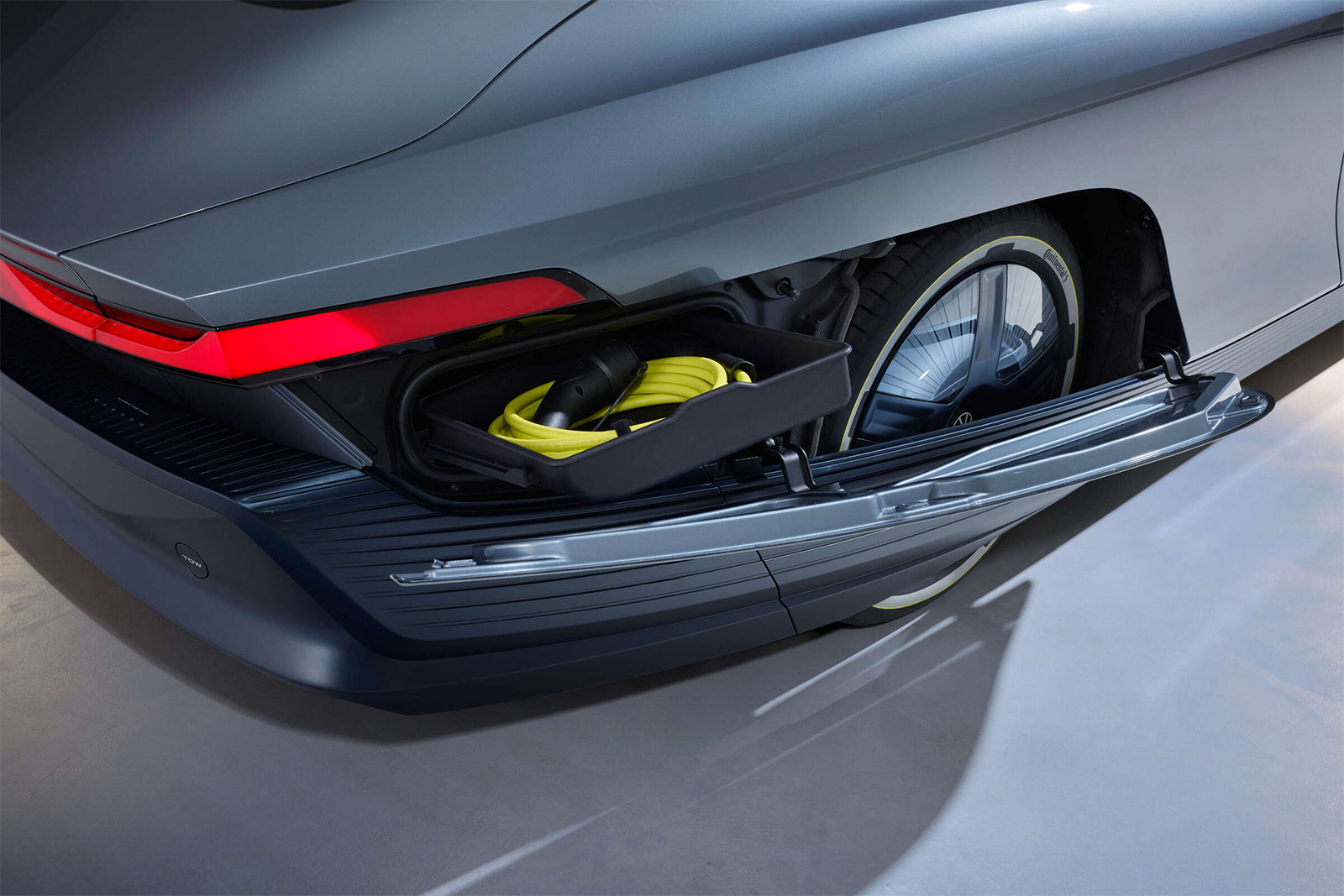
That urinal-shaped thing in the middle of the dash I guess is for storage, since there seems to be no glove box or anything. Actually, storage isn’t too terrible, with about 17 cubic feet of storage in a rear trunk, and while there’s no frunk, there are these nifty little storage cubbies aft of the rear wheels:
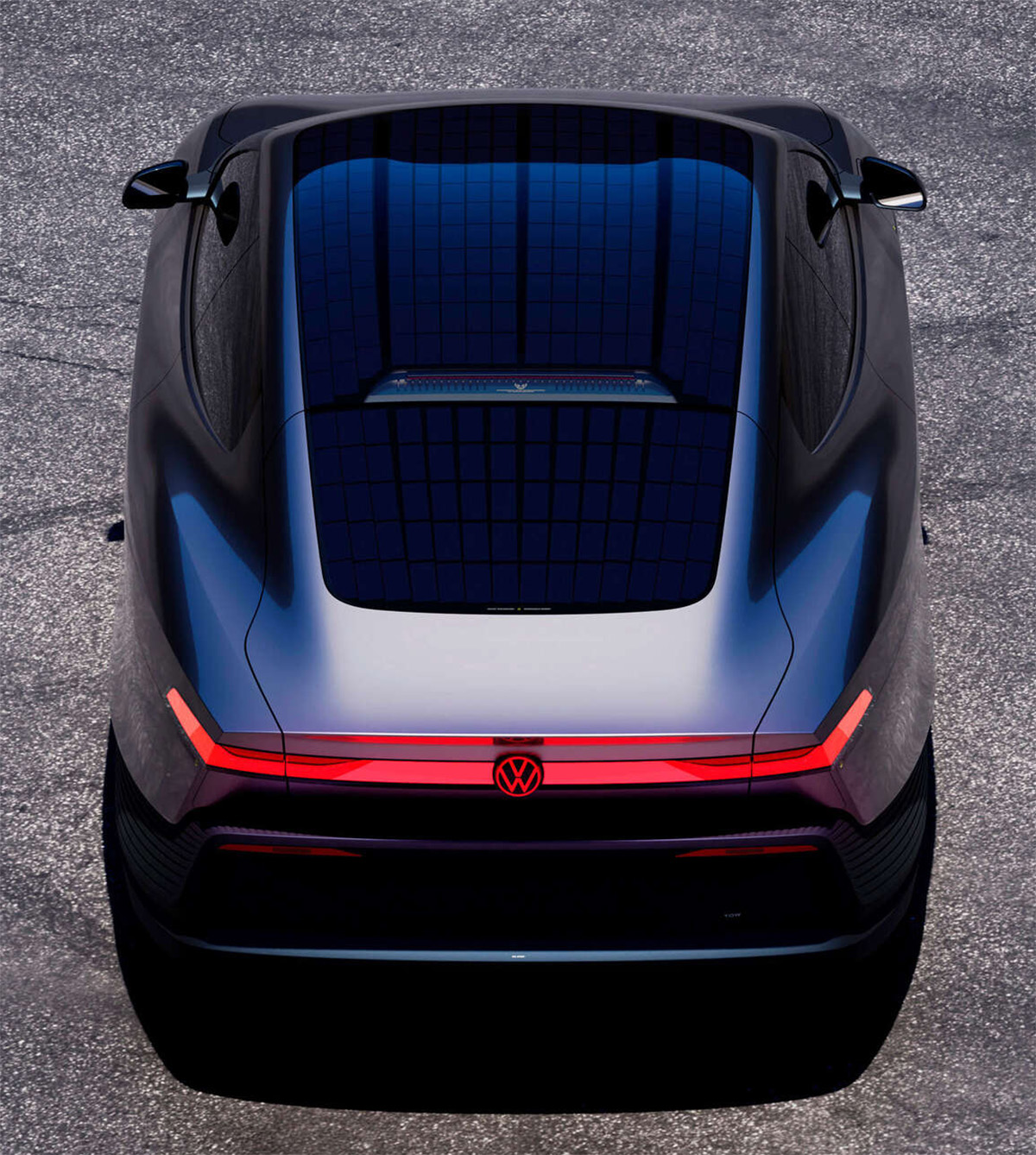
There’s also solar cells integrated into the glass roof and rear window, making a total of 370W of output, but that’s under ideal circumstances. They claim it can increase range by 30 km/day, but I’d take that with some salt.
VW is claiming a world record for the car’s run, but it is a very specific record:
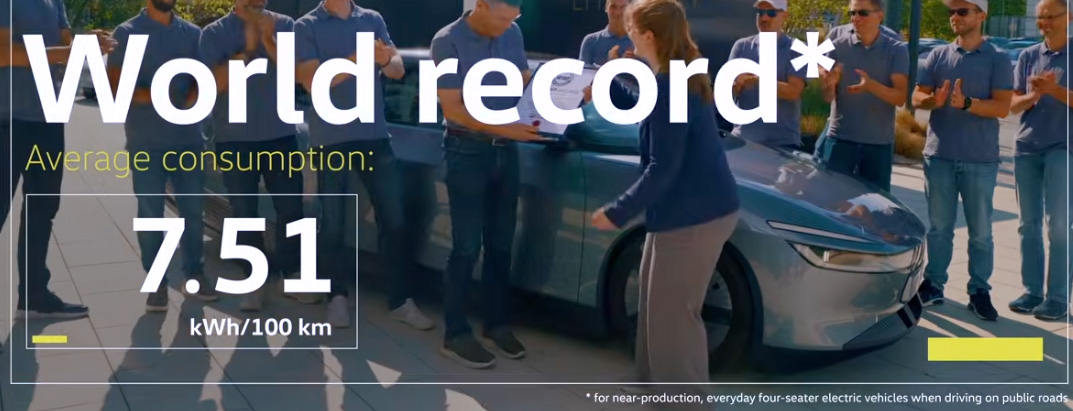
9 mi/kWh for a “near-production, everyday four-seater electric vehicle when driving on public roads” is good. So, sure, I guess they earned that.
As far as the overestimation of range that seems to have been everywhere, well, I make plenty of mistakes, too. But it’s a good reminder that things that sound too good to be true often are, and to 1. read the press release more closely and 2. do the math.


When thinking about solar installed on things, I usually derate it to about 80% of the nameplate output, and assume only the four peak hours in the middle of the day. It’s a little pessimistic but leaves more guessing room for things like overcast. So that solar panel – and I really think every EV should have solar on it especially when it is as energy efficient as this – is good for about 1.2kW-h per day – about 9-10 miles worth of charge. Knowing that that could displace 20% of my commute all by itself, that’s nothing to sneeze at.
The net kilowatt-hours per 100km is more than double what my RAV4 Prime delivers – that sort of performance would yield well over 100 miles per charge, which we know of course is never going to happen because the bricklike R4P would have to violate a lot of physics before it could.
It’s just me and the missus anymore. I could easily see this rig in the stable, I love long range and nippy little rides.
Imo this sounds like it would be a good car for those who leased and enjoyed the GM EV1 back in the day. An EV that’s good for getting you places without too many other people or lots of stuff, but now with much better range and efficiency.
As a former G1 Insight owner and current TDI owner, the XL1 is the car I always wanted. But this is a close second, plz plz plz can we get this in the states?
I hope this car sees mass production. Without mass production, it will be absurdly expensive like the XL1. With mass production, it could be affordable.
If this were sold in the USA, it would be among very few new cars I’m interested in. I wish it were less tech-laden and more like the Slate from that standpoint, but I’ll take what I can get.
I’d especially love to have one with about half the original battery, for more weight savings, but with a power-dense selection of battery so that the motor/inverter can remain maxed out in terms of power. Then one could have a very sporty, fun, relatively lightweight 2+2 coupe.
If there’s one thing we should have learned from the last 10 or so years it’s that a lot of Americans don’t know bullshit when they see it, especially if they like the look of it.
Hate to break it to you, but most of the outlets making this mistake were from the East side of the pond (though certainly some ‘Murican outlets did it as well). The real takeaway is a lot of journalists don’t have functioning BS filters these days, which yes, is definitely a lesson from the past decade.
That didn’t stop plenty of Americans from falling for it. And while I can’t speak on the rest of the world, people failing to realize the obvious nonsense coming down from on high is a daily occurrence here.
I’m pretty sure pouty self-hating Americans get reincarnated as Canada Geese… just makes too much karmic sense.
This is where having an Actual Automotive Engineer not only available for your staff to consult but as a founding editor pays off, I guess.
Pretty cool showcase of technology and some of it should trickle into mainstream production. Even if this does go into production it’d be a highly limited expensive toy. It’s a cool concept but not a viable mainstream sensible car solution for most people at a reasonable price.
Toecutter, paging Mr. Toecutter.
COTD
When I met Toecutter a few years ago, he showed up on a… I’m not sure what you’d call it, but it was a bullet-shaped bicycle. Super efficient, skinny tires; the man knows all about Vehicle Demand Energy.
Deathtrap. The word you’re looking for is deathtrap.
Widowmaker is also acceptable.
(No disrespect. I appreciate what our friend has done and respect that he practices what he preaches.)
Can you imagine being at the wheel of this vehicle for 12 hours while it is setting the record at 42mph? Maybe they had some wet paint chips in there for him to look at drying to keep his attention up.
To be fair 12 hours is 12 hours whether you’re cruising on Kentucky back roads or doing 90MPH on the highway in Texas.
Arguably the 12 hours enjoying the view might be more enjoyable.
That’s what the urinal is for.
This is a VW I’d buy.
I’ve owned a lot of VWs. I’ve actively avoided their SUVs, as they are booooooring to drive. My family fleet has a GTI, a Jetta, and a Passat. Definitely a pattern. They need to stop with all of the teasing and get this into people’s hands quickly. THIS is what they should’ve put out instead of the ID.4. Holds four people, a huge trunk for stuff, and good range. I’m sure they’ll find a way to cock this up.
In this case, I think “near production” means they built it off to the side of the factory near a production line.
This just highlights the pathetic state of automotive “journalism” these days.
Just parrots reiterating corporate press releases.
That’s pretty much all we have now.
To be fair, I almost made the same mistake!
Perhaps if the journalism here were better than the otherwise pathetic state, it might be worth my money.
But you’re not AI or some intern being paid minimum wage, so you actually caught it. Same can’t be said for 1/2 the automotive outlets out there.
Exactly – it’s not surprising that after someone made the mistake that it was copied over and over. Because the other “people” aren’t reading the press release, they are just copying stories.
On arrival in Vienna, it had a remaining range of 164.0 km.
That’s because this piece of information has no redeeming value whatsoever if the car has been recharged underway. Our brains are wired to make sense of what we read, even if the reason for including this sentence in the press release is nothing but “well, because VW…”.
It’s worse than just parroting- VW didn’t even state the 900 mile range thing, that was them failing reading comprehension and doing bad math with no sanity check.
Neat! Now, are they going to produce it with buttons and all? It would at least show they’re trying to compete with the Chinese cars in Europe.
Remember when the Taycan was first announced, and it was called the Mission E?
They’re obviously not direct competitors, but would be interesting to understand the efficiency of this versus the Cybercab, which is shaped quite similarly. If I recall correctly the Cybercab was rated above 200 MPGe by the EPA
I like the idea of an EV with a solar roof. Many have stated that it’s ‘not worth the cost’
But if the car is a daily driver that is parked outside all day, every day, and you work at a place that doesn’t offer free EV charging for employees, it can be a great solution.
Not just that – but the free electrons can keep cooling fans on for the interior as well as the batteries in the summer, or keep the batteries pre-heated in winter – all without losing any range.
So yeah, it’s worth it.
And, if the radiant energy is being absorbed by the solar cells, it theoretically keeps the car cooler, right?
Bingo.
Double-Win.
I wish my EV6 had solar panels in place of the sunroof I never use. Even if all they did was trickle charge the 12V battery it would be nice, since the car is never off and the 12V battery takes the brunt of that. But it would be extra nice if they could charge the big battery too.
If I got a Slate, the idea of a solar Tonneau cover seems interesting. If I could drive to work, park a Slate where it isn’t in the shade and get enough charge to go home and come back to work the next day, then I might not need to figure out how to do a charger at home.
Assuming it would work, $2200/$3600 (not sure what package I would need) doesn’t seem too bad if I could EV without having to worry about re-wiring anything at home, especially since I wouldn’t be paying for the electricity.
Even a very gradual recharge could be worthwhile. I don’t think there are any ICE cars that can slowly refill their tanks with free gas while just sitting in a parking lot.
The “worth” of the cost is certainly proportional to the efficiency of the vehicle. If 320W of power (optimistically) provides 2kwh (again, optimistically) over the course of the day you are getting optimistically 5-6 miles of charge a day on a “typical” EV. Realistically it’s half that, for a roof that costs more and will degrade and break, etc, etc, and save you 50 cent/day.
But on something with 3x the efficiency of a Mach-e or BlazEV, you end up with enough extra range to make it to the grocery store – certainly the juice is worth the squeeze.
But since electricity is still charged by the kwh you’re “saving” the same amount of money. Because 2kwh = 2kwh
However, it would lower a greater percentage of your electric bill.
I don’t know what VW means by “near-production,” because this car looks showroom ready right now. Maybe they mean they haven’t determined if they’re going to mass produce it yet?
But yeah, a lot of those articles’ headlines look awfully clickbaity. Enough so that I think they knew exactly what they were doing and chose to go with the inaccurate figure to get us clickin’.
I think it means that the concept hasn’t made it to board certification, where it will get picked apart by committee and driven to irrelevance by marketing and cost savings “ideation”.
…I’m not bitter about the I.D. Buzz, what are you talking about!
That is disappointing but probably correct
looking beyond the hyper efficient EV stuff.
The steering wheel with real buttons and the center mounted physical controls for climate control and volume is a solid sign VW learned their customers hated the haptic steering wheel controls and the touch sliders on the screen of their EV products.
Nah, it’s a prototype. The bean counters will cut the buttons and put in unlit haptic touchpads for cost, er, weight savings. It saves 0.001 grams. Or one soda bottle every twenty cars. Very efficient.
XL1 was terrible (terrible) at being a “car”…but as a vehicle that churned out hyper MPG’s it was great. I’ve driven and ridden in one and a buddy of mine did a grand tour of the West in one and…they’re loud, cramped and loud.
Oh, you’re not supposed to go over a certain elevation or the bolts that hold the gull-wing doors might jettison themselves explosively.
“Oh, you’re not supposed to go over a certain elevation or the bolts that hold the gull-wing doors might jettison themselves explosively.”
I wanna see that happen! Let’s take one on a drive through the Himalayas!!!
I have two American dollars in my wallet right now that I am willing to put toward this cause!
If we can get the Lane Museum to let us borrow it again and take it to Loveland Pass….
Paging TFL…
This is what I always imagined for a true Insight G1 replacement. A lot of people look at the total miles they can drive with a full charge but they dont calculate how much energy is going to cost to “fill it up”. A Silverado EV can go 493 miles but the battery is absurd on that thing.
The long range of a Lucid with the battery size of a Nissan leaf, hell yeah.
A VW I’d maybe buy if it were a reasonable price! I wonder how much of a hit range takes with real tires on it.
Yeah, same. Which means it won’t see the light of day again after an initial flurry of auto show appearances and press coverage, just like all the better Cadillac concepts
and/or how much a set of those Magic Tires will set you back.
Nice publish time
Regardless of all the range confusion, this thing is actually pretty cool.
It’s rather good looking (in a futuristic cockroach kinda way), it’s got whitewalls, it’s got a RAMbox, and it’s a liftback.
It is super cool.
Yeah it definitely gives me Honda Insight vibes (mostly based on the same teardrop look).
It’s the ID.Polo Karmann-Ghia! If VW can license the Ghia name from Ford…
I’m guessing a lot of the other outlets got those insane figures because they just fed VW’s press release into some AI slop pot and it spit out 900 miles of range.
I’d bet 900 miles of electricity on that