

Looking back to 2016, most automakers have not been able to grow their sales in the United States from what might have been the all-time peak for the market. Toyota is one of the few to pull off the trick, and it’s continued to claw more share nearly every year. But when Toyota hears footsteps every night on the decks, they belong to Hyundai.
The Morning Dump is all about transformation, with Hyundai transforming itself into a full-line automaker that makes everything. Having vanquished Honda, Stellantis, and Nissan, the company has Ford, GM, and especially Toyota in its sights. While Hyundai tries to beat Toyota, Ford is merely trying to match the Japanese automaker with quality.


Honda is considering joining the fight with another plant in the United States, but only if the White House will agree to confirm a trade deal. How much market is there even worth fighting for? According to a new analysis, sales continue to remain mostly stable.
Hyundai Will Launch More Than 100 New Models, Including 50+ In North America, A Ton Of Hybrids

There’s a fun chart over at GCBC that shows how major automakers fared in Q2 of 2026 compared to Q2 of 2025 and Q2 of 2016. This ten-year gap is especially interesting because 2016 was probably peak new car in the United States, with over 17.5 million cars sold, or about 1.2 million more than last year.
Over that time, GM, Ford, Honda, Steallantis, Nissan, and Mitsubishi have all lost ground. The winners? Toyota has grown 7.8%, Subaru has grown 12.5%, and Hyundai Motor Group (Hyundai + Kia + Genesis) grew an incredible 27.9%. Only Mazda grew more, increasing by 33%, but it’s still a relatively small player compared to Hyundai.
The South Korean automaker first built its reputation on low prices, then on having the longest/best warranty, and then on style and performance. Both Hyundai and Kia have gone from being the least interesting choices in most categories to, if not the best choice, at least a close second or third. The company also hired a bunch of great engineers and designers, and was careful to offer both EVs and hybrids, instead of overindexing on EVs.
GM, Toyota, and Ford are the only automakers who stand between Hyundai and the top of the sales charts in the United States, though I don’t think an outright sales victory is necessarily worth it. Hyundai can be more profitable than Ford selling fewer cars, and it’s unreasonable to expect that the automaker will ever top Ford or GM in trucks.
Can it top Toyota, though? Yeah. It might be able to top Toyota. And that seems to be the plan. CEO José Muñoz addressed reporters and investors in Seoul earlier today and his goal is clearly to compete in just about every space and to do so profitably:
“Our fundamentals have never been stronger. Hyundai Motor Group is the third-largest automotive group and the second-most profitable, which gives us the ability to invest while others are pulling back. We are bringing more than 100 new models to market by 2030 with multiple powertrain options and raising our operating margin above 9 percent. We are leveraging partnerships to scale new technologies and opportunities and becoming a physical AI company which will produce and deploy robots and robotaxis.”
The robots and robotaxis of it all I’ll leave aside for now, because I’m more interested in the 100+ new vehicles and the categories they’re shooting for:
The new Santa Fe EREV will arrive in the first half of 2027, representing an uncompromising approach to electrification. The Santa Fe EREV is expected to deliver more than 600 miles of total range, combining an EV-like daily driving experience while addressing range and charging anxiety for customers. The vehicle will be built in the United States at Hyundai Motor Manufacturing Alabama.
The momentum doesn’t stop there. The company is targeting ‘white spaces’ where the brand is underrepresented today. These segments account for roughly 29 percent of all automotive sales, highlighting significant opportunities for growth. These include body-on-frame vehicles, including a midsize pickup, and light commercial vehicles.
While body-on-frame is not a true ‘white space’ because it’s so crowded in the United States, it’s a new category entirely for Hyundai, which only has the expensive, unibody Santa Cruz for trucklet at the moment.
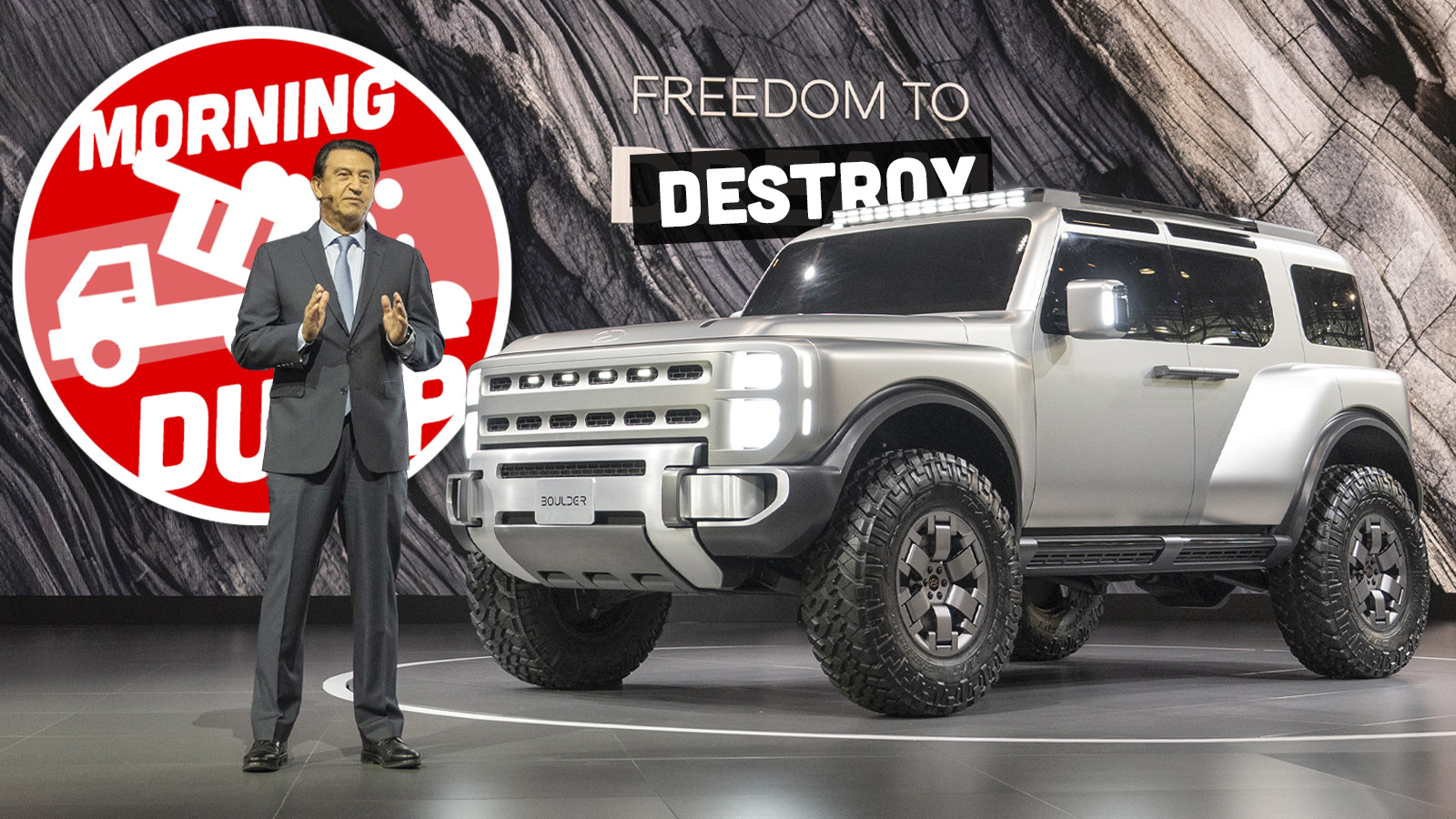
At the New York Auto Show this year, Hyundai showed the clearly body-on-frame Boulder Concept, which is essentially a Hyundai version of a Ford Bronco. While I’m sure Hyundai would be happy to nab some Bronco sales, I do think the Toyota 4Runner is the target. The same goes for the midsize truck that Hyundai is planning, which could be a real competitor to the Tacoma. And then there’s the EREV Santa Fe, which represents a great opportunity for the brand.
My whole sense of Hyundai is that it wants to find that sweet spot where it can sell a bunch of cars without sacrificing margin (the goal of all automakers, though one not every large OEM seems capable of achieving), meaning that it’s aiming way more at the space Toyota fills than either GM or Ford.
Honda Quietly Threatens To Postpone New US Plant If USMCA Isn’t Extended

Honda continues to let the current administration know that it’s likely going to be unwilling to invest the $20 billion it had slated for new production in the United States if the White House can’t the United States-Mexico-Canada Agreement (USMCA) extended.
Honda Executive Vice President Noriya Kaihara told reporters at a roundtable in Washington the automaker is close to full production capacity in North America and needs a new factory.
However, “if there is no USMCA agreement in the future, we may have to change our direction,” Kaihara said, adding the company will need to make a decision within a year or two and would like the plant to be running by around 2030.
He said currently Honda is not passing on the costs of tariffs to buyers in North America. The U.S. imposed 50 per cent tariffs on US$20 billion of Canadian products on Saturday, and Canada said it was retaliating effective September 8.
Because Honda has a decent tariff rate for its Japanese-built cars, it might, net, be cheaper and easier for the company to just import more cars, or at least easier given that Japanese automakers aren’t paying tariffs on parts its using to build cars there.
It’ll Be Years Before We Really Know If Ford Fixed Its Quality Problems

David and I got to chat briefly with Ford CEO Jim Farley in the lobby of a hotel during Car Week, and one of the takeaways is that, hopefully, Farley will come onto our podcast to explain his views on right-to-repair.
Jamie LeReau over at the Detroit Free Press also snagged time with Farley as well, and his conversation centered around the tough decision to sideline trucks until they could fix the quality. In theory, it worked, and Ford topped Lexus in the most recent J.D. Power IQS study, so the company is heading in the right direction.
Here’s a quote from that piece:
“The real impressive part of Toyota and many of the Chinese (automakers) as well, but especially Toyota, is their sustainability of what they do,” Farley said. “They never drop the ball. They never go backwards. They don’t think there’s an end. At Toyota, we had a really famous saying, that I think about every day: No problem. Big problem. In Toyota, even if you are perfect in quality and you’re beating everyone, no one is happy. You’re going for perfection.”
How long will it take? Analyst Karl Brauer tells the Freep we won’t really know if Ford actually nailed it for a while:
“The real challenge is executing high-quality new-vehicle launches and production over a period of five, 10, 15 years,” Brauer said. “That’s what Toyota has done — created a reputation for high-quality cars based on decades of producing long-lasting vehicles that suffer minimal post-purchase issues. That kind of consistency goes beyond any single person or team, because people and teams change. Toyota has mastered the art of making high-quality vehicle production a company mantra that goes beyond any single person or team. That’s what Ford has to do, and it won’t be easy.”
Check back into the TMD in five years.
August Car Sales Will Be Down A Bit, But Generally Stable
Here’s a chart:

It’s from the monthly sales estimate for August from Cox Automotive, and you’ll see it’s mostly negative. A lot of this is because last year there was a rush of buyers flocking to EVs before the tax credits ended, so the numbers are going to probably look lower in August and September of this year and then magically look a lot better in October or November.
“August new-vehicle sales continue to hold up well despite significant economic uncertainty and ongoing trade disputes dominating many news headlines,” said Charlie Chesbrough, senior economist at Cox Automotive. “High gas prices, interest rates that are trending higher, and historically low consumer confidence have not discouraged new-vehicle buyers from making a major purchase as much as might be expected. The current market continues to remind us that new-vehicle buyers today are more affluent, with excellent credit or cash reserves, and may not be as impacted by inflationary pressures as other consumers. If the economy and stock market can remain on a growing but volatile path, new-vehicle sales will likely continue to follow.”
SAAR, which is a bit more stable of a measure, is 16.3 million, which is only a little off the 16.5 million in August of last year.
What I’m Listening To While Writing TMD
There is no one single Dolly Parton song that can capture this amazing woman’s legacy, her generosity, her goodness. I’ve often said that she’s the greatest living American, and it’s impossible to imagine now who can replace her. She was an angel who shared 80 years with us flawed mortals, and the hope that cuts through all this sadness is that we now have the best case scenario for humanity advocating for us in heaven. Even though it makes me tear up every time, “Coat of Many Colors” is probably my favorite Dolly Parton song as it embraces her spirit of generosity, kindness, and her beautiful perspective on the world.
The Big Question
Who will be the three biggest automakers in the United States in 2036. In what order?
Top photo: Hyundai




I’d take a Telluride/Palisade over anything available for purchase in the US in the same segment.
I would have, but not so much now that the NA 3.8 is going away.
For all the progress Hyundai has made in the last decade, they’res still going to have to learn how to build cars like Toyota if they truly want to be competitive. The gap in build quality between a Corolla and an Elantra is still too wide.
But, but, but, the warranty!!!
I think it would be funny if the Chinese came in and got in the top 3 in the US. I don’t think it’s possible, in 15 to 20 years maybe.
If Toyota can get consumers reasonable cars they might be able to to get to number 1. But not with their dealers doing what they are doing. Ford also could do well with their EUV platform and various hybrids. But again their dealers cause them issues. GM always seems to be doing nothing then pulls out something that is ok enough to save them. The way Hyundai is going with their prices I’m not sure they will do anything. On the ev side they are getting better but everywhere else they are far worse.
If Toyota find the cheap mass market cars does sub brands or rules their dealers with an iron fist. Then Toyota, GM, Ford
If not then the same GM, Toyota, Ford it’s been for some time.
In 20 years time if they all keep on keeping on. Value large range Chinese brand, Toyota, GM or Ford
Kia has been making pickup trucks for decades. The kia bongo has been around since 1980. They made smaller ones starting in the mid to late 80s. They are quite popular in south Korea. But also in various central, south American and Caribbean countries. Hyundai also has the porter that’s quite popular in south Korea and the Philippines has been around since the late 70s.
I started watching a Dolly Parton documentary yesterday that was titled “Is Dolly Parton really that great?” and when I got to the end it showed a new title: “Yeah, she really was that great.” I didn’t even clock the change in tense until I clicked on the comments. What a kick to the balls that was.
Deals agreed to by this White House are worth less than the paper they’re printed on. Deals announced on social media by this White House are also somehow worth less than the paper they’re printed on.
Maybe if you’re only ranking on “interesting”. They’ve had some pretty big styling misses lately, and reliability seems to be an issue across their lineups. I realize everyone is having reliability issues with something these days and you just roll the dice and hope you get a Wednesday build instead of a Friday one, but H/K seem to be especially big offenders in this area.
The fact that they require him to come on a podcast to explain them makes me think I’m not going to like what he has to say.
Perhaps in the US.
Hyundai/Kia have the Tasman, Porter, Bongo, and a slew of vans. Heck, they’ve even got a bus. BOF isn’t new to them; I could see them looking on bringing over the Tasman.
Only if they redesign it.
Toyota is still riding high on its quality reputation and hybrids, but the current styling – woof. At least the older ones were inoffensive, if bland. H/K has the design chops, but a lot of unanswered reliability questions – particularly with ICE drivetrains. Honda is too small without a viable merger. Ford and GM are fully reliant on trucks, GM is flushing its reputation down the toilet with engine issues and Ford isn’t much better. Stellantis is a shitshow. VAG, etc… are almost non-entities anymore here.
Ten years from now it will be Toyota, H/K, and some brand out of China.
Unless Toyota screws up so bad as to lose it’s resale value, they’ll continue to do well for the near future.
The current crop of Tundras is not doing so hot. They really need to get the V6 issues squared away. The general consensus is they are not good anymore which is bad.
I must be an outlier on the H/K design chops thing, or I’m still not over the Sorento I owned for far too long, but personally I don’t care for a lot of the more recent H/K designs – especially the most recent stuff. Given their quality issues, it all feels like lipstick on a pig to me.
If we’re talking brands, it will be Shitbox Showdown, Facebook Marketplace and Buy Here/Pay Here.
I’m not sure why anyone even bothers to build new cars anymore given current affordability.
It’s interesting that Farley talks about management strategy that Ford tried to develop in the 80s but seemed to walk away from. Toyota’s quality is the natural evolution of Deming’s quality and management philosophies. Ford made efforts to adopt these in the 80s but the short-term focus on profits seems to have taken over.
Looking forward ten years, it’s hard to tell who will be the top three. It’s like throwing a stone in a pond and guessing how many ripples will be made. There is just too much going on, and honestly, I think one of the US manufacturers will have to fail HARD, without a bail-out before any real change is made.
*Stellantis has entered the chat*
Given how many people I personally know that had H/K engines fail spontaneously, it’s going to take a lot more than a pretty design to win me over.
This exactly. Hyundai/Kia has figured out how to sell a crazy high number of cars, but they don’t seem to care about longevity. Which, cynically / business-mindedly (?), I totally get: why care about 2nd owners when most of the money can be made on a 3 year lease? It only needs to be an attractive package that runs for 5 years tops. Sucks for us used car buyers!
Long warranties are generally offered by companies with bad longevity records, not good ones. Companies with good longevity records don’t have to offer long warranties to attract customers. Think Toyota and Honda. Also, watch Tommy Boy.
Not to mention that the long warranty is a joke. Ask me how I know…
I’ll ask.
Can you reply in under 2,000 words?
(deep breath) So I’m the second owner of a 2018 Sante Fe Sport with the turbo V6 (not really the car we wanted/needed, but it was the post-Covid used market in 2021 and not many good options). Turns out this entire line of engines has a known fatal issue with oil consumption, and Hyundai has placed an extended warranty on vehicles with this engine to 150,000 miles. of course, the famous 10 yr/100,000 warranty only applies to the first owner. At 76,000 miles, ours suddenly drank half its oil capacity in 3,000 miles. Before filing a warranty claim to replace the engine, the dealer claimed we need to first undergo a top end engine cleaning for several thousand dollars. I begrudgingly went along with this service, which did not solve the problem, and when we filed the claim for engine replacement it was denied for being too high mileage… at 70,000 fewer miles than the warranty should cover.
Also the whole experience has been miserable: no one but a useless AI agent answers the phone at any department of the dealership, it seems like the whole engine cleaning thing is basically a tactic to get an expensive/useless work order for the Service dept., Hyundai corporate was no help in explaining or allowing to re-file the warranty denial, and now that I’m trying to offload this lemon the dealership offered me the lowest possible KBB value (even though it’s been well-maintained and looks great).
Screw Hyundai – apparently it’s clowns top to bottom.
TLDR: warranty was not honored for no clear reason, most customer service interactions were terrible, and I’m selling this thing to Carvana for $3k more than the dealership would give me
Wow! That is horrible. They make Dodge service look good in comparison!
What are you getting to replace it and does it have the things to make you happy?
We’re getting a deal on a 2019 Toyota Highlander Hybrid via a family member, which should be rock solid and twice as good on gas.
Ideally for our lifestyle we’d get a Sienna Hybrid but we can’t realistically afford one – oh well.
Nice!
I’ll just take the butcher’s word for it.
I like them and have rented many H/K products. I would maybe even consider leasing one. But actual long term ownership? Yeah, hard NO. I’m sticking with Toyota or Honda. The lowest mileage car in my fleet has 140k, my daily has 267k.
Just saw LCD Soundsystem at Just Like Heaven in Pasadena last weekend. As always, an amazing performance, and Losing My Edge was a highlight.
Saw them in 2016 at Lolla… what an awesome experience it was.
I went to Coachella that year specifically to see them. 🙂
Yeah, there were a TON of people watching LCD at Just Like Heaven. I had a spot on the rail watching the Rapture play at the other stage, so by the time I got over to the main stage the best I could do was watching LCD from pretty far back. A great performance, as always from Murphy and friends.
After my wife’s experience last year, getting pretty close to heatstroke and me noting there was basically a line at the medical tent, we ponied up for Clubhouse tickets. Considering they were about 2x the cost to see just The Strokes at The Forum last year, and included air conditioned areas with shade, free food and booze, and access to the fronts of the stages, it was well worth it.
I own a 92 Sc400, 2004 RX330, 2007 4Runner, and a 2010 Highlander. It’s gonna take a lot for me to change what IMO has been a no brainer when buying vehicles. I wish Hyundai the best of luck.
Three biggest automakers in US in 2036? Trump Ford, Trump GM and Trump Tesla.
Are we considering KIA and Hyundai as one or two different? If two different I don’t think either crack the top 3. If they are considered one then maybe they can but with how far ahead Toyota and GM sat last year and even Fjord it is hard to see Hyundai/Kia over take them in the next 10 years but it isn’t impossible.
I consider Hyundai and Kia as one overall corporate entity. Not as intertwined as the GM divisions of old. Maybe more akin to the relationship of Ford’s old stake in Mazda with the extent of platform and powertrain sharing, yet with very distinct differences.
Oh, I would say they are at least as intertwined as the GM divisions, if not more so. They already share basically all of their platforms, use the same suppliers, and use the same engineering resources. Yes they are legally distinct corporate entities, but in Korea that means less than other places.
Are the same engineers employed for both companies? Or if not directly employed, contracted for both companies? This an interesting area.
To my understanding it’s a mix of both. Hyundai Motor Group (the parent company) has a huge technical division that does a lot of the baseline engineering (powertrains, chassis, manufacturing process, etc), then Hyundai/Kia/Genesis all have their own smaller engineering divisions that do the detail work like interiors packaging, suspension tuning, and body paneling, but it’s more like design studio work than the heavy technical stuff the parent group handles.
Since the US now thinks that North Korea is Best Korea and South Korea is starting to catch some heat for all the steel it’s been exporting to the US (we import more from SK than Canada now so incoming tariffs) I think Hyundai is going to be catching some strays real soon.
From largest to smallest: Arcimoto, Heine-Velox, and Ford.
It’s a longshot but if it pays off I’ll be hailed as a genius.
“Ford is merely trying to match the Japanese automaker with quality.”
*CHORTLE*
And I’m merely trying to match Odermatt in the super G.
It’s good that Hyundai is targeting Toyota with earnestness. Competition is good and Toyota needs someone to genuinely threaten their market standing. People are on waiting lists for routine hybrids, that crap needs to end yesterday.
Bingo – Toyota is becoming complacent IMO. Maybe shake things up a bit.
Maybe they are not so “routine.” A check of the used market will show that.
Unless we are referring only to sales numbers, only way to “beat” Toyota is to match their reliability, not by simply making more shit that spends any more than one minute in the shop fixing a manufacturer’s error.
Hyundai. Toyota. BYD
Ford using a JD Power Initial quality study win as a metric to show improvement on quality tells me that actual vehicle quality has not improved at all. Ford still cost cuts the hell out of their vehicles, designs in horrific serviceability, and does not learn from their mistakes. Seriously, JD Power IQS survey tells you less than nothing about how a car will age in a year, much less 5-10+ where Fords regularly start to fall apart.
Also, heck yes to Honda for sticking up for themselves to the administration. Someone needs to. Honda having a lot of business in Canada, with Google telling me they build 400k vehicles and 200k engines per year in Canada means USMCA going away and 50% tariffs are horrible for their business. As an American I fully support Mark Carney and Canada for giving the US the middle finger on the mess they’ve created. I just hope this ends soon because it’s exhausting.
I think it’s literally impossible for a quarterly brained American company to ever achieve long term anything.
That MBA brain can get executives heavily compensated and lauded in the business press. The bean counting and managing by spreadsheet can go on for a very, very long time. “Neutron” Jack Welch is arguably the archetype of this model of business.
If the administration gives Honda the commitment they’re looking for, can Honda really count on the administration not to change their minds randomly?
Blackmail only works until the blackmailer runs out of money.
I’m pretty sure that’s exactly why they’re going after the USMCA, which once an agreement like that is signed into law is at least harder to overturn than a Truth Social post saying “I won’t screw you over also screw this random person I have beef with today thank you for your attention in this matter”
Not that anything from this admin has value, but from Honda’s POV this is about the best they could hope for.
USMCA, the international agreement for free trade touted as the best thing since sliced bread, that’s been slapped with tariffs and disregarded by the same person as, somehow, the worst thing?
Waiting on USMCA to restore things right now will take far more than just Honda, Ford, and GM pushing that same button.
I wouldn’t count on this administration to plan a one car funeral.
The beatings will continue until morale improves.
Slate, Mazda, and Rivian
What do you mean I need to ask people outside this comment section?
You forgot the Chinese companies that the commenters think are taking over the market.
In this scenario, did Rivian keep their name after they bought VW and Stellantis?
I sure would. Keep the Skoda, Porsche, Lancia, Citroen and can most of the rest.
“gives us the ability to invest while others are pulling back”
Moving forward while others continue to stagnate, that bodes well for the future.
I’d love to see a 4Runner competitor from Hyundai. Right now, the only 4Runner competition is other Toyotas.
Even though they’re all BOF/4WD, I do not see the Bronco and Wrangler as direct 4R competitors.
When I bought my 2021 4Runner, I originally was planning on a Bronco. But Ford’s problems delayed them to the point I couldn’t wait anymore, and got my Toyota.
I never even considered the Wrangler. They’re garbage vehicles and the owners are toxic dorks.
But today, I’d be choosing between the Lexus version, 4Runner, or Land Cruiser. There’s nothing else in that segment until Scout comes out.
I want the Scout to be good but ugh VW is yeah…. Hahah thought right now for a replacement for my Polestar 2 it is either the Scout and R3X (though the scout would replace both the 2 and my FJ at that point)
I love the idea of the Scout, but I’ll believe it when I see it.
Yeah I have debated about applying for jobs with them as I may or may not work for a VW owned company but I do not want to work outside Detroit (I want to get out of the rust belt) though they do have engineering jobs in Charlotte NC. But and it is a big BUT is will they even last? Job security is something I like having and uprooting my whole life to move for a job that could be gone whenever is a tuff sell.
Yeah, those 3 Toyota vehicles are nice, but none really ideal. I think the LC looks the best, but I don’t necessarily want the hybrid drivetrain. I REALLY wanted to like the 4R, but it just hasn’t grown on me yet. And the fact that it seems so much smaller inside is really a big negative.
Buying that 21 4R was a good move, you can probably sell it for close to what you paid for it. Personally, I think the 5th gen 4Runner is likely the last “keep forever” vehicle that will be built.
Potential Ford issues aside, what I’d really like as a SUV would be a fixed roof Bronco, but I doubt we’ll ever see that.
I am with you on the fixed roof Bronco. It was amusing how they claimed to be addressing the wind noise issues with the Filson edition. Why the hell didn’t you address it for year prior?
The real question is will the Filson changes filter down?
I’ll be selling it next year when we move overseas, and expect to get basically what I paid in 2021, now with 42k miles on it.
Their value holding is no joke.
“I REALLY wanted to like the 4R, but it just hasn’t grown on me yet. And the fact that it seems so much smaller inside is really a big negative.”
Agreed, again. And it doesn’t just seem small inside, it genuinely is. The backseat lost a lot of room and the need to accomodate the battery pack really screwed up the cargo area. The spare is no longer full size, it’s narrower in tread width so it doesn’t hang below the bumper.
The hybrid drives well, though. That torque fill from the electric motor makes routine driving effortless even if it doesn’t look like it from the 0-60 stats.
And yet, even with the smaller spare, every time I’m behind a new 4runner, I can’t help but notice the spare below the trunk floor, and how it’s off center. Makes my eye twitch lol
Same with the Landcruiser!
Why Ford has never brought in the Everest will always confound me.
This ^^
I remember seeing Toxic Dorks live back when they were still Blue Leather Dog Genitals.
“I’d love to see a 4Runner competitor from Hyundai. Right now, the only 4Runner competition is other Toyotas.”
Completely agree. I don’t want a removable roof and all the NVH and internal packaging compromises it entails. Ten years ago I bought a 4Runner new in part because it’s a good vehicle and in part because there were no competitors. There still aren’t any direct competitors and the new one kinda sucks.
Yes, that’s why I ended up with one too. I REALLY wanted a Wrangler, but for my use case, even the Wrangler guys were telling me to go 4Runner. It was a great vehicle for the 7 years I owned it. The 6th gen not interesting me was what pushed me over the edge to a fullsize pickup.
Ford has an SUV called the Everest in other markets based on the Ranger, that would absolutely rule as a T4R competitor here.
Yes! I watched a review of one a while back, I was like “I want that!”
I’ve seen a lot of Everests in Thailand. It’s a good-looking SUV and I’m guessing Ford simply doesn’t think there’s room for it and the Bronco here.
Probably less likely that and more likely lack of production capacity and it would eat into Explorer sales.
Was “Steallantis” an accident or some sort of Freudian slip?
I can’t unsee how similar that Hyundai concept looks to the 2005 Ford Bronco concept. Same freakin color, too!
‘These include body-on-frame vehicles, including a midsize pickup, and light commercial vehicles.”
A small(ish) BOF 6’ bed pickup would give you a huge market all to yourself.
TBQ: BYD, SAIC, and Geely
50 new models is far too many new models of cars
I guess that depends on how different they are.
I strongly suspect 50 models is accounting for every powertrain variant, ie a new Santa Fe Gas, Hybrid, and PHEV are counted as 3 models. Realistically I think we can expect ~20-25 new models total when accounting for powertrain options, and I suspect they may be lumping in the Kia equivalents into that figure as well.
Yeah, this, automakers often consider each power train option, or even trim package, to constitute a “model”
I mean, there are a lot of different markets on this planet…